
Life, 1883-07-05 · page 13 of 16
Life — July 5, 1883 — page 13: what you’re looking at
What you’re looking at
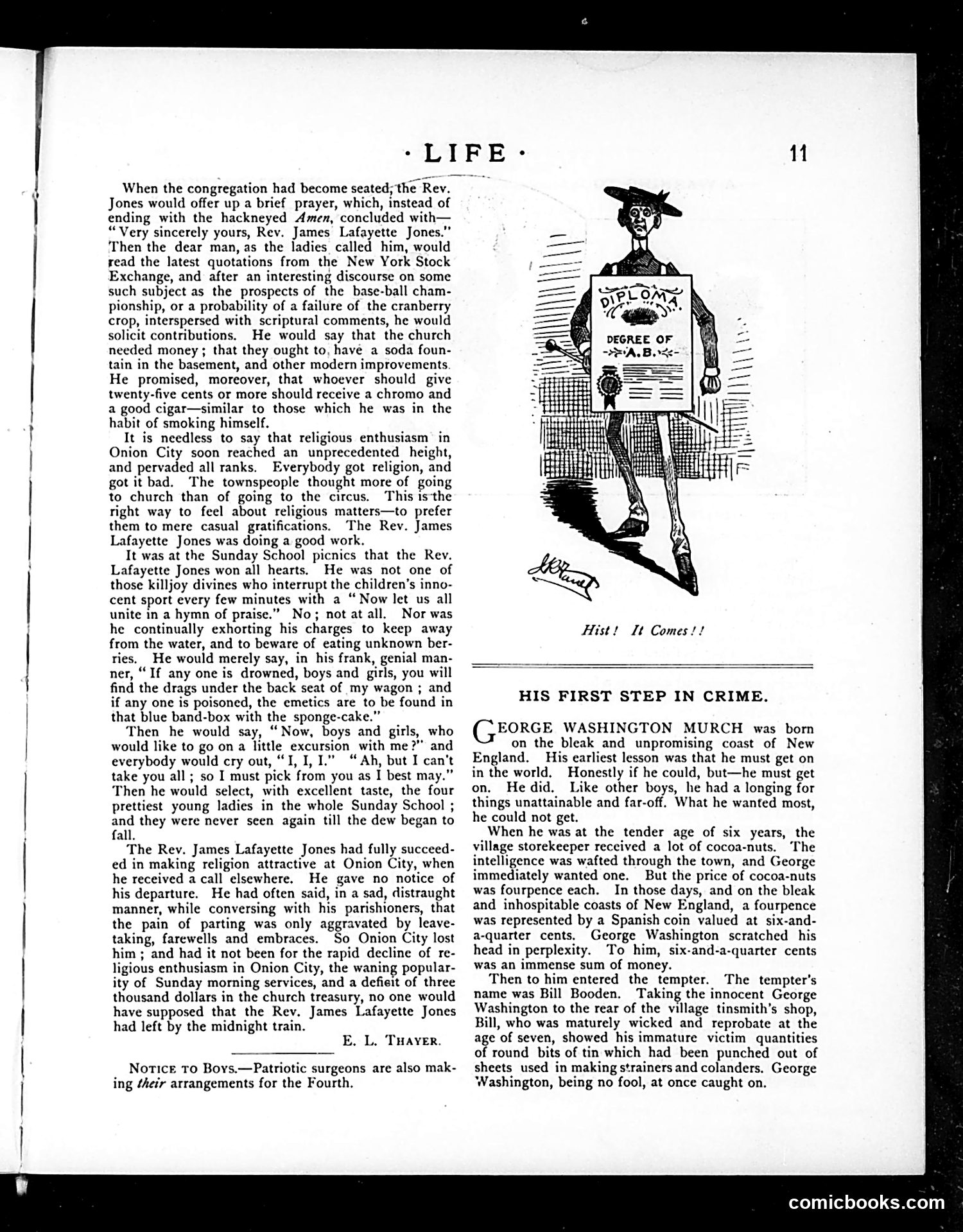
This 1890s satirical page contains two separate stories mocking American society. **"Rev. James Lafayette Jones"** (by E.L. Thayer) satirizes corrupt clergy and gullible congregations. The reverend exploits his parishioners by mixing stock-market tips with scripture, offering chromos and cigars as donation incentives, and soliciting funds for church "improvements" (a soda fountain). The darkest satire: he selects the four prettiest young ladies for Sunday School outings from which they "were never seen again till the dew began to fall"—suggesting predatory behavior. He abandons the parish without notice when religious enthusiasm wanes and church funds disappear. **The cartoon** shows a diploma-holding figure labeled "Hiss! It Comes!!" — likely representing a fraudulent "degree" or credential, reinforcing themes of fakery. **"His First Step in Crime"** (George Washington Murch) begins a story about a boy's moral corruption, starting with childhood theft of cocoa-nuts, establishing Life's moralistic yet ironic social commentary on American character. Both pieces satirize hypocrisy, greed, and moral decay in Gilded Age America.
📄 Transcribed text from this page (OCR, searchable)
Machine-transcribed from the original scan — historical spelling and the odd misread are preserved.
-LIFE- 11 When the congregation had become seated, the Rev. Jones would offer up a brief prayer, which, instead of ending with the hackneyed Amen, concluded with— “Very sincerely yours, Rev. James Lafayette Jones.” ‘Then the dear man, as the ladies called him, would read the latest quotations from the New York Stock Exchange, and after an interesting discourse on some such subject as the prospects of the base-ball cham- pionship, or a probability of a failure of the cranberry crop, interspersed with scriptural comments, he would solicit contributions. He would say that the church needed money ; that they ought to, have a soda foun- tain in the basement, and other modern improvements. He promised, moreover, that whoever should give twenty-five cents or more should receive a chromo and a good cigar—similar to those which he was in the habit of smoking himself. It is needless to say that religious enthusiasm in Onion City soon reached an unprecedented height, and pervaded all ranks. Everybody got religion, and got it bad. The townspeople thought more of going to church than of going to the circus. This isthe right way to feel about religious matters—to prefer them to mere casual gratifications. The Rev. James Lafayette Jones was doing a good work. It was at the Sunday School picnics that the Rev. Lafayette Jones won all hearts. He was not one of those killjoy divines who interrupt the children’s inno- cent sport every few minutes with a “Now let us all unite in a hymn of praise.” No; not atall. Nor was he continually exhorting his charges to keep away from the water, and to beware of eating unknown ber- ties. He would merely say, in his frank, genial man- ner, “If any one is drowned, boys and girls, you will find the drags under the back seat of my wagon ; and if any one is poisoned, the emetics are to be found in that blue band-box with the sponge-cake.” Then he would say, “ Now, boys and girls, who would like to go on a little excursion with me?” and everybody would cry out, “I, I, 1.” “Ah, but I can't take you all; so I must pick from you as I best may.” Then he would select, with excellent taste, the four prettiest young ladies in the whole Sunday School ; and they were never seen again till the dew began to fall. The Rev. James Lafayette Jones had fully succeed- ed in making religion attractive at Onion City, when he received a call elsewhere. He gave no notice of his departure. He had often said, in a sad, distraught manner, while conversing with his parishioners, that the pain of parting was only aggravated by leave- taking, farewells and embraces. So Onion City lost him ; and had it not been for the rapid decline of re- ligious enthusiasm in Onion City, the waning popular- ity of Sunday morning services, and a defieit of three thousand dollars in the church treasury, no one would have supposed that the Rev. James Lafayette Jones had left by the midnight train. E. L. THAYER. Notice To Boys.—Patriotic surgeons are also mak- ing their arrangements for the Fourth. DEGREE OF RAB Hist! It Comes! ! HIS FIRST STEP IN CRIME. EORGE WASHINGTON MURCH was born on the bleak and unpromising coast of New England. His earliest lesson was that he must get on in the world. Honestly if he could, but—he must get on, Hedid. Like other boys, he had a longing for things unattainable and far-off. What he wanted most, he could not get. When he was at the tender age of six years, the village storekeeper received a lot of cocoa-nuts. The intelligence was wafted through the town, and George immediately wanted one. But the price of cocoa-nuts was fourpence each. In those days, and on the bleak and inhospitable coasts of New England, a fourpence was represented by a Spanish coin valued at six-and- a-quarter cents. George Washington scratched his head in perplexity. To him, six-and-a-quarter cents was an immense sum of money. Then to him entered the tempter. The tempter’s name was Bill Booden. Taking the innocent George Washington to the rear of the village tinsmith’s shop, Bill, who was maturely wicked and reprobate at the age of seven, showed his immature victim quantities of round bits of tin which had been punched out of sheets used in making strainers and colanders. George Washington, being no fool, at once caught on. comicbooks.com