
A complete issue · 17 pages · 1883
Life — June 28, 1883
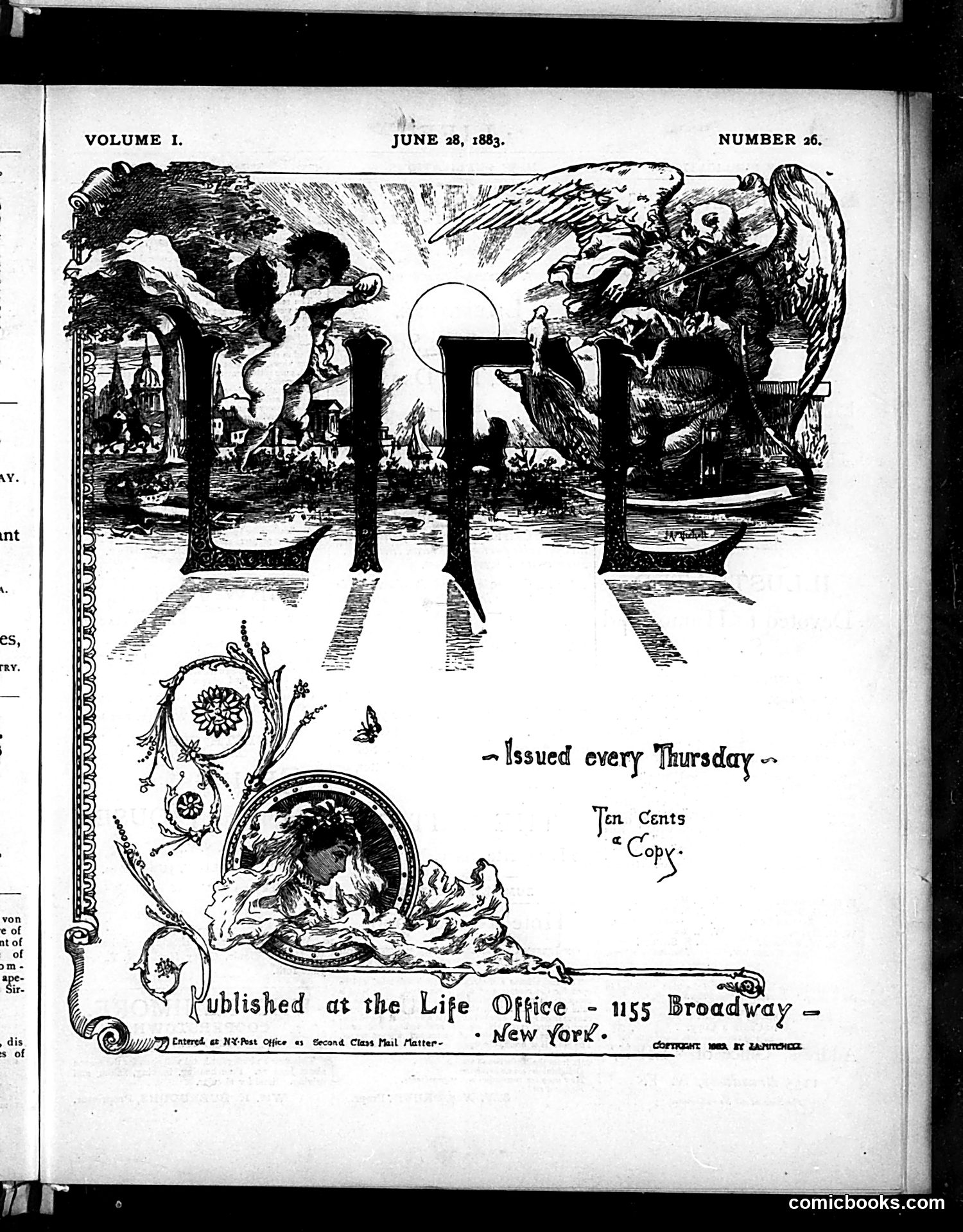
**June 28, 1883** This is the cover of *Life* magazine, a satirical weekly published at 1155 Broadway in New York. The central image shows an ornate gateway or portal framing a fantastical scene with classical and mythological figures—cherubs, winged beings, and ethereal forms—set against a luminous background with a full moon. The elaborate decorative border and allegorical imagery suggest this cover uses fantasy and mythology to comment on contemporary American society, though the specific satirical target remains unclear from the visual alone. The artistic style is characteristic of 1880s magazine illustration, employing engraving techniques. Without additional context, the exact subject of satire cannot be definitively determined, though the grandiose presentation likely mocked something current to 1883 readers.
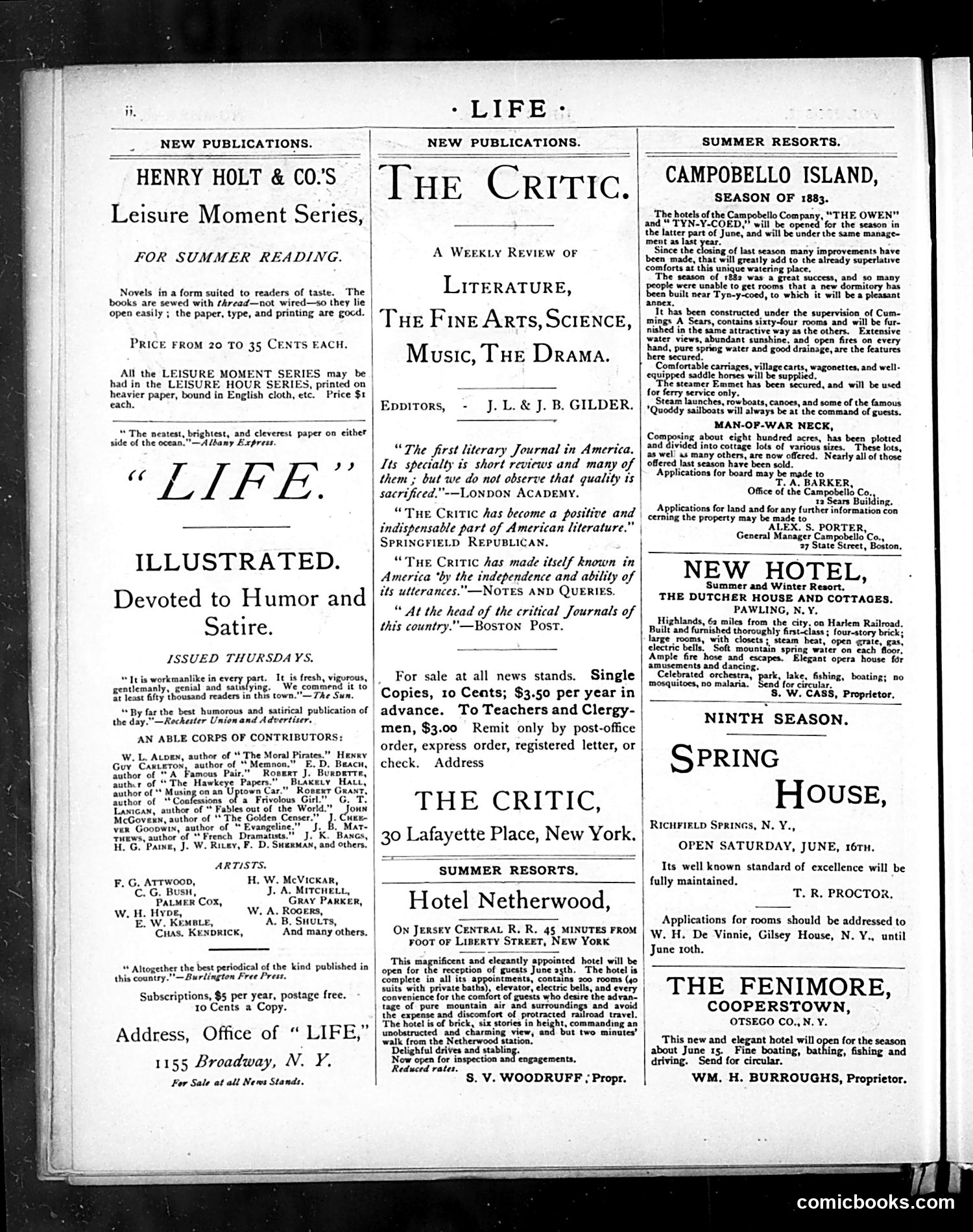
I'm examining this page carefully, but I must be direct: **this appears to be primarily an advertising and promotional page rather than a satirical cartoon page**. The page contains advertisements for: - Henry Holt & Co.'s "Leisure Moment Series" books - *Life* magazine itself (described as "Illustrated. Devoted to Humor and Satire") - *The Critic* literary journal - Several summer resort hotels (Campobello Island, Hotel Netherwood, Spring House, The Fenimore) While the page announces *Life*'s satirical purpose and lists contributor names, **no actual cartoon or comic content is visible in this image**. To explain specific satire or jokes from this issue, I would need to see the actual illustrated cartoon panels, which aren't present on this page.
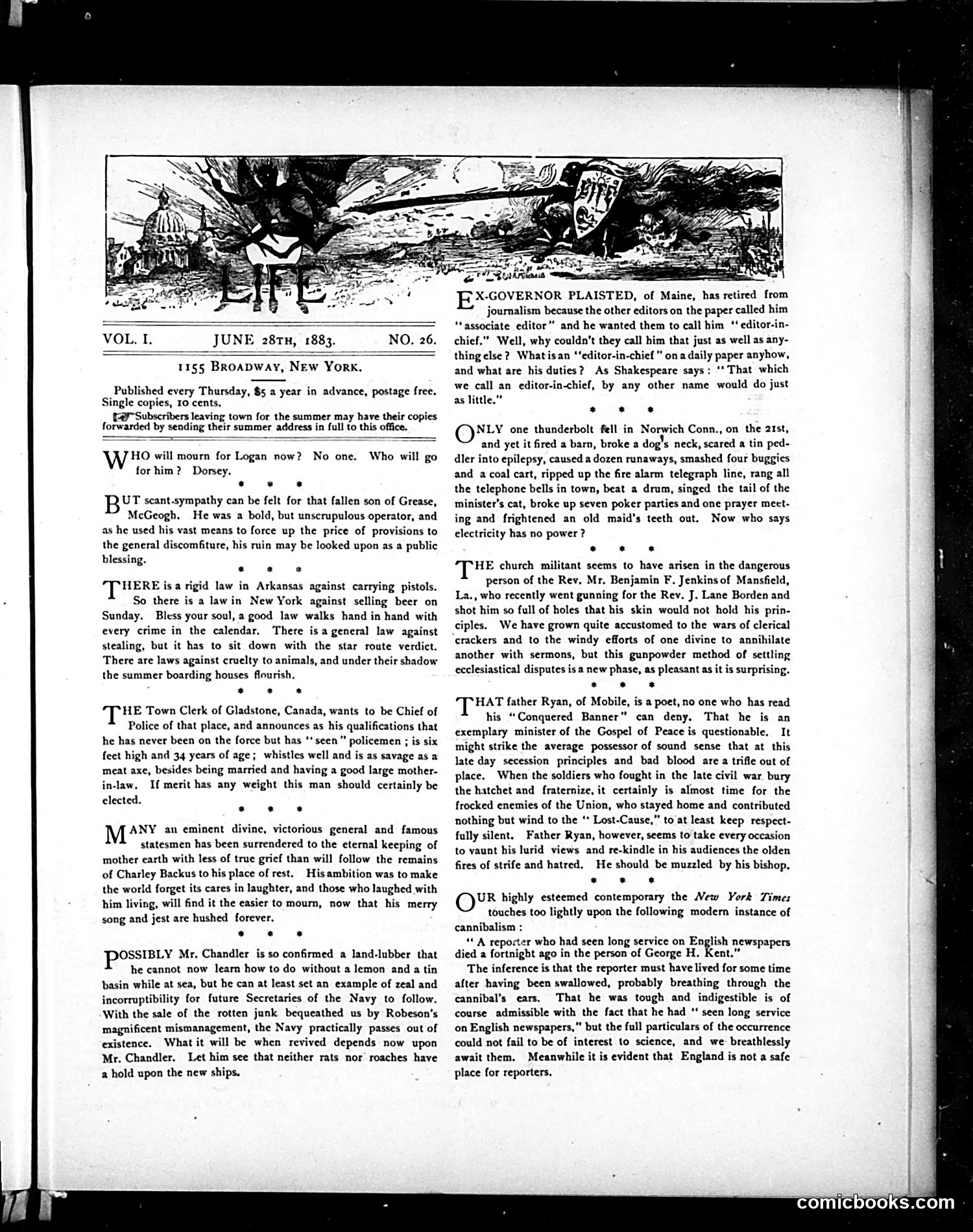
The page contains satirical commentary rather than political cartoons. The small illustration at the top appears to be a decorative header showing a figure in a chair. The text critiques several contemporary figures and issues: 1. **Logan's death** - opening with "Who will mourn for Logan now?" (likely General John A. Logan, who died in 1886) 2. **Father Ryan** - criticized as a "church militant" poet who allegedly advocated violence rather than peace, mocking his "Conquered Banner" poem 3. **Journalism disputes** - commentary on an ex-governor of Maine's editorial title dispute 4. **Cannibalism reference** - sardonic criticism of the *New York Times* reporting on a deceased reporter, George H. Kent, with dark humor about journalists being "swallowed" into obscurity The satire targets political figures, clergy, and journalistic practices of 1880s America with characteristic Victorian-era social commentary.
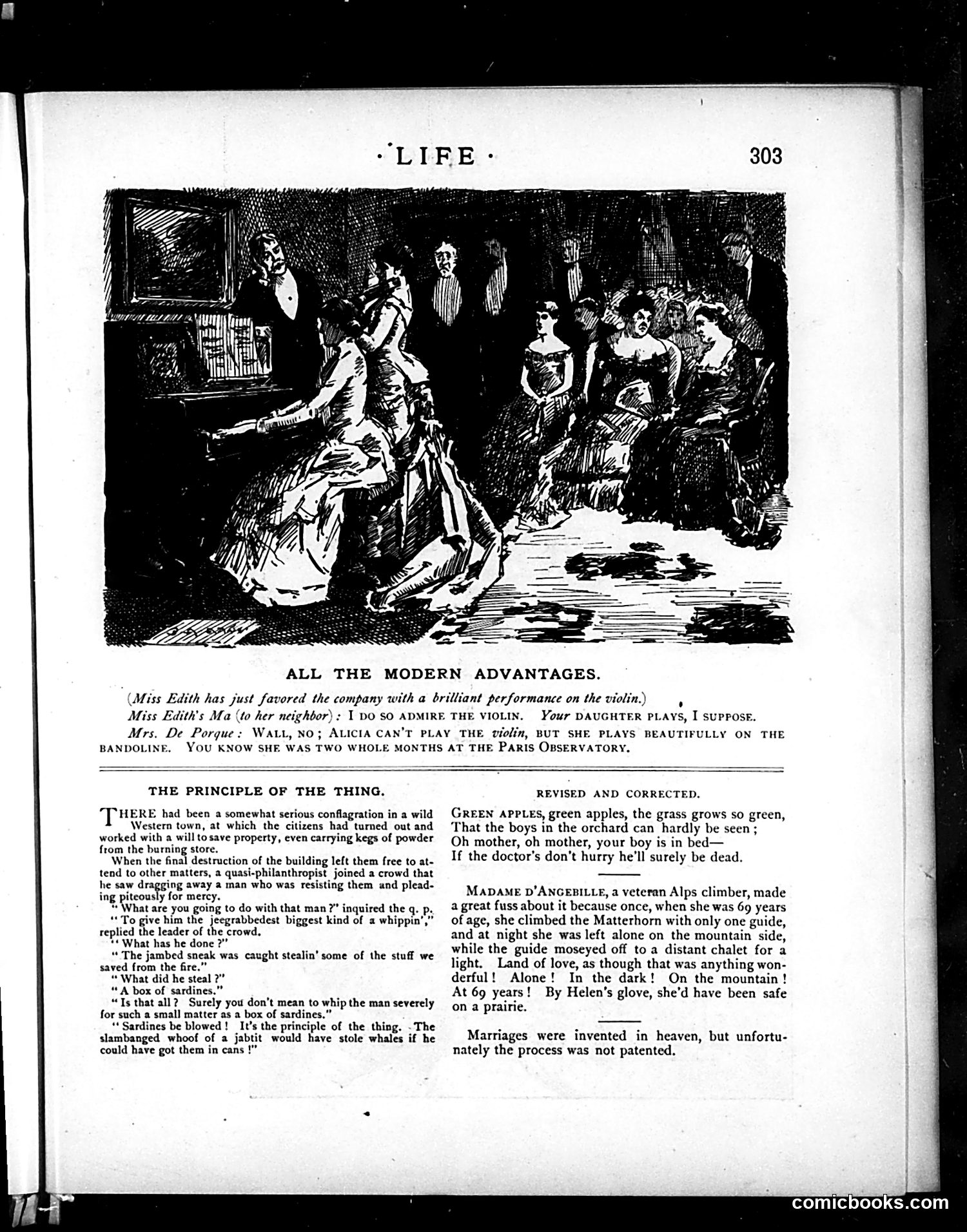
**"All the Modern Advantages"** depicts a social gathering where a woman plays violin while others listen. The caption jokes that Miss Edith has performed brilliantly, and her neighbor expresses admiration—but reveals the punchline: Edith's daughter "plays beautifully on the bandoline" (a hair-styling tool), not violin. The satire mocks Victorian-era pretensions about "modern accomplishments" for women, suggesting that even when women pursue serious cultural pursuits like violin, they're still primarily valued for beauty and grooming. **"The Principle of the Thing"** and **"Revised and Corrected"** appear to be separate humorous anecdotes about social hypocrisy and domestic situations, typical of Life's satirical commentary on contemporary middle-class life and manners. The overall theme critiques superficial modernization and gendered expectations of the era.
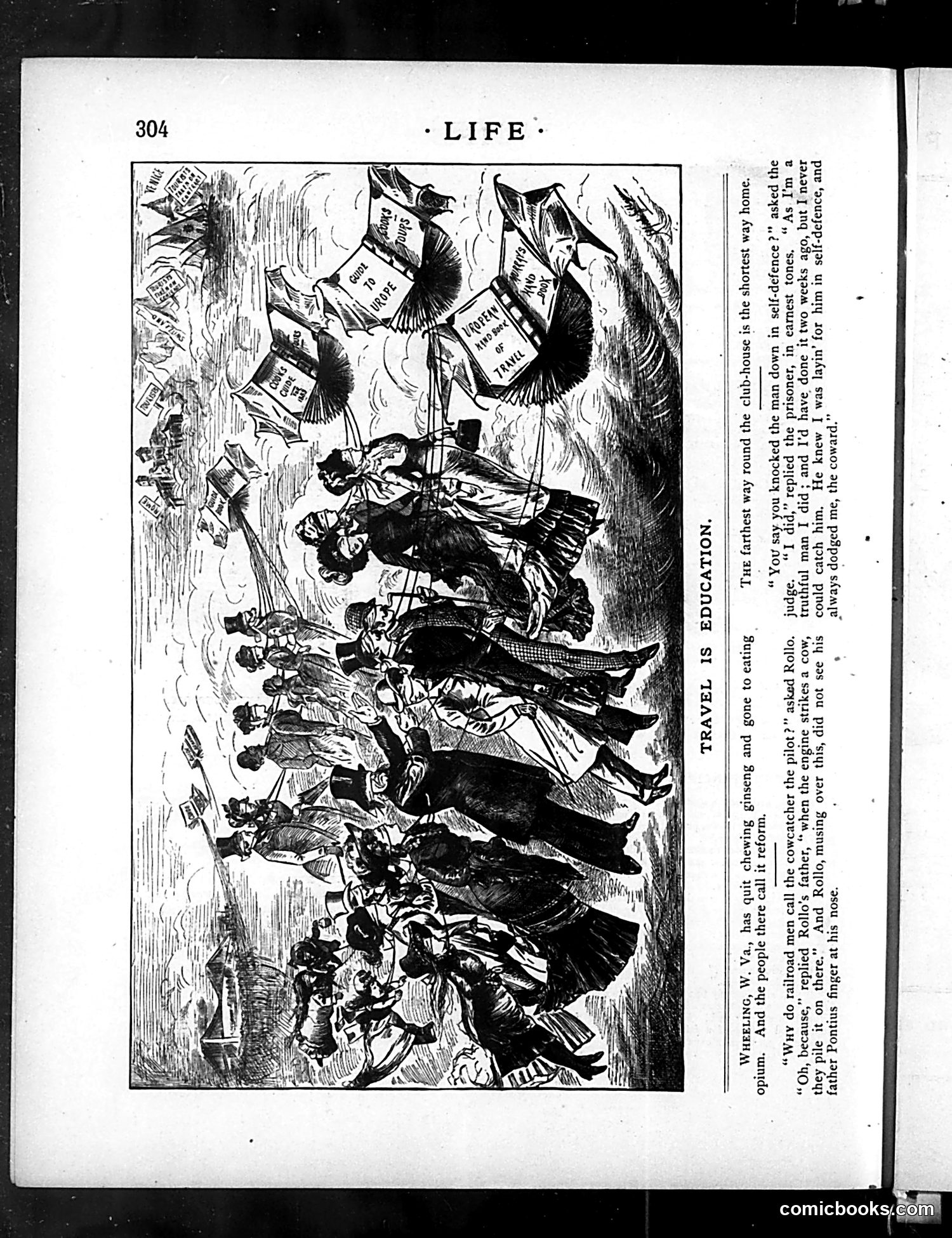
This cartoon satirizes the chaotic state of American education through travel. The image depicts numerous figures (appearing to be students, teachers, or educational officials) in tumultuous, disorderly motion—suggesting travel as educational chaos rather than improvement. The accompanying text references W. V. and educational philosophy, mentioning that "travel is education" while satirizing how this concept has been corrupted. The text suggests institutions claiming to provide "rounded" character development through travel, when in reality the experience is confused and disorganized. The cartoon critiques the era's enthusiasm for travel-based education as a fad that produces disorder rather than genuine learning. The frantic composition emphasizes that without proper structure, educational travel becomes mere confusion masquerading as enlightenment.
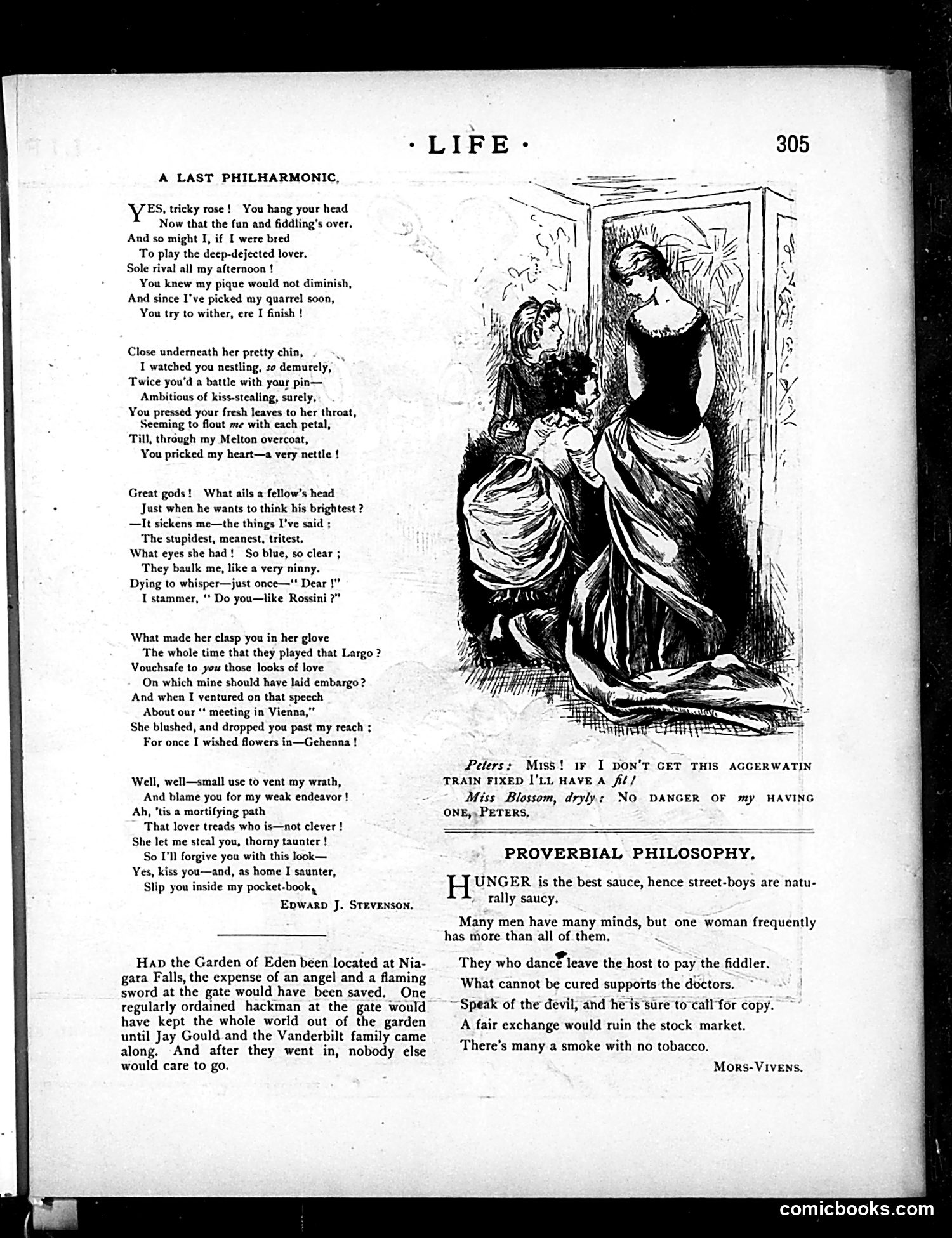
The page contains two distinct sections: **"A Last Philharmonic"** (poem by Edward J. Stevenson): A romantic poem about a failed courtship, where the speaker recalls an intimate moment with a woman who rejected him. The accompanying illustration shows two figures at a window—likely depicting the scene described. **"Proverbial Philosophy"** (attributed to Mors-Vivens): A collection of satirical aphorisms mocking human nature and society. Examples include cynical observations about hunger, womankind, dancing, doctors, and the devil. These are gentle social satires typical of Life's style—witty critiques of everyday human folly rather than specific political targets. The page reflects Life's early 20th-century approach: combining romantic/sentimental poetry with biting social commentary.
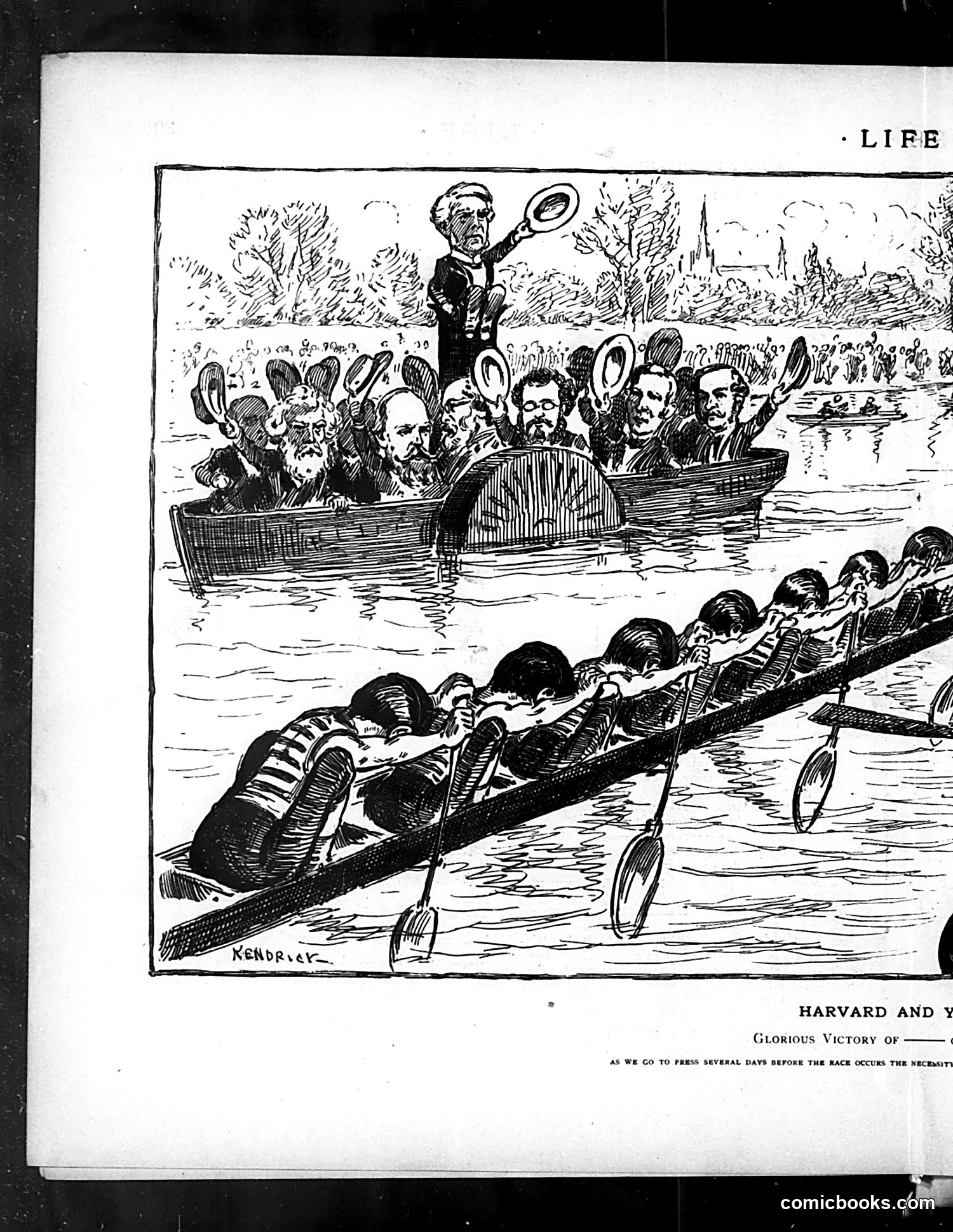
This satirical cartoon depicts a rowing competition between Harvard and Yale. The bottom boat contains rowers in striped uniforms, while the top boat holds what appears to be faculty or administrators wielding oars like weapons, with one figure standing elevated above the others. The caption references "Glorious Victory" and mentions "several days before the race occurs," suggesting the satire critiques premature celebration or overconfidence about the competition's outcome. The humor likely mocks either the institutions' rivalry, administrative involvement in athletics, or the American tendency to celebrate victories before they actually happen. The exaggerated poses and weapon-like oars suggest absurdity in the proceedings.
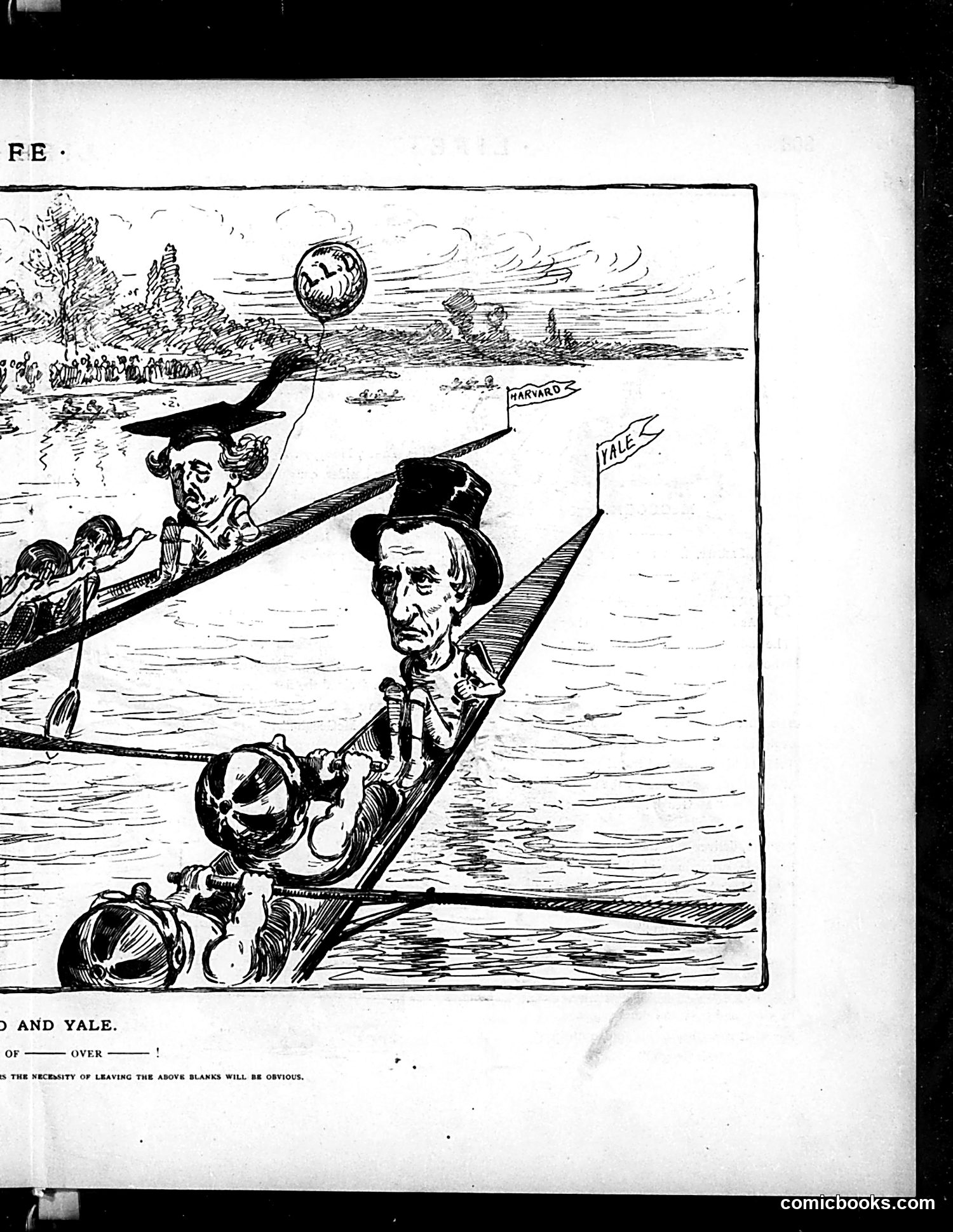
This satirical cartoon depicts two caricatured figures in a boat on water, labeled "HARVARD" and "YALE." They appear to be balancing precariously while holding spheres (possibly representing endowments or institutional assets). The exaggerated facial features suggest mockery of these prestigious universities. The caption references "the necessity of leaving the above blanks will be obvious," implying the cartoon criticizes something about Harvard and Yale that readers should recognize but which the publication won't explicitly state—likely financial troubles, administrative scandals, or questionable practices at these institutions. The crowded shoreline and figures in the background suggest public attention or concern about these universities' situations. Without the magazine's date, the specific scandal referenced remains unclear.
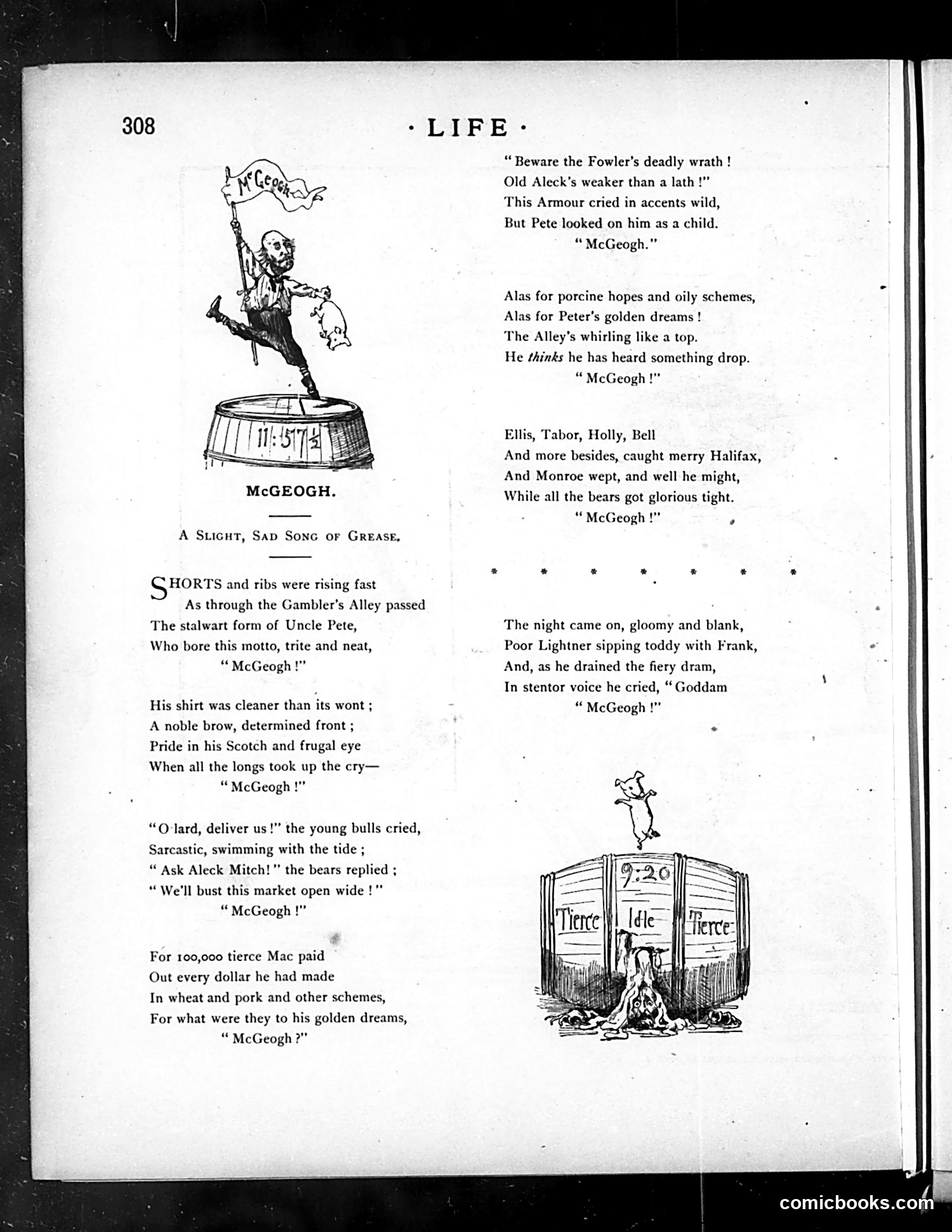
This satirical poem mocks a failed grain speculation scheme, likely from the 1880s Chicago commodities market. "Uncle Pete" McGeogh is a Scottish trader who invested his entire fortune (100,000 "tierce"—large casks of grain) betting on wheat and pork prices, apparently influenced by optimistic "golden dreams." The poem names actual Chicago market figures: Armour (the meatpacking magnate who warned McGeogh), Aleck Mitchell, and various traders. McGeogh's confidence crumbles as the market "whirls like a top"—prices collapse unpredictably. The refrain "McGeogh!" becomes increasingly desperate as previously confident traders ("the bears," speculators betting on price declines) celebrate while McGeogh and others face ruin. The final image of desperate drinking suggests financial devastation. This reflects Life's satirical take on reckless speculation and the volatile, destructive nature of commodity trading.
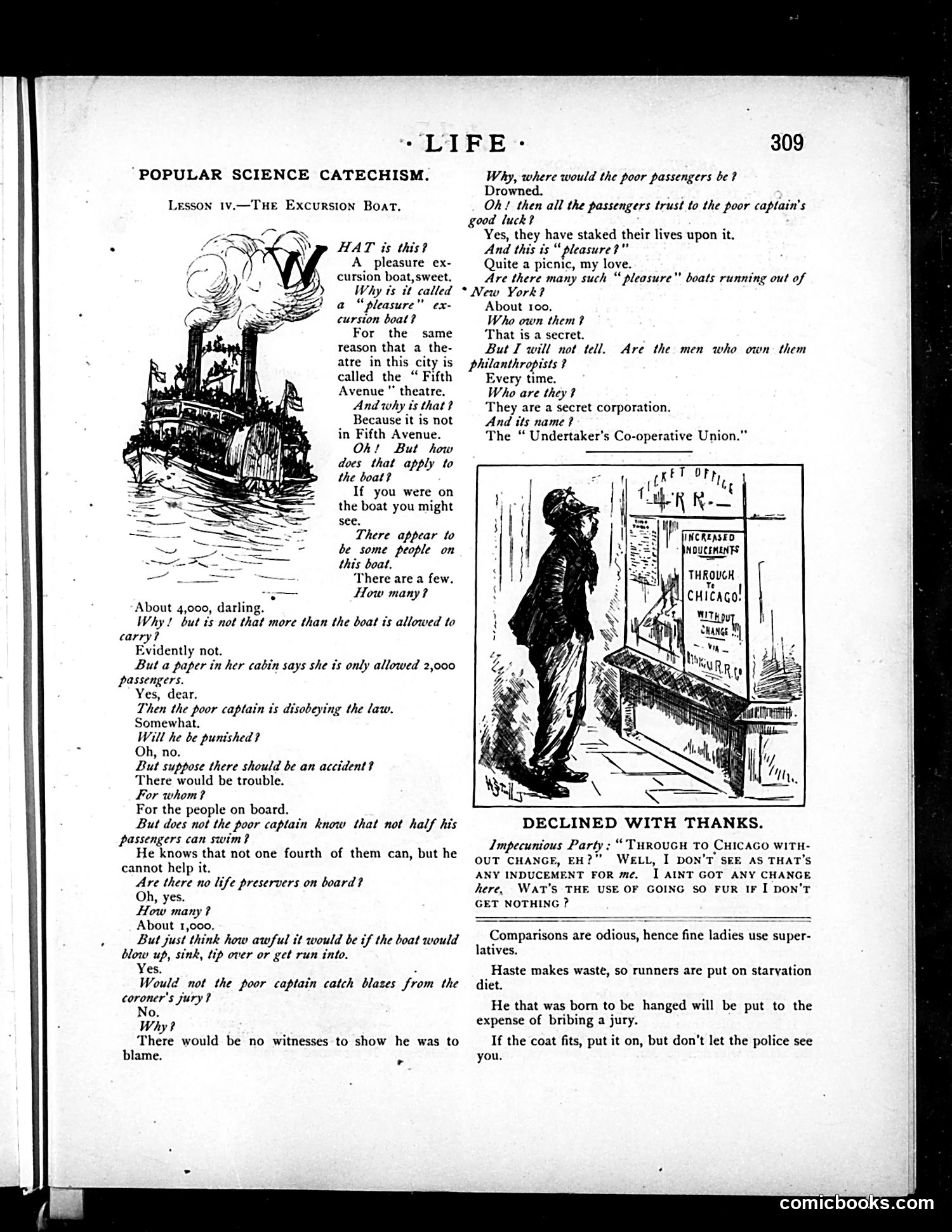
This page satirizes the dangerous negligence of excursion boat operators in early 1900s New York. The main "Popular Science Catechism" dialogue mocks a pleasure boat that carries approximately 4,000 passengers despite legal capacity of only 2,000—with only about 1,000 life preservers available. The satire's targets: the ship's captain who violates safety laws with impunity; the anonymous "secret corporation" owners (sarcastically called the "Undertaker's Co-operative Union," implying passengers will die); and the legal system that provides no real accountability—there would be "no witnesses" if disaster struck, so the captain faces no consequences. The accompanying cartoon shows a man declining a train ticket to Chicago, joking he lacks spare change—social commentary on poverty. The final aphorisms mock class inequality and corruption. The page's core message: wealthy boat operators prioritize profit over passenger safety, relying on legal loopholes and anonymity to avoid responsibility for inevitable tragedies.
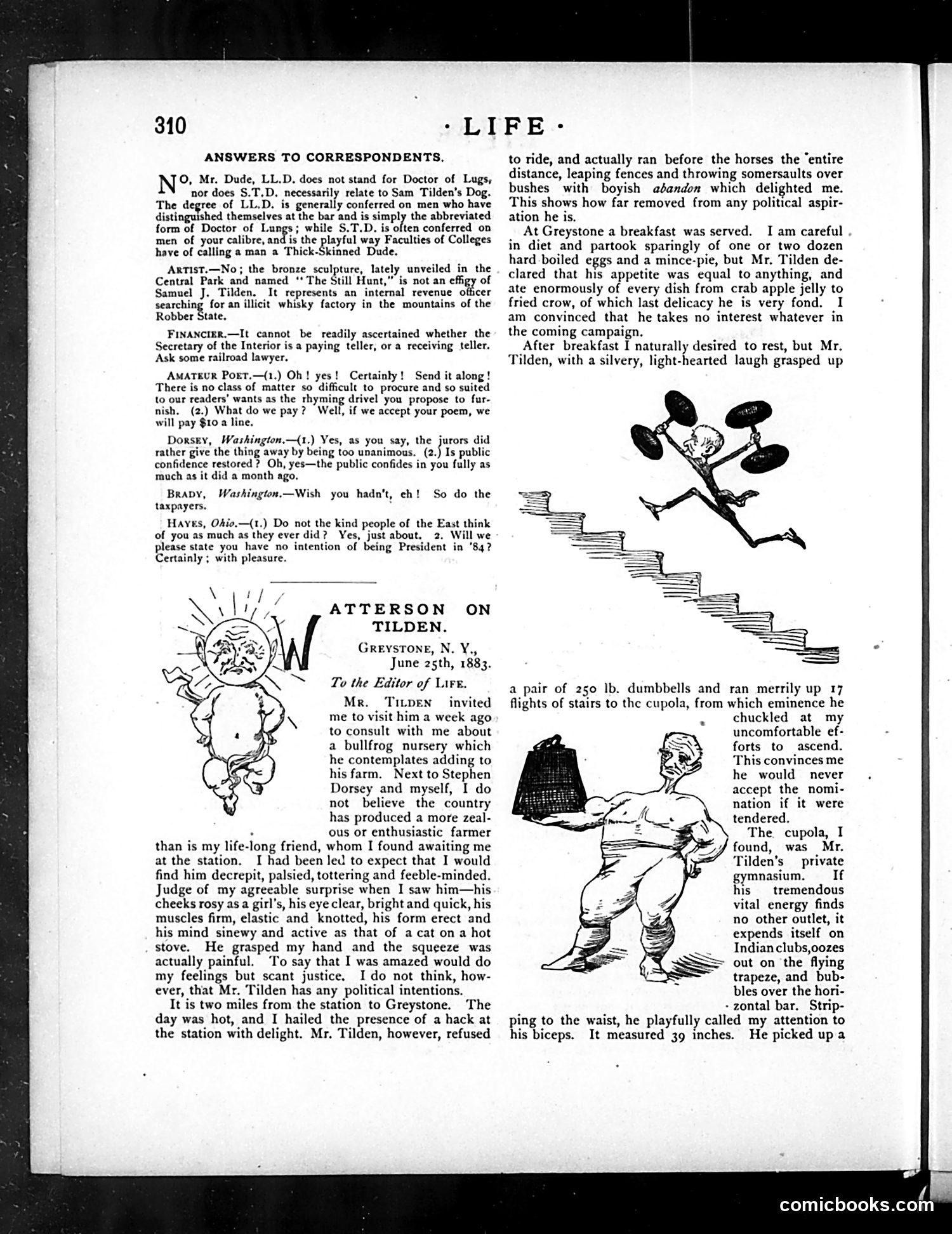
This 1883 *Life* magazine piece mocks former presidential candidate Samuel Tilden through faux-earnest testimony. A correspondent claims to visit Tilden's farm and describes him performing superhuman feats—running miles without tiring, lifting 250-pound dumbbells, sprinting up 17 flights of stairs—all while insisting Tilden has "no political intentions." The satire works through ironic contradiction: every description of Tilden's vigorous vitality and youthful energy implicitly suggests he's physically capable of running for president again, directly contradicting the letter-writer's assurances otherwise. The cartoons above (a jumping figure, a muscular man with dumbbells) reinforce this theme visually. The joke targets rumors that the elderly Tilden might seek the 1884 presidential nomination despite his age and previous electoral losses in 1876. *Life* suggests his denials of political ambition are transparently false—his obvious vigor proves he *could* run, making his supposed disinterest unconvincing.
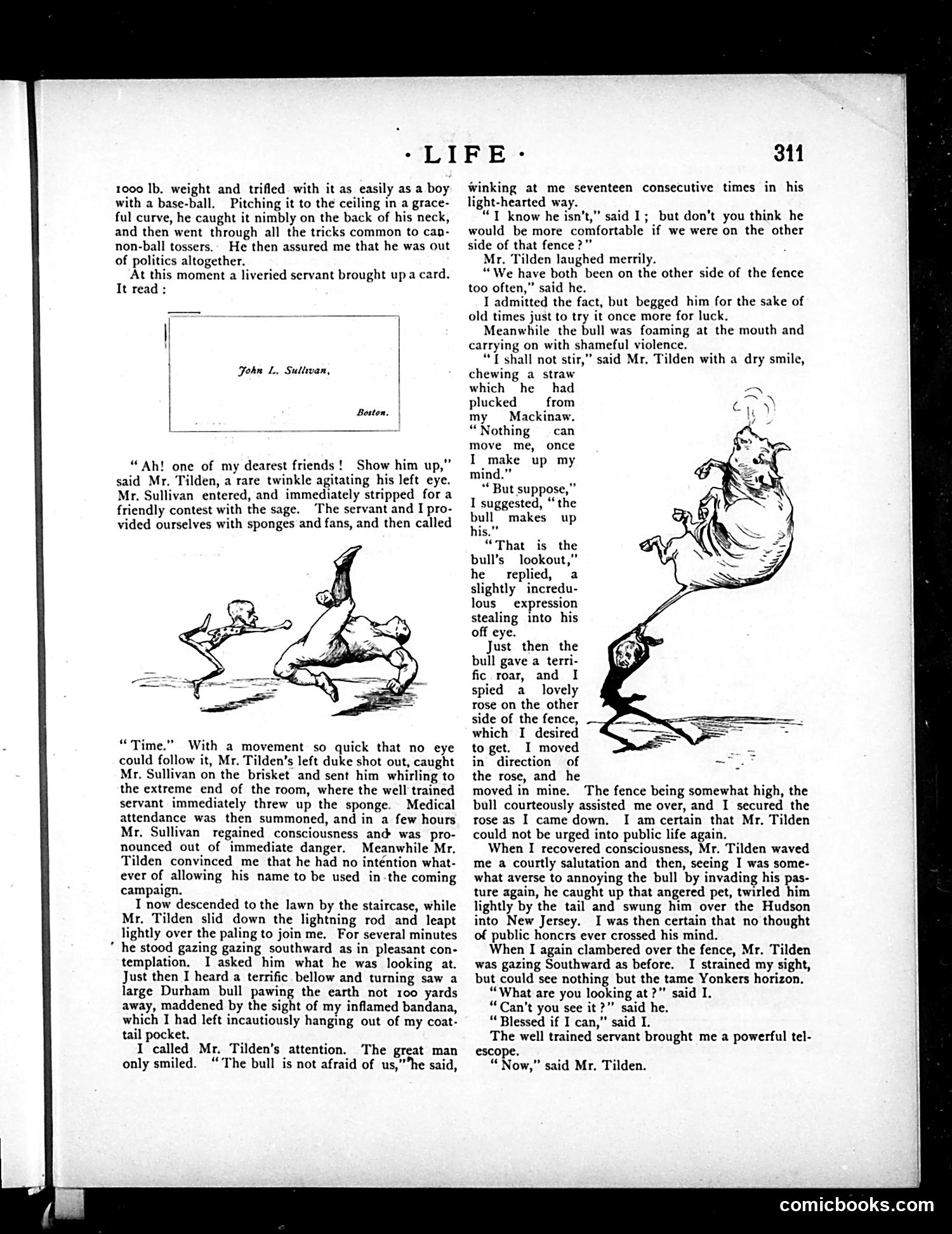
This is a satirical story mocking Samuel J. Tilden (1876 Democratic presidential candidate) and his claims of disinterest in politics. The narrative uses absurdist humor to suggest Tilden is lying about staying out of the political arena. The joke escalates through increasingly ridiculous scenarios: Tilden casually defeats boxer John L. Sullivan in a boxing match, then faces down a charging bull without moving, claiming "nothing can move me once I make up my mind"—an obvious metaphor for his political stubbornness. When the narrator is nearly gored, Tilden serenely tosses the bull over the Hudson River into New Jersey. The punchline is that despite his protestations of political retirement, Tilden remains unmovable from his public ambitions. The repeated phrase "we have both been on the other side of the fence too often" references his and the narrator's past political involvement, satirizing his unconvincing denials of future candidacy.
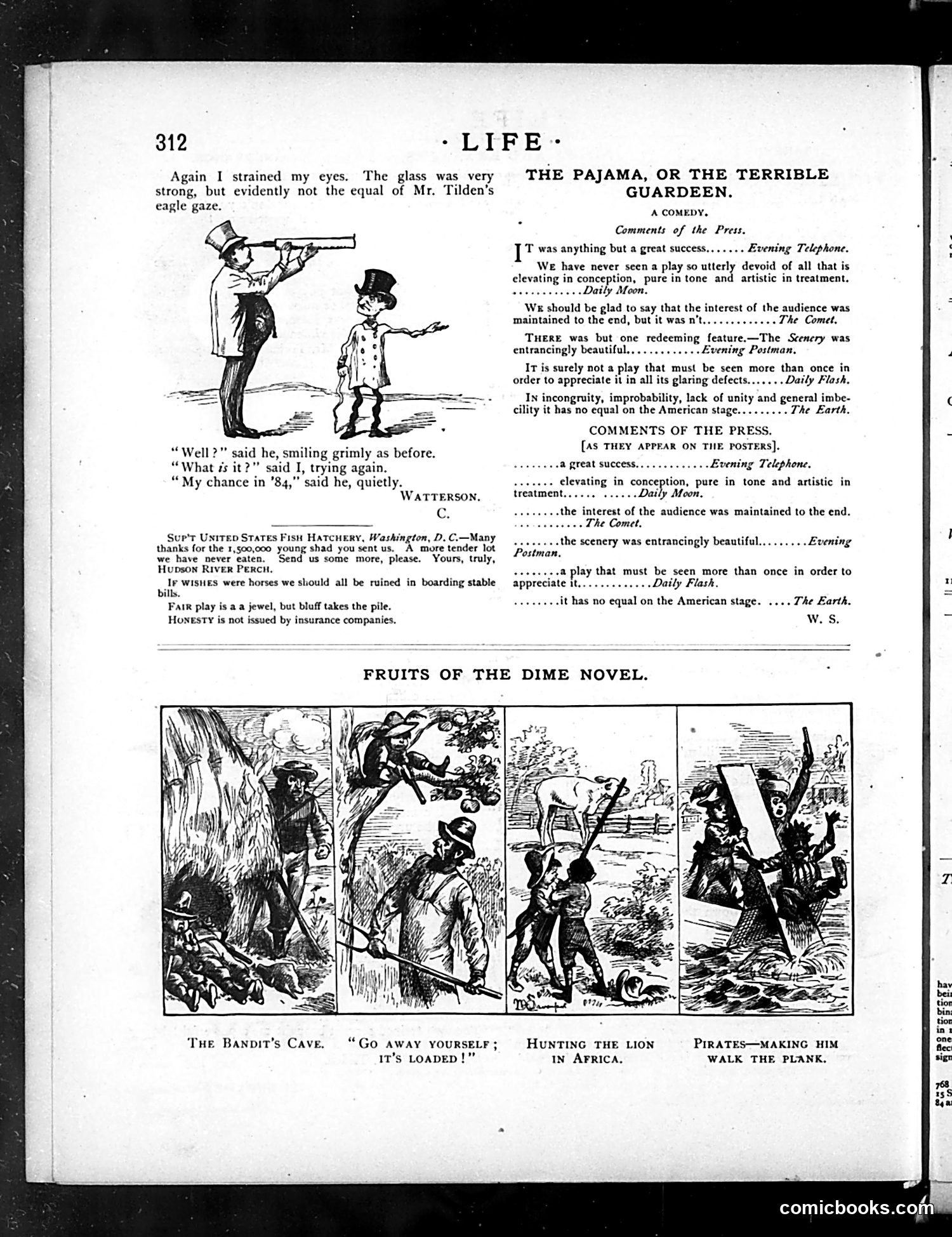
The top cartoon depicts a character using a telescope, with dialogue referencing "Mr. Tilden's eagle gaze" and "My chance in '84." This appears to reference Samuel J. Tilden, the Democratic presidential candidate in 1876, whose disputed election loss to Rutherford B. Hayes was still politically relevant. The joke suggests someone's political prospects for 1884. Below are brief satirical notices (possibly faux advertisements) and theater reviews for "The Pajama, or the Terrible Guardeen." The humor lies in contrasting what critics actually wrote (uniformly negative reviews) with how those same quotes could be selectively edited and presented on theatrical posters as positive endorsements—a practice mocking the dishonesty of theatrical advertising. The bottom section shows four dramatic etchings illustrating dime novel scenarios ("Fruits of the Dime Novel"), satirizing the sensational adventure fiction popular at the time.
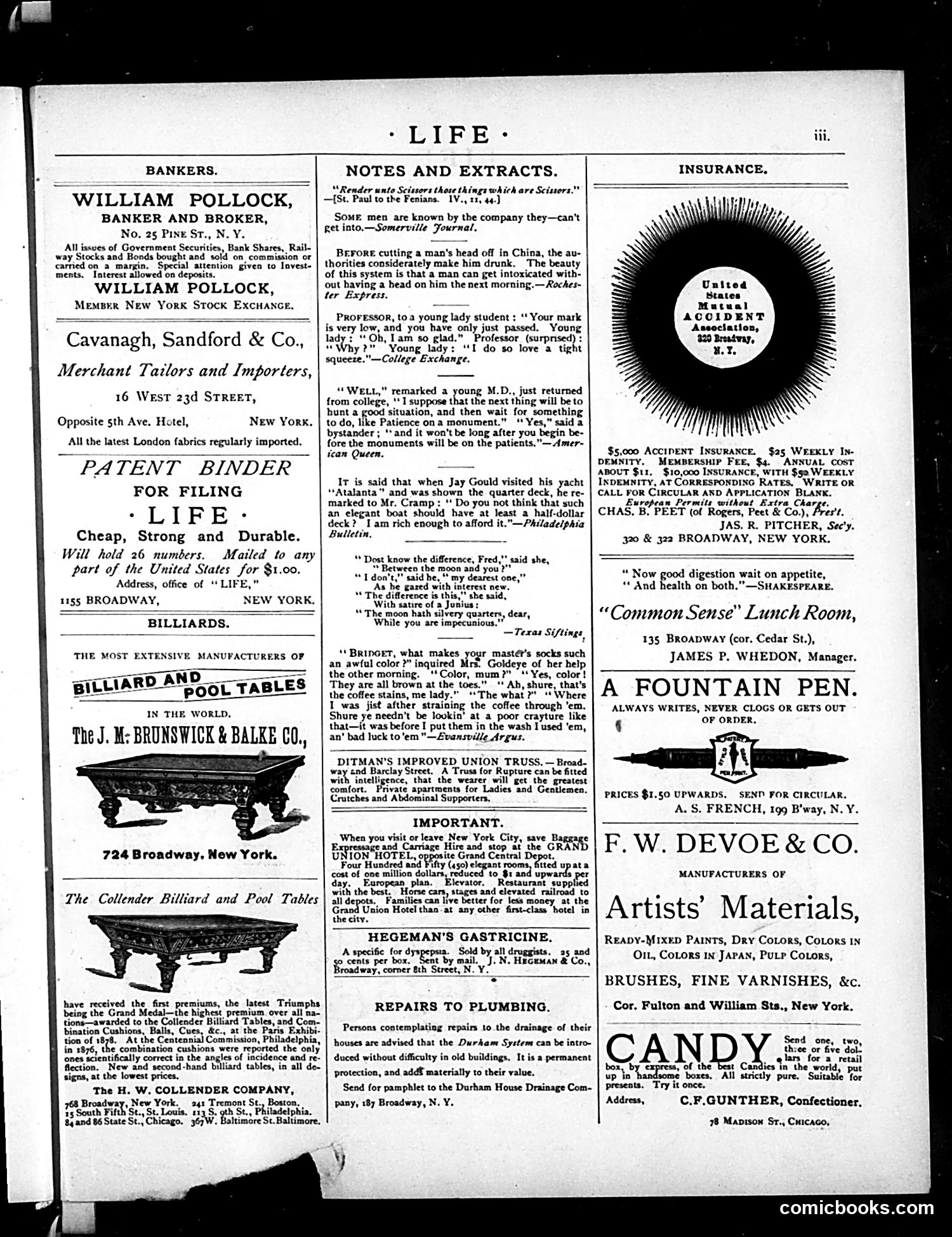
This page is primarily **advertisements and filler content**, not a political cartoon with a coherent satirical point. The center column, "Notes and Extracts," collects brief humorous quips and anecdotes from various newspapers—wordplay about scissors and Fenians, dark humor about executing drunk men in China, professor/student banter, and jokes about wealthy Jay Gould and Irish servants. These are light, disconnected jokes typical of 19th-century satirical magazine fillers: puns about poverty, drunkenness, class differences, and ethnic stereotypes. The right side advertises products: insurance, fountain pens, artists' materials, and candy. The left side promotes financial services and billiard tables. **There is no single coherent cartoon or unified satirical target here**—this appears to be a standard inside page mixing miscellaneous humor snippets with paid advertisements, which was typical Life magazine structure of the era.
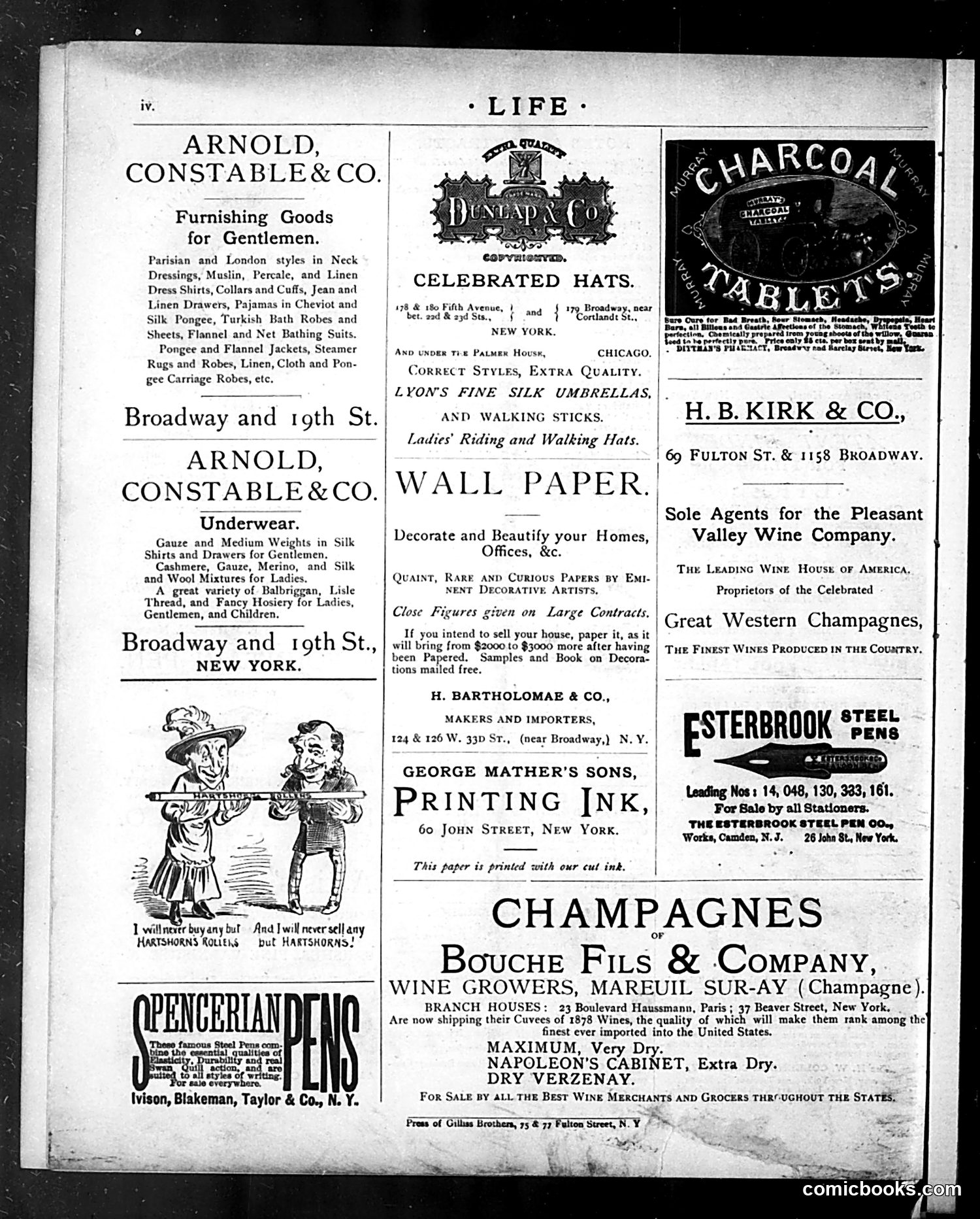
This page is primarily **advertising with one small cartoon**. The cartoon appears in the lower left, showing two caricatured figures (a woman and a man) declaring they will only buy/sell "Hartshorns" salts—a popular 19th-century digestive remedy and household product. The joke is a **pun on brand loyalty**: the figures' emphatic statements ("I will never buy any but...") mimic exaggerated commercial testimonials of the era, while the repetitive insistence on this mundane product is humorously absurd. It's satirizing both the aggressive advertising tactics of the time and consumers' irrational brand devotion. The surrounding content is standard period advertising for gentlemen's furnishings, wines, stationery, and household goods—typical of Life's revenue model. The cartoon serves as light editorial humor amidst commercial pages, a common format for the magazine.
I can see this is a scanned page from what appears to be a historical publication, but the image is almost entirely black with only marginal text visible on the left and right edges, and a watermark reading "comicbooks.com" at the bottom right. The OCR text provided is minimal—just a copyright symbol and the website attribution. Without legible cartoon imagery or substantive text content visible in the image itself, I cannot identify specific figures, political references, or satirical points. This appears to be either a poorly scanned page, a blank page from the publication, or a scanning/image quality issue that prevents meaningful analysis of any cartoon or satirical content that may originally have existed here.