
A complete issue · 16 pages · 1883
Life — June 21, 1883
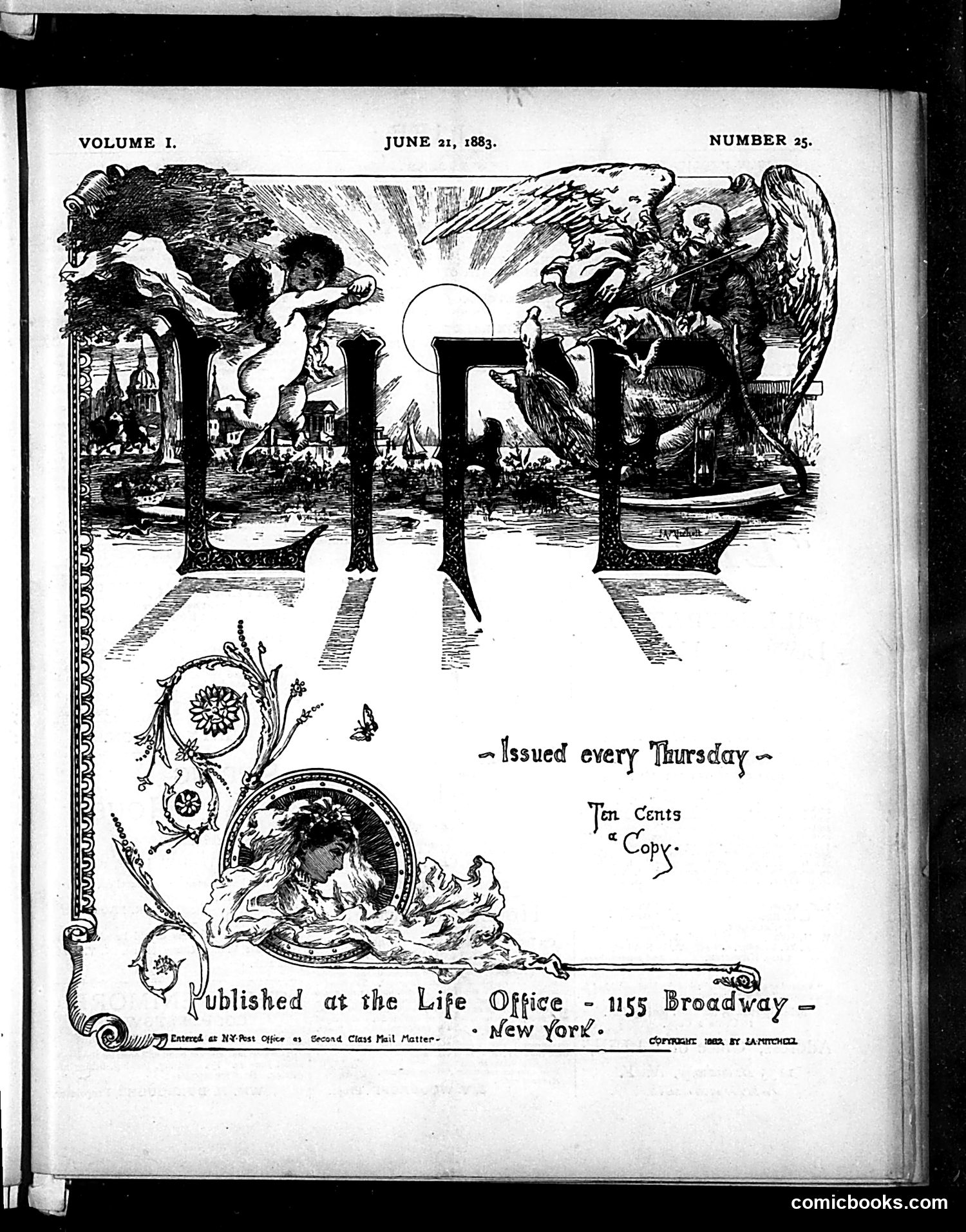
This is the cover of Life magazine's first volume, establishing its identity as a weekly satirical publication. The ornate engraving features two allegorical scenes: on the left appears a classical cityscape with figures in robes, while on the right winged figures (possibly representing divine or supernatural forces) hover above a landscape. A large circular medallion portrait occupies the lower left. The elaborate decorative border and classical imagery suggest Life positioned itself as a sophisticated, artistically ambitious humor magazine. The price (ten cents) and publication details indicate this was aimed at educated urban readers. The specific allegorical meanings of the figures remain unclear without additional contemporary context, but the aesthetic emphasizes refinement and intellectual content rather than crude comedy.
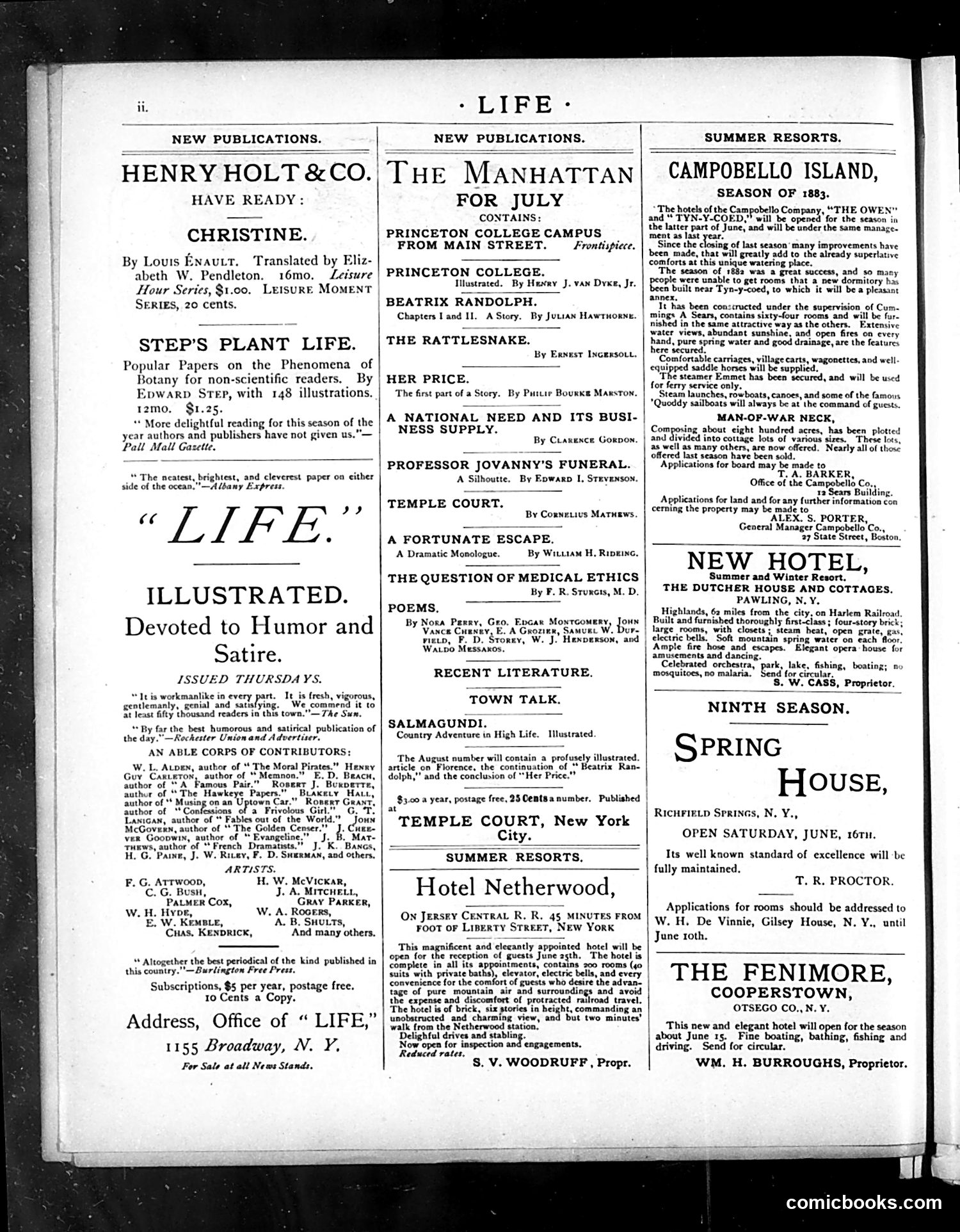
This page is **primarily advertising** for the satirical magazine *Life* itself and various summer resorts, hotels, and new publications from the 1880s-1890s era. The left column advertises *Life* magazine, describing it as "Devoted to Humor and Satire" and "Illustrated," emphasizing its appeal to "vigorous, gentlemanly, genial and satisfying" readers. It lists notable contributors including W.L. Alden and other writers. The remaining columns contain advertisements for summer destinations (Campobello Island, Hotel Netherwood, Spring House) and new book publications. There are no visible political cartoons or satirical illustrations on this page—it functions as a classified advertising section rather than editorial content, making specific social commentary analysis impossible.
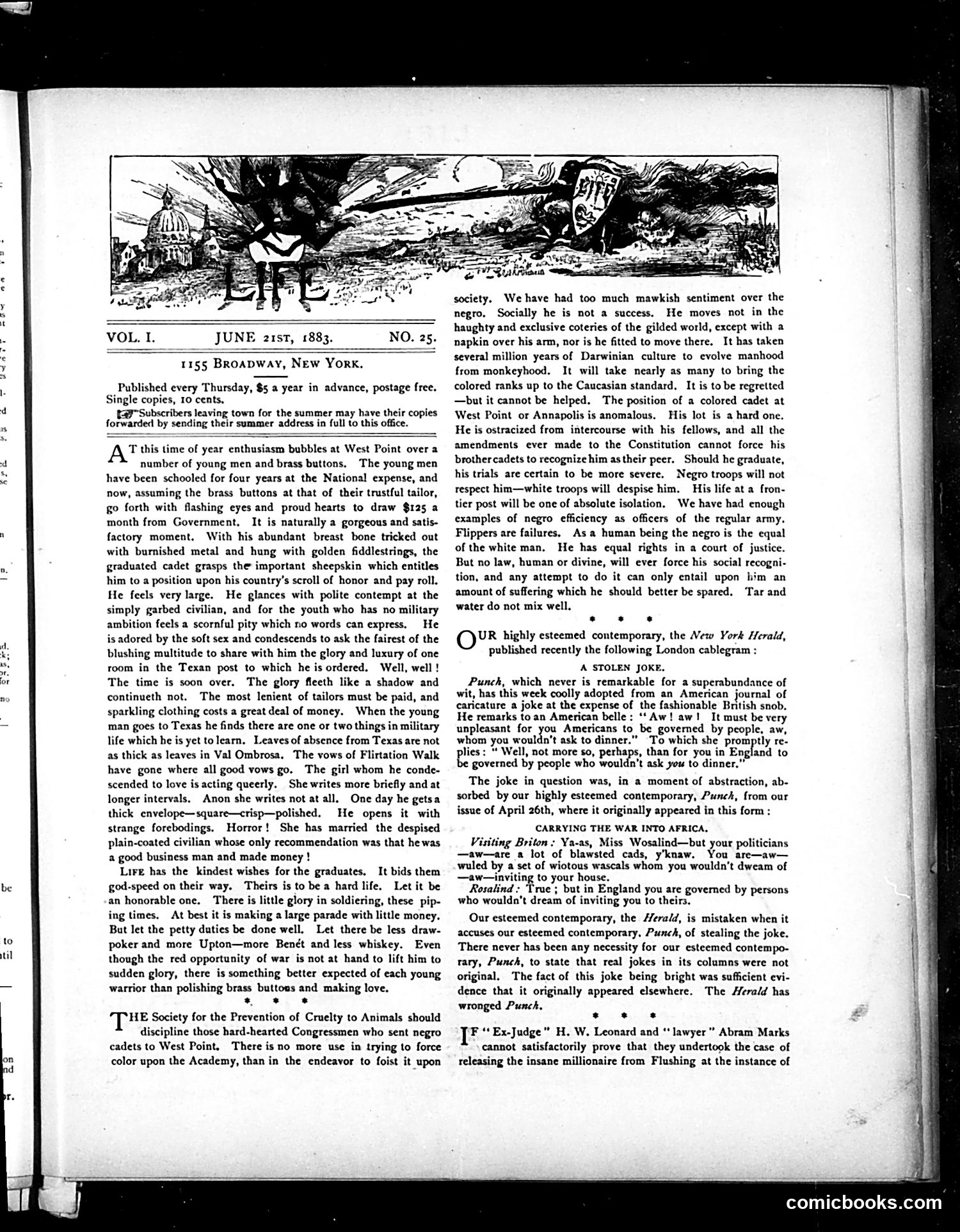
The cartoon at the top depicts a cadet at West Point military academy. The accompanying article criticizes young officers' arrogance after graduation, mocking their inflated self-importance and social pretension. The text sarcastically describes how a cadet "feels very large" and possesses "blushing multitude to share with him the glory and luxury of one room in the barracks." The article also contains racist commentary about Black soldiers and integration at military academies, reflecting deeply prejudiced 19th-century attitudes. Below, the page includes editorial commentary on *Punch* magazine's satirical content and discusses a legal case involving "Ex-Judge" H.W. Leonard and a millionaire named Flushing. The overall tone is satirical social commentary typical of 1880s American humor magazines.
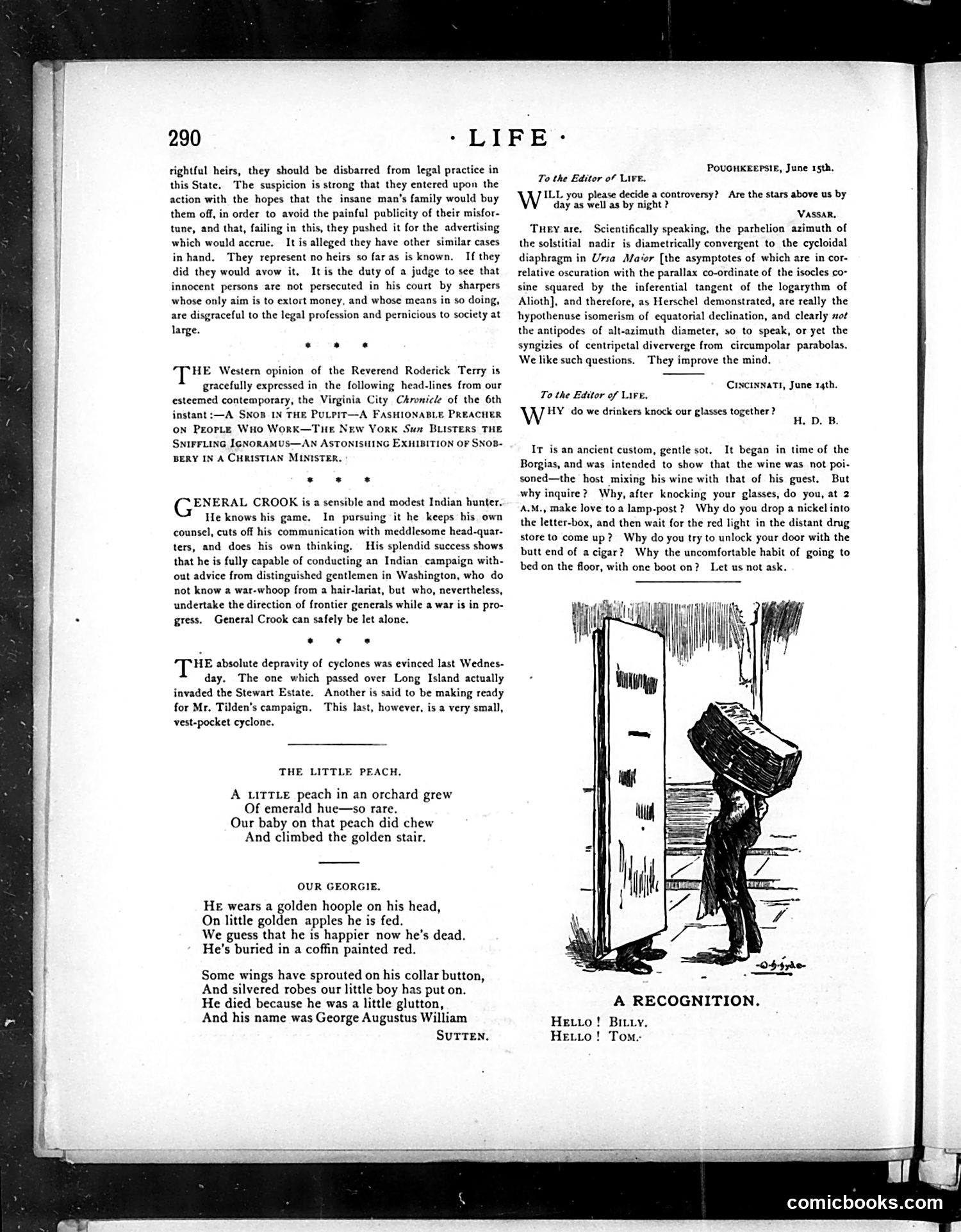
**"A Recognition"** cartoon depicts two men encountering each other—one carrying a large barrel or container on his shoulders. The dialogue reads "Hello! Billy" / "Hello! Tom," suggesting a chance meeting between acquaintances. The joke likely turns on the figure's burden and their casual greeting despite his awkward situation. Without additional context about who "Billy" and "Tom" refer to, the satire's specific target remains unclear. However, the cartoon appears to mock either: - The absurdity of encountering someone in an undignified position - A reference to a contemporary public figure or scandal The surrounding text includes poetry and editorial commentary on various topics, but doesn't directly explain this cartoon's meaning or references.
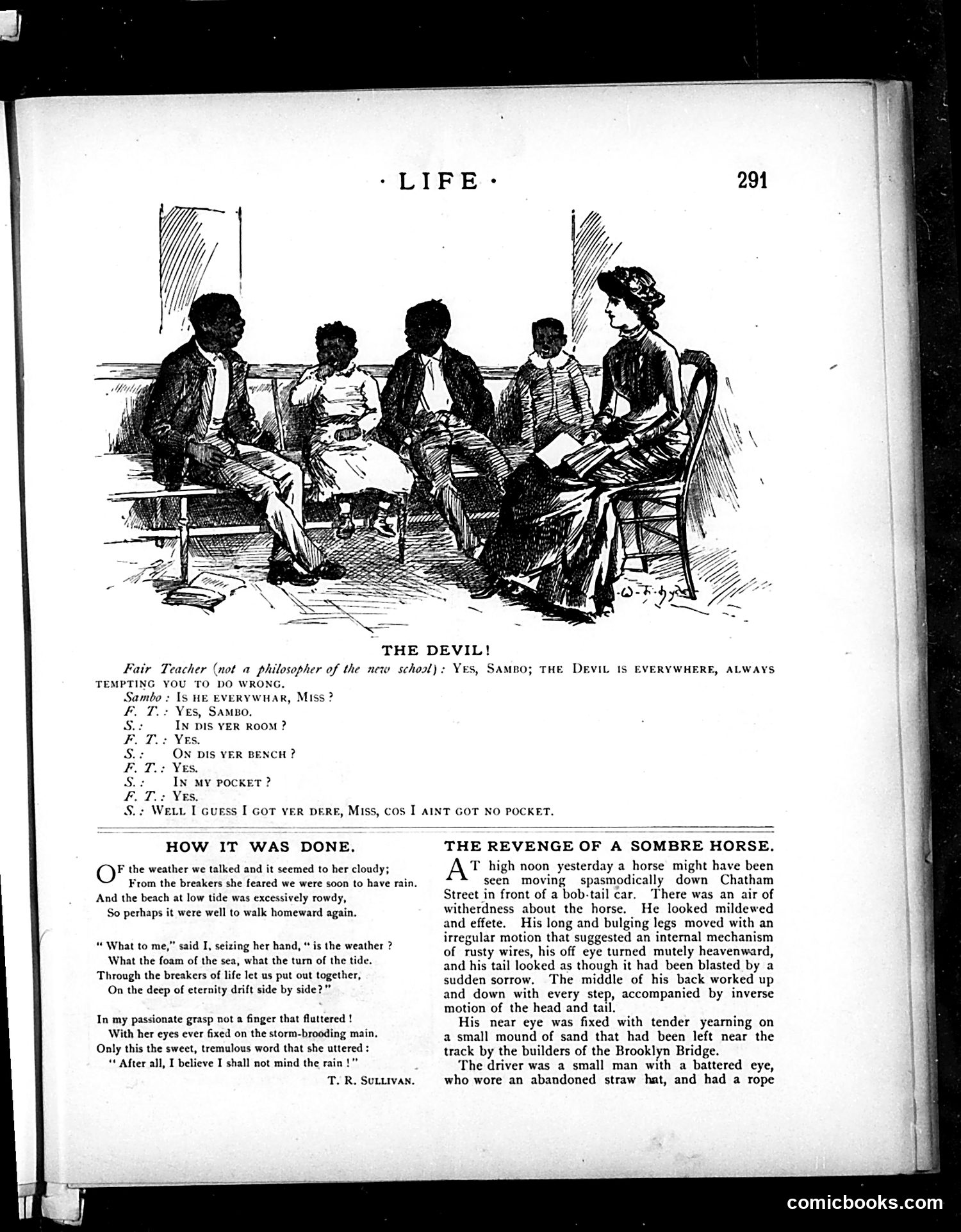
**"The Devil" Cartoon:** This depicts a Fair Teacher (identified as "a philosopher of the new school") telling students that the Devil is everywhere, tempting wrongdoing. A student named Sambo then systematically asks if the Devil is in various locations—the schoolroom, classroom bench, his pocket—each time receiving "Yes" as confirmation. The joke's punchline reveals Sambo's actual concern: he's lost his pocket money and sardonically concludes he "ain't got no pocket" since the Devil must have taken it. The satire mocks both new educational philosophies emphasizing moral temptation and the student's practical, self-interested reframing of abstract theology. **Other Content:** Two separate pieces appear below: "How It Was Done" (poetry about weather) and "The Revenge of a Sombre Horse" (prose about an oddly-behaving horse near Brooklyn Bridge).
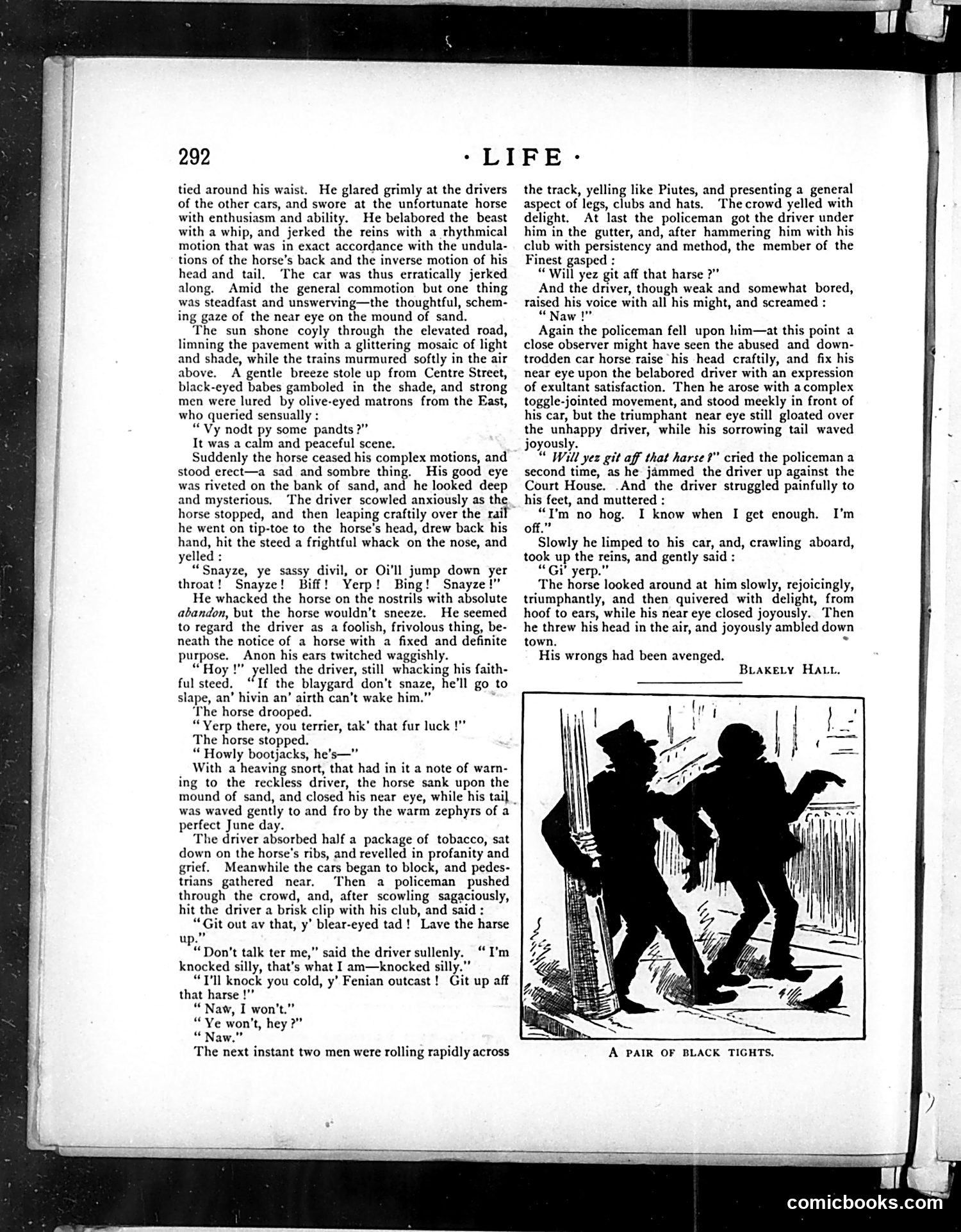
This page from *Life* magazine depicts a street altercation between a driver and a policeman. The text describes an increasingly heated confrontation: the driver abuses his horse; a policeman intervenes; the driver becomes insolent and refuses orders; the policeman hits him with a club; they struggle. The illustration shows two silhouetted figures in violent conflict on a city street. The caption "A Pair of Black Tights" appears to be a pun—referring both to the dark clothing visible in the scene and to "tights" meaning confrontations or struggles. The satire likely critiques either police brutality or public disorder depending on *Life*'s editorial stance at publication. Without the date, the specific incident referenced remains unclear, though it illustrates early 20th-century urban tensions between authorities and citizens.
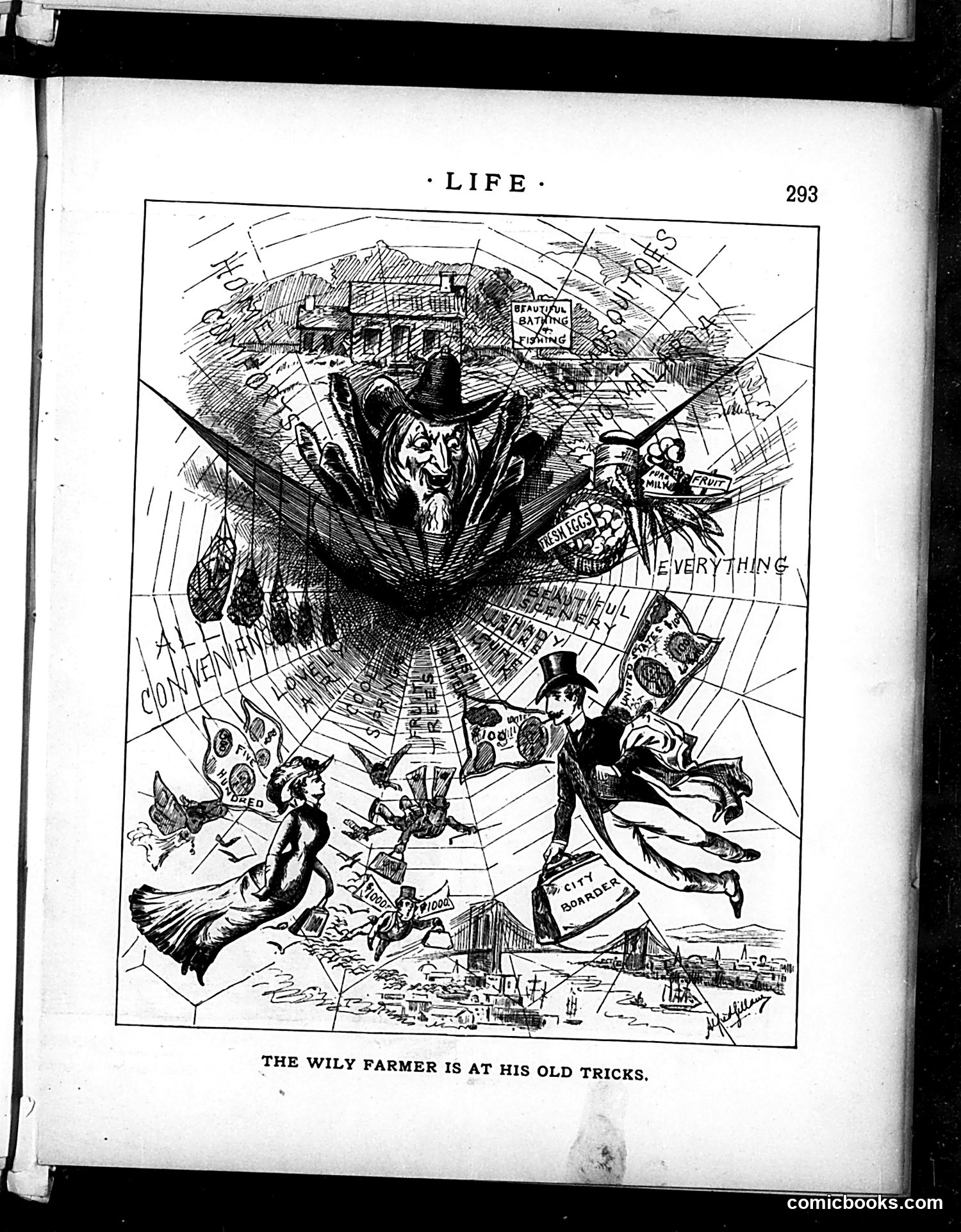
This political cartoon depicts a demonic or devil-like figure at the center of a web-like structure, surrounded by various commercial products and urban scenes. The central figure wears a hat and has exaggerated, menacing features characteristic of turn-of-the-century caricature. The web radiates outward with labels including "contentment," "everything," and references to goods like milk, spice, and butter. Two well-dressed men appear to be caught or struggling within this web structure, suggesting they're trapped by commercial schemes. The title suggests this depicts farmers using deceptive tactics, likely satirizing agricultural fraud, market manipulation, or monopolistic practices common during the early 20th century. The "wily farmer" appears portrayed as a devilish manipulator controlling commerce and trapping consumers through his schemes.
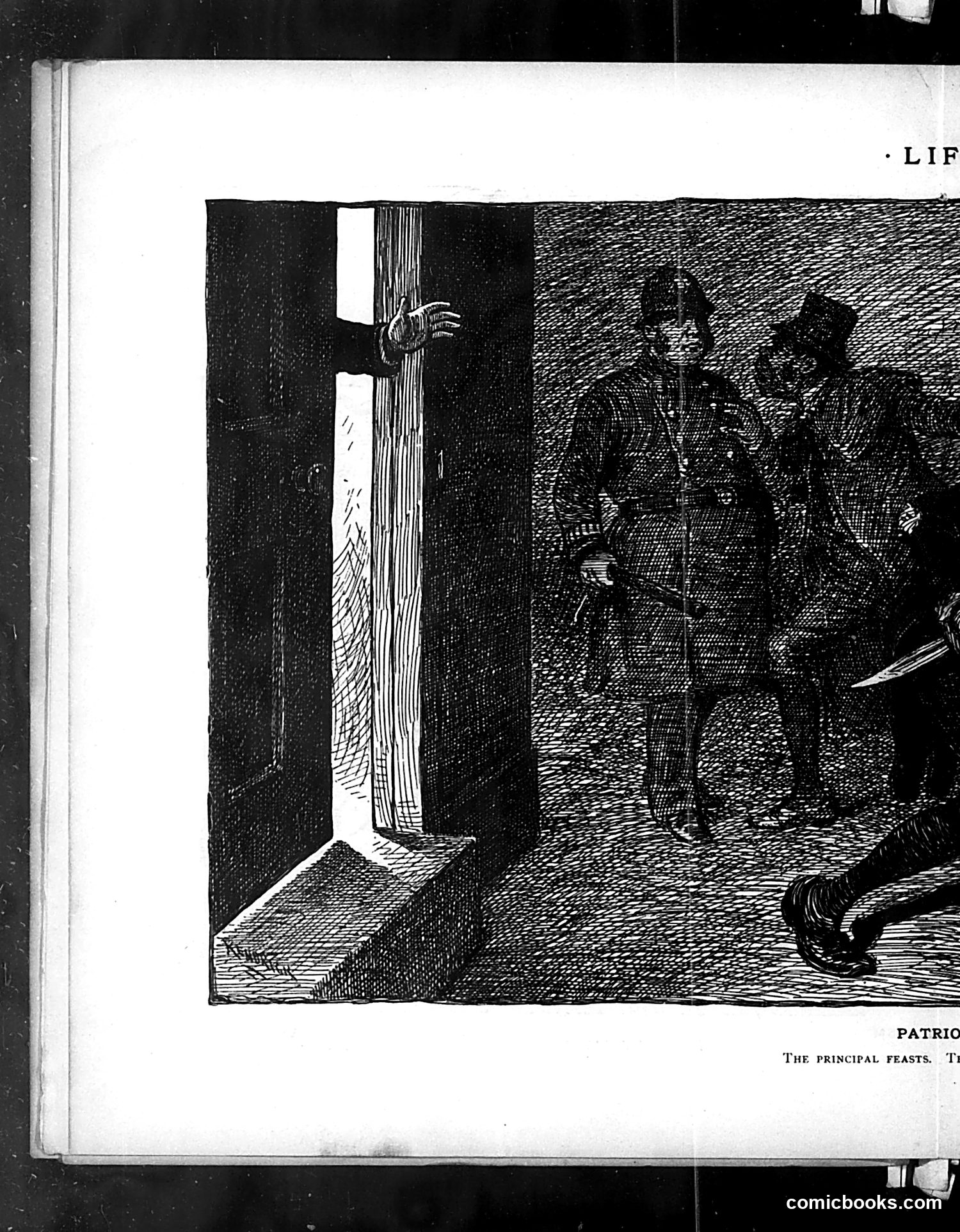
This is an engraved illustration titled "PATRIO[T]" with a caption beginning "THE PRINCIPAL FEASTS. TH[...]" The image depicts a darkened interior scene where a figure peers through a doorway or opening on the left, while several men in military or formal uniforms stand in a lit courtyard or plaza on the right. The composition suggests clandestine observation—the hidden figure watching uniformed officials or soldiers. Without the complete caption, the specific political reference is unclear, but the visual metaphor suggests satire about covert surveillance, espionage, or hidden patriotic/unpatriotic activity. The stark contrast between darkness and light, observer and observed, implies commentary on secretive political machinations. The "patriot" title likely carries ironic weight regarding the figure's true allegiances or actions.
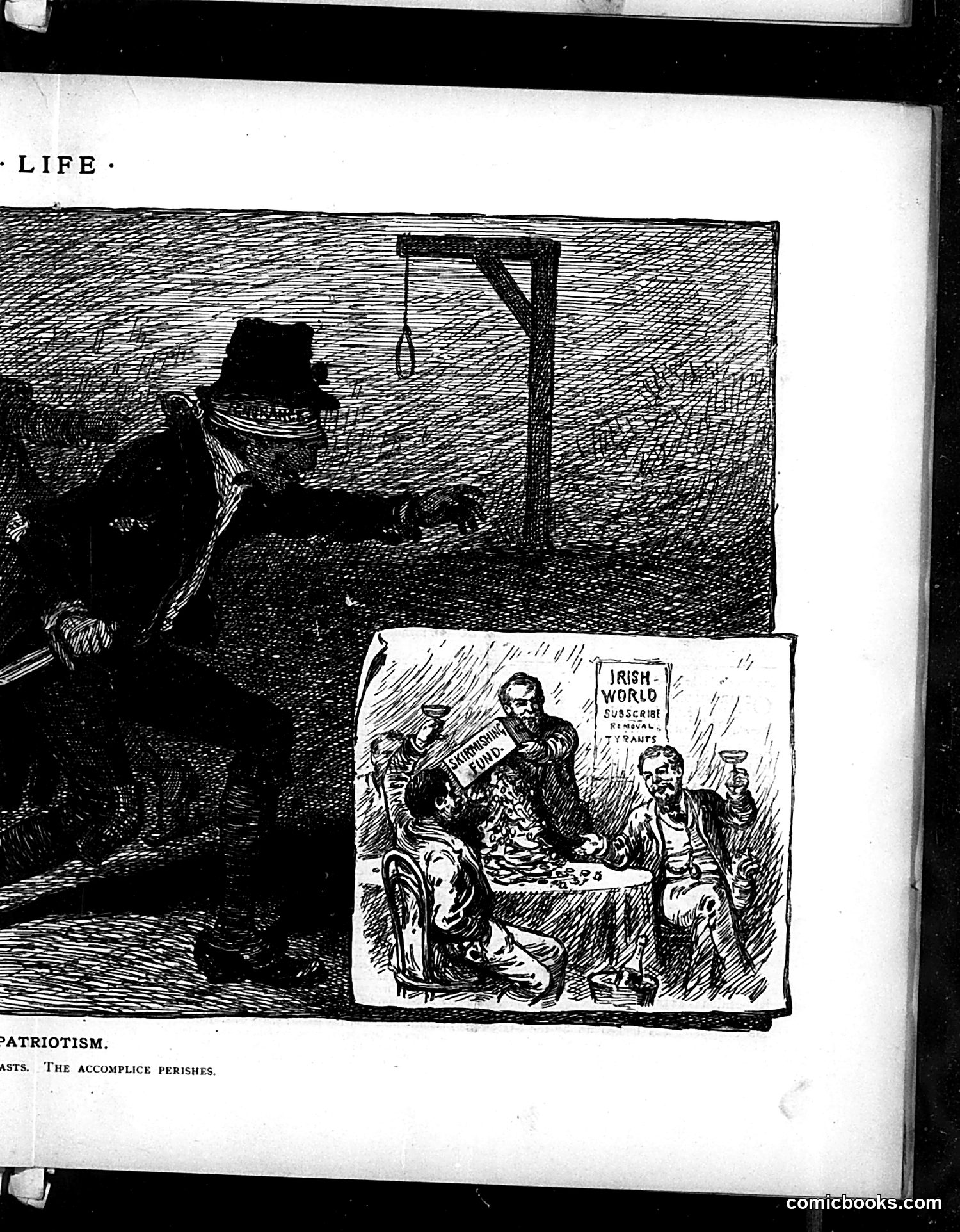
This is a stark political cartoon from *Life* magazine depicting capital punishment and political complicity. The large left panel shows a gallows with a figure approaching execution—a visual metaphor for state-sanctioned killing. The smaller right panel, labeled "Irish World," depicts what appears to be political or journalistic figures sitting at a table, seemingly indifferent to or complicit in the execution visible through a window behind them. The caption "Patriotism" with the phrase "The accomplice perishes" suggests the cartoon criticizes those who profit from or enable executions while maintaining patriotic rhetoric. The "Irish World" reference indicates this likely concerns Irish-American political discourse and accusations that certain publications or politicians tacitly support execution while claiming patriotic authority. The satire condemns hypocrisy: those who claim patriotism while enabling violence.
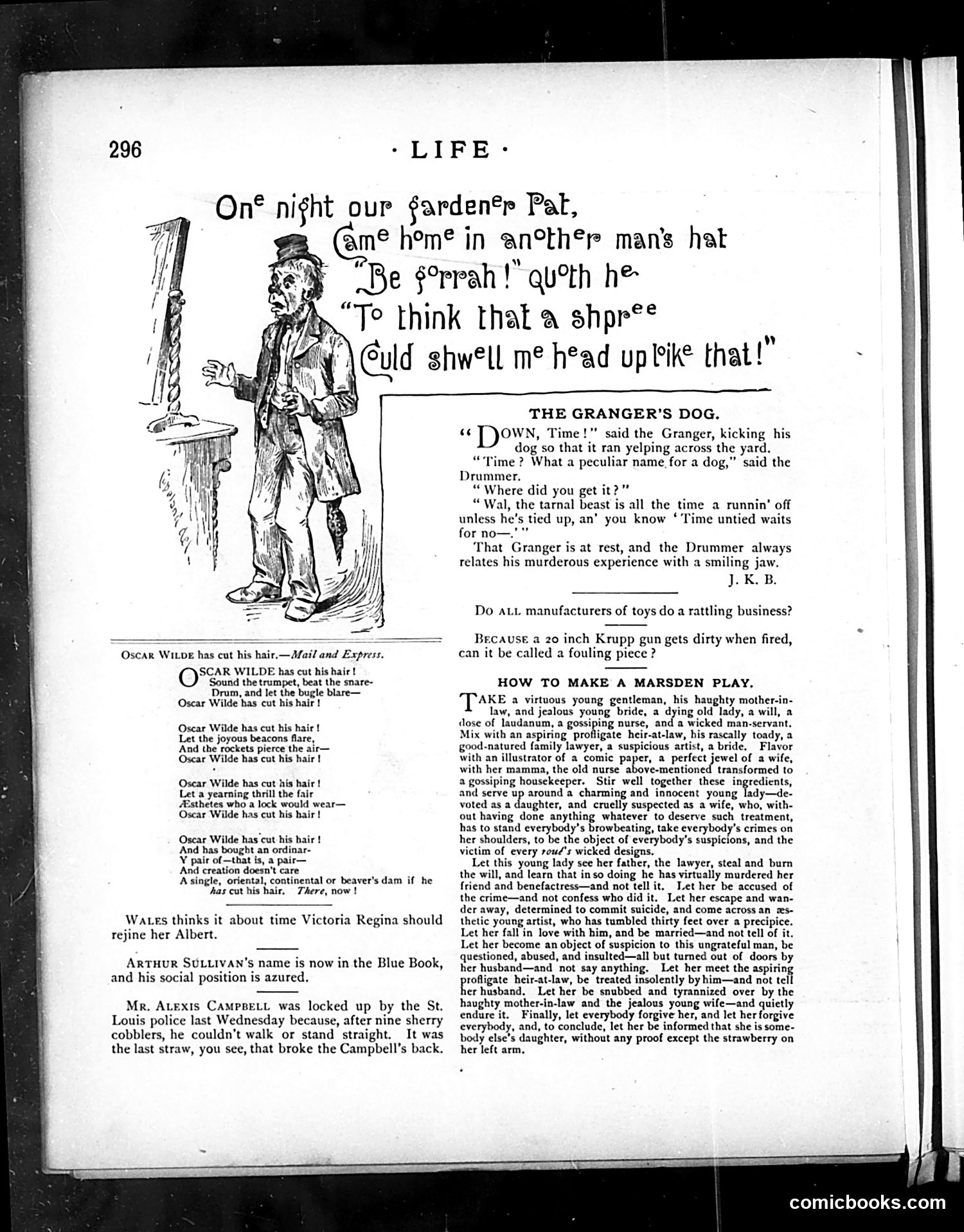
This page contains satirical commentary typical of 19th-century Life magazine: **The Oscar Wilde Item:** A humorous mock-announcement that Oscar Wilde has cut his hair, treated as major news. This satirizes Wilde's famous aesthetic persona and his distinctive appearance—his long hair was part of his carefully cultivated public image as a dandy and art-for-art's sake advocate. The repetitive verse mockingly celebrates this mundane act as if it were momentous. **"The Granger's Dog":** A rural humor piece where a farmer names his dog "Time" (because it constantly runs away "unless he's tied up"), then beats it. The joke plays on the phrase "time waits for no man"—the dog's name is a pun on this proverb. **Other Items:** Brief gossip about Arthur Sullivan (composer) gaining social status, and a drunk man's arrest—typical satirical snippets on contemporary figures and absurdities. **"How to Make a Marsden Play":** A recipe-format parody mocking melodramatic stage formulas—mixing virtuous heroines, wicked servants, wrongful accusations, and convenient forgivenesses into predictable theatrical plots.
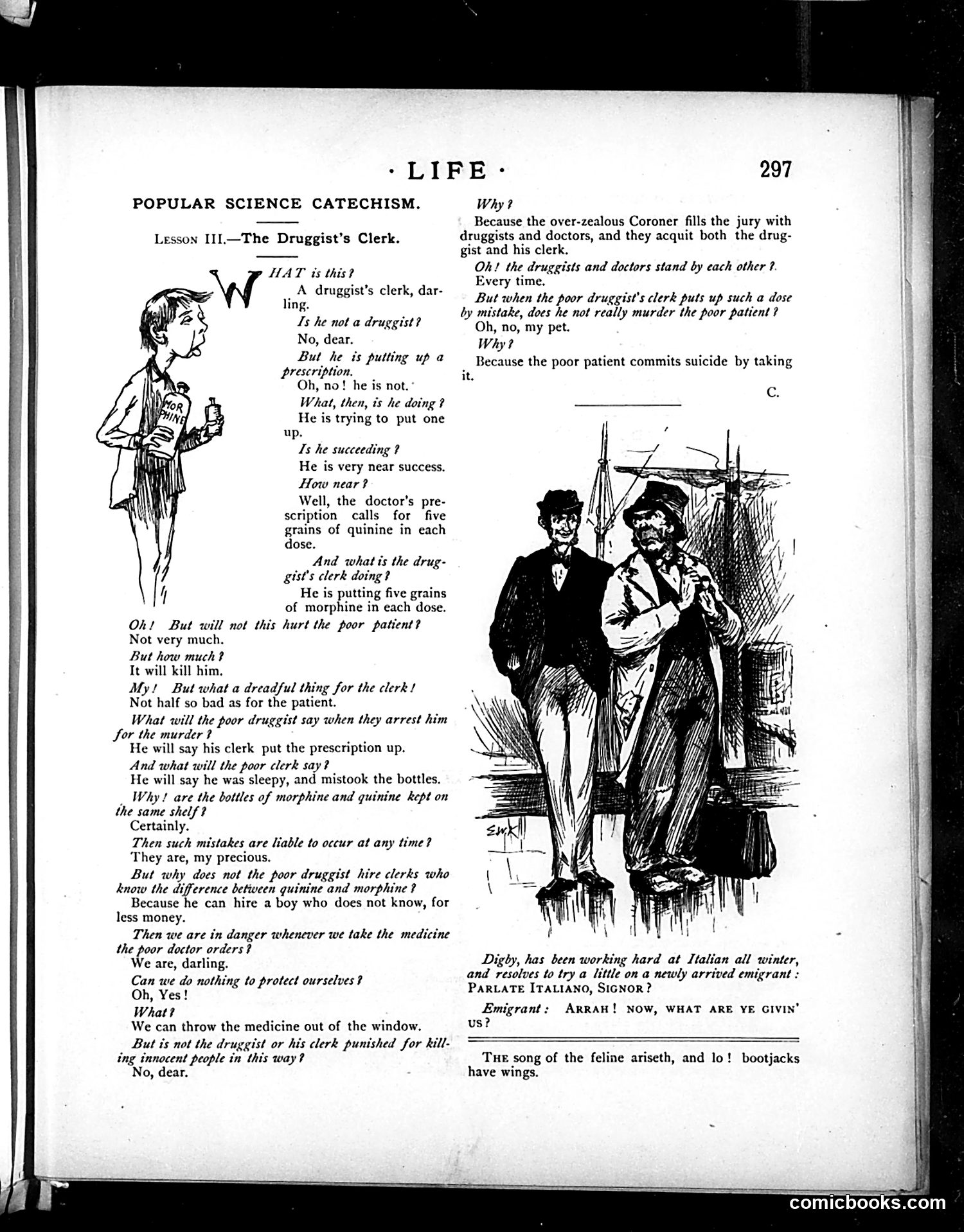
This is a scathing satirical dialogue mocking the complete lack of regulation and accountability in late-19th-century pharmacy. The joke exposes a horrifying reality: a druggist's clerk deliberately substitutes morphine for quinine in a prescription, killing the patient. The satire systematically demolishes every excuse: - The clerk pleads sleepiness; bottles sit on the same shelf - The druggist hires cheap, untrained boys to save money - When deaths occur, coroners pack juries with druggists and doctors who acquit each other - The patient is somehow blamed for "committing suicide" by taking the poisoned medicine The cartoon attacks professional collusion and the absence of pharmaceutical standards or legal consequences. This reflects genuine public concern about unregulated druggists in an era before the FDA (established 1906). The piece advocates transparency and safety reform by exposing how systematic negligence and professional self-protection made poisoning both common and unpunishable.
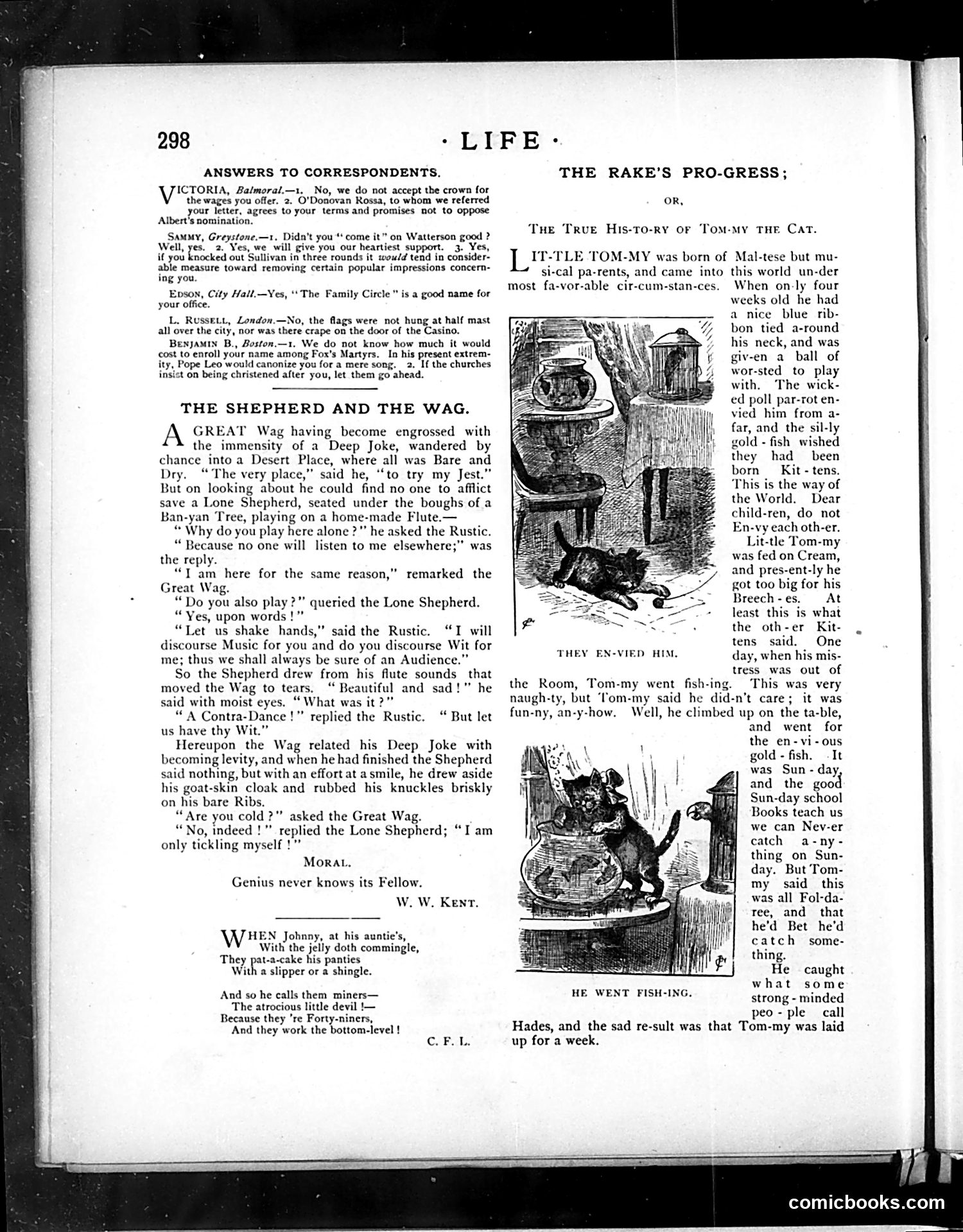
This page combines reader responses with three satirical pieces typical of 19th-century Life magazine's humor. The **"Answers to Correspondents"** section mocks contemporary figures through coded replies—references to Victoria/Balmoral, O'Donovan Rossa (an Irish nationalist), and Pope Leo suggest topical political jabs about British royalty and religious authority. **"The Shepherd and the Wag"** is a fable mocking wit itself: a clever joker meets a humble shepherd and discovers his clever jokes fail to entertain—the shepherd must literally tickle himself laughing. The moral criticizes those who think themselves witty but produce no genuine response. **"Tom-my the Cat"** is a serialized cautionary tale (following the "Rake's Progress" tradition) teaching children morality through animal characters. The text humorously explains Tom-my's downfall through verse, suggesting consequences await misbehavior—here, breaking Sunday-school rules by fishing on the Sabbath. The illustrations show the cat's misadventures. All three pieces use satire, fables, and didactic humor characteristic of Victorian-era family magazines.
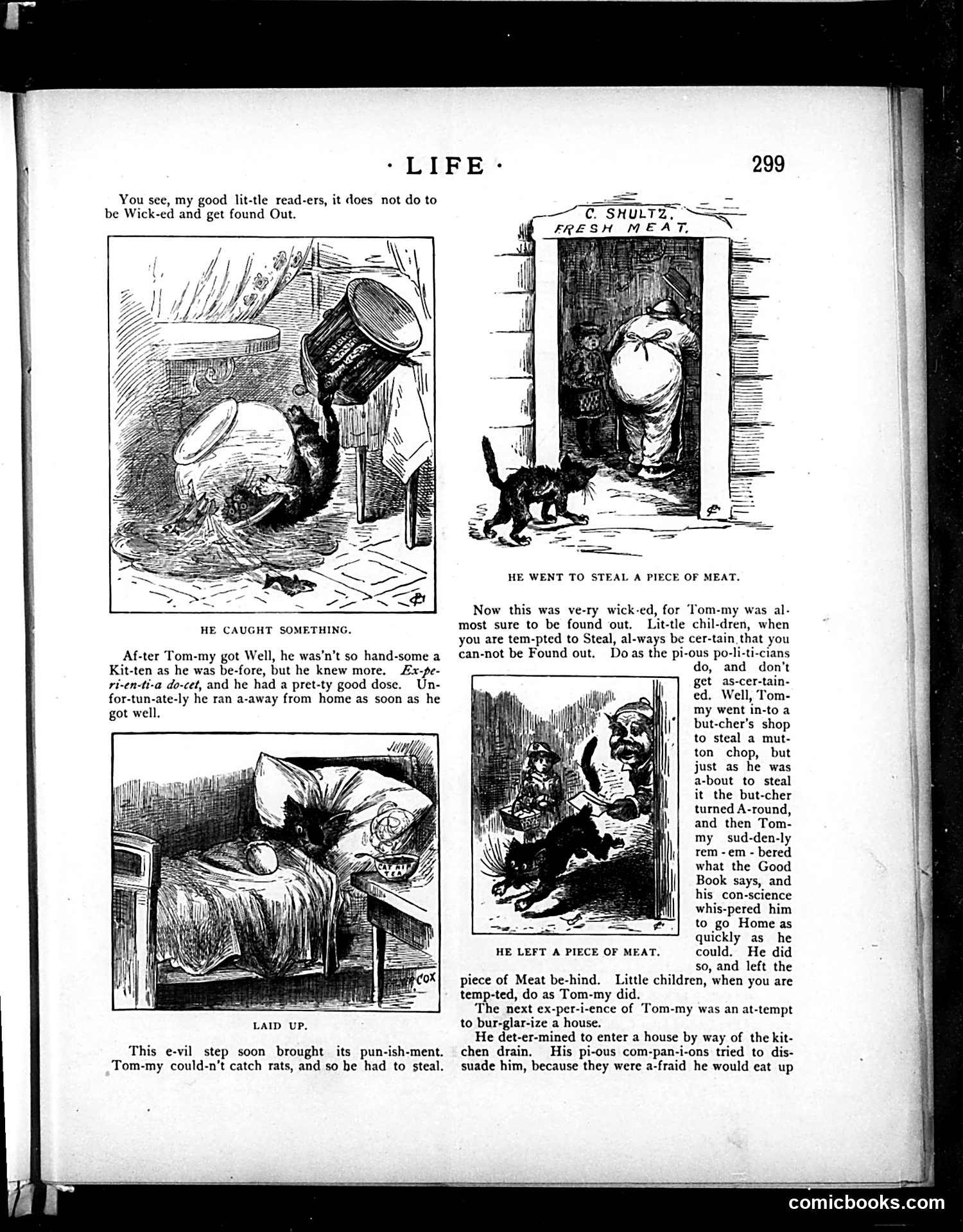
This is a Victorian-era moral fable using a cat character named Tom-my to teach children about consequences of wrongdoing. The narrative follows the cat after recovering from illness: weakened and unable to catch rats legitimately, Tom-my turns to theft and burglary. The satire is gently ironic—the text preaches morality ("Do not be Wicked") while depicting Tom-my's crimes. Notably, the butcher shop scene shows Tom-my's conscience intervening before he steals meat, suggesting even animals possess moral sense. The humor lies in applying human ethical frameworks to animal behavior and in the deadpan, exaggerated solemnity of the moral instruction. The artist (C. Shultz) uses this comic strip format to parody the period's didactic children's literature, which relied heavily on cautionary tales about crime and punishment to instruct young readers.
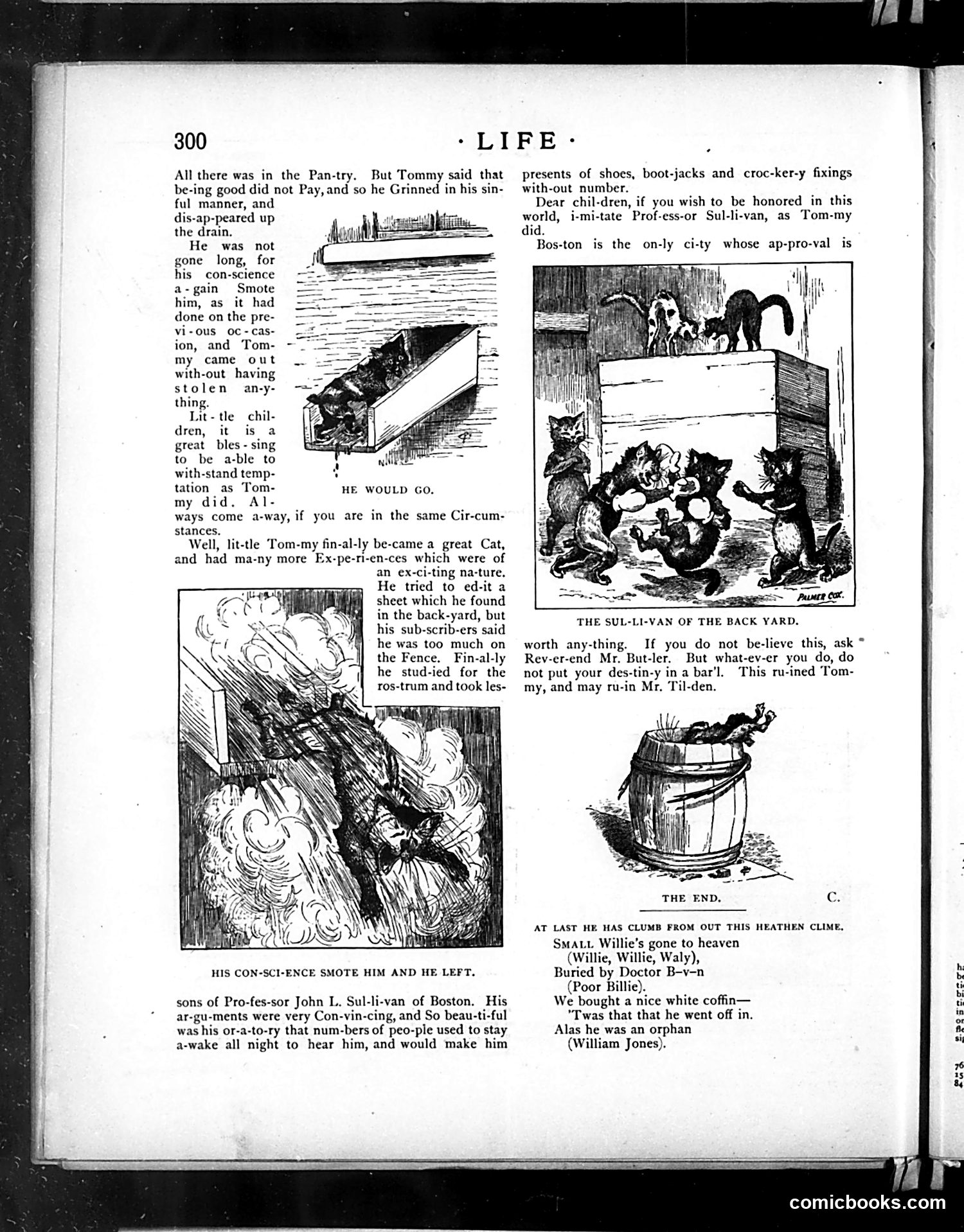
This page presents a children's morality fable told in exaggerated verse, mocking Victorian moral instruction. Young Tommy the cat learns virtue, then grows up to study rhetoric under "Professor John L. Sul-li-van of Boston"—likely a satirical reference to boxer John L. Sullivan, famous for his powerful arguments (fists). The joke is that brutal pugilism is presented as respectable oratory worthy of honor. The text humorously advises children to imitate Sullivan to gain Boston's approval and presents of shoes and crockery—mocking both the city's pretensions and the absurdity of rewarding violence with household goods. A brief epitaph for "Small Willie" follows, suggesting infant mortality—a common occurrence treated with dark humor typical of Life magazine's irreverent approach to serious subjects.
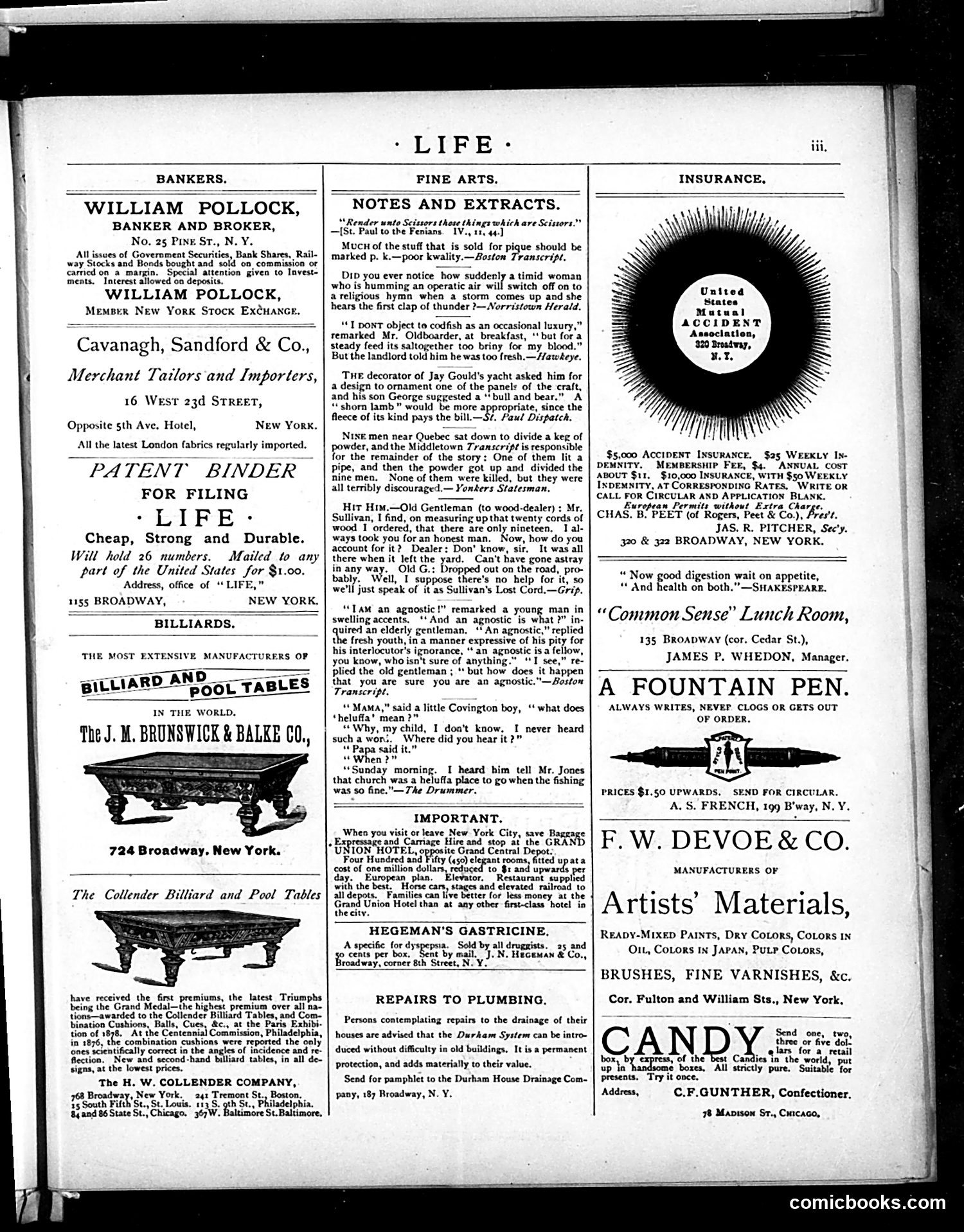
This is primarily an **advertising page** from Life magazine, featuring commercial notices for bankers, billiard manufacturers, merchant tailors, and other businesses typical of late 19th-century New York. The "Fine Arts" section contains **"Notes and Extracts"**—brief satirical anecdotes and wordplay rather than political cartoons. These mock everyday absurdities: a landlord's stingy codfish, Jay Gould's son suggesting a "bull and bear" (stock market terms) to decorate a yacht, a wood dealer short-changing a customer, and a pompous young man claiming to be an "agnostic" without understanding the term. The humor is gentle social satire targeting pretension, dishonesty, and ignorance among ordinary people and businessmen. The Gould reference alludes to the famous robber baron, but these pieces primarily poke fun at common human foibles rather than advancing specific political arguments. **No major political figures or events are depicted or referenced.**
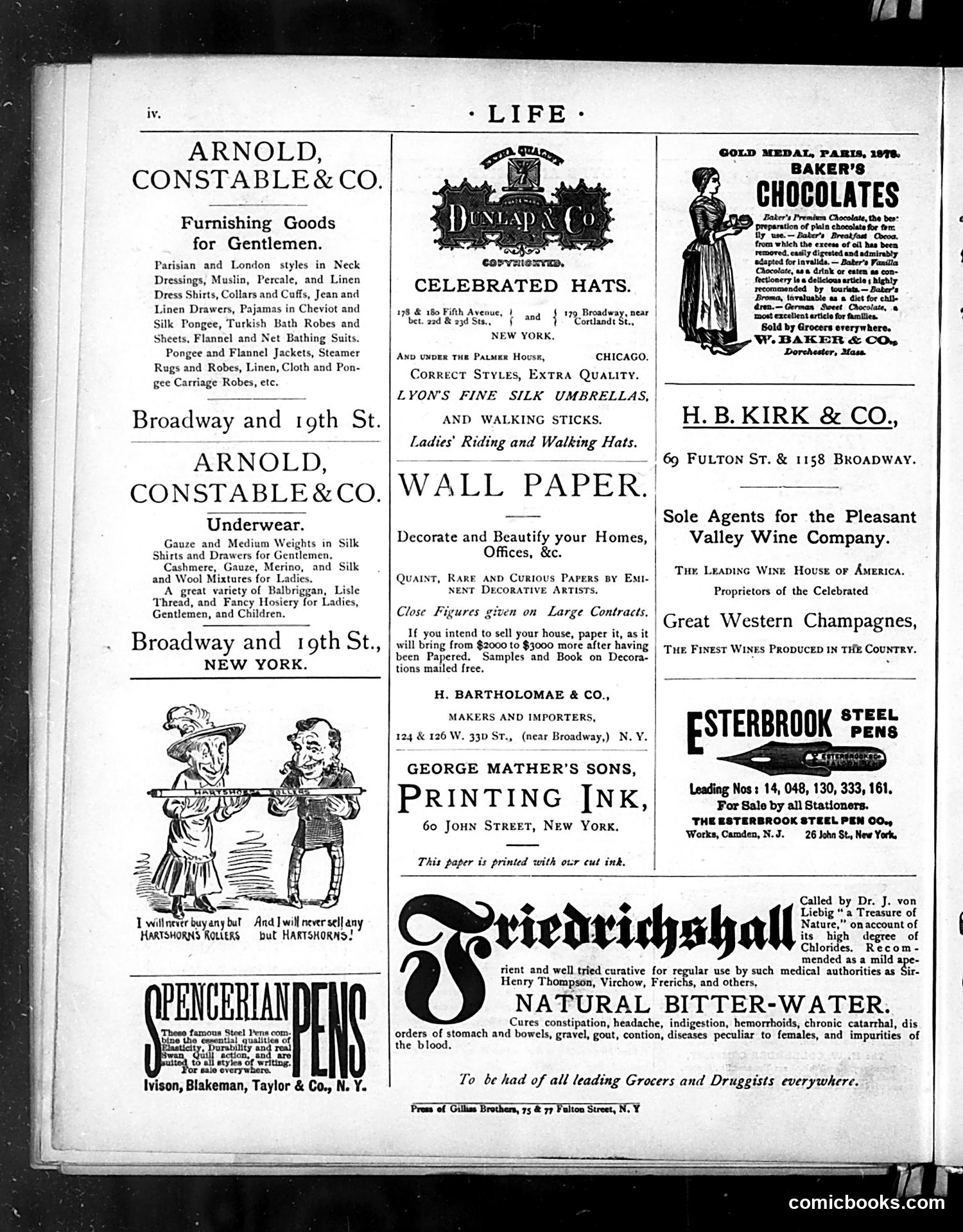
This page is primarily **advertising**, typical of Life magazine's revenue model. However, it contains one notable cartoon depicting two figures in a dispute over **Hartshorn's Rollers** (window shade mechanisms). The cartoon satirizes competitive advertising practices of the era. One figure declares "I will never buy any but Hartshorn's Rollers," while the other counters "And I will never sell any but Hartshorn's!" The joke appears to target aggressive brand loyalty claims and exaggerated product exclusivity marketing—both the consumer's stubborn brand devotion and the merchant's refusal to stock competitors. This reflects late-19th-century commercial culture where businesses made emphatic, often absurd claims about product superiority. The satire mocks how both buyer and seller adopt inflexible positions, suggesting the absurdity of such extreme brand partisanship in everyday commerce.