
Life, 1883-06-21 · page 3 of 16
Life — June 21, 1883 — page 3: what you’re looking at
What you’re looking at
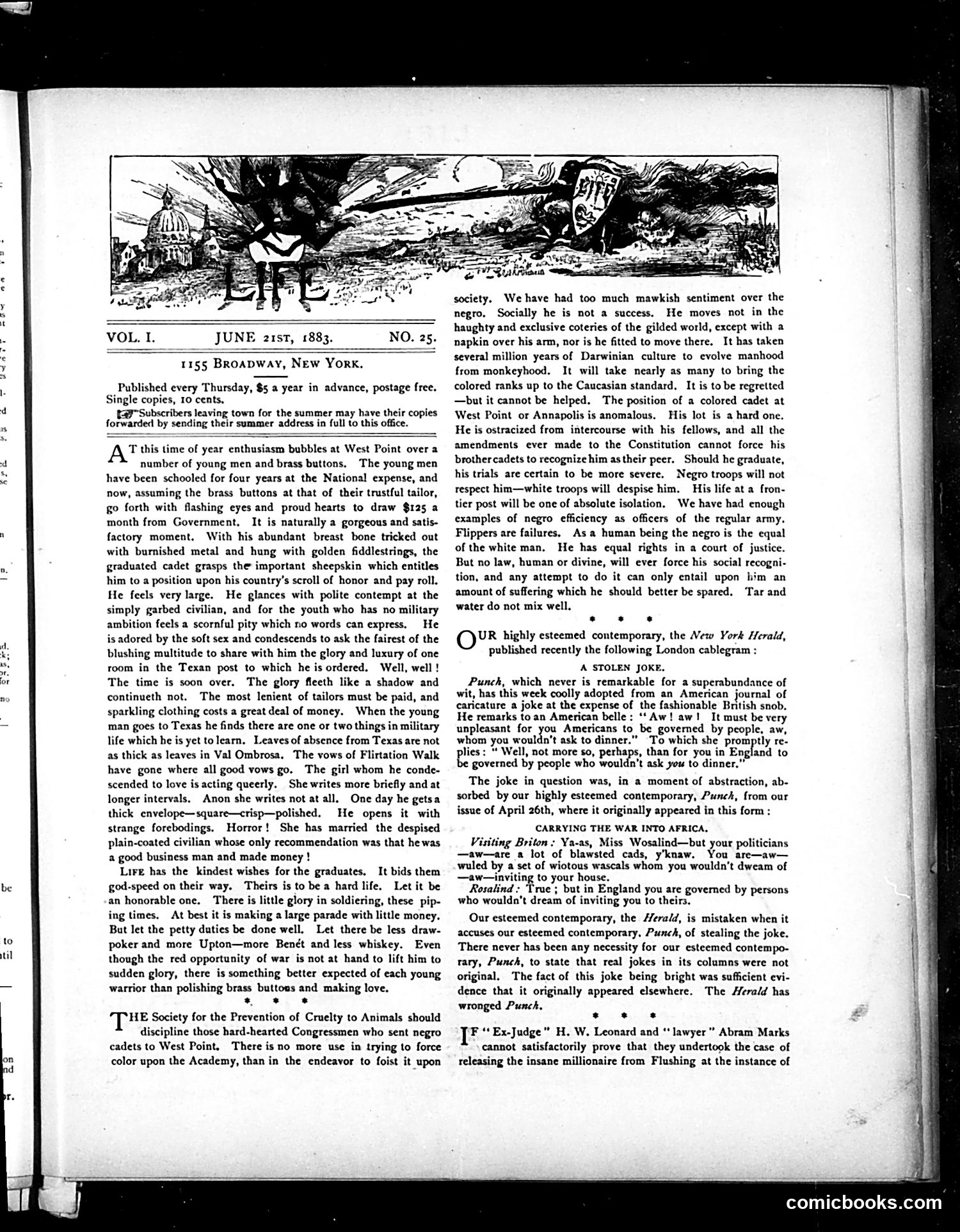
The cartoon at the top depicts a cadet at West Point military academy. The accompanying article criticizes young officers' arrogance after graduation, mocking their inflated self-importance and social pretension. The text sarcastically describes how a cadet "feels very large" and possesses "blushing multitude to share with him the glory and luxury of one room in the barracks." The article also contains racist commentary about Black soldiers and integration at military academies, reflecting deeply prejudiced 19th-century attitudes. Below, the page includes editorial commentary on *Punch* magazine's satirical content and discusses a legal case involving "Ex-Judge" H.W. Leonard and a millionaire named Flushing. The overall tone is satirical social commentary typical of 1880s American humor magazines.
📄 Transcribed text from this page (OCR, searchable)
Machine-transcribed from the original scan — historical spelling and the odd misread are preserved.
JUNE a2ist, 1883. NO. 25. 1155 BRoapway, New York. Published every Thursday, $5 a year in advance, postage free. Single copies, 10 cents. [ay Subscribers leaving town for the summer may have their copies forwarded by sending their summer address in full to this office. A? this time of year enthusiasm bubbles at West Point over a number of young men and brass buttons. The young men have been schooled for four years at the National expense, and now, assuming the brass buttons at that of their trustful tailor, go forth with flashing eyes and proud hearts to draw $125 a month from Government, It is naturally a gorgeous and satis- factory moment, With his abundant breast bone tricked out with burnished metal and hung with golden fiddlestrings, the graduated cadet grasps the important sheepskin which entitles him to a position upon his country’s scroll of honor and pay roll. He feels very large. He glances with polite contempt at the simply garbed civilian, and for the youth who has no military ambition feels a scornful pity which no words can express, He is adored by the soft sex and condescends to ask the fairest of the blushing multitude to share with him the glory and luxury of one room in the Texan post to which he is ordered. Well, well! The time is soon over. The glory fieeth like a shadow and continueth not. The most lenient of tailors must be paid, and sparkling clothing costs a great deal of money. When the young man goes to Texas he finds there are one or two things in military life which he is yet tolearn, Leaves of absence from Texas are not as thick as leaves in Val Ombrosa, The vows of Flirtation Walk have gone where all good vows go. The girl whom he conde- scended to love is acting queerly. She writes more briefly and at longer intervals. Anon she writes not at all. One day he getsa thick envelope—square—crisp—polished. He opens it with strange forebodings. Horror! She has married the despised plain-coated civilian whose only recommendation was that he was a good business man and made money ! Lire has the kindest wishes for the graduates. It bids them god-speed on their way, Theirs is to be a hard life. Let it be an honorable one. There is little glory in soldiering, these pip- ing times, At best it is making a large parade with little money. But let the petty duties be done well. Let there be less draw- poker and more Upton—more Benét and less whiskey. Even though the red opportunity of war is not at hand to lift him to sudden glory, there is something better expected of each young warrior than polishing brass buttoas and making love. es 8 «© Tae Society for the Prevention of Cruelty to Animals should discipline those hard-hearted Congressmen who sent negro cadets to West Point, There isno more use in trying to force color upon the Academy, than in the endeavor to foist it upon society, Wehave had too much mawkish sentiment over the negro. Socially he is not a success. He moves not in the haughty and exclusive coteries of the gilded world, except with a napkin over his arm, nor is he fitted to move there, It has taken several million years of Darwinian culture to evolve manhood from monkeyhood. It will take nearly as many to bring the colored ranks up to the Caucasian standard. It is to be regretted —but it cannot be helped. The position of a colored cadet at West Point or Annapolis is anomalous. His lot is a hard one, He is ostracized from intercourse with his fellows, and all the amendments ever made to the Constitution cannot force his brothercadets to recognizehim astheir peer. Should he graduate, his trials are certain to be more severe. Negro troops will not respect him—white troops will despise him. His life at a fron- tier post will be one of absolute isolation, We have had enough examples of negro efficiency as officers of the regular army. Flippers are failures, Asa human being the negro is the equal of the white man. He has equal rights in a court of justice. But no law, human or divine, will ever force his social recogni- tion, and any attempt to do it can only entail upon him an amount of suffering which he should better be spared. Tar and water do not mix well. * 8 8 Ov highly esteemed contemporary, the Mew York Herald, published recently the following London cablegram : A STOLEN JOKE. Punch, which never is remarkable for a superabundance of wit, has this week coolly adopted from an American journal of caricature a joke at the expense of the fashionable British snob. He remarks to an American belle: ‘‘ Aw! aw! It must be very unpleasant for you Americans to be governed by people, aw, whom you wouldn’t ask to dinner.” To which she promptly re- lies : “ Well, not more so, perhaps, than for you in England to governed by people who wouldn’t ask you to dinner.” The joke in question was, in a moment of abstraction, ab- sorbed by our highly esteemed contemporary, Punch, from our issue of April 26th, where it originally appeared in this form: CARRYING THE WAR INTO AFRICA. Visiting Briton: Ya-as, Miss Wosalind—but your politicians —aw—are a lot of blawsted cads, y’knaw. You are—aw— wuled by a set of wiotous wascals whom you wouldn't dweam of —aw—inviting to your house. Rosalind : True ; but in England you are governed by persons who wouldn't dream of inviting you to theirs. Our esteemed contemporary, the Herald, is mistaken when it accuses our esteemed contemporary, Punch, of stealing the joke. There never has been any necessity for our esteemed contempo- rary, Punch, to state that real jokes in its columns were not original, The fact of this joke being bright was sufficient evi- dence that it originally appeared elsewhere. The Herald has wronged Punch, See [F “ ExJudge” H.W. Leonard and “lawyer” Abram Marks cannot satisfactorily prove that they undertook the case of releasing the insane millionaire from Flushing at the instance of comicbooks.com