
A complete issue · 16 pages · 1883
Life — June 14, 1883
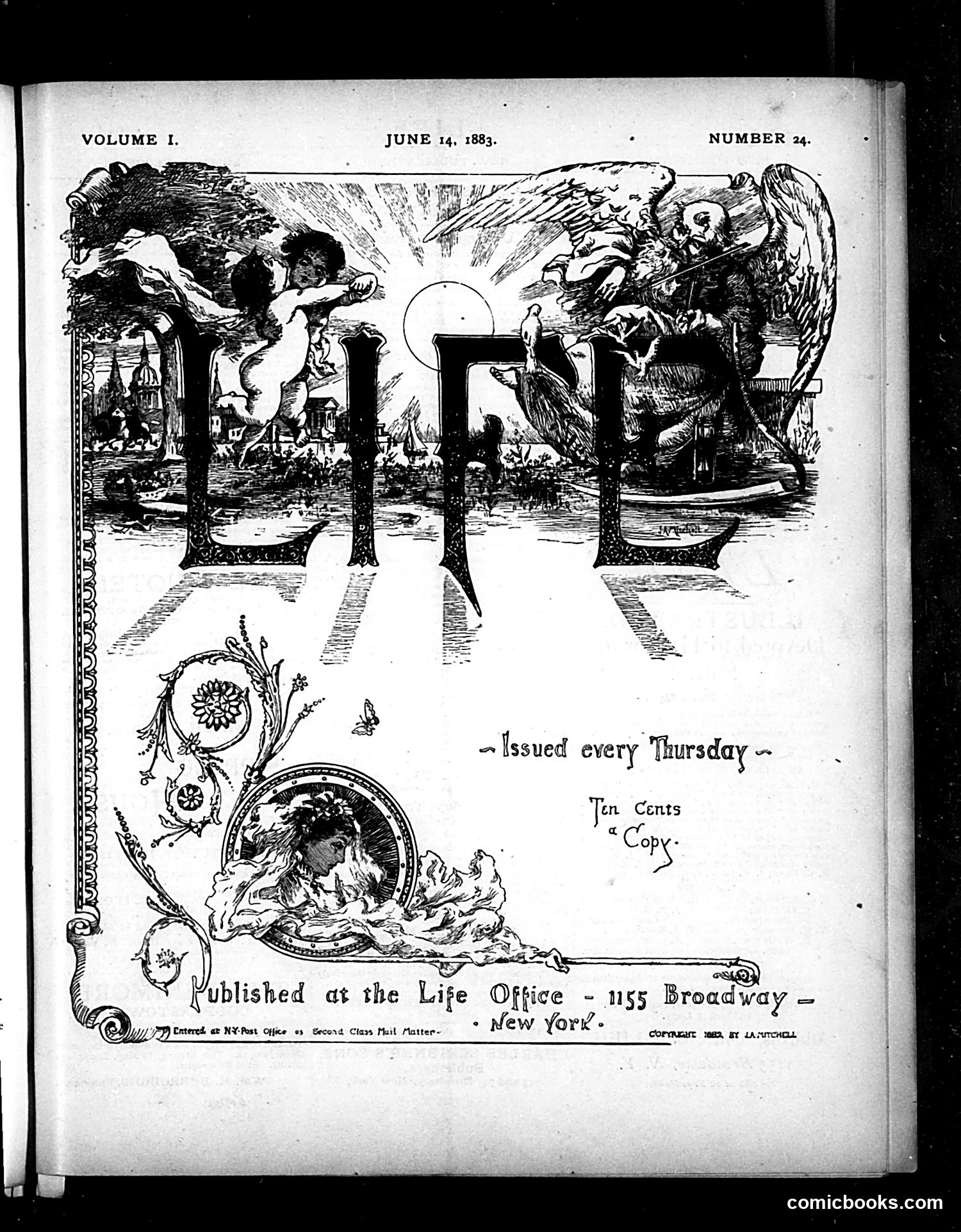
This is the cover of *Life* magazine from June 14, 1883 (Volume 1, Number 24). The central illustration depicts a fantastical, allegorical scene featuring classical and mythological figures—including cherubs, an angel, and what appears to be personified concepts—arranged around the large letters "LIFE" that dominate the composition. The imagery suggests themes of aspiration, spirituality, or the magazine's editorial vision for American culture. The ornate decorative borders and classical references reflect the aesthetic sophistication *Life* cultivated as a satirical publication aimed at educated readers. Without additional context about specific 1883 events or political figures, the exact satirical targets remain unclear, though the grandiose treatment likely comments ironically on contemporary American society or cultural pretensions. The "$0.10 a Copy" price and Broadway publication address confirm this is an early issue of the influential magazine.
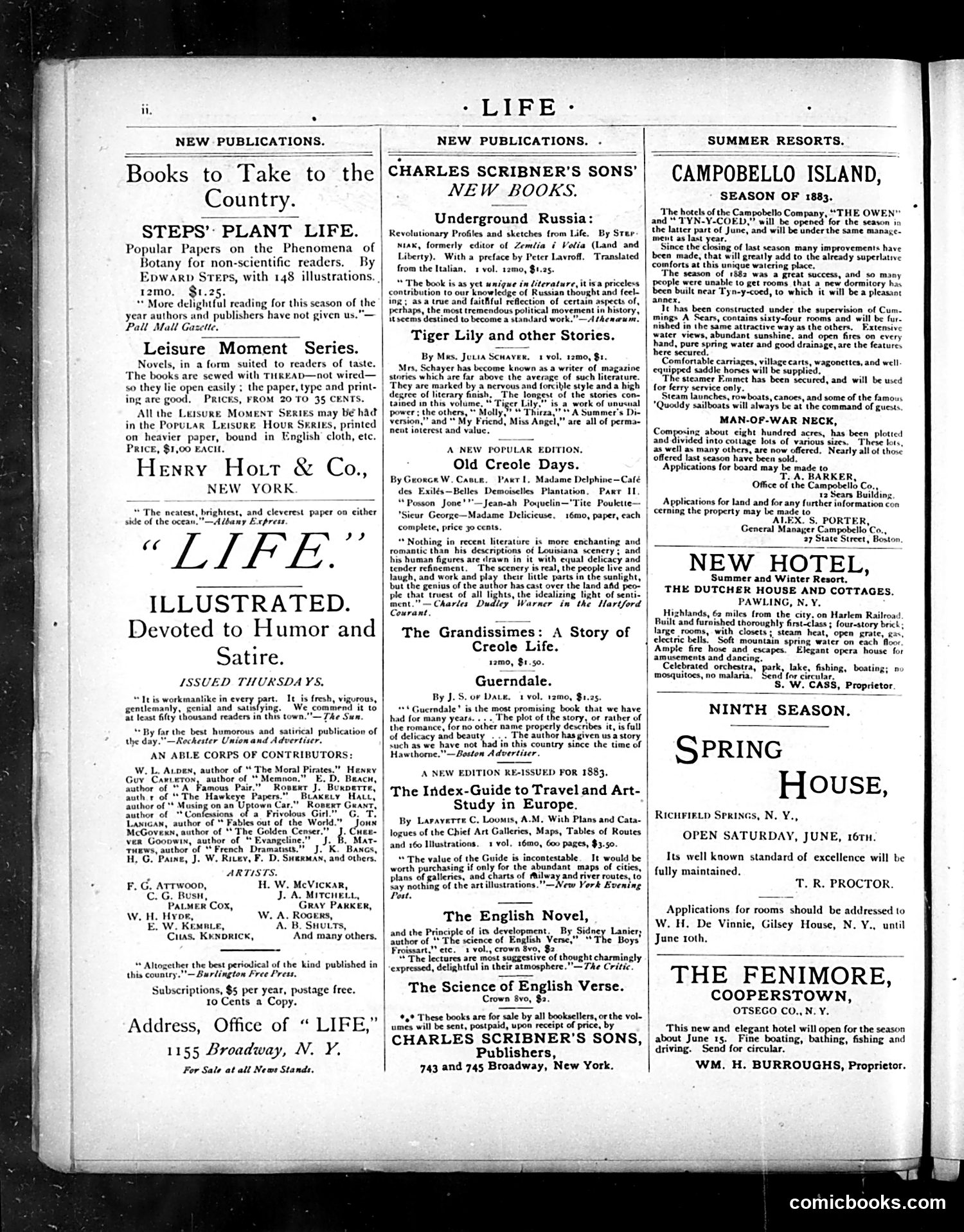
This page is predominantly **advertising and announcements** rather than political cartoons or satirical content. The layout shows three columns of advertisements for: - New book publications (left column) - Charles Scribner's Sons' new books, including titles on Russia and Creole life (center) - Summer resort advertisements for hotels and cottages in upstate New York (right column) The only editorial content is a small notice about *Life* magazine itself, describing it as "illustrated" and "devoted to Humor and Satire," with information about contributors and subscription rates. No political figures, caricatures, or social commentary are visible on this page. This appears to be a standard late-19th-century magazine page mixing publishing industry announcements with leisure destination advertising.
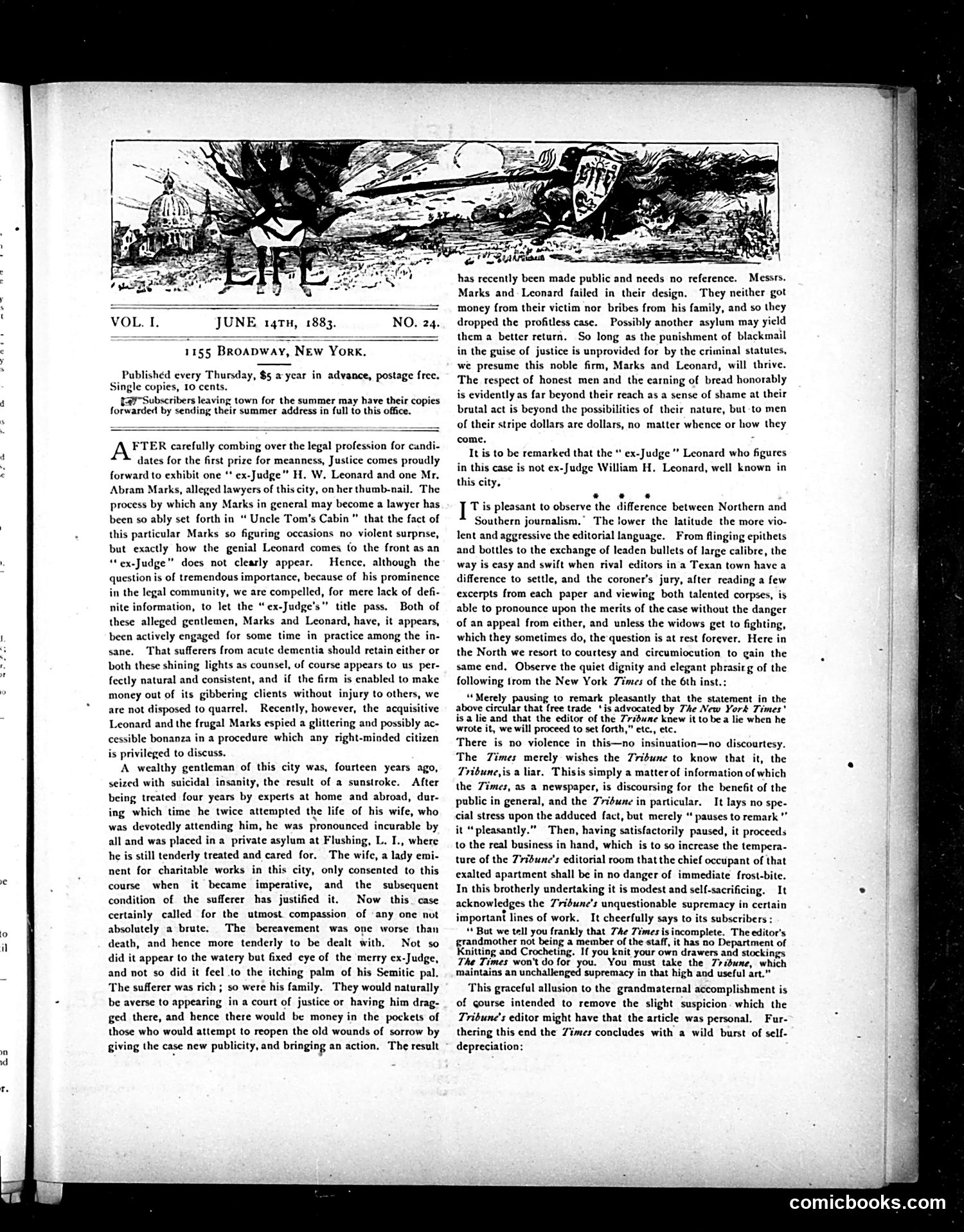
The masthead illustration depicts a nighttime landscape with classical architectural elements, establishing the magazine's artistic pretensions. The article discusses a legal dispute involving "ex-Judge" H. W. Leonard and others named Marks and Alvan Marks—alleged to be swindlers or confidence men. The text sarcastically praises their criminal enterprise ("noble firm"), noting they extorted money through blackmail then abandoned their victim. The piece critiques the New York *Times* for claiming moral superiority while engaging in similar editorial battles with rival papers. Life accuses the *Times* of hypocrisy—condemning violence in journalism while itself being aggressive and confrontational. This represents 1880s press warfare: competing newspapers attacking each other's credibility and methods while covering local scandals.
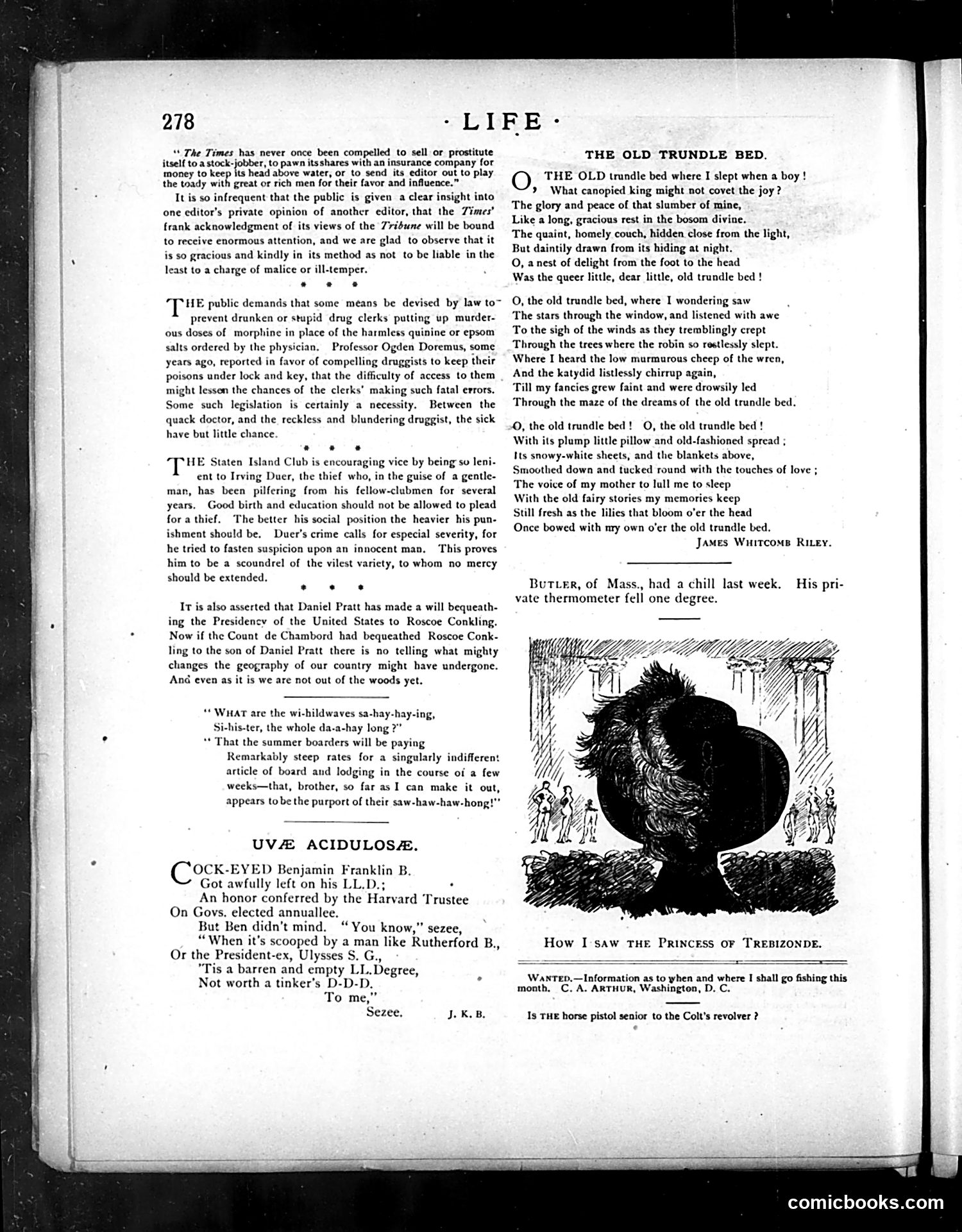
The page contains three distinct items: 1. **Editorial commentary** on The Times newspaper's independence and a discussion of drug regulation policy, mentioning Professor Ogden Doremus's advocacy for controlling druggists' access to poisons. 2. **"The Old Trundle Bed"** — a nostalgic poem by James Whitcomb Riley celebrating childhood memories of a simple bed, with no apparent satire. 3. **"Uvæ Acidulosæ"** — a brief satirical poem (by J.K.B.) mocking Benjamin Franklin B., apparently a Harvard graduate whose credentials (LL.D.) are mockingly dismissed as worthless. The satire targets pretentious academic titles. 4. A small illustration captioned "How I Saw the Princess of Trebizonde" with a classified notice seeking fishing information. The page mixes sentimental poetry with mild academic satire, typical of Life magazine's content.
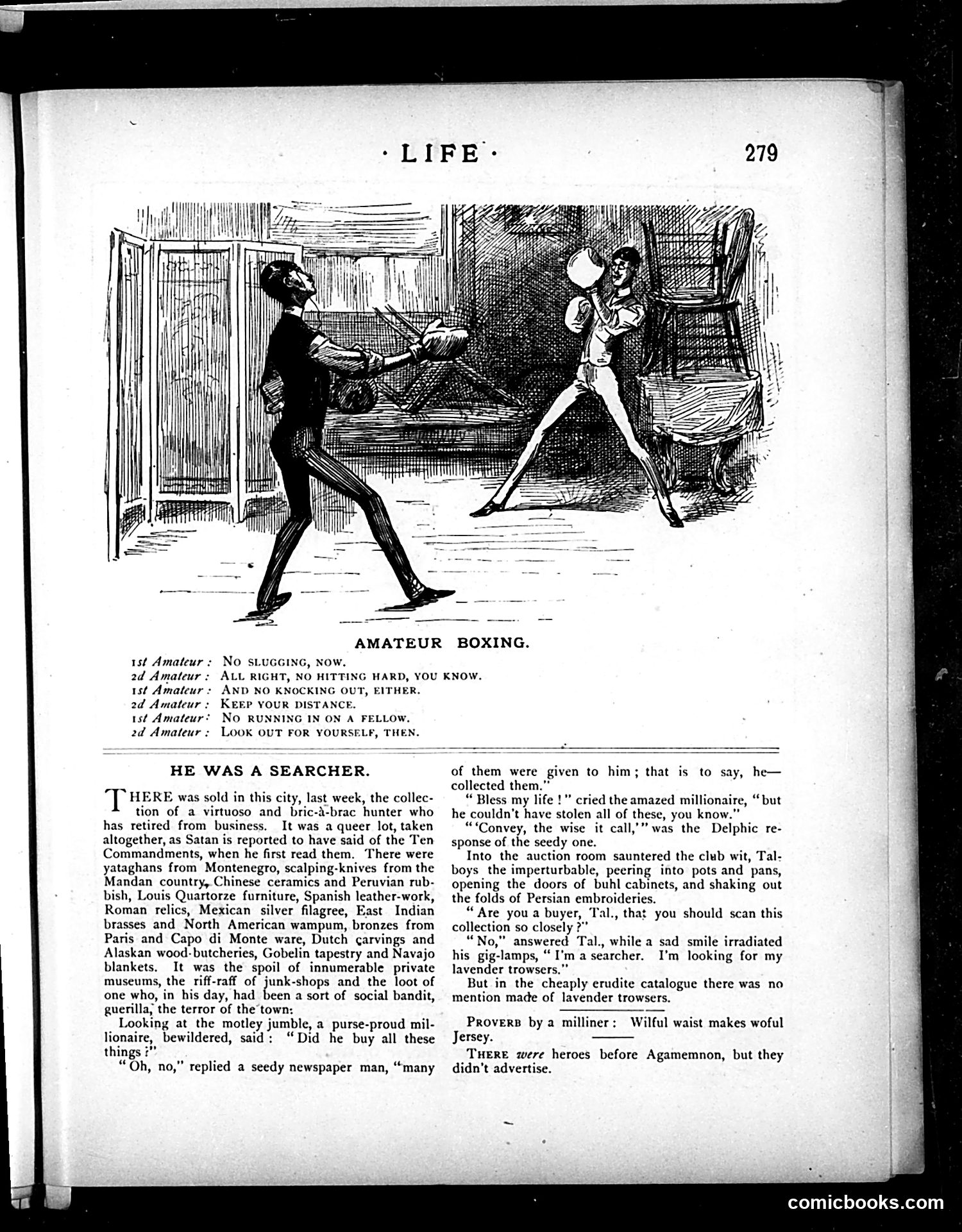
**"Amateur Boxing" Cartoon:** This satirical illustration mocks inexperienced boxers attempting a match. The dialogue reveals the absurdity: one amateur instructs "no slugging," "no hitting hard," "no knocking out," emphasizing "keeping distance" and "no running." The joke is that these aren't boxing rules at all—they're the opposite of boxing. The cartoon ridicules genteel amateur sportsmen who want the appearance of boxing without actual combat, reducing the sport to a charade of cautious posturing. **"He Was a Searcher" Story:** This text piece satirizes an eccentric millionaire-collector who purchased an enormous random assortment of valuable and worthless items at auction (Persian furniture, Native American artifacts, etc.). A newspaper reporter's quip—"many of them were given to him"—suggests the collection's chaotic nature. The "seedy" employee who claims to be searching for "lavender trousers" underscores the absurdity of such indiscriminate collecting.
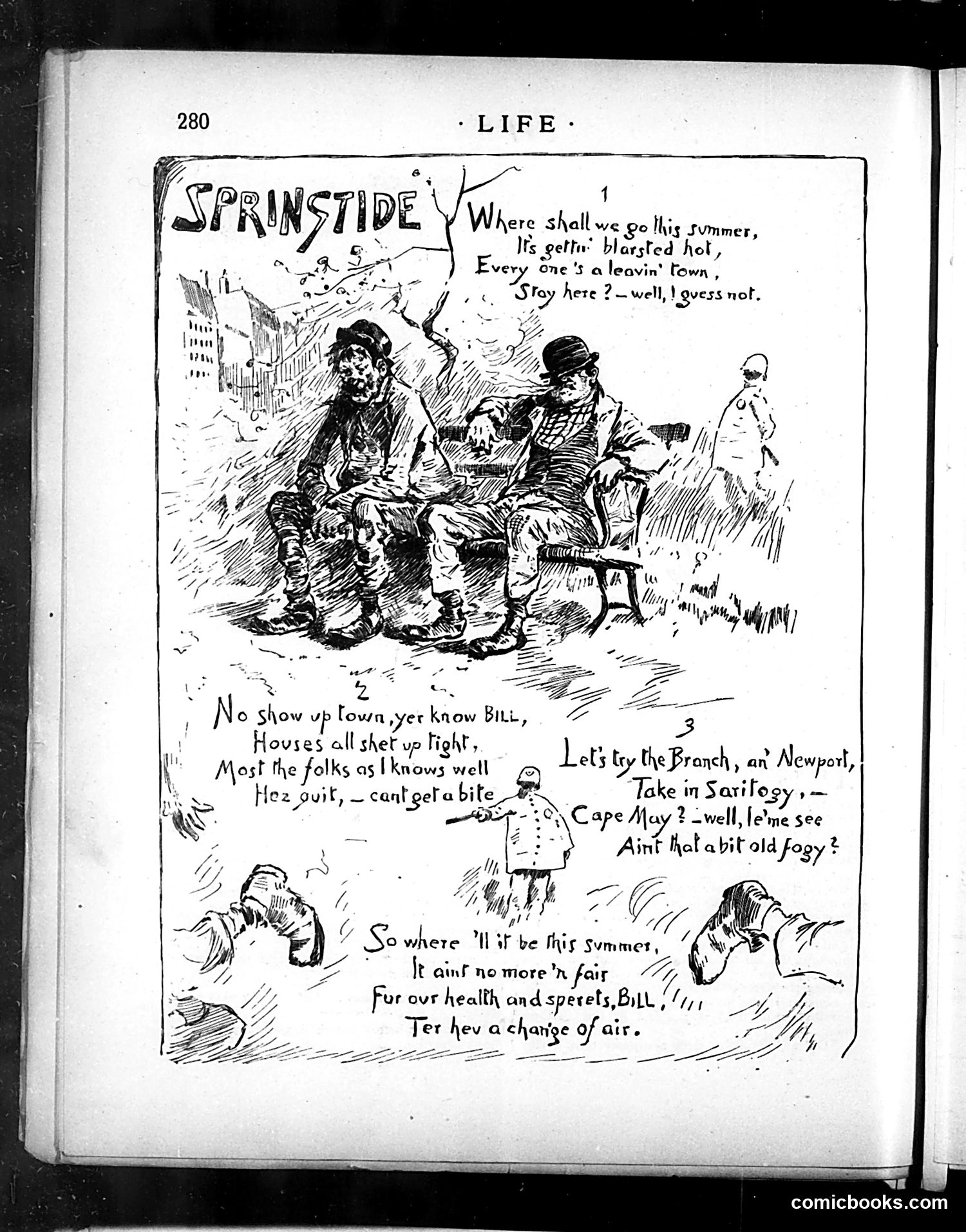
This satirical cartoon depicts working-class men debating summer vacation plans during what appears to be the late 19th or early 20th century. The humor centers on their limited options: they mention "no show up town" because "houses all shet up tight," suggesting wealthy residents flee the city in summer, leaving no employment opportunities. The men propose visiting various locations (Brandy, Newport, Saratoga, Cape May) in increasingly sarcastic tones, clearly unable to afford such fashionable resort destinations. The final punchline—"ain't no more'n fair / Fur our health and sperets, Bill, / Ter hev a change of air"—satirizes the working poor's inability to access the same leisure time and travel privileges as the wealthy, despite needing respite equally.
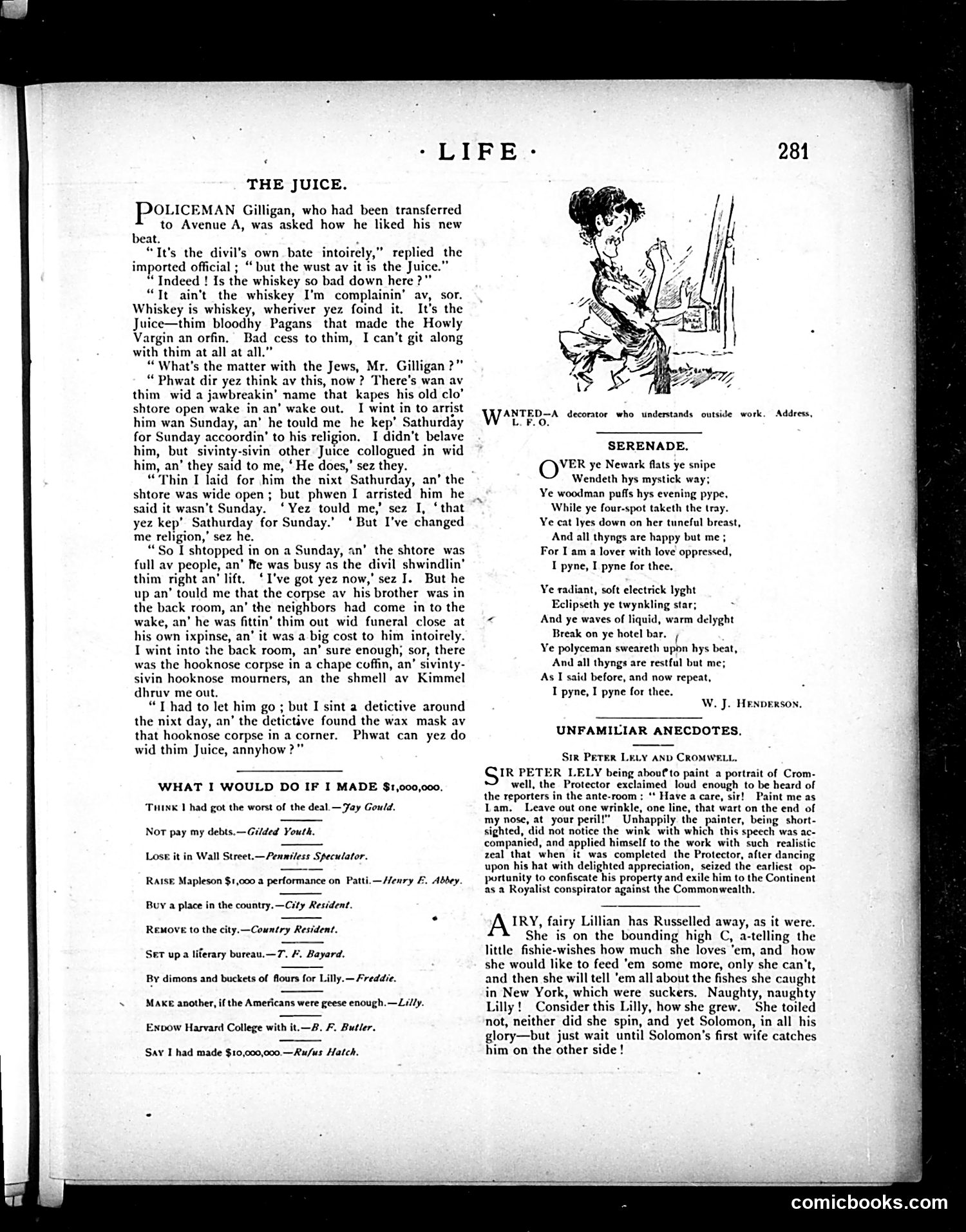
The main text satirizes **Policeman Gilligan**, an Irish immigrant transferred to Avenue A (a tenement district). The humor hinges on ethnic and religious stereotypes: Gilligan complains about whiskey quality, then defends Jewish neighbors against prejudice, creating ironic commentary on inter-ethnic tensions in working-class New York. The narrative mocks both Irish drinking culture and religious rigidity—Gilligan arrests a man for violating Jewish Sabbath observance, then discovers the "corpse" at the man's funeral was actually a ruse. The satire suggests Irish cops' arbitrary enforcement of laws and their misunderstanding of immigrant communities. The accompanying cartoon (right) depicts a woman at a window, likely illustrating domestic scenes referenced in period humor. The page reflects early 20th-century American anxieties about immigration and religious/cultural conflict.
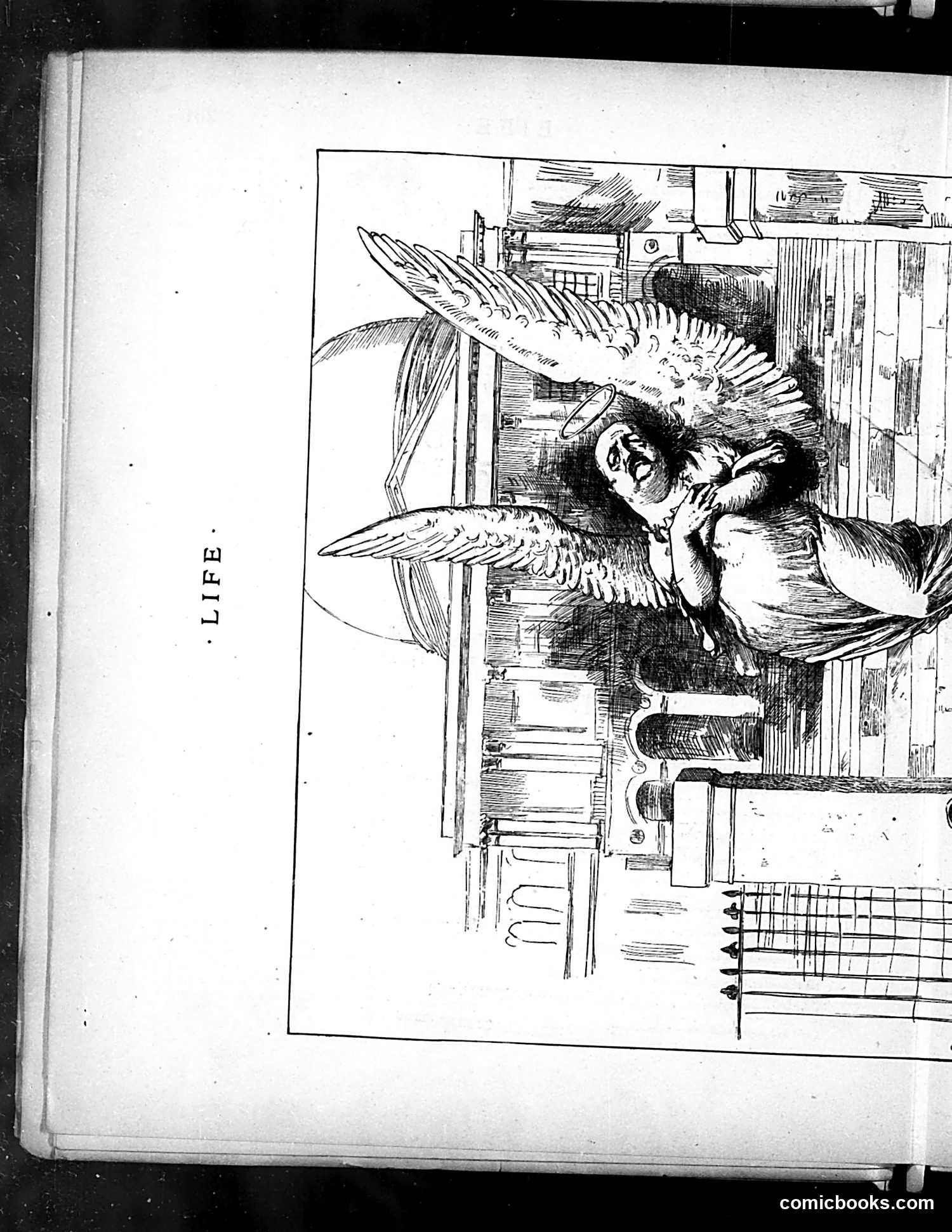
The page shows a single illustration labeled "LIFE" at left. The cartoon depicts a figure with a human face and large bird wings in what appears to be an indoor domestic setting. The figure seems to be interacting with household items or furniture. **What I can identify:** This is clearly satirical artwork from Life magazine's early era, using a hybrid human-bird form for social or political commentary. The domestic interior setting suggests the satire concerns everyday life or social behavior. **What remains unclear:** Without additional context or readable captions, I cannot definitively identify which specific person or social issue this caricatures. The bird-human hybrid likely represents a particular stereotype or characteristic the cartoonist wished to mock, but the exact target and meaning are not determinable from the image alone.
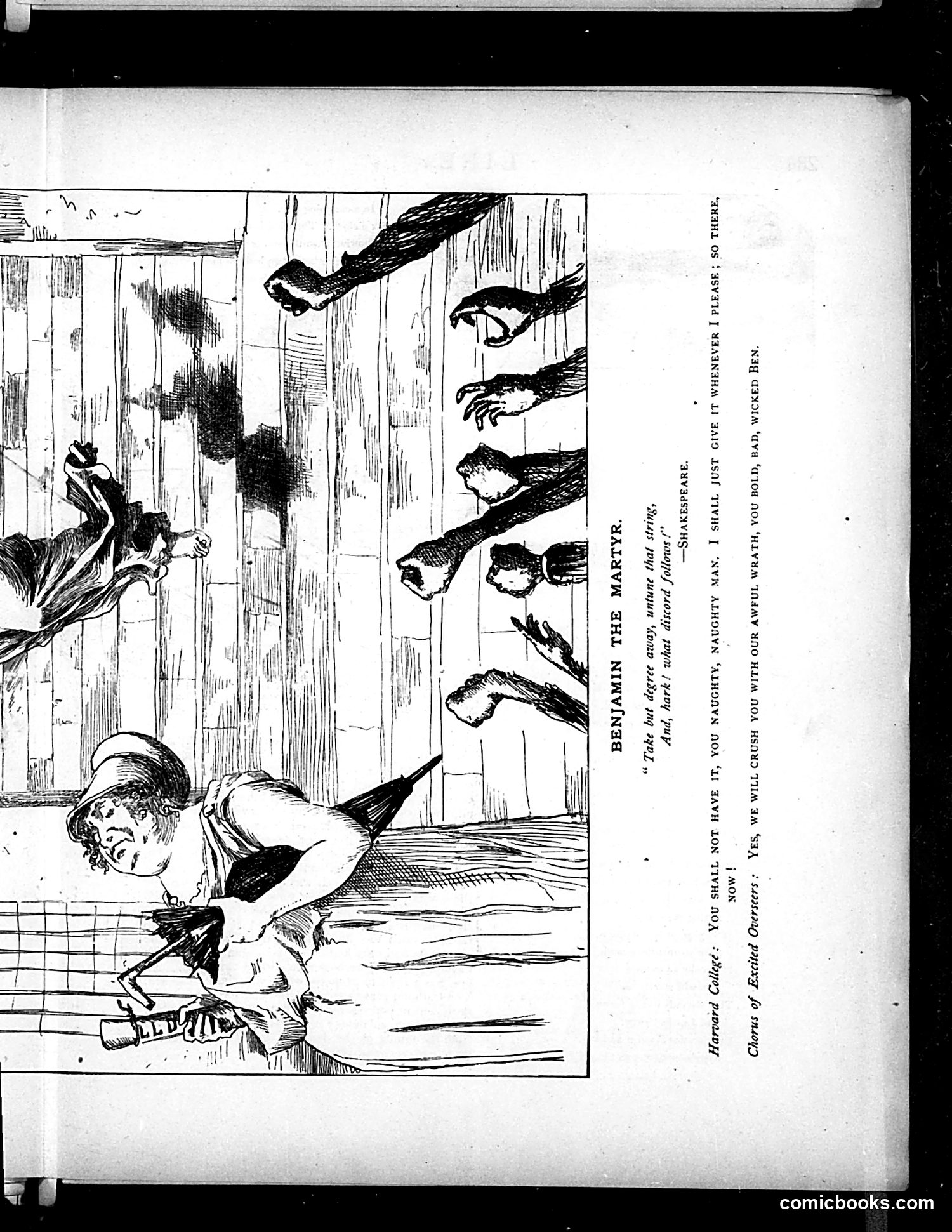
This political cartoon depicts Benjamin (identity unclear from image alone) as a Christian martyr, shown prone on the ground while severed hands rain down from above—a grotesque visual metaphor for persecution or execution. The caption's religious language ("martyr," "Calvary") frames the subject as a victim of injustice. The inscription references an "Enchanted Greybeard" and mentions "You will crush your awful with you roll bird wrecked box," though this OCR text appears corrupted and unclear. Without additional context about which Benjamin or which historical moment this references, the cartoon's specific political target remains uncertain. The imagery suggests depicting someone as unjustly victimized or condemned, likely commentary on a controversial legal case or political persecution from Life magazine's era.
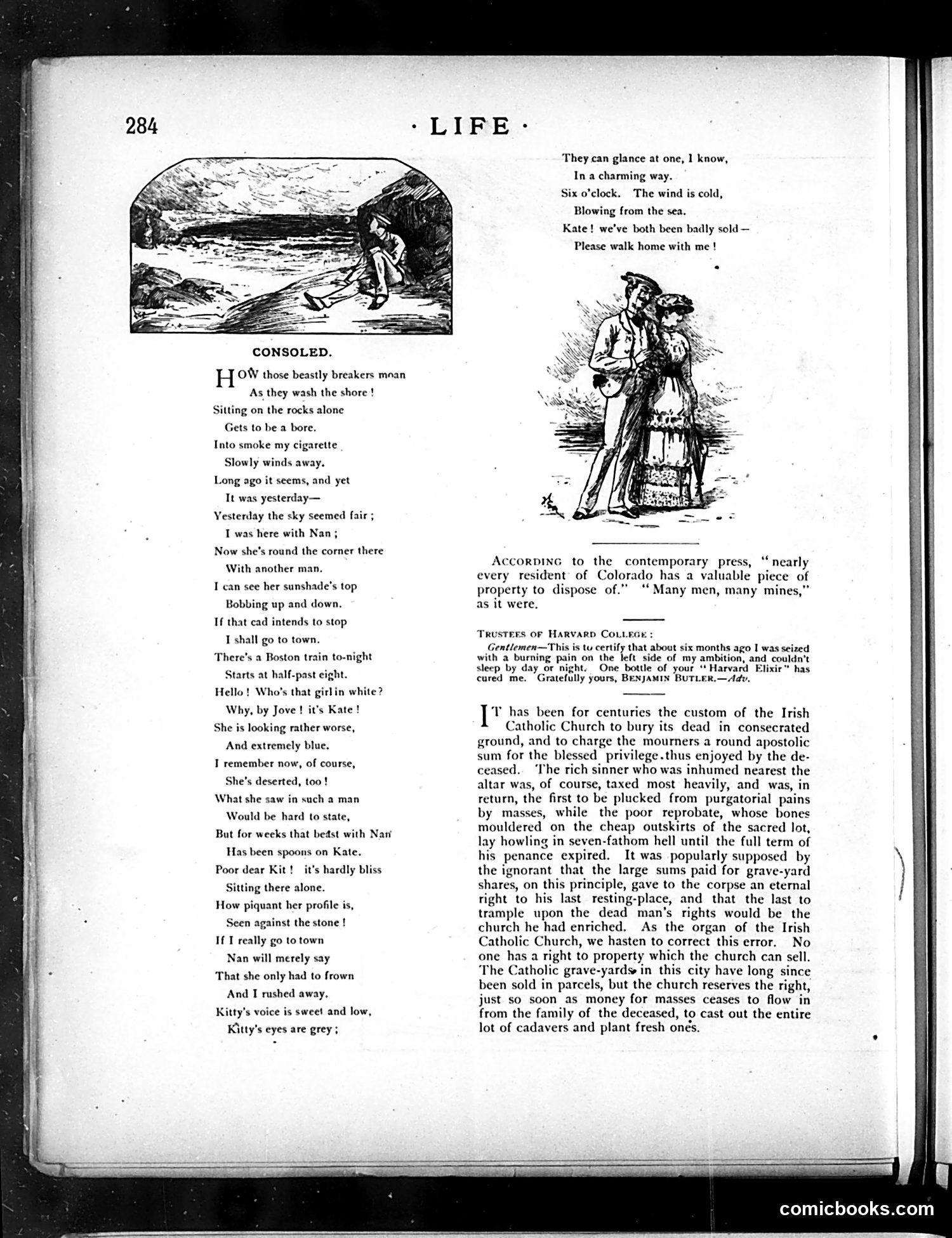
**The Main Cartoon ("Consoled"):** This is a romantic comedy about a jilted man sitting alone by the shore, brooding over his lost love "Nan" who has taken up with another man. As he contemplates taking a train out of town in despair, he spots "Kate"—another woman who has *also* been abandoned (by the same man who stole Nan). The humor lies in their mutual misery: both have been "badly sold" (betrayed), so he consoles himself by asking her to walk home with him. It's gentle satire on romantic fickleness and how the rejected bond over shared heartbreak. **The Text Below:** The remaining content includes a fake advertisement ("Harvard Elixir" testimonial from Benjamin Butler) and a serious article criticizing the Irish Catholic Church's practice of selling burial plots—then evicting bodies when families can no longer pay for masses. It's biting satire exposing the Church's commercialization of the dead. The tonal contrast between the light romantic verse and the grim ecclesiastical critique is typical of *Life*'s satirical range.
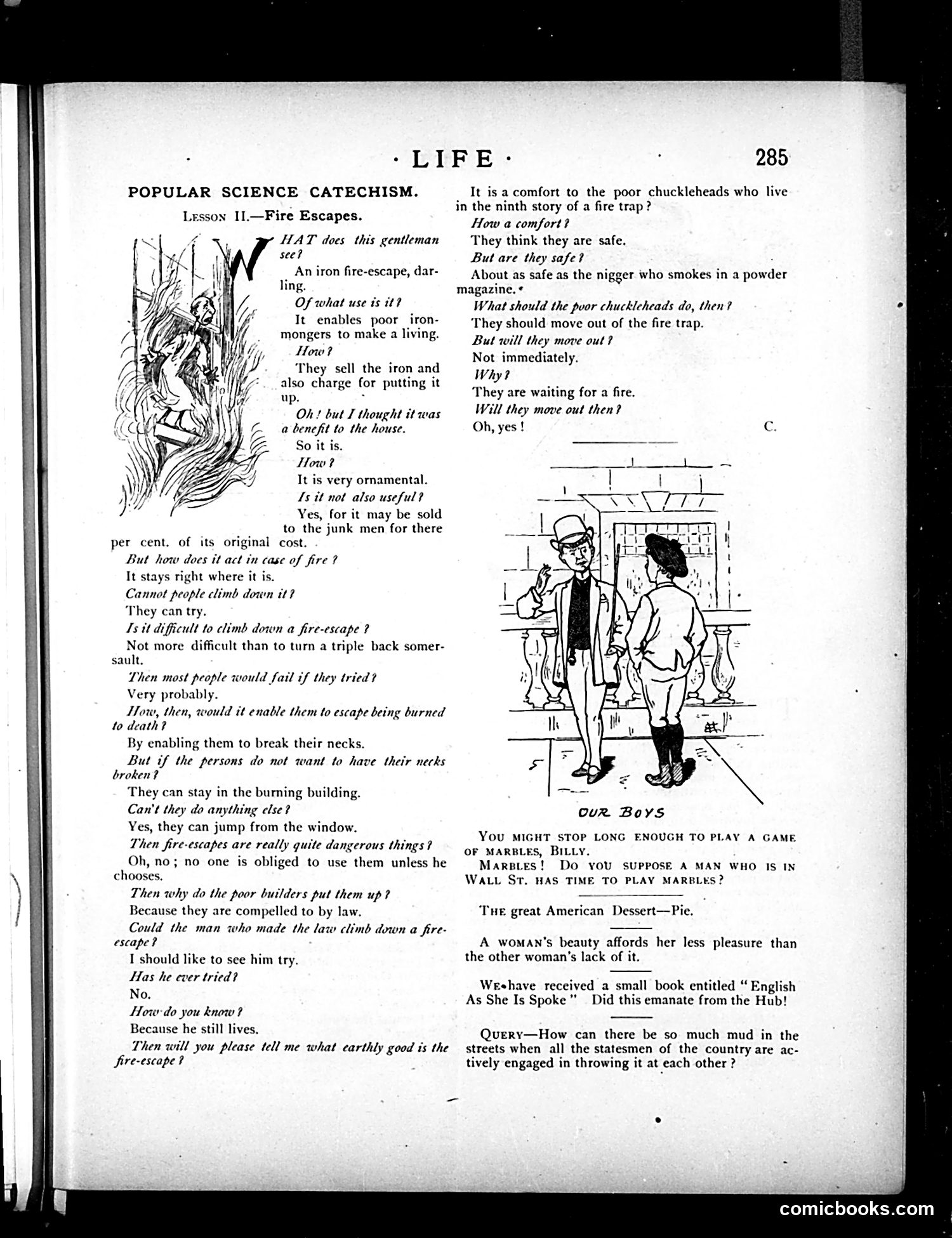
This "Popular Science Catechism" mocks fire escapes as legally mandated but practically useless safety theater. Through Socratic dialogue, the author ridicules the contradiction: fire escapes are ornamental, difficult to use (harder than a triple backflip), and actually dangerous—people are more likely to break their necks than escape fires. The satire's target is building code compliance divorced from reality. Poor tenants in unsafe buildings ("fire traps") are forced to accept illusory safety measures, then stay in dangerous conditions anyway because they can't afford to move. The final punchline—they'll only leave after an actual fire—exposes the law's fundamental failure: it placates rather than protects. The accompanying illustration shows two men discussing marbles, satirizing Wall Street traders too busy making money to engage in simple leisure—a separate jab at American business culture's obsession with profit over life.
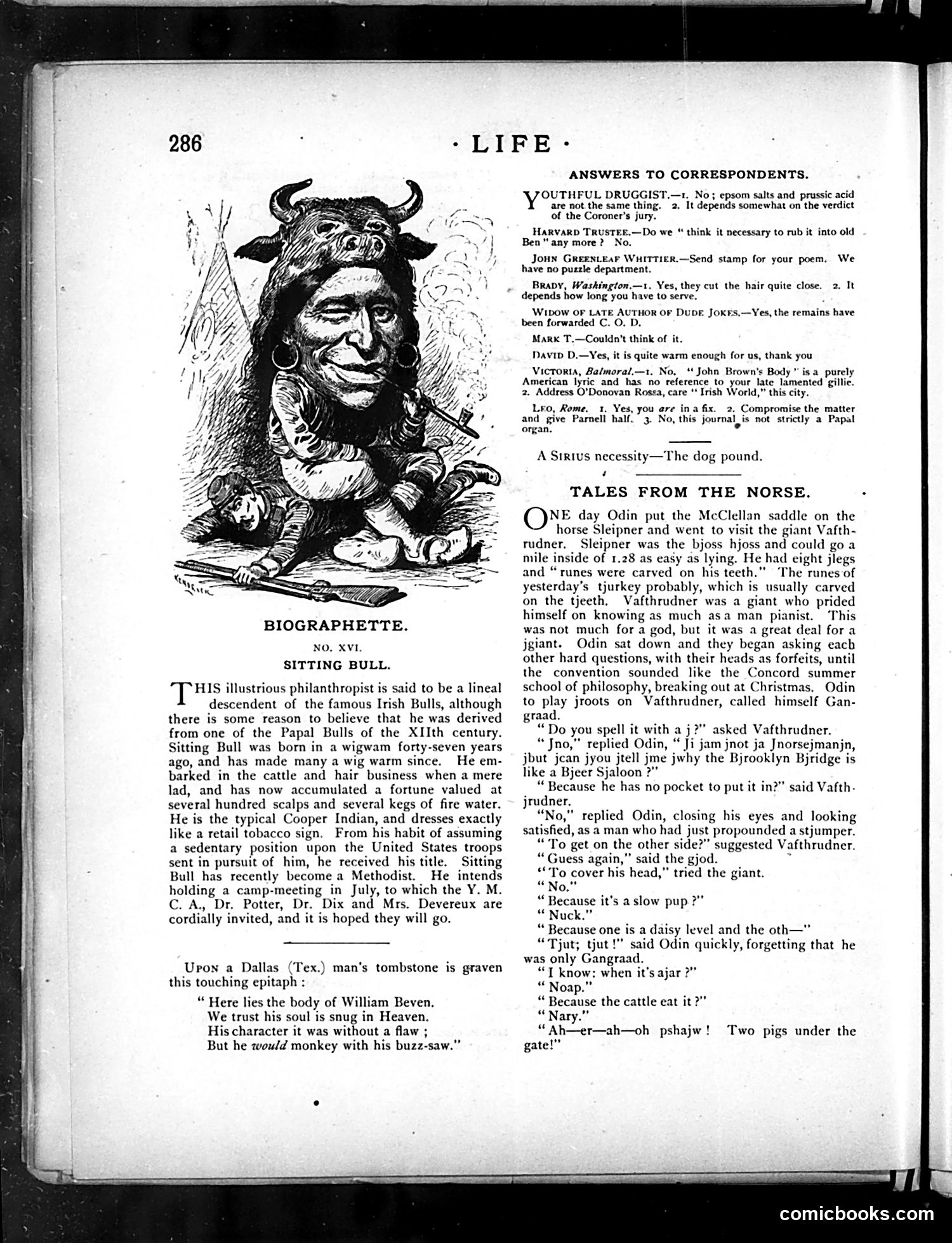
The main cartoon depicts **Sitting Bull**, the Lakota leader, rendered as a grotesque caricature with exaggerated features—horns, prominent nose, and coarse hair. The accompanying "Biographette" is *Life* magazine's satirical mock-biography. The satire works through absurdist humor and racial mockery typical of 1880s American publications. It makes nonsensical puns ("Irish Bulls," "Papal Bulls," "wig warm"), reduces Sitting Bull to stereotypes (accumulating "scalps" and "fire water"), and ridicules his recent conversion to Methodism by sarcastically inviting religious figures to his planned camp-meeting. The caricature represents the dehumanizing racism of the era—presenting a real political/military leader as a buffoonish figure of fun. This reflects American attitudes following the Indian Wars and Sitting Bull's surrender in 1881. The joke assumes readers shared contempt for Native Americans and their leaders.
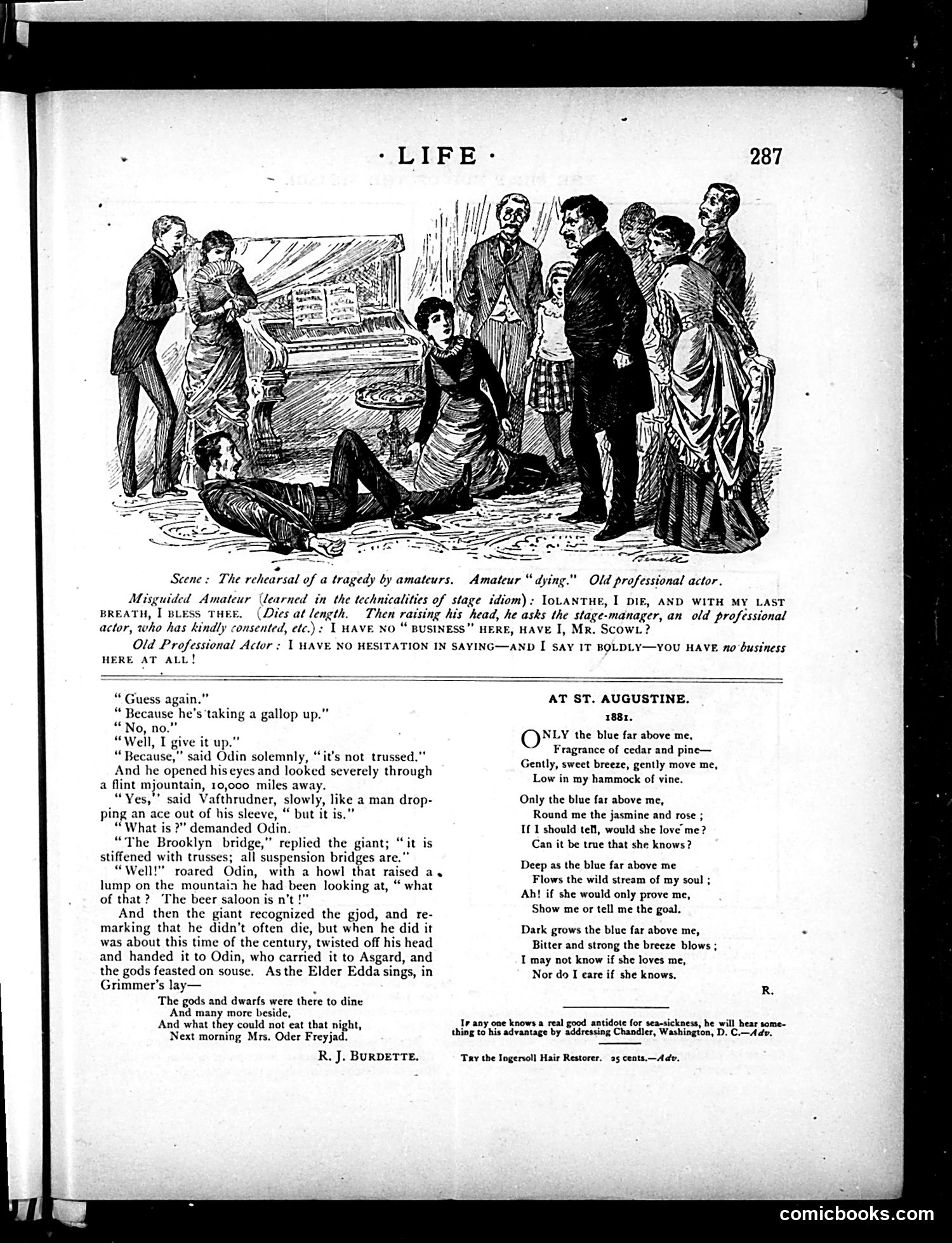
This page contains two distinct pieces of satire: **The Main Cartoon** depicts amateur theatricals gone wrong. An overeager amateur actor, having memorized theatrical terminology ("business" = stage action), performs an elaborate death scene. When he asks the seasoned professional stage manager if he has "business" at that moment, the old pro delivers a cutting insult: the amateur has *no* business performing *at all*. The joke mocks pretentious amateurs who adopt professional jargon without genuine talent—a common subject for satirizing social climbers in the Victorian era. **The Literary Content** includes a humorous Norse mythology passage about Odin and a giant debating bridge engineering, followed by a romantic poem ("At St. Augustine, 1881") about unrequited love. These appear filler content typical of satirical magazines. **The Advertisements** at bottom promote patent medicines (hair restorer, sea-sickness remedy)—standard period advertising. The satire targets amateur performers overreaching their abilities through pretense rather than skill.
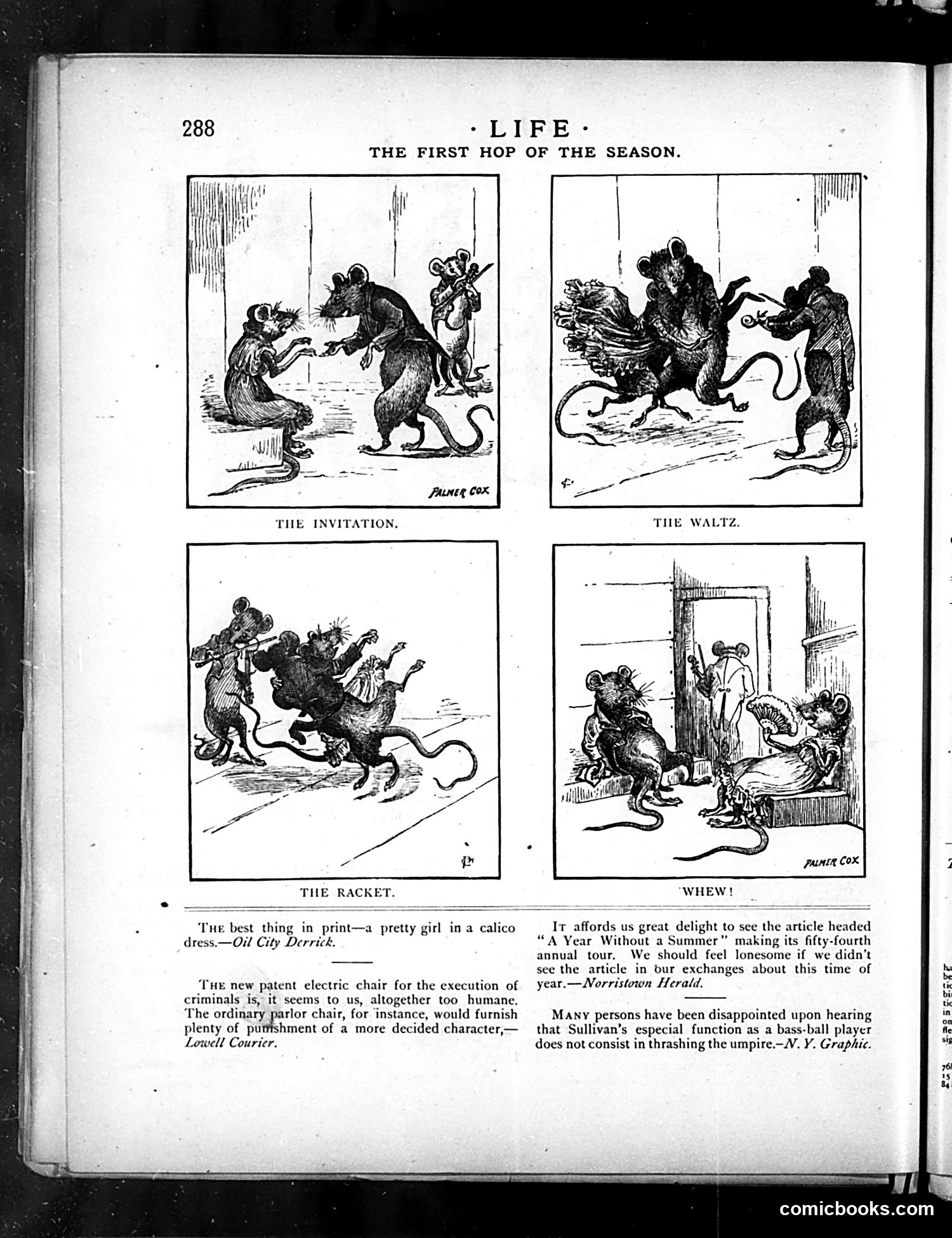
This page features four sequential comic panels depicting anthropomorphic mice attending a dance ("hop"). The narrative follows a mouse from invitation through various dance movements—the waltz, the racket (vigorous dancing), to an exhausted "Whew!" The humor is visual slapstick: mice in human clothing and situations, with exaggerated physicality during dancing. The artist is Palmer Cox, known for his "Brownie" characters. Below are unrelated satirical snippets from Life magazine: - A quip about pretty girls in calico dresses - Criticism of the electric chair as "too humane" - A joke about a baseball player named Sullivan allegedly not thrashing umpires (suggesting he had a reputation for doing so) - Complaints about a recurring newspaper article about poor summer weather The page exemplifies Life's mix of illustrated humor and editorial commentary on contemporary social issues and personalities.
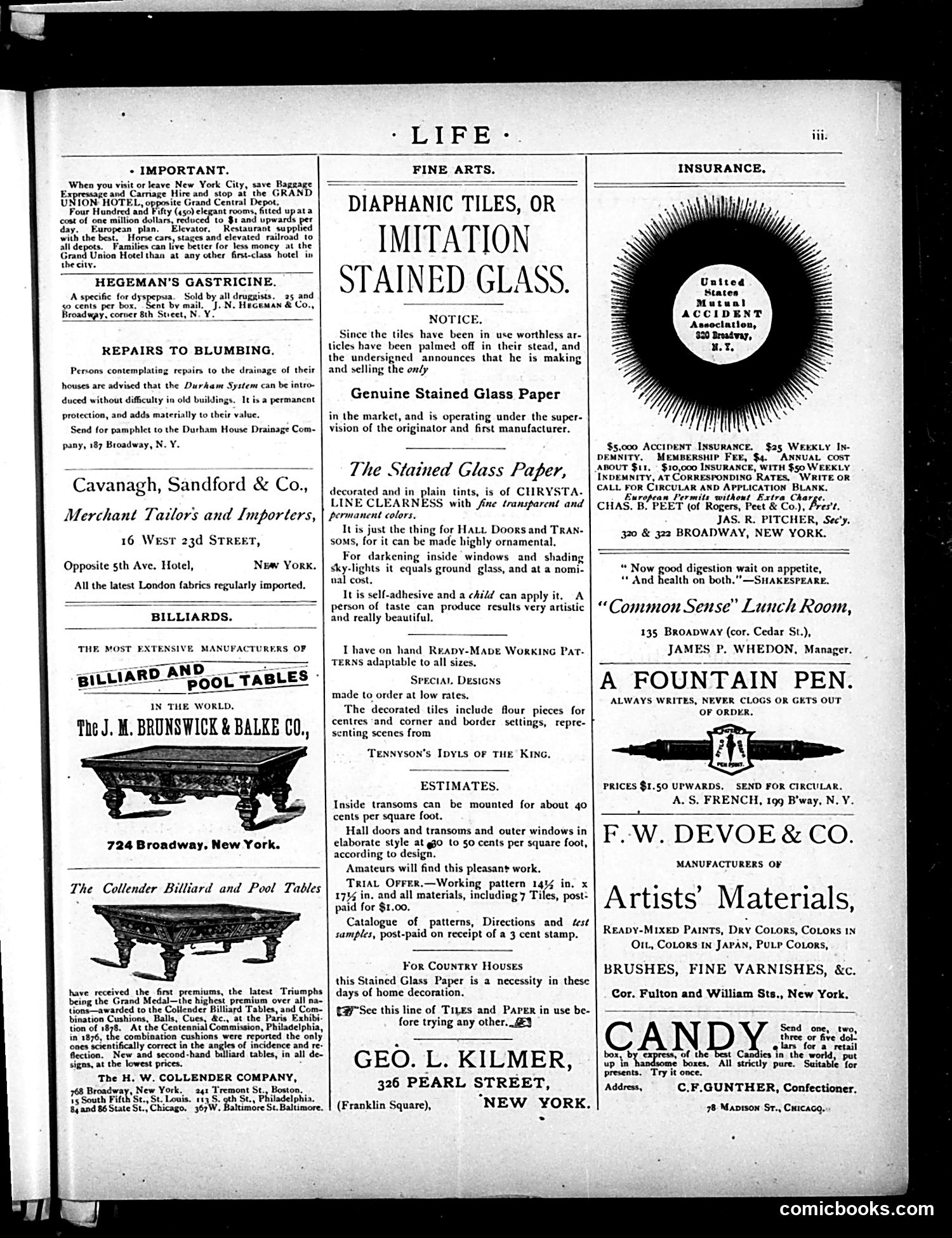
This page is primarily **advertising**, not political satire or editorial cartooning. It contains commercial advertisements for various products and services aimed at late-19th-century consumers and businesses. The notable content includes ads for: - Hotels and restaurants - Billiard and pool table manufacturers (with product illustrations) - Merchant tailors - Artists' materials and supplies - Insurance services - A fountain pen - Candy and other goods The large **insurance logo** (circular seal for United States Mutual Accident Association) is the only image with potential symbolic weight, but it functions simply as a company emblem rather than commentary. There is **no political cartoon or satirical content** visible on this page. The "LIFE" masthead indicates this is the famous satirical magazine, but this particular page served an advertising revenue function rather than editorial commentary. Modern readers would recognize this as a typical magazine advertising section from the Gilded Age.
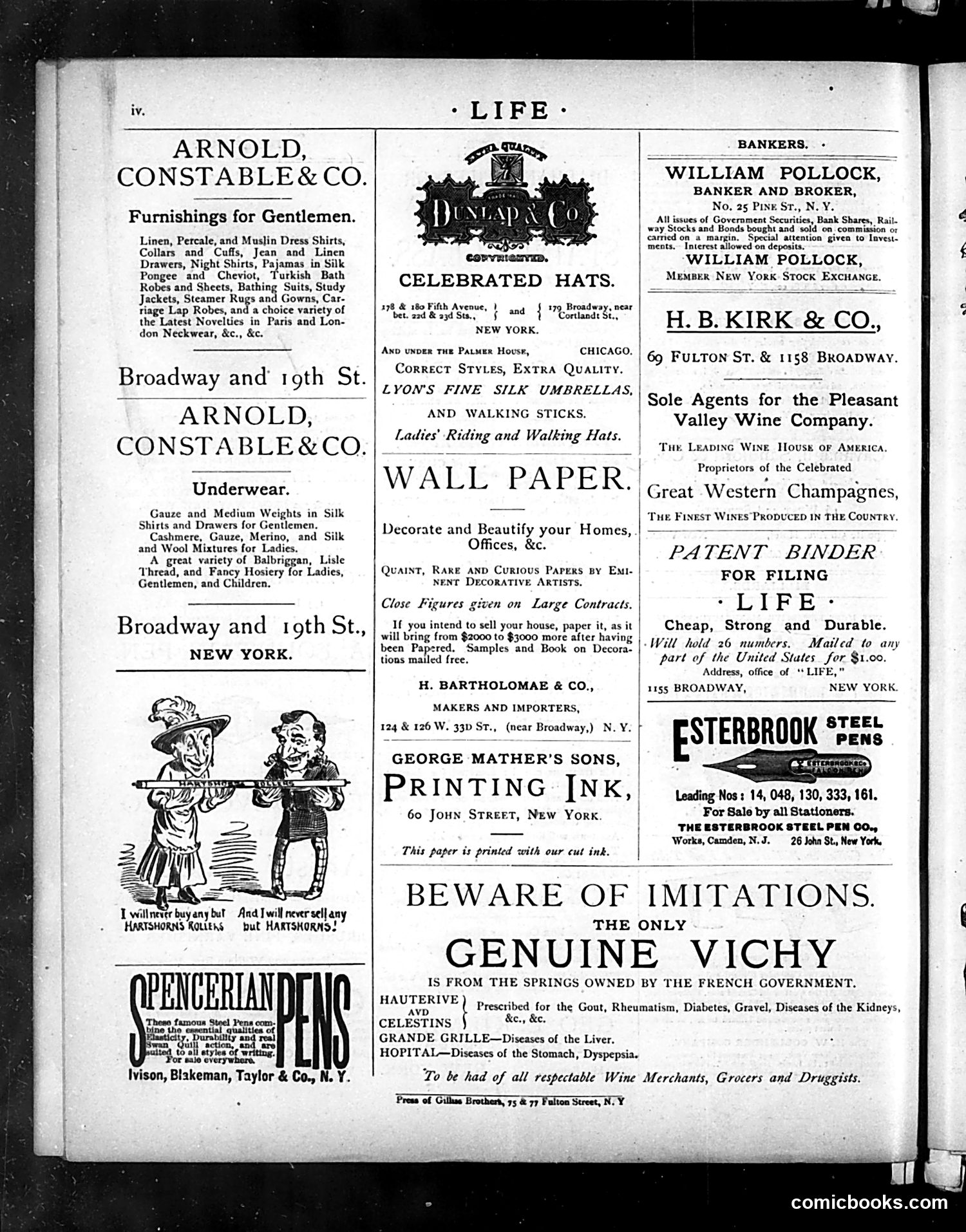
This page is primarily **advertising**, not editorial or satirical content. The single cartoon appears in the left column: two figures arguing about **Hartshorns Rollers** (window shades), with one insisting he'll "never buy any but Hartshorns" while the other declares he'll "never sell any but Hartshorns." The joke is straightforward product loyalty humor—a play on brand devotion. Both speaker and seller are equally committed to the product, suggesting its quality/reliability. The rest of the page contains typical late-19th-century ads: gentlemen's furnishings (Arnold, Constable & Co.), banking services, wallpaper, wine merchants, printing supplies, and steel pens. One ad warns against counterfeits of "Genuine Vichy" water, claiming only French government-owned springs are authentic—a common tactic to combat knock-offs. No significant political or social satire is present. This is a standard commercial magazine page from the era.