
Life, 1883-06-14 · page 3 of 16
Life — June 14, 1883 — page 3: what you’re looking at
What you’re looking at
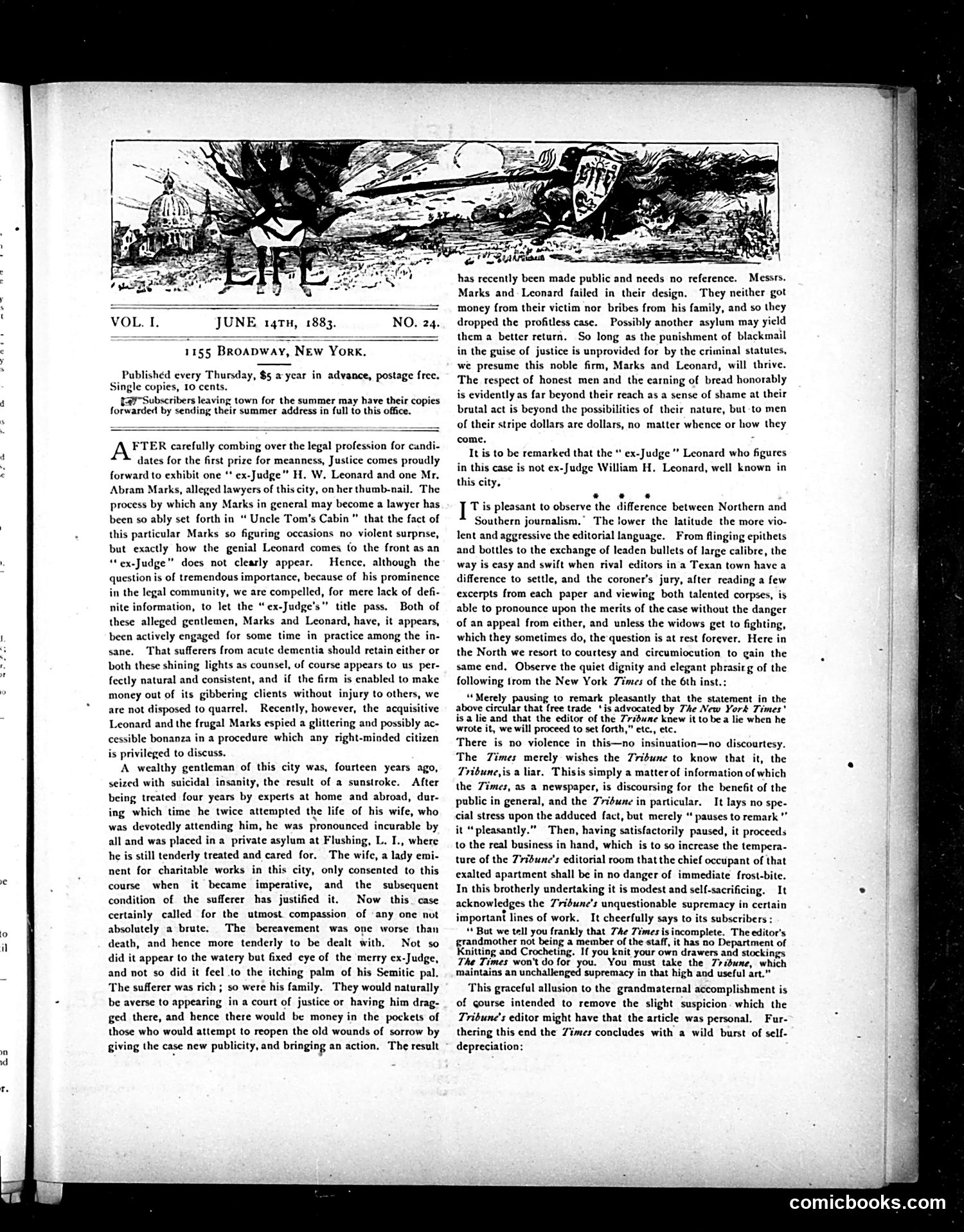
The masthead illustration depicts a nighttime landscape with classical architectural elements, establishing the magazine's artistic pretensions. The article discusses a legal dispute involving "ex-Judge" H. W. Leonard and others named Marks and Alvan Marks—alleged to be swindlers or confidence men. The text sarcastically praises their criminal enterprise ("noble firm"), noting they extorted money through blackmail then abandoned their victim. The piece critiques the New York *Times* for claiming moral superiority while engaging in similar editorial battles with rival papers. Life accuses the *Times* of hypocrisy—condemning violence in journalism while itself being aggressive and confrontational. This represents 1880s press warfare: competing newspapers attacking each other's credibility and methods while covering local scandals.
📄 Transcribed text from this page (OCR, searchable)
Machine-transcribed from the original scan — historical spelling and the odd misread are preserved.
JUNE 14TH, 1883. VOL. I. 1155 Broapway, New York. Published every Thursday, $5 a year in advance, postage free. Single copies, 10 cents. II~Subscribers leaving town for the summer may have their copies forwarded by sending their summer address in full to this office. FTER carefully combing over the legal profession for candi- dates for the first prize for meanness, Justice comes proudly forward to exhibit one ‘* ex-Judge” H. W. Leonard and one Mr. Abram Marks, alleged lawyers of this city, on her thumb-nail. The process by which any Marks in general may become a lawyer has been so ably set forth in “ Uncle Tom’s Cabin" that the fact of this particular Marks so figuring occasions no violent surpnse, but exactly how the genial Leonard comes fo the front as an “ex-Judge” does not clearly appear. Hence, although the question is of tremendous importance, because of his prominence in the legal community, we are compelled, for mere lack of defi- nite information, to let the “ex-Judge’s” title pass. Both of these alleged gentlemen, Marks and Leonard, have, it appears, been actively engaged for some time in practice among the in- sane, That sufferers from acute dementia should retain either or both these shining lights as counsel, of course appears to us per- fectly natural and consistent, and if the firm is enabled to make money out of its gibbering clients without injury to others, we are not disposed to quarrel, Recently, however, the acquisitive Leonard and the frugal Marks espied a glittering and possibly ac- cessible bonanza ina procedure which any right-minded citizen is privileged to discuss. A wealthy gentleman of this city was, fourteen years ago, seized with suicidal insanity, the result of a sunstroke. After being treated four years by experts at home and abroad, dur- ing which time he twice attempted the life of his wife, who was devotedly attending him, he was pronounced incurable by all and was placed in a private asylum at Flushing, L. I., where he is still tenderly treated and cared for. The wife, a lady e nent for charitable works in this city, only consented to this course when it became imperative, and the subsequent condition of the sufferer has justified it. Now this case certainly called for the utmost compassion of ‘any one not absolutely a brute, The bereavement was one worse than death, and hence more tenderly to be dealt with. Not so did it appear to the watery but fixed eye of the merry ex-Judge, and not so did it feel to the itching palm of his Semitic pal. ‘The sufferer was rich ; so were his family. They would naturally be averse to appearing in a court of justice or having him drag- ged there, and hence there would be money in the pockets of those who would attempt to reopen the old wounds of sorrow by giving the case new publicity, and bringing an action. The result has recently been made public and needs no reference. Messrs. Marks and Leonard failed in their design. They neither got money from their victim nor bribes from his family, and so they dropped the profitless case. Possibly another asylum may yield them a better return. So long as the punishment of blackmail in the guise of justice is unprovided for by the criminal statutes, we presume this noble firm, Marks and Leonard, will thrive. The respect of honest men and the earning of bread honorably is evidently as far beyond their reach as a sense of shame at their brutal act is beyond the possibilities of their nature, but to men of their stripe dollars are dollars, no matter whence or how they come. It is to be remarked that the * ex-Judge ” Leonard who figures in this case is not ex-Judge William H. Leonard, well known in this city, * 8 @ T is pleasant to observe the difference between Northern and Southern journalism.” The tower the latitude the more vio- lent and aggressive the editorial language. From flinging epithets and bottles to the exchange of leaden bullets of large calibre, the way is easy and swift when rival editors ina Texan town have a difference to settle, and the coroner's jury, after reading a few excerpts from each paper and viewing both talented corpses, is able to pronounce upon the merits of the case without the danger of an appeal from cither, and unless the widows get to fighting, which they sometimes do, the question is at rest forever. Here in the North we resort to courtesy and circumiocution to gain the same end, Observe the quiet dignity and elegant phrasirg of the following trom the New York Zimes of the 6th inst.: “Merely pausing to remark pleasantly that the statement in the above circular that free trade ‘is advocated by The New York Times’ is a lie and that the editor of the 7ridune knew it to bea lie when he wrote it, we will proceed to set forth,” etc., etc. There is no violence in this—no insinuation—no discourtesy. The Times merely wishes the 7risune to know that it, the Tribune, is a liar, Thisis simply a matter of information of which the 7imes, as a newspaper, is discoursing for the benefit of the public in general, and the 7ribune in particular. It lays no spe- cial stress upon the adduced fact, but merely “ pauses to remark "” it “pleasantly.” Then, having satisfactorily paused, it proceeds to the real business in hand, which is to so increase the tempera- ture of the 7ridunc’s editorial room that the chief occupant of that exalted apartment shall be in no danger of immediate frost-bite. In this brotherly undertaking it is modest and self-sacrificing. It acknowledges the 7ridune’s unquestionable supremacy in certain important lines of work. It cheerfully says to its subscribers : “+ But we tell you frankly that The Times isincomplete. The editor's grandmother not being a member of the staff, it has no Department of Knitting and Crocheting. If you knit your own drawers and stockings The Times won't do for you. You must take the 7+idune, which maintains an unchallenged supremacy in that high and useful art.” This graceful allusion to the grandmaternal accomplishment is of gourse intended to remove the slight suspicion. which the Tribune's editor might have that the article was personal. Fur. thering this end the Zimes concludes with a wild burst of self- depreciation: comicbooks.com