A complete issue · 36 pages · 1936
Judge — July 1936
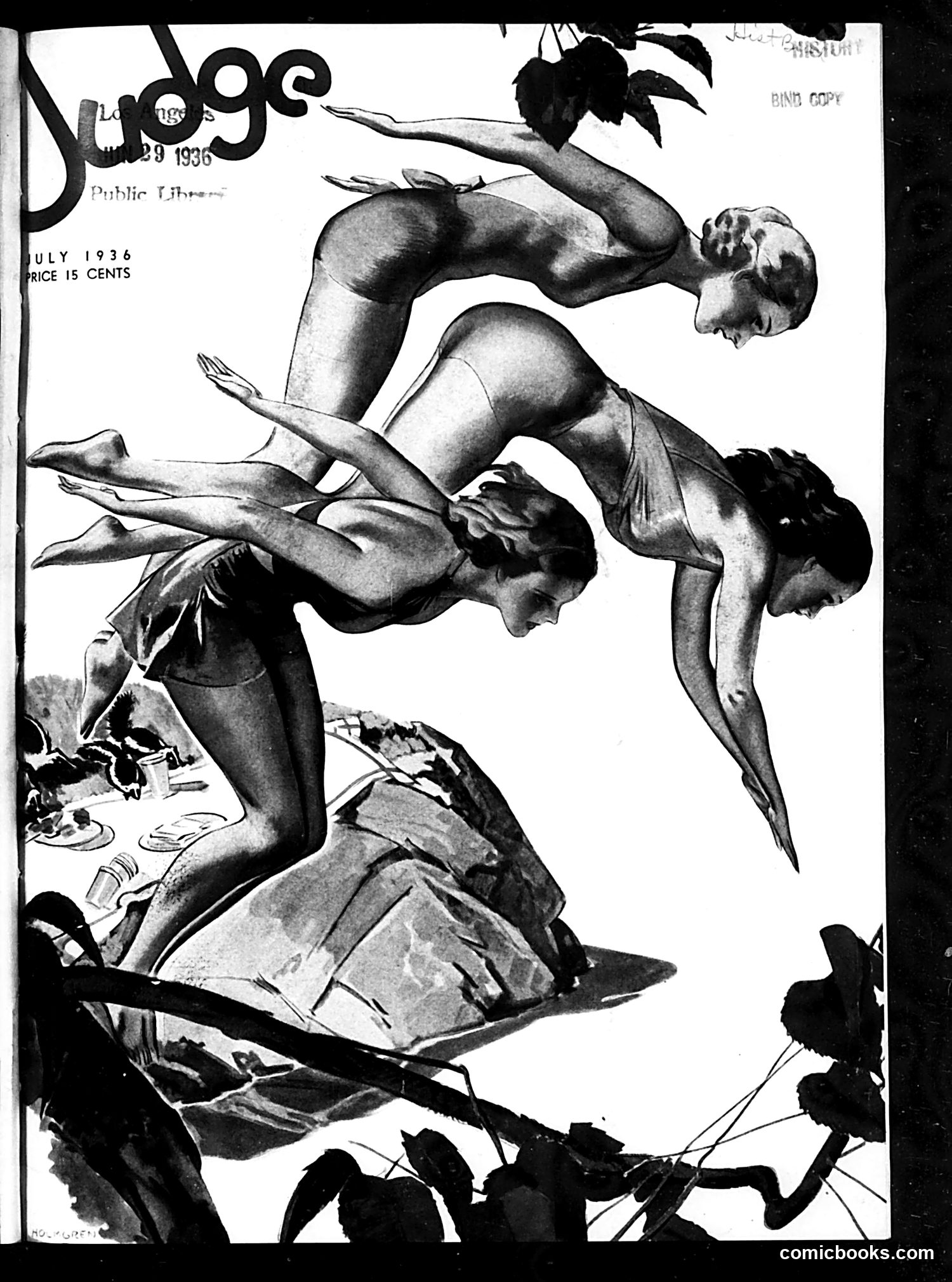
# Judge Magazine, July 1936 This page appears to be primarily **advertising or cover art** rather than political satire. The image shows three figures in a tropical or beach setting with stylized poses among foliage and what appears to be beach gear. Without clear identifying text or captions visible in the image, I cannot definitively identify the specific figures or determine what social/political commentary, if any, this represents. The art style is consistent with 1930s illustration, and the tropical setting suggests either vacation/leisure themes or possibly a commentary on escapism during the Depression era. The "PRICE IS CENTS" notation and July 1936 dating are visible, but additional context from surrounding page content would be needed for accurate interpretation of any satirical intent.
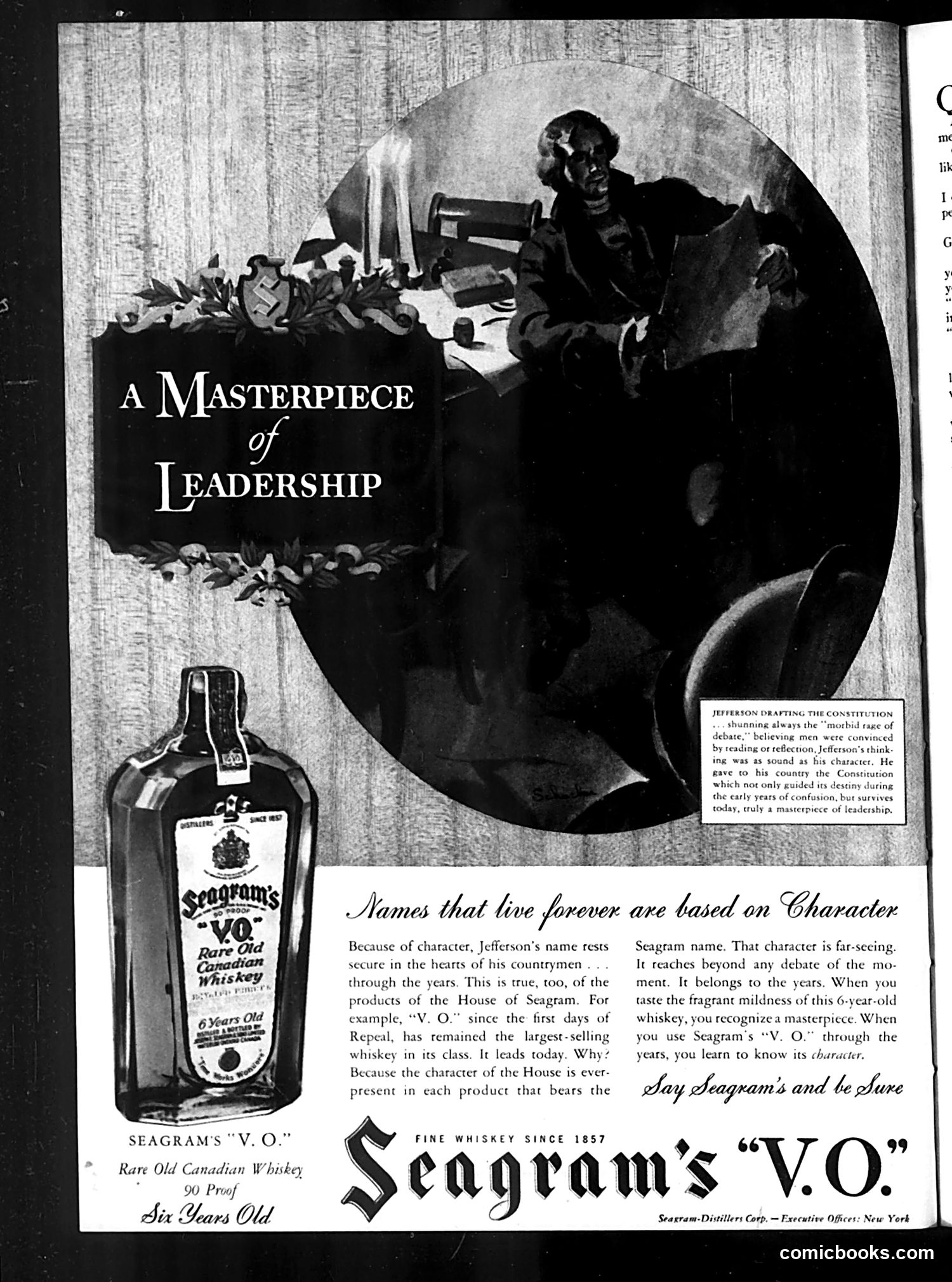
# Analysis This page is primarily a **Seagram's whiskey advertisement**, not satire or political commentary. The top illustration labeled "A Masterpiece of Leadership" appears to reference Thomas Jefferson drafting the Constitution, used metaphorically to associate Seagram's whiskey with American founding ideals and careful craftsmanship. The accompanying text claims that Jefferson's character—like Seagram's "V.O." whiskey—endures through time because of inherent quality. The ad argues that both Jefferson's reputation and Seagram's whiskey brand survive because of their fundamental "character." This is advertising rhetoric using historical gravitas to sell liquor. There is no actual political cartoon or satire present—it's purely commercial messaging leveraging American historical imagery to suggest the product embodies principled excellence.
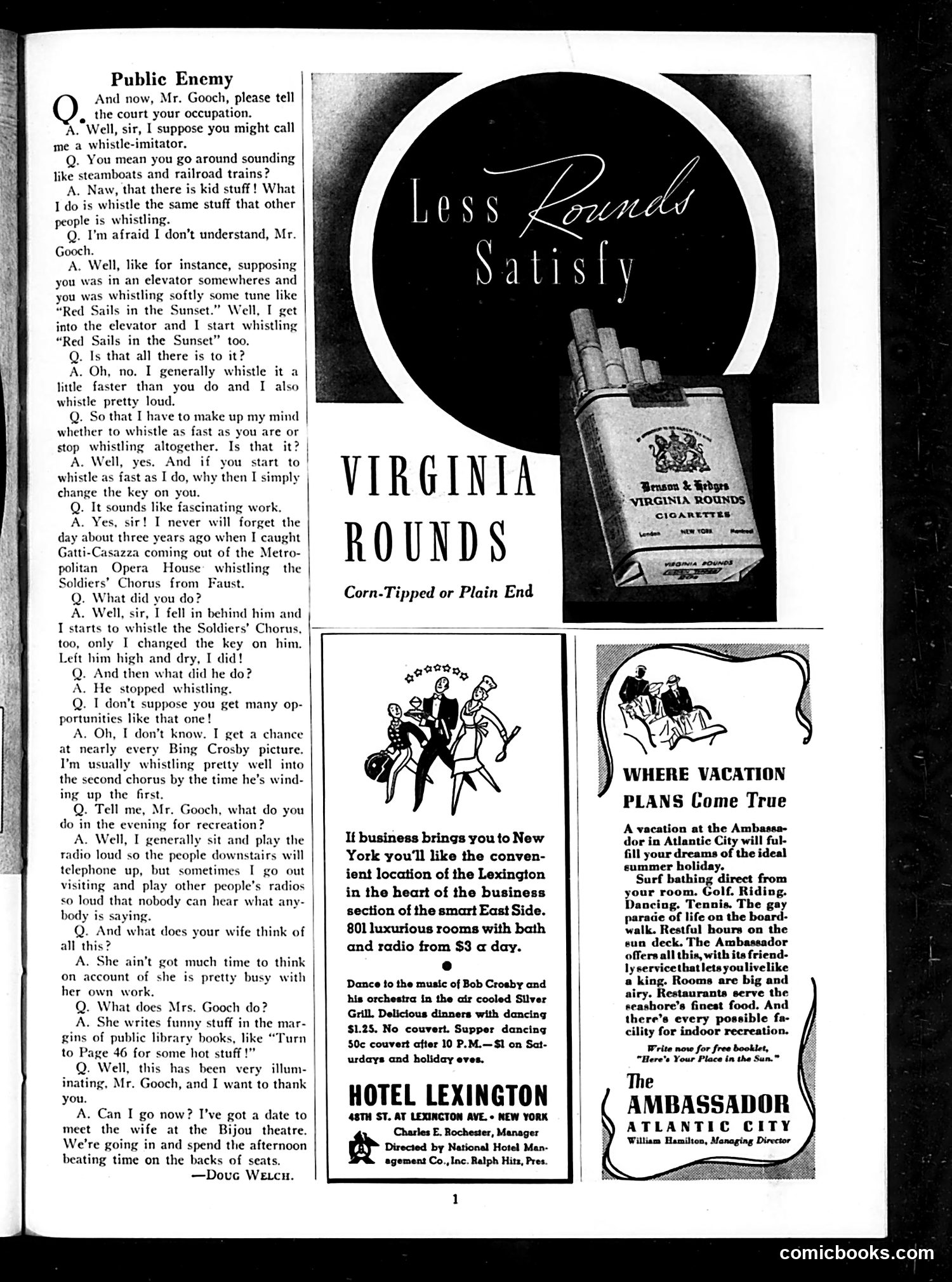
# Page Analysis This page is primarily **advertising with minimal editorial content**. The left column contains a humorous Q&A interview with "Mr. Gooch," a "whistle-imitator" who recreates sounds of steamboats and trains by whistling. The interviewer asks about his techniques and modest career opportunities. The satire is gentle: Gooch represents a vaudeville-era novelty performer with a peculiar, niche talent. The humor derives from treating his whistling act with mock-seriousness through formal courtroom-style questioning. The page features three advertisements: Virginia Rounds cigarettes (with "Less Rounds Satisfy" slogan), Hotel Lexington in New York, and The Ambassador hotel in Atlantic City. These dominate the page's content, indicating this is primarily a commercial rather than editorial issue.
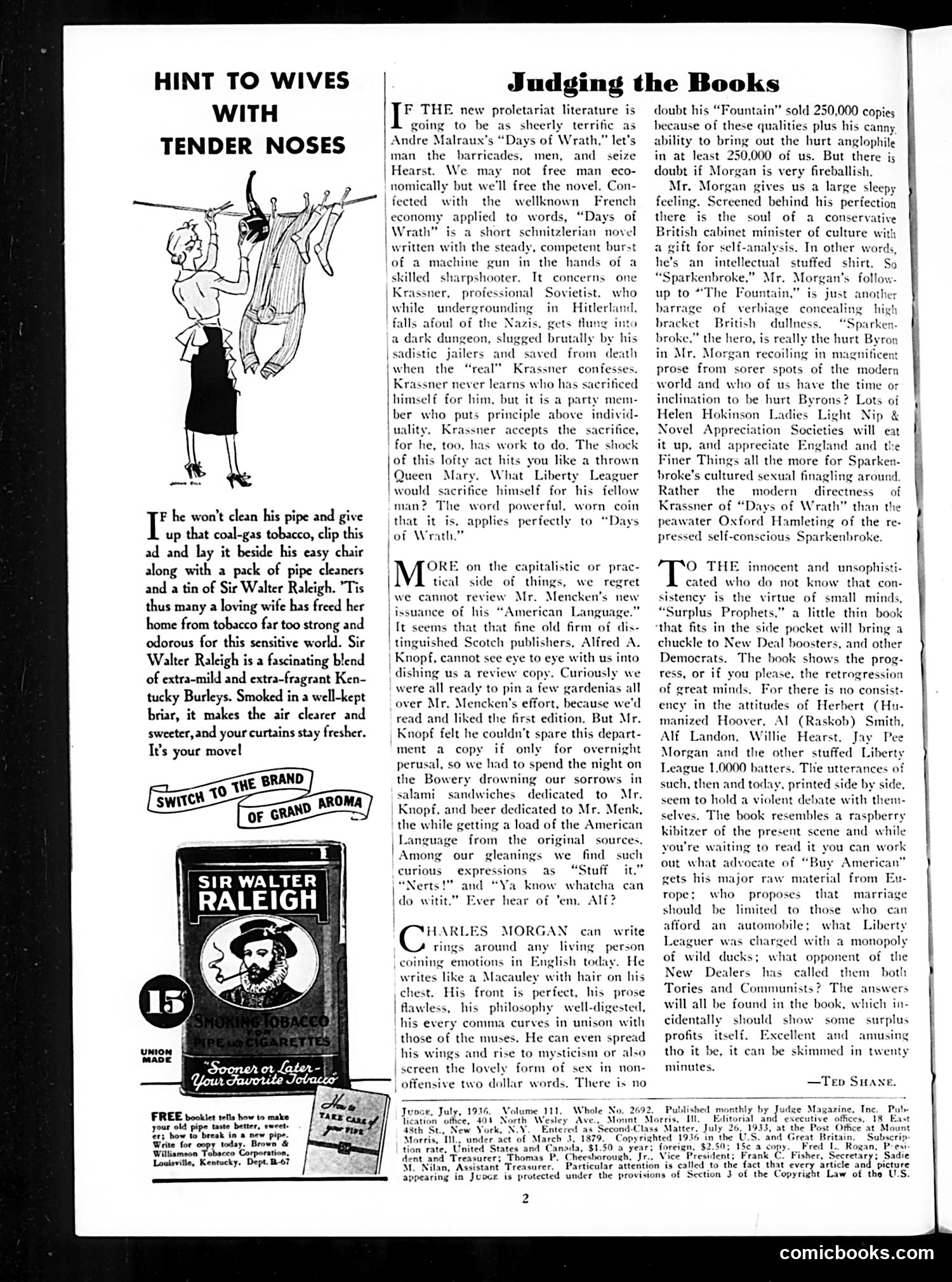
# Analysis of Judge Magazine Page (July 1936) This page contains book reviews and a cigarette advertisement, not political cartoons. The left side features a humorous illustration titled "Hint to Wives with Tender Noses"—a comic drawing of a woman clothespinning her nose while hanging laundry, satirizing wives' complaints about pipe tobacco smell. The accompanying text humorously suggests Sir Walter Raleigh cigarettes as a solution, claiming they're less odorous than pipes. The right side reviews three books: André Malraux's "Days of Wrath," Mr. Meneken's "The American Language," and Charles Morgan's work. The reviews discuss literary merit and social commentary typical of 1930s intellectual discourse. The primary content is advertising and literary criticism rather than political satire, reflecting Judge's mixed editorial-commercial format during this period.
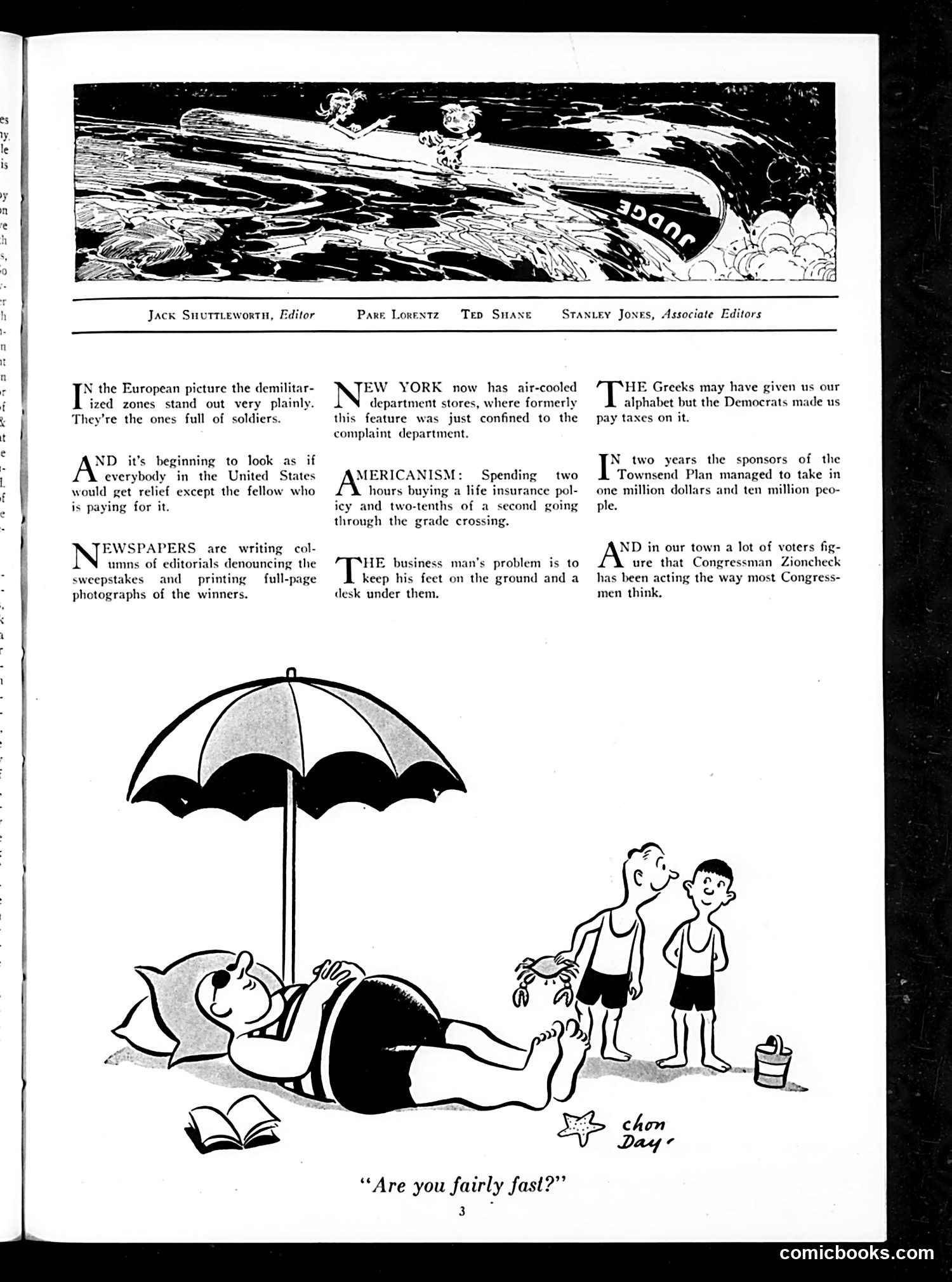
# Analysis This page from *Judge* contains political commentary and a cartoon. The text snippets mock various targets: European militarism, American consumerism (the "Americanism" joke about expensive purchases), Democratic taxation policy, newspaper sensationalism around sweepstakes, and Congressional representative Zioncheck's political behavior. The main cartoon, titled "Are you fairly fast?" by Chon Day, depicts a man lying under an umbrella on a beach, apparently napping or sunbathing, while two children stand nearby. The joke appears to satirize either parental laziness during summer recreation or, less clearly, may reference a period when beach activities were becoming more accessible to working-class Americans. The humor relies on visual irony rather than explicit political commentary.
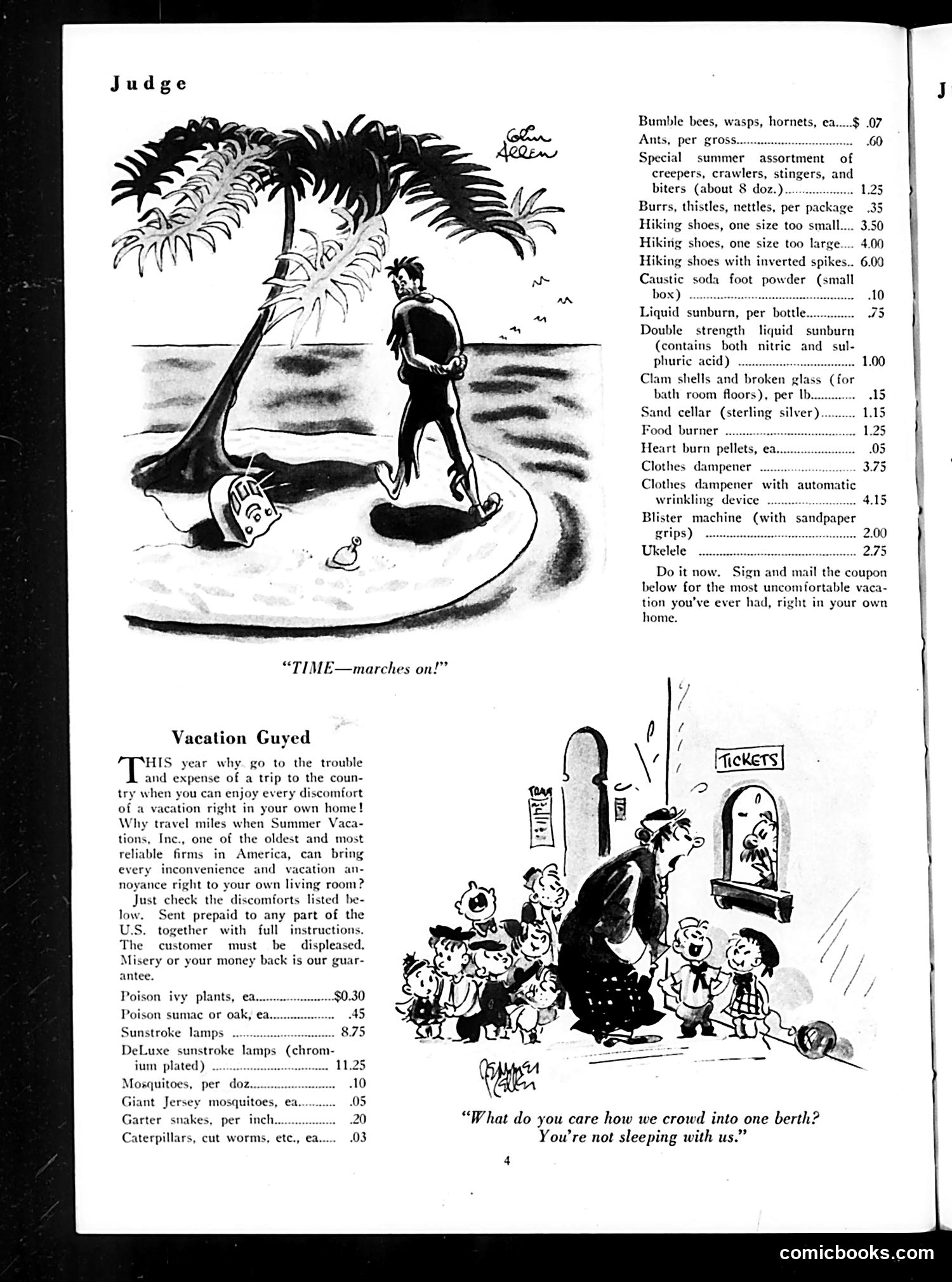
# Analysis of Judge Magazine Page This page contains two distinct elements: a satirical cartoon titled "TIME—marches on!" and an advertisement for "Vacation Guyed" by Summer Vacations, Inc. The top cartoon depicts a man stranded on a desert island with a palm tree, apparently marooned with only a bottle labeled "TIME" as company. The satire comments on how time passes slowly during isolation or tedium—a commentary on the subjective experience of boredom. The lower section advertises a vacation service offering to deliver various "discomforts" to customers' homes, including poison ivy plants, mosquitoes, sunstroke lamps, and other annoyances. This is satirical commentary on poorly planned vacations, suggesting that traveling creates more problems than staying home. The accompanying cartoon shows an overcrowded travel scenario, mocking vacation chaos and overcrowding at popular destinations.
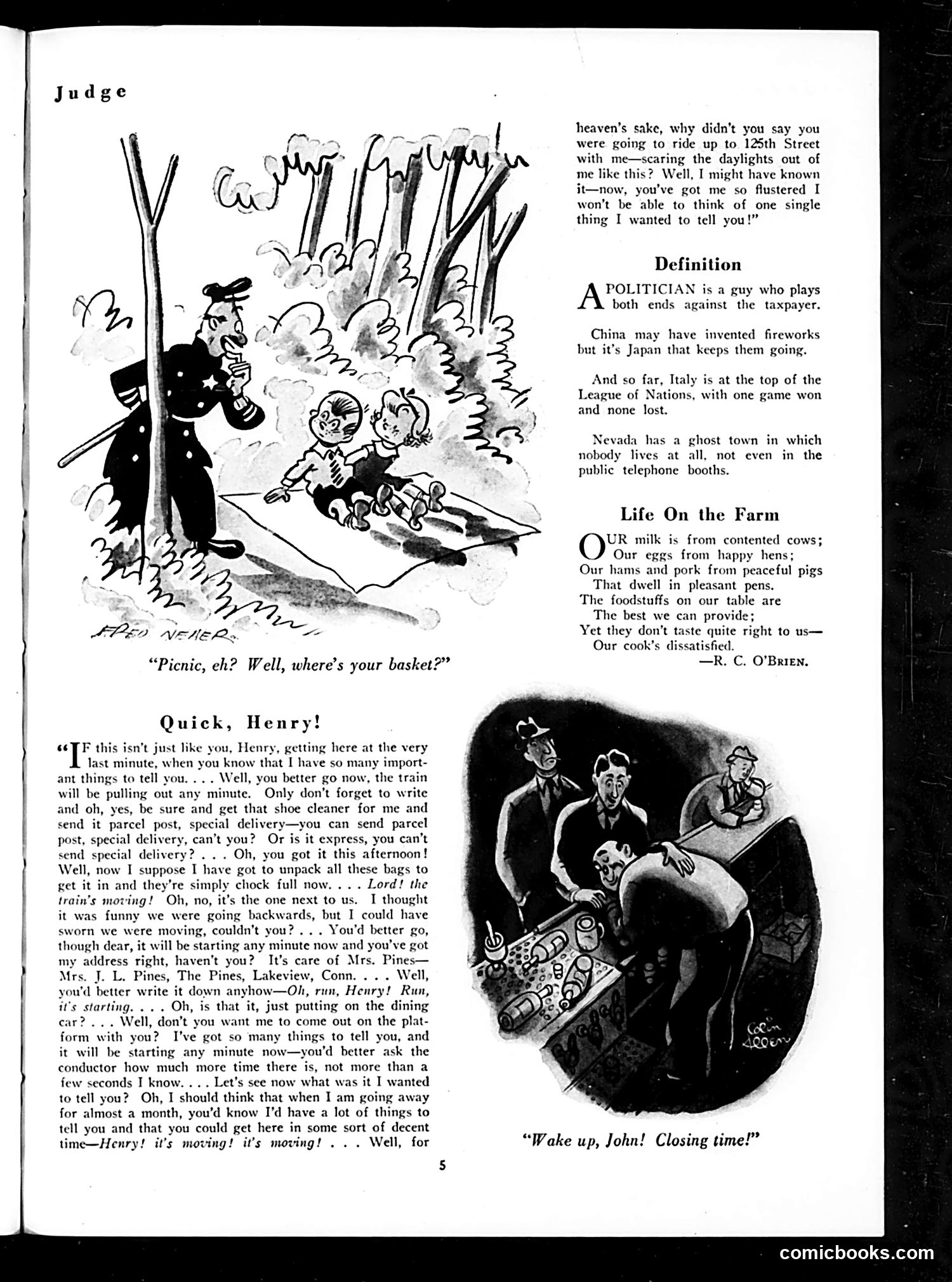
# Explanation of Judge Magazine Page The top cartoon depicts a judge figure wearing military regalia supervising children's activities, captioned "Picnic, eh? Well, where's your basket?" This appears to satirize judicial or governmental overreach into ordinary civilian life—suggesting authorities intrusively monitoring routine activities. The "Quick, Henry!" section is a lengthy domestic humor piece about a harried husband dealing with last-minute moving preparations, showcasing everyday marital comedy typical of early 20th-century Judge magazine. The bottom cartoon, "Wake up, John! Closing time!", shows men in what appears to be a bar or tavern being asked to leave, likely satirizing Prohibition-era enforcement or drinking culture. The "Definition" and "Life On the Farm" sections contain brief satirical quips and verse—standard Judge filler content mocking politicians and rural life.
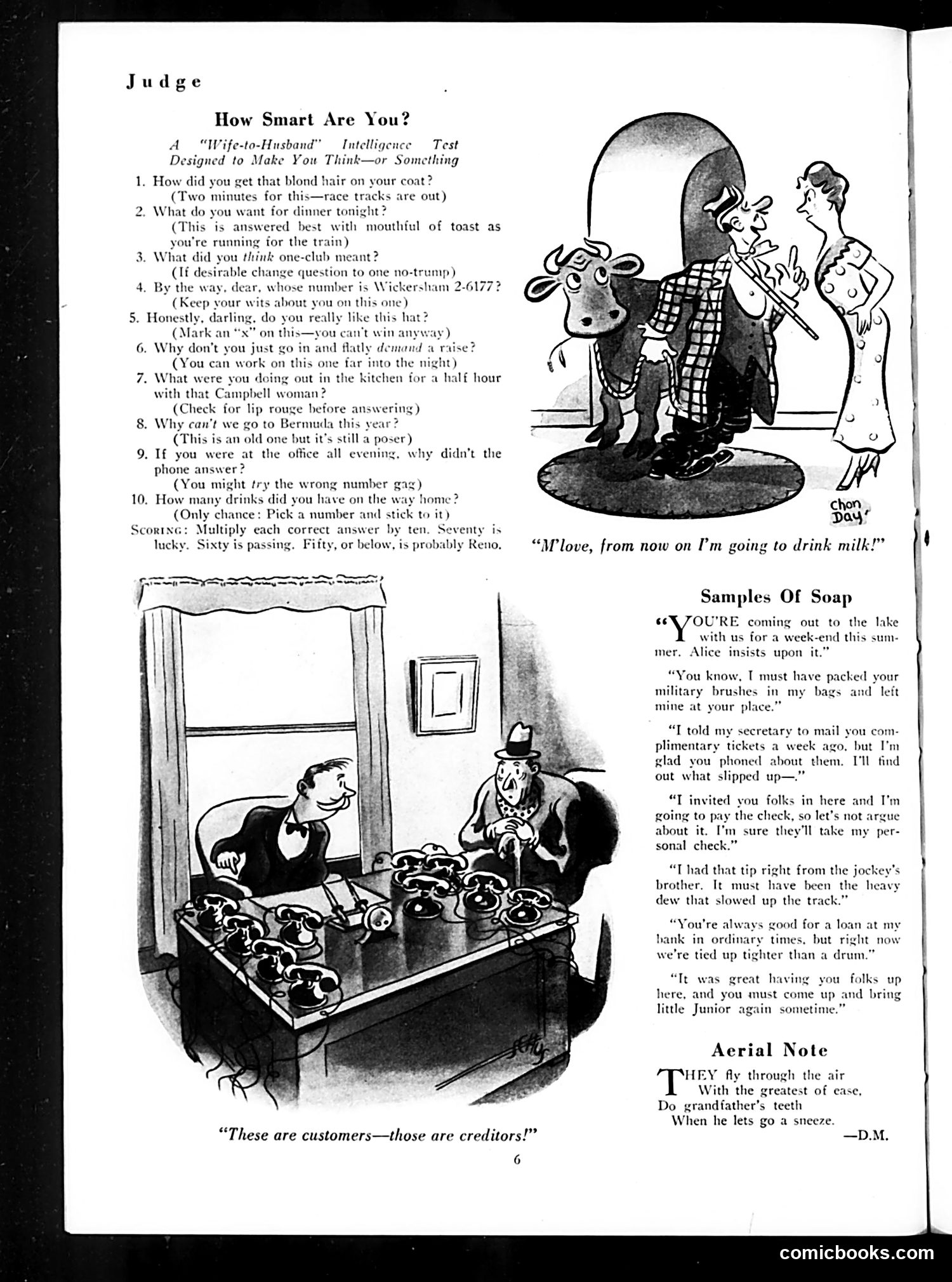
# Analysis of Judge Magazine Page This page contains three distinct items of humor: **"How Smart Are You?"** is a "Wife-to-Husband Intelligence Test"—a quiz with deliberately absurd or unanswerable questions (like "whose number is Wickersham 2-6177?"). The scoring system acknowledges most answers are guesses, satirizing the popular intelligence tests gaining prominence in the early 20th century. **"These are customers—those are creditors!"** shows a shopkeeper distinguishing between paying customers and people owed money, likely commenting on Depression-era economic hardship when distinguishing between actual sales and outstanding debts became crucial. **"Samples of Soap"** and **"Aerial Note"** are brief humorous dialogues/verses with no clear political reference—simply period entertainment. The page primarily satirizes intelligence testing trends and economic struggles through humor rather than direct political commentary.
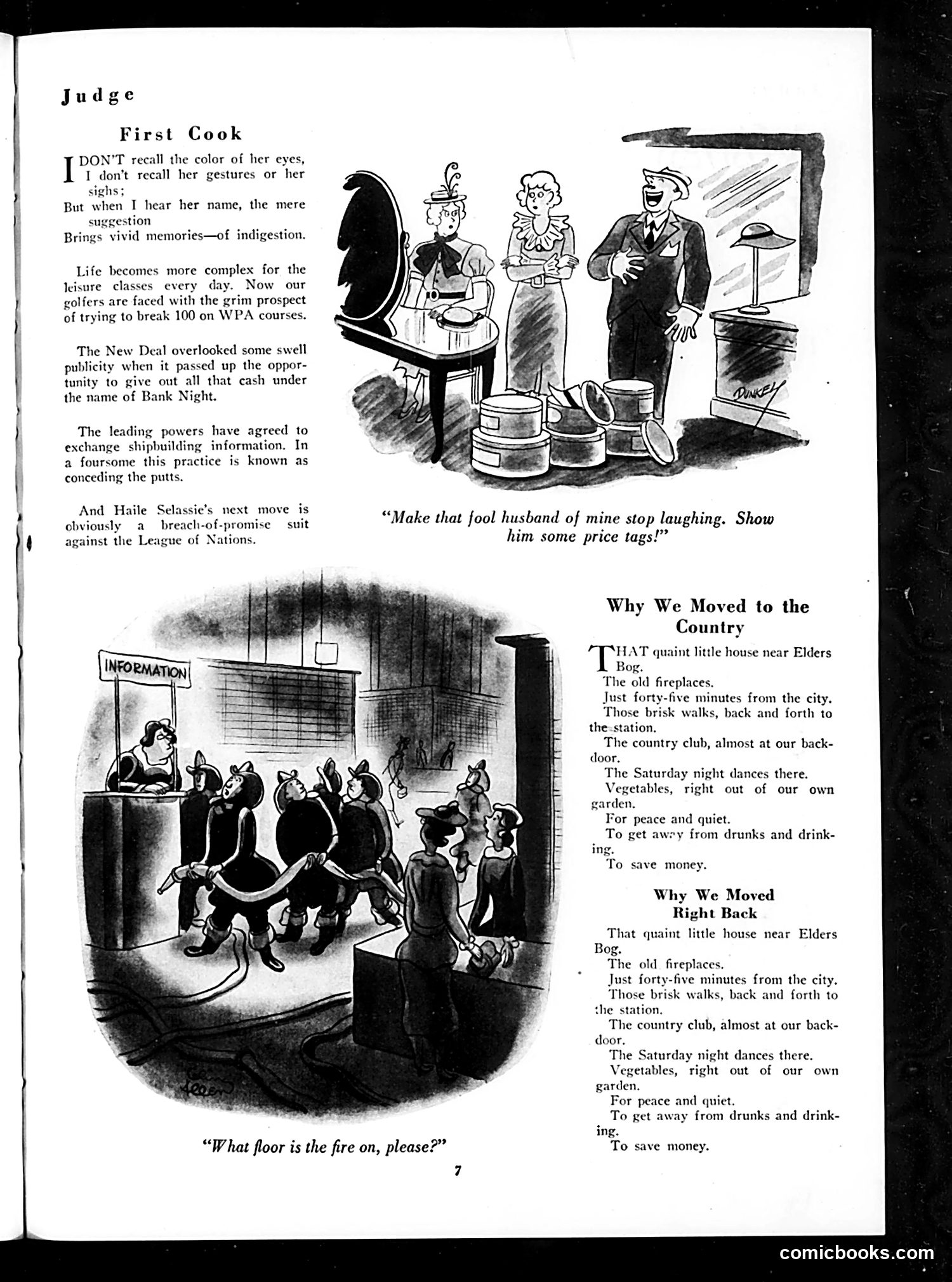
# Explanation for Modern Readers This Judge magazine page contains three satirical pieces: **"Judge First Cook"** mocks the leisure class during the New Deal era. The cartoon shows a woman at a piano while others laugh—the joke being that hearing her name triggers memories of indigestion, suggesting she's a terrible cook despite her upper-class status. **The lower cartoon** satirizes government bureaucracy: crowds ask an "Information" clerk "What floor is the fire on, please?"—implying New Deal agencies created such labyrinthine confusion that people couldn't find basic information during emergencies. **"Why We Moved to the Country/Right Back"** humorously lists identical reasons for both moving away from and returning to a country house, mocking the indecisiveness of wealthy urbanites chasing pastoral fantasies.
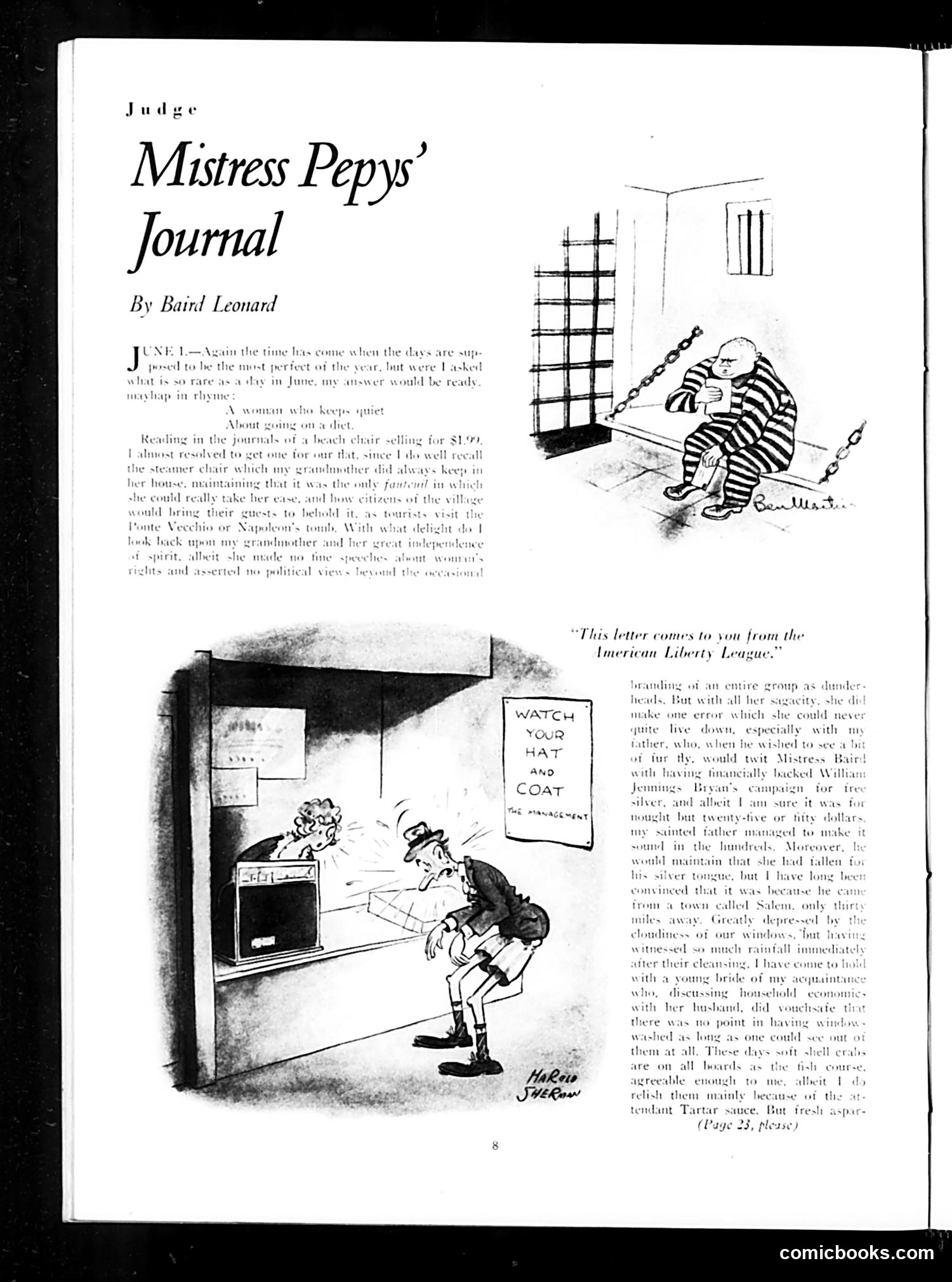
# Mistress Pepys' Journal - Explanation for Modern Readers This is a humorous society column by Baird Leonard, presented as a "journal" entry mimicking the historical Samuel Pepys's diary style. The two cartoons illustrate anecdotes about upper-class domestic life and social hypocrisy. The text references the **American Liberty League**, a real anti-New Deal organization of the 1930s, using it satirically to mock the grandmother's conservative politics despite her family's financial struggles. The joke critiques wealthy elites who opposed social programs while benefiting from inherited wealth. The bottom cartoon shows a woman at a "Watch Your Hat and Coat" check, illustrating the era's concern with petty theft and social anxiety about servants or working-class people in public spaces. Overall, the piece gently satirizes upper-class pretension, financial contradiction, and domestic concerns of 1930s-era society women, using period-specific references to economic inequality and political attitudes that modern readers would need historical context to fully appreciate.
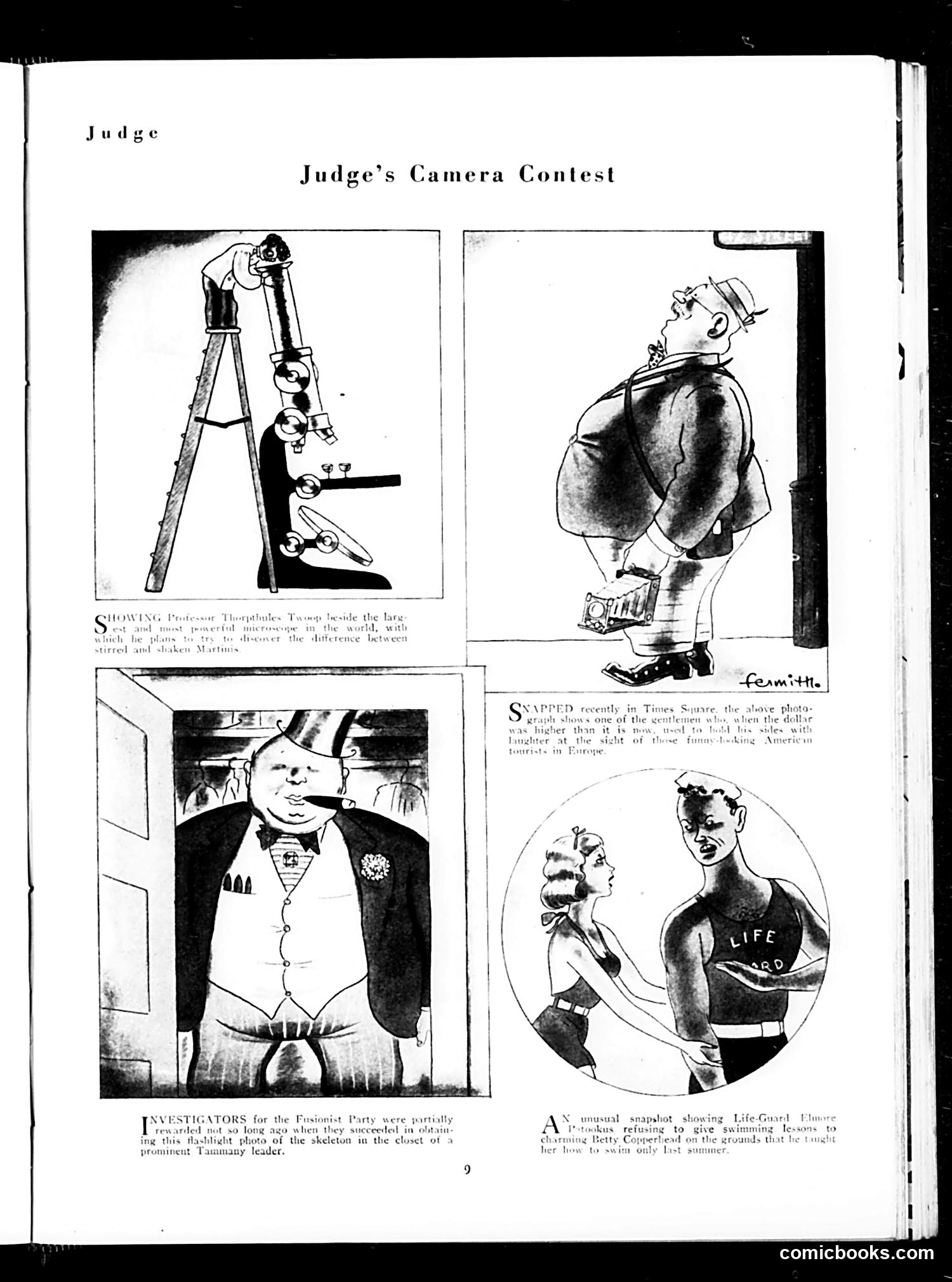
# Judge's Camera Contest This page presents humorous photographs supposedly submitted to Judge magazine's camera contest, mocking their quality and subjects. The top left shows "Professor Thorndyke" demonstrating a microscope—likely satirizing scientific pomposity. Below, a rotund man in formal wear represents a failed flashlight photo contestant, captioned as capturing "one of the scarecrows in his closet." The right side features two circular photos: one shows a woman labeled as a "P-tracks refusing to give swimming lessons to charming Betty Copperhead on the grounds that he taught her to swim only last summer"—a joke about infidelity or scandal. The satire targets both amateur photographers' poor submissions and contemporary social figures, using exaggerated caricature to mock vanity, pretension, and scandalous behavior among the wealthy or prominent.
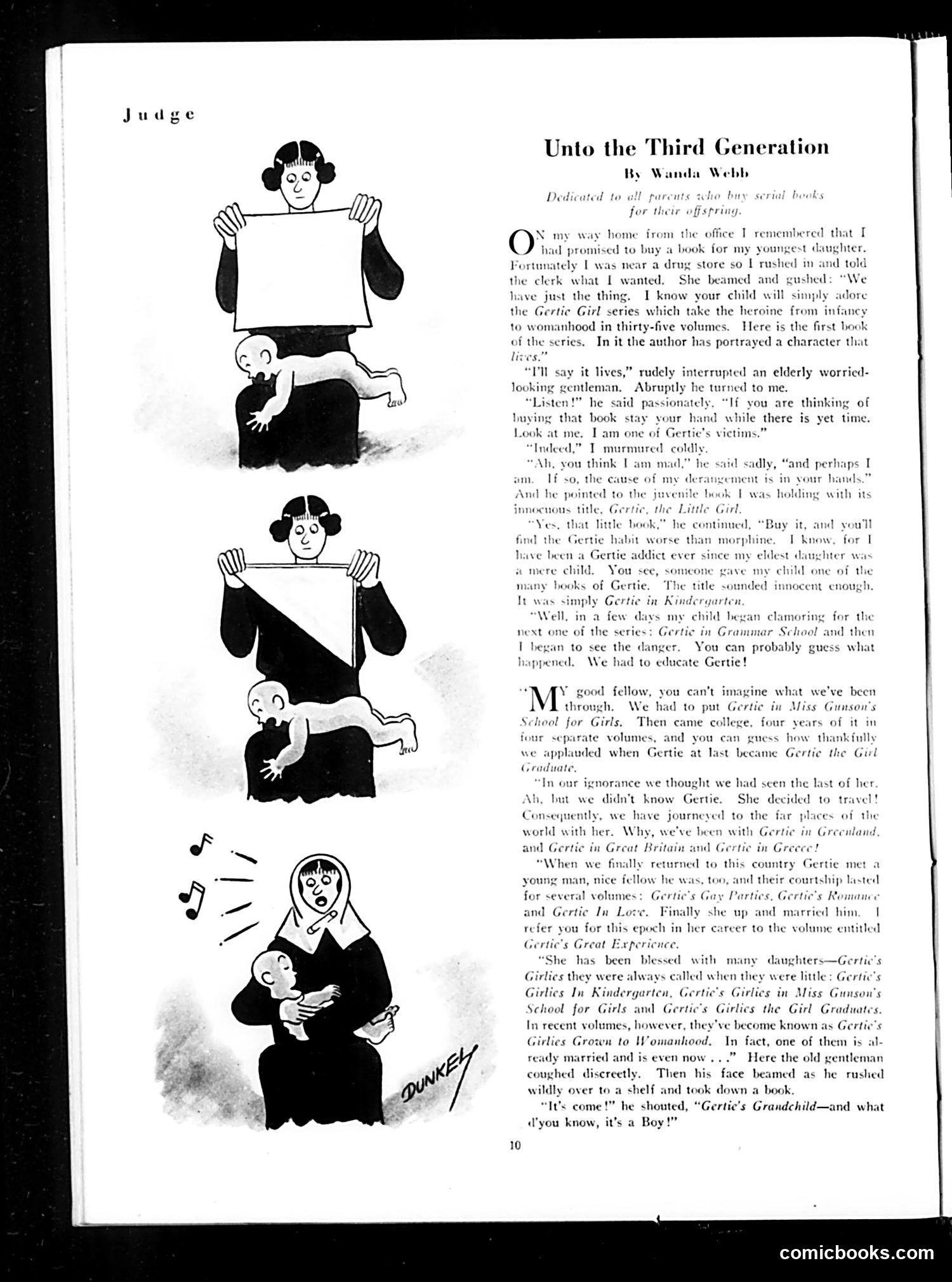
# "Unto the Third Generation" - Judge Magazine This satirical piece mocks the runaway commercial success of the "Gertie Girl" book series—a real phenomenon of early 20th-century children's literature. The illustrations show the generational cycle: a judge figure holding increasingly larger books representing how the series expanded across decades. The joke: an exhausted elderly man encounters the author buying the *first* Gertie book for his daughter, and warns her it's a trap. He describes becoming a helpless "Gertie addict"—forced to purchase 35+ volumes following the character from infancy through womanhood, then her daughters' entire lives, and now her *grandchild's* story. Each life stage spawned multiple spin-off books (school, college, romance, travel, etc.). The satire targets both the publishing industry's profit-driven sequelization and parents' inability to resist buying these books for their children—creating a three-generation consumption cycle. The final punchline—the grandchild is a boy—suggests the series will continue indefinitely, spawning yet another line of books.