
Judge, 1936-07 · page 14 of 36
Judge — July 1936 — page 14: what you’re looking at
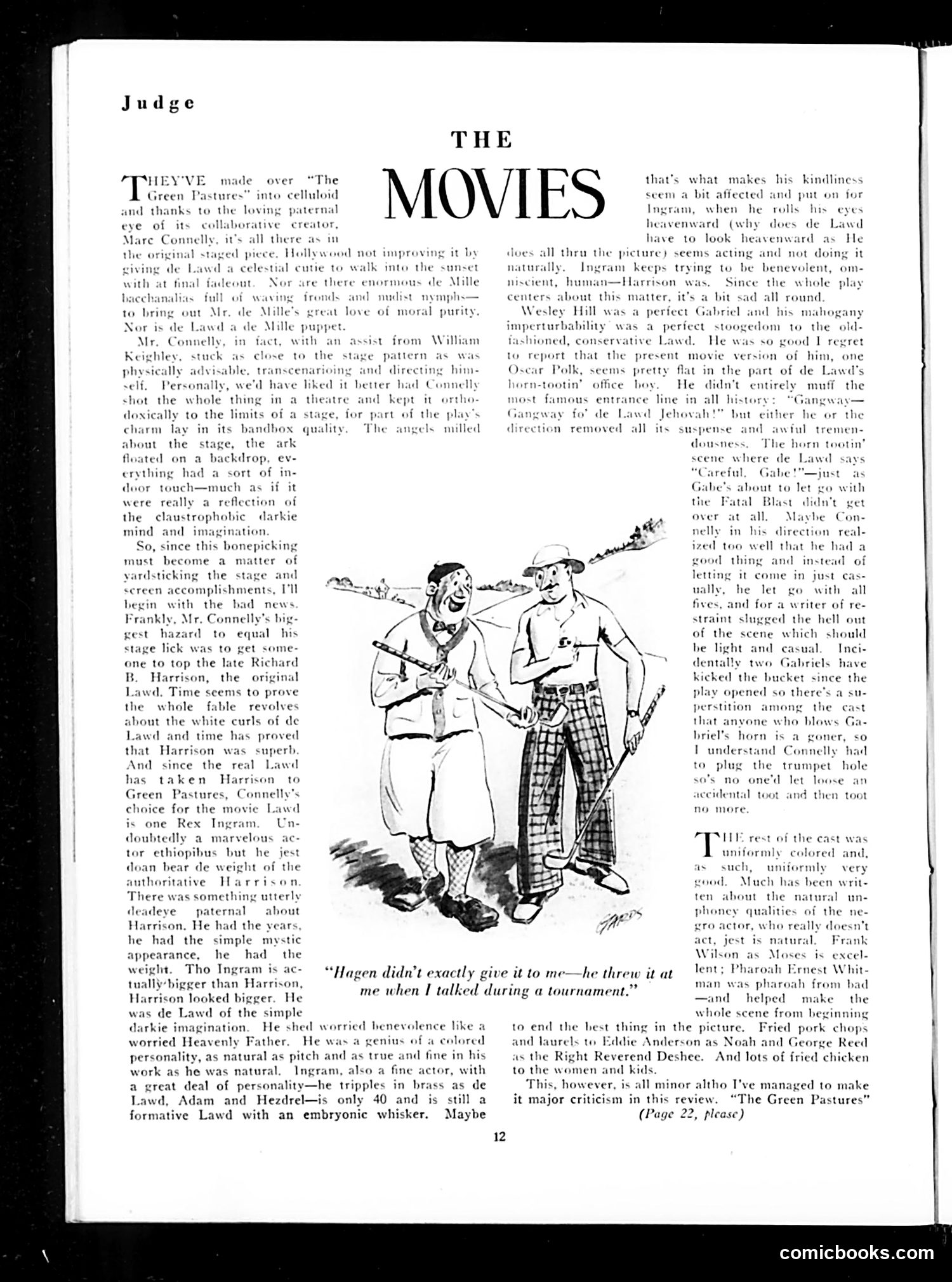
A restored page from Judge, 1936-07. Page through the whole issue in the reader above.
📄 Transcribed text from this page (OCR, searchable)
Machine-transcribed from the original scan — historical spelling and the odd misread are preserved.
HEY'VE made over Green Pastures” into celluloid and thanks to the lovin, | eye of its collaborative creator, “The patern Mare Connelly, it’s all there as in the or xed piece. Hollywe t improving it by a celestial cutie to wa ko into the sunset with at fins deout. Nor are there Mille us ds and mudd Dacehanalias f to bring out Mr Nor is de Lawe _ Mr. Connelly, in’ fact, with an assist from William at love of moral purity, Keighley, stuck as to the » pattern as was physically advisable. transcenarioing and directing him- self, Personally, we'd have liked it better had Connelly the whole thing in a theatre »xically to the limits of a st kept it ortho- ior part of the play's charm lay in its bandbox quality. The angels milled about the stage, the ark ted on a backdrop, e erything had door touch—much as if it ge, a sort of it were really a reflection of the claustrophobic darkie mind and imaginat So, since this k epicking must become a matter of yardsticking the stage and screen accomplishments, I'll begin with the bad news Frankly, Mr. Connelly’s big- gest stage lick was to get some- one to top the late Richard B. Harrison, the original Lawd, Time seems to prove the whole fable azard to equal his revolves about the white curls of de Lawd and time has proved that Harrison was superb And since the real Lawd has taken Harrison to Green Pastures, Connelly’s choice for the movie Lawd is one Rex Ingram. Un- doubtedly a marvelous ac- ethiopibus but he jest an bear de weight of the authoritative Harrison : re was something utterly radeve paternal about Harrison. He had the years he had the simple mystic appearance, he had the weight. Tho Ingram is « tuall\’bigger than Harrison, Harrison looked bigger. He was de Lawd of the simple darkie imagination. He shed worried benevolence like a worried Heavenly Father red personality, as natural as pitch and as true and fine in his work as he was natural. Ingram, also a fine actor, with a great deal of personality—he tripples in brass as de Lawd, Adam and Hezdrel—is only 40 and is still a formative Lawd with an embryonic whisker. Maybe He was a genius of THE MOVIES “Hagen didn’t exactly give it to me—he threw it at me when I talked during a tournament.” that’s what makes his kindliness seem a bit affected and put on for Ingram, when he re heavenward (why de have to look heaven does all thru the picturey seems acting and not doi naturally. Ing keeps trying to be benevi ent, om- Since the whole play centers about this matter, it’s a bit sad all round niscient, humarn Wesley Hill was a perfect Gabriel and his mahogany imperturbability was a perfect stoogedom to the old- fashioned, conservative Lawd. He was s« to report that the present movie version of him, one Osear Polk, seems pretty flat in the part of de Lawd’s horn-tootin’ office bey He n't entirely muff the 1 history 1 most famous entrance line in “Gangway— Gangway fo’ de Lawd Jehovah!” but either he or the direction removed all its suspense and awiul tremen- dousness, The horn teotin’ scene where de Lawd says “Careful ats Gahe’s ab » with the Fatal Blast didn’t yet over at all Mayhe Con- nelly in his direction. real- ized too well that he h thing and instead of it come in just cas- he let go with all fives, and for a writer of re- straint slugged the hell out the scene which should be light and ual. Inci- dentally two Gabriels have kicked the bucket since the play opene: F 1 so there su- perstition among the cast that anyone who blows briel’s horn is a goner, so I understand Connelly had to plug the trumpet hole so’s no one’d let loos rccidental toot 4 d then no more 7 i rest of the cast was uniformly colored and, is such, uniformly very good. Much has been writ- ten about the natural un- phoney qualit of the ne- ietor, who re; rG ly doesn't act, jest is natural, Frank Wilson as Moses is excel- > Phare irnest Whit- ywas pharoah from bad —and helped make the whole scene from beginning to end the best thing in the picture. Fried pork chops and laurels to Eddie Anderson as Noah and George Reed as the Right Reverend Deshee. And lots of fried chicken to the women and kids This, however, is all minor altho I've managed to make it major criticism in this review. “The Green Pastures” (Page 22, please) comicbooks.com