
Judge, 1936-07 · page 20 of 36
Judge — July 1936 — page 20: what you’re looking at
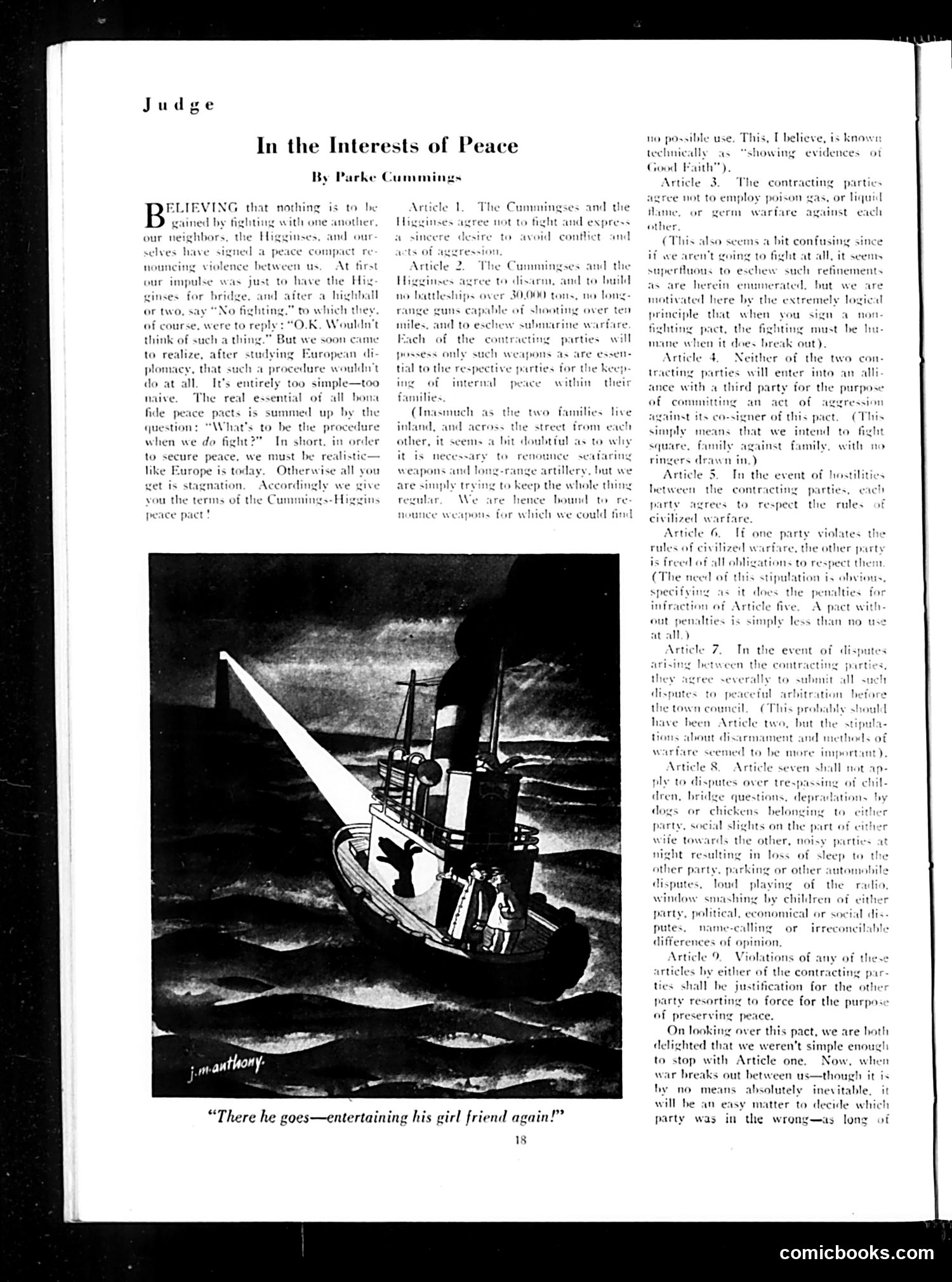
A restored page from Judge, 1936-07. Page through the whole issue in the reader above.
📄 Transcribed text from this page (OCR, searchable)
Machine-transcribed from the original scan — historical spelling and the odd misread are preserved.
Judge selves hay nouncing vi our impuls di In the Interests of Peace By Parke summings ELIEVING that nothing is to he ed by fighting with one another, the Higgin The Cummir ugree not to fight our neighbors tL peace compact between us. disarm, and to build or two, say“) shooting over of course, were to re think of such a thing to realize, after stu O.K. Wouldn't ut we soon came miles, and toe submarine warfare only such weapons as are essen- plomacy, that such a procedure wouldn't at all. It's ent naive. The real e rely too simple—too summed up : “What's to be the p when we do fight?” Ace pacts ful as to why cure peace, we must be realistic “urope is today. Otherwise all y nation p the whole th f the Cummings-Higgins no possible use. This, T believe, is knows technically Good Faith “showing evidences ot Article 3. The contracting parties liquid me, or germ warfare against each ce not to employ poison 4 (This also seems a bit confusing since if we aren't going to f at all, it seems superfluous to eschew such refinements sare herein enumerated. but we are motivated here by the extremely logical tiple that pact, the mane when it do nmoyou sign ano! hting must: be break out) Article 4. Neither of the two con- tracting parties will enter into an alli va third party for the purpose mite an act of tinst its co-signer of this pact. (This that we intend to fight square, family against family, with no. ringers drawn in.) simply me Articl In the event of hostilities between the contracting parties, exeh party evs to respect the rules of civilized warfare. Article If one party violates the rules of civilized warfare. the other p is freed of all obligations to respect thent (The need of this stipulation is obvious, specifying as it does the penalties fo infraction of Article five. A pact with out penalties is simply less than no tse at all.) Article 7. In the event of « ween the contractir severally tos ne peaceful arbitrati i. (This pr ly should n Article two, but the st Hions about disarmament and met sof warfare seemed to bn more importan Article seven shall not lisputes over tre dren, bridge que dogs or chicks 1 v. social ions, deprarl helon: wife towards the other, ne ng in le other party, pa or o Fr attomobile loud playing of the radio, window smashing by children of either party, politi put dispu al, economical or soci na . ve-ealling or irreconei differences of opinion Article 9. articles by eith ties sha iolations of any « rv of the contracting par Tbe justifi om for the other party resorting to force for the purpose of preservi x peace. On looking over this pact, we are bot hted that we weren't simple enoug to stop with Article one. Now, whe war breaks out between us—though it is de hy no means absolutely inevitable, it will be an easy matter to decide wh party was in the wrong—as long of comicbooks.com