A complete issue · 36 pages · 1936
Judge — March 1936
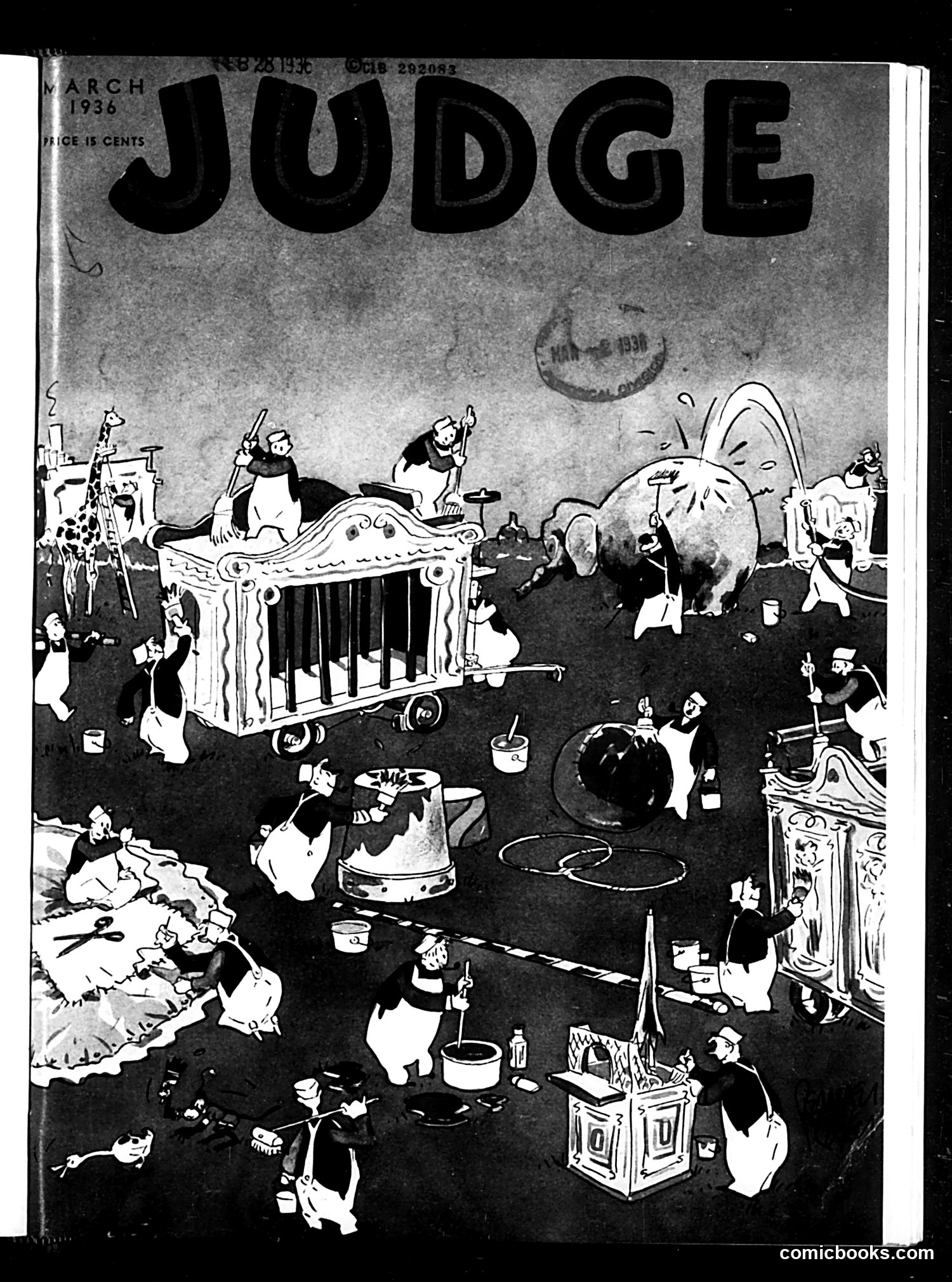
# Analysis of Judge Magazine Cover, March 1936 This satirical cover depicts a chaotic nursery scene, likely commenting on New Deal government programs of the 1930s. The elaborate baby carriage at center, surrounded by numerous caretakers and implements, appears to represent a government agency or bureaucratic program being overly complicated and inefficiently managed. The multiple figures attending to the single baby suggest excessive government spending, redundant staffing, or bureaucratic waste—common conservative criticisms of FDR's Depression-era initiatives. The various toys and paraphernalia scattered about reinforce themes of governmental excess and mismanagement. The title "JUDGE" and March 1936 date confirm this is from the magazine's satirical commentary period, when it frequently criticized New Deal policies as wasteful or poorly conceived.
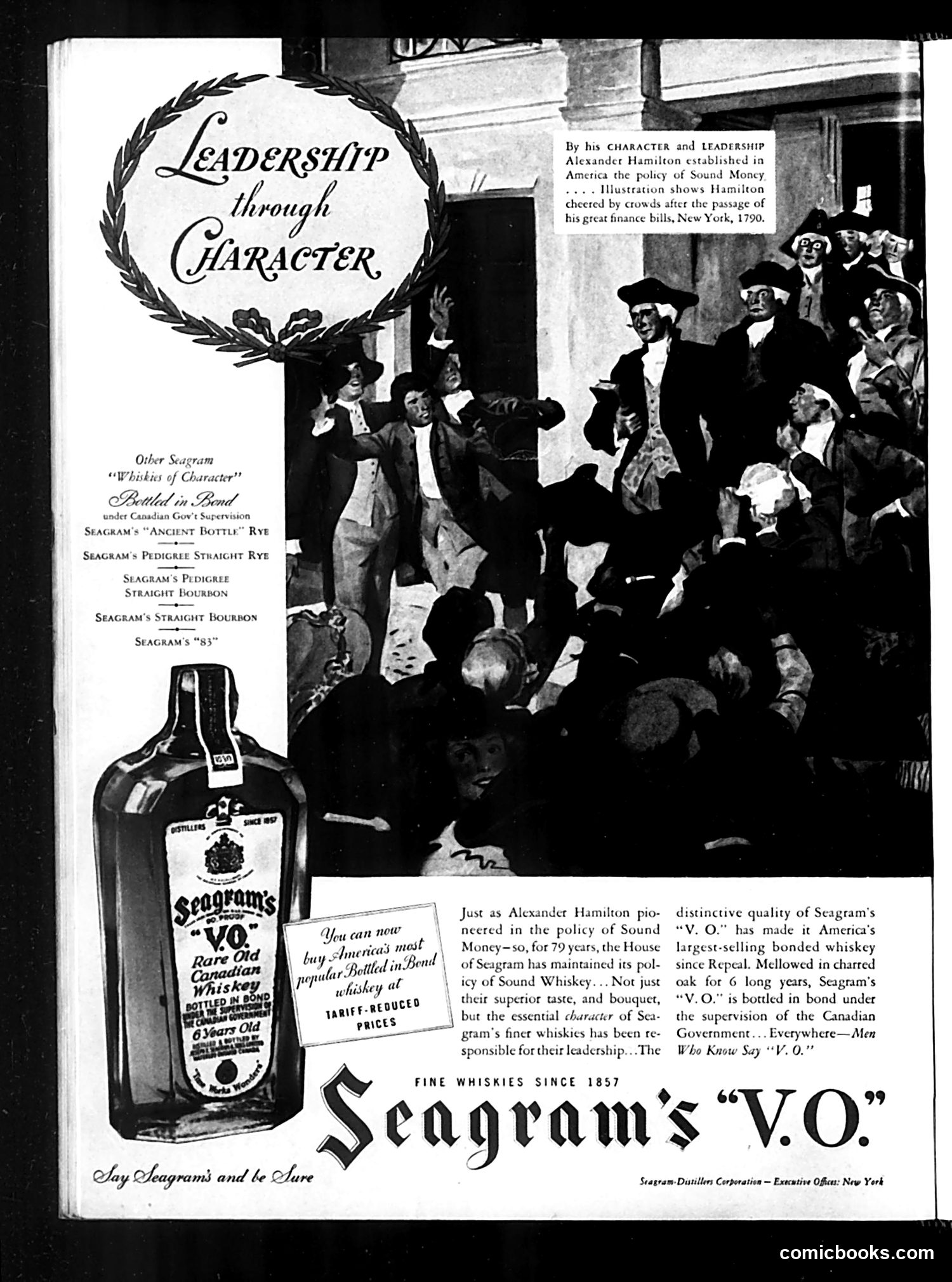
# Analysis This page is primarily **advertising for Seagram's V.O. whiskey**, not political satire. The ad uses a historical theme rather than contemporary politics. The left side shows "Leadership through Character," featuring an illustration of Alexander Hamilton being cheered by crowds after passage of his 1790 finance bills in New York. The ad connects Hamilton's character-driven leadership to Seagram's whiskey's reputation and longevity since 1857. The text explicitly compares Hamilton's "policy of Sound Money" to Seagram's maintenance of quality standards in whiskey production over 76 years. It's a brand-building strategy: associating the product with American historical leadership and stability. The page is essentially a sophisticated commercial disguised as historical commentary, typical of Judge's advertising approach during the Prohibition-era repeal period.
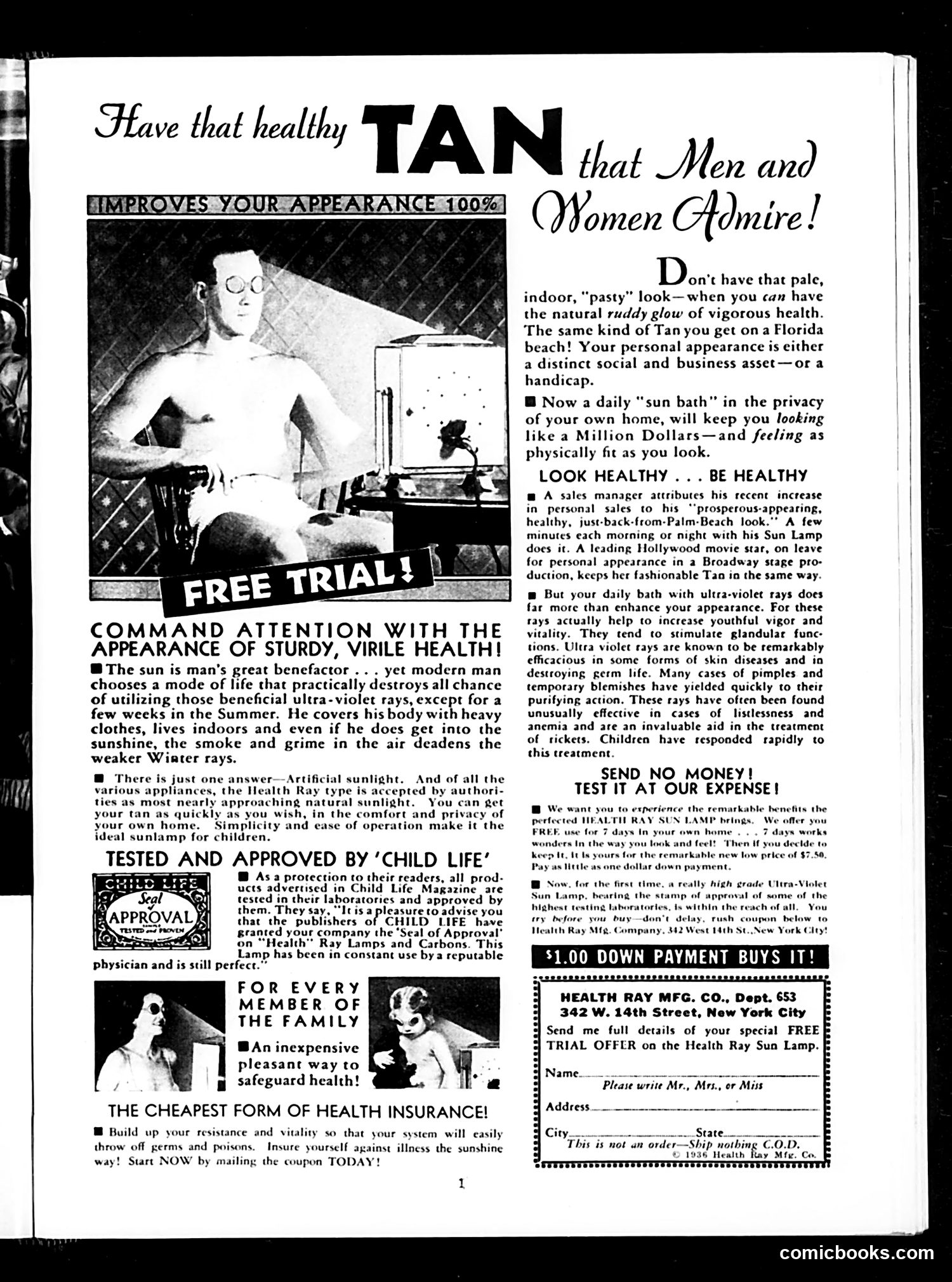
# Analysis This page is **primarily advertising, not satire or political commentary**. It promotes a "Health Ray Sun Lamp" — an artificial ultraviolet light device marketed for home use to create a suntan indoors. The ad targets both men and women, claiming tanned skin signals "vigorous health" and improves appearance and social standing. It emphasizes convenience (no beach trip needed) and health benefits, citing UV rays' purported ability to fight rickets and increase "youthful vigor." There's a testimonial from a Hollywood movie extra and a "Child Life Seal of Approval" endorsement. The imagery shows a shirtless man using the lamp. This reflects 1930s-40s health fads promoting artificial tanning before the dangers of UV exposure were widely understood. The $1 down payment offer targets working-class buyers.
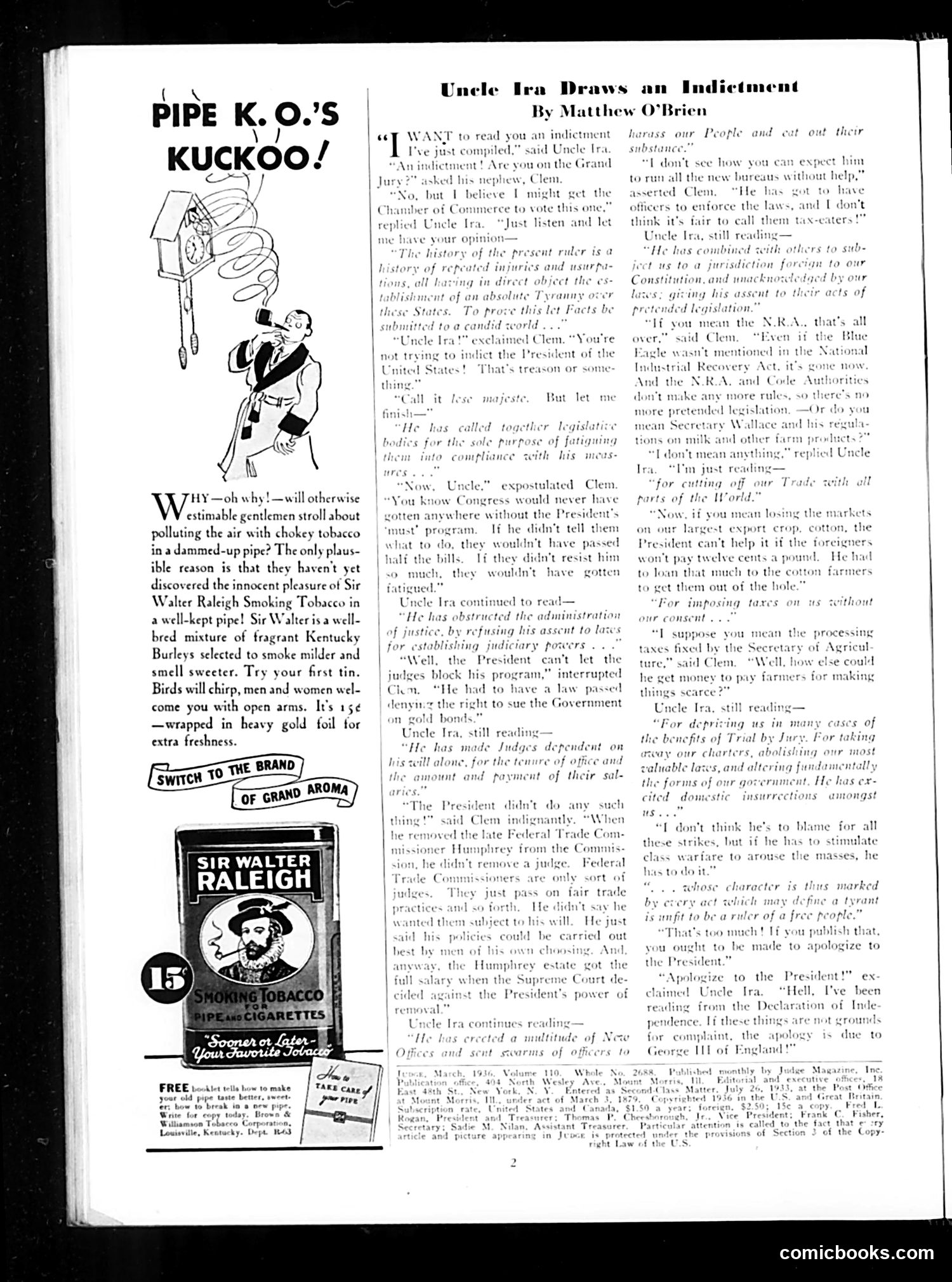
# Political Satire Analysis This Judge magazine page contains two distinct elements: **Left side:** A Sir Walter Raleigh pipe advertisement with a humorous caption mocking the popularity of milder tobacco products among gentlemen. **Right side:** "Uncle Ira Draws an Indictment" by Matthew O'Brien satirizes President Franklin D. Roosevelt's New Deal policies. Uncle Ira (appearing to represent an older conservative) reads complaints about various Roosevelt administration programs—the N.R.A., judicial reform, trade restrictions, and executive power expansion. The satire presents these policies as governmental overreach and tyranny. The article criticizes Roosevelt for bypassing Congress, removing checks on executive power, and implementing legislation without proper constitutional procedure. This reflects conservative opposition to FDR's 1930s New Deal expansion.
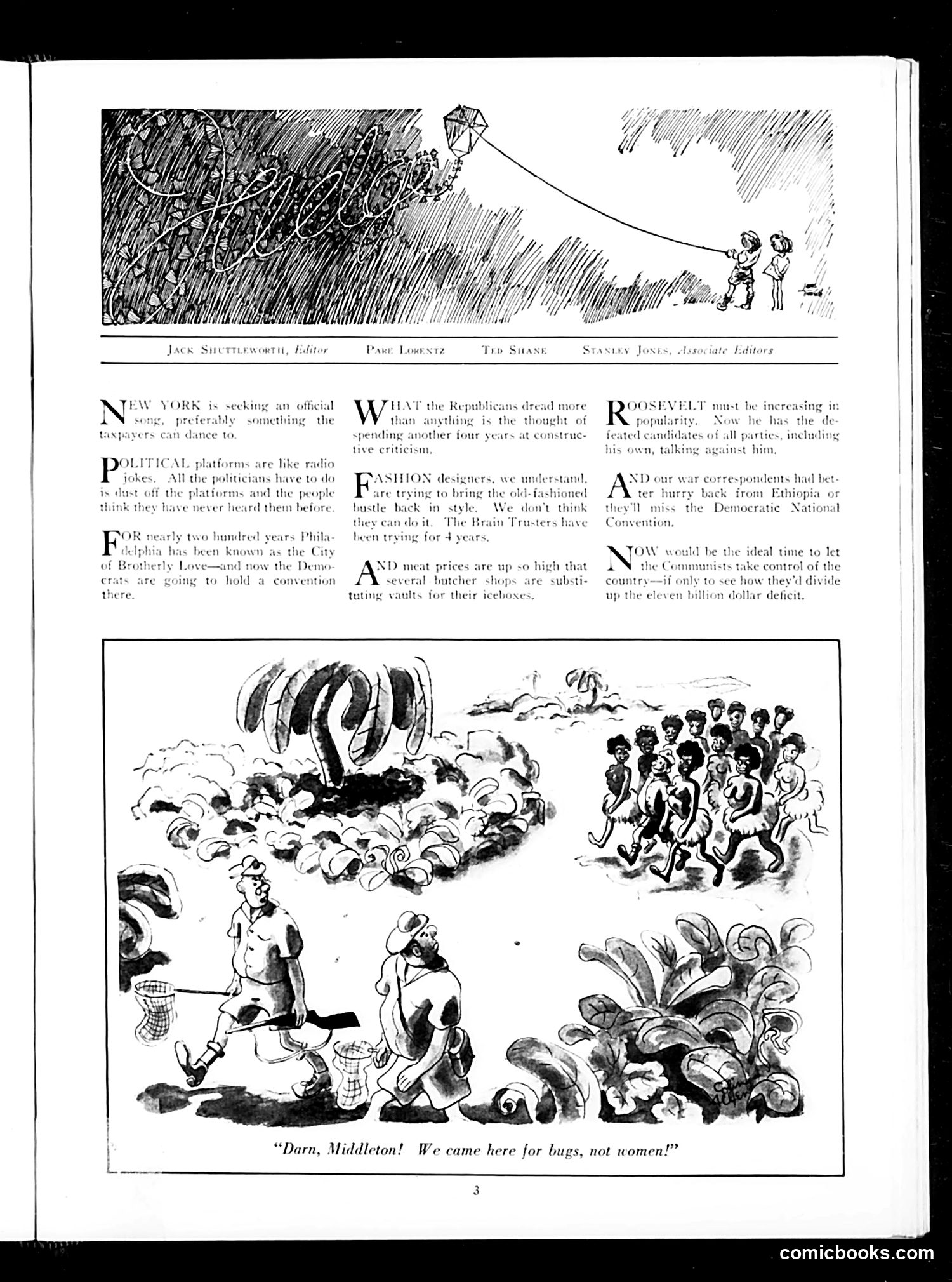
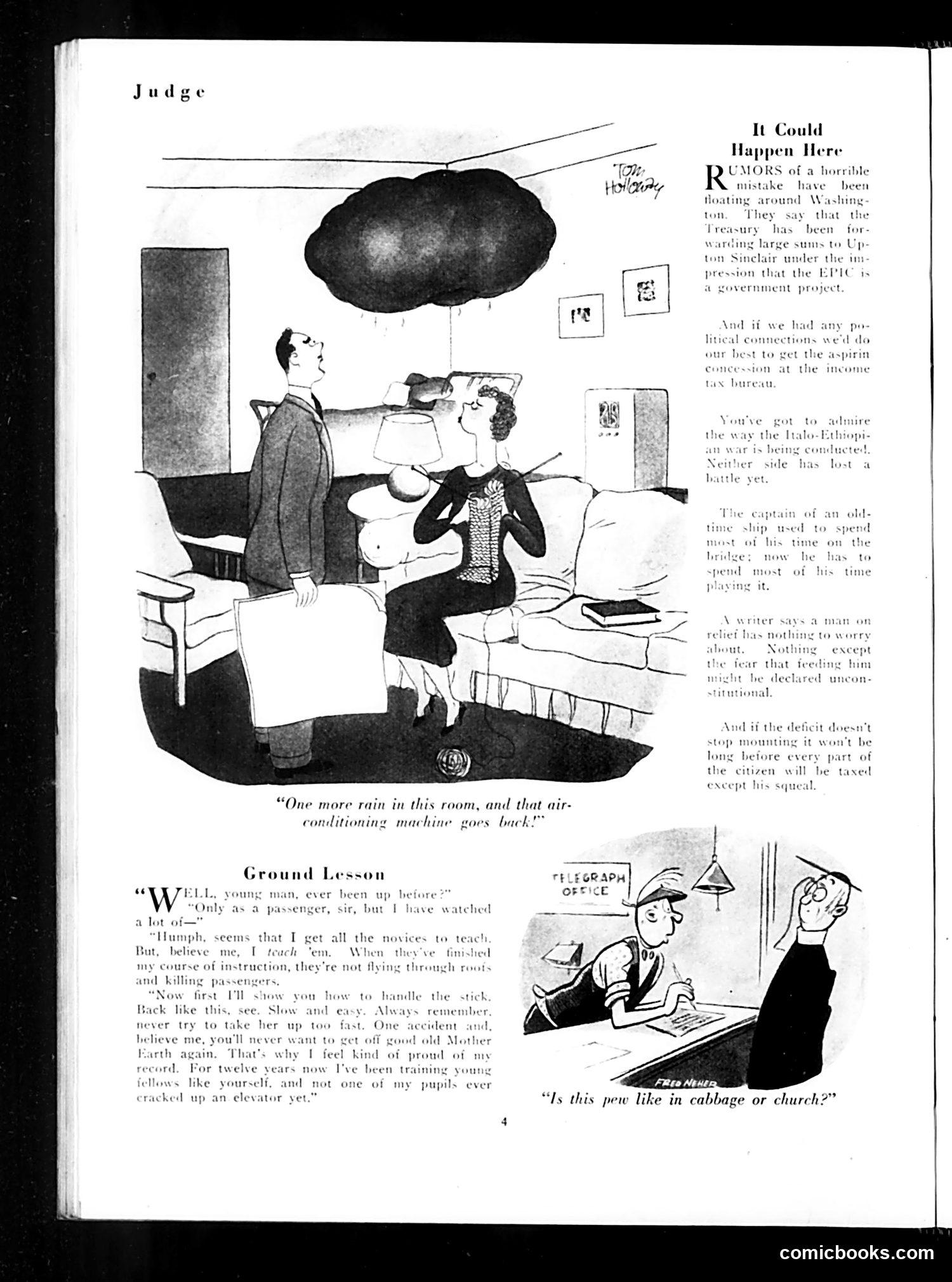
# "Judge" Magazine Page Analysis **Top Cartoon ("It Could Happen Here"):** Depicts two men in an office with a large dark cloud overhead labeled "Treasury." The satire suggests rumors that the Treasury Department has been forwarding large sums to Upton Sinclair under the impression the WPA (Works Progress Administration) is a government project. The joke implies this would be a "horrible mistake"—mocking either government incompetence or suspicion of socialist sympathies. The scattered dollar bills suggest frivolous spending. **Bottom Section ("Ground Lesson"):** Shows an elevator operator instructing a young trainee on safety procedures, boasting of his twelve-year perfect safety record. The humor derives from his condescending, overly casual attitude toward dangerous work—suggesting complacency despite claimed expertise. Both pieces use humor to critique government inefficiency and workplace overconfidence.
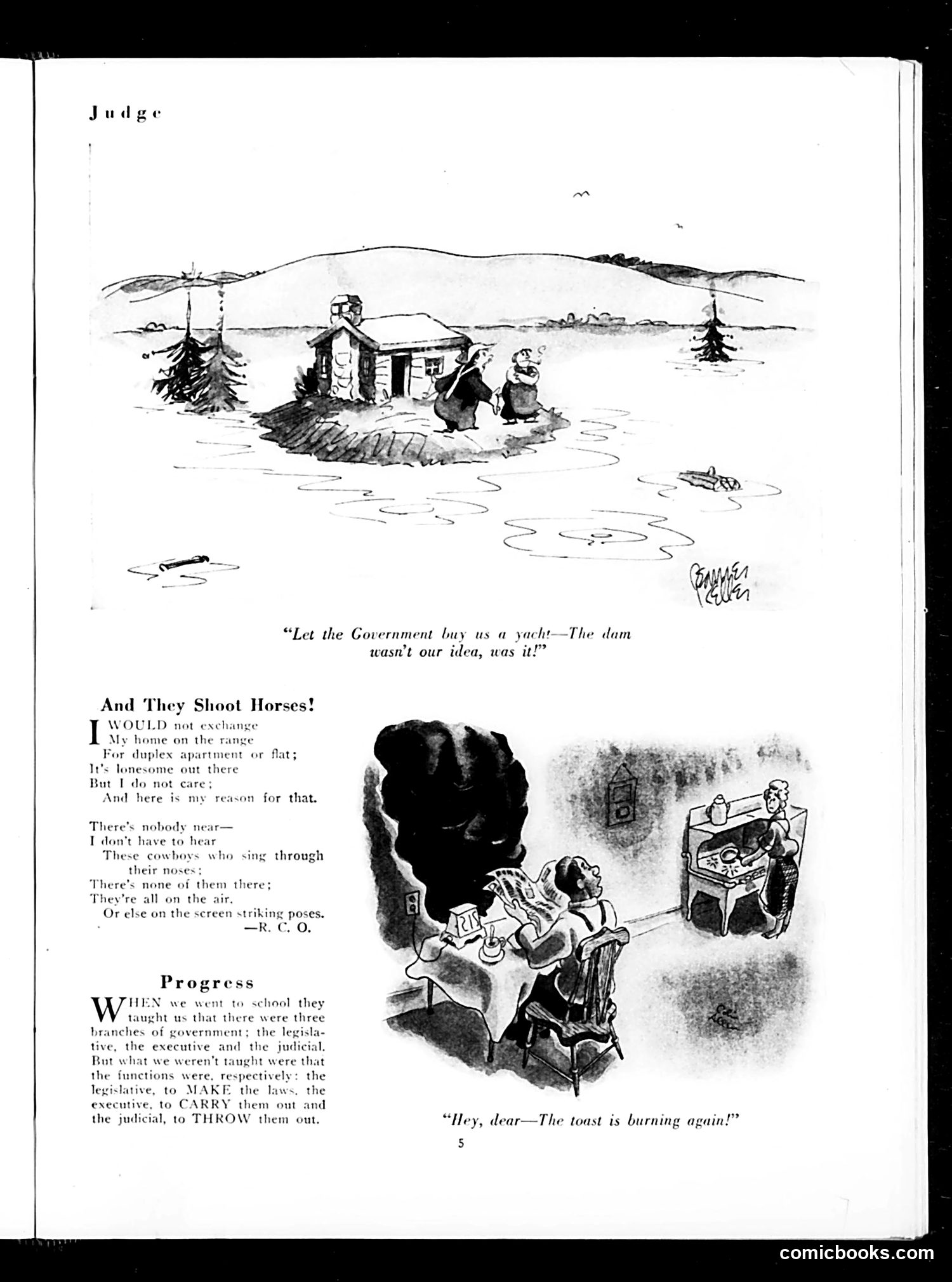
# Analysis of Judge Magazine Page **Top Cartoon ("Judge"):** Shows people in a flooded shack requesting government purchase them a yacht, claiming "the dam wasn't our idea." This satirizes citizens seeking lavish government assistance or bailouts, mocking entitlement attitudes toward public spending. **"And They Shoot Horses!"** Section: A poem (attributed R.C.O.) criticizes the prevalence of cowboy singers on radio and in movies, complaining about their ubiquity and artificial "striking poses." The accompanying cartoon shows a frustrated listener at a radio while musicians perform elsewhere—satirizing the dominance of cowboy entertainment in 1930s popular culture. **"Progress"** Section: Explains the three government branches' theoretical functions (legislative makes laws, executive carries them out, judicial enforces them), likely ironically commenting on governmental dysfunction.
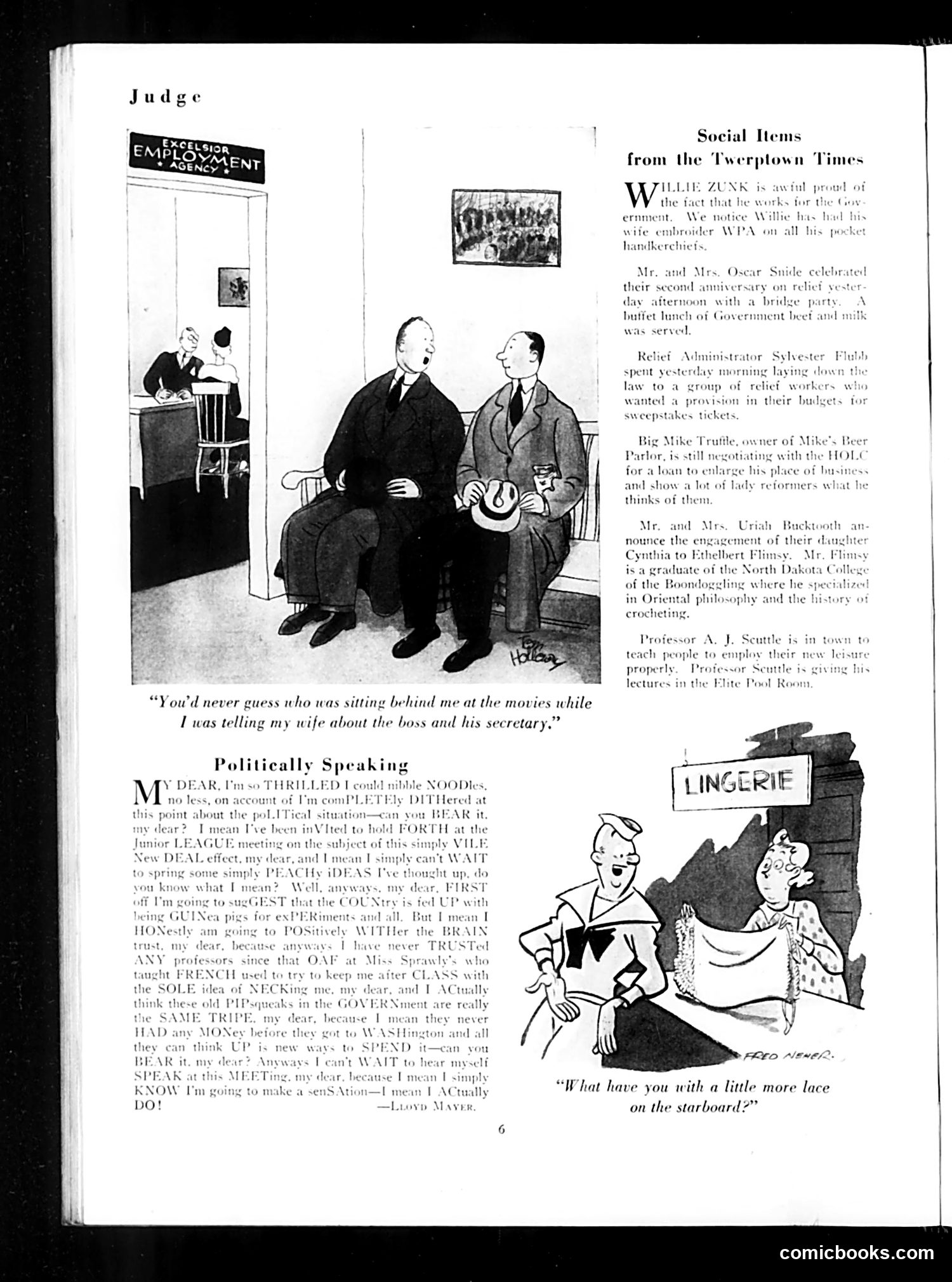
# Judge Magazine Page Analysis This page contains two separate satirical pieces: **Top Cartoon:** A man sits between two figures at a movie theater, telling his wife about workplace gossip regarding "the boss and his secretary." The humor relies on the classic trope of an oblivious husband loudly discussing office affairs in public while appearing unaware of his own indiscretion or social awkwardness. **"Politically Speaking" Column:** A rambling letter using excessive capitalization and fragmented thoughts to satirize political discourse. The writer complains about political situations while employing deliberately chaotic reasoning—misspellings, contradictory arguments, and stream-of-consciousness style mock incoherent political debate and discourse of the era. **Bottom Cartoon:** A lingerie shop scene where a man requests "a little more lace on the starboard"—using nautical terminology humorously when discussing women's undergarments.
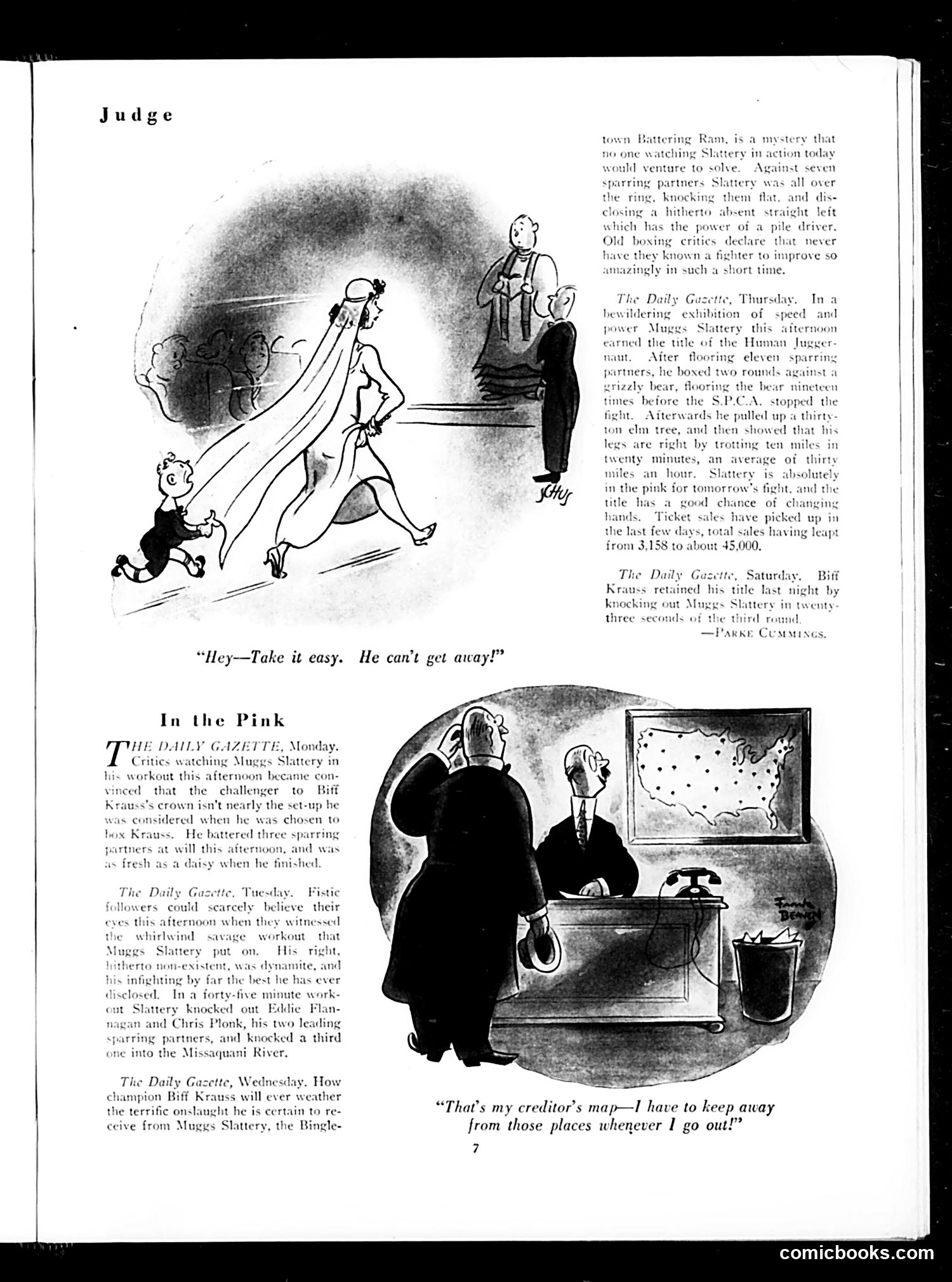
# Content Analysis: Judge Magazine Page This page satirizes boxing and prize-fighting culture through two cartoons. The top illustration, captioned "Hey—Take it easy. He can't get away!," depicts a boxer (likely Muggs Slattery, referenced in the text) being restrained during a bout—mocking the violence and chaotic nature of professional boxing. The bottom cartoon, "In the Pink," shows a man studying a map marked with creditor locations, a visual pun on the phrase "in the pink" (meaning healthy/well). The joke satirizes debt and financial anxiety—the man must literally map out locations to avoid his creditors. The text entries from "The Daily Gazette" provide context about boxing matches and Slattery's fights, but the satire targets both the brutality of boxing entertainment and the broader anxieties of financial hardship among ordinary people.
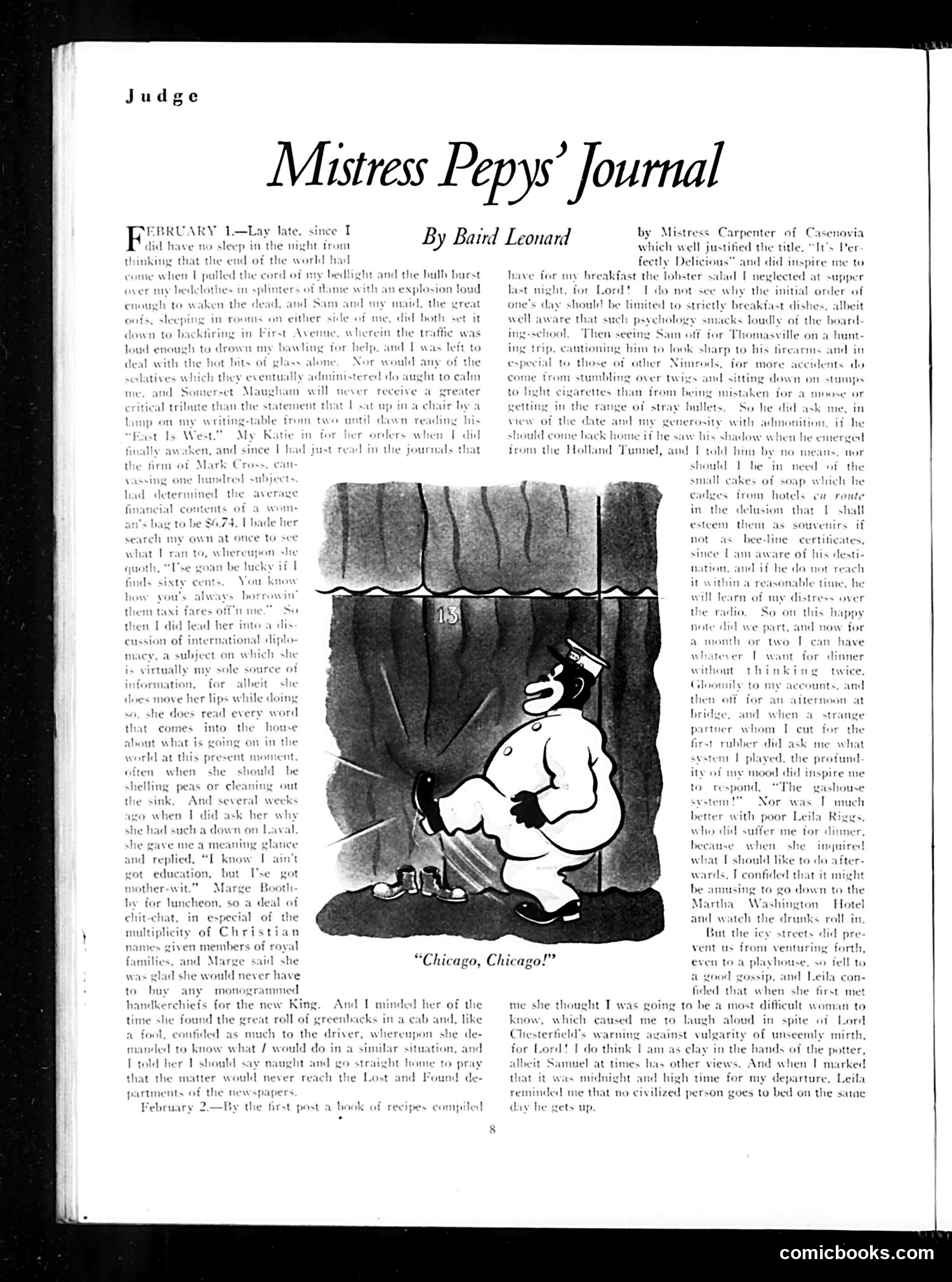
# "Mistress Pepys' Journal" - Analysis This is a humorous diary column by Baird Leonard, styled as entries from a female society figure (identified as "Mistress Carpenter of Casenovia"). The column mimics Samuel Pepys' famous 17th-century diary, applying that literary conceit to contemporary high-society gossip. The cartoon depicts the diarist in a domestic scene. The humor derives from her breathless accounts of trivial social matters—breakfast disputes, cab rides with servants, visits to friends like "poor Leila Riggs"—treated with mock-serious importance. The satire targets the self-important pretensions of wealthy women whose days revolve around minor social dramas and hotel gossip. References to "Martha Washington Hotel" and casual complaints about servants' behavior reflect period class attitudes. The "Chicago, Chicago!" caption suggests urban sophistication. This is essentially satirizing the vapid concerns and gossipy nature of society women through pseudo-literary parody—transforming mundane domestic occurrences into faux-historical "journal entries."
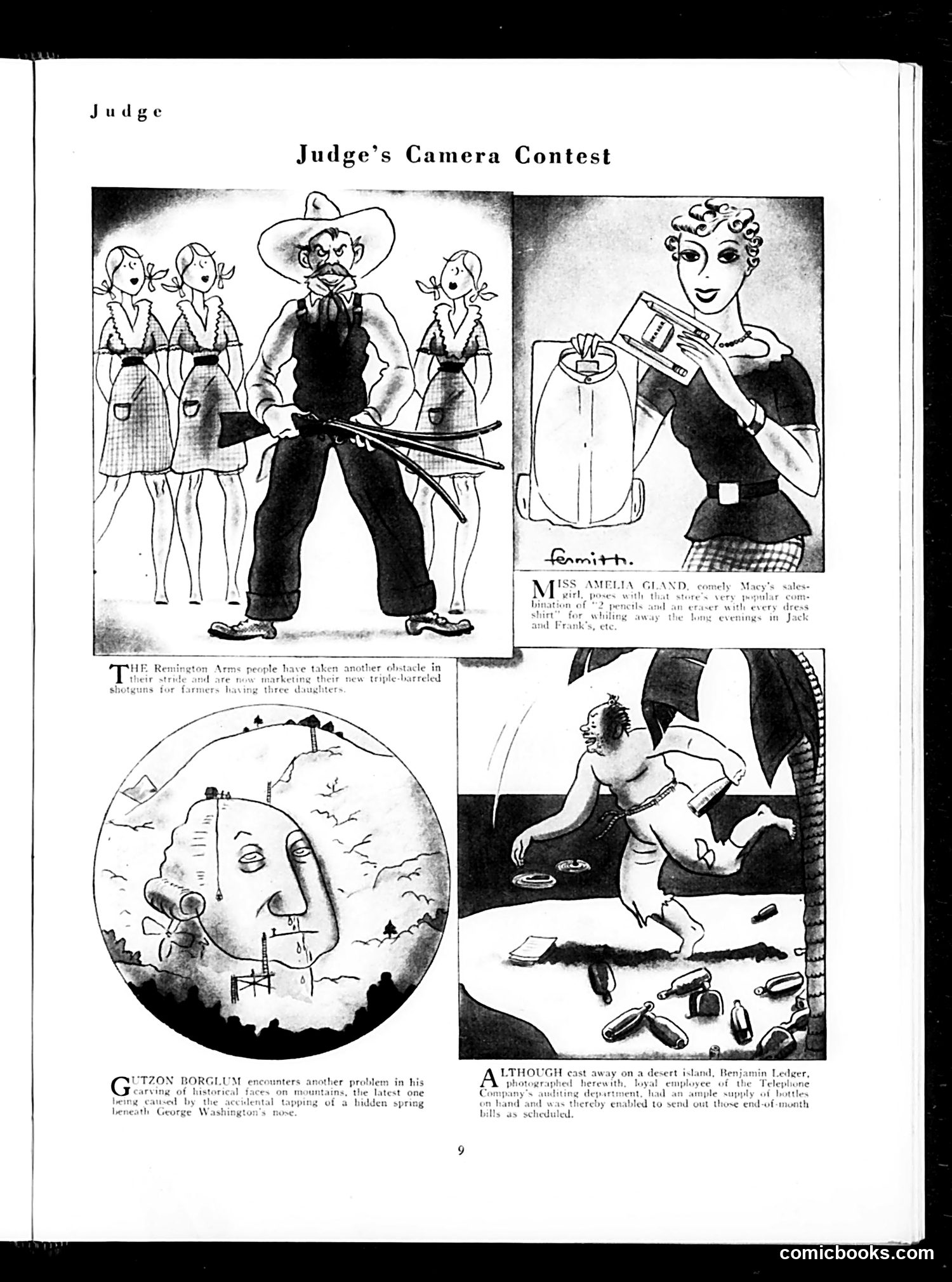
# Judge's Camera Contest This page showcases humorous photo submissions to a contest. The top cartoon depicts a cowboy judge selecting between entries—a satirical jab at the Remington Arms company's marketing of triple-barreled shotguns to farmers with three daughters. The other entries shown are absurdist gags: one features a woman with beauty products, another shows someone's problem with hidden springs (likely referencing Gutzon Borglum, the sculptor, with a visual pun on Mount Rushmore/George Washington), and a third depicts someone stranded on a desert island with Telephone Company bottles—suggesting commentary on corporate reach or dependency. The humor relies on visual wordplay and contemporary consumer culture references typical of early 20th-century satirical magazines.
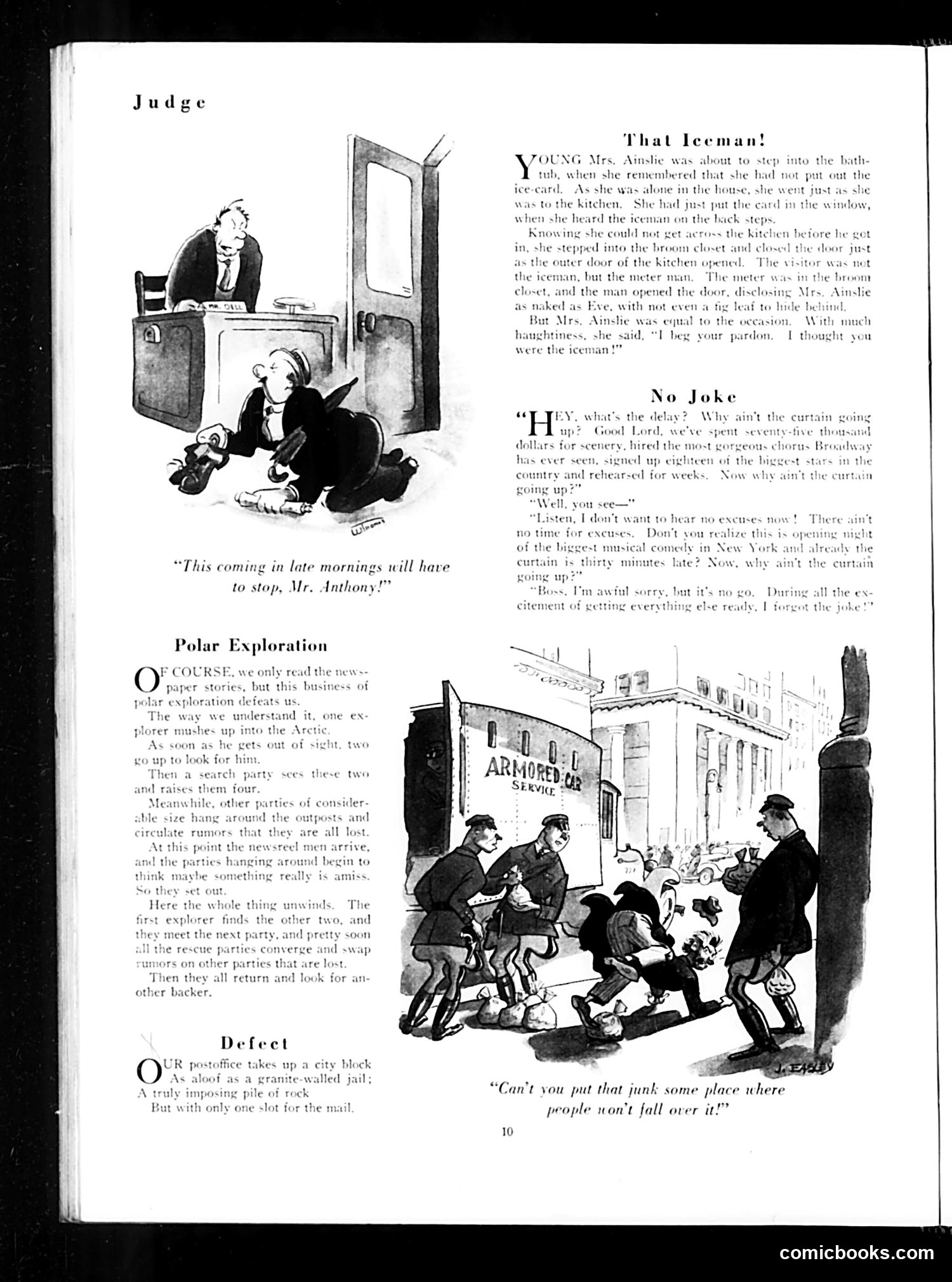
# Judge Magazine Page Analysis This page contains three separate humorous pieces: **"That Iceman!"** (top): A domestic comedy about a young wife caught off-guard by the iceman's arrival while she's bathing. She frantically tries to hide, having forgotten to put out the ice-card (a sign requesting ice delivery). The joke plays on Victorian propriety—the embarrassment of an unexpected male visitor encountering a woman in dishabille. The cartoon shows her scrambling while a judge sits above, seemingly presiding over domestic mishaps. **"No Joke"** (right): Theater/show business satire about a Broadway musical's opening night. A producer complains the curtain won't rise, citing the enormous cost and effort invested. The joke mocks theatrical chaos and last-minute disasters undermining expensive productions. **"Polar Exploration"** and **"Defect"**: Brief satirical poems about Arctic expeditions and municipal infrastructure (a post office building), using mock-serious language to deflate their importance. The page exemplifies *Judge*'s early 20th-century style: domestic comedy, theatrical satire, and lighthearted social observation with pen-and-ink illustrations.