
Judge, 1936-03 · page 23 of 36
Judge — March 1936 — page 23: what you’re looking at
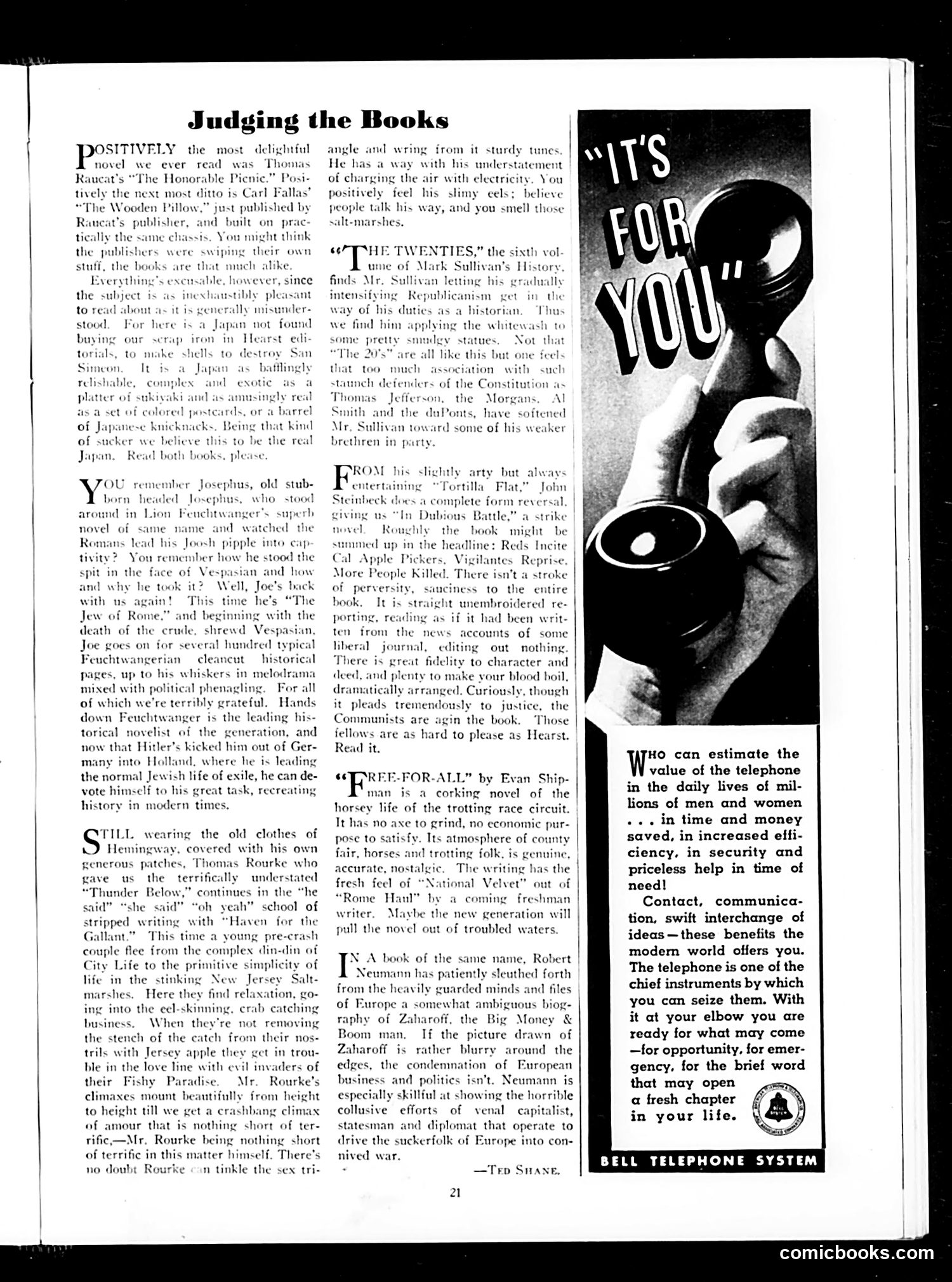
A restored page from Judge, 1936-03. Page through the whole issue in the reader above.
📄 Transcribed text from this page (OCR, searchable)
Machine-transcribed from the original scan — historical spelling and the odd misread are preserved.
Ppeeine “Y the most delightful novel we ever read w Raucat’s “The Honorable Pic tively the next most ditto is Carl Fallas’ “The Wooden Pillow,” just published by Raneat’s publisher, and built on_ pr tically the same cl You might think s Thomas ic.” Posi- the publishers iping their own stuff, the boc rat much alike. Everything's excusable, | ver, since the subject is as inexhaustibly pleasant to read aly ts itis generally misunder- For 1 buying our ser tori Simeon. It stoc Japan not found p iron in Hearst edi shells to destroy S: bafflin to make a Japan a complex vaki ane ingly real barrel of Japane at kind of sucker we believe the real old stub- Josephus, who stood osephus, JOU remember born he ound in L novel of s Romans 1 tivity? You rem spit in the face of 1 Fenehtwanger’s superb hed the je name and wa ul his Joosh pipple into cap ww he stood the Vespasian and how Well, Joe's 1 ime he's “The Jew of Rome.” and beginning with the death of the crude, shrewd Vespasian. Joe goes on for several hundred typical Feuchtwangerian — cleancut mber t y he took it? and wi with us ain! historical pages, up to his whiskers in melodrama mixed with political phenagling. For all of which we're terribly grateful. Hands down Feuchtwanger is the leading his- torical novelist of t ation, and now that Hitler’s kicked him out of Ger- many i ie is leading the norma ile, he can de- vote himself to his great task, recreating history in modern times. the old clothes of . covered with his own generous patches, Thomas Rourke who gave us the terrifically understated “Thunder Below,” continues in the “he wearing Onan WJ Hemingwa said” “she said” “oh yeah" school of stripped writing with “Haven for the Gallant.” This time a young pre-crash couple flee from the complex din-din of City Life to the primitive simplicity of life in the stinking New Jersey marshes. Here they find relaxation, ing into the eel-skinning, b catching business. When they're not removing of the catch from their nos- trils with Jersey apple they get in trou- ble in the love line with evil invaders of their Fishy Paradise. Mr. Rourke’s climaxes mount beautifully from height to height till we get a crashbang climax of amour that is nothing short of ter- rific—Mr. Rourke being nothing short of terrific in this matter himself. There's no doubt Ri the stenc ke con tinkle the sex tri- Judging the Books angle and wring from it sturdy tunes. He has a way with his under tement of charging the air with electricity. You positively feel his slimy eels; believe people talk his way, and you smell those silt-marshes, 66 HE TWENTIES,” the sixth vol ume of Mark Sullivan's History, finds Mr, Sullivan letting his gradually intensifying Republicanism the way of his duties as a historian. ‘Thus we find hi »ply some pretty: smudgy “The 20’ that too g the whitewash to statues, Not th e this but are g much iation w staunch defenders ¢ the Constitution as Thomas Jefferson M s. Al Smith 1 the duPonts, have tened Mr. Sullivan toward some of his weaker brethren in party. arty but “Torti u ; sa complete form reve giving us “In Dubious Battle,” a strike novel ie book might be 1 up in the headline: Reds Incite Cal Apple Pickers, Vigi ‘ople Killed Rou summ nt There isn’t a stroke to the entire ght unembroidered re- is if it had been writ- news accounts of some liberal journal, editing out nothing. re portin ten from the reat fidelity to character and deed, and plenty to make your blood boil, dramatically arranged. Curiously, though it pleads tremendously to justice, the Communists are agin the book. ‘Those fellows are as hard to please as Hearst. Read it. 66 TO REE-FOR-ALL” by E man is a van Ship- corking novel of the horsey life of the trotting race circuit. It has no axe to grind, no economic pur- pose to satisfy. Its atmosphere of cc fair, horses and trotting folk accurate, nostalgi fresh feel of “Nation “Rome Hanl” by ac writer. Maybe the new generation will pull the novel out of troubled waters. s genuin 1 Velvet” out of ming freshman Neumann has patiently from the heavily guarded minds and files of Europe a somewhat ambiguous biog- raphy of Zaharoff, the Big Money & Boom man. If the picture drawn of Zaharoff is rather blurry around the edges, the condemnation of European business and polities isn’t. Neumann is especially skillful at showing the horrible collusive efforts of venal capitalist, statesman and diplomat that operate to drive the suckerfolk of Europe into con- nived war. sleuthed forth ‘Treo SHANE. The writing has the | . A book of the same name, Robert | HO can estimate the Wreise of the telephone in the daily lives of mil- lions of men and women ... in time and money saved, in increased effi- ciency, in security and priceless help in time of need! Contact, communica- tion, swift interchange of ideas—these benefits the modem world offers you. The telephone is one of the chief instruments by which you can seize them. With | it at your elbow you are ready for what may come —for opportunity, for emer- gency, for the brief word that may open a fresh chapter in your life. BELL TELEPHONE SYSTEM comicbooks.com