A complete issue · 36 pages · 1935
Judge — August 1935
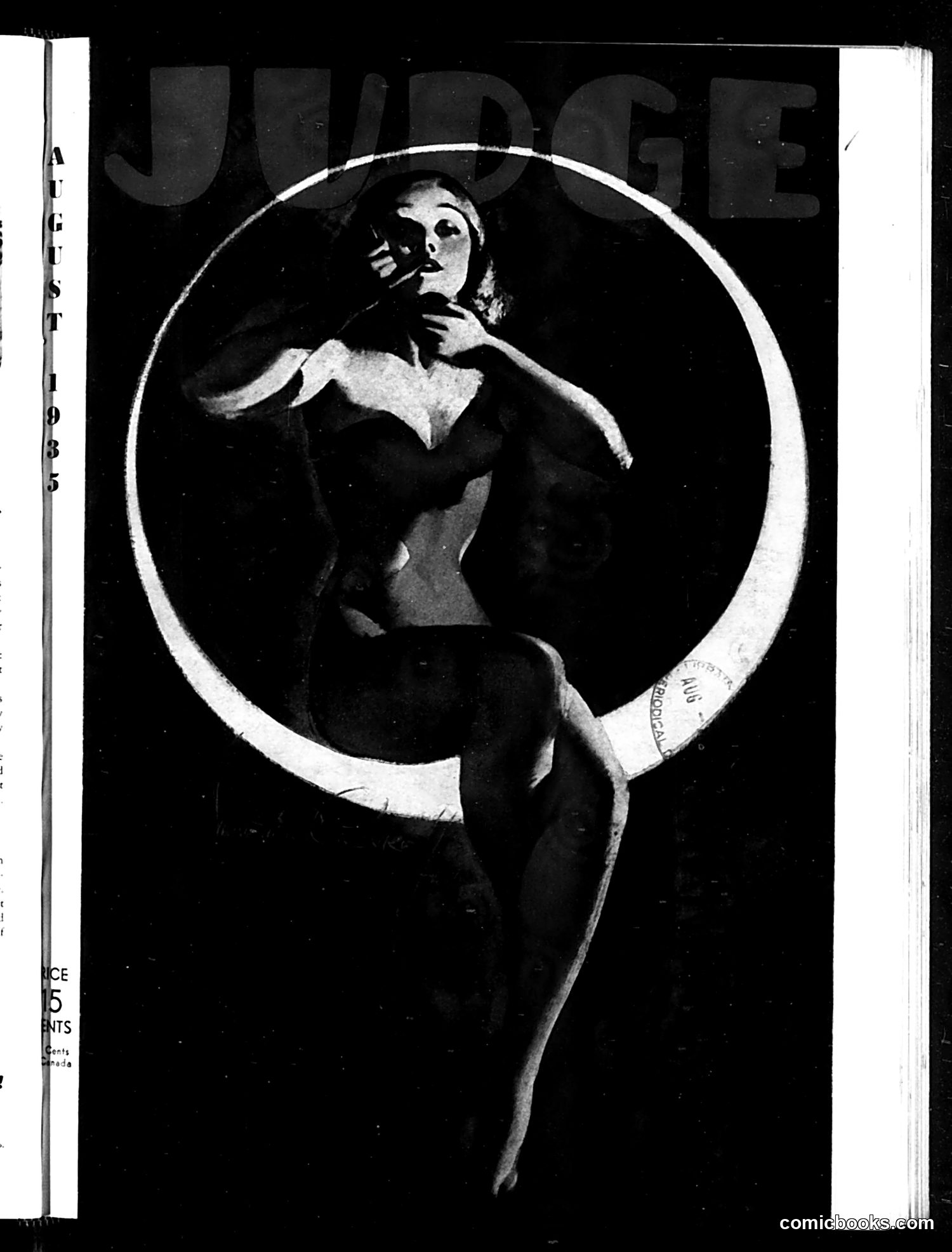
# Judge Magazine Cover Analysis This appears to be a Judge magazine cover featuring an Art Deco-style illustration of a woman in an elegant pose within a circular frame. The word "JUDGE" is visible at the top of the page. Without additional OCR text or clear identifying captions visible in the image, I cannot definitively explain the specific satirical content or political/social references this cover addresses. The artistic style suggests this is from the 1920s-1930s era, when Judge was known for commentary on contemporary American culture, politics, and social issues. To accurately identify the figures being caricatured and explain the satirical point, I would need clearer text or additional context about the publication date and article titles.
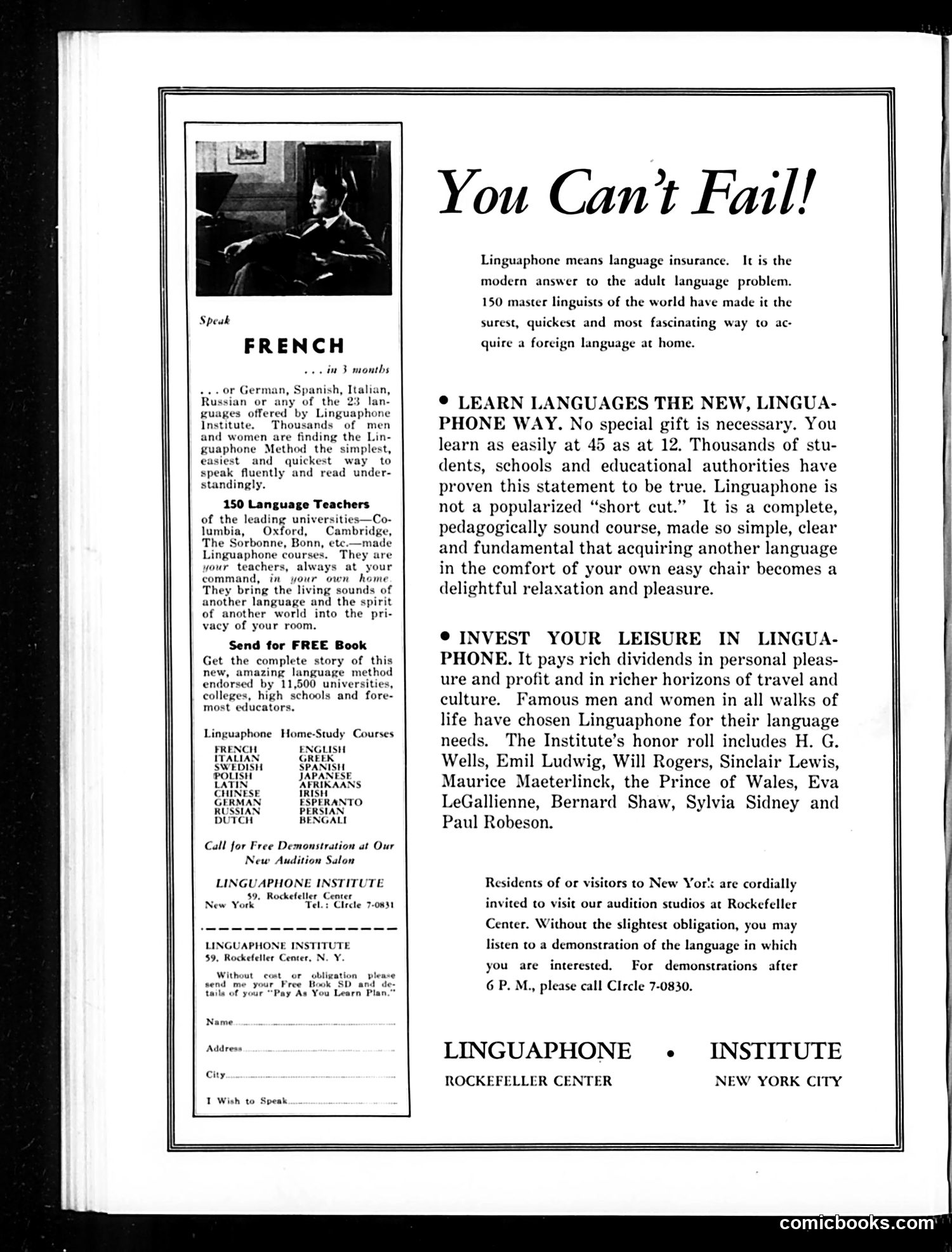
# Analysis This page is primarily an **advertisement for Linguaphone Institute**, a language-learning correspondence course, rather than satirical content. The top-left shows a photograph of a man speaking French, labeled "Speak FRENCH... in 3 months." The ad's humor is implicit rather than explicit: it promises remarkably rapid language acquisition ("as easily at 45 as at 12") and claims famous figures including H.G. Wells, Emil Ludwig, and Paul Robeson used the method. The "You Can't Fail!" headline uses hyperbolic confidence typical of mid-20th-century advertising. There is no political satire or caricature present. This appears to be a straightforward (if somewhat exaggerated) commercial pitch placed within Judge magazine, reflecting the publication's reliance on advertising revenue alongside editorial content.
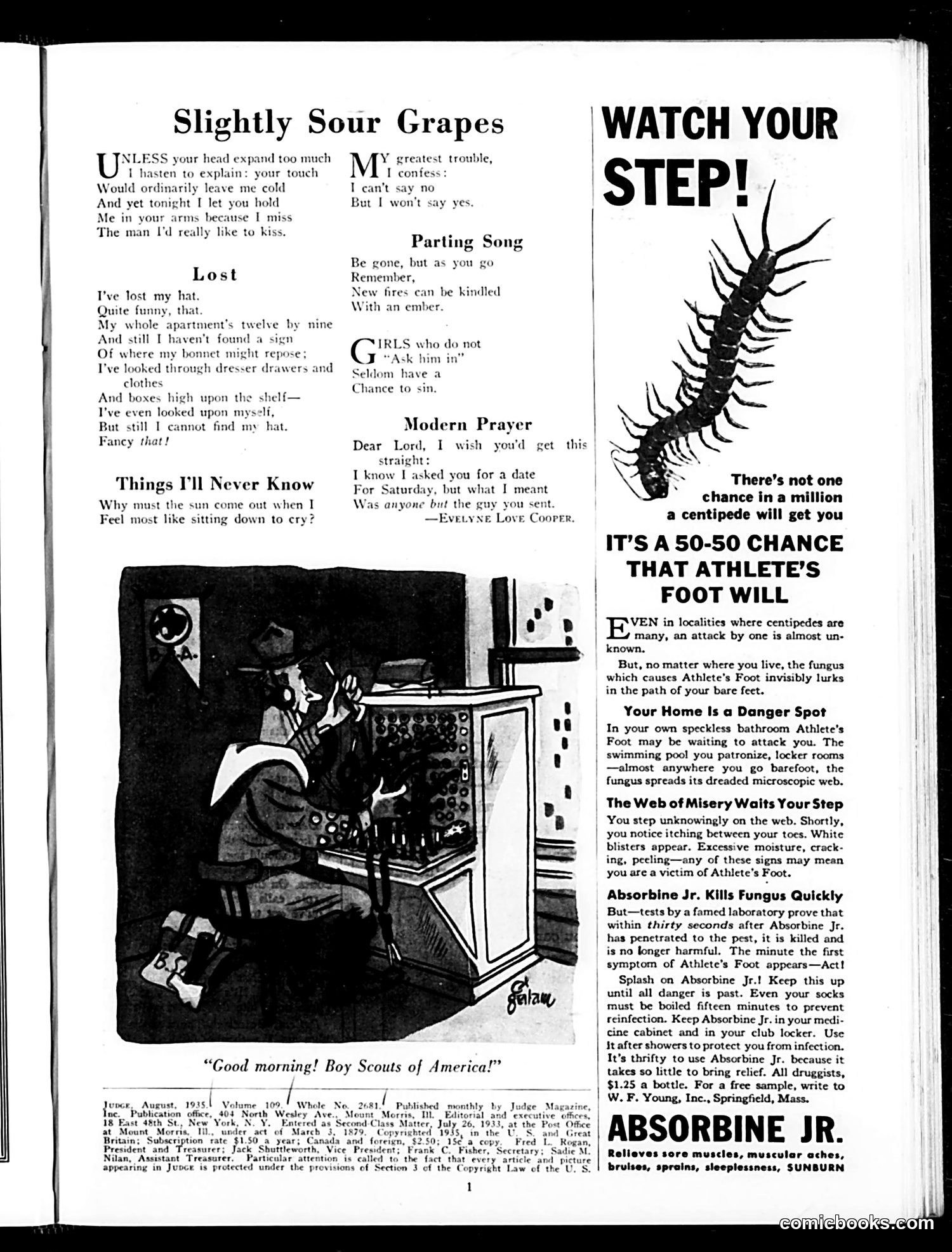
# Judge Magazine Page Analysis This page combines poetry and advertising. The left side features light verse on romantic disappointment and loss, typical of Judge's humor. The main cartoon (captioned "Good morning! Boy Scouts of America!") depicts a person at a radio, likely satirizing early 1930s domestic life and the popularity of radio broadcasts. The right side is dominated by an advertisement for Absorbine Jr., a topical medicine. The "WATCH YOUR STEP!" heading and centipede image are marketing devices warning readers about athlete's foot fungus. This reflects genuine health concerns of the era before modern antifungal treatments. The ad emphasizes the product's speed and effectiveness, typical of period medical advertising that often made bold claims. The placement alongside family-oriented content suggests the product's mainstream consumer appeal.
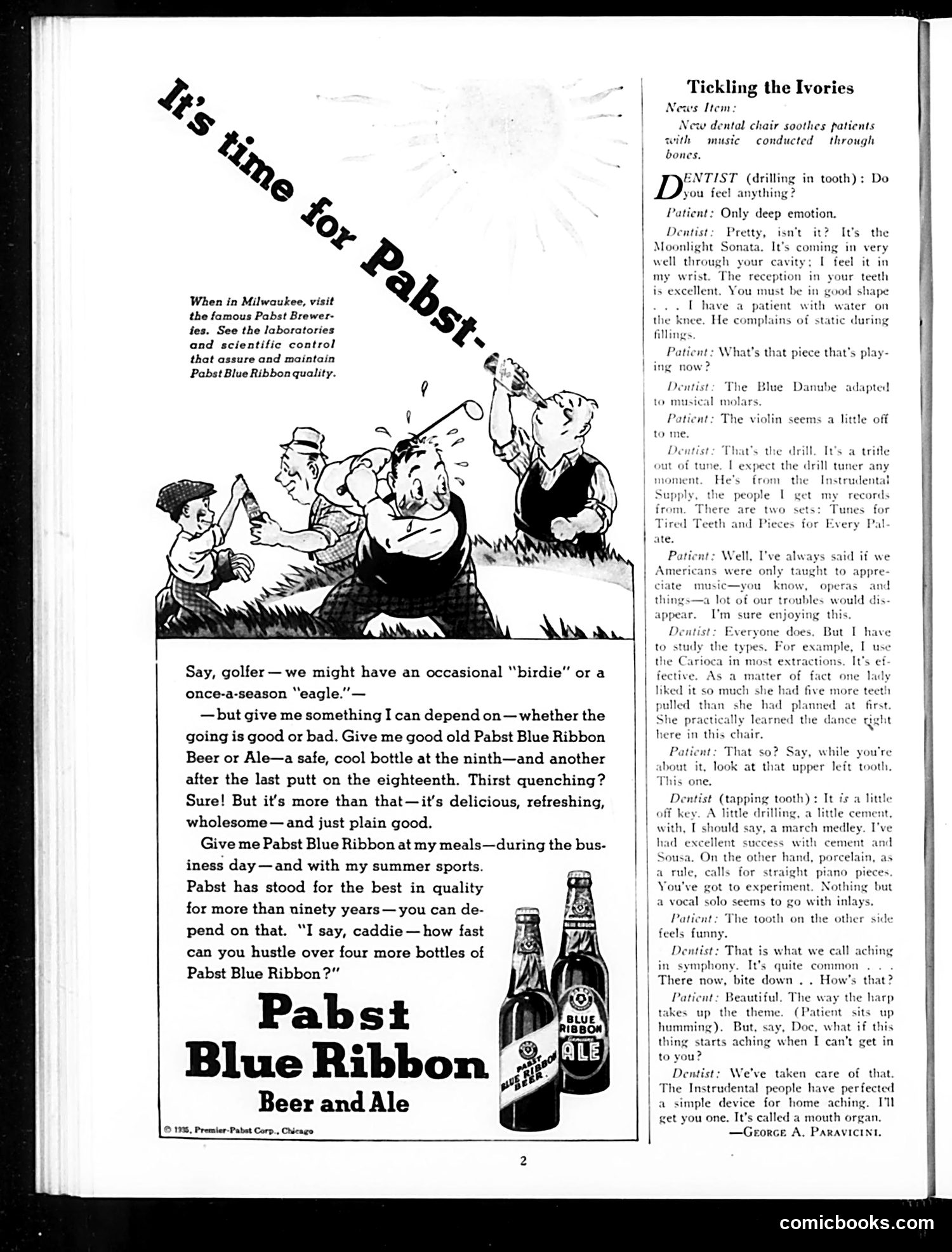
# Analysis This page is primarily **advertising, not political satire**. The left side features a full Pabst Blue Ribbon Beer and Ale advertisement with a cartoon showing golfers. The ad uses humor to pitch beer as a reliable beverage for leisure activities and meals, with the tagline emphasizing Pabst's "ninety years" of dependability. The right side contains "Tickling the Ivories," a humorous dialogue between a dentist and patient. The dentist plays classical music (Moonlight Sonata, Blue Danube) through a drill vibrating the patient's teeth, creating an absurd musical experience. The humor derives from the unexpected juxtaposition of dental work and high culture—turning painful procedure into inadvertent concert performance. This is light comedy, not political commentary.
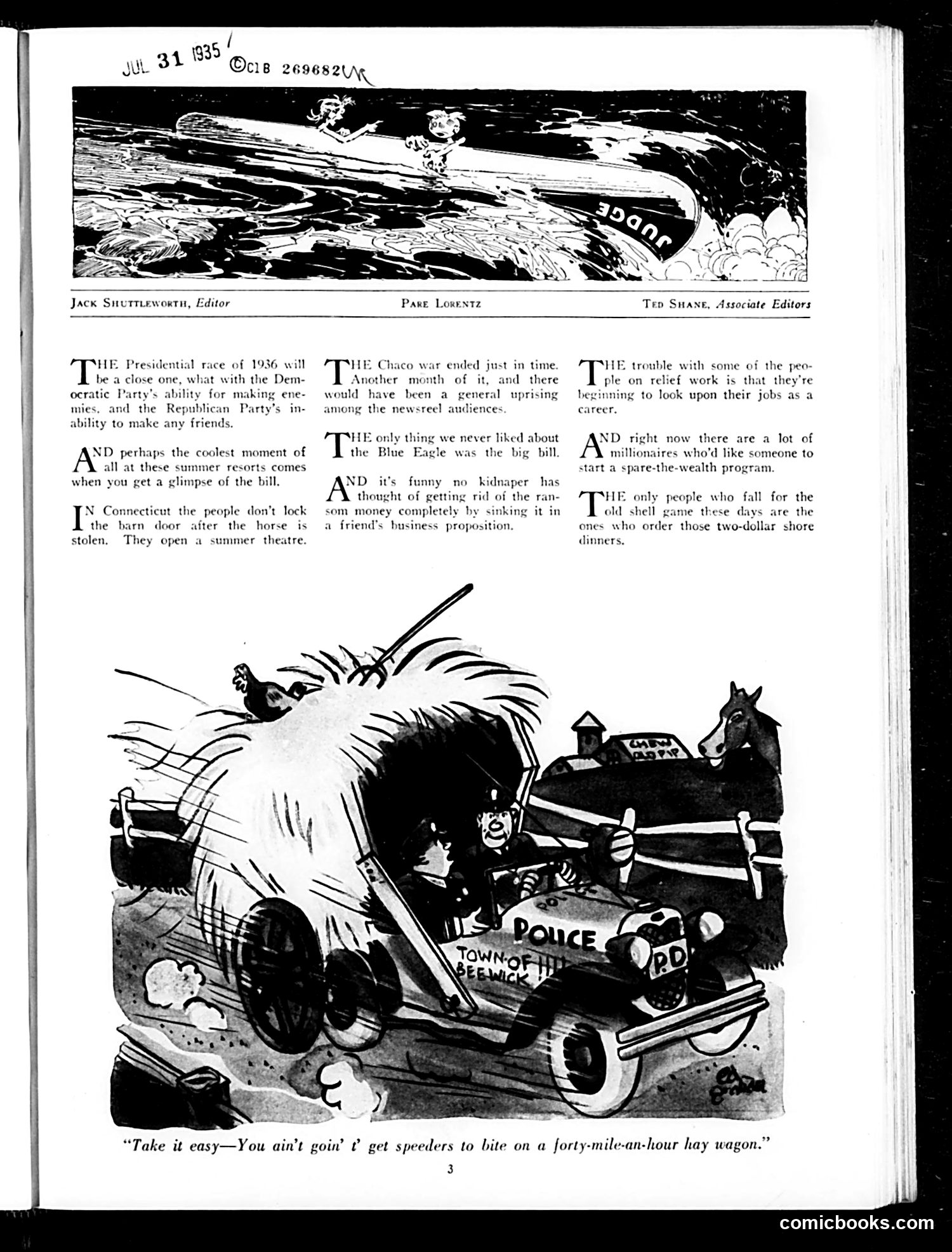
# Analysis of Judge Magazine Page (July 31, 1935) The main cartoon depicts a police officer in a tiny car being struck by an enormous hay wagon. The caption reads: "Take it easy—You ain't goin' t' get speeders to bite on a forty-mile-an-hour hay wagon." This is rural satire: a small-town policeman attempts to enforce speed limits using a comically oversized farm implement as bait, assuming speeding drivers will be attracted to (and chase) it. The joke mocks ineffective small-town policing tactics and rural law enforcement's limitations. The editorial text above discusses the 1936 Presidential race, the Chaco War's conclusion, the "Blue Eagle" (NRA symbol), and economic complaints about millionaires and relief workers—typical Depression-era political commentary. The overall page reflects 1930s American concerns about politics, economics, and rural life.
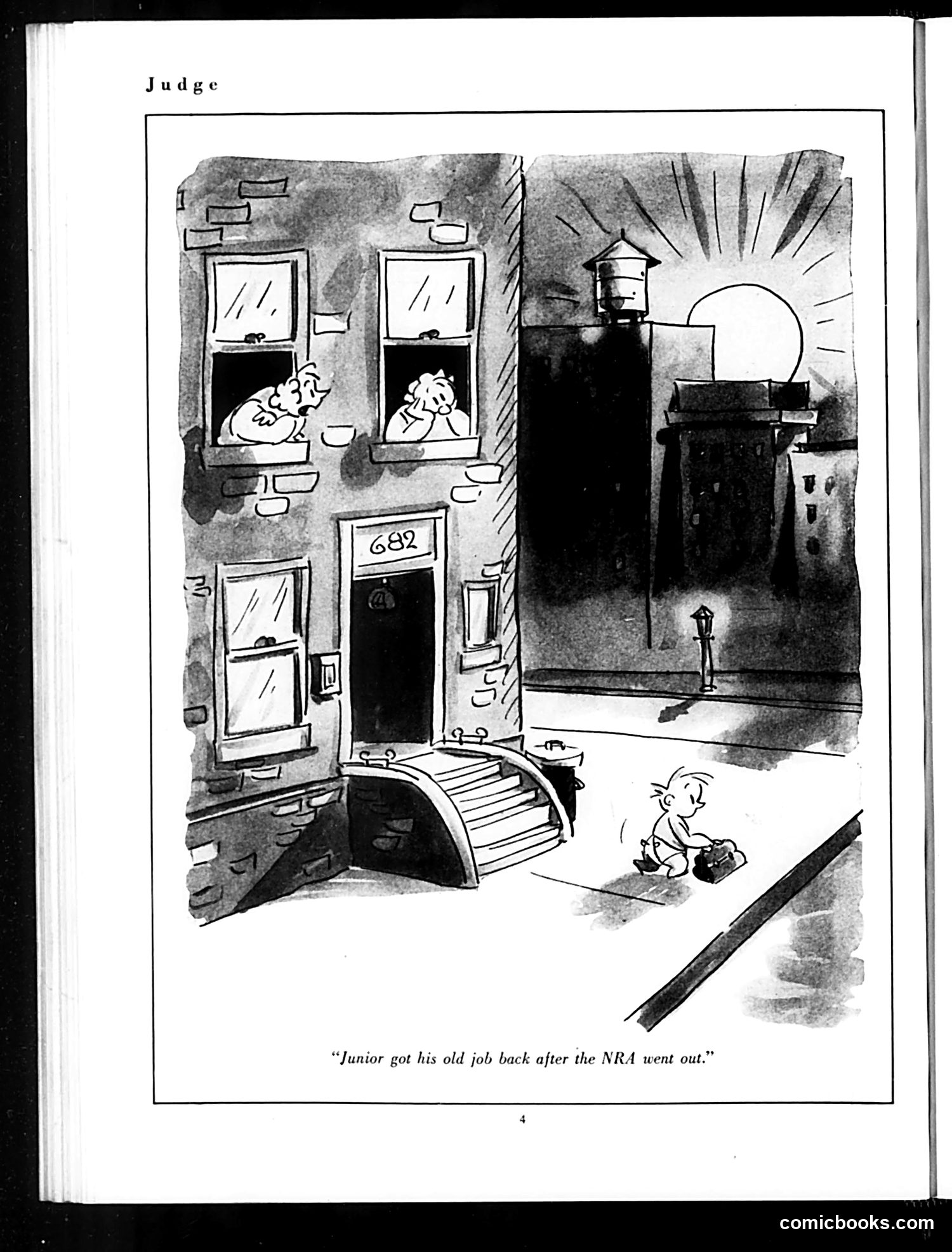
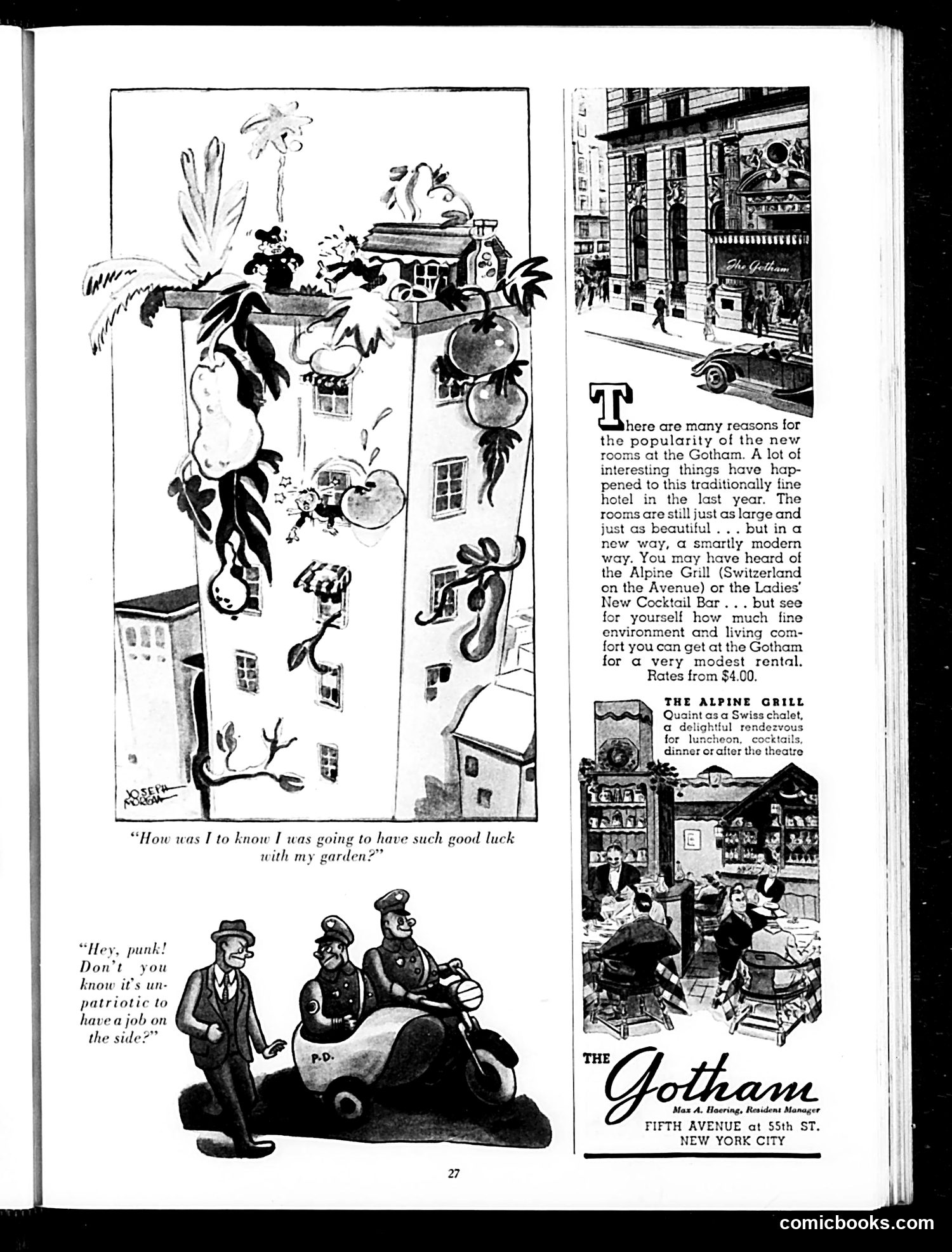
# Analysis of Judge Cartoon Page This cartoon satirizes economic conditions following the National Recovery Administration (NRA), a New Deal program (1933-1935). The caption reads: "Junior got his old job back after the NRA went out." The image shows a tenement building with residents in windows overlooking a street scene. A small child carries a toolbox or lunch pail, apparently returning to child labor work. The satire critiques the NRA's collapse by suggesting that without its protections, vulnerable workers—specifically children—were forced back into exploitative labor conditions. The cartoon reflects contemporary anxieties about the Depression era and debates over New Deal effectiveness. It uses dark humor to highlight social consequences of losing Depression-era worker protections, particularly the vulnerability of child laborers.
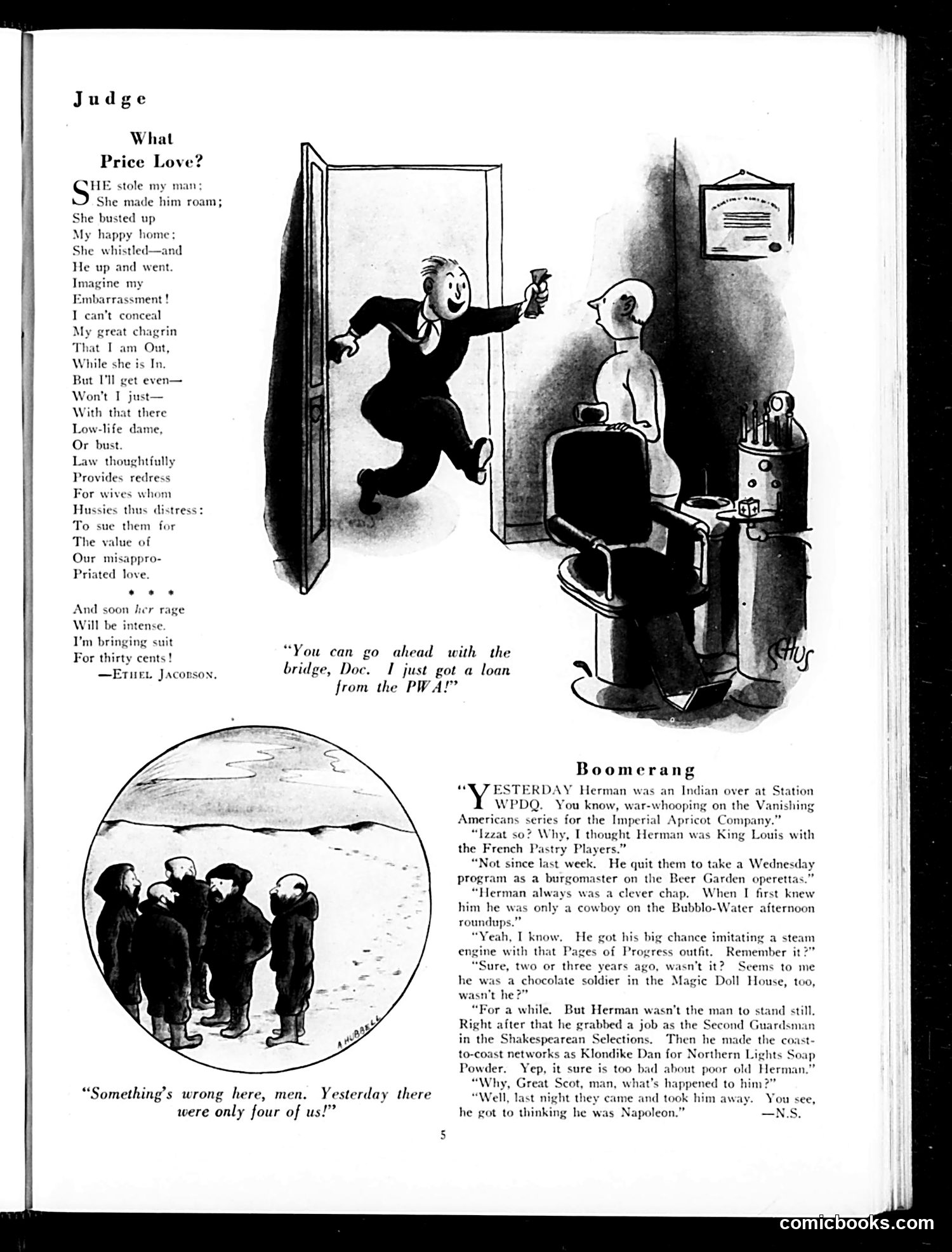
# Analysis of Judge Magazine Page 5 **Top Cartoon ("What Price Love?"):** A woman has left her husband, causing him distress. The poem by Ethel Jacobson suggests a husband's frustration with his wife's infidelity and her subsequent demands—likely for alimony or settlement. The cartoon shows a man at a doctor's office receiving the news that his wife left him, while he ruefully discusses finances. The satire targets both the wife's apparent indiscretion and contemporary divorce proceedings that financially disadvantaged men. **Bottom Section ("Boomerang"):** This anecdote describes Herman, an Indian performer at a radio station (WPDO) who worked in various entertainment capacities—from Shakespearean productions to soap powder advertisements. The humor stems from his repeated career boomerangs: each ambitious attempt (steam engine imitation, etc.) failed, always returning him to lesser positions, like "thinking he was Napoleon." The satire mocks both the entertainment industry's fickleness and performers' delusions of grandeur.
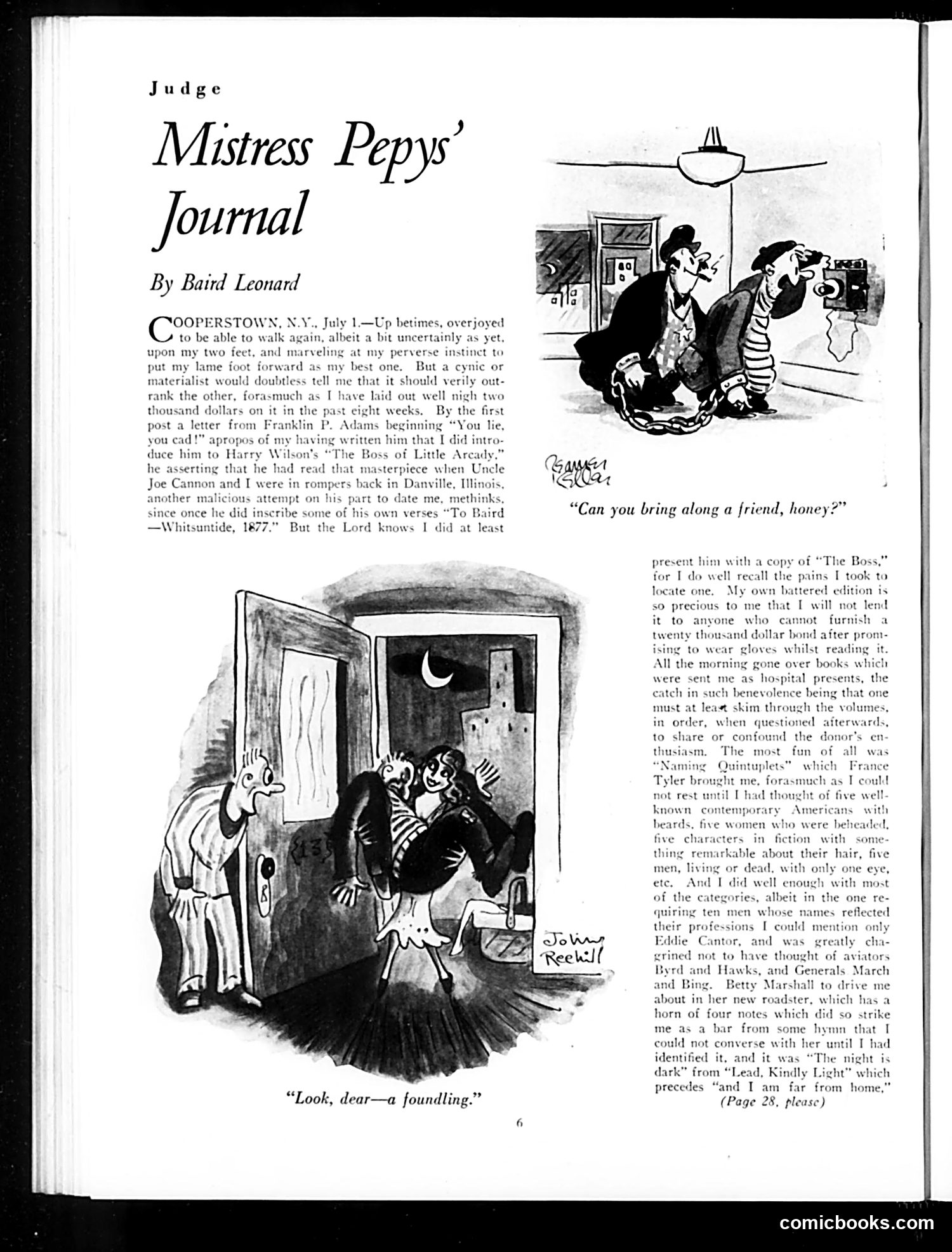
# Analysis of Judge Magazine Page This page contains "Mistress Pepys' Journal" by Baird Leonard, a humorous column referencing Samuel Pepys' famous historical diary. The two cartoons illustrate anecdotes from the author's life. The upper cartoon shows a cameraman asking "Can you bring along a friend, honey?"—likely satirizing Hollywood's casual attitude toward romantic relationships. The lower cartoon depicts someone at a doorway exclaiming "Look, dear—a foundling," suggesting a comedic domestic scenario. The text discusses the author's efforts to locate a copy of Harry Wilson's "The Boss of Little Arcady" and various literary mishaps. References to contemporary figures like Betty Marshall and her automobile suggest 1920s-era social commentary, though the exact satirical targets remain unclear without fuller context.
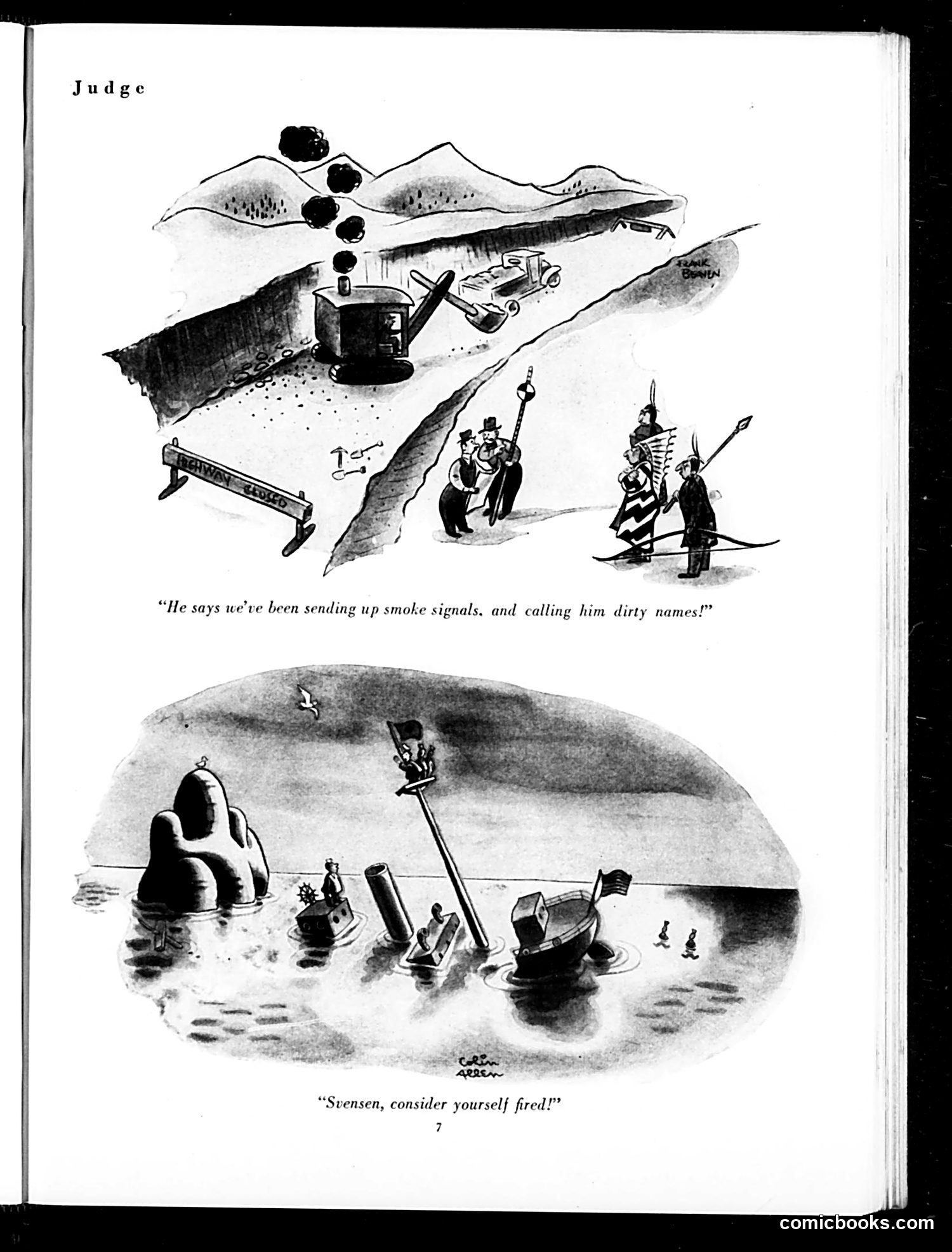
# Analysis of Judge Page This page contains two political cartoons satirizing a military or naval figure (likely a commanding officer or admiral) named Svensen. **Top cartoon:** Military personnel on land accuse Svensen of sending "smoke signals" and calling him "dirty names." The figure appears to be a high-ranking officer (suggested by the formal dress and authority position). **Bottom cartoon:** Svensen, apparently in a naval/submarine setting with various military vessels and fortifications visible, receives a dismissal order: "Svensen, consider yourself fired!" The satire appears to criticize Svensen's conduct—either unprofessional behavior (the "dirty names"), incompetence, or poor communication ("smoke signals"). The cartoon uses his firing as the punchline, suggesting he's being held accountable for his failures. The exact historical context remains unclear without additional dating information.
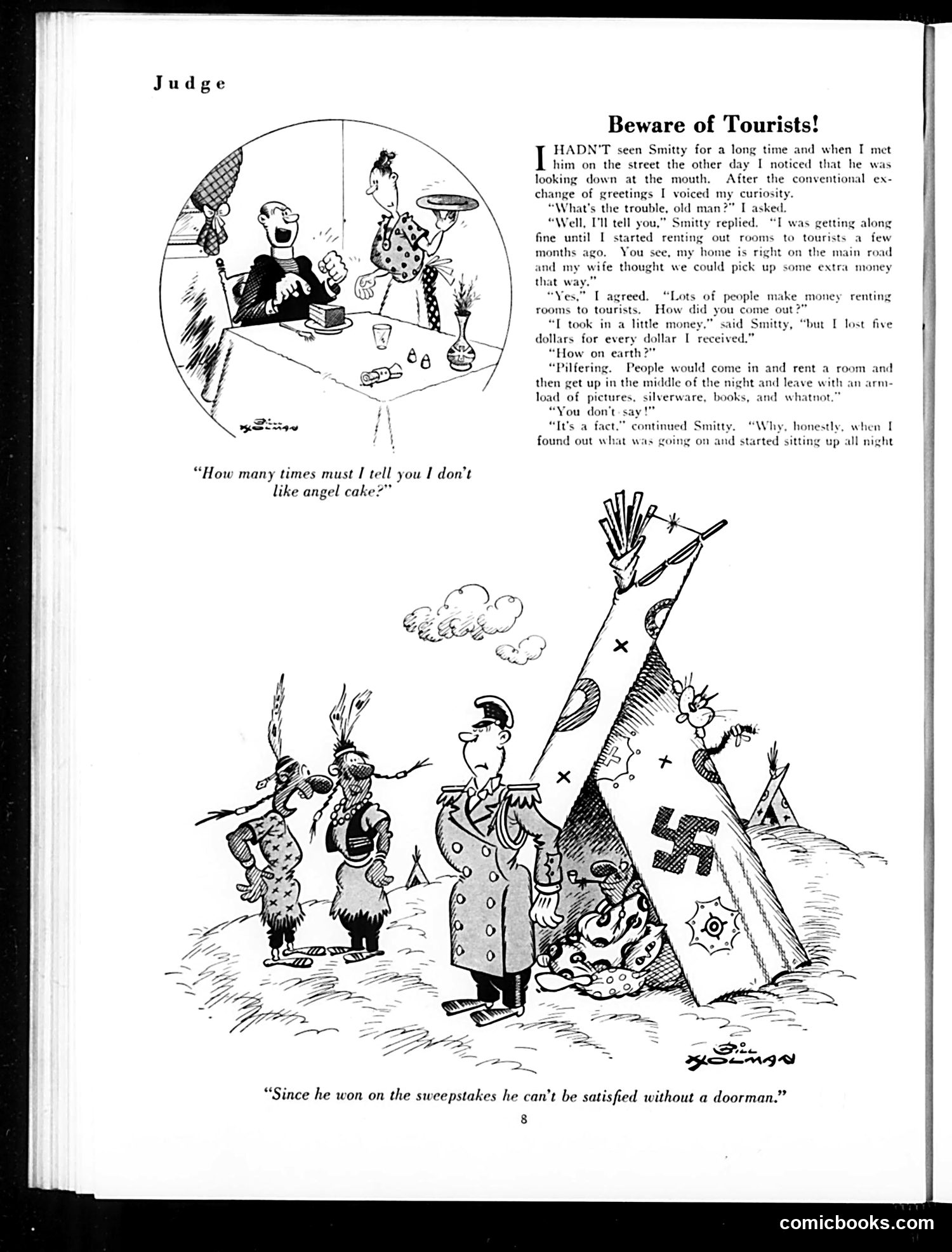
# "Beware of Tourists!" — Judge Magazine Satire This page contains two separate satirical cartoons mocking social anxieties of the era. **Top cartoon:** A domestic dispute where a husband repeatedly complains about angel cake, illustrating marital frustration over trivial matters. **Main story & bottom cartoon:** A cautionary tale about renting rooms to tourists. "Smitty" describes how his home-rental scheme backfired: tourists systematically stole his possessions—pictures, silverware, books—leaving him financially ruined despite charging fees. The story warns middle-class homeowners against this money-making scheme. **Bottom cartoon's secondary joke:** A nouveau-riche sweepstakes winner has become so pretentious after winning that he now demands a doorman, mocking social climbing and the corrupting effects of sudden wealth. The satire targets both the dishonesty of travelers and the false assumptions of ordinary people trying to profit from hospitality. The page reflects anxieties about tourism, theft, and changing social class mobility in early 20th-century America.
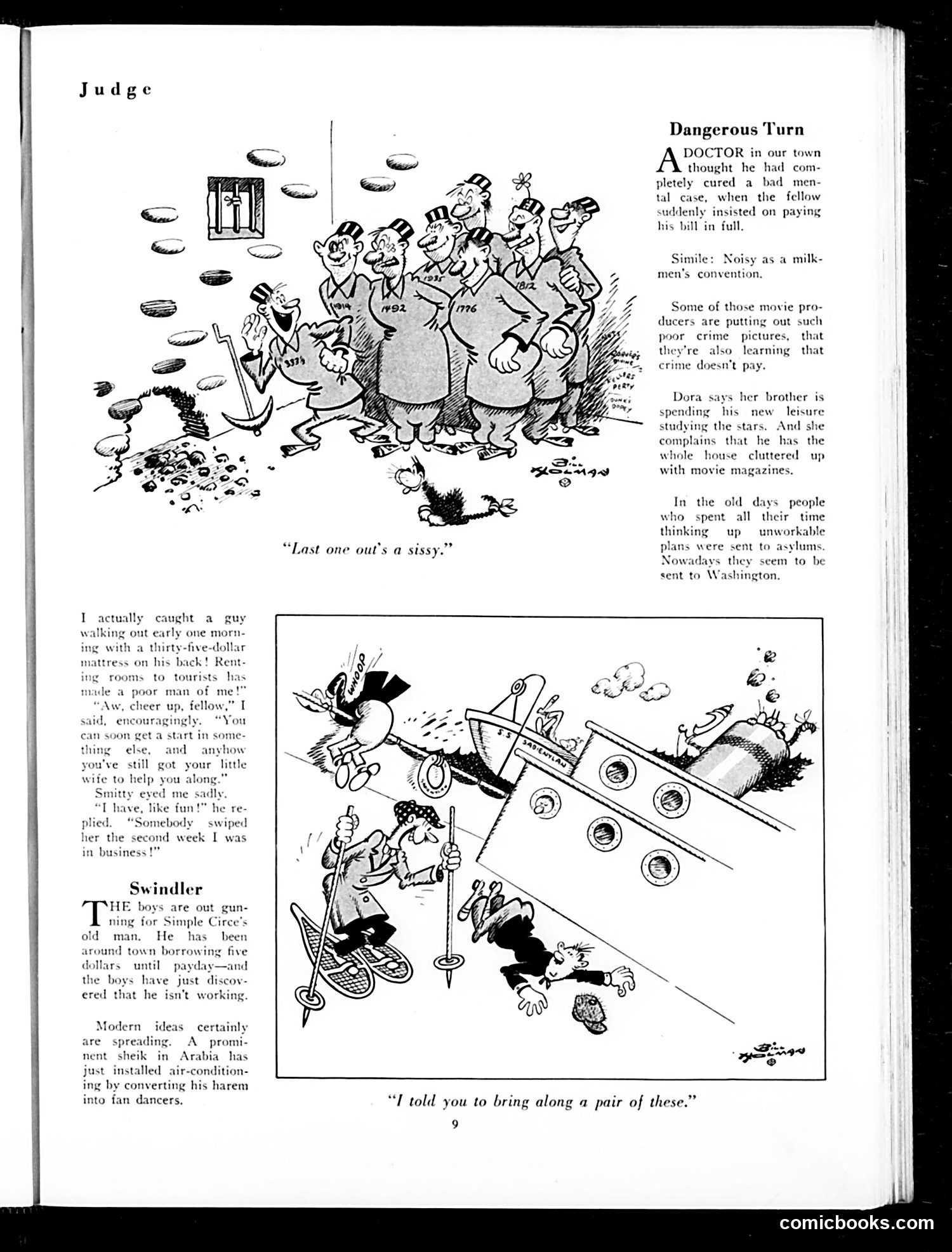
# Judge Magazine Page Analysis This page contains several short satirical pieces typical of Judge's humor: **"Dangerous Turn"** mocks a psychiatric patient who, after being "cured," insists on paying his doctor's bill in full—suggesting his mental illness has worsened. The satire implies that financially responsible behavior is itself a sign of insanity. **"Swindler"** describes con artists targeting rental-room landlords, playing on post-WWI economic anxieties about urban crime and financial vulnerability. The bottom cartoon caption "I told you to bring along a pair of these" (showing what appears to be skis or similar equipment for an airplane) satirizes modern recreational trends. **Other brief items** joke about movie producers making poor crime films, a woman's brother spending leisure time with movie magazines, and—in a jab at Washington—comparing ineffectual politicians to historically institutionalized dreamers. The humor reflects 1920s-era concerns: urban crime, changing social mores, and skepticism toward both Hollywood and government.
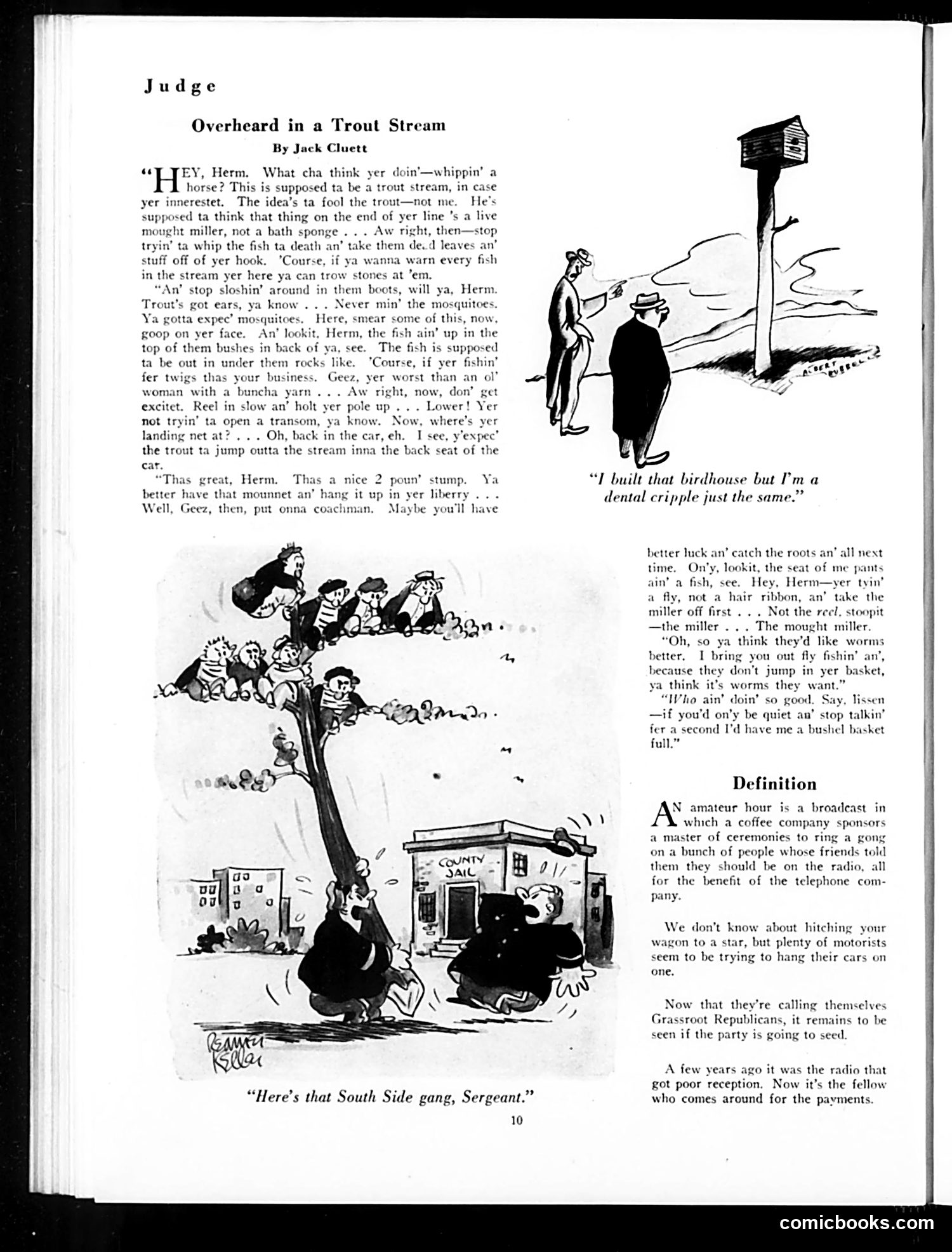
# "Overheard in a Trout Stream" - Explanation for Modern Readers This humorous story by Jack Cluett depicts an experienced fisherman (Herm) patiently instructing an incompetent novice on fly-fishing technique. The novice repeatedly makes amateur mistakes: using a bath sponge instead of a proper lure, thrashing about loudly, standing in the water splashing, tangling his line in tree branches and the car seat, and confusing a hair ribbon with fishing equipment. The satire targets the arrogance of rank beginners who ignore expert advice. The exasperated instructor's running commentary—delivered in working-class dialect—humorously catalogs each blunder while the novice insists on trying obviously wrong approaches (like using worms instead of flies). The accompanying cartoons and brief "Definition" section offer unrelated social commentary on radio amateur hours and other contemporary topics, typical of Judge magazine's mixed-content format.