
Judge, 1935-08 · page 23 of 36
Judge — August 1935 — page 23: what you’re looking at
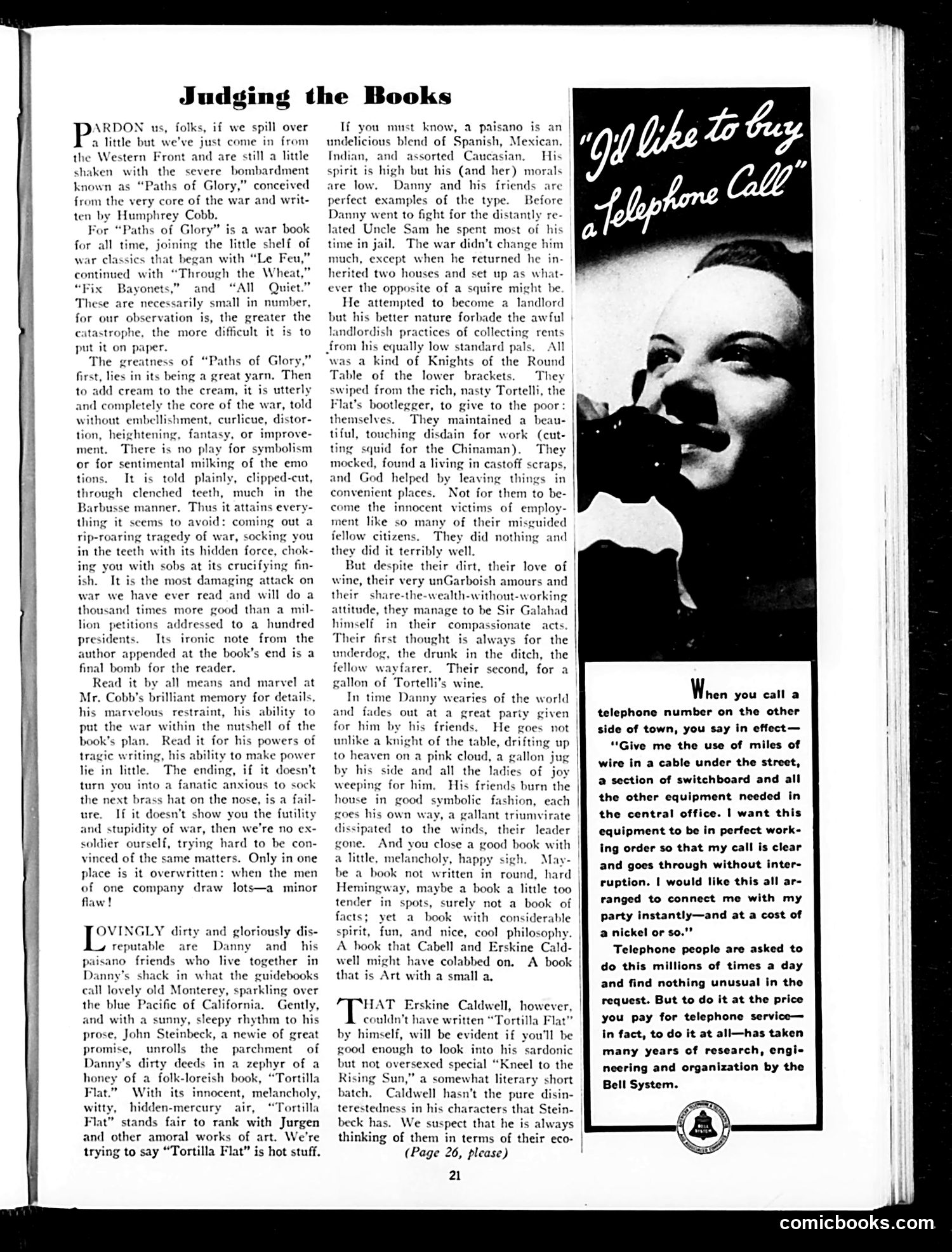
A restored page from Judge, 1935-08. Page through the whole issue in the reader above.
📄 Transcribed text from this page (OCR, searchable)
Machine-transcribed from the original scan — historical spelling and the odd misread are preserved.
Judging the Book \RDON us, folks, if we spill over a little but we've just come in from the Western Front and are still a little shaken with the severe bombardment known as “Paths of Glory,” conceived from the very core of the war and writ- ten by Humphrey Cobb. Paths of Glory” is a war book for all time, joining the little shelf of war classics that began with “Le Feu,” continued with “Through the Wheat,” “Fix Bayonets,” and “All Quiet. These are necessarily small in number, rr our observation is, the greater the astrophe, the more difficult it is to put it on paper. The greatness of “Paths of Glory,” first, lies in its being a great yarn. Then to add cream to the cream, it is utterly and completely the core of the war, told without embellishment, curlicue, distor- ighteni fa y, or improve- ment. There is no play for symbolism or for sentimental milking of the emo tions, It is told plainly, clipped-cut, through clenched teeth, much in the Barbusse manner. Thus it attains every- thing it seems to avoid: coming out a rip-roaring tragedy of war, socking you in the teeth with its hidden force, chol ing you with sobs at its crucifying fin- ish. It is the most damaging attack on war we have ever read and will do a thousand times more good than a mil- lion petitions addressed to a hundred presidents. Its ironic note from the author appended at the book’s end is a final bomb for the reader. Read it by all means and marvel at Mr. Cobb’s brilliant memory for details, his marvelous restraint, his ability to put the war within the nutshell of the book’s plan. Read it for his powers of tragic writing, his ability to make power lie in little. The ending, if it doesn’t turn you into a fanatic anxious to sock the next brass hat on the nose, is a fail- ure. If it doesn’t show you the futility and stupidity of war, then we're no ex- soldier ourself, trying hard to be con- vinced of the same matters. Only in one place is it overwritten: when the men of one company draw lots—a minor flaw! tion, OVINGLY dirty and gloriously dis- reputable are Danny and_ his paisano friends who live together in Danny's shack in what the guidebooks call lovely old Monterey, sparkling over the blue Pacific of California. Gently, and with a sunny, sleepy rhythm to his prose, John Steinbeck, a newie of great promise, unrolls the parchment of Danny’s dirty deeds in a zephyr of a honey of a folk-loreish book, “Tortills Flat.”| With its innocent, melancholy, witty, hidden-mercury air, “Tortilla Flat” stands fair to rank with Jurgen and other amoral works of art. We're trying to say “Tortilla Flat” is hot stuff. If you must know, a paisano is an undelicious blend of Spanish, Mexican. Indian, and assorted Caucasian. His spirit is high but his (and her) morals are low. Danny and his friends ar perfect examples of the type. Before Danny went to fight for the distantly re- lated Uncle Sam he spent most of his time in jail, ne war didn’t change him much, except when he returned he in- herited two houses and set up as what- ever the opposite of a squire might be. He attempted to become a landlord but his better nature forbade the awful landlordish practices of collecting rents from his equally low standard pals. All was a kind of Knights of the Round Table of the lower brack They swiped from the rich, nasty Tortelli, the Flat’s bootlegger, to give to the poor: themselves. tiful, touching disdain for work (cut- ting squid for the Chinaman). They mocked, found a living in castoff scraps, and God helped by leaving things in | convenient places. Not for them to be- come the innocent victims of employ- ment like so many of their misguided fellow citizens. They did nothing and they did it terribly well. But despite their dirt, their love of wine, their very unGarboish amours and their share-the-wealth-without-working attitude, they manage to be Sir Galahad himself in’ their compassionate acts. Their first thought is always for the underd: the drunk in the ditch, the fellow wayfarer. Their second, for a gallon of Tortelli’s wine. In time Danny wearies of the world and fades out at a great party given for him by his friends, He goes not unlike a knight of the table, drifting up to heaven on a pink cloud, a gallon jug by his side and all the ladies of joy weeping for him. His friends burn the house in good symbolic ion, each goes his own way, a gallant triumvirate dissipated to the winds, their leader gone. And you close a good book with a little, melancholy, happy sigh. May- be a book not written in round, hard Hemingway, maybe a book a little too tender in spots, surely not a book of facts; yet a book with considerable spirit, fun, and nice, cool philosophy. A book that Cabell and Erskine Cald- well might have colabbed on. A book that is Art with a small a, HAT Erskine Caldwell, however, couldn't have written “Tortilla Flat” by himself, will be evident if you'll be good enough to look into his sardonic but not oversexed special “Kneel to the Rising Sun,” a somewhat literary short batch, Caldwell hasn't the pure disin- terestedness in his characters that Stein- beck has. We suspect that he is always thinking of them in terms of their eco- (Page 26, please) 21 hey maintained a beau- | When you call a telephone number on the other side of town, you say in effect— “Give me the use of miles of wire in a cable under the street, a section of switchboard and all the other equipment needed in the central office. | want this equipment to be in perfect work- ing order so that my call is clear and goes through without inter- ruption. | would like this all ar- ranged to connect me with my party instantly—and at a cost of a nickel or so."” Telephone people are asked to do this millions of times a day and find nothing unusual in the request. But to do it at the price you pay for telephone service— in fact, to do it at all—has taken many years of research, engi- neering and organization by the Bell System. comicbooks.com.