
Judge, 1935-08 · page 14 of 36
Judge — August 1935 — page 14: what you’re looking at
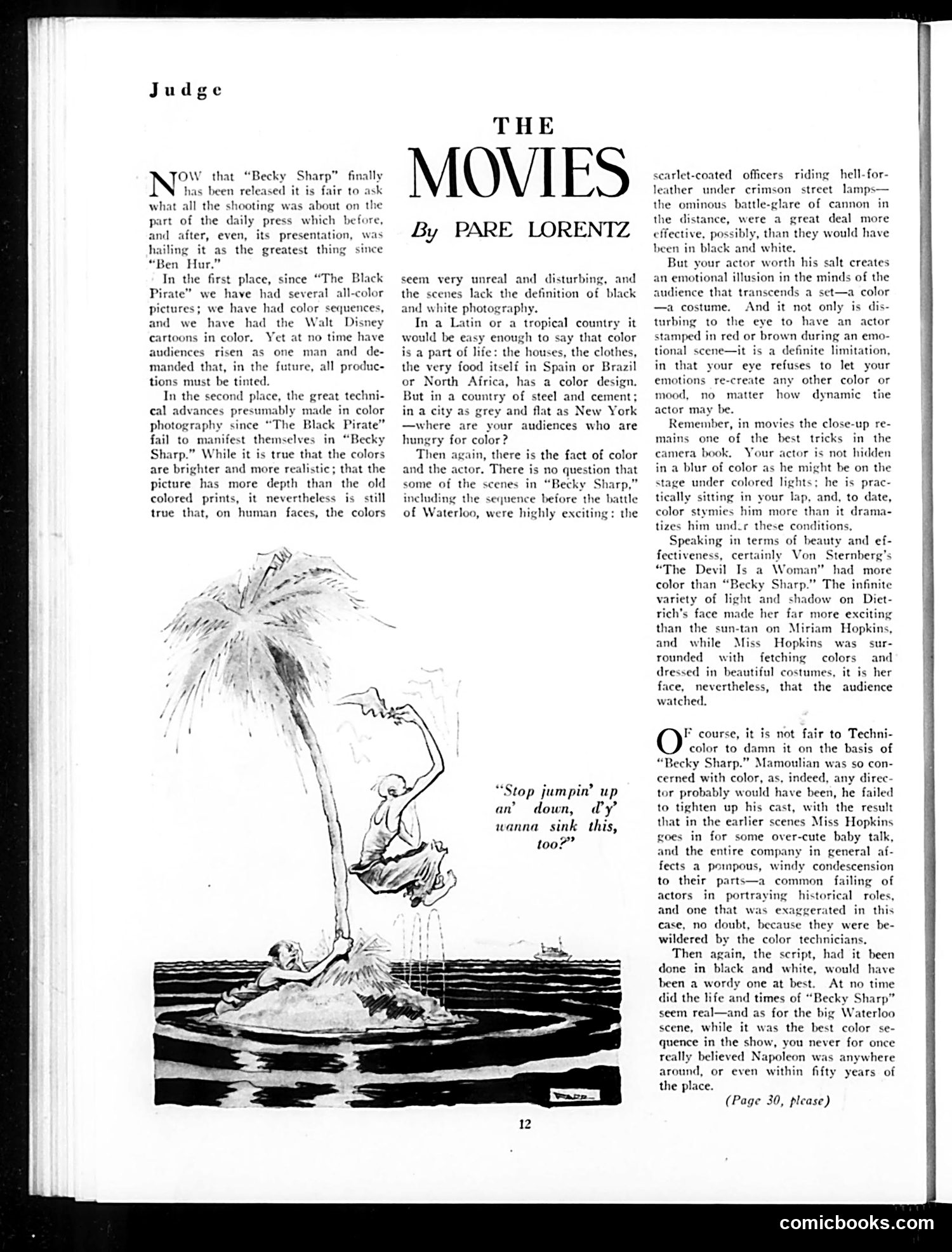
A restored page from Judge, 1935-08. Page through the whole issue in the reader above.
📄 Transcribed text from this page (OCR, searchable)
Machine-transcribed from the original scan — historical spelling and the odd misread are preserved.
Judge No that “Becky Sharp” finally has been released it is fair to ask what all the shooting was about on th part of the daily press which before, nd after, even, its presentation, was hailing it as the greatest thing since “Ben Hur.” In the first place, since “The Black Pirate” we have had several all-color pictures; we have had color sequences, and we have had the Walt Disney cartoons in color. Yet at no time have audiences risen as one man and de- manded that, in the future, all produc- tions must be tinted. In the second place, the great techni- cal advances presumably made in color photography since “The Black Pirate” fail to manifest themselves in “Becky Sharp.” While it is true that the colors are brighter and more realistic; that the picture has more depth than the old colored prints, it nevertheless is still true that, on human es, the colors THE MOVIES By PARE LORENTZ seem very unreal and disturbing, and the scenes lack the definition of black and white photography. In a Latin or a tropical country it would be easy enough to say that color is a part of life: the houses, the clothes, the very food itself in Spain or Brazil or North Africa, has a color design. But in a country of steel and cement; in a city as grey and flat as New York —where are your audiences who are hungry for color? Then in, there is the fact of color and the actor. There is no question that some of the scenes in “Becky Sharp,” including the sequence before the battle of Waterloo, were highly exciting: the “Stop jumpin’ up ; > an dou ny, dy wanna sink this, too?” searlet-coated officers riding hell-for- Jeather under crimson street lamps— the ominous battle-glare of cannon in the distance, were a great deal more effective, possibly, than they would have been in black and white, But your actor worth his salt creates an emotional illusion in the minds of the audience that transcends a set—a color a costume. And it not only is « turbing to the eye to have an actor stamped in red or brown during an emo- tional scene—it is a definite limitation, in that your eye refuses to let your emotions re-create any other color or mood, no matter how dynamic the actor may be. Remember, in movies the close-up re- mains one of the best tricks in the camera book. Your actor is not hidden in a blur of color as he might be on the ge under colored lights; he is prac- tically sitting in your lap, and, to date, color stymies him more than it drama- tizes him und.r these conditions, Speaking in terms of beauty and ef- fectiveness, certainly Vor ternberg’s “The Devil Is a Woman” had more color than “Becky Sharp.” The infinite variety of light and shadow on Diet- rich’s face made her far more exciting than the sun-tan on Miriam Hopkins, and while Miss Hopkins was sur- rounded with fetching colors and dressed in beautiful costumes, it is her face, nevertheless, that the audience watched. F course, it is not fair to Techni- color to damn it on the is of “Becky Sharp.” Mamoulian was so con- cerned with color, as, indeed, any direc- tor probably would have been, he failed to tighten up his cast, with the result that in the earlier scenes Miss Hopkins goes in for some over-cute baby talk, and the entire company in general af- fects a pompous, windy condescension to their parts—a common failing of actors in portraying historical roles, and one that was exaggerated in this case, no doubt, because they were be- wildered by the color technicians, Then again, the script, had it been done in black and white, would have been a wordy one at best. At no time did the life and times of “Becky Sharp” seem real—and as for the bi aterloo scene, while it was the best color se- quence in the show, you never for once really believed Napoleon was anywhere around, or even within fifty years of the place. (Page 30, please) comicbooks.com