A complete issue · 36 pages · 1934
Judge — April 1934
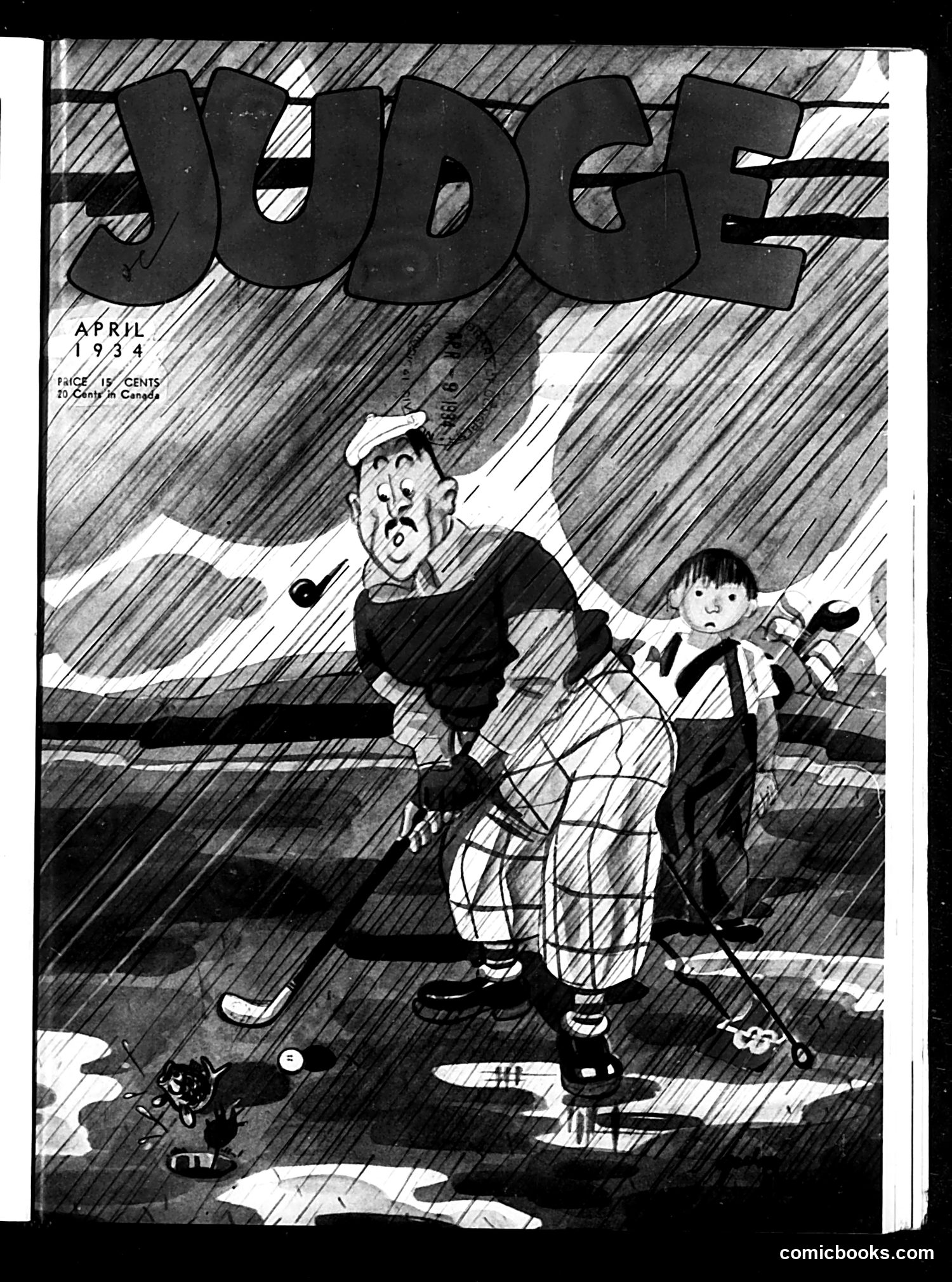
# Judge Magazine, April 1934 This cover depicts an adult and child caught in heavy rain, both appearing distressed and poorly clothed. The figure appears to be a working-class father struggling to protect his child from the downpour. Given the April 1934 date, this likely satirizes economic hardship during the Great Depression. The imagery suggests commentary on poverty and the plight of families unable to afford adequate shelter or clothing during this period. The "JUDGE" masthead indicates this is satirical commentary rather than straightforward news. The exaggerated, somewhat crude rendering of the figures' expressions emphasizes the desperation of their situation—a common editorial approach in Depression-era humor magazines that used comedy to address social suffering and critique economic conditions.
# Analysis This page is primarily **advertising, not political satire**. It promotes Schenley liquors and their "Mark of Merit" guarantee seal. The decorative emblem at the top—a starburst with ribbon banner—serves as the company's quality mark. The text instructs consumers to look for this mark on bottle necks as assurance of product quality from "the house of Schenley." The bottom line calls the Schenley mark "your unfailing guide," positioning it as a trusted indicator in an era when product regulation was limited and brand reputation mattered significantly for consumer confidence. This represents straightforward brand marketing rather than satirical commentary. The page demonstrates how Judge magazine, like most publications of its era, carried commercial advertisements alongside editorial content.
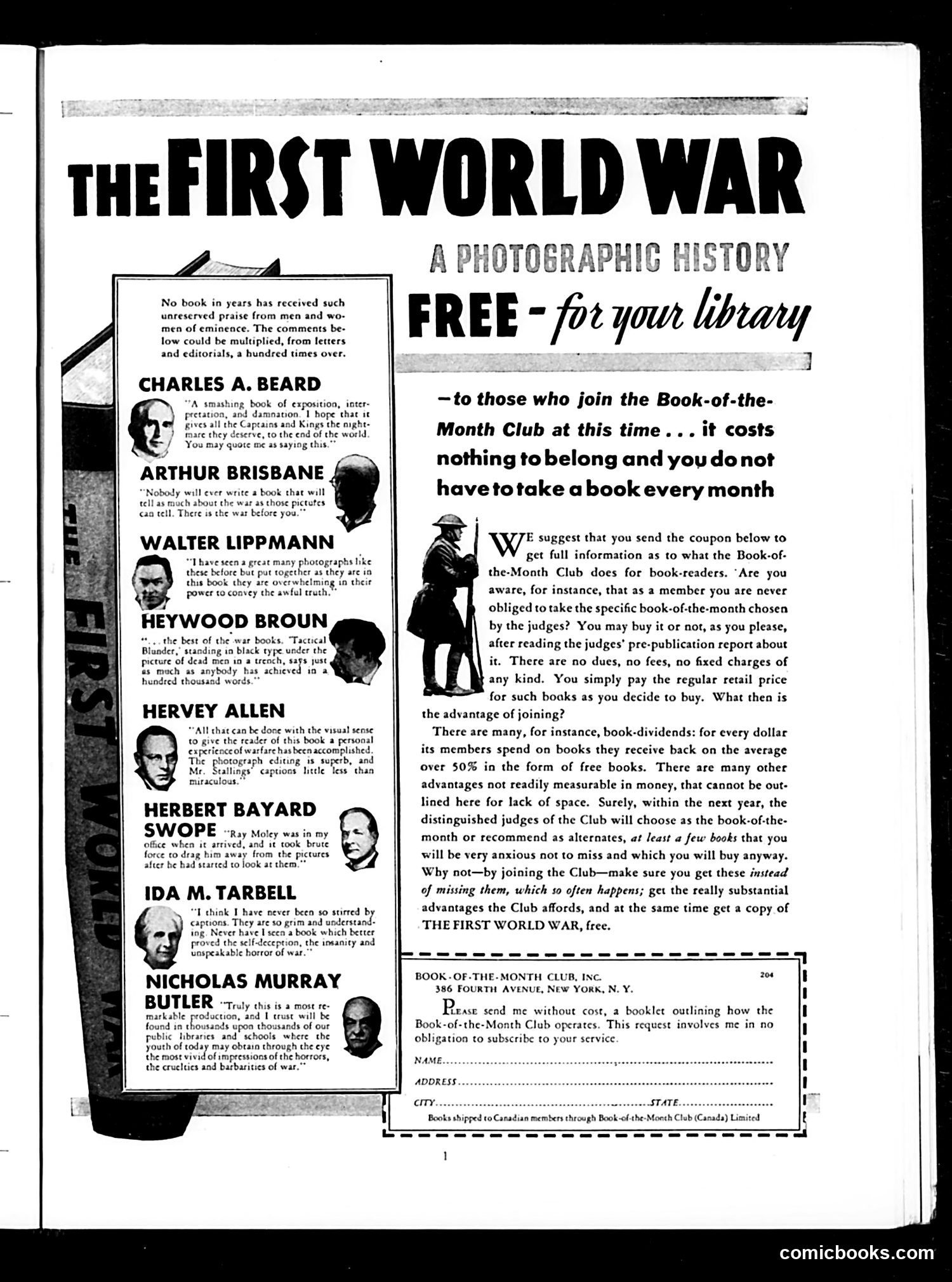
# Content Analysis This page is primarily **advertising**, not satire or cartoon commentary. It promotes "The First World War: A Photographic History" as a free gift for joining the Book-of-the-Month Club. The left side features **testimonials from notable figures** endorsing the book's value—including Charles A. Beard, Arthur Brisbane, Walter Lippmann, Heywood Broun, and others. Their quotes praise the book's photographic documentation of WWI's reality and historical importance. The right side explains the Book-of-the-Month Club's membership benefits: members receive free books (over 50% value in giveaways), pay only for selections they choose, and face no subscription obligation. The image shows a **soldier in military uniform**—likely representing WWI troops—reinforcing the book's war subject matter. This is a commercial appeal to readers, not political satire.
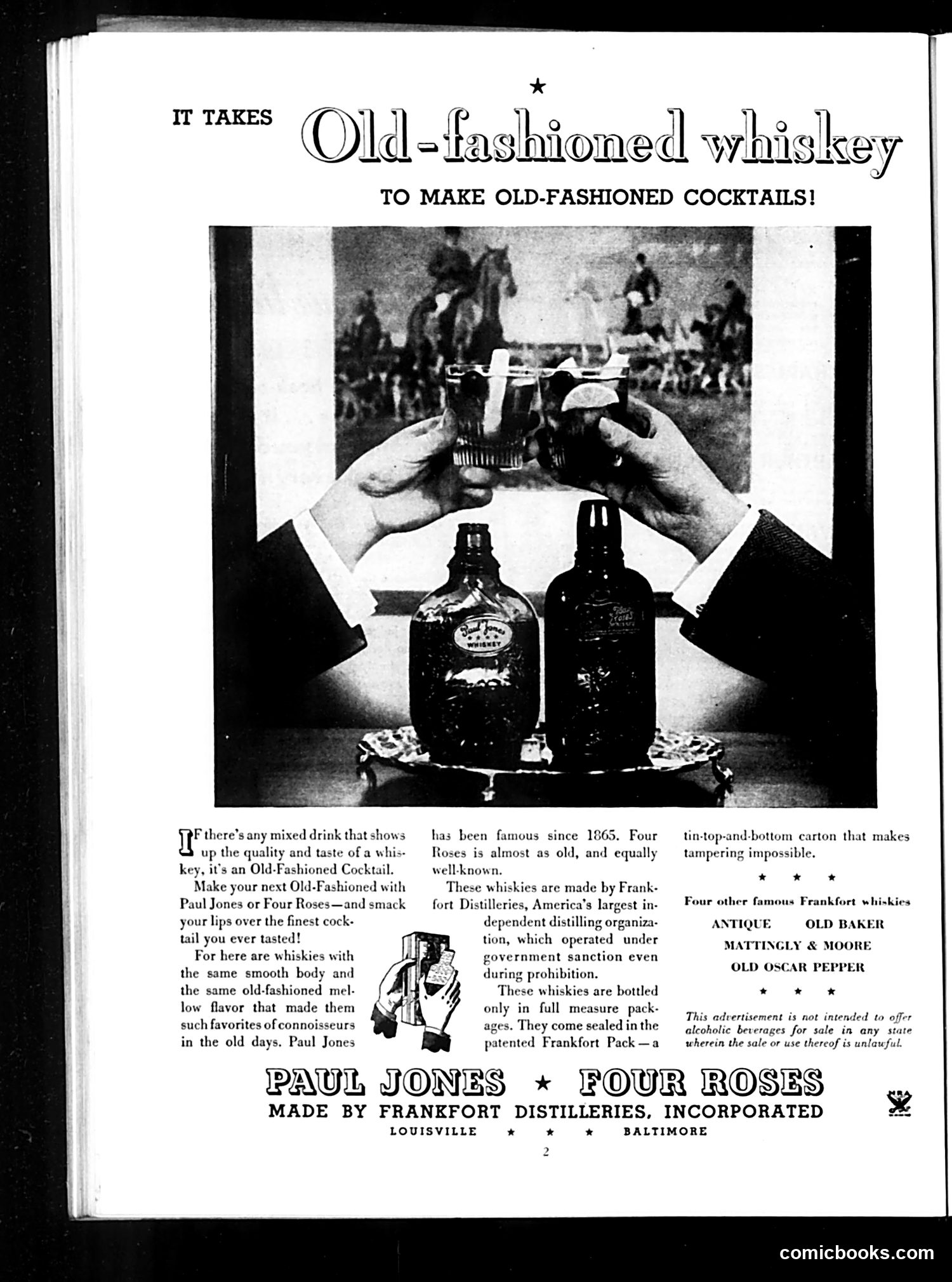
# Analysis This page is **primarily an advertisement**, not satire or political commentary. It promotes Paul Jones and Four Roses whiskeys made by Frankfort Distilleries (Louisville and Baltimore). The ad emphasizes that these are old, established whiskey brands (Paul Jones since 1865, Four Roses "almost as old") suitable for making Old Fashioned cocktails. The image shows hands holding cocktail glasses with whiskey bottles displayed below. The disclaimer at bottom—"This advertisement is not intended to offer alcoholic beverages for sale in any state wherein the sale or use thereof is unlawful"—suggests this ran during Prohibition or its aftermath, when alcohol sales were restricted or recently legalized. The ad's focus on quality heritage and proper packaging reflects post-Prohibition marketing strategies.
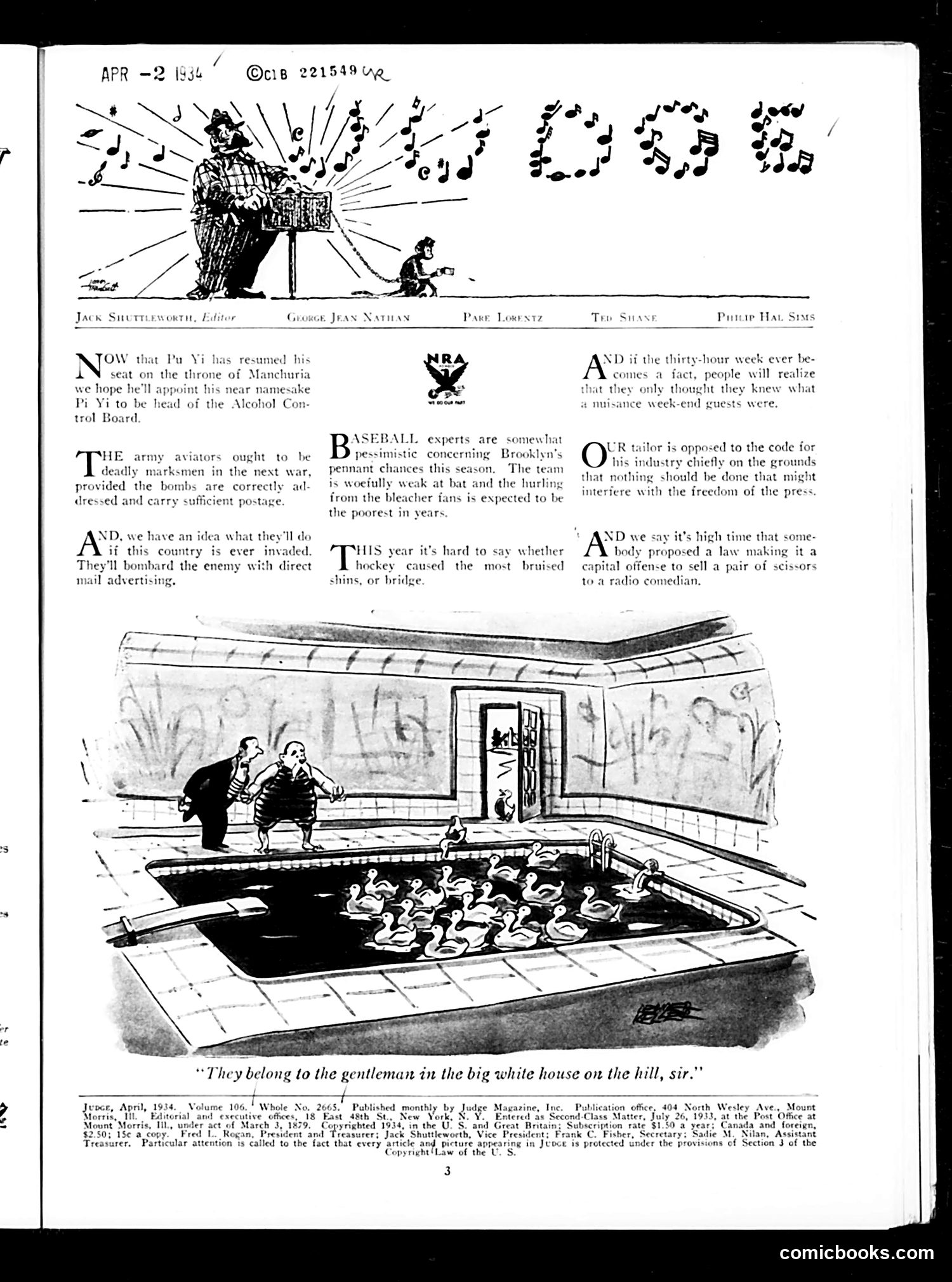
# Judge Magazine, April 1934 - Satire & Cartoon Analysis The page contains several brief satirical columns about current events, plus one prominent cartoon at the bottom. **The Cartoon:** Two men in suits stand beside an indoor swimming pool filled with ducks. The caption reads: "They belong to the gentleman in the big white house on the hill, sir." This is a joke about President Franklin D. Roosevelt at the White House, likely satirizing either his New Deal programs or his personal wealth/resources during the Depression era. **The Text:** Brief commentaries mock: - Pa Xi's (unclear reference) appointment to the Alcohol Control Board - Army aviators' bombing capabilities - Brooklyn's weak baseball team - Hockey injuries - A proposed law allowing scissors sales to comedians (absurdist humor) The overall tone is light political satire typical of 1930s American humor magazines.
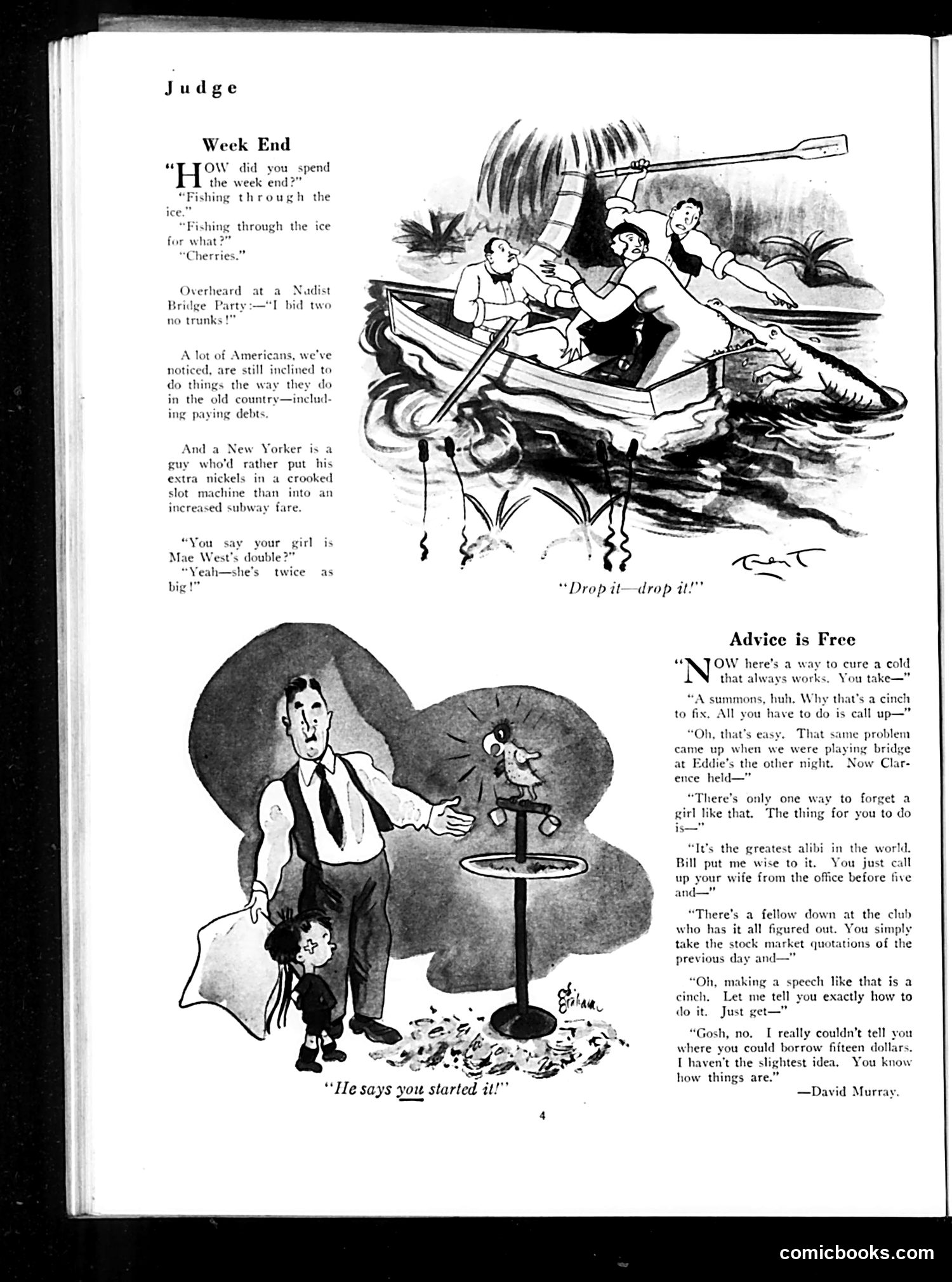
# Judge Magazine Page Analysis This page contains two humor pieces satirizing American social behavior: **"Week End"** mocks outdated leisure activities—particularly ice fishing for cherries, a nonsensical pursuit. The joke appears to reference how Americans cling to old-fashioned pastimes. A secondary joke references a "Nudist Bridge Party" where someone "bid two no trumps," playing on the double entendre of "no trunks" (clothing). **"Advice is Free"** satirizes male excuses for infidelity. A man blames a cold on his wife's "Mae West" physique (referencing the famous actress known for curvaceous appearance), then receives increasingly absurd advice about forgetting her—culminating in the suggestion to check stock market quotes or borrow money from the club. Both pieces mock masculine behavior and relationships during the interwar period.
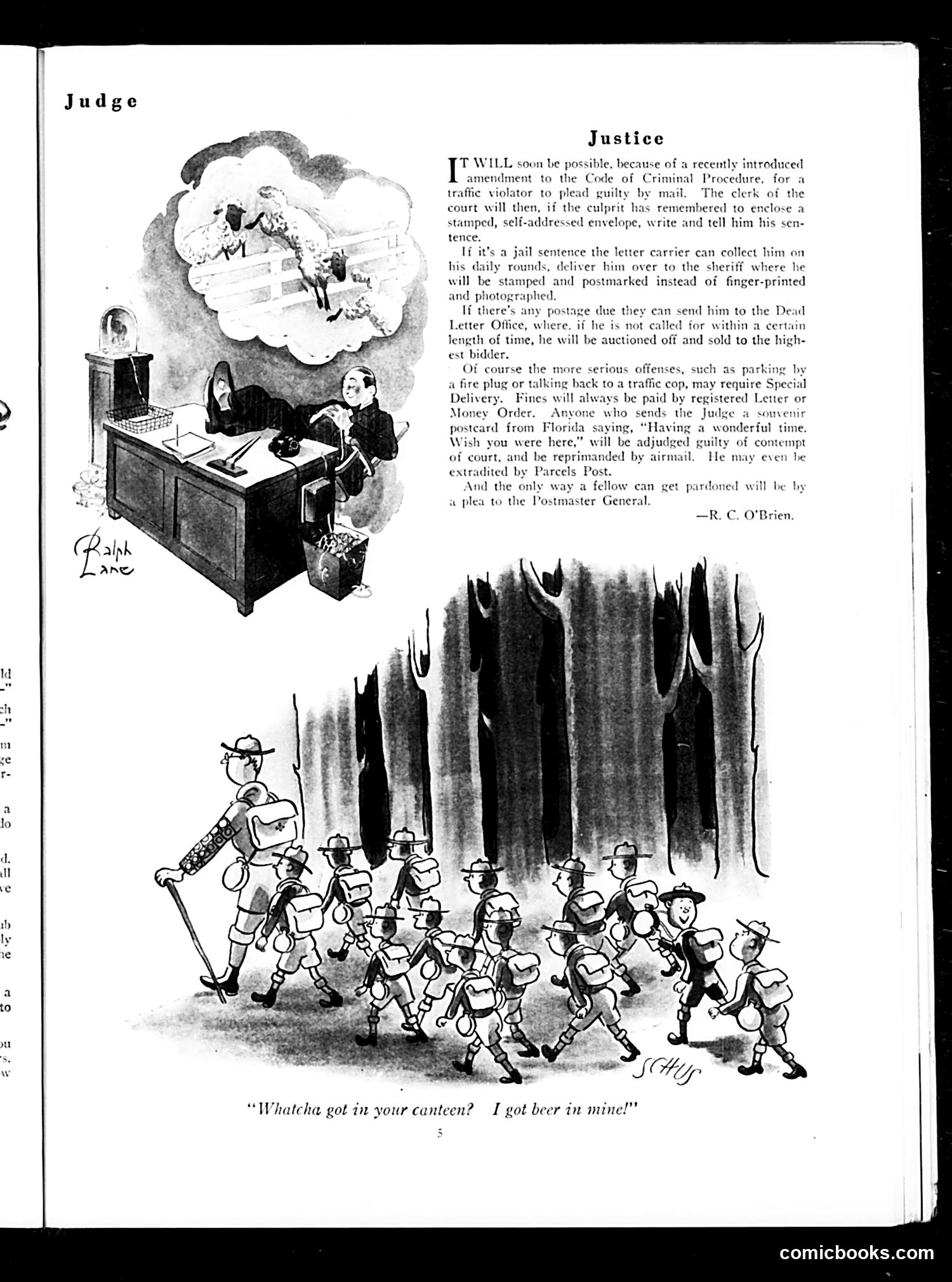
# Analysis The top cartoon by Ralph Barton depicts a judge at his desk receiving mail—satirizing a proposed amendment to the Code of Criminal Procedure allowing guilty pleas by mail. The humor imagines absurd consequences: jail sentences delivered by stamped envelope, traffic fines via registered letter, and even convicted criminals pleading to the Postmaster General for pardons. The bottom cartoon by Cesare shows soldiers in a forest with the caption "Whatcha got in your canteen? I got beer in mine!" This appears to reference Prohibition-era enforcement, likely satirizing soldiers during WWI or the subsequent "dry" period, contrasting official military rules against alcohol with soldiers' actual behavior—a common Judge magazine joke theme.
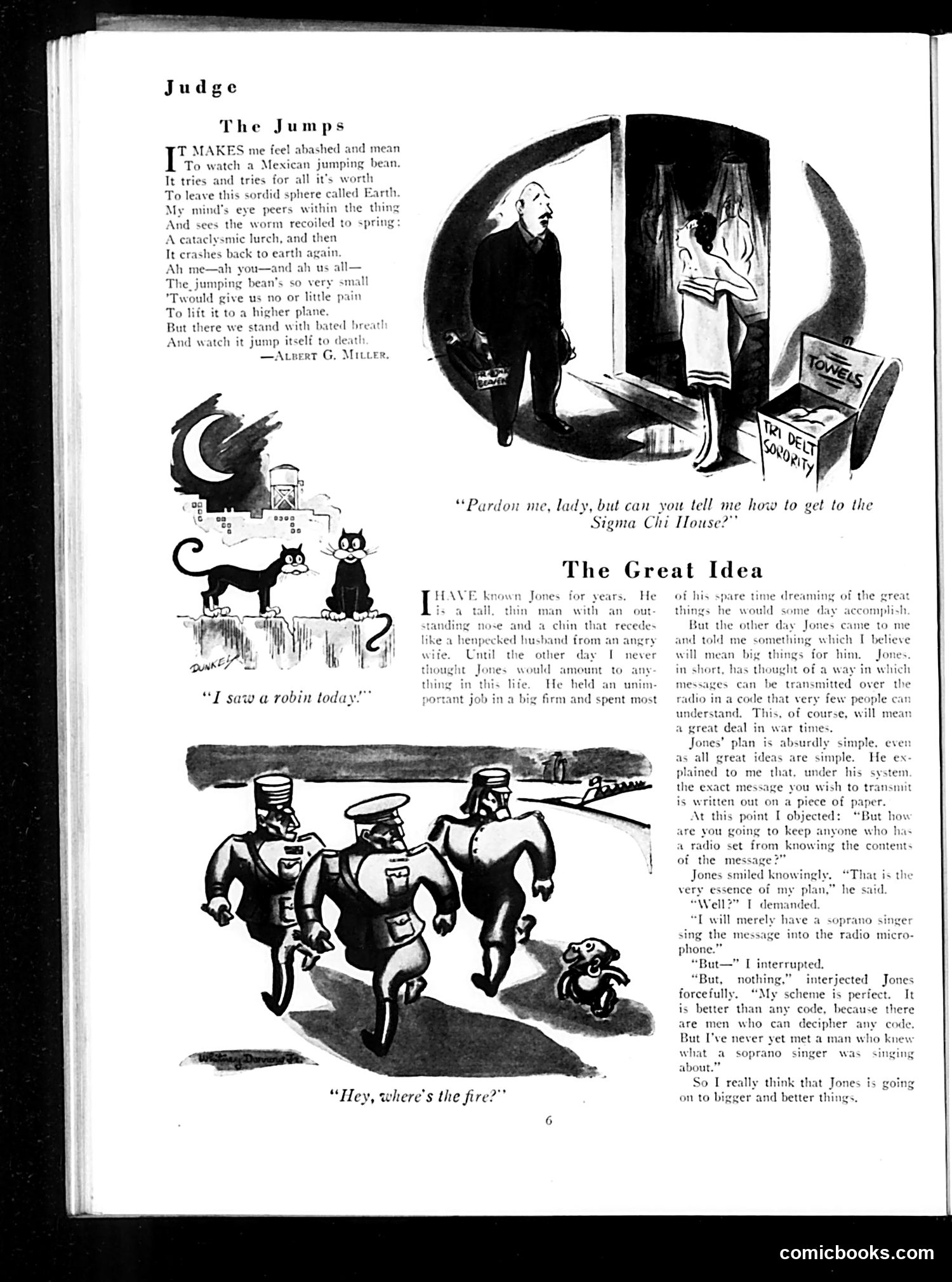
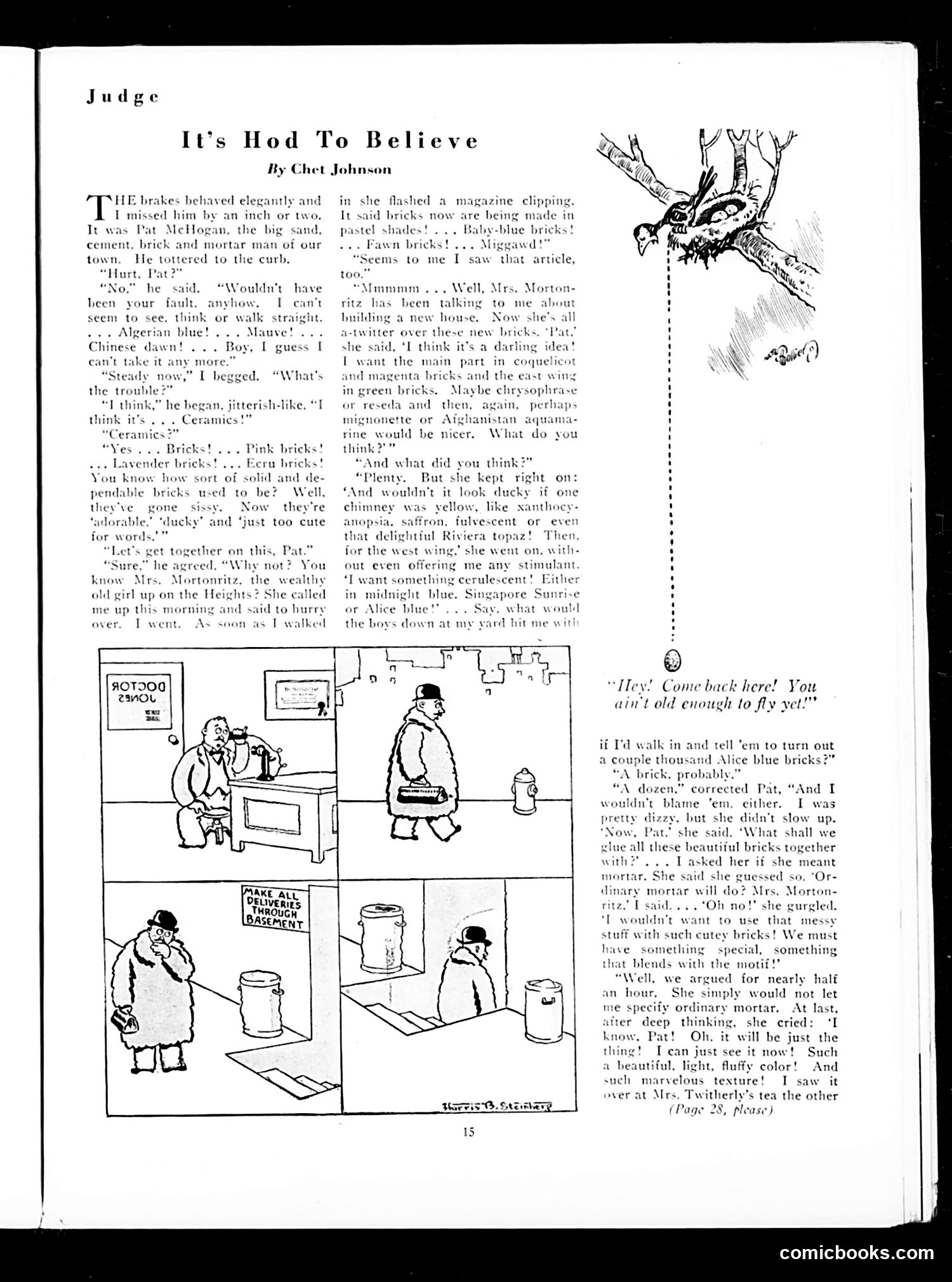
# Judge Magazine Page Analysis This page contains three distinct pieces: **"The Jumps"** (top): A poem by Albert G. Miller mocking someone's anxious state—watching a "Mexican jumping bean" that repeatedly "springs" and crashes. The metaphor satirizes nervous fidgeting or anxiety, likely about some contemporary concern. **"I saw a robin today!"** (middle): A cartoon showing two black cats observing a robin, with deadpan commentary—a simple visual gag about cats' predatory interest. **"The Great Idea"** (right): A prose piece describing Jones's scheme to transmit secret wartime radio messages by having a soprano singer encode them into song lyrics, believing no one will decipher music-hidden content. The narrator questions the plan's security, but Jones confidently argues people won't suspect a soprano knows anything meaningful. The satire mocks overconfidence in a simplistic "clever" wartime scheme.
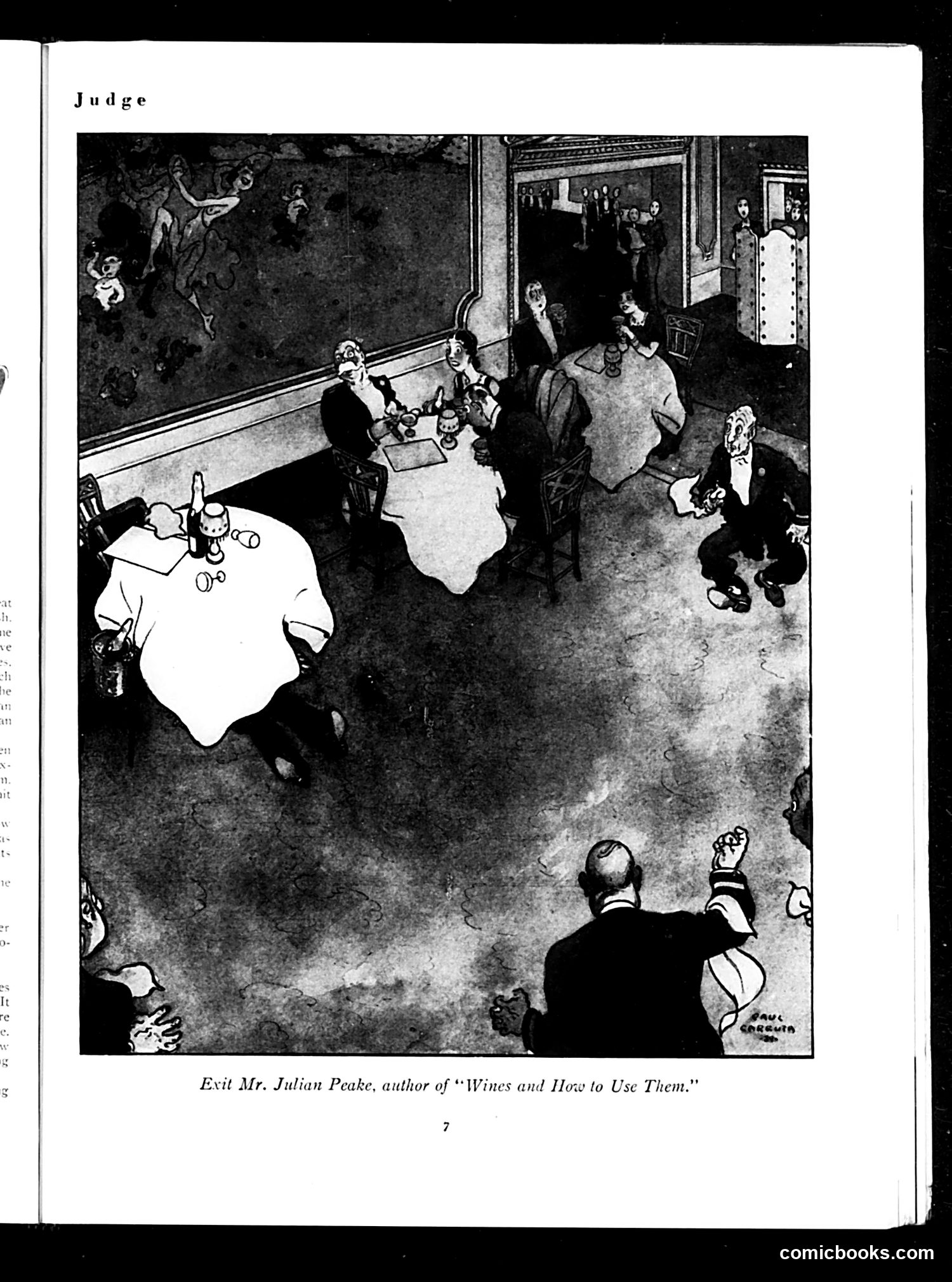
# Analysis This page from *Judge* magazine shows a satirical cartoon titled "Exit Mr. Julian Peake, author of 'Wines and How to Use Them.'" The caption indicates the cartoon depicts Mr. Julian Peake leaving what appears to be an upscale social gathering or restaurant. The bird's-eye perspective shows well-dressed figures in an interior space with a round table in the foreground and various guests throughout the room. The satire likely mocks Peake through ironic reference to his book about wine consumption. The "exit" framing suggests either his embarrassing departure from the scene or his removal from polite society—implying his actual behavior contradicted his expertise or authority on refined wine etiquette. The cartoon ridicules the gap between someone's claimed sophistication and their actual conduct.
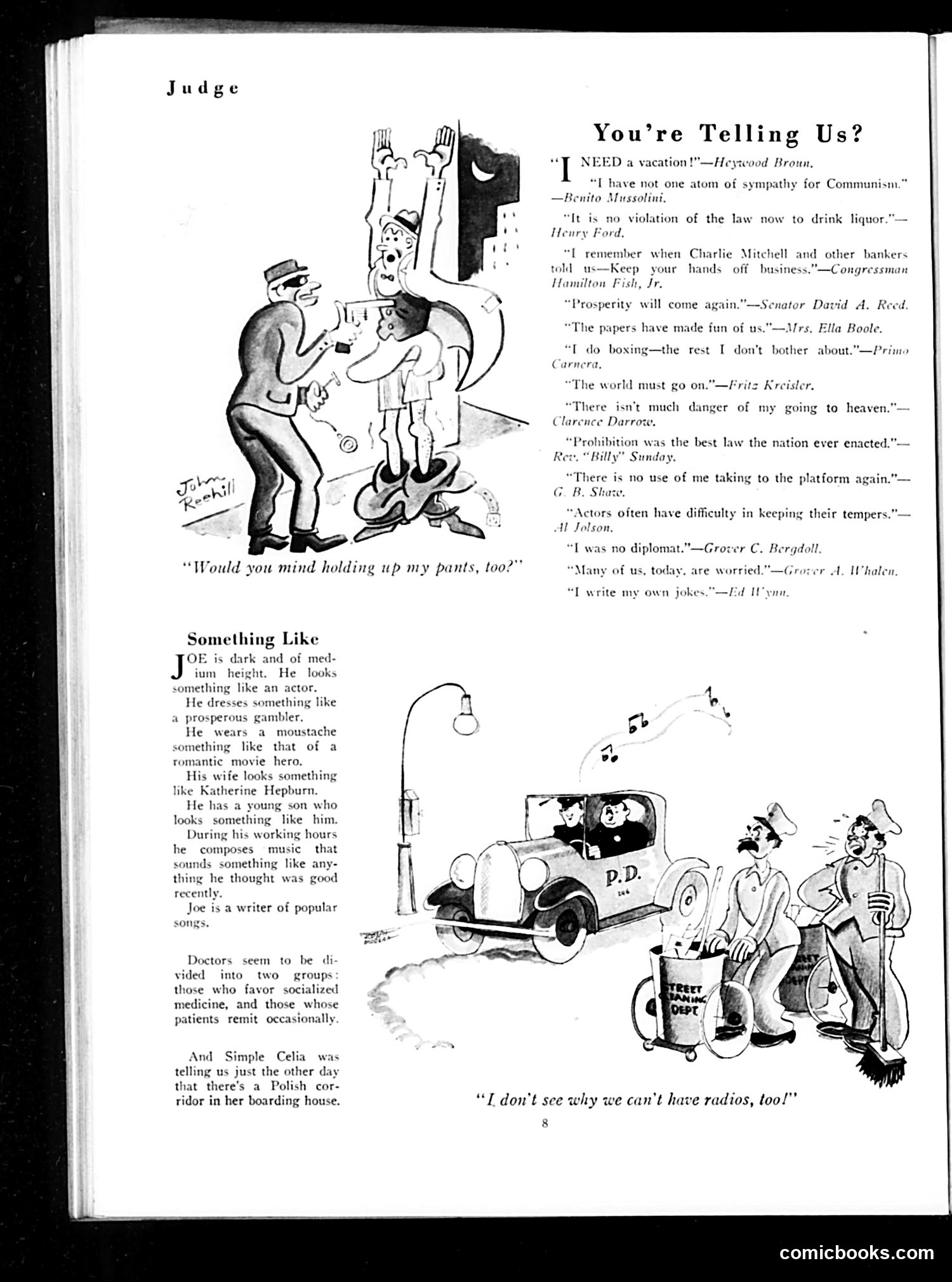
# Judge Magazine Page Analysis This page contains two satirical sections: **"You're Telling Us?"** presents ironic quotes from prominent figures of the era (Mussolini, Henry Ford, Senator Reed, Billy Sunday, etc.), with the implicit joke being that their statements contradict reality or their known positions. For instance, Ford claiming no violation in drinking liquor mocks Prohibition-era hypocrisy, while Billy Sunday's claim that Prohibition was "the best law" is undercut by its obvious failure. **"Something Like Joe"** humorously describes a songwriter through vague comparisons—he resembles an actor, dresses like a gambler, has a movie-star mustache, wife like Katharine Hepburn—but "composes music that sounds something like anything he thought was good recently." This satirizes formulaic popular songwriting of the period. The bottom cartoon shows police and street cleaners arguing about radios, likely commenting on debates over municipal equipment or public amenities during economic hardship. The overall tone mocks contemporary public figures, consumer culture, and professional mediocrity.
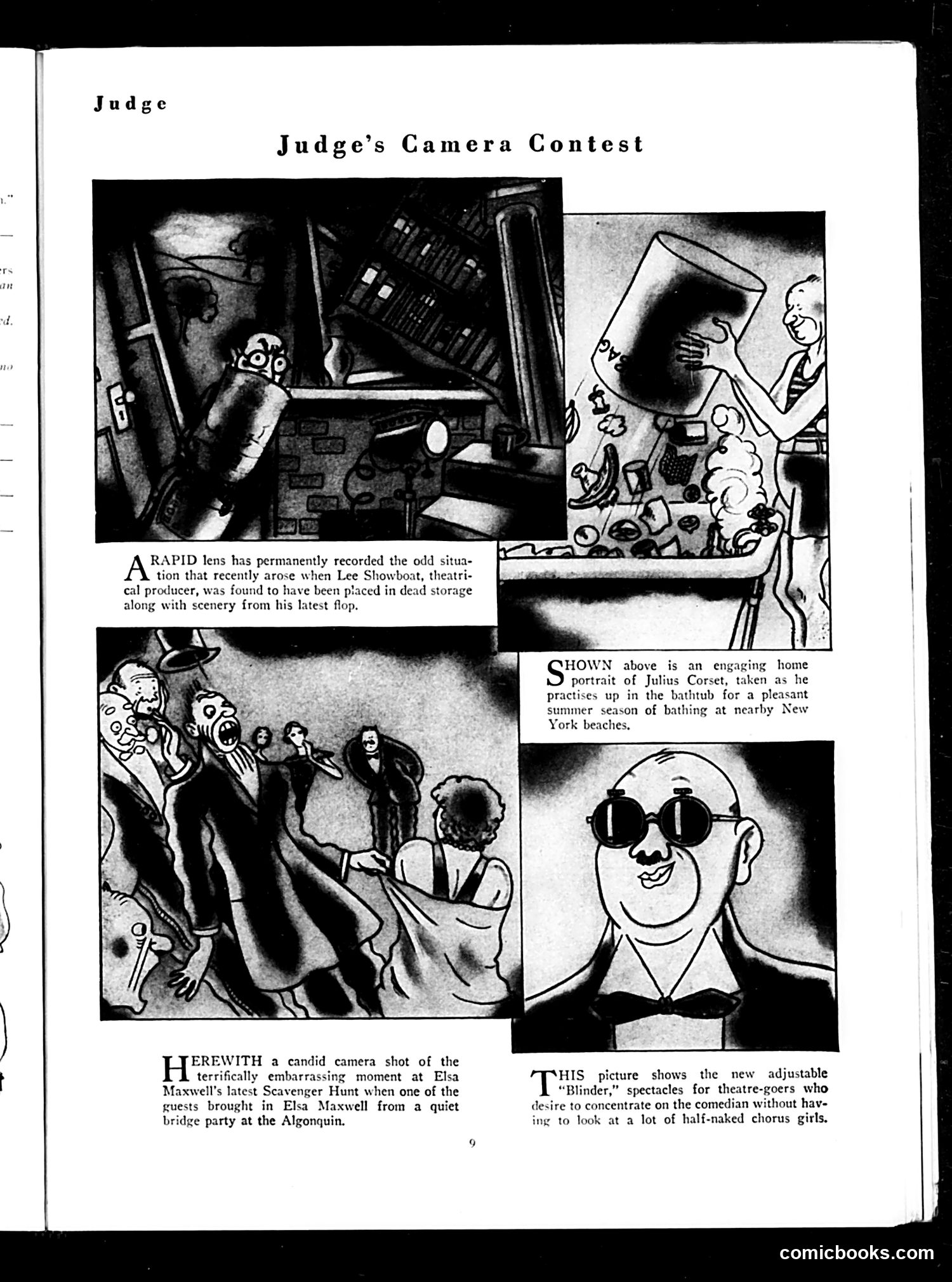
# Judge's Camera Contest Explanation This page features humorous "candid camera" photographs satirizing 1920s theatrical and high-society figures. The top image jokes that theatrical producer Lee Showboat was literally placed in "dead storage" with his failed show's scenery—mocking his flop production. The middle photo captures socialite Elsa Maxwell at one of her famous scavenger hunts, where guests were fetched as "items" to retrieve, humorously suggesting Maxwell herself was brought as a prize. The bottom images mock entertainment culture: one shows Julius Corset (unclear who this refers to) bathing; the final cartoon satirizes prudish theater-goers with adjustable "Blinder" spectacles designed to block views of chorus girls' bodies while watching comedians—a jab at both moral hypocrisy and the era's sexualized chorus line performances. The satire targets vanity, theatrical pretension, and sexual double standards of the Jazz Age elite.
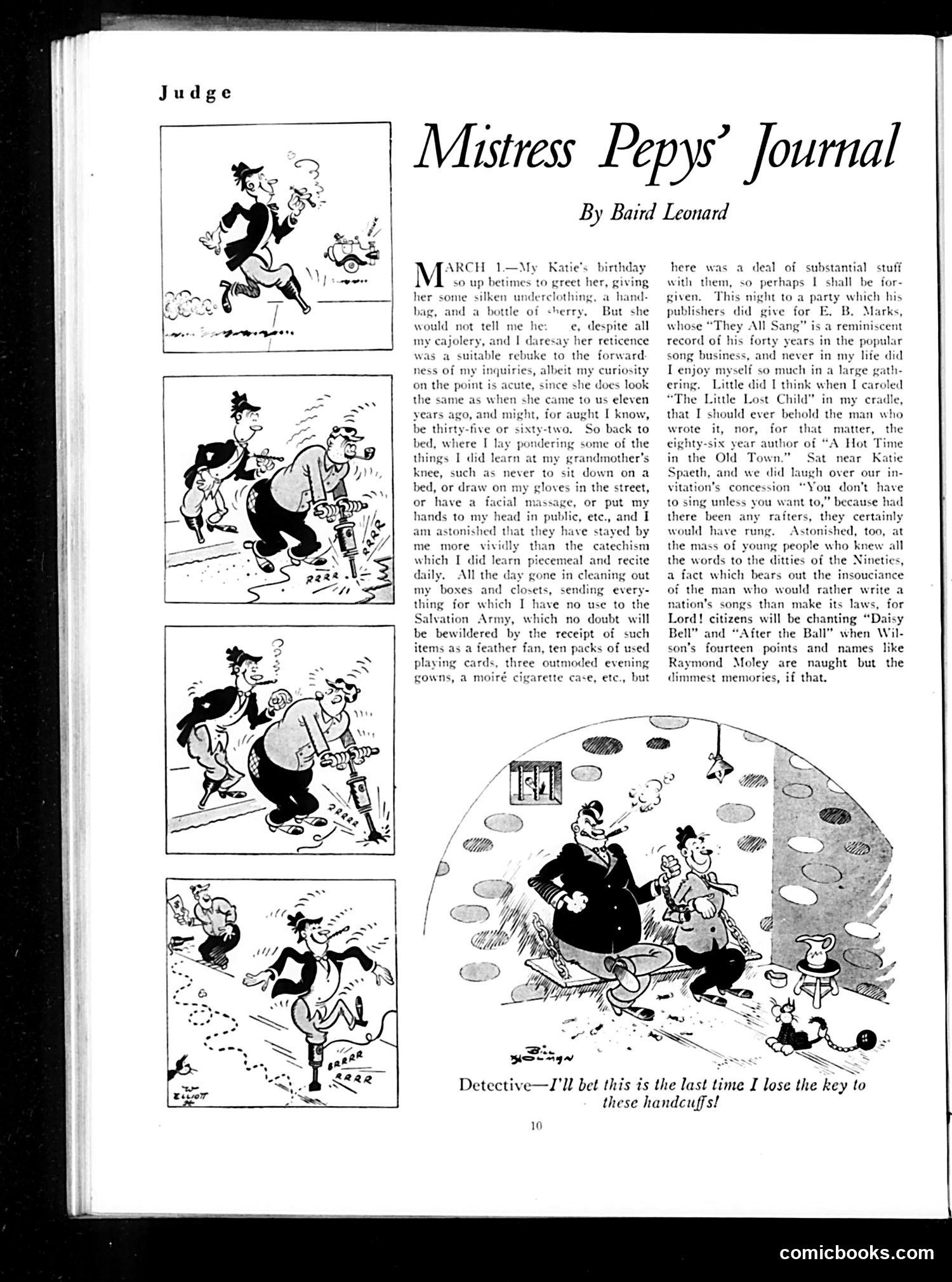
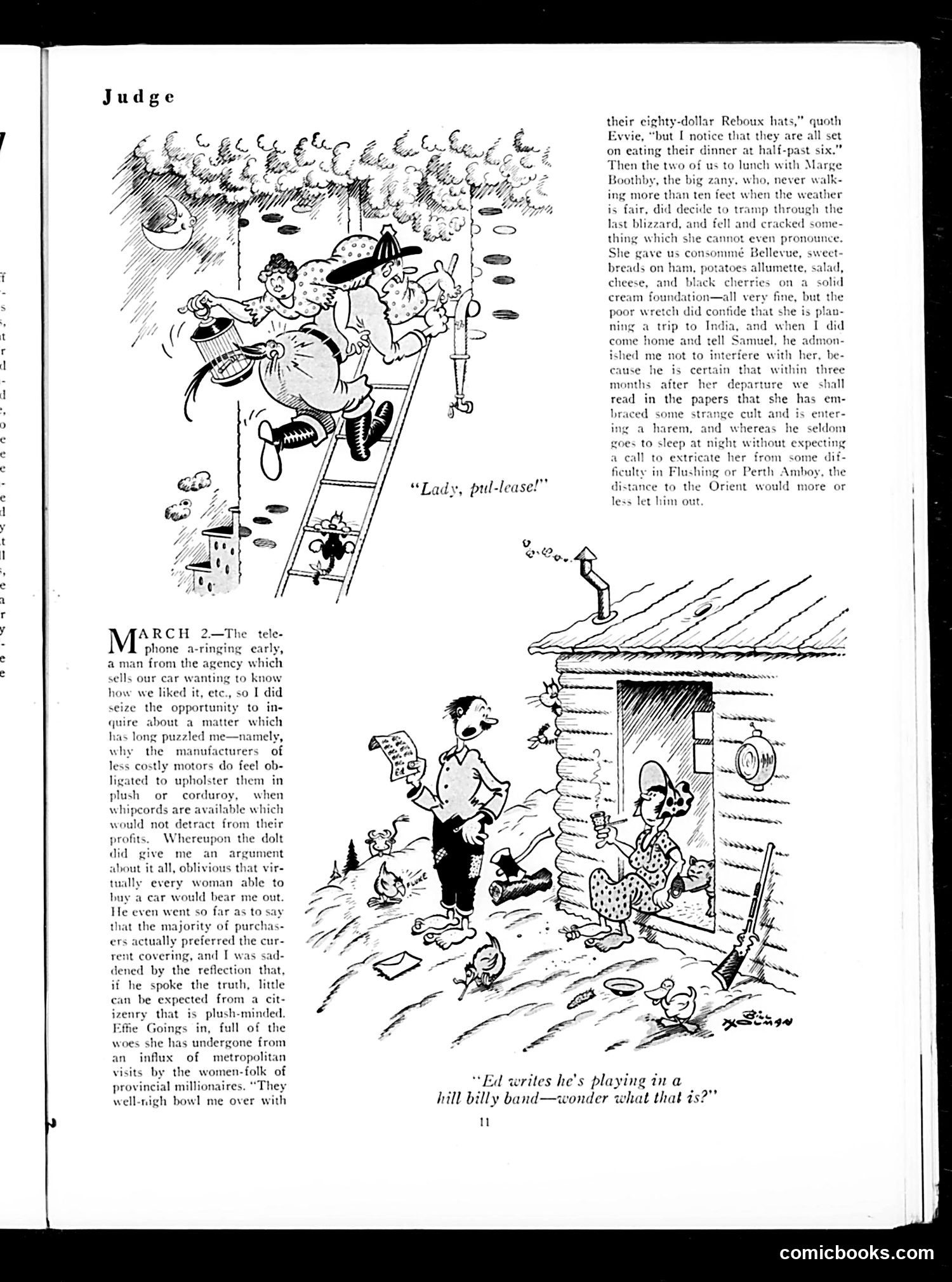
# "Mistress Pepys' Journal" - Judge Magazine This is a humorous column mimicking Samuel Pepys' famous 17th-century diary, but set in the early 20th century. The narrator describes mundane domestic activities and social events with mock-serious reflection. The main joke plays on the contrast between Pepys' historically significant observations and this "Mistress Pepys'" trivial concerns: spring cleaning, etiquette rules learned from her grandmother (not sitting on beds while dressing, facial massages in public), and donating items to the Salvation Army. A secondary satire mentions attending a party for E.B. Marks celebrating his songwriting career. The writer reflects that popular songs outlast political achievements—Wilson's "Fourteen Points" and contemporary politician Raymond Moley will be forgotten while 1890s songs like "Daisy Bell" endure. The cartoon panels show slapstick domestic chaos, while the larger illustration depicts a detective losing handcuff keys—unrelated comedic vignettes typical of Judge's mixed-content format.