
Judge, 1934-04 · page 20 of 36
Judge — April 1934 — page 20: what you’re looking at
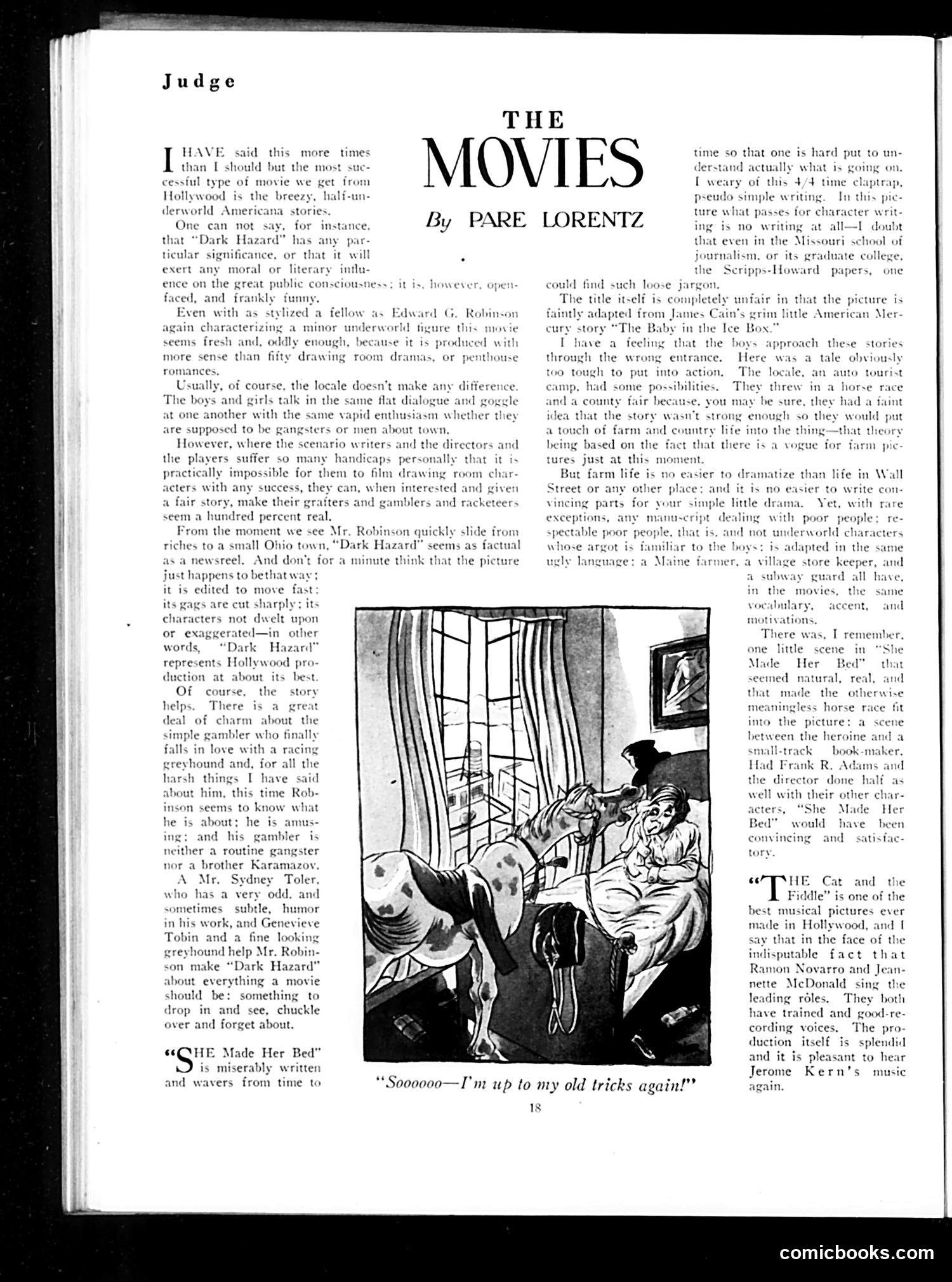
A restored page from Judge, 1934-04. Page through the whole issue in the reader above.
📄 Transcribed text from this page (OCR, searchable)
Machine-transcribed from the original scan — historical spelling and the odd misread are preserved.
THE HAVE said this more times I than [ should but the most sue- cessiul type of movie we get fror Hollywood is the breezy, half-un- derworld Americana stories. MOVIES time so that one is hard put to un- derstand actually what is goir I weary of this 4/4 time claptrap, pseudo simple writing. In this pie- ture what passes for character w One can not say, for ins By PARE LORENTZ ing is no writing at all—l doubt that “Dark Hazard” has any par ticular significance, or that it w exert any moral or literary intlu- ence on the great public consciousnes faced, and frankly funny. Even with as stylized fellow as Edward G. Robir again characterizing a minor underworld figure this movie seems fresh and, oddly enough, because it is produced witl more sense than fifty drawing room dramas, or penthouse romances. Usually, of course, the locale doesn’t make a The boys at difference. 1 girls talk in the same flat dialogue and goggle at one another with the same vapid enthusiasm whether they are supposed to be gangsters or men about town. However, where the scenario writers and the directors and the players suffer so many handicaps personally it is practically impossible for them to film drawing room char- acters with any success, they can, when interested and given a fair story, make their grafters and gamblers and racketeers seem a hundred percent real. From the moment we see Mr. Robinson quickly sl irc riches to a small Ohio town, “Dark Hazard” seems as factual a newsreel, And don’t for a minute e picture just happens to bethat way ; ed to move fast gags are cut sharply; its characters not dwelt upon or exaggerated—in other words, “Dark Hazard” represents Hollywood pro- ducti about its best Of course, the story helps. There is a grea deal of charm about the gambler who finally s in love w a raci yhound and, for all t harsh. thin I have said out him, this time Re inson seems to know what he is about; he is amus- and his neither a routine gar nor a brother Karamazov. A Mr. Sydney Toler, who has a very odd, and etimes subtle, humor 1 his work, and Genevieve Tobin 1 a fine looking greyhound help Mr. Robin- son make “Dark Hazard” yout everything a movie should be: something to drop in and see, chuckle over and forget about. “QE Made Her Bed” i s miserably written and wavers from time to cury story “The Baby in the Ice Box too tough to put in camp, a touch of farm and country life i being based on the f: tures just at this moment vineing parts for y« exceptions, any manuseriy “Sooo000—I'm up to my old tricks again!” that even in the Missouri school of journalism, or its graduate colleg 1 suc’ se jarg The title itseli is completely unfair in that the picture is in’s grim little American ntly adapted from James we feeling that t boys approach these stories the wre entrance. Here was a tale obviously action, The locale, an auto tourist and a county fair because, you may be sure, they had a faint fy ry wasn’t strc h so they would put the thing—that theory et that th a vogue for farm pic But farm life is no e r to dramatize than life in Wall Street or any other place: and it is no easier to write con- simple little drama. Yet, with rare dealing with poor people: re- table poor people. that is, and not underworld characters tis familiar to the boys: is adapted in the same ugly language: a Maine farmer, a village store keeper, and i subway guard all in the movies, the same vocabulary, accent, and motivations There was, T rem one little scene in Made Her Bed” seemed natural, real that made the otherwise meaningless horse race fit into the picture scene between the heroine anc small-track — book-maker. Had Frank R. Adams and the director done half as well with their other char- acters, “She Made Her Bed” would have been vineing and satisfac- Fiddle” best musical pictures ever made in Hollywood, and I say that in the face of the indisputable fact that Ramon Novarro and Jean- nette McDonald sing the leading roles. They both have trained and cording voices, The pro- duction itself is splendid and it is pleasant to hear Jerome Kern’s_ music again, nod-re- comicbooks.com