
Judge, 1934-04 · page 18 of 36
Judge — April 1934 — page 18: what you’re looking at
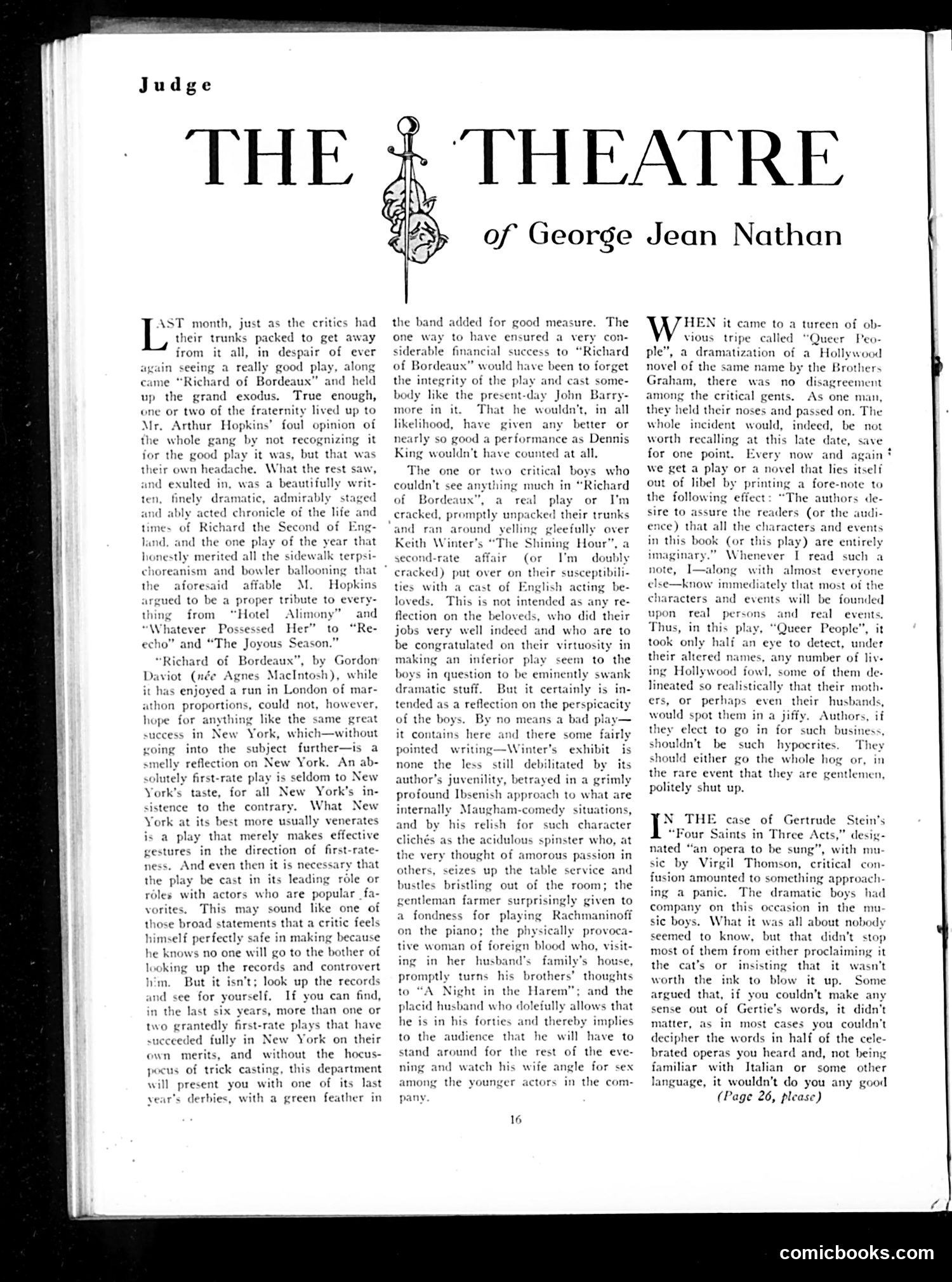
A restored page from Judge, 1934-04. Page through the whole issue in the reader above.
📄 Transcribed text from this page (OCR, searchable)
Machine-transcribed from the original scan — historical spelling and the odd misread are preserved.
T month, just as the critics had their trunks packed to get away from it all, in despair of ever again seeing a really good play, along came “Richard of Bordeaux” and held up the grand exodus. True enough, one or two of the fraternity lived up to Mr. Arthur Hopkins’ foul the whole gang by not recognizing it ior the good play it was, but that was their own headache. W: the rest saw, 1 exulted in, w beautifully writ- n, finely dramatic, admirably staged und ably acted chre nion of i icle of the life and t Richard the Second of Eng- land, and the one play of the year that honestly merited all the sidewalk terpsi- choreanism and bowler ballooning that affable M. Hopkins argued to be a proper tribute to ever: thing from “Hotel Alimony” and “Whatever Possessed Her” to “Re- o” and “The Joyous Season the aforesaid “Richard of Bordeaux”, by Gordon Daviot (née Agnes MacIntosh), while it has enjoyed a run in London of mi athon proportions, could not, however, hope for anything like the same great success in New York, which—without ing into the subject further—is a smelly reflection on New York. An ab- solutely first-rate play is seldom to New York's taste, for all New York's in- sistence to the contrary. What New York its best more usually venerates is a play that merely makes effective gestures in the direction of first-rate- ness. And even then it is necessary that the play be cast in its leading role or roles with actors who are popular fa vorites. This n sound like one of those broad statements that a critic feels himself perfectly safe in making becau he knows no one will go to the bother of looking up the records and controvert him. But it isn’t; look up the records and see for yourself. If you can find, ie last six years, more than one or two grantedly first-rate plays that have succeeded fully ii ew York on their own merits, and rout the hocus- pocus of trick casting, this department will present you with one of its last green feather in year’s derbies, with a “ cracked) put over on their suscey the band added for good measure. The one way to have ensured a very c siderable financial success to “Richard of Bordeaux” would have been to forget the integrity of the play and cast some- body like the present-day John Barry- more in it. That he wouldn't, in all likelihood, have given any better or nearly so good a performance as Dennis King wouldn't have counted at all. The one or two critical boys who couldn't see anything much in “Richard of Bordeaux”, a real play or I'm cracked, promptly unpacked their trunks and ran around yelling gleefully over Keith Winter’s “The Shining Hour”, a I-rate affair (or I'm = doubly tibili- gz be- loveds. This is not intended as any re- flection on the beloveds, who did their jobs very well indeed and who are to be congratulated on their virtuosity in making an inferior play seem to the boys in question to be eminently swank dramatic stuff. But it certainly is i tended as a reflection on the perspicacity ties with a cast of English actir of the boys. By no means a bad play— irly -Winter’s exhibit is none the less still debilitated by its author’s juvenility, betrayed in a grimly it contains here and there some f pointed writin; profound Ibsenish approach to what are internally Maugham-comedy situations, and by his relish for such character clichés as the acidulous spinster who, at the very thought of : norous passion in others, seizes up the table service and bustles bristling out of the room; the gentleman farmer surprisingly given to a fondness for playing Rachmaninoff on the piano; the physically provoca- tive woman of foreign blood who, visit- ing in her husband's family’s hot promptly turns his brothers’ thoug to “A Night in the Harem”; and the placid husband who dolefully allows that he is in his forties and thereby implies to the audience that he will have to stand around for the rest of the eve- ning mong nd watch his wife angle for sex the younger actors in the com- pany 16 “THEATRE of George Jean Nathan HEN it came to a tureen of ob- vious tripe called “Queer Peo- ple”, a dramatization of a Hollywood novel of the same name by the Brothers Graham, there was no disagreement among the critical gents. / they held their no: s one man, and passed on. The whole incident would, indeed, be not worth recalling at this late date, save for one point. Every now and again we get a play or a novel that lies itself out of libel by printin the following a fore-note to effect: “The authors de- sire to assure the readers (or the audi- ence) that all characters and events in this book (or this play) are entirely imaginary.” Whenever I read such a note, I—along with almost everyone 1 now ir ¢ ediately that most of the J events will be founded upon real persons and real events. Thus, in this play, “Queer People”, it took only half an eye to detect, under th ing characters altered names, any number of liv. Hollywood fowl, some of them de- lineated so realistically that their moth. ers, or perhaps even their husbands, would spot them in a jiffy. Authors, if they elect to go in for such business, shouldn't. be such hypocrites. should either go the whole he the rare event that the politely shut up. They or, in lemen, N THE case of Gertrude Stein’s our Saints in Three Acts,” desig- nated “an opera to be sun; with mu sic by Virgil Thomson, critical con- fusion amounted to something approach- ing a panic. he dramatic boys had company on this occasion in the mu sic boys. What it was all about nobody seemed to know, but that didn’t stop most of them from either proclaiming it the cat’s or insisting that it wasn't worth the ink to blow it up. Some argued that, if you couldn't make any sense out of Gertie’s words, it didn't tter, as in most cases you couldn't ipher the words in half of the cele- brated operas you heard and, not being familiar with Italian or some other language, it wouldn’t do you any good (Page 26, please) comicbooks.com