A complete issue · 36 pages · 1931
Judge — October 17, 1931
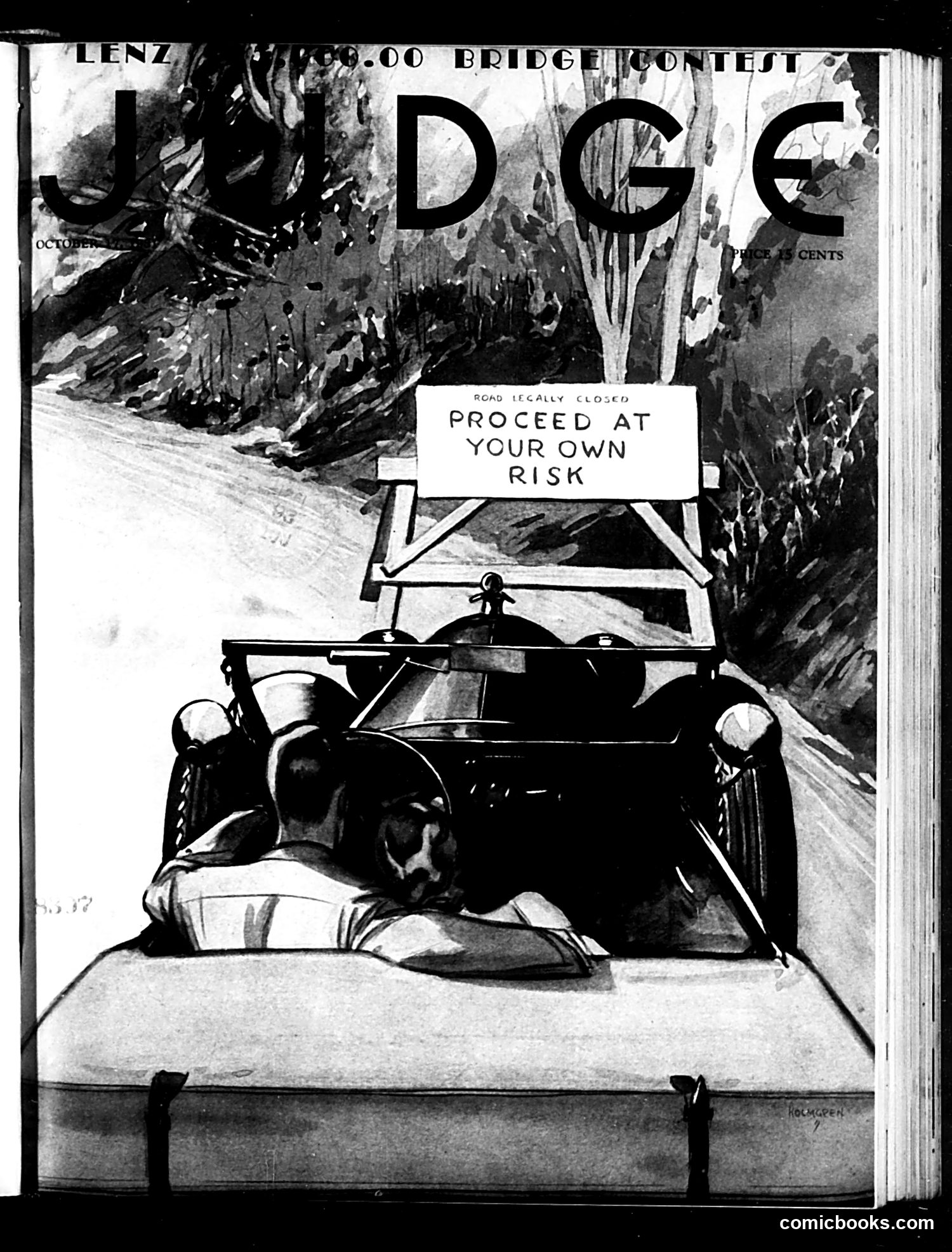
# Judge Magazine: "Bridge Contest" Cartoon This appears to be a cover or full-page illustration from Judge magazine's "Bridge Contest" feature, dated October (year unclear from image). The main image shows a convertible automobile approaching a narrow, dramatically carved mountain pass or tunnel with a warning sign reading "ROAD LOCALLY CLOSED / PROCEED AT YOUR OWN RISK." The satire seems to reference reckless driving or taking unnecessary risks on dangerous roads—a commentary on automotive hazards of the era. The large "JUDGE" text overlays the scene, suggesting this illustrates the magazine's humorous take on contemporary driving behavior and the growing automobile culture's dangers. Without additional context, the specific "bridge contest" being referenced remains unclear, though it likely involved some publicized driving challenge or stunt.
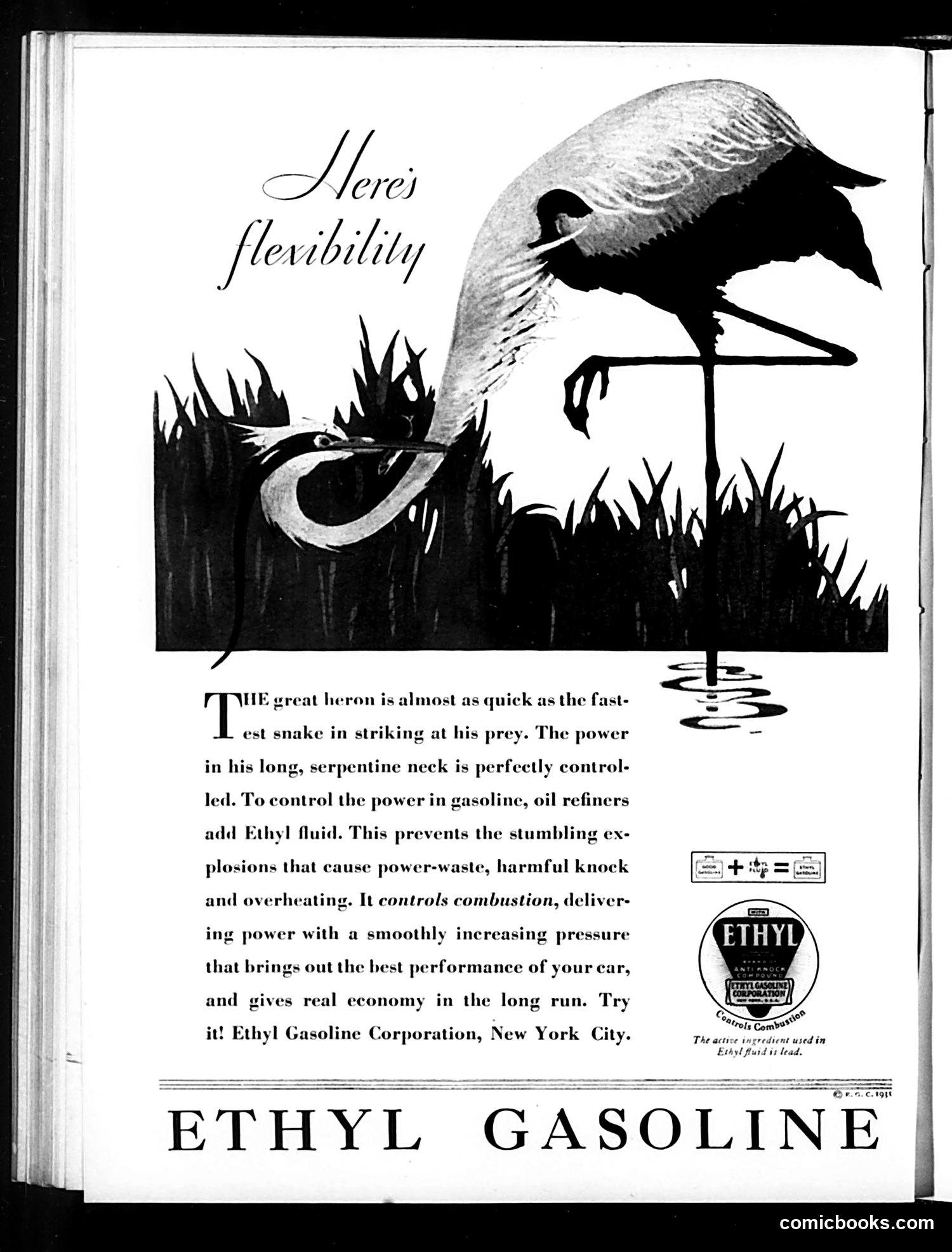
# Analysis This page is primarily **advertising** for Ethyl Gasoline, not satire or political commentary. The illustration shows a great heron with a long, flexible neck striking at prey in marsh grass. The ad uses the heron's controlled neck flexibility as a metaphor for the gasoline's combustion control. Just as the heron's "power in his long, serpentine neck is perfectly controlled," Ethyl Gasoline controls fuel combustion through added Ethyl fluid, preventing engine problems like "stumbling explosions" and "knock." The "Here's flexibility" headline reinforces this parallel between animal physiology and mechanical performance. This is a creative marketing approach from the Ethyl Gasoline Corporation of New York City, using nature imagery to convey technical product benefits to automobile owners.
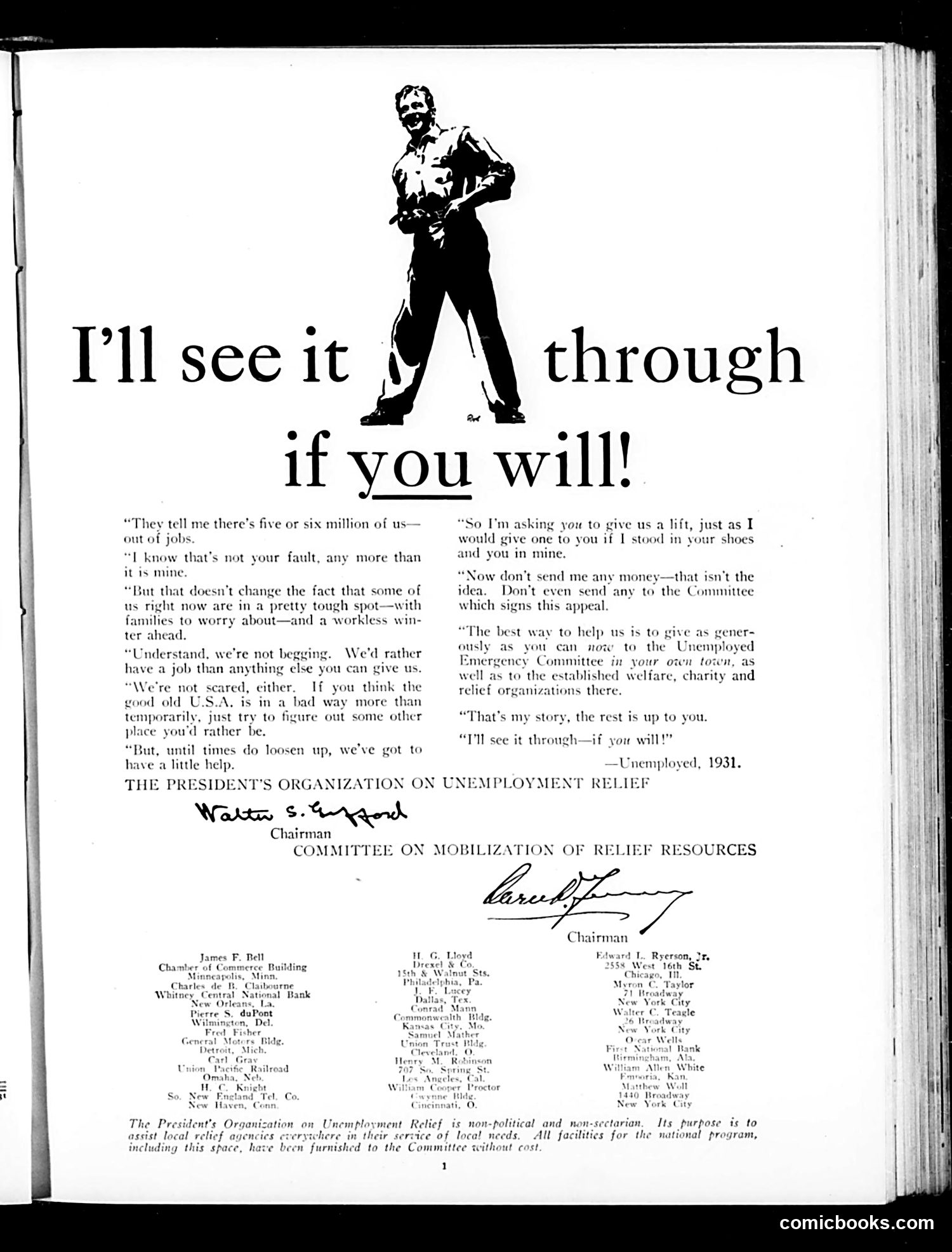
# Analysis This is not satirical content but rather a **public service appeal** from 1931. The confident male figure represents an unemployed worker making a direct appeal to readers during the Great Depression. The message asks Americans to support unemployment relief—not through money donations, but by: - Giving generously to local unemployment committees - Supporting established welfare and charity organizations - Helping mobilize relief resources in their communities The quote "I'll see it through if you will!" frames relief as a shared civic responsibility. The appeal is signed by Walter S. Gifford, Chairman of the President's Organization on Unemployment Relief (established under Hoover), emphasizing this was an official government-endorsed campaign to encourage private charitable giving and community action during the economic crisis.
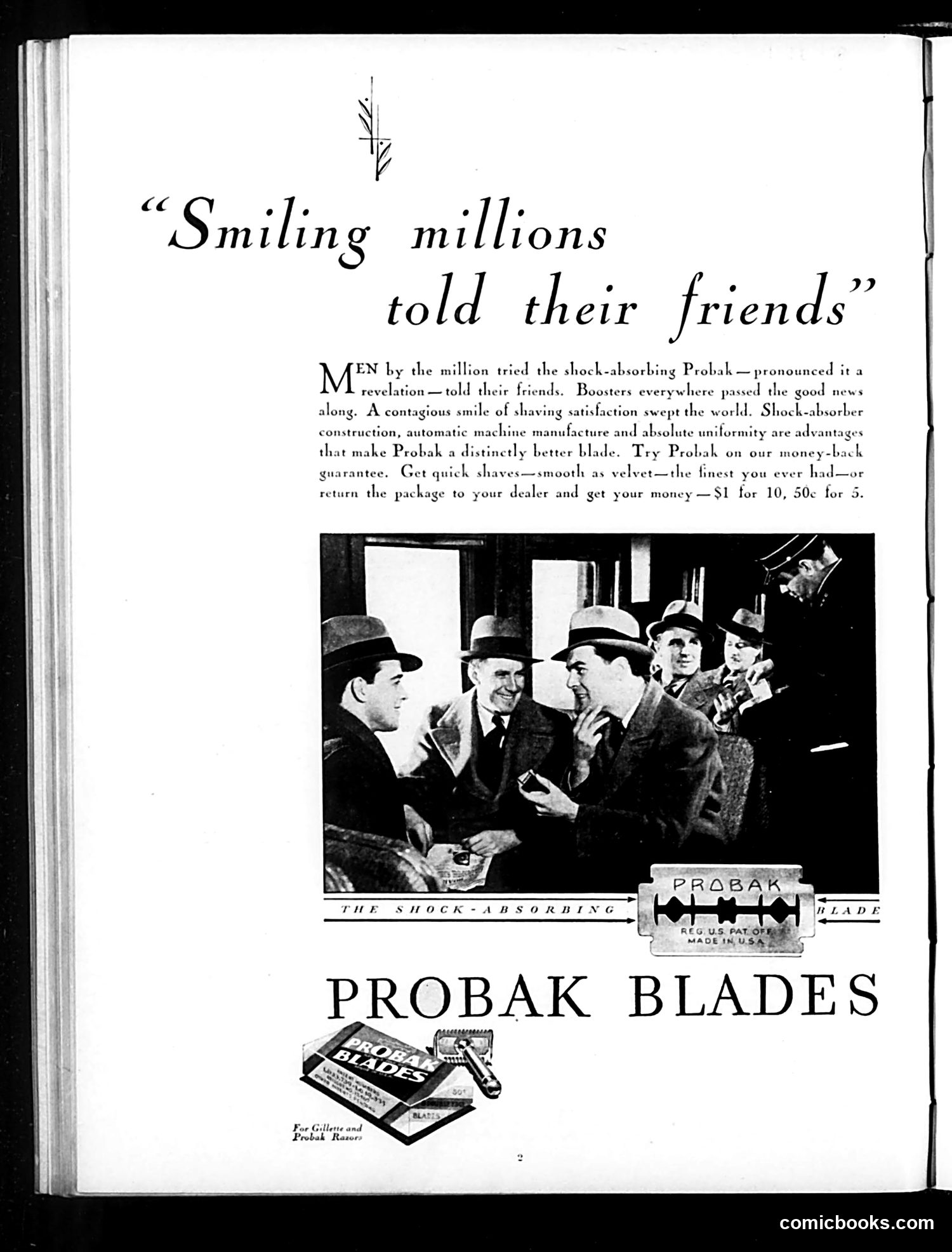
# Analysis of Probak Blades Advertisement This is primarily a **commercial advertisement**, not political satire. The page promotes Probak razor blades with the headline "Smiling millions told their friends." The image shows **five men in suits and hats** (typical 1920s-30s business attire) apparently discussing or recommending the product to one another. The caption suggests this represents word-of-mouth marketing—satisfied customers spreading positive news about the blades. The ad emphasizes the product's features: shock-absorbing construction, automatic manufacturing, and uniformity. It includes a money-back guarantee and pricing ($1 for 10, 50¢ for 5). The small product image at bottom shows the Probak blade package and razor. This appears to be standard advertising copy leveraging social proof and peer recommendation as a marketing strategy.
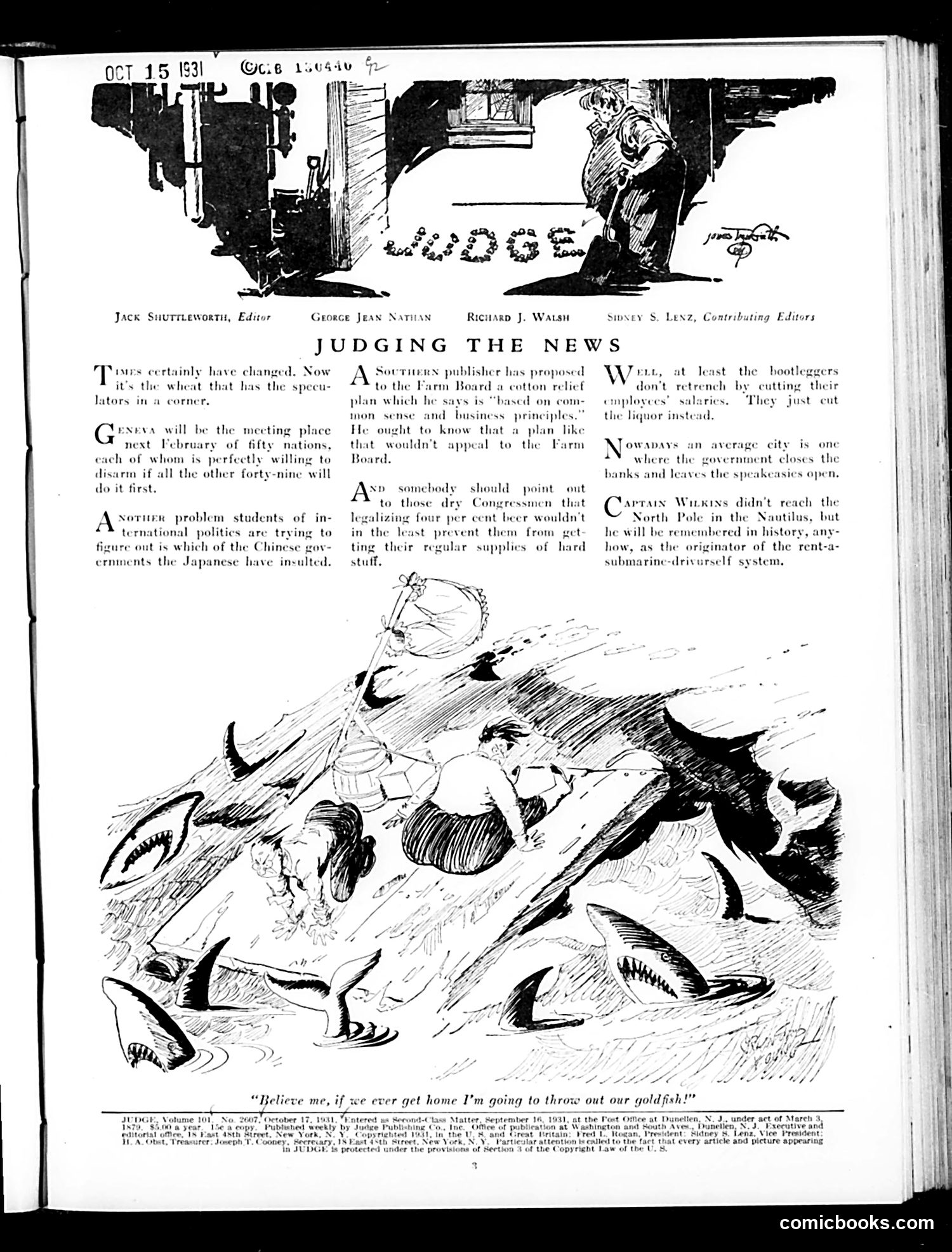
# "Judging the News" - October 15, 1931 This editorial cartoon satirizes American economic and political failures during the Great Depression. The large fish with sharp teeth represent predatory economic forces or loan sharks. The drowning figures—businessmen and ordinary citizens—illustrate ordinary people being destroyed by financial collapse and exploitation. The surrounding commentary mocks various targets: Southern publishers proposing inadequate farm relief, Congress's inability to prevent bootleggers from accessing alcohol during Prohibition, cities that close banks while keeping speakeasies open (revealing misplaced priorities), and references to Captain Wilkins and submarine technology. The overall message: while politicians debate trivial matters, ordinary Americans drown in economic catastrophe. The cartoon indicts institutional failure to address Depression suffering with urgency.
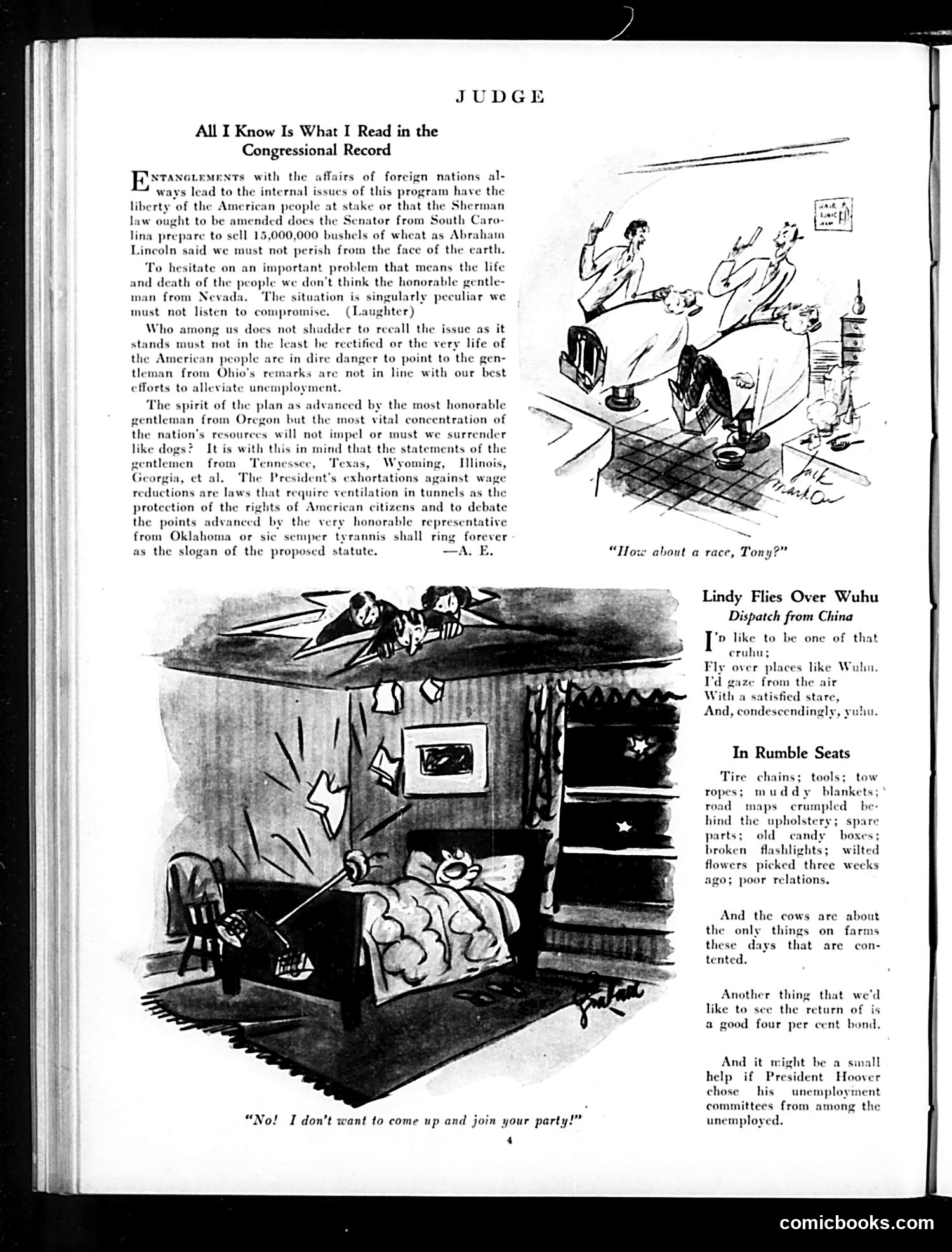
# Judge Magazine Page Analysis This page contains political commentary and cartoons, likely from the 1930s era based on references to President Hoover and unemployment. **Top Cartoon**: "How about a race, Tony?" depicts what appears to be a political debate about wage reductions and labor rights, with the speaker defending American workers' interests against compromise positions. **Bottom Cartoon**: "No! I don't want to come up and join your party!" shows someone in bed refusing an invitation—likely satirizing reluctance to participate in social activities during economic hardship. **Right Column**: Includes a poem about flying over Wuhu, China, and "In Rumble Seats" listing Depression-era hardships (broken tools, wilted flowers, poor relations). The final section critiques President Hoover's unemployment committee selection, suggesting he should choose unemployed people themselves. The overall theme addresses economic depression, labor disputes, and government response to unemployment.
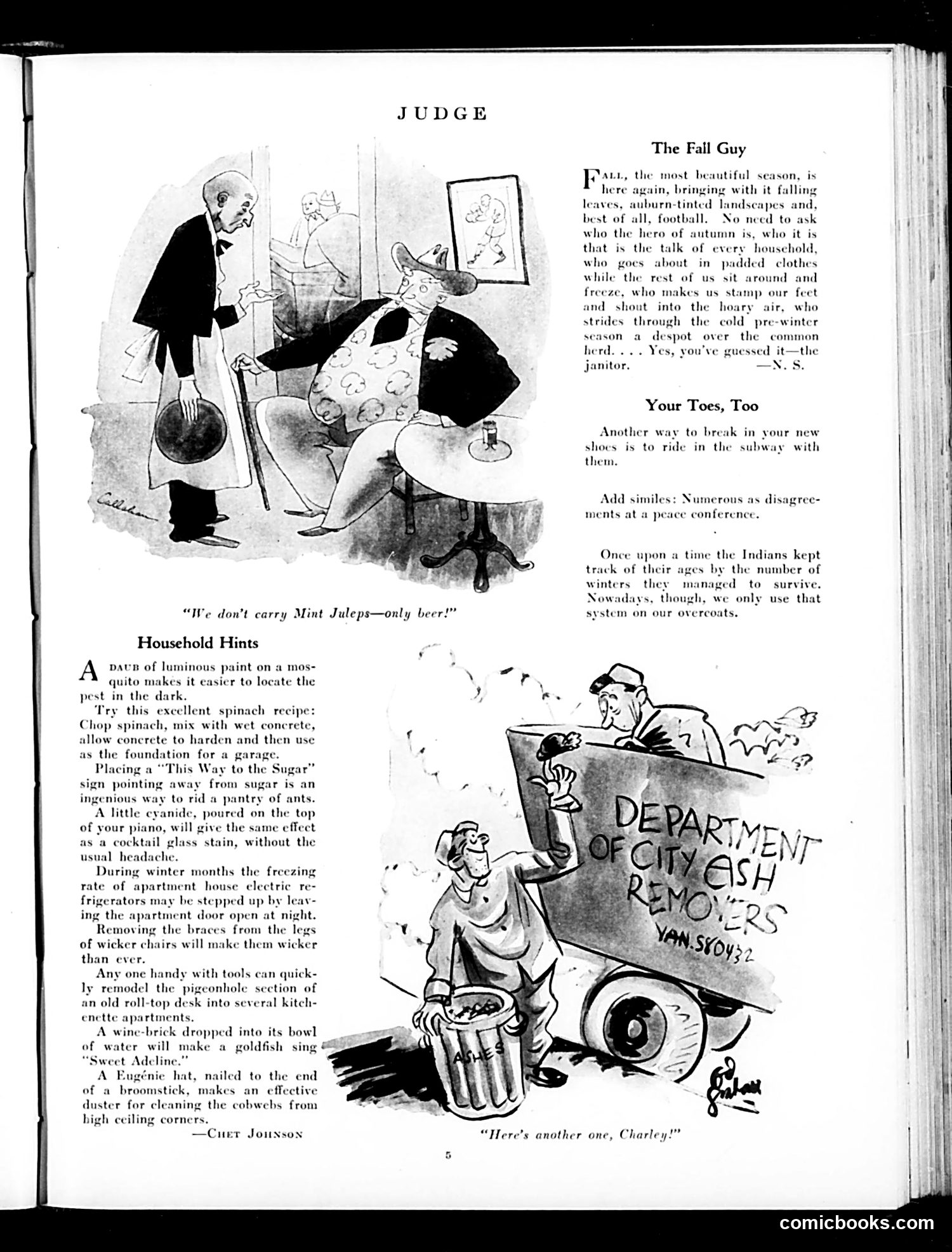
# Analysis of Judge Magazine Page This page contains satirical humor and household hints rather than political cartoons. The main cartoon shows a man confronting a woman about carrying "Mint Juleps," a Southern alcoholic drink—likely satirizing Prohibition-era concerns about hidden alcohol consumption. The "Household Hints" section offers absurdist practical advice (using spinach as garage foundation paint, cyanide on pianos) that appears intentionally ridiculous rather than genuine. The bottom cartoon depicts the "Department of City Fish Demos" dumping fish, with the caption "Here's another one, Charley!"—likely mocking inefficient city government or some contemporary municipal scandal, though the specific reference is unclear without additional context. Overall, this represents Judge's typical mix of domestic humor and gentle institutional satire from the early 20th century.
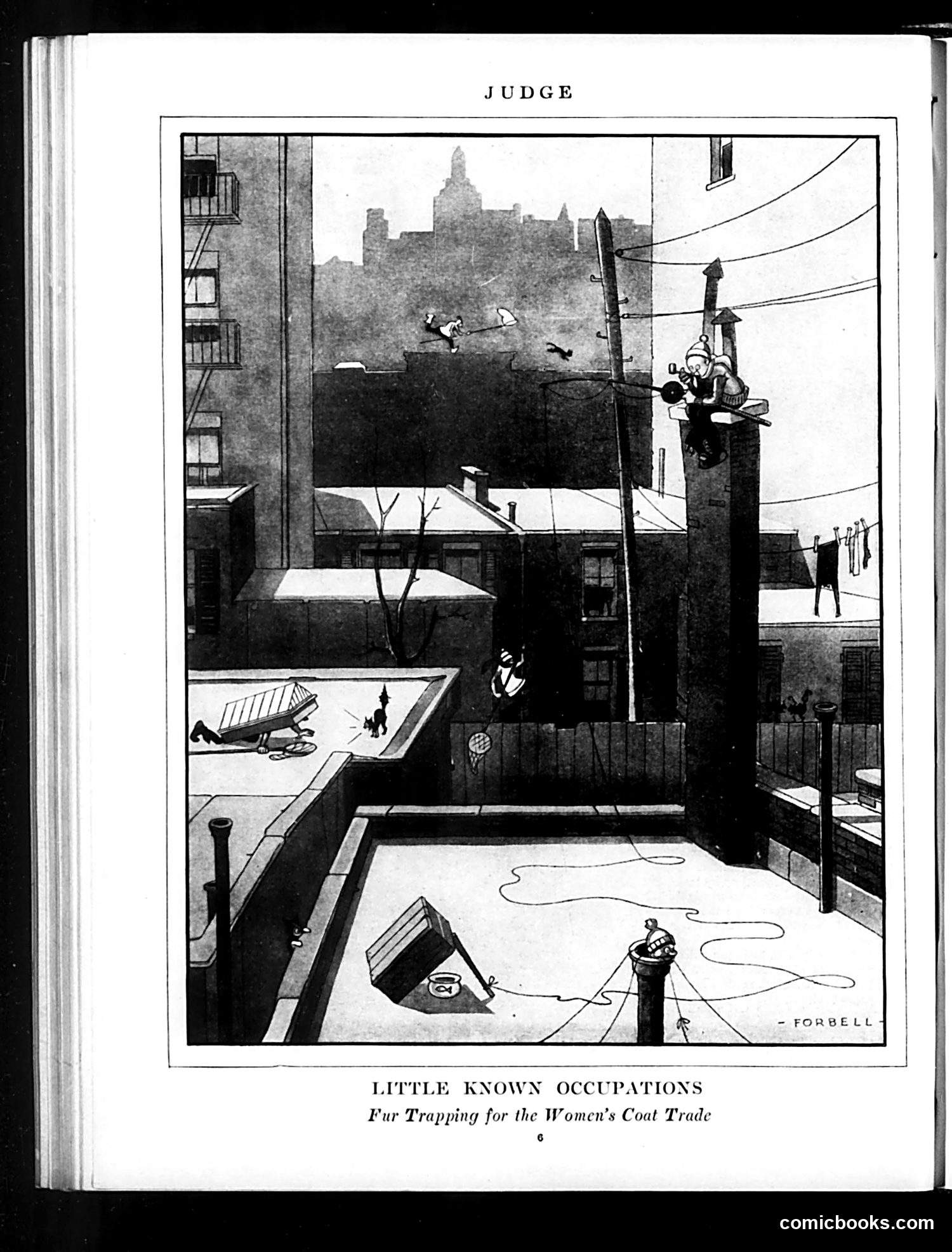
# Analysis This is a satirical cartoon titled "Little Known Occupations: Fur Trapping for the Women's Coat Trade." The illustration depicts an urban rooftop scene where figures appear to be catching rats or other small animals in traps and snares strung across the space. The satire mocks the fur industry's supply chain by suggesting that women's fur coats—luxury items—are sourced through crude, undignified urban "trapping" rather than legitimate hunting or farming. The rooftop setting, with clotheslines and modest urban architecture visible, emphasizes the contrast between the supposed elegance of fur fashion and the shabby reality of its procurement. The cartoon likely critiques both the fur trade's practices and the vanity of wealthy women who purchase these coats, presenting their fashion choices as dependent on unsavory, lower-class labor.
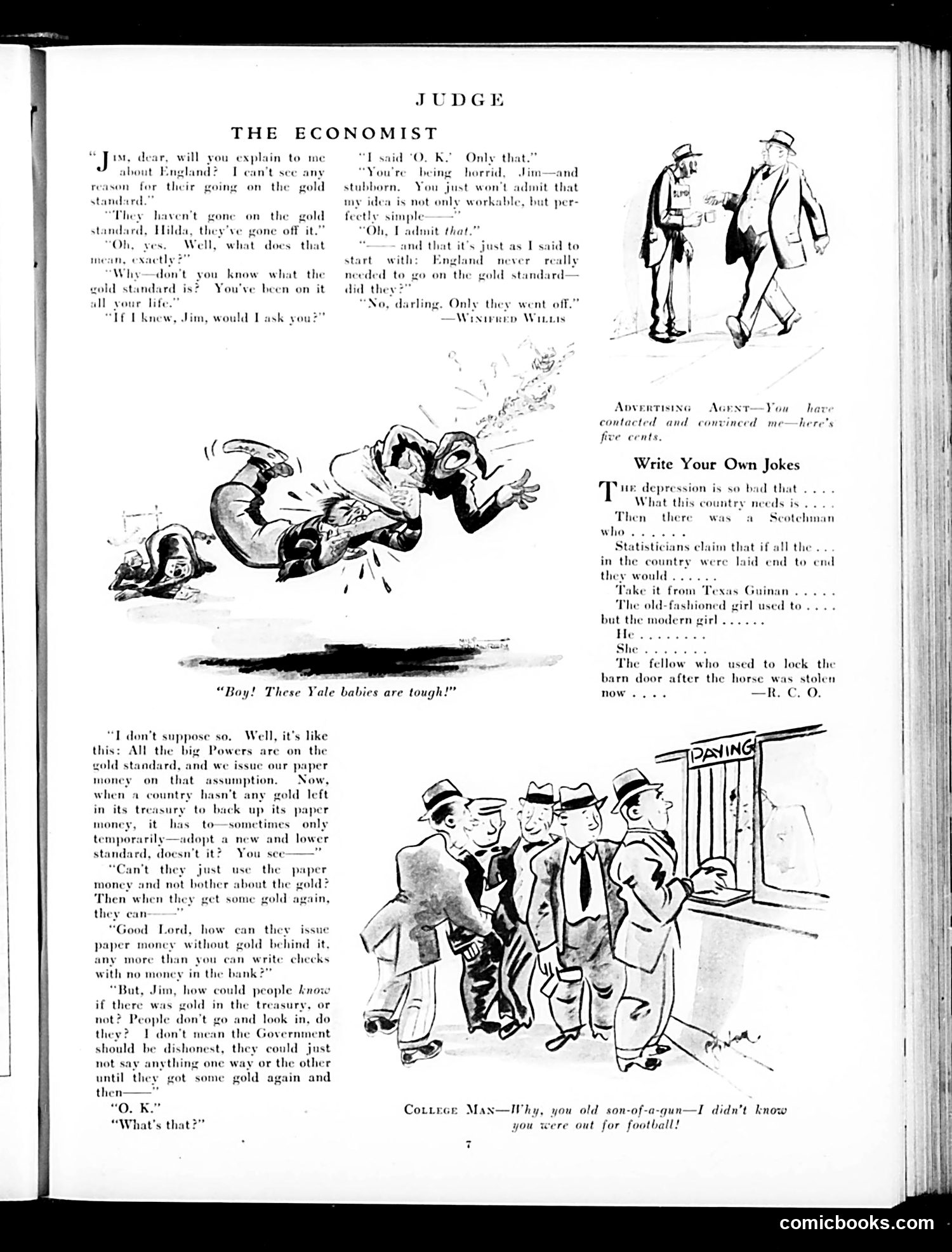
# "Judge" Page: Gold Standard Economics Satire This page satirizes public confusion about the gold standard during the Great Depression era. The main cartoon depicts a dialogue between "Jim" (apparently an economist or informed man) and "Hilda" (an average woman), where he struggles to explain why countries abandoned the gold standard—the monetary system backing paper currency with physical gold reserves. The satire targets both parties: Hilda's willful ignorance ("If I knew, Jim, would I ask you?") and Jim's condescending, circular explanations that ultimately fail to clarify anything. The joke is that even experts couldn't adequately explain economic policy to ordinary citizens. The secondary cartoon shows three men entering a "Dancing" establishment, with a college man quip about football, offering lighter relief. The "Write Your Own Jokes" section provides depression-era humor prompts, reflecting Judge's satirical response to 1930s economic crisis and social anxiety.
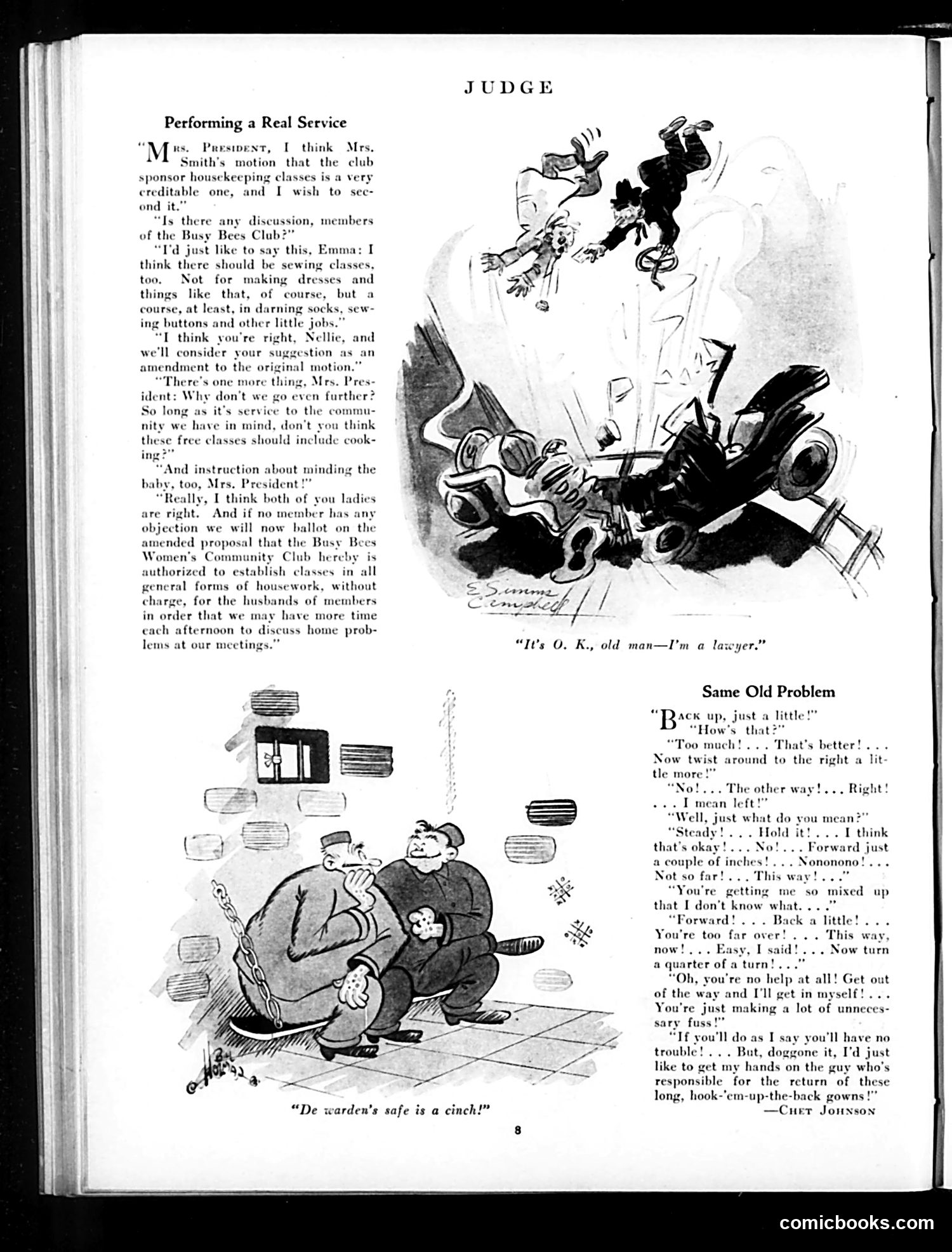
# "Performing a Real Service" and "Same Old Problem" **Top cartoon**: A women's club debates expanding their housekeeping classes. The satire targets early 20th-century women's organizations and gender roles—the women propose teaching domestic skills (sewing, darning) to community members, but one member suggests the *real* service would be offering free housework classes to members' **husbands**, freeing the women for afternoon club meetings. The joke exposes the contradiction: women's clubs ostensibly exist for community service, but the actual priority is female leisure time away from domestic duties. **Bottom cartoon**: A couple struggling with a woman's dress—likely a "hook-em-up-the-back" gown requiring fastening assistance. The humor lies in the contradictory, confusing directions the woman gives ("Back up... No, the other way... I mean left"), frustrating the man. The caption blames dress designers for the impractical garment. This satirizes contemporary fashion design as illogical and burdensome, making even simple dressing impossible without help.
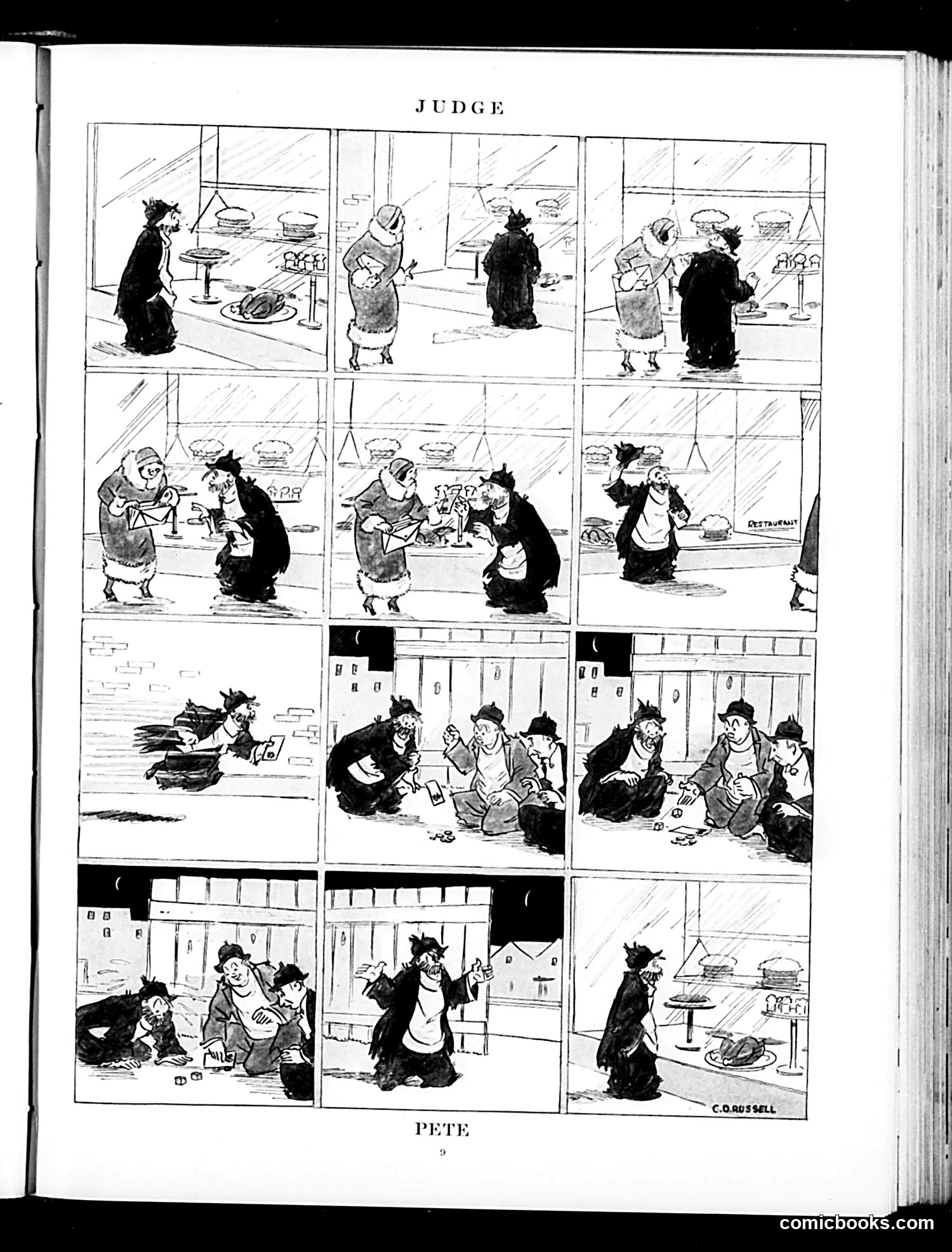
# "Judge" Page: "Judge" and "Pete" Comics This page contains two comic strips by C.D. Russell satirizing urban social dynamics, likely from the early 20th century. **"Judge"** (top): Shows wealthy diners at an upscale restaurant observing homeless or poor people outside windows. The satire contrasts comfortable, well-fed patrons with hungry outsiders—commenting on economic inequality and indifference of the wealthy. **"Pete"** (bottom): Depicts what appears to be vagrants or homeless men gambling or socializing in alleyways and street corners, shown in increasingly chaotic scenes. The strip likely satirizes urban poverty, street life, or criminal underworld activity. Both strips use exaggerated caricature typical of Judge's satirical style, critiquing either class disparities or social problems of urban America. The exact historical moment remains unclear without publication date context.
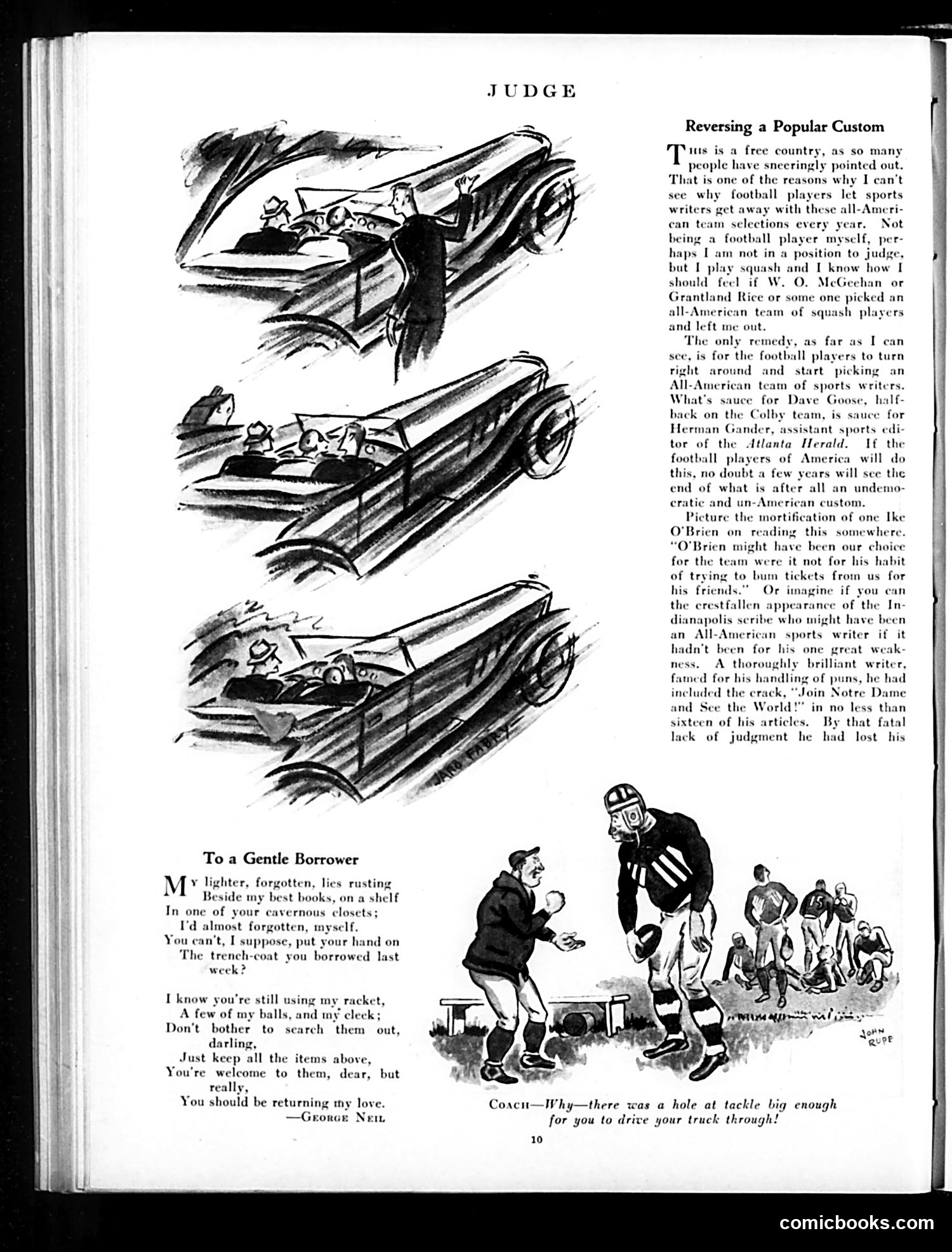
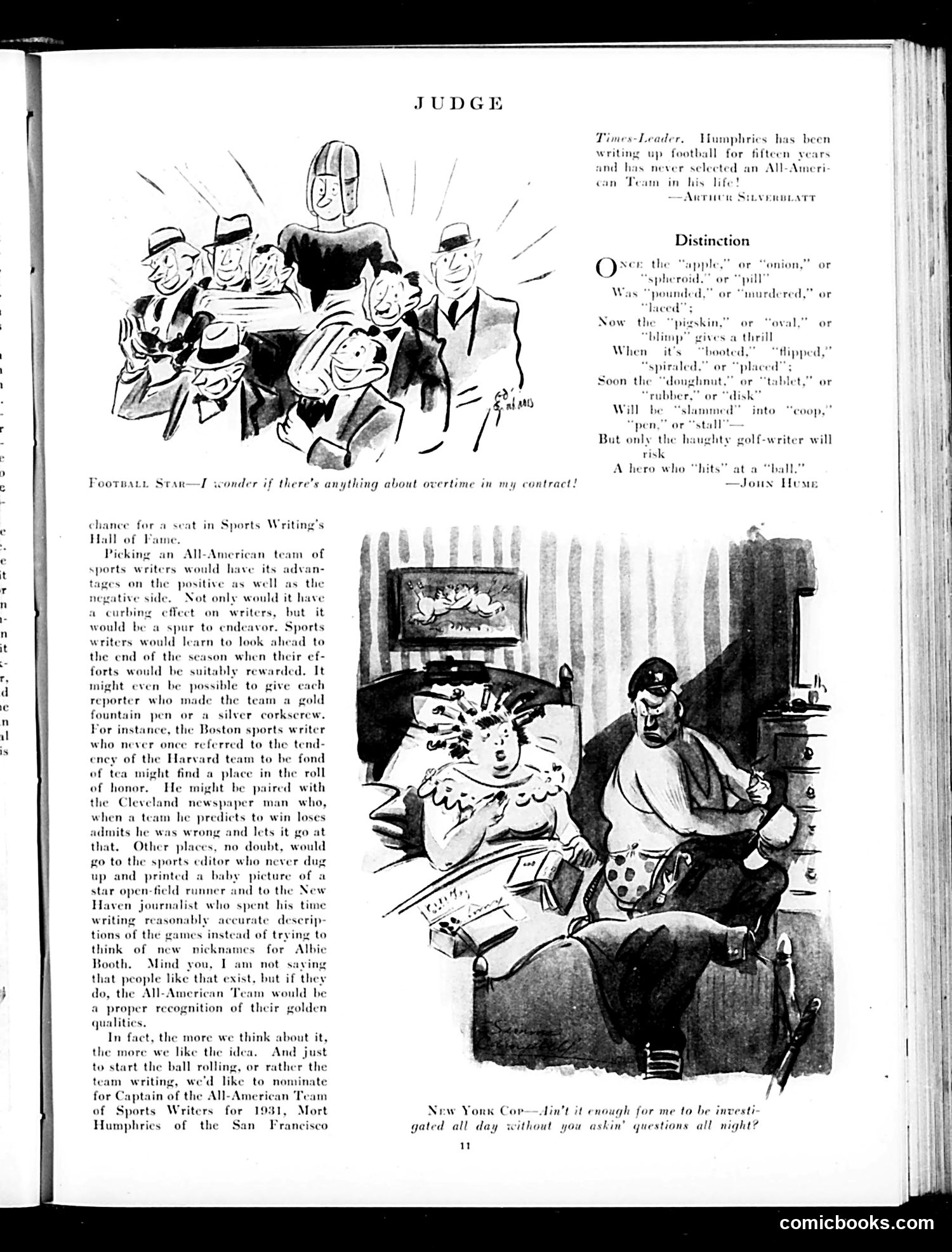
# Satire Analysis: Judge Magazine Page This page contains two distinct pieces of social commentary: **"Reversing a Popular Custom"** (main article with car illustrations): The author critiques sportswriters' power to select "All-American" football teams annually, arguing this is undemocratic. He proposes football players reciprocate by selecting an All-American team of sportswriters, then humorously imagines which writers would be excluded—like Dave Goose for bumming tickets, or an Indianapolis scribe for overusing a tired pun about Notre Dame. The satire mocks both the arbitrary nature of these selections and sportswriters' influence over athletics. **"To a Gentle Borrower"** (poem by George Neil): A lighthearted complaint about a friend who borrowed the author's lighter, books, racket, balls, clock, and trench coat—but hasn't returned them or "my love." The humor lies in cataloging increasingly absurd borrowed items, culminating in the romantic plea. **"Coach" cartoon**: Shows a football coach reproaching a player for tackling so aggressively he drove through the opposing team like a truck through a hole. All three pieces use gentle humor about contemporary social customs and interpersonal dynamics.