
Judge, 1931-10-17 · page 22 of 36
Judge — October 17, 1931 — page 22: what you’re looking at
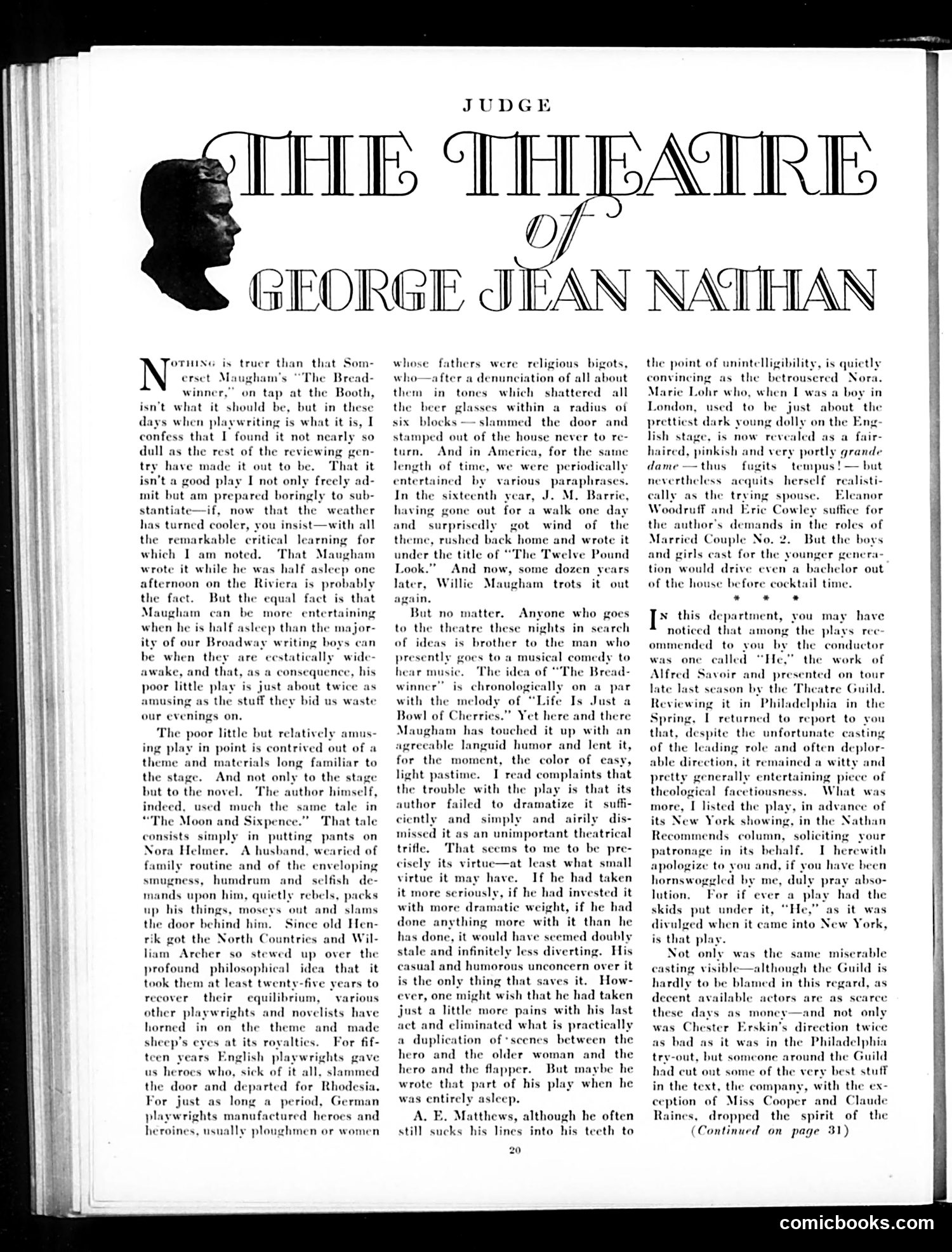
A restored page from Judge, 1931-10-17. Page through the whole issue in the reader above.
📄 Transcribed text from this page (OCR, searchable)
Machine-transcribed from the original scan — historical spelling and the odd misread are preserved.
JUDGE EB THEATRE GFORGE ie NACHHIAN yTHING is truer than that Som- N erset Maugham’s “The Bread- winner,” on tap at the Booth, isn’t what it should be, but in these days when playwriting is what it is, I confess that I found it not nearly so dull as the rest of the reviewing gen- try have made it out to be. That it isn’t a good play I not only freely ad- mit but am prepared boringly to sub- stantiate—if, now that the weather has turned cooler, you insist—with all the remarkable critical learning for which I am noted. That Maugham wrote it while he was half asleep one afternoon on the Riviera is probably the fact. But the equal fact is that Maugham can be more entertaining when he is half asleep than the m. ity of our Bre be when they dway writing boys can re cestatically wide- awake, and that, as a consequence, his poor little pls amusing as the stuif they bid us waste our evenings on. is just about twice as The poor little but relatively amus- ing play in point is contrived out of a theme and materials long familiar to the stage. And not only to the stage but to the novel. The author himself, indeed, used much the e tale “The Moon and consists simply in putting pants on Nora Helmer. A husband, w ied of family routine and of the enveloping smugness, humdrum and_ selfish de- mands upon him, quietly rebels, packs up his things, moseys out and slams the door behind him. Since old Hen- rik got the North Countries and Wil- liam Archer so stewed up over the profound philosophical idea that it took them at least twenty-five years to recover their equilibrium, | varions other playwrights and novelists have horned in on the theme and made t its royalties. For fif- English playwrights gave . sick of it all, slammed the door and departed for Rhodesia. For just as long a period, German playwrights manufactured heroes and heroines, usually ploughmen or women whose fathers were religious bigots, who—after a denunciation of all about them in which shattered all the beer glasses within a six blocks - tones radius of the door and stamped out of the house never to re- turn. And in America, for the same length of time, we were periodically slammed entertained by various paraphrases. In the sixteenth year, J. M. Barrie, having gone out for a walk one ¢ and surprisedly got wind of the theme, rushed back home and wrote it under the title of “The Twelve Pound Look.” And now, some dozen years later, Willic Maugham trots it out again, But no matter. Anyone who goes to the theatre these nights in search of ideas is brother to the man who presently goes to a musical comedy to The idea of “The Bread- winner” is chronologically on a par with the melody of “Li Bowl of Cherries.” Yet here and there Maugham has touched it up with an agreeable languid humor and lent it, for the moment, the color of easy, light pastime. I read complaints th the trouble with the play is that its author failed to dramatize it ciently and simply and_ airily missed it as an unimportant thes trifle. That seems to me to be pre- cisely its virtue—at least what small virtue it may have. If he had taken it more seriously, if he had invested it with more dramatic weight, if he had done anything more with it than he has done, it would have seemed doubly stale and infinitely less diverting. His casual and humorous unconcern over it is the only thing that saves it. How- ever, one might wish that he had taken just a little more pains with his act and eliminated what is practically a duplication of sscenes between the hero and the older woman and the hero and the flapper. But maybe he wrote that part of his play when he was entirely asleep. A, E, Matthews, although he often still sucks his lines into his teeth to 20 hear music. Is Just a the point of unintelligibility, is quietly convincing as the betrousered Nc Marie Lohr who, when [was a boy in London, used to be just about the prettiest dark young dolly on the Eng lish stage ge, is now revealed as a fair- haired, pinkish and very portly grande dame —thus fugits tempus! — but nevertheless acquits herself r cally as the trying spouse. Woodruff and Eric Cowley suffice for the author's demands in the roles of Married Couple No. 2. But the boys and girls cast for the younger genera- tion would drive even a bachelor out of the house before cocktail time. " *# * Ik this department, you may have noticed that among the plays ree- ommended to you by the conductor was one called “He,” the work of Alfred Savoir and presented on tour late last season by the Theatre Guild. Reviewing it in Philadelphia in the Spring, I returned to report to ye that, despite the unfortunate casting of the leading role and often deplor- able direction, it remained a witty and of was . [ listed the play, in advance of w York showing, in the han Recommends column, soliciting your > in its behalf. Ihe lution, For if ever a skids put under it, divulged when it came into New York, play. Not only was the same miserable ting visible—although the Guild is hardly to be blamed in t decent available actors are these day y—and not only was Chester Erskin’s direction twice as bad as it was in the Philadelphia try-out, but someone around the Guild had cut out some of the y best stuff in the text, the company, with the ex- ception of Miss Cooper and Claud Raines, dropped the spirit of the ‘ontinued on page 31) comicbooks.com