A complete issue · 36 pages · 1931
Judge — October 3, 1931
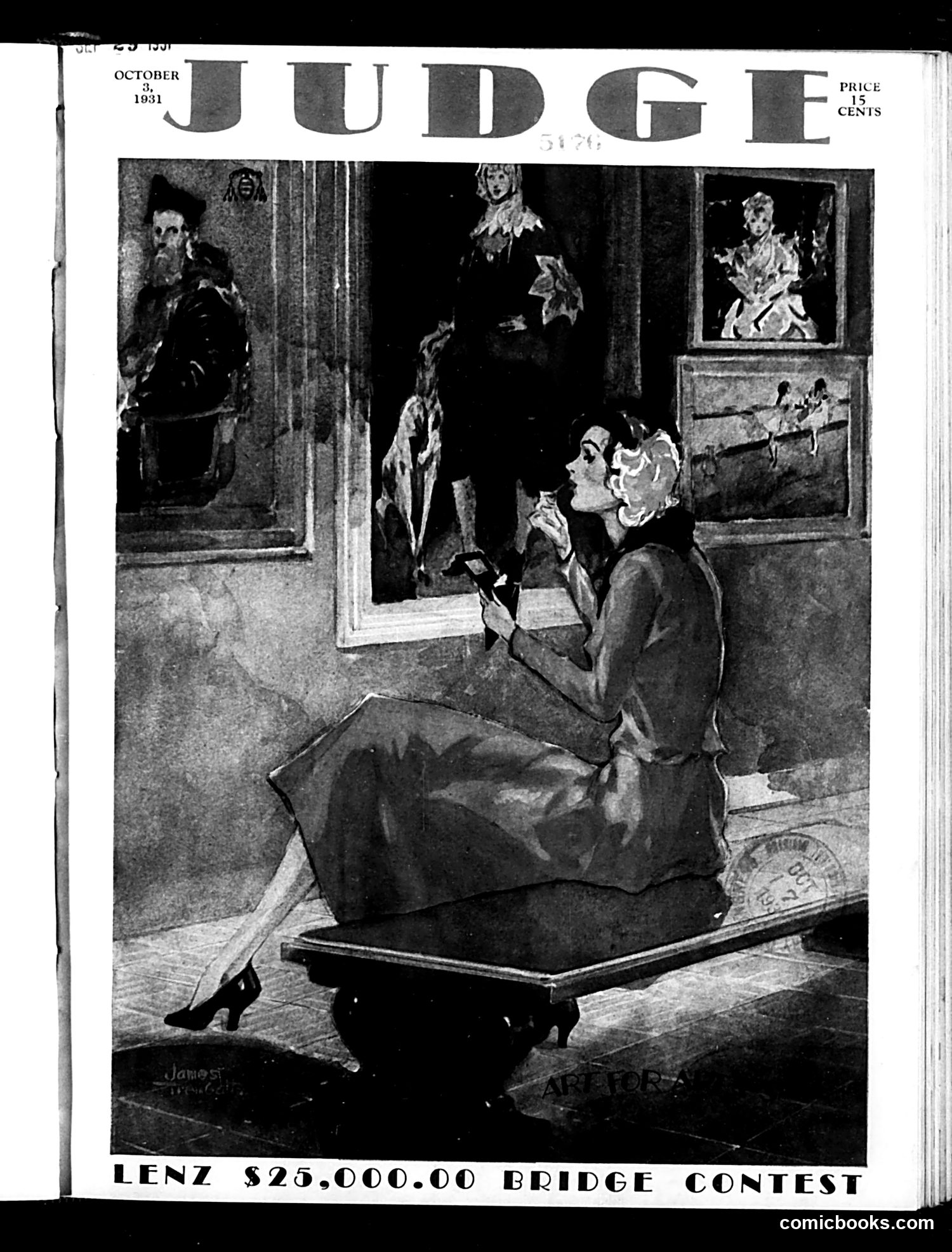
# Judge Magazine Cover - October 3, 1931 This cover satirizes the "Lenz $25,000.00 Bridge Contest," advertising a competition offering substantial prize money. The cartoon depicts a woman at what appears to be a gaming table or bridge game, viewing portraits on a wall behind her. The imagery suggests the satirical point: that bridge—the card game—had become such a popular gambling pastime that it warranted major contests and prize money. The 1931 date places this during the Great Depression, making the $25,000 prize particularly striking. The satire likely mocks both the popularity of bridge as a leisure activity and the irony of significant money being offered for card games while many Americans faced financial hardship. The woman's animated expression emphasizes the game's appeal and excitement.
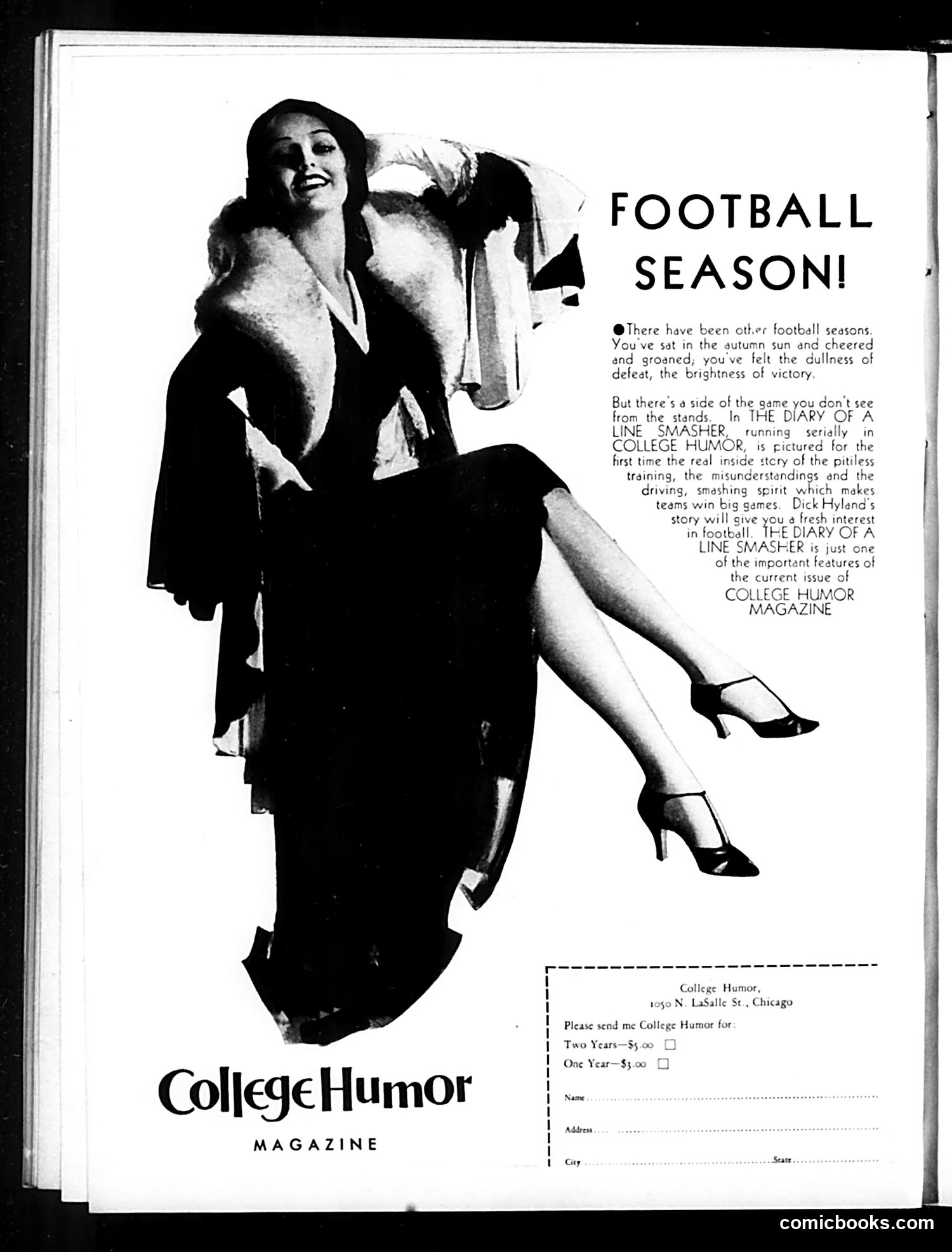
# Analysis This page is primarily **advertising for College Humor Magazine**, not political satire. The advertisement announces an upcoming feature: "The Diary of a Line Smasher," a humorous account by Dick Hyland about college football training and team dynamics. The image shows a stylized woman in 1920s-30s attire being lifted or tossed, likely representing the energetic, playful tone of college life that College Humor magazine targeted. The ad emphasizes that readers will get "the real inside story" of football beyond what stadium crowds see—the "pithless training, misunderstandings and driving, smashing spirit" behind victories. This reflects College Humor's appeal to college-age readers seeking entertainment focused on campus life, sports, and youth culture rather than political commentary.
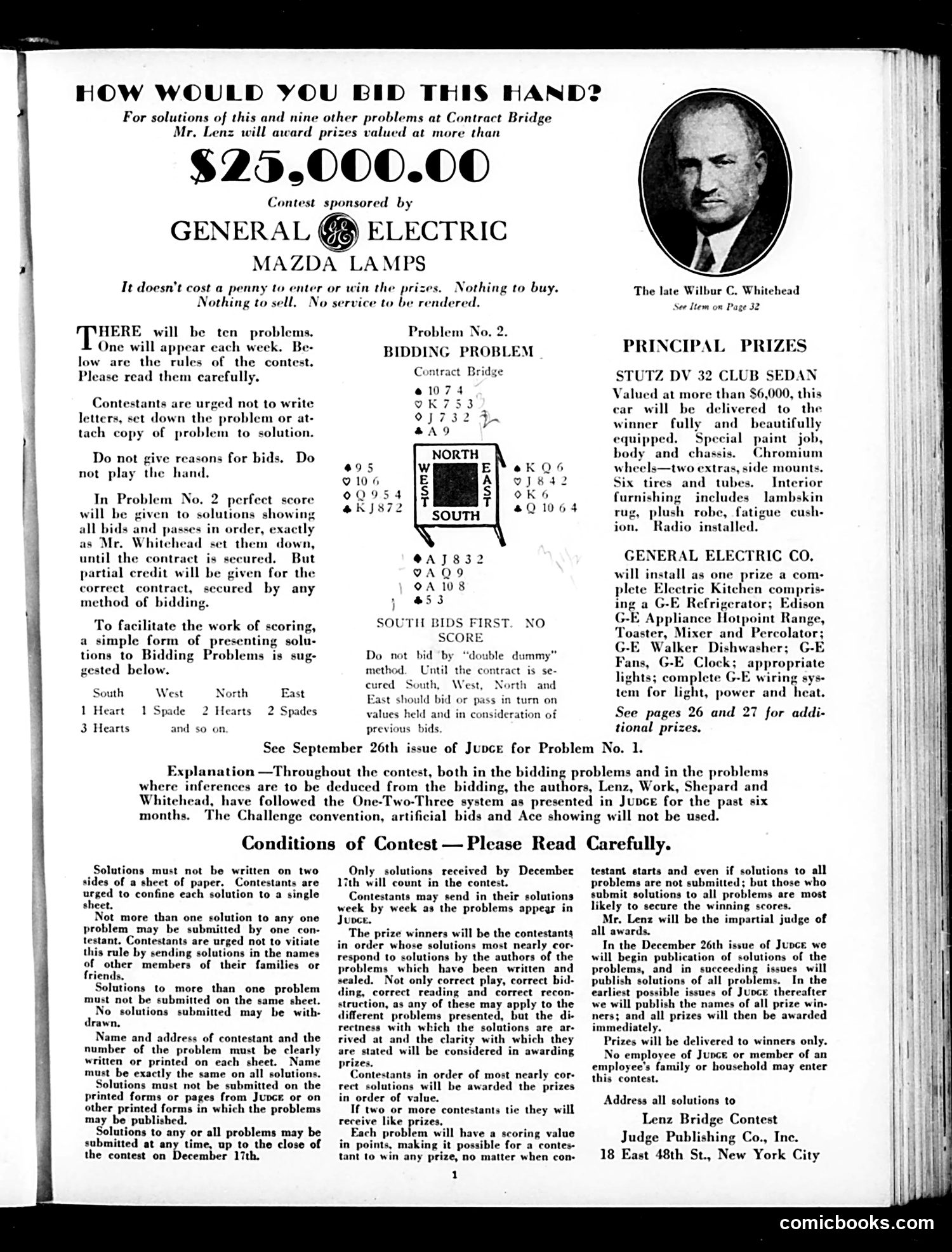
# Analysis This page is primarily **advertising and contest material**, not satirical content. It announces a bridge contract bridge problem-solving contest sponsored by General Electric's Mazda Lamps division, offering $25,000 in prizes (including a Stutz DV 32 automobile valued at $6,000). The portrait shows **Wilbur C. Whitehead**, referenced as "the late" (deceased), though the context for his inclusion isn't explained on this page. The contest rules dominate the layout, addressing how to submit solutions to weekly bridge bidding problems. While this appears in *Judge* magazine, the page functions as a **commercial promotion rather than political satire**—typical of how magazines of this era mixed editorial content with substantial advertising revenue.
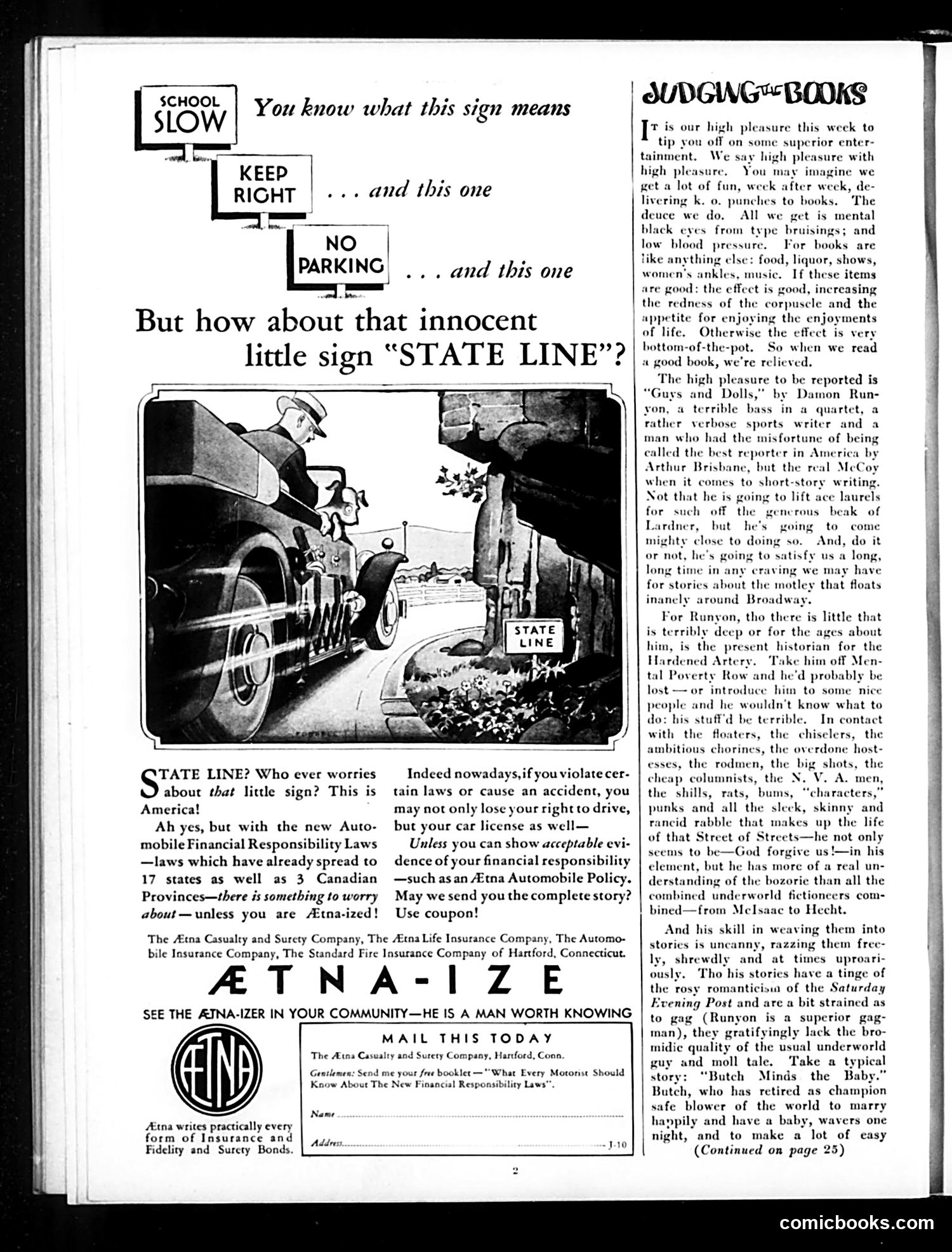
# Explanation for Modern Readers This page satirizes the "STATE LINE" sign—a boundary marker between states. The cartoon jokes that while everyone understands traffic signs like "SCHOOL SLOW," "KEEP RIGHT," and "NO PARKING," nobody worries about the STATE LINE sign, despite its legal significance. The satire's point: Under new Automobile Financial Responsibility Laws spreading across 17 U.S. states and Canadian provinces, crossing a state line could have serious consequences. If you caused an accident, you might lose your driving privileges or car license unless you could prove financial responsibility—such as an Aetna automobile insurance policy. The cartoon warns drivers that this "innocent little sign" now carries real legal weight, making insurance essential for interstate travel.
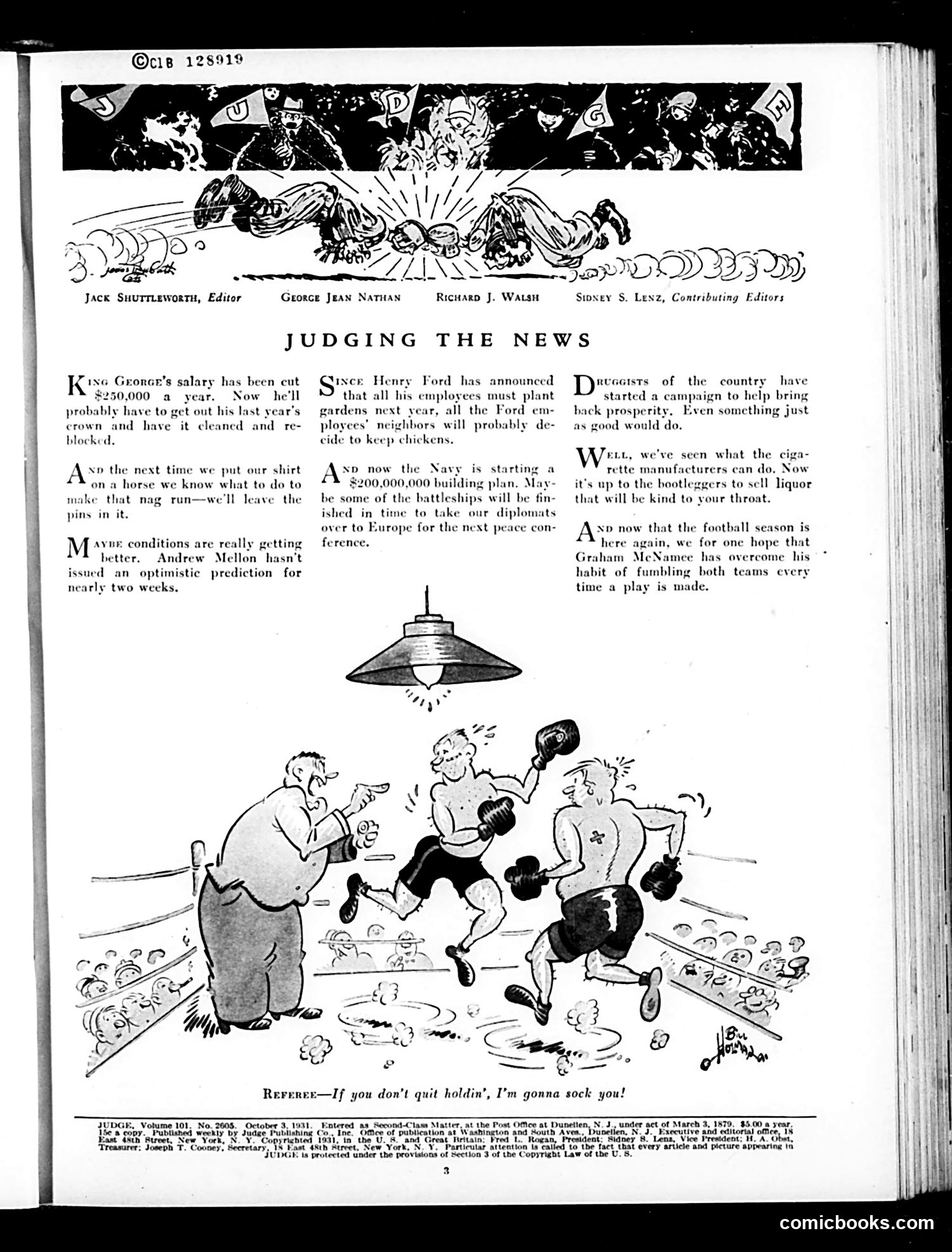
# "Judging the News" - October 3, 1931 This editorial cartoon page satirizes contemporary news events through brief commentary and a boxing cartoon. The main illustration depicts a boxing referee threatening to "sock" a boxer who won't "quit holdin'"—a visual pun on holding/clinching in boxing. The surrounding text commentary addresses: - **King George's salary cut** ($250,000/year reduction) - **Henry Ford's employee gardening requirement** - **Navy's $200 million battleship building plan** during peace negotiations - **Druggists' campaign** against bootleg liquor - **Football season**: hoping coach Graham McNamee improved his fumbling habit The cartoon uses humor to mock current events—economic hardship, labor practices, military spending, and prohibition-era bootlegging—reflecting Depression-era public concerns.
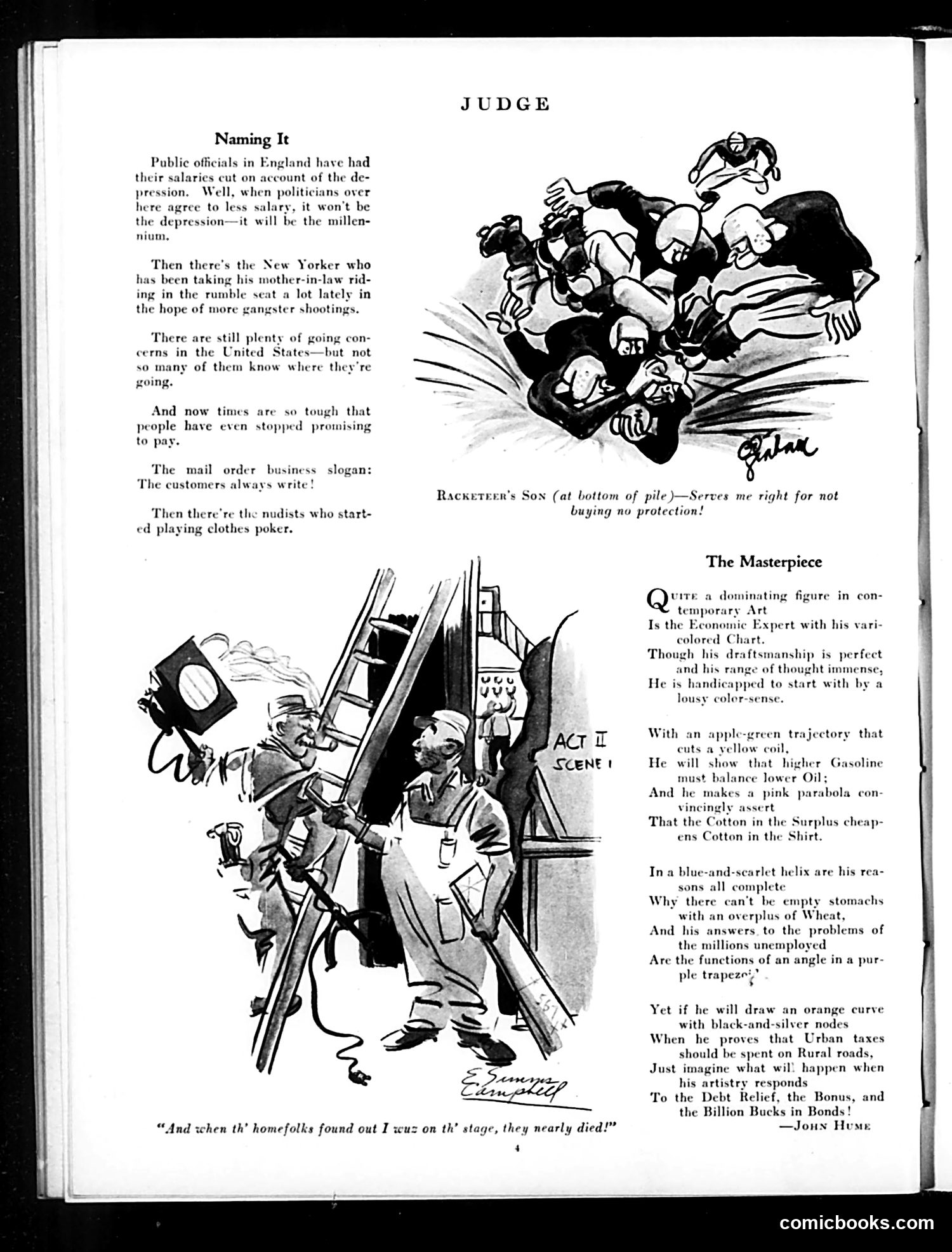
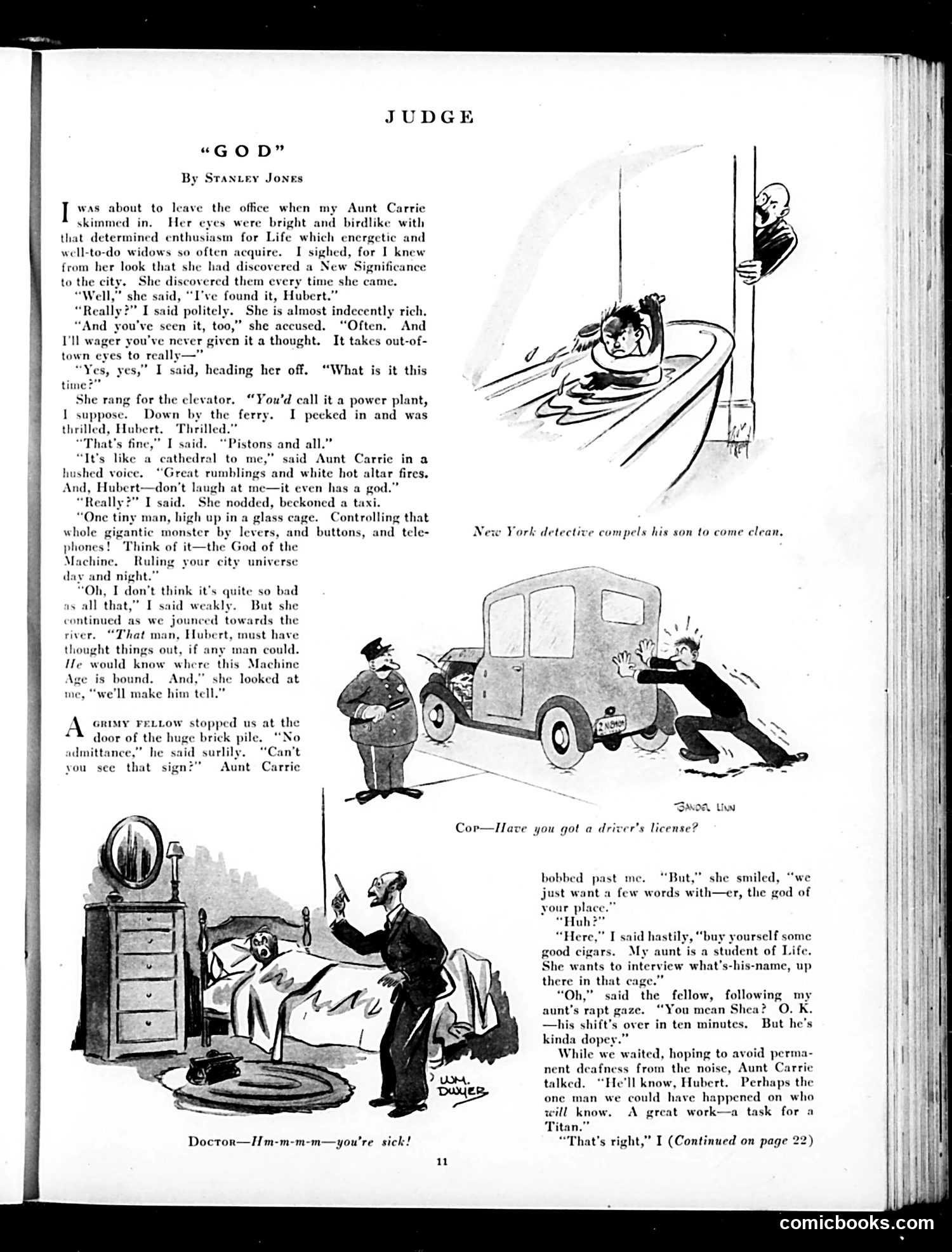
# Analysis of Judge Page The page contains two satirical cartoons mocking contemporary problems during an economic depression. The upper cartoon depicts a "Racketeer's Son" complaining about not buying "protection"—a direct reference to organized crime extortion rackets that plagued American cities in the 1920s-1930s. The joke is that even criminals' offspring expect payoffs. The lower cartoon shows a stage scene captioned about "homefolks" discovering someone "was on th' stage," suggesting social scandal around theatrical work. The right-side poem "The Masterpiece" satirizes economists and their charts predicting economic solutions during hard times—mocking their abstract theories as useless when faced with real unemployment, food shortages, and poverty. The "Economic Expert" represents the perceived failure of expert analysis to address the Depression's actual human suffering.
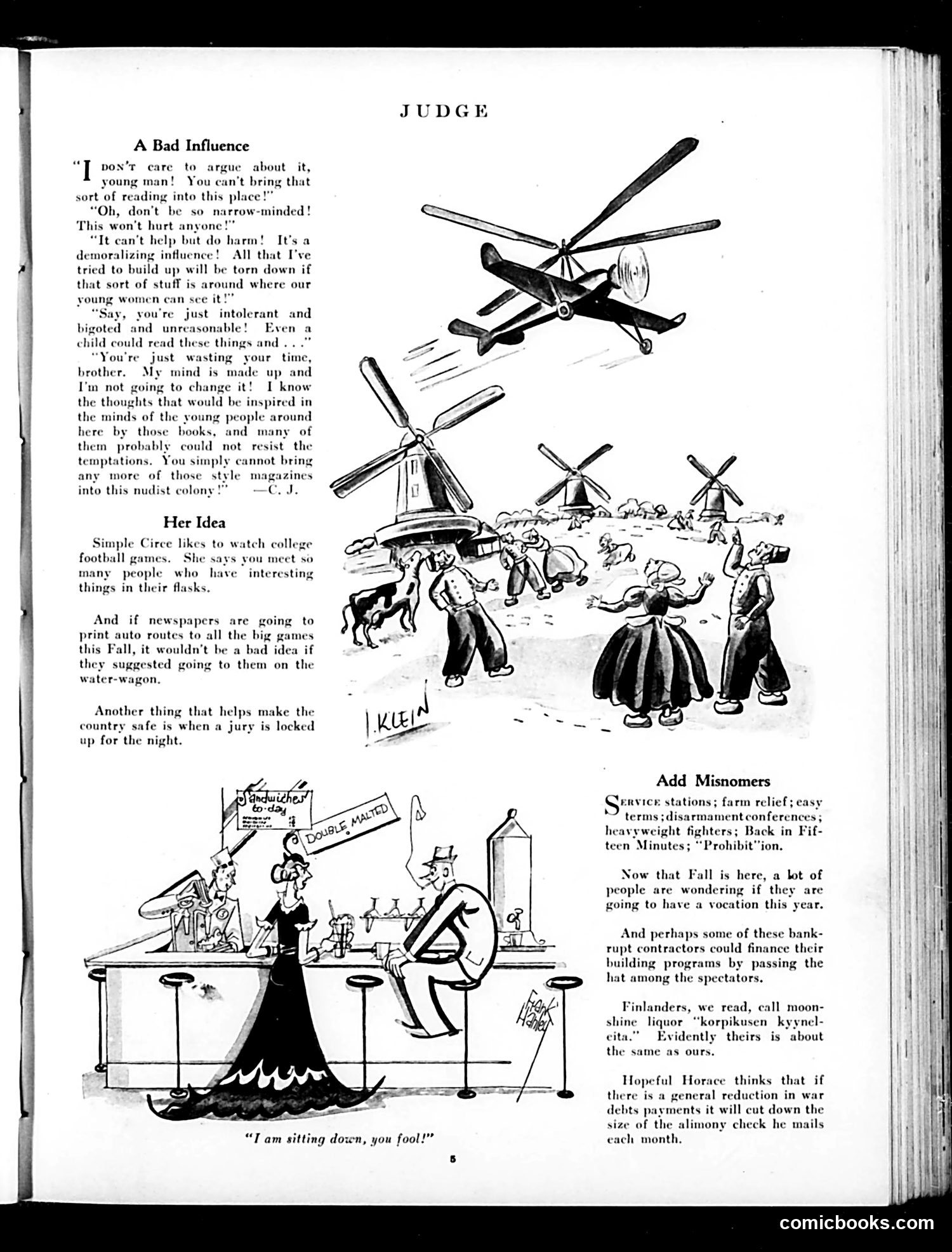
# Judge Magazine Page Analysis This page contains three satirical pieces criticizing various social trends of the era: **"A Bad Influence"** argues that controversial literature ("that sort of reading") corrupts young people and threatens social values—a common censorship debate of the early 20th century. **"Her Idea"** mocks a woman's suggestion to watch college football games and attend auto races, satirizing women's emerging interest in previously male-dominated activities and public spaces. **The lower cartoon** depicts a bar scene with the caption "I am sitting down, you fool!"—likely satirizing alcohol consumption and Prohibition-era debates, showing a woman at a bar in defiance of traditional gender norms. **"Add Misnomers"** lists contemporary concerns: farm relief, disarmament conferences, and "Prohibition"—suggesting anxiety about post-WWI social and political changes.
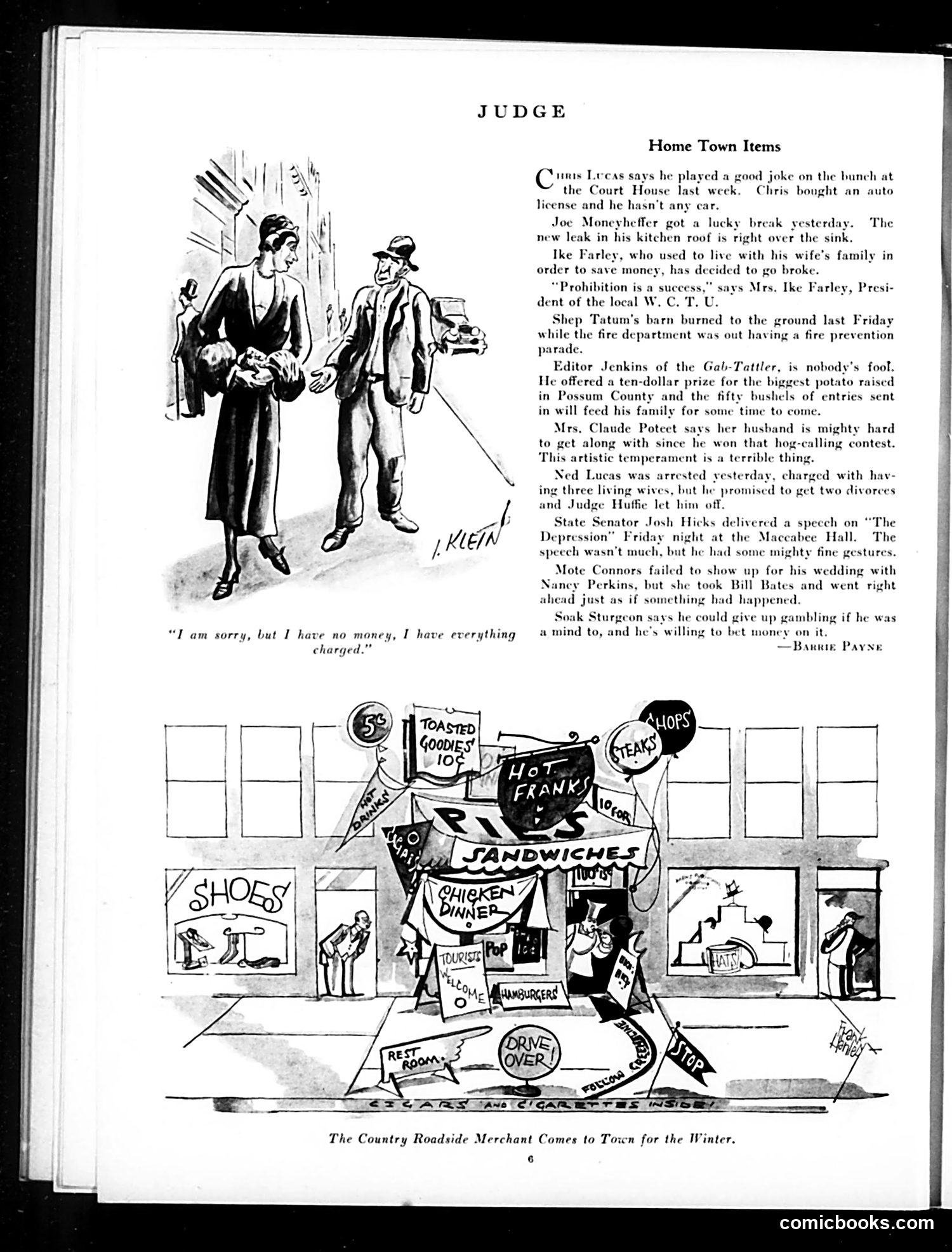
# Explanation for Modern Readers This page contains two distinct sections: **Top cartoon**: A man tells a judge "I am sorry, but I have no money, I have everything charged." This satirizes the emerging consumer credit culture—buying goods "on charge" (credit) rather than with cash. The joke is ironic: despite claiming poverty, he's acquired substantial possessions through debt. **Bottom cartoon**: "The Country Roadside Merchant Comes to Town for the Winter" depicts a roadside stand exploding with commercial signage (hot franks, sandwiches, chicken dinner, shoes, rest rooms, drive-over). This satirizes the proliferation of tacky roadside tourist attractions and commercialization of American highways—a phenomenon that accelerated in the 1920s-30s with automobile travel. The chaotic visual metaphor suggests this commercialism is overwhelming and somewhat ridiculous.
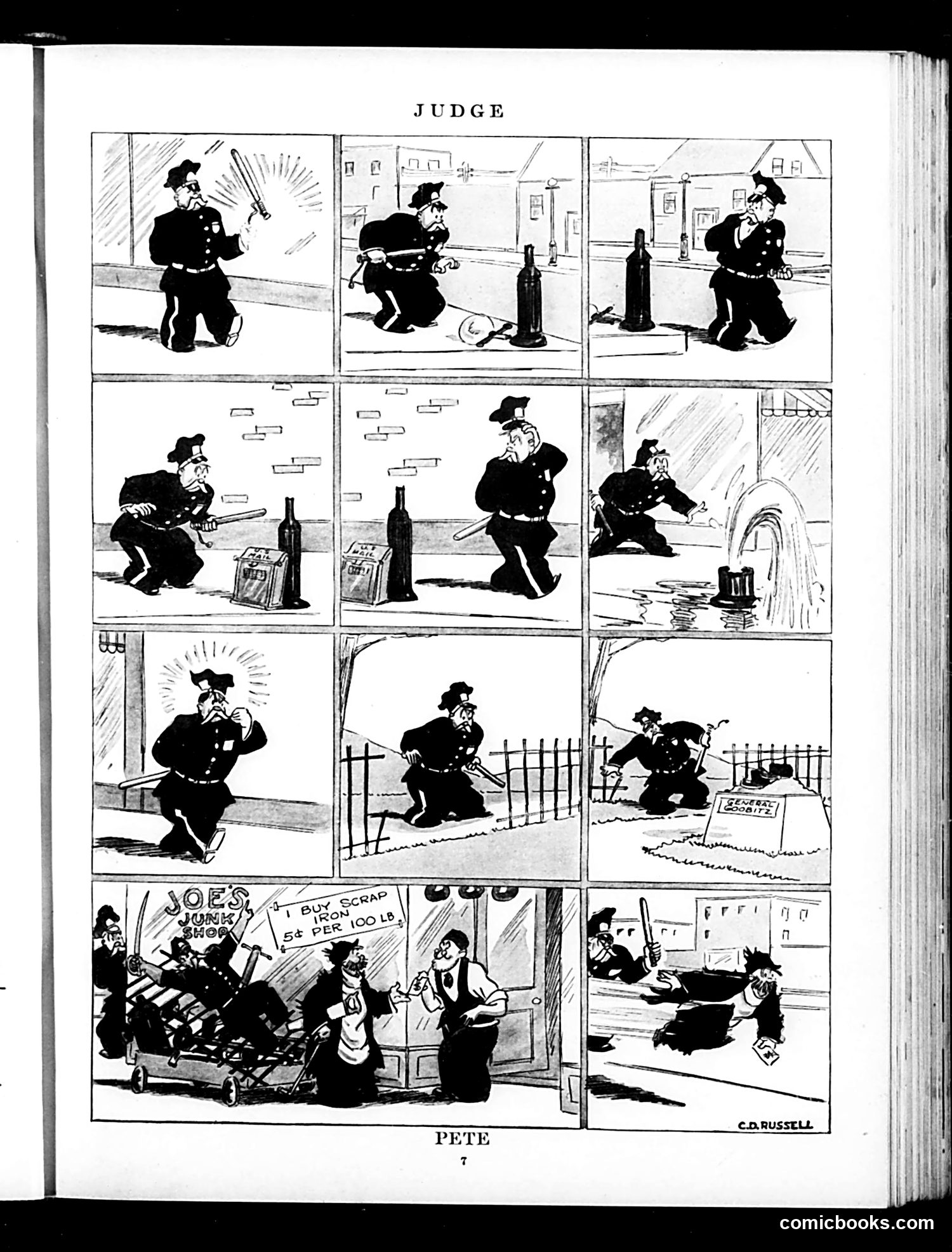
# "Judge Pete" Comic Strip Analysis This is a sequential comic strip titled "Judge Pete" by C.A. Russell, depicting a police officer or judge character navigating various urban situations. The narrative follows Pete through encounters involving: - Confiscated alcohol bottles (suggesting Prohibition-era enforcement) - Scrap metal collection and sales ("Buy scrap 5¢ per 100 lbs") - Interactions at what appears to be "Joe's Pawn Shop" The humor appears satirical toward law enforcement and civic authority during Prohibition, mocking Pete's attempts to maintain order while dealing with black-market activities and petty commerce. The strip suggests corruption or the absurdity of enforcing unpopular laws. Without additional context about the magazine's date, the specific political targets remain unclear, though the Prohibition references and street-level crime scenarios are evident.
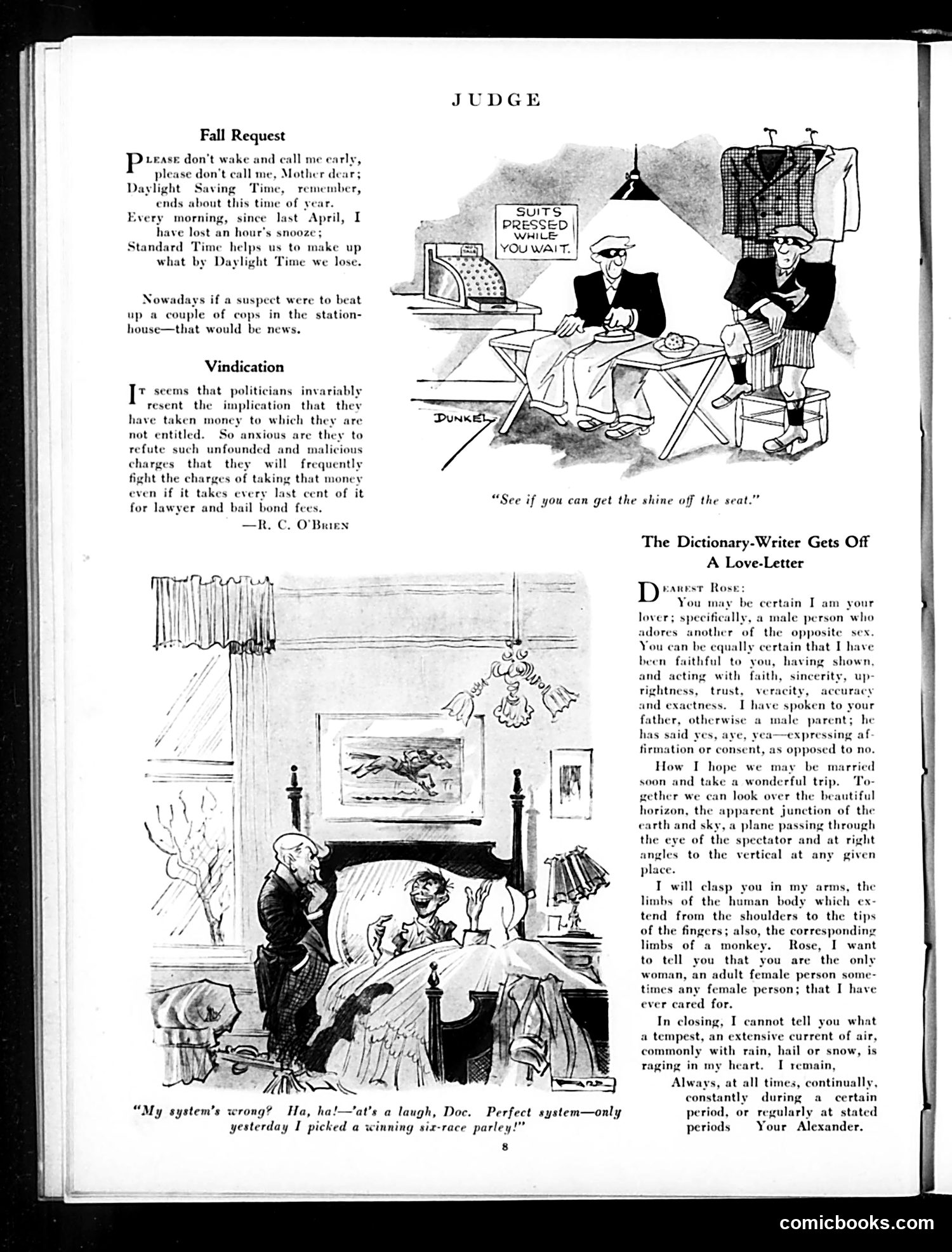
# Judge Magazine Page Analysis This page contains three distinct satirical pieces: **"Fall Request"** mocks Daylight Saving Time's end in autumn, complaining about lost sleep since April when it began. **"Vindication"** satirizes corrupt politicians who spend enormous sums on lawyers and bail bonds defending themselves against bribery accusations—ironically proving guilt through their desperate denials. **"The Dictionary-Writer Gets Off A Love-Letter"** parodies pedantic writing by presenting a love letter where every emotion is replaced with dictionary definitions. The lover describes Rose using technical language ("limbs of the human body which extend from the shoulders to the tips of the fingers") instead of romantic language. The cartoon below shows a doctor and patient, with the caption joking about a "perfect system" for winning horse races—a parallel mockery of absurd certainty. The satire targets pretentious, overcomplicated language and the gap between how things should be expressed versus how pedants actually express them.
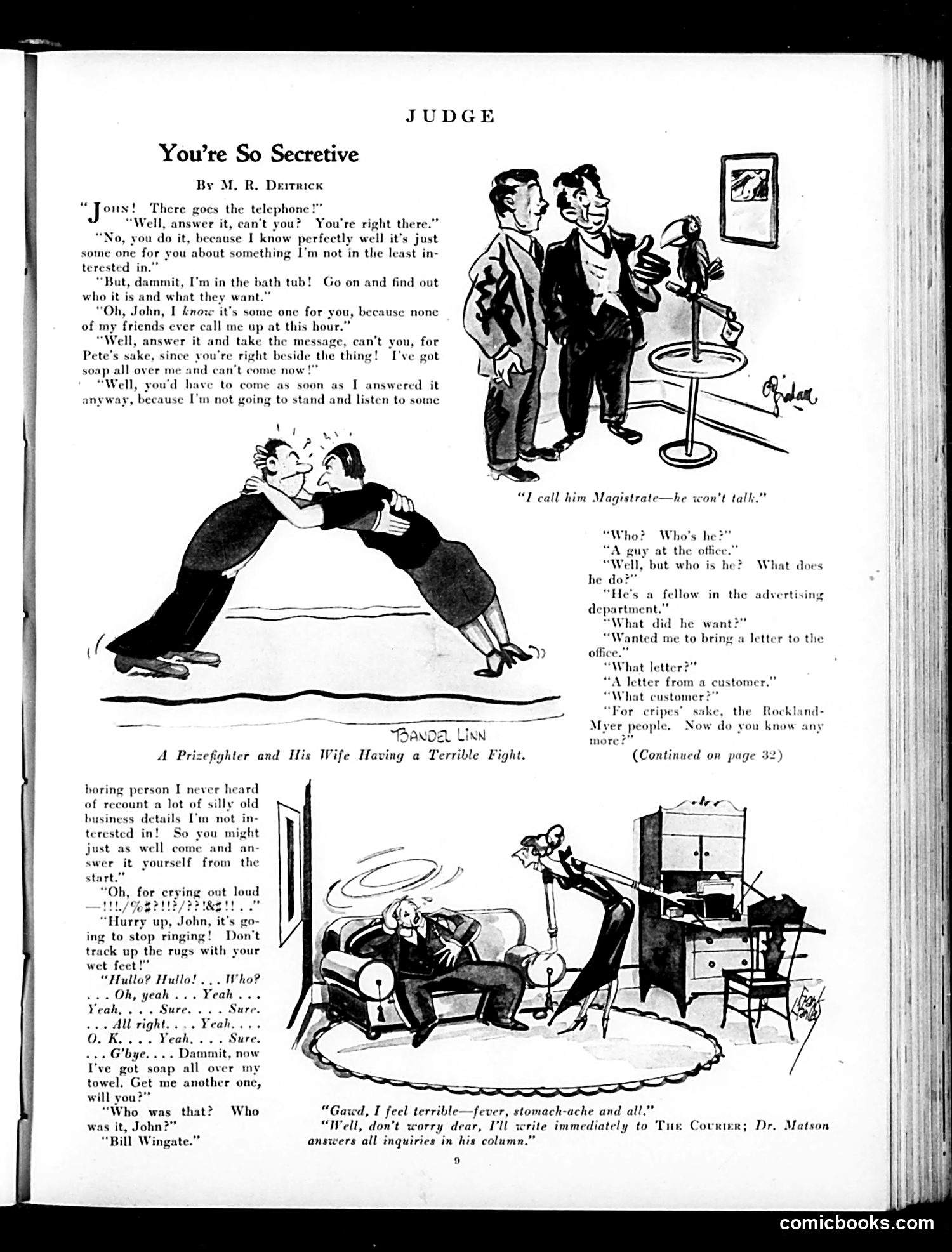
# "You're So Secretive" - Judge Magazine This domestic comedy depicts a married couple's petty argument over answering a ringing telephone. The husband, in the bathtub, refuses to answer; the wife insists it's for him. When she finally answers, it's a business call from "Bill Wingate" at the advertising department regarding a letter for Rockland-Myers customers—details the wife finds boring and resents. The satire mocks 1920s-30s married life: the passive-aggressive buck-passing, gender dynamics around domestic duties, and husbands' reluctance to take work calls at home. The wife's resentment at being treated as a secretary mirrors period anxieties about women's domestic servitude. The lower cartoon shows the couple's quarrel escalated into physical comedy—the "terrible fight" of the title—suggesting marital discord over trivial matters.
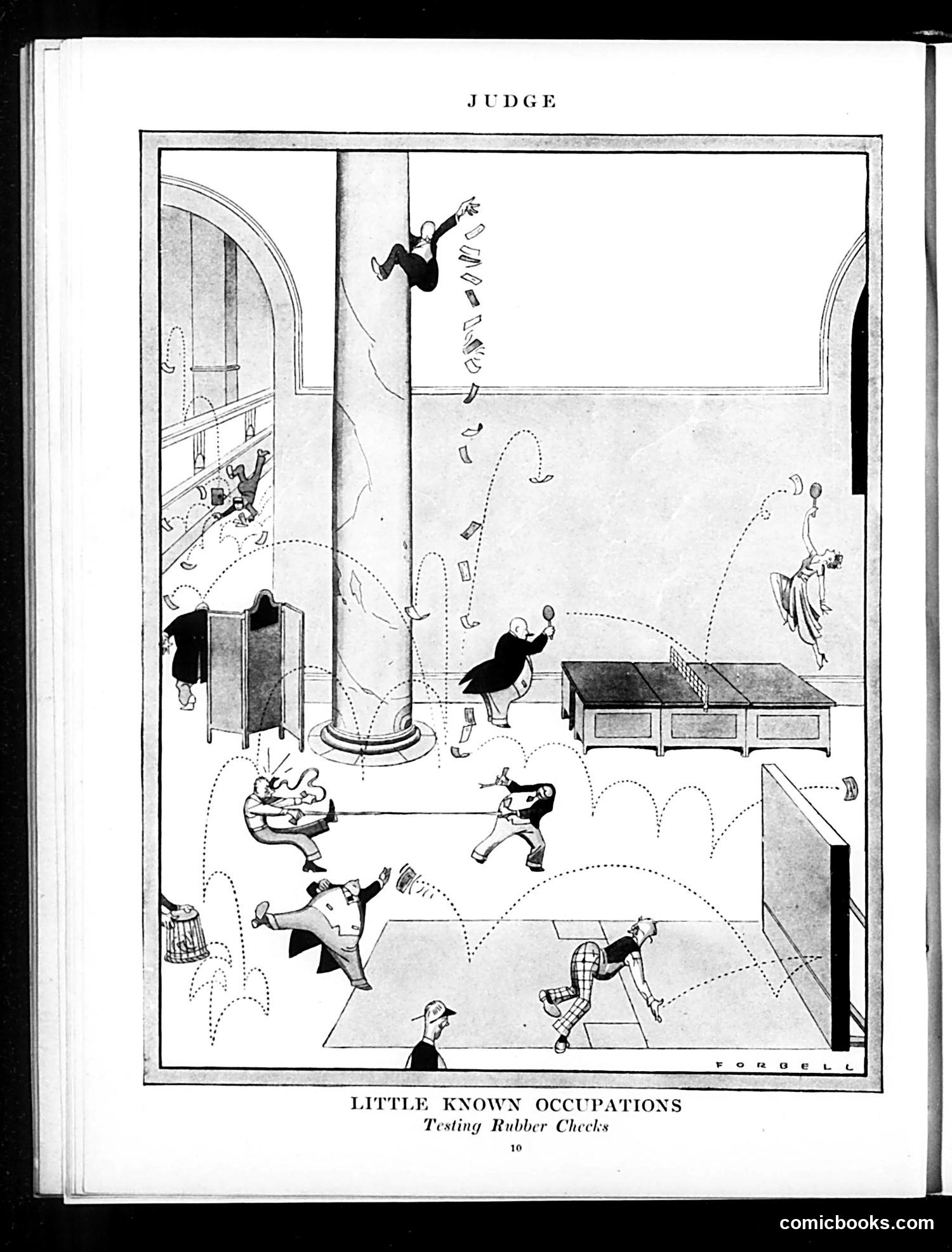
# "Testing Rubber Checks" - Judge Magazine Cartoon This cartoon satirizes the occupation of testing rubber checks—checks that "bounce" or fail due to insufficient funds. The illustration shows a chaotic courtroom or institutional setting where various figures are literally testing the elasticity of rubber checks depicted as dotted-line trajectories bouncing around the room. The humor derives from the double meaning: "rubber check" is slang for a bad check, but the cartoon depicts them as actual rubber objects with physical bounce properties. The scene parodies both the absurdity of having such an occupation and the frustration of financial fraud. Multiple figures are shown in exaggerated poses reacting to these bouncing checks, suggesting the widespread problem of check fraud in early 20th-century commerce.