
Judge, 1931-10-03 · page 15 of 36
Judge — October 3, 1931 — page 15: what you’re looking at
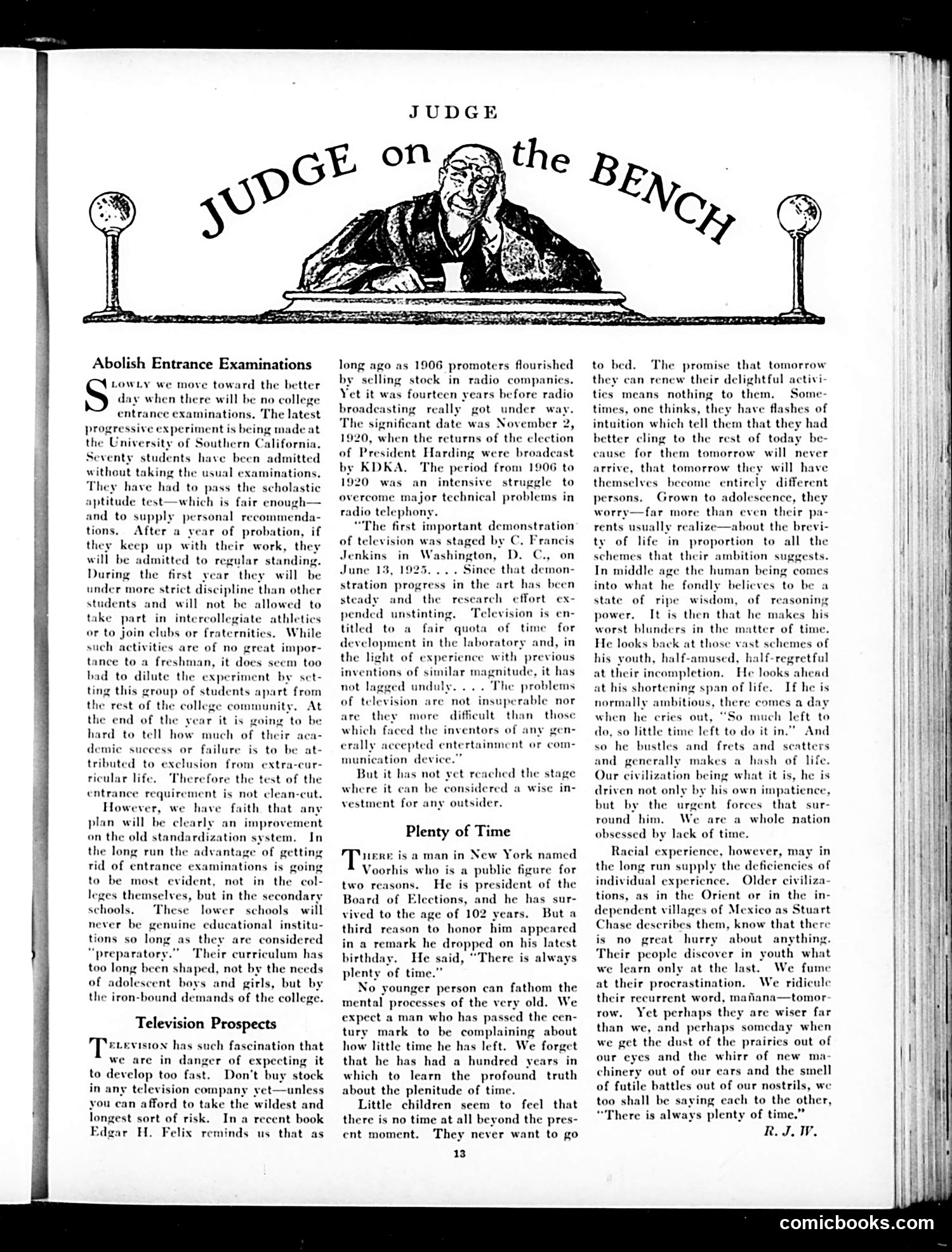
A restored page from Judge, 1931-10-03. Page through the whole issue in the reader above.
📄 Transcribed text from this page (OCR, searchable)
Machine-transcribed from the original scan — historical spelling and the odd misread are preserved.
Abolish Entrance Examinations LoWLy we move toward the better S day when there will be no college entrance examinations, The latest progressive experiment is being made the University of Southern ( Seventy students have been without ing the usual examinations. They have had to pass the scholastic aptitude test—which is fair enough— and to supply personal recommenda- tions. After a year of probation, if they keep up with their work, they will be admitted to regular standin During the first year they will be under more strict discipline than other students and will not be allowed to part intercollegiate athletics or to join clubs or fraternities. While such activities are of no great impor- tance to a freshman, it does seem too bad to dilute the experiment by set- ting this group of students apart from the rest of the college community, At the end of the year it is going to be hard to tell how much of their demic success or failure is to be tributed to exclusion from extra ricular life. Therefore the test of the entrance requirement is not cle However, we have faith th plan will be clearly an improvement on the old standardization system. In the long run the advantage of getting rid of entrance examinations is going to be most evident, not in the leges themselves, but in the secondary schools. These lower schools will never be genuine cducational institu- tions so long are considered “preparatory curriculum has too long been shaped, not by the needs of adolescent boys and girls, but t the iron-bound demands of the college. col- Television Prospects T viston has such fascination that we are in danger of expecting it to develop too fast. Don’t bu in any television company y you can afford to take the est sort of risk. ar H, Idest and In a recent book Felix reminds us that as long ago as 1906 promoters flourished by selling stock in radio companies. Yet it was fourteen years before radio broadcasting really got under way. The significant date was November 2, 1920, when the returns of the election of President Harding were broadcast by KDKA. The period from 1906 to 20 an intensive struggle to overcome major technical problems in radio telephony. “The first important demonstration of television was staged by C. Francis Jenkins in Washington, D. C., on June 13, 5 . Since that demon- stration progress in the art has been steady and the research effort ex- pended unstinting, ‘Television is en- titled to a fair quota of time for development in the laboratory and, in the light of experience with previous inventions of similar magnitude, it has not lagged unduly. ... The problems of television are not insuperable nor are they difficult’ than. those which faced the inventors of any gen- erally munication device.’ But it has not yet reached the stage where it can be considered a wise in- vestment for any outsider. more epted entertainment or © Plenty of Time Ture is a man in New York named Voorhis who is a public figure for two reasons. He is president of the Board of Elections, and he has sur- vived to the age of 102 years. But a third reason to honor him appeared i ark he dropped on his latest He said, “There is always plenty of time.” No younger person can fathom the mental processes of the very old. We expect a man who has passed the cen- tury mark to be complaining about how little time he has left. We forget that he has had a hundred years in which to learn the profound truth about the plenitude of time. Little children seem to feel that there is no time at all beyond the pres- ent moment. They never want to go 13 to bed. The promise that tomorrow they can renew their delightful activi ties means nothing to them. Some- times, one thinks, they have flashes of intuition which tell them that they better cling to the rest of to cause for them tomorrow will never arrive, that tomorrow they will have themselves become entirely different persons. Grown to adolescence, they worry—far more than even their pa- rents usually realize—about the brevi- ty of life in proportion to all. the schemes that their ambition suggests. In middle age the human being comes into what he fondly believes to be a state of ripe wisdom, of reasonin power. It is then that he makes his worst blunders in the matter of time. He looks back at those vast schemes of his youth, half-amused, half-regretful at their incompletion. He looks ahead at his shortening span of life. If he is normally ambitious, there comes a day when he cries out, “So much left to do, so little time left to do it in.” And so he bustles and frets and scatters and generally makes a hash of life. Our civilization being what it is, he is driven not only by his own impatience, but by the urgent that sur- round him, We are a whole nation d by lack of time. Racial experience, however, 1 the long run supply the deficien individual experience. Older civili tions, as in the Orient or in the in- dependent villages of Mexico as Stuart Chase describes them, know that there is no great hurry about anything. Their people discover in youth what we learn only at the last. We fume at their procrastination. We ridicule their recurrent word, mafiana—tomor row. Yet perhaps they are wiser far than we, and perhaps someday when we get the dust of the prairies out of our eyes and the whirr of new ma chinery out of our ears and the smell of futile battles out of our nostrils, we too shall be ing each to the other, “There is always plenty of time.” R.JLW. forces obsess comicbooks.com