A complete issue · 36 pages · 1931
Judge — September 19, 1931
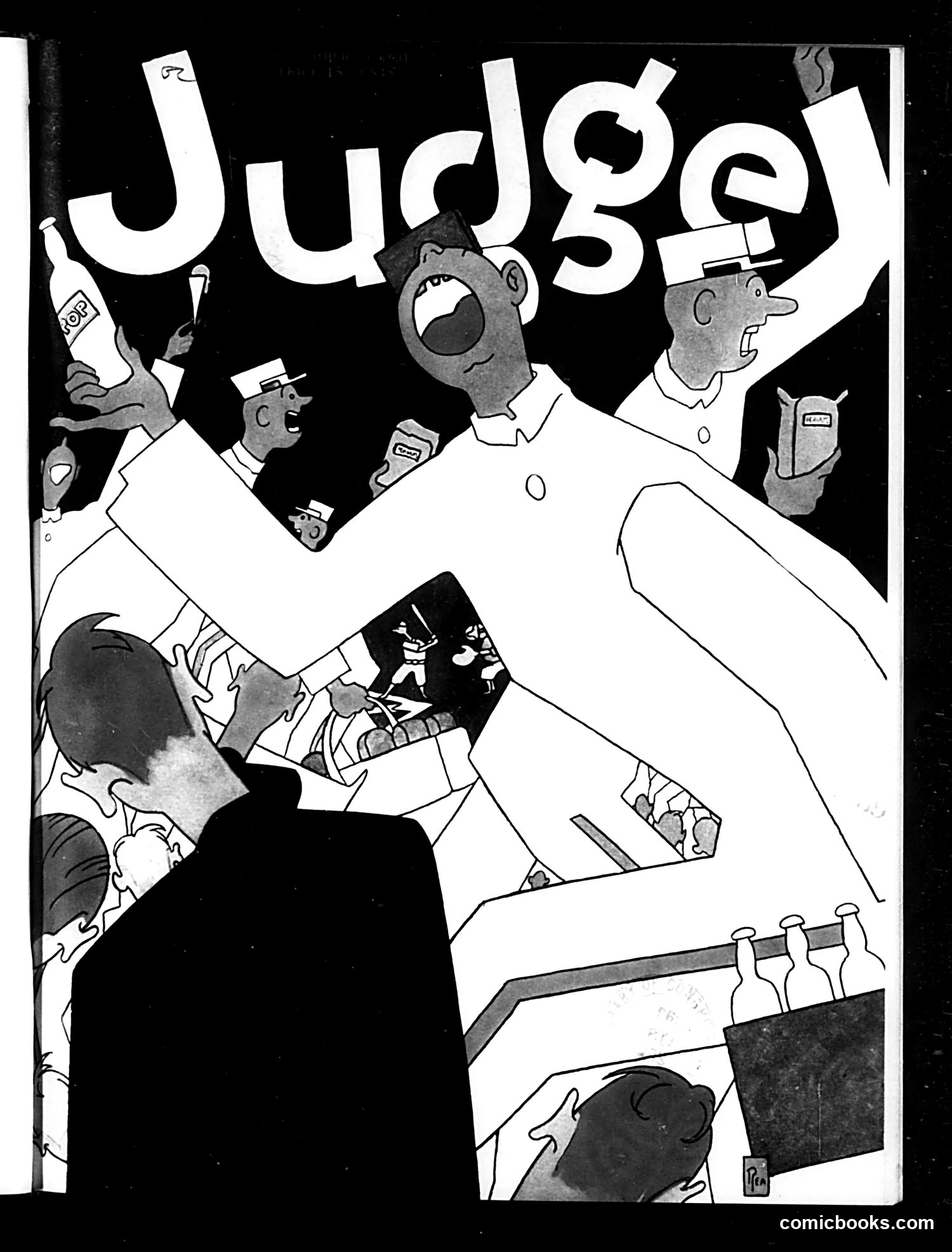
# "Jungley" This page from *Judge* magazine appears to be a satirical cartoon about urban chaos or wild behavior, suggested by the title "Jungley" and the frenzied scene depicted. The central figure—a large man in business attire with an exaggerated expression—is surrounded by smaller figures in what seems to be a chaotic indoor setting, possibly a bar or restaurant (bottles visible in lower right). The satire likely mocks either: - Excessive urban nightlife/entertainment culture - Unrestrained consumer behavior or "jungle-like" conduct in civilized settings - Specific contemporary social chaos Without clearer identifying details or caricature marks pointing to specific politicians or public figures, the exact political target remains unclear, though the "civilized" versus "wild" contrast suggests commentary on modern social behavior.
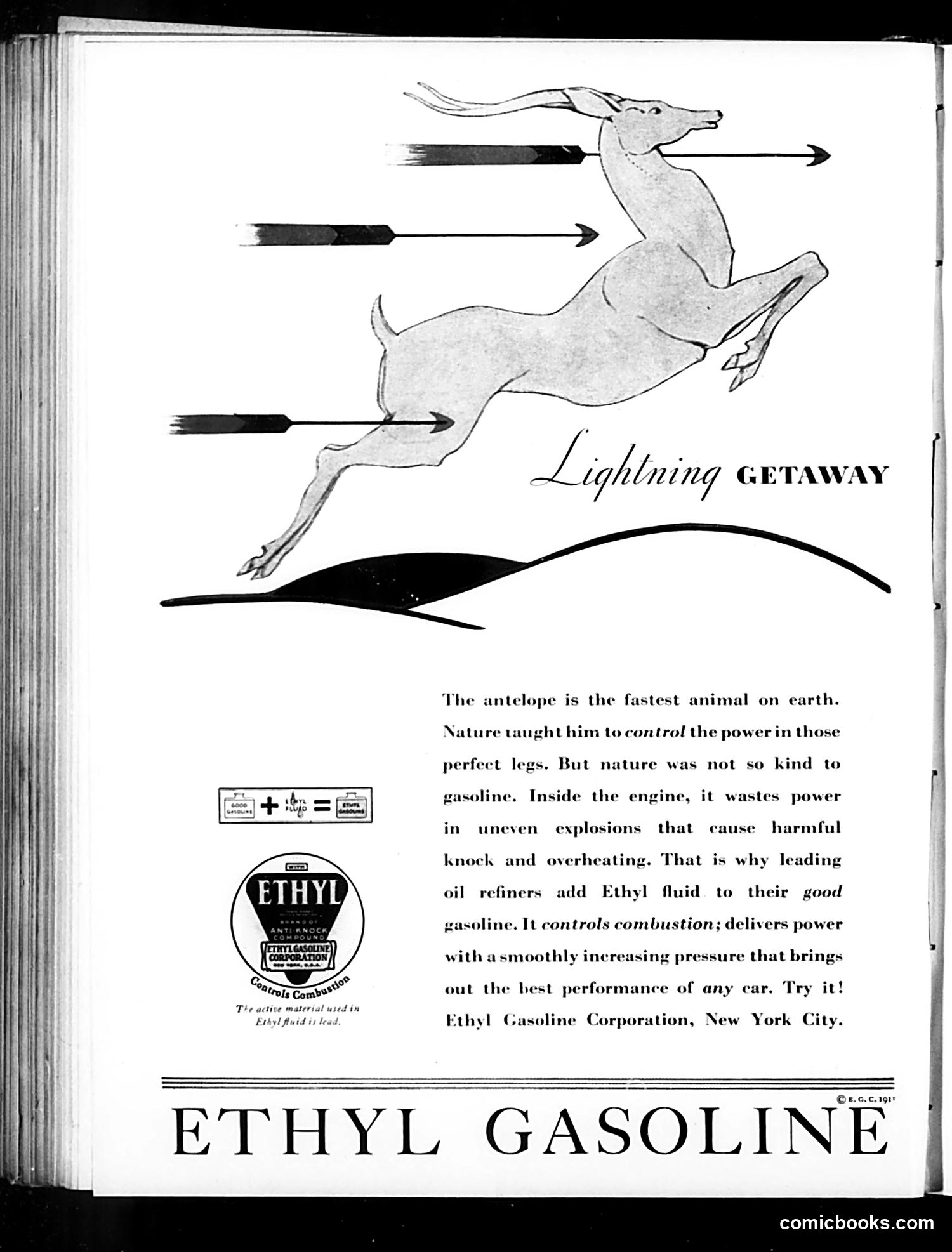
# Analysis This page is **primarily an advertisement**, not satire or political commentary. The "Lightning Getaway" illustration shows an antelope in mid-leap, used as a metaphor for speed and control. The ad compares the antelope's natural ability to "control" its powerful legs to what Ethyl gasoline supposedly does for engines. Just as nature gave the antelope perfect leg control, Ethyl fluid allegedly controls gasoline combustion, preventing "knock and overheating" and delivering smooth power. The comparison is purely **commercial rhetoric** — using an animal metaphor to sell a fuel additive by associating it with natural perfection and power. There is no political satire or social commentary present. This reflects 1920s advertising techniques emphasizing technological solutions to mechanical problems.
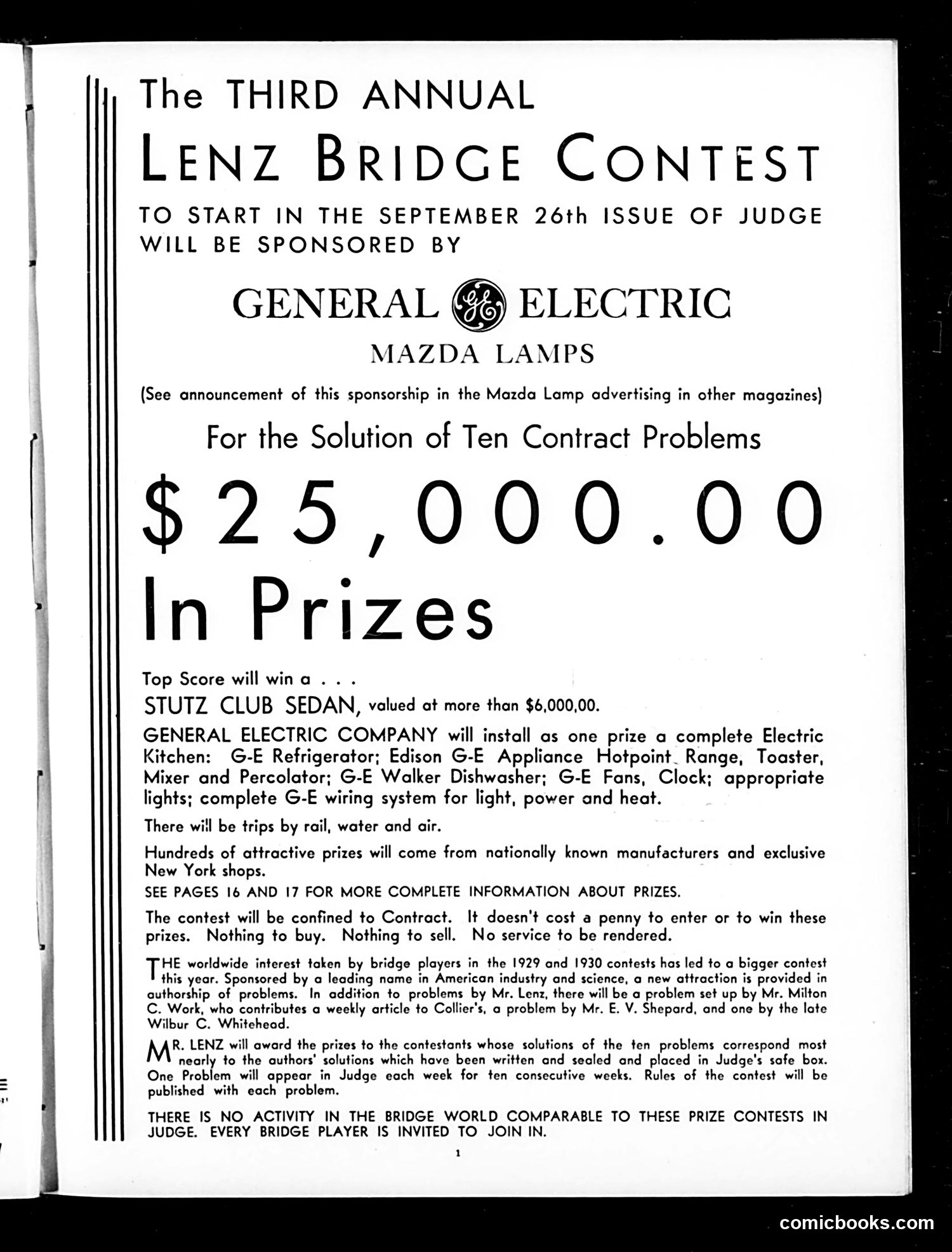
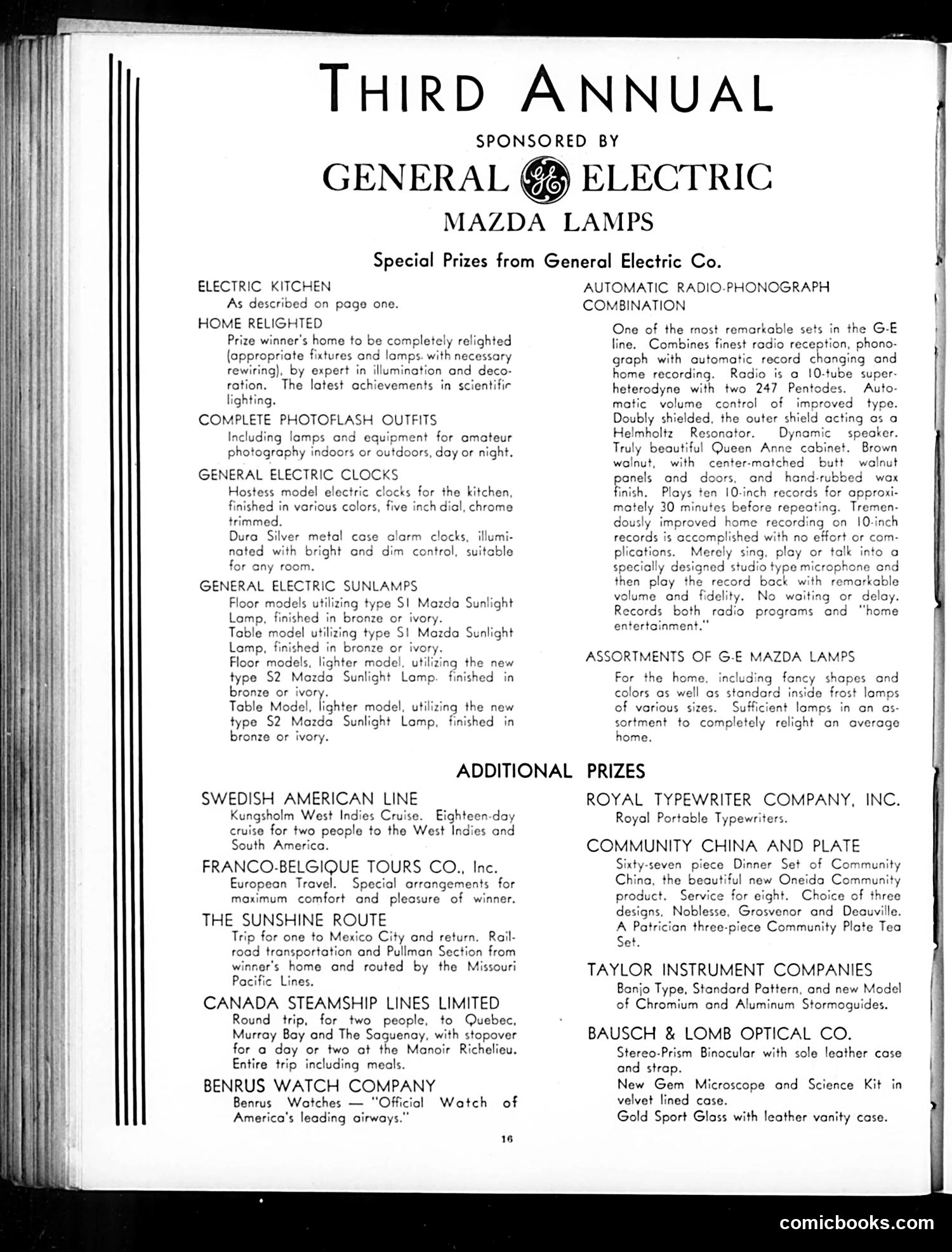
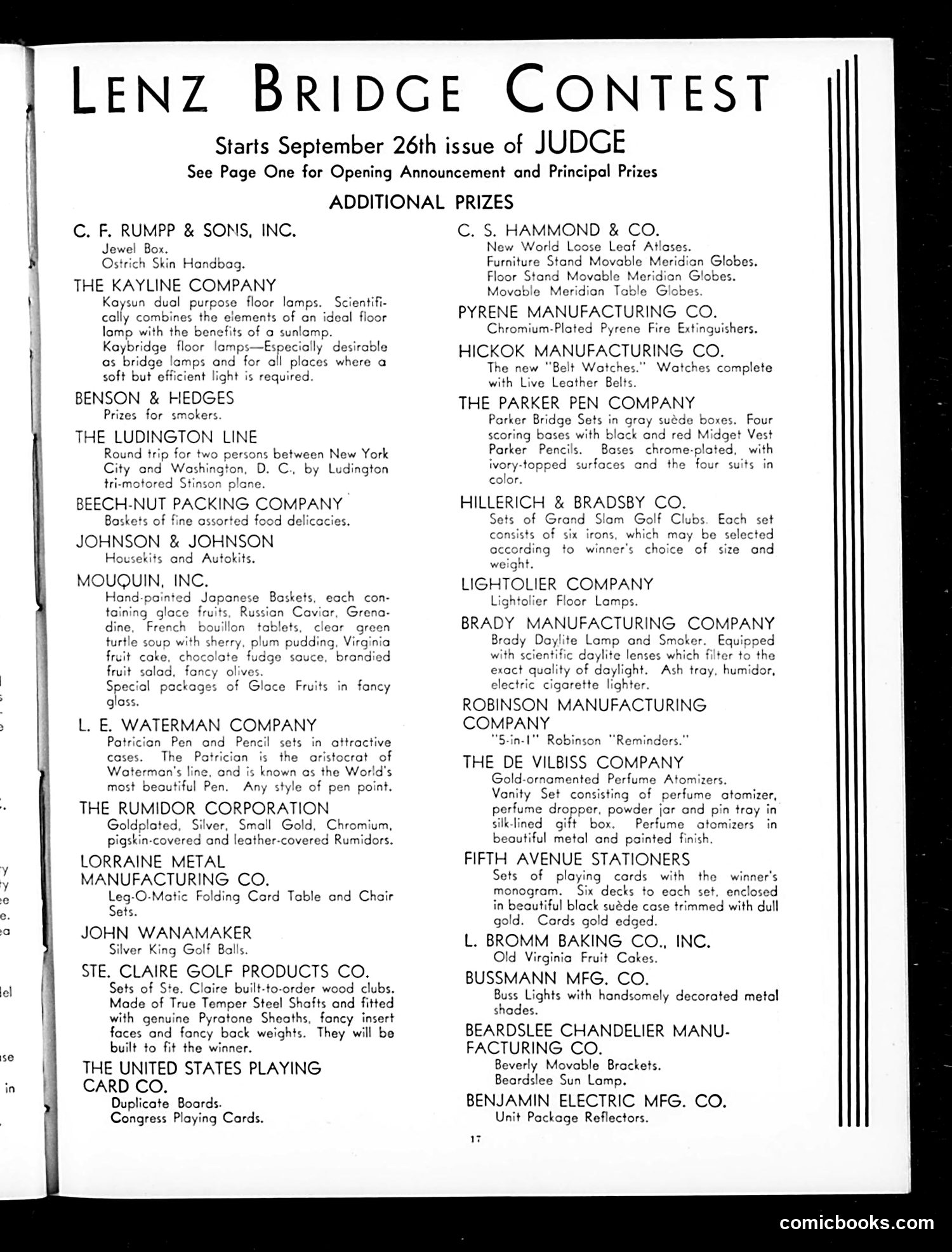
# Analysis This page is primarily **advertising, not satire or cartoon content**. It announces the Third Annual Lenz Bridge Contest, sponsored by General Electric (Mazda Lamps), offering $25,000 in prizes for solving ten contract bridge problems. The contest details indicate this was a significant promotion: the top prize was a Stutz Club Sedan (valued over $6,000), plus a complete electric kitchen from General Electric. Additional prizes came from "nationally known manufacturers." The text notes that bridge player interest from 1929-1930 contests inspired this larger competition, with problems contributed by bridge experts of the era. There are no identifiable political figures or satire present—this is straightforward commercial promotion leveraging the bridge game's popularity during the early Depression era.
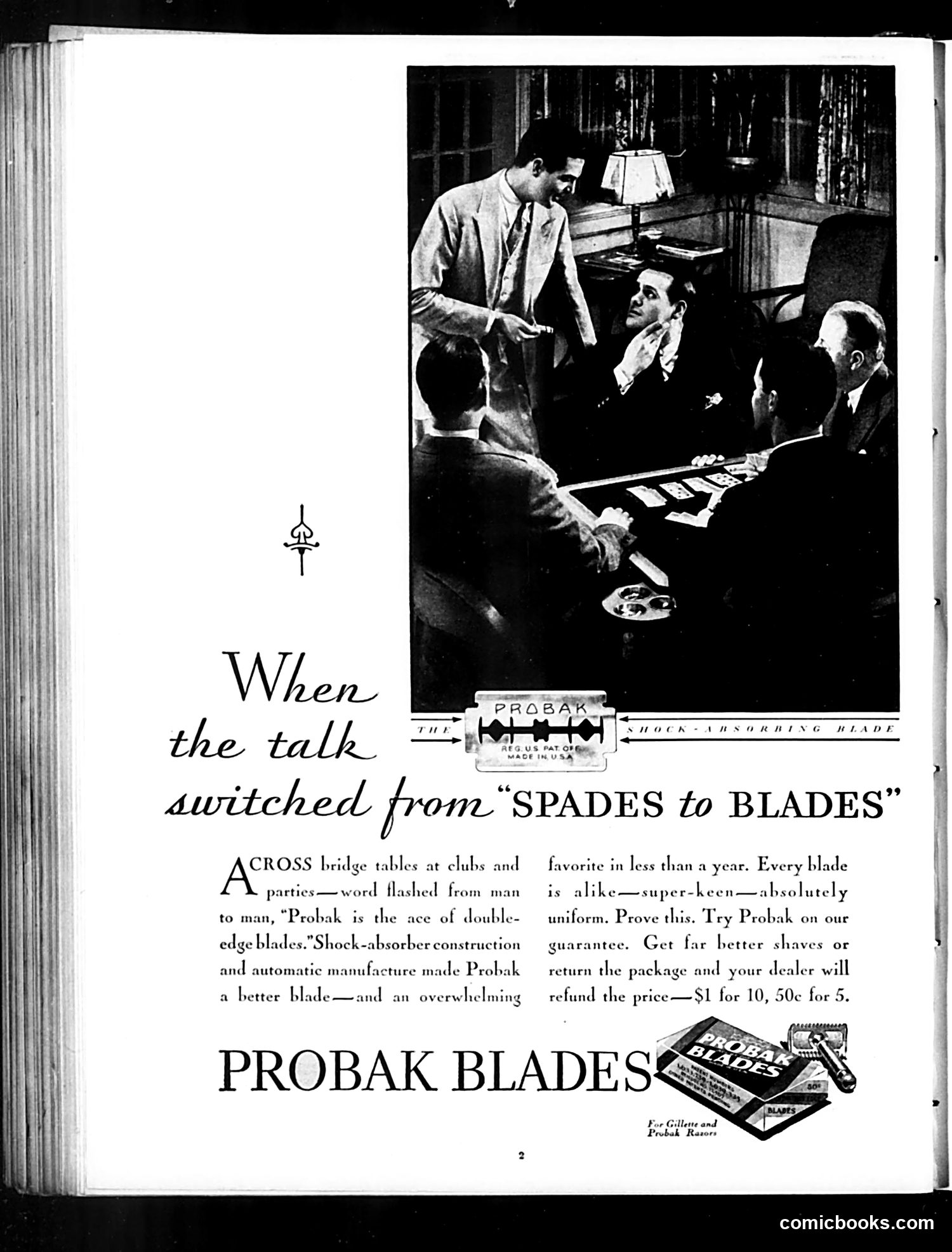
# Analysis This is primarily **advertising, not satire**. The page promotes Probak razor blades, using a social scene to advertise the product. The image shows men in formal attire at what appears to be a bridge game or social gathering. The headline "When the talk switched from 'SPADES to BLADES'" is a pun—playing on the card game "spades" to introduce discussion of razor blades. The advertisement claims Probak blades became "the favorite in less than a year" and emphasizes their "shock-absorber construction" and uniform quality. It includes a money-back guarantee: "$1 for 10, 50¢ for 5." There is no political satire here—this is straightforward commercial copy using a relatable social scenario to market a consumer product to Judge magazine's male readership.
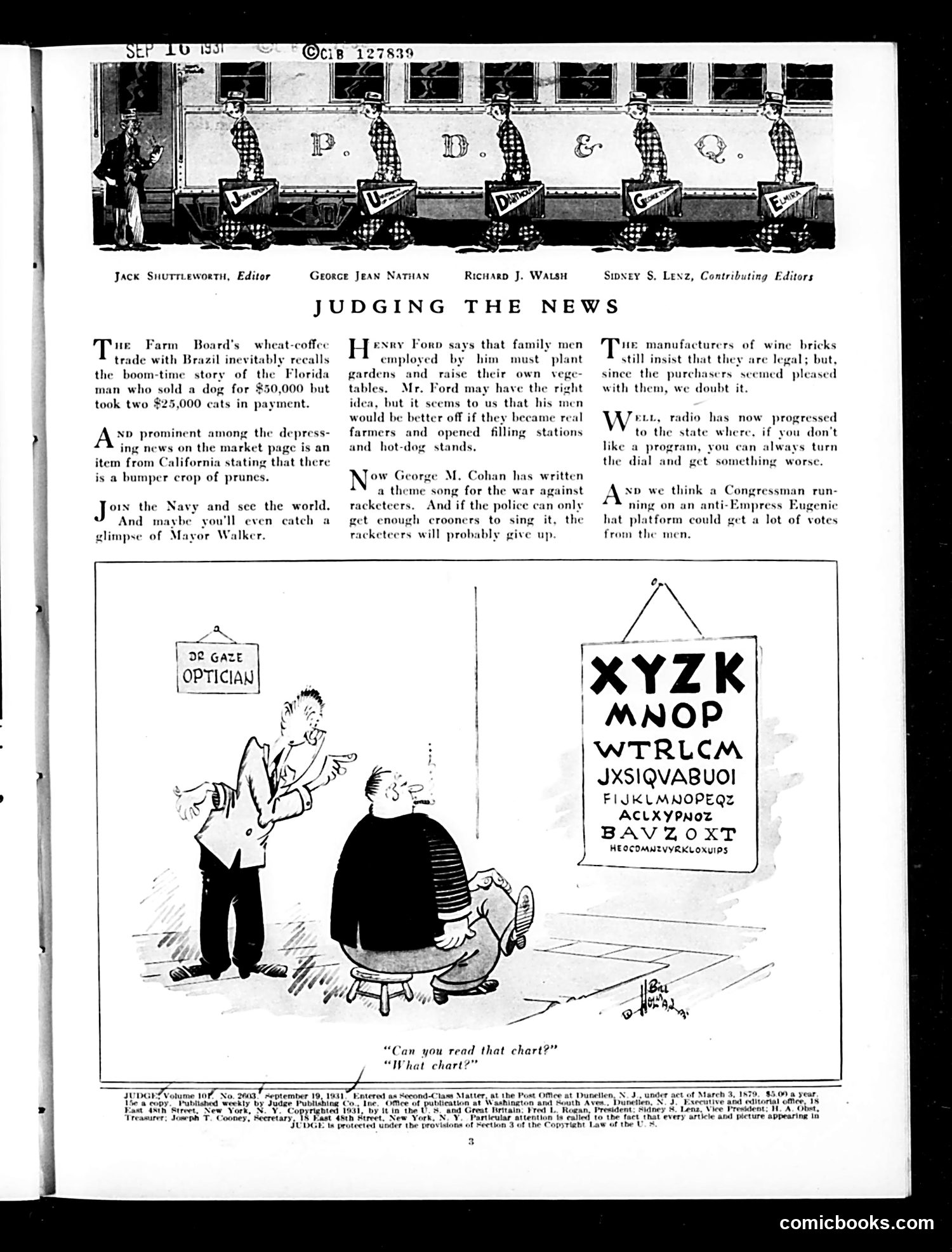
# "Can You Read That Chart?" This cartoon satirizes vision problems and optometry. An optician displays an eye chart to a patient who cannot read it, with the man gesturing in frustration. The joke relies on irony: the eye chart itself is rendered in deliberately illegible, jumbled letters (XYZK MNOP, etc.), making it impossible for anyone—patient or reader—to actually read. The cartoon appears to mock either incompetent opticians or the absurdity of vision testing itself. The sign "DE GAZE OPTICIAN" may be a play on words related to looking/gazing. This was likely humorous to 1931 readers familiar with visiting eye doctors, poking fun at a common, slightly uncomfortable medical experience.
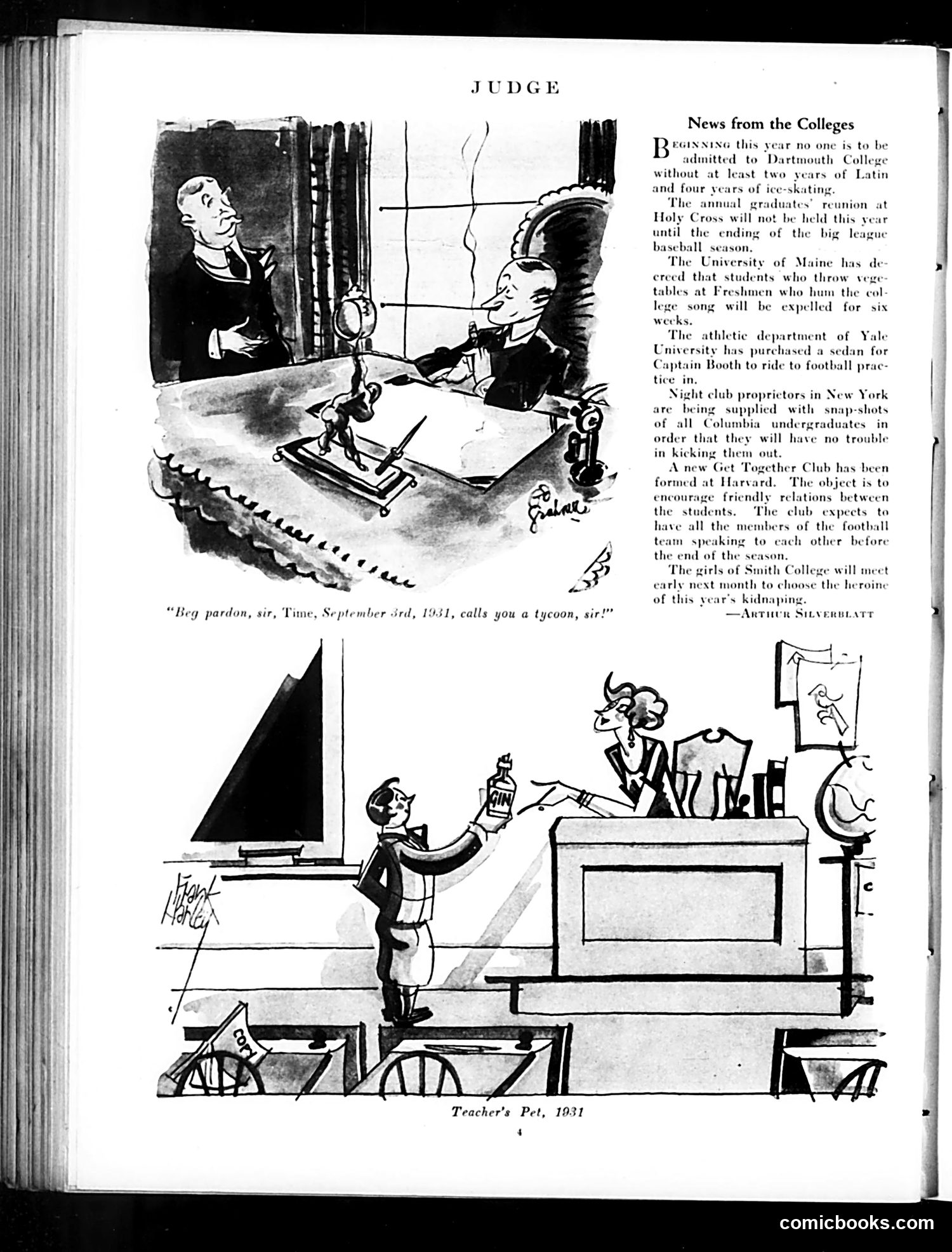
# Cartoon Analysis: Judge Magazine, 1931 The top cartoon satirizes college admissions standards. A stern authority figure (likely a college dean) calls a young man a "tycoon," mocking him for apparently gaining admission through wealth or connections rather than merit. The caption references "Time, September 3rd, 1934," suggesting a contemporary scandal about preferential college admissions. The bottom cartoon depicts a teacher's pet scenario in 1931—a student offers a bottle (likely alcohol, given Prohibition-era context) to an authority figure at a desk, while other students watch from below. This satirizes corruption and favoritism in education, showing how students attempt to gain advantage through bribery rather than academic performance. Both cartoons critique institutional integrity during the Depression era.
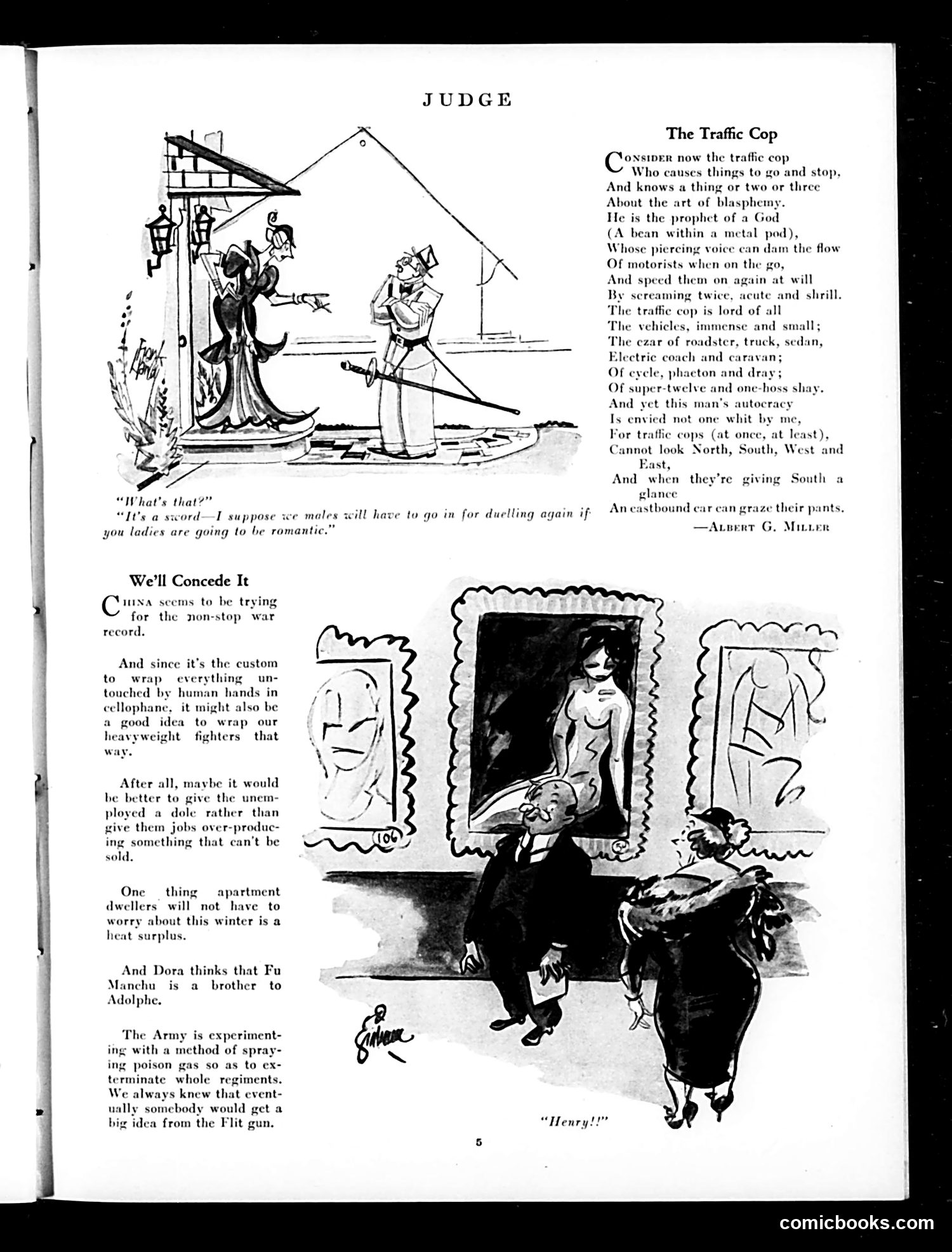
# "The Traffic Cop" and "We'll Concede It" **"The Traffic Cop"** satirizes the absolute authority of traffic police, who control vehicle flow with imperious hand gestures. The poem mocks their petty autocracy—they command cars in all directions yet "cannot look North, South, West and East" simultaneously. The joke suggests their power is absurdly limited despite their imperious demeanor. The cartoon caption jokes about "dueling" traffic violations, playing on their authority to issue citations. **"We'll Concede It"** comments on China's seemingly endless warfare and suggests wrapping fighters in cellophane like boxing matches to prevent casualties. The accompanying cartoon shows a man viewing nude paintings, possibly satirizing art appreciation or moral standards. Both pieces employ absurdist humor typical of Judge's satirical style, mocking contemporary institutions and social conventions.
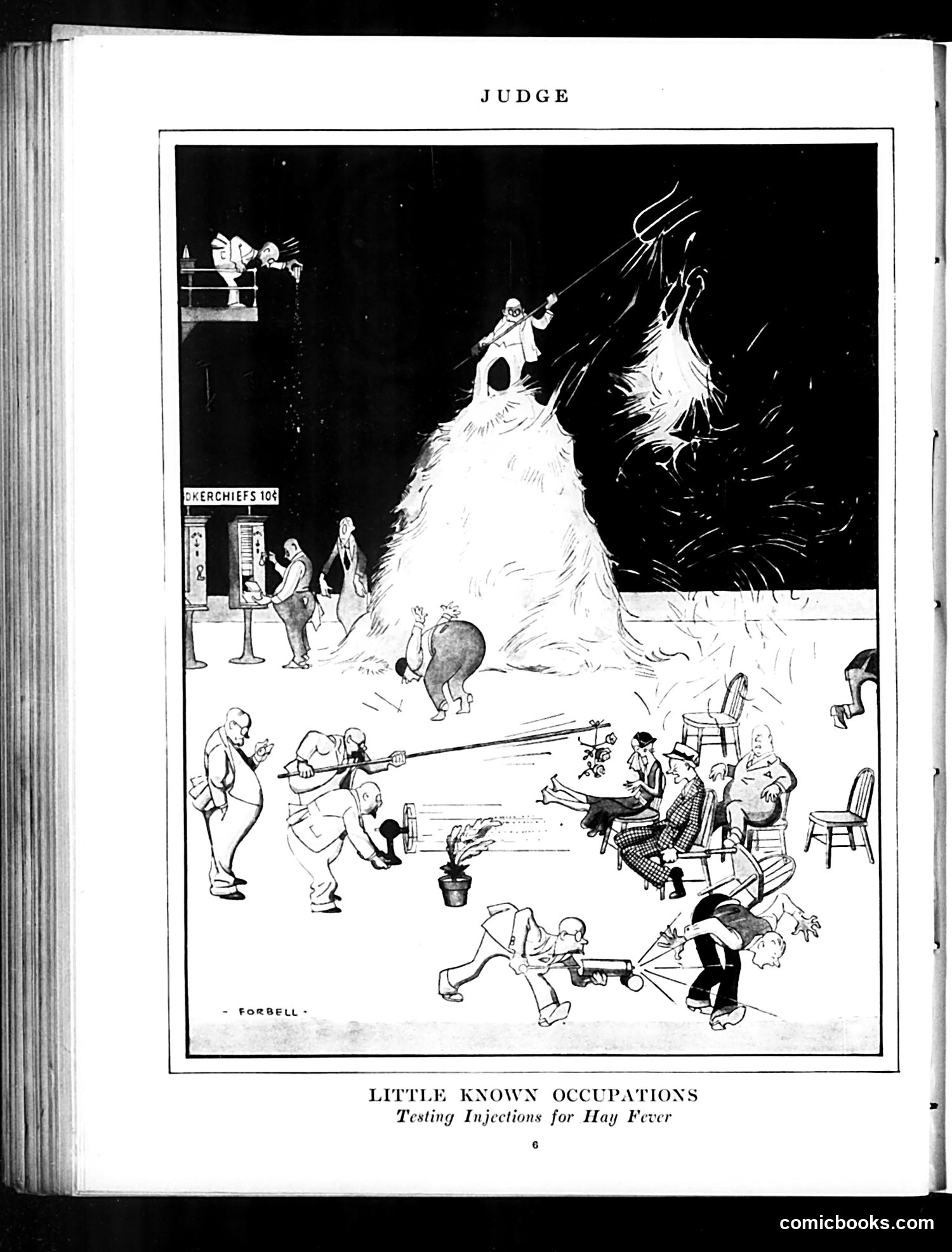
# "Little Known Occupations: Testing Injections for Hay Fever" This Judge cartoon satirizes the emerging medical practice of allergy treatment through injections. The scene depicts a chaotic "testing" scenario where various people are being injected with hay fever treatments—some willingly, others coerced or tricked into participation. The humor derives from the absurdity and danger of unregulated medical experimentation. The giant ghost-like figure looming overhead (likely representing hay fever itself or its effects) emphasizes the desperation driving these treatments. The "Little Known Occupations" framing suggests this is an undignified, questionable profession—essentially professional test subjects or unwilling guinea pigs for dubious medical procedures. This reflects early-20th-century skepticism toward experimental medicine and the wild west of unregulated pharmaceutical testing before modern safety standards existed.
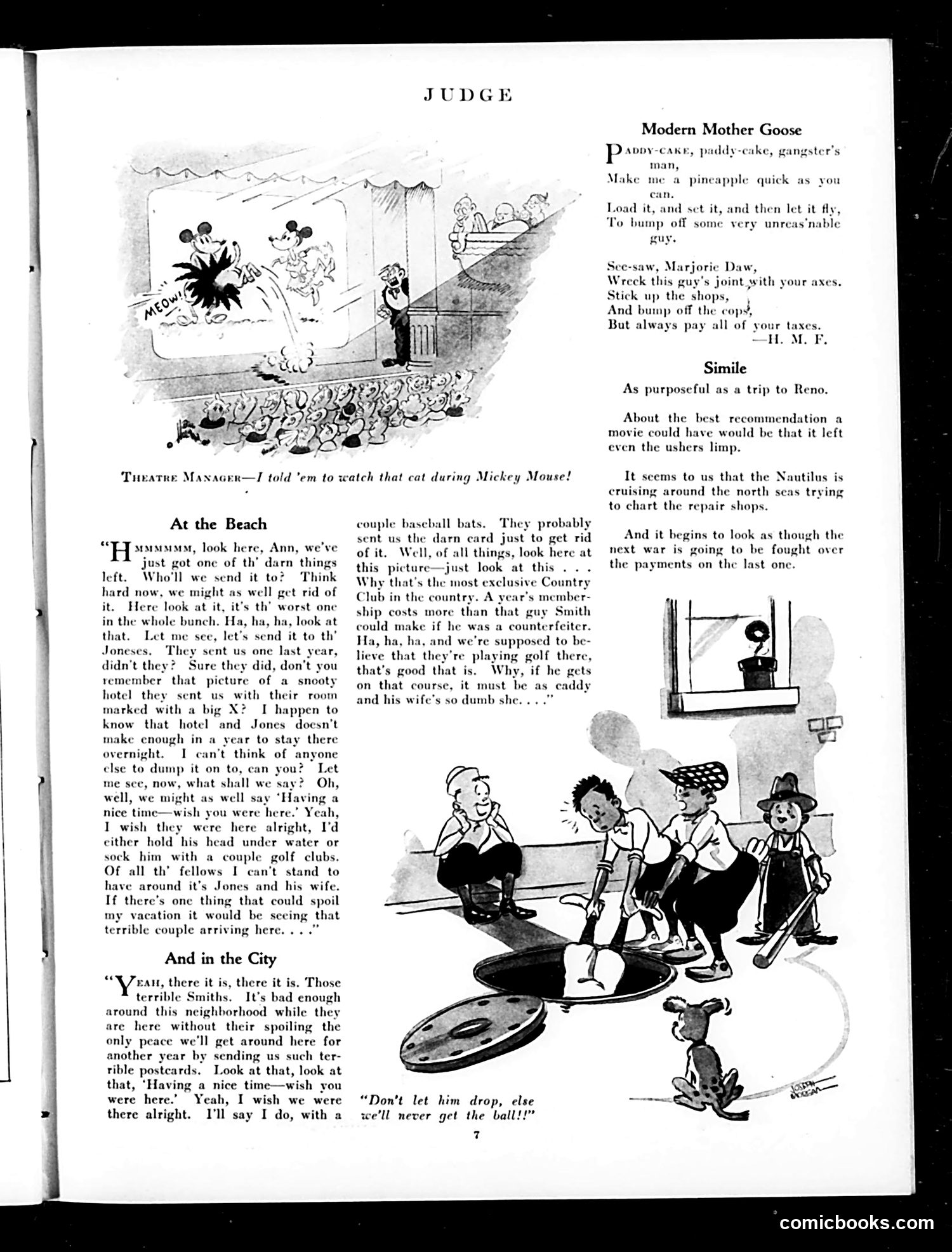
# Analysis: Judge Magazine Page This page contains three satirical pieces targeting 1920s American social behavior and culture. **"At the Beach" and "And in the City"** mock the hypocrisy of vacation postcards. Neighbors exchange insulting, boastful postcards—claiming to visit exclusive country clubs and resorts they likely cannot afford—while privately despising each other. The satire targets both the pretense of aspirational leisure and the passive-aggressive social ritual of vacation greetings. References to "the Joneses" invoke the era's familiar phrase about keeping up appearances. **"Modern Mother Goose"** parodies nursery rhymes with 1920s criminal slang ("bump off," "stick up the shops"). It's dark humor mocking Prohibition-era gangsterism and bootlegging violence, presenting organized crime as casually as children's verse. **The theater cartoon** references Mickey Mouse, indicating this is from the late 1920s when the character debuted. The overall tone reflects Judge's satirical approach: ridiculing middle-class pretension, organized crime, and social conformity through exaggerated dialogue and absurdist humor.
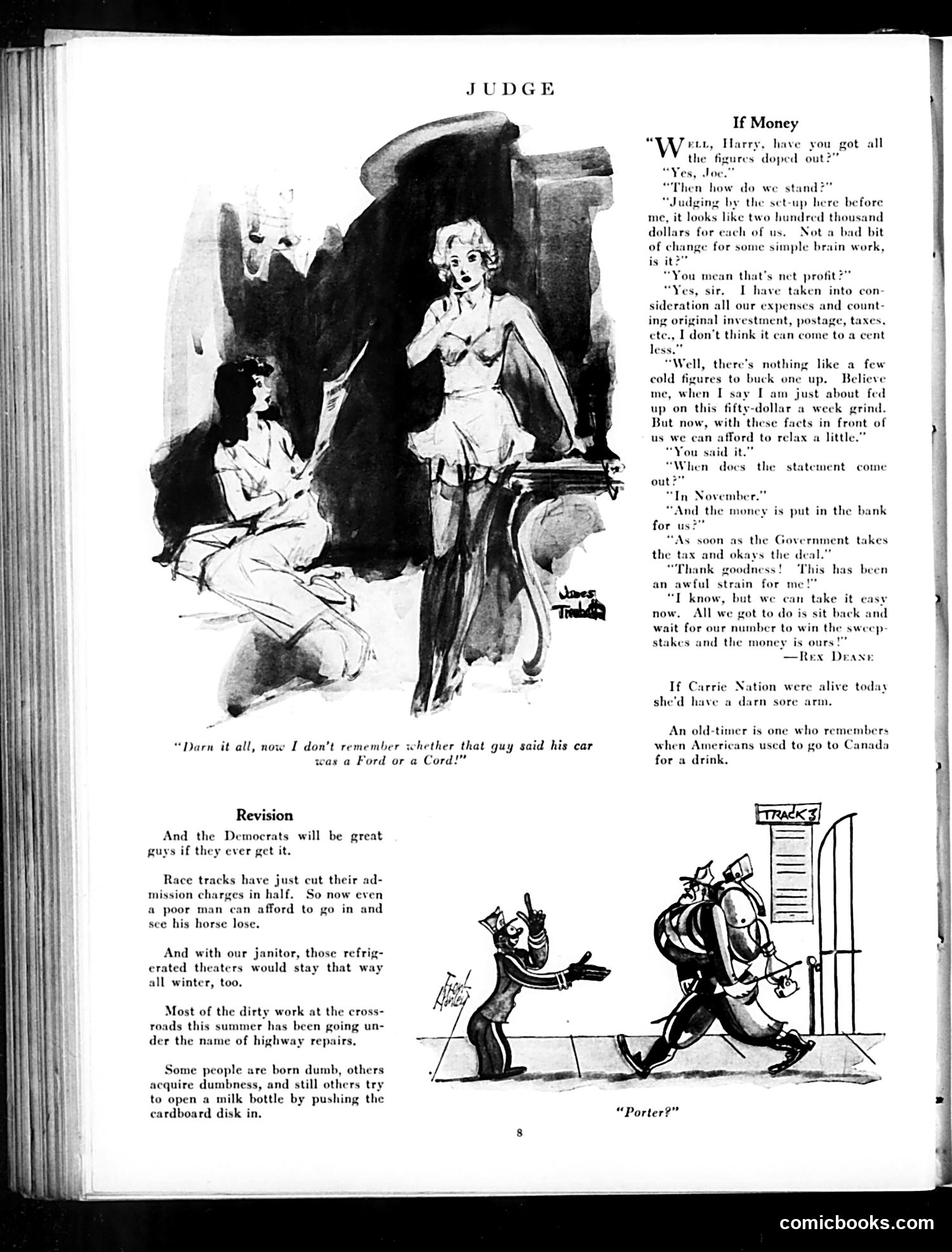
# Analysis of Judge Magazine Page This page contains satirical commentary on 1920s American life: **Main Cartoon ("Judge"):** Two men discuss splitting $200,000 in profits from what appears to be an illicit scheme—likely bootlegging or stock manipulation. They plan to hide money in banks and wait for government approval, suggesting either prohibition-era liquor dealing or financial fraud. The satire mocks their casual criminality and naive belief they'll avoid legal consequences. **Secondary Jokes ("Revision"):** Brief satirical quips targeting: - Democrats' political incompetence - Economic hardship (poor men gambling away money at race tracks) - Government road work as disguised public spending - General human stupidity **Carrie Nation Reference:** References the famous temperance crusader (1846-1911), suggesting increased drinking in the modern era would exhaust even her zealous activism. The overall tone reflects post-Prohibition cynicism about widespread lawbreaking and corruption in 1920s America, presented as darkly comedic observations.
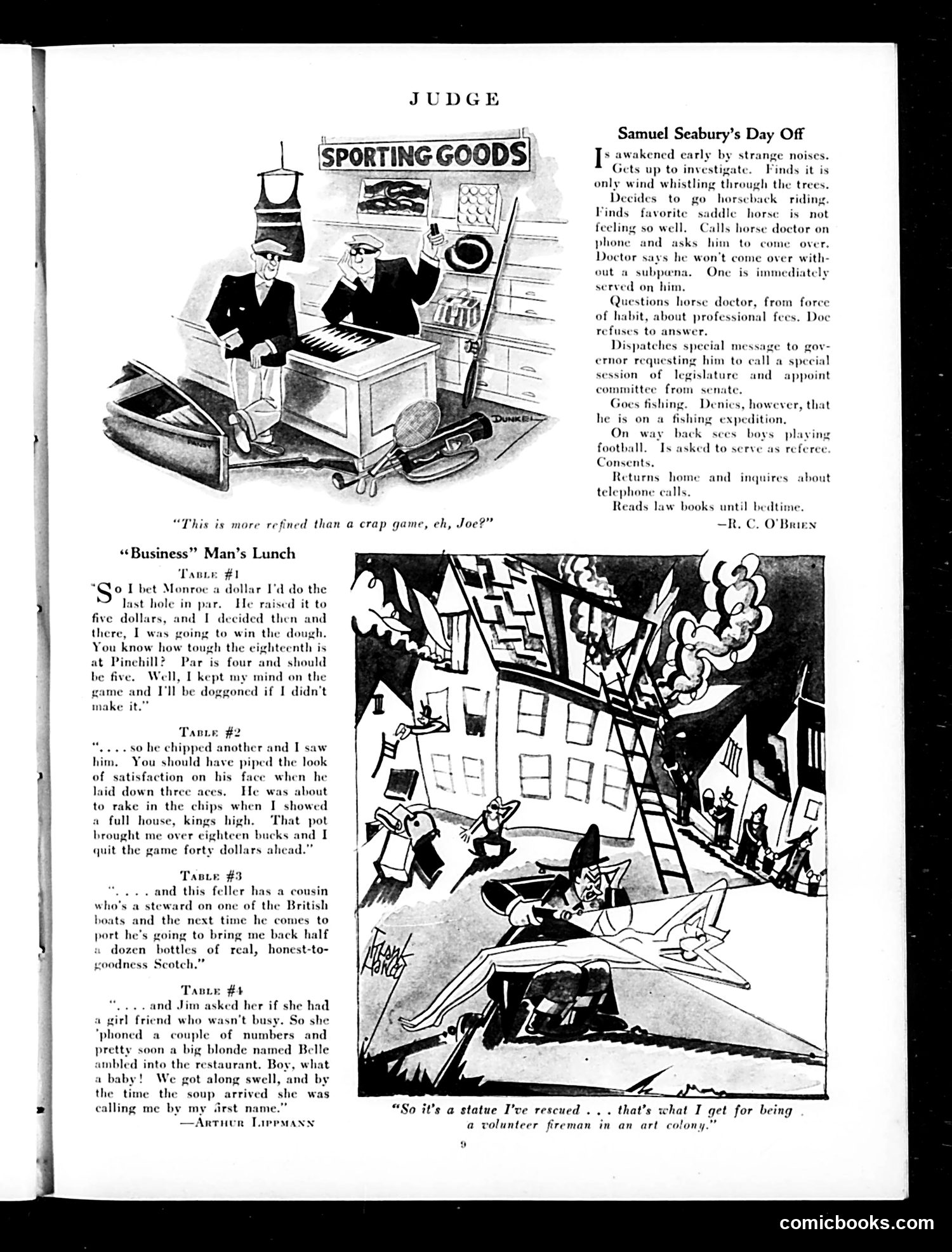
# Analysis for Modern Readers **"Samuel Seabury's Day Off"** satirizes Judge Samuel Seabury, a prominent New York prosecutor famous for investigating corruption in the 1930s. The joke shows him obsessively applying his prosecutorial habits to everyday life: he subpoenas a horse doctor about fees, demands a special legislative session over minor issues, and insists his fishing trip isn't actually a "fishing expedition"—playing on his famous investigations where officials claimed innocence while clearly guilty. **"Business Man's Lunch"** presents four anecdotes of male boasting at a restaurant, where businessmen recount gambling wins, romantic conquests, and smuggling schemes. The satire mocks masculine bravado and the era's casual attitude toward illegal activities like bootlegging (alcohol smuggling during Prohibition). The **sporting goods cartoon** caption—"more refined than a crap game"—suggests the men's stories, while framed as respectable business talk, are essentially as frivolous and chance-based as gambling.
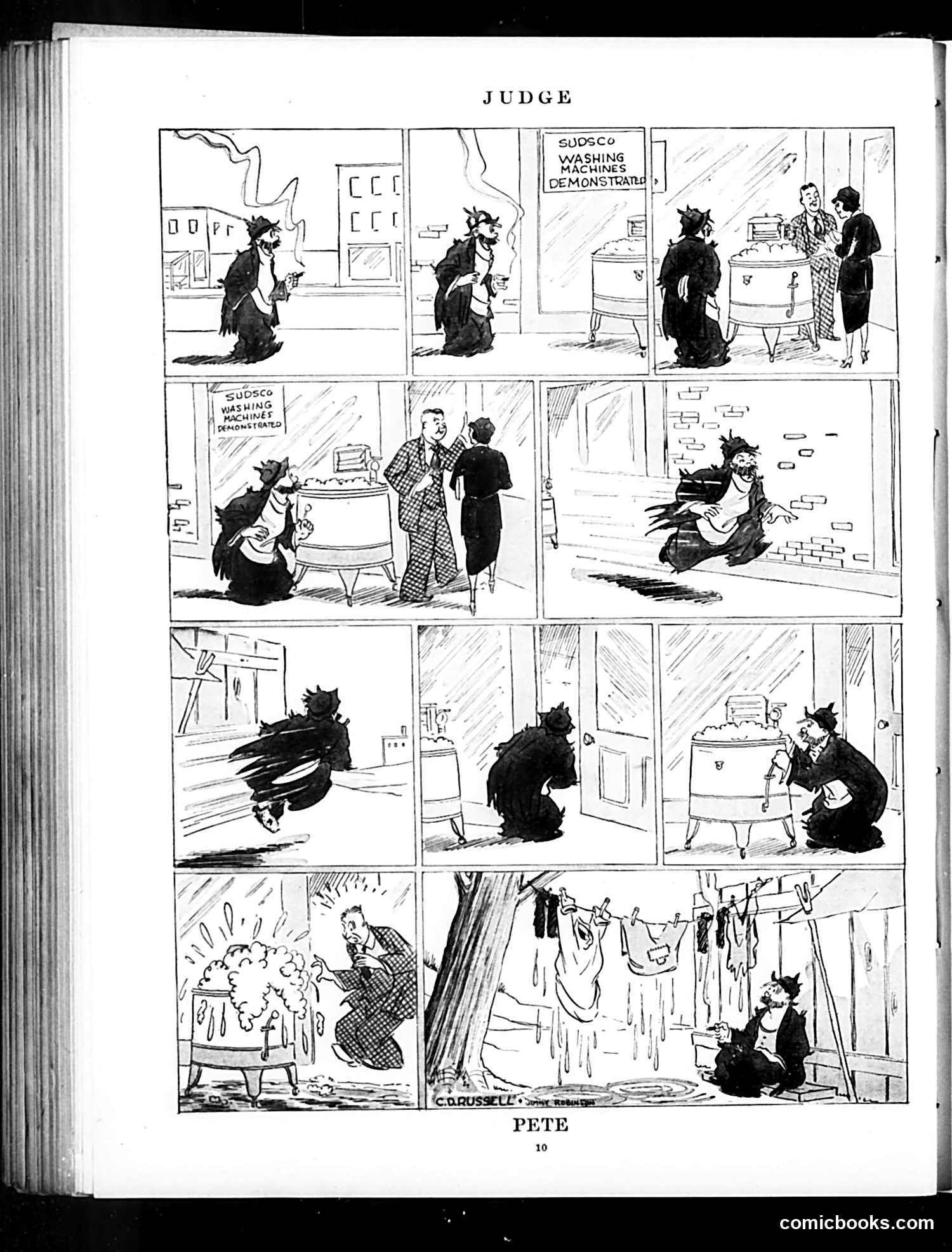
# "Judge Pete" Comic Strip Analysis This is a multi-panel comic strip titled "Judge Pete" (credited to C. Rosselli) depicting a domestic comedy about a Sudsco washing machine demonstration. The narrative follows a woman's escalating frustration: she attends a product demonstration, becomes intrigued by the appliance, purchases it, then struggles with its operation and the resulting chaos—water overflow, flooding, and escaped laundry. The satire targets early 20th-century "labor-saving" appliance marketing that promised to simplify housework. The joke is that this new technology actually creates more work and domestic disasters than traditional methods. It mocks both the overpromising of modern conveniences and women's supposed incompetence with mechanical devices—a common trope in period humor.