
Judge, 1931-09-19 · page 22 of 36
Judge — September 19, 1931 — page 22: what you’re looking at
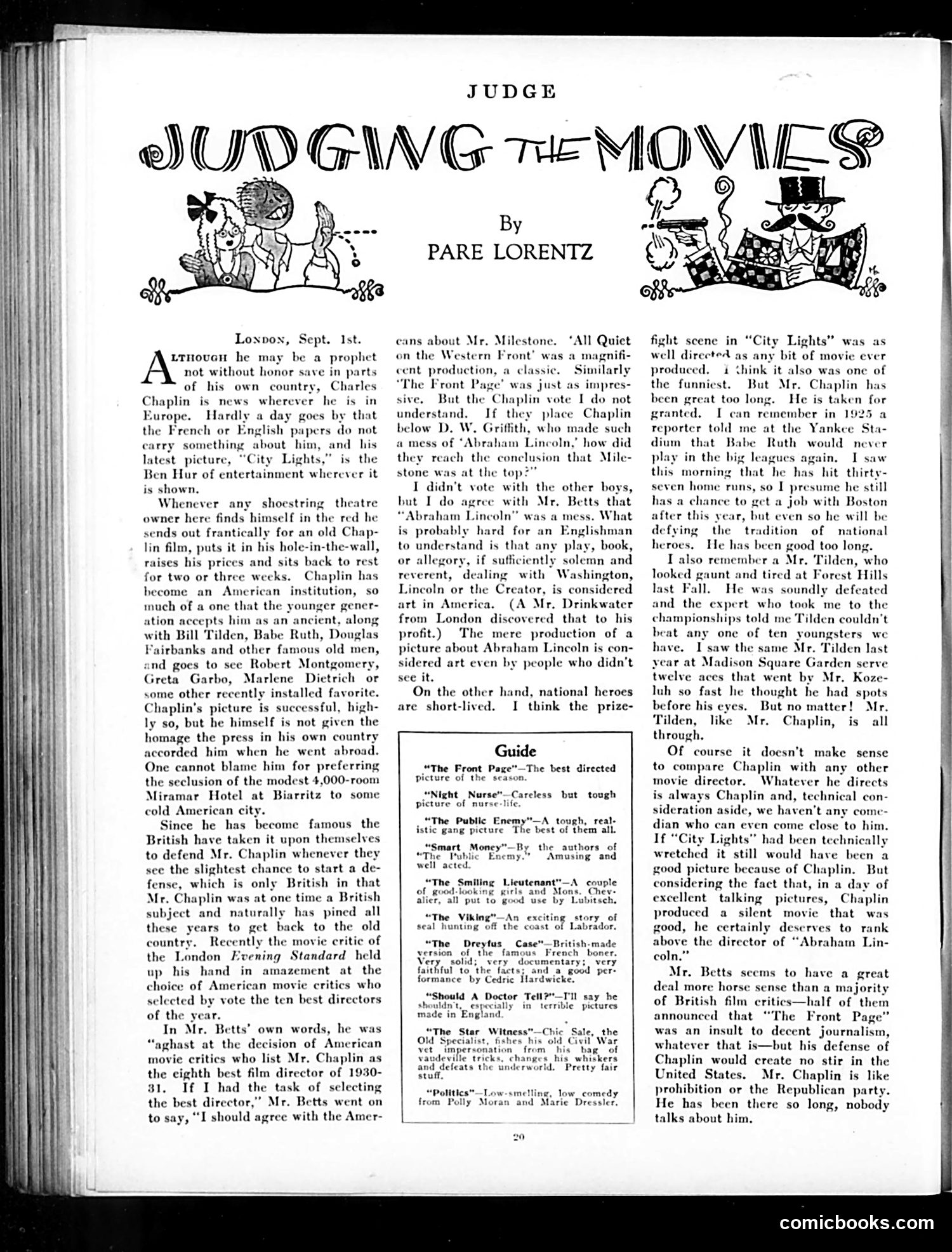
A restored page from Judge, 1931-09-19. Page through the whole issue in the reader above.
📄 Transcribed text from this page (OCR, searchable)
Machine-transcribed from the original scan — historical spelling and the odd misread are preserved.
e) UW G\NVG THEM DON, Sept. Ist. ttnoven he may be a prophet not without honor save in parts of his own country, Charles Chaplin is news wherever he is in Europe. Hardly a day goes by that the French or English papers do not carry something about him, and his latest picture, “City Lights, Ben Hur of entertainment wherever it is shown, Whenever any shoestring theatre owner here finds sends out frantically for an old Ch lin film, puts it in his hole-in-the-w raises his prices and sits back to rest for two or three weeks. Chaplin has become an American institution, so much of a one that the younger gener- ation accepts him as an ancient, along with Bill Tilden, Babe Ruth, Douglas Fairbanks and other famous old men, and goes to see Robert Montgomery, Greta Garbo, Marlene Dietrich or some other recently installed favorite. Chaplin's picture is successful, high- ly so, but he himself is not given the homage the press in his own country accorded him when he went abroad. One cannot blame him for preferring the seclusion of the modest 4,000-room Miramar Hotel at Biarritz to some cold American city. Since he has become famous the British have taken it upon themselves to defend Mr. Chaplin whenever they see the slightest chance to start a d fense, which is only British in that Mr. Chaplin was at one time a British subject and naturally has pined all these years to get back to the old country. Recently the movie critic of the London Evening Standard held up his hand in amazement at the choice of American movie critics who selected by vote the ten best directors of the year. In Mr. Betts’ own words, he was “aghast at the decision of American movie critics who list Mr. Chaplin as the eighth best film director of 1930- 31, If I had the task of selecting the best director,” Mr. Betts went on ould agree with the Amer- JUDGE By PARE LORENTZ cans about Mr. Milestone. ‘AI Quiet on the Western Front’ was a magnifi- cent production, a classic. Similarly ‘The Front Page’ was just as impres- sive. But the Chaplin vote I do not understand. If they place Chaplin below D. W. Griffith, who made such a mess of ‘Abraham Lincoln,’ how did they reach the conclusion that Mile- stone was at the top?” I n't vote with the other boys, but I do agree with Mr. Betts that “Abraham Lincoln” was a mess. What is probably hard for an Englishman to understand is that any play, book, or allegory, if sufficiently solemn and reverent, dealing with Washington, Lincoln or the Creator, is considered art in America. (A Mr. Drinkwater from London discovered that to his profit.) The mere production of a picture about Abraham Lincoln is con- sidered art even by people who didn’t see it. On the other hand, national heroes are short-lived. I think the prize- Guide “The Front Page"—The best directed picture of the season. ight Nurse”-Careless but ure of nurse-life “The Public Enemy"—A tough, real- ic gang picture The best of them all. tough “Smart “The By the authors of Enemy.” Amusing and “The Smiling Lieutenant"—A couple of good-looking girls and Mons. Chey. alier, all put to good use by Lubitsch, “The Viking”—An exciting story, of seal hunting off the coast of Labrador. “The Dreyfus Case"—British-made xersion of the famous French boner. Very solid; very documentary; very faithful to the facts: and a good per- formance by Cedric Hardwicke. “Should A Doctor Tell?” shouldn't, especially made in England. hl say he in terrible pictures “The Star Witness"—C! pe 8 "—Low-smetling, low comedy “Polit! irom y Moran and Marie Dressler. vt ~~ § o> gece produced. i think it also was one of the funniest. But Mr. Chaplin has been great too long. He is taken for granted, [ can remember in a reporter told me at the Yankee Sta- dium that Babe Ruth would never play in the big leagues again. I saw this morning that he has hit thirty seven home runs, so I presume he still has a chance to get a job with Boston after this year, but even so he will be defying the tradition of national heroes. He has been good too long. T also remember a Mr, Tilden, who looked gaunt and tired at Forest Hills last Fall. He was soundly defeated and the expert who took me to the ampionships told me Tilden couldn't beat any one of ten youngsters we have. I saw the same Mr. Tilden last year at Madison Square Garden serve twelve aces that went by Mr. Koze- luh so fast he thought he had spots before his ¢ But no matter! Mr. Tilden, like Mr. Chaplin, is all through. Of course it doesn’t make sense to compare Chaplin with any other movie director. Whatever he directs is always Chaplin and, technical con- sideration aside, we haven't any come- dian who can even come close to him. had been technically wretched it still would have good picture because of Cha considering the fact that, in a day of excellent talking pictures, Chaplin produced a silent movie that was good, he certainly deserves to rank above the director of “Abraham Lin- coln,”” Mr. Betts seems to have a great deal more horse sense than a majority of British film critics—half of them announced that “The F was an insult to decent journalism, whatever that is—but his defense of Chaplin would create no stir in the United States. Mr. Chaplin is like prohibition or the Republican party. He has been there so long, nobody talks about him. comicbooks.com