
Judge, 1931-09-19 · page 15 of 36
Judge — September 19, 1931 — page 15: what you’re looking at
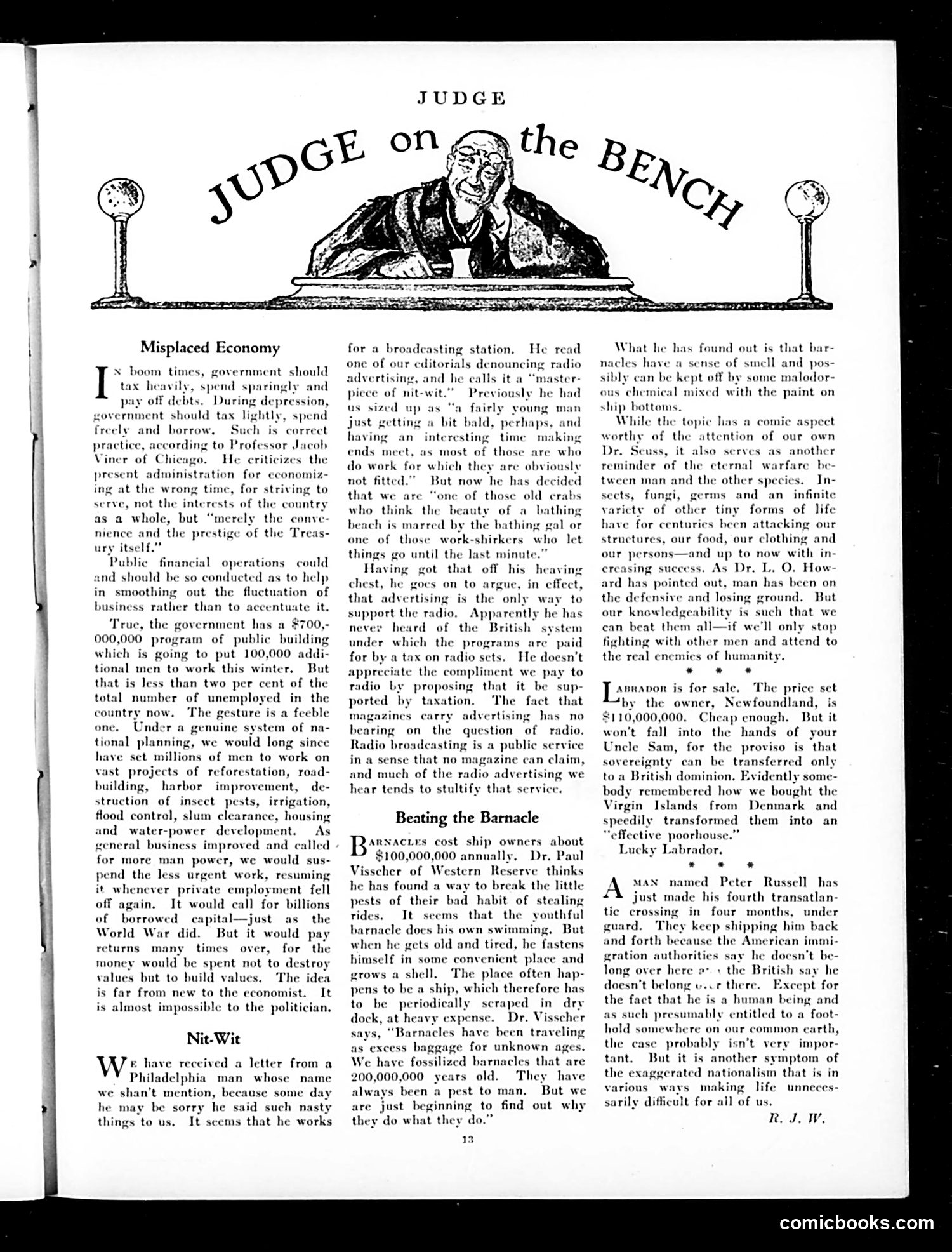
A restored page from Judge, 1931-09-19. Page through the whole issue in the reader above.
📄 Transcribed text from this page (OCR, searchable)
Machine-transcribed from the original scan — historical spelling and the odd misread are preserved.
Misplaced Economy S boom times, government should tax heavily, spend 5} pay off debts. During « government should tax lig freely and borrow. practice Viner of Chica present a ringly and pression, Such is corre according to Professor | go. He ing at the wrong time, for strivi serve, not the interests of the ¢ as a whole, but nie untry “merely the conve- and the prestige of the Treas- ury itself.” Publie financial operations could and should be so conducted as to help in smoothing out the fluctuation of business rather than to accentuate it. True, the government has a $700,- 000,000 program of public building which is going to put 100,000 addi- tional men to work this winter. But that is less than two per cent of the total number of unemployed in the intry now. The gesture is a feeble one. Under a genuine system of na- tional planning, we would long sinc have set millions of men to work on vast projects of reforestation, road- building, harbor improvement, de- struction of insect pests, irrigation, flood control, slum clearance, housing and water-power development. As neral business improved and called for more man power, we would sus- pend the less urgent work, resuming it whenever private employment fell off again. It would call for billions of borrowed capital—just as the World War did. But it would pay returns many times over, for the money would be spent not to destroy values but to build values, The idea is far from new to the economist. It is almost impossible to the politician, C Nit-Wit ived a letter from a man whose name » day ay be sorry he said such nasty things to us. It seems that he works JUDGE for a broadcasting station. He one of our editorials denoun: advertising, and he calls it a ter- picce of nit-wit.”” Previously he had us sized up as “a fairly young man just getting a bit bald, perhaps, and having an interesting time making ends meet, as most of those are who do work for which they are obviously not fitted.” But now he has decided that we are “one of those old crabs who think the beauty of a bathing beach is marred by the bathing gal or one of those work-shirkers who let things go until the last minute.” Having got that off his heaving chest, he on to argue, in effect, that advertising is the only way to support the radio. Apparently he has never heard of the British’ system under which the programs are paid for by a tax on radio sets. He doesn’t appreciate the compliment we pay to read radio - radio by proposing that it be sup- ported by taxation. ‘The fact that rines carry advertising has no ing on the question of radio. Radio broadcasting is a public service in a sense that no ma nel and much of the radio advertising we hear tends to stultify that service. Beating the Barnacle Brwrscees cost. ship owners about $100,000,000 annually, Dr. Paul Visscher of Western Reserve thinks he has found a way to break the little pests of their bad habit of stealing rides. It seems that the youthful barnacle docs his own swimming. But when he gets old and tired, he fastens himself in some convenient place and The place often hap- ship, which therefore has ly scraped in’ dry at heavy expense. Dr. Visscher »s have been traveling as excess baggage for unknown ages. We have fossilized barnacles th 200,000,000 ts old. They al 1 pest to man, But we are just beginning to find out why they do what they do.” grows a shell. pens to be to be dock, been What he has found out is that bar- nacles have a sense of smell and pos- sibly can be kept off by some malodor- ous chemical mixed with the paint on ship bottoms. While the topic has a comic aspect worthy of the attention of our own Dr. Seuss, it also serves as reminder of the eternal warfare be tween man and the other species. In- fungi, germs and an infinite varicty of other tiny forms of life have for centuries been a king our structures, our food, our clothing and our persons—and up to now with in creasing success. As Dr. L. O. How ard has pointed out, man h the defensive and losing ground. But our knowledgeability is such that we can beat them all—if we'll only stop fighting with other men and attend to the real enemies of humanity. “ * « [2rmon is for sale. The price set by the owner, Newfoundland, is 10,000,000. Cheap enough. But it won't fall into the hands of your Uncle Sam, for the proviso is that sovereignty can be transferred only toa British dominion. Evidently some- body remembered how we bought the Virgin Islands from Denmark and speedily transformed them into an “effective poorhouse.” Lucky Labrador. * * A named Peter Russell has just made his fourth transatlan- tic crossin, four months, under guard. They keep shipping him back and forth because the American immi gration authorities say he doesn’t be- long over here a> + the British say he doesn’t belong v..r the Except for the fact that he is a human being and as such presumably entitled to a foot- hold somewhe: ur common earth, the case prok n't ve impor- tant. But it is another symptom of the exaggerated nationalism that is in various ways making life unneces- sarily difficult for all of us. RJ. W. sects, been on MAN i comicbooks.com