
Judge, 1931-09-19 · page 16 of 36
Judge — September 19, 1931 — page 16: what you’re looking at
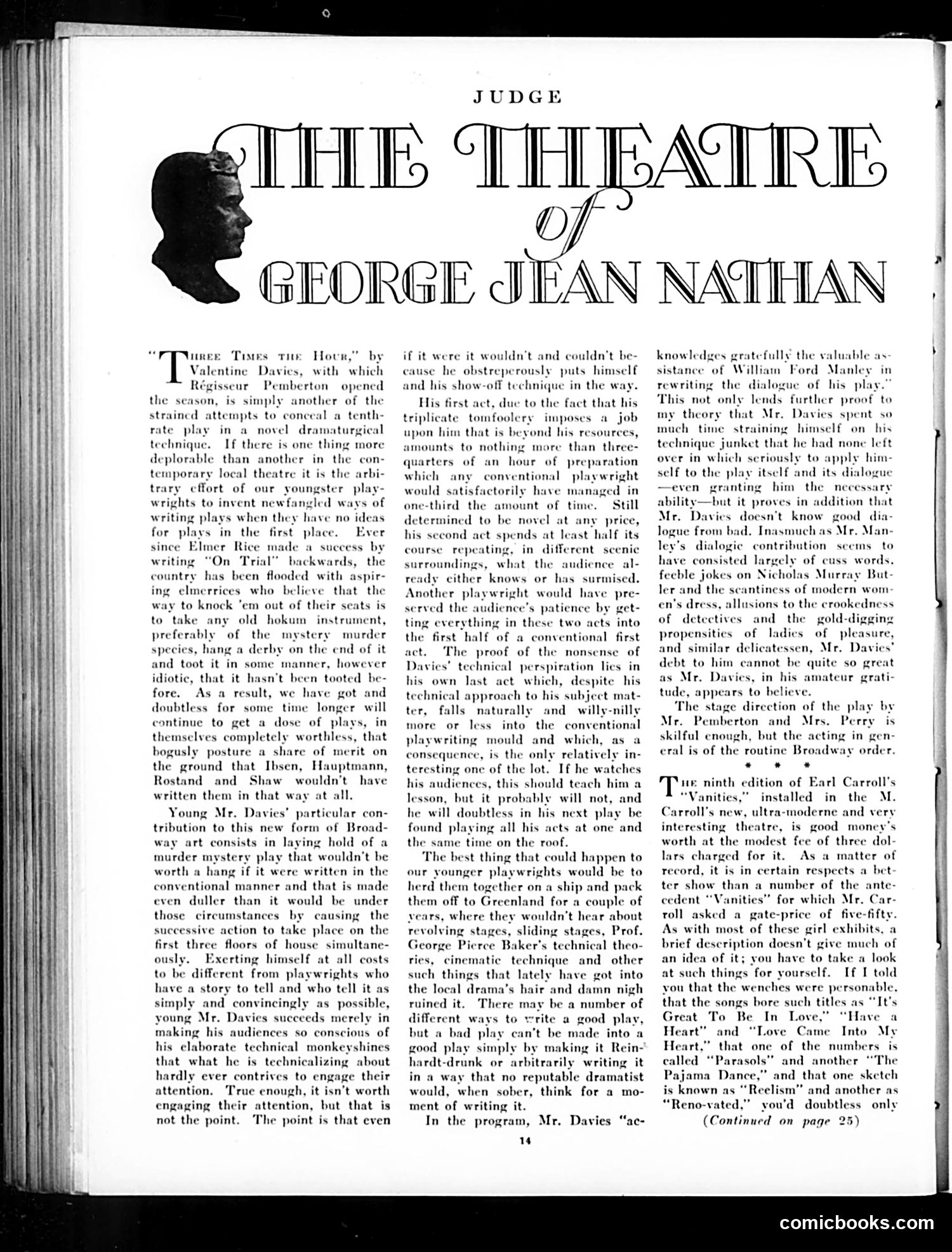
A restored page from Judge, 1931-09-19. Page through the whole issue in the reader above.
📄 Transcribed text from this page (OCR, searchable)
Machine-transcribed from the original scan — historical spelling and the odd misread are preserved.
. tree Times tire Hovr,” by Tia ntine Davies, with which Régisseur Pemberton opened the season, is simply another of the strained attempts to conceal a tenth- rate play in a novel dram technique. If there is one thing more deplorable than another in the con- temporary local theatre it is the arbi- trary effort of our youngster play- wrights to invent newfangled ways of writing plays when they have no ideas for plays in the first place. Ever since Elmer Rice made a success by writing “On Trial” backwards, the country has been flooded with aspir- ing elmerrices who believe that the way to knock ‘em out of their seats is to any old hokum instrument, preferably of the mystery murder species, hang a derby on the end of it and toot it in some manner, however idiotic, that it hasn't been tooted be- fore. As a result, we have got and doubtless for some time longer will continue to get a dose of plays, in themselves completely worthless, that bogusly posture a share of merit on the ground that Ibsen, Hauptmann, Rostand and Shaw wouldn't have written them in that way at all, Young Mr. Davies’ particular con- tribution to this new form of Broad- way art consists in ng hold of murder mystery p at wouldn't be worth a hi f it were written in the conventional manner and that is made even duller than it would be under those circumstances by causing the successive action to take place on the first three floors of house simultane- ously. erting himself at all costs to be different from playwrights who have a story to tell and who tell it as simply and con as possible, young Mr. Davies succeeds merely in making his audiences so conscious of his elaborate technical monkeyshines that what he is technicalizing about hardly ever contrives to engage their attention. True enough, it isn’t worth engaging their attention, but that is not the point. The point is that even JUDGE ks GEORGE J O if it were it wouldn't and couldn't be- cause he obstreperously puts himself and his show-off technique in the w: His first act, due to the fact that his triplicate tomfoolery imposes a job upon him that is beyond his resources, amounts to nothing more than three- quarters of an hour of preparation which any conventional playwright would satisfactorily have mani one-third the amount of time. Still determined to be novel at any price, his second act spends at least half its course repeating, in different: scenic surroundings, what the audience al- ready either knows or has. surt Another playwright would served the audience's patien ting everything in these twe the first half of a convent act. The proof of the nonsense of Davies’ technical perspiration lics in his own last act which, despite his technical approach to his subject mat- alls naturally and willy-nilly more or less into the conventional playwriting mould and which, as a consequence, is the only relatively in- x one of the lot. If he watches his audiences, this should teach him a lesson, but it probably will not, and he will doubtless in his next play be found playing all his acts at one and the same time on the roof. The best thing that could happen to our younger playwrights would be to herd them together on a ship and pack them off to Greenland for a couple of rs, where they wouldn't hear about revolving s , sliding stages, Prof. George Pierce Baker's technical theo- ries, cinematic technique and other zs that lately have got into the local drama’s hair and damn nigh ruined it. There may be a number of different ways to write a good play, but a bad play can’t be made into a good play simply by making it Re hardt-drunk or arbitrarily writing it in a way that no reputable dramatist would, when sober, think for a mo- ment of writing it. In the program, Mr. Davies ‘ac- 4 ma ed. ACR Es NATHAN knowledges gratefully the valuable as sistance of William Ford Manley in rewriting the dialogue of his play.” This not ¢ lends further proof to my theory that Mr. Davies spent so much time straining himself his technique junket that he had none left over in which seriously to apply him- self to the play itself and its di : —even granting him the ssary ability—but it proves in addition that Mr. Davies doesn’t know good dia- logue from bad, Inasmuch as Mr. Man- ley’s dialogic contribution seems to have consisted largely of cuss words. feeble jokes on Nicholas Murray But- ler and the scantiness of modern wom Iusions to the crookedness ives and the gold-dig propensities of ladies of pl and similar delicatessen, Mr. Da debt to him cannot be quite so gre as Mr. Davies, in his amateur gr: tude, appears to believe. The stage direction of the play by Mr. Pemberton and Mrs. Perry is skilful enough, but the acting in gen- eral is of the routine Broadway order. * 8 « Tt ninth edition of Earl Carroll's Vanitie: installed in the M. Carroll’s new, ultra-moderne and very interesting theatre, is good money's worth at the modest fee of three dol- lars charged for it. As a matter of record, it is in certain respects a bet ter show than a number of the ante- cedent “Vanities” for which Mr. Car- roll asked a gate-price of five-fifty. As with most of these girl exhibits, a brief description doesn’t give much of an idea of it; you have to take a look at such things for yourself. If I told you that the wenches were personable, that the songs bore such title “It's t 1 Be In Love,” “Have a part” and “Love Came Into My eart,”” that one of the numbers is called “Parasols” and another “The Pajama Dance,” and that one sketch is known as “Reelism” and another as “Reno-vated,” you'd doubtless only (Continued on page 25) comicbooks.com