A complete issue · 36 pages · 1931
Judge — August 15, 1931
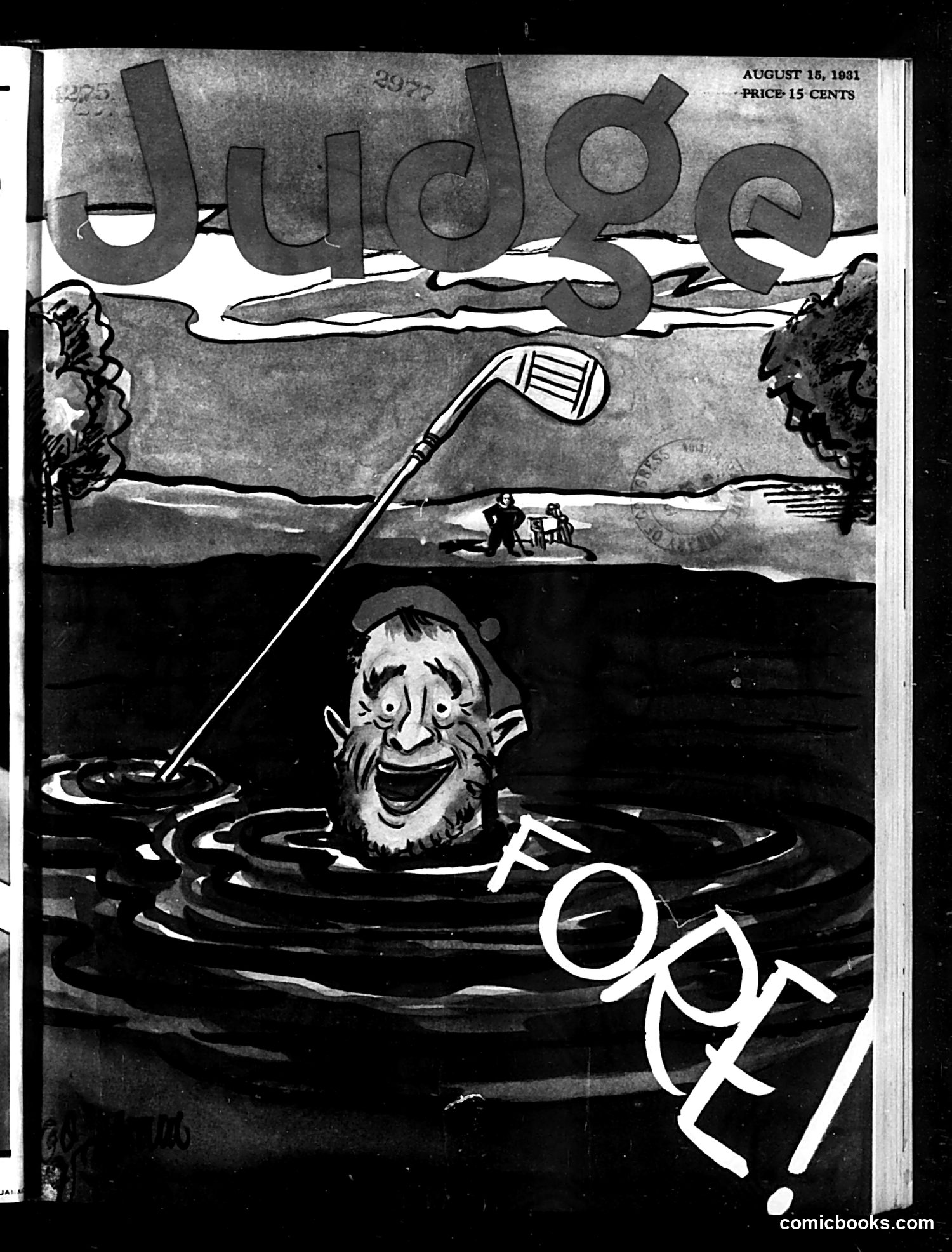
# Analysis of Judge Magazine Cover, August 18, 1931 This cover depicts a grotesque caricatured figure in water, holding a golf club, with the large text "JUDGE" overhead. The figure appears to be a caricature of a wealthy or prominent person struggling or drowning, rendered in an exaggerated, unflattering style typical of satirical cartooning. Given the August 1931 date, this likely references the economic hardship of the Great Depression. The golf club—a symbol of leisure and wealth—combined with the struggling figure suggests satire about financial collapse or the plight of the previously wealthy during economic crisis. The grotesque facial features and body language convey mockery of someone facing downfall. The exact identity of the caricatured figure remains unclear without additional context.
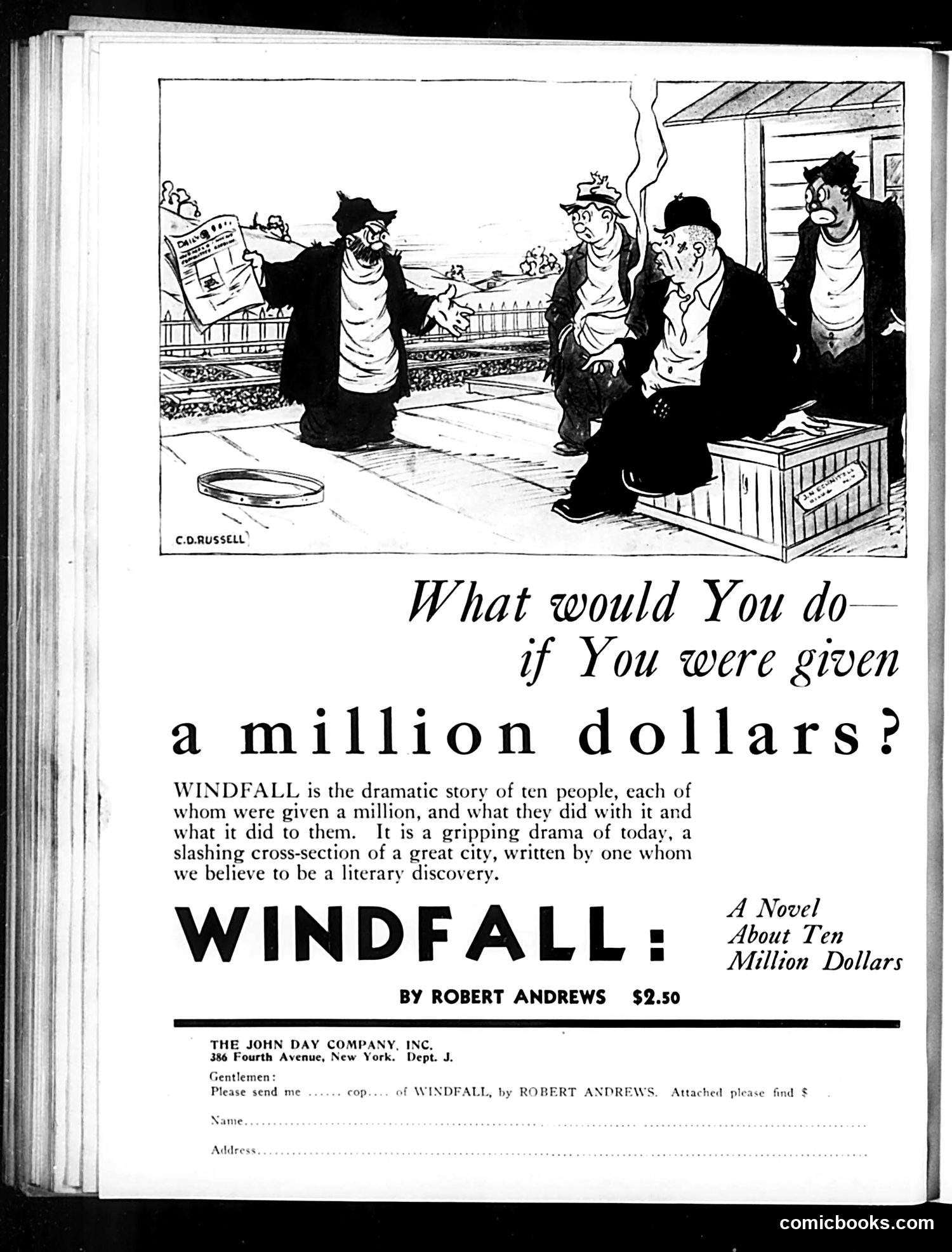
# Analysis of "Windfall" Advertisement Page This page is primarily a book advertisement rather than editorial satire. It promotes *Windfall* by Robert Andrews ($2.50, published by John Day Company), described as "a novel about ten million dollars." The cartoon illustration by C.D. Russell depicts ten figures in dark coats and hats examining something on the ground—likely meant to represent people discovering sudden wealth. The advertisement's headline poses a rhetorical question to readers: "What would You do if You were given a million dollars?" The book itself appears to explore how different people handle sudden fortune—a common literary theme examining human nature and class dynamics. The advertisement aims to intrigue potential readers by suggesting the novel offers insight into how ordinary people behave when receiving enormous sums of money, positioning it as social commentary for the magazine's audience.
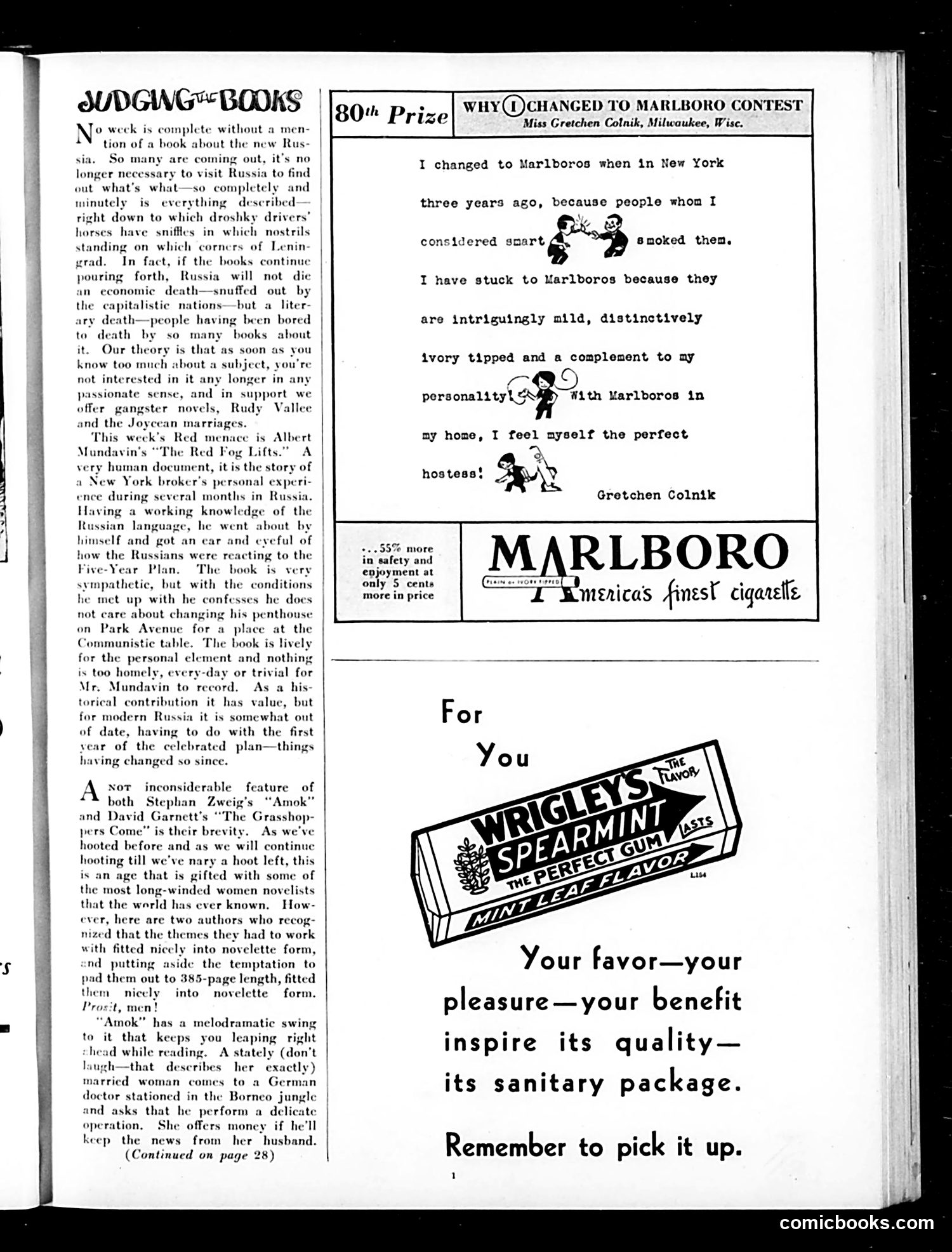
# Analysis of Judge Magazine Page This page is primarily **advertising and book reviews** rather than political satire. The main content includes: **"Judging the Books"** - a literary column reviewing new Russian-themed novels, particularly Albert Mundavin's "The Red Fog Lifts" about a New York broker's experiences in Russia during the Soviet period. The reviewer notes the book reflects an earlier era of Russian history, now somewhat dated. **The cartoon element** is modest: a small illustrated testimonial from "Gretchen Colnik" explaining why she switched to Marlboro cigarettes, featuring cartoon figures. This is essentially an **advertorial** - advertising disguised as editorial content. The page also features **Wrigley's Spearmint gum and Marlboro cigarette advertisements**, typical of 1930s-40s magazine content. There is no significant political satire present.
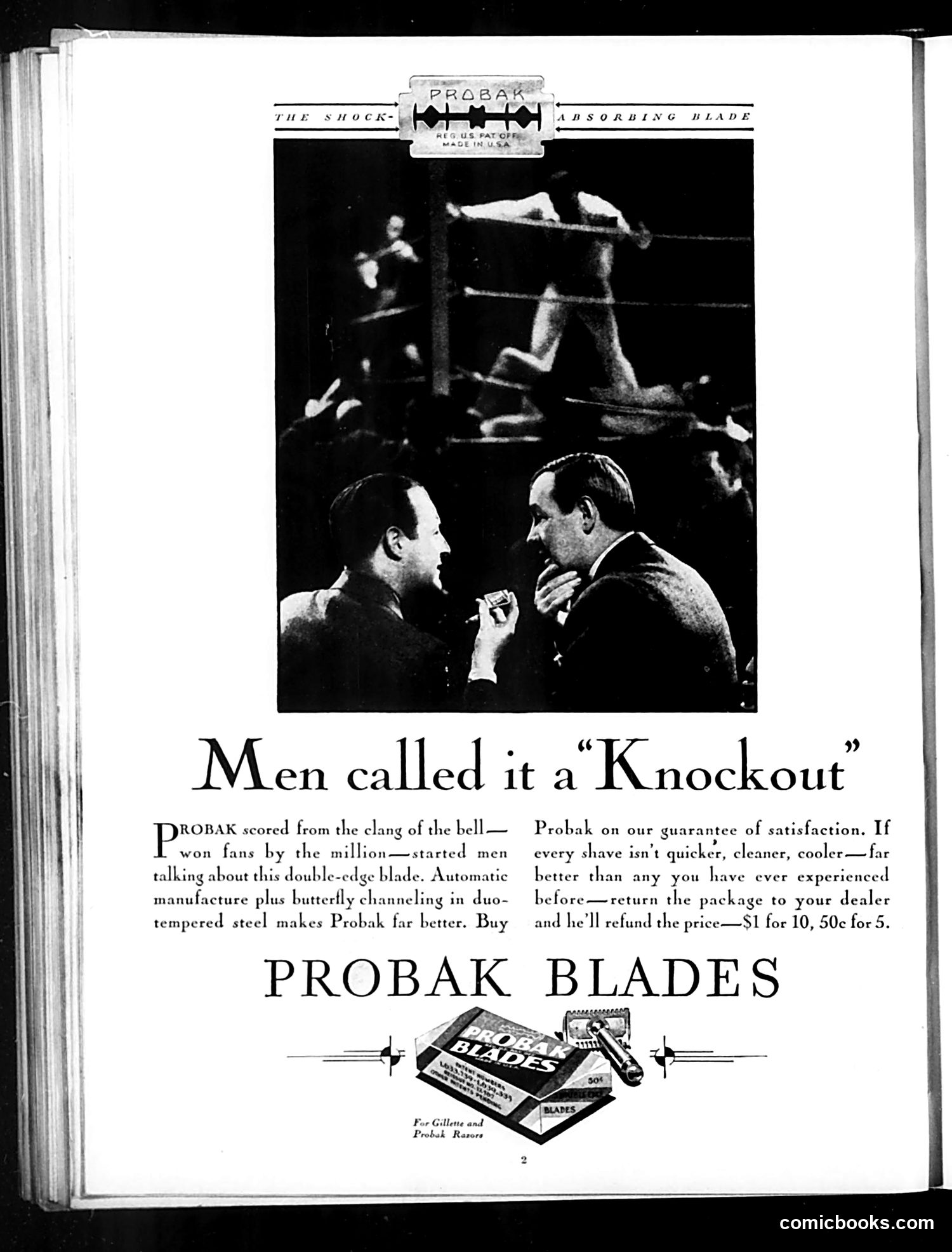
# Analysis This page is primarily **advertising, not satire**. It's a Probak razor blade advertisement disguised as editorial content in Judge magazine. The ad uses a boxing match metaphor—"Men called it a Knockout"—comparing Probak blades' performance to a boxer's decisive victory. The photograph shows two men in conversation (likely meant to evoke boxing spectators or promoters) and a boxing match in the background. The copy emphasizes Probak's manufacturing superiority: "double-edge blade," "butterfly channeling," and "duo-tempered steel." It appeals to male vanity and shaving satisfaction, offering a money-back guarantee ($1 for 10 blades, 50¢ for 5). The "Judge" magazine placement lends credibility through the satirical publication's audience and brand association, though the content itself contains no political or social satire.
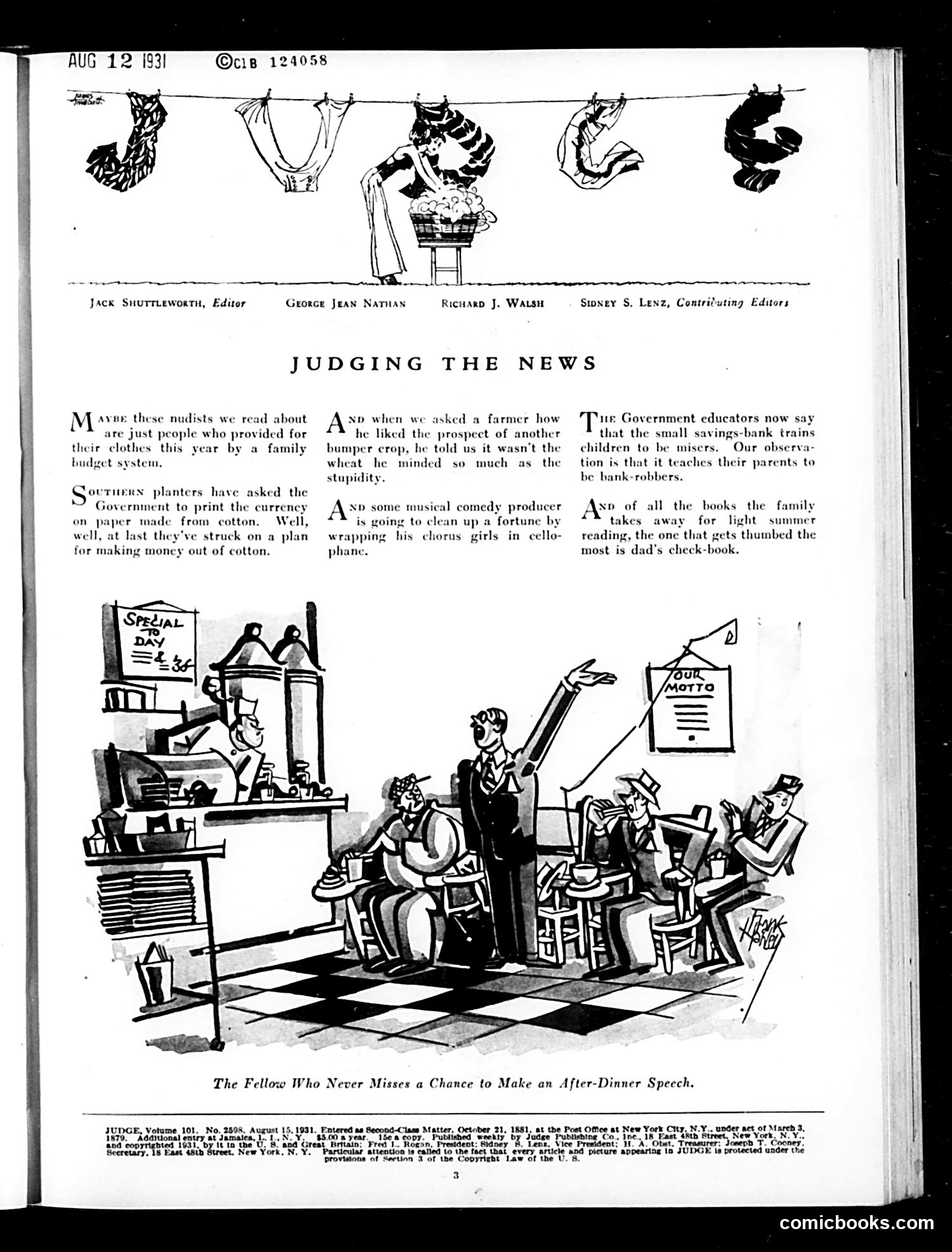
# "Judging the News" - August 12, 1931 This satirical page mocks contemporary social commentary and economic anxieties during the Great Depression era. **The main cartoon** depicts "The Fellow Who Never Misses a Chance to Make an After-Dinner Speech"—a man standing amid what appears to be a social gathering, gesturing grandiosely while others sit reading. The satire targets verbose after-dinner speakers who monopolize social occasions. **The text vignettes** mock various absurdities: mutists (likely nudists) in fashionable clothing, Southern planters suggesting currency printed on cotton, farmers complaining about bumper crops, musical producers wrapping chorus girls in cellophane, government educators calling children "misers," and families treating the father's checkbook as light summer reading. The overall theme critiques pretension, foolish economic suggestions, and social affectation during Depression-era uncertainty.
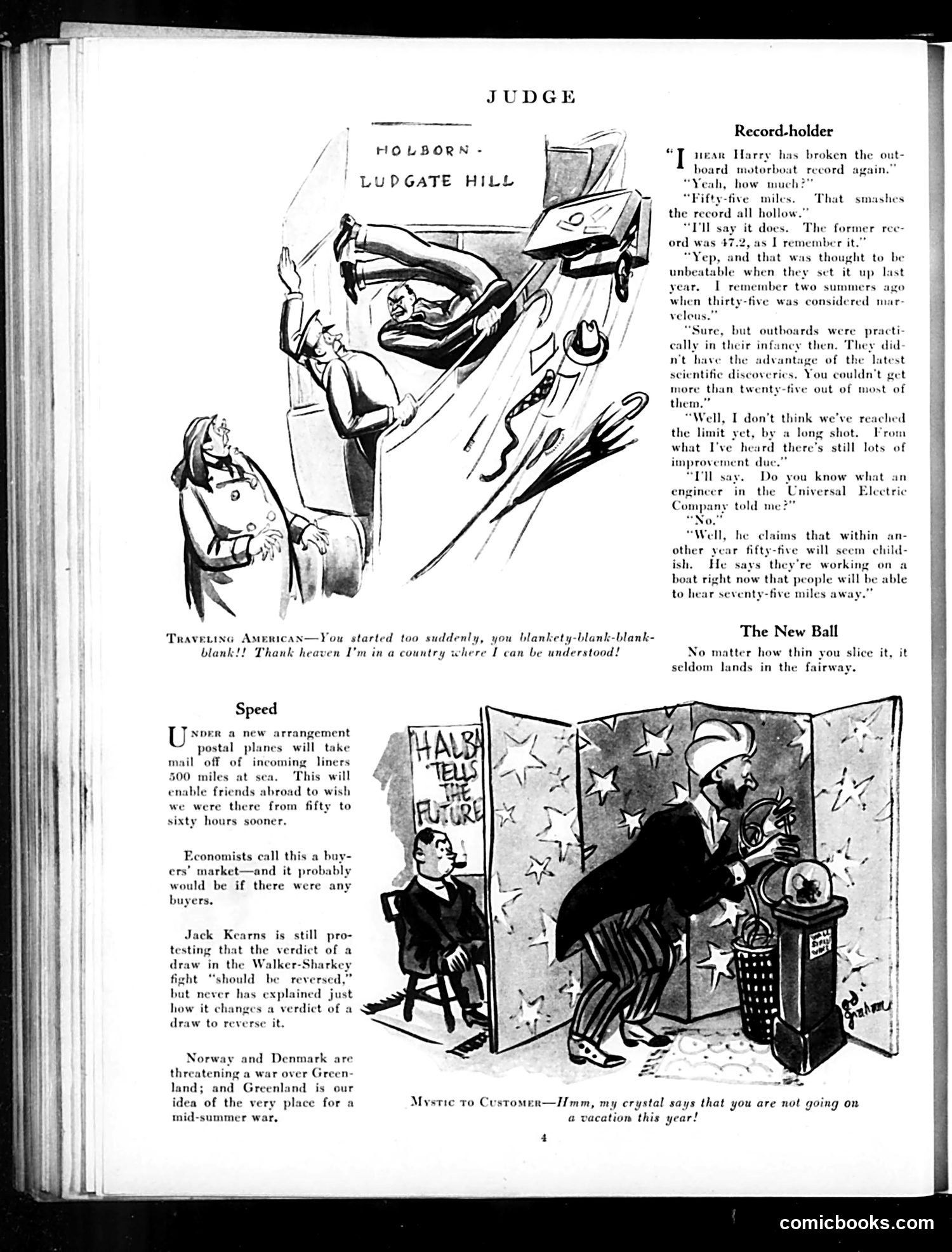
# Analysis of Judge Magazine Page This page contains three satirical pieces: **"Judge" (top)**: Mocks excessive motorboat speed records on Holborn-Ludgate Hill. A "traveling American" character expresses relief at being somewhere understandable, satirizing American tourists' bewilderment abroad. **"Speed" (middle)**: Comments on postal delivery improvements and economic speculation, mentioning Jack Kearns and a Walker-Sharkey fight verdict dispute. References a potential war between Norway and Denmark over Greenland as absurdly unsuitable for conflict timing. **"The New Ball"** and **"Mystic to Customer"** (bottom): Two brief captioned cartoons. The first jokes about golf balls landing in fairways; the second shows a fortune teller's crystal ball predicting no vacation—likely reflecting post-WWI economic uncertainty or Depression-era concerns about leisure affordability. The overall tone reflects early-to-mid 20th century American concerns about technology, travel, and economic anxiety.
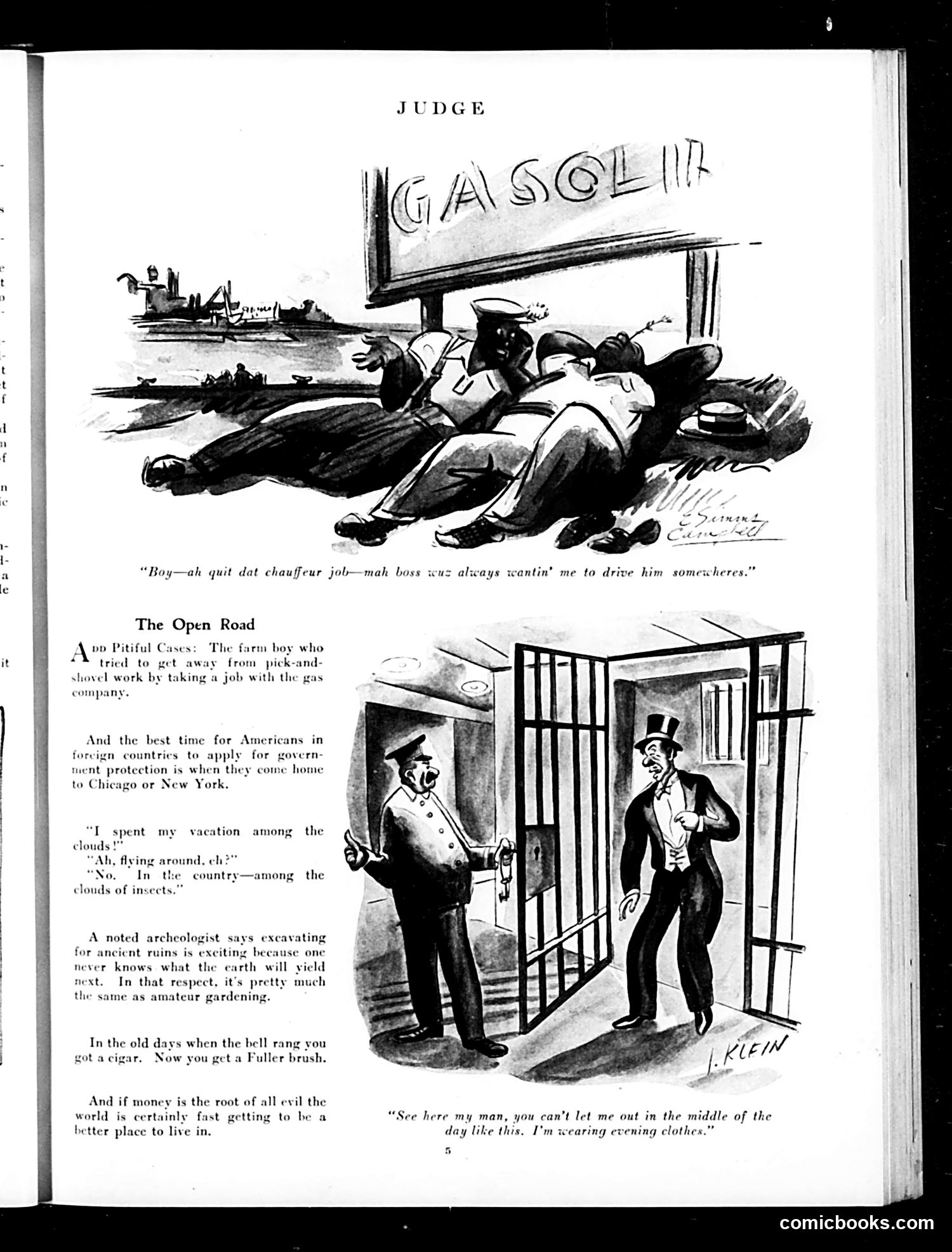
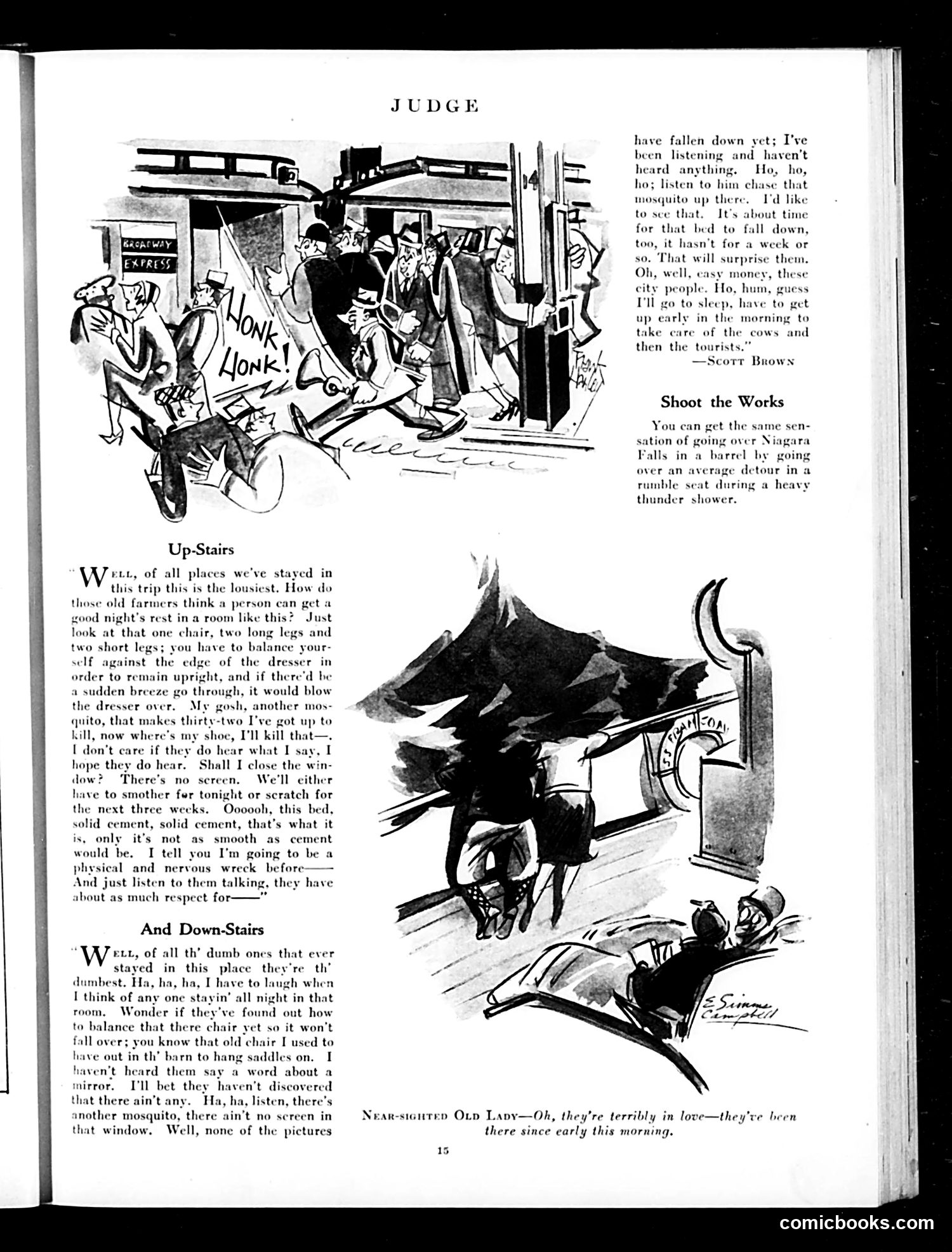
# Analysis of Judge Page This page contains three separate satirical pieces: **Top cartoon**: Shows men collapsed under a "Gasoline" sign. The caption jokes about a chauffeur refusing to drive anywhere, suggesting gasoline prices or availability were so problematic that even paid drivers wouldn't work—likely referencing wartime fuel rationing or shortages. **"The Open Road" section**: Contains brief humorous observations about American life, including jokes about vacation travel, archaeology, and consumer goods (cigars, Fuller brushes). **Bottom cartoon**: A man in formal evening wear stands in a doorway while another man blocks him, saying he cannot go out "in the middle of the day like this." The joke appears to mock rigid social conventions about when formal attire should be worn—criticizing excessive formality or class pretension.
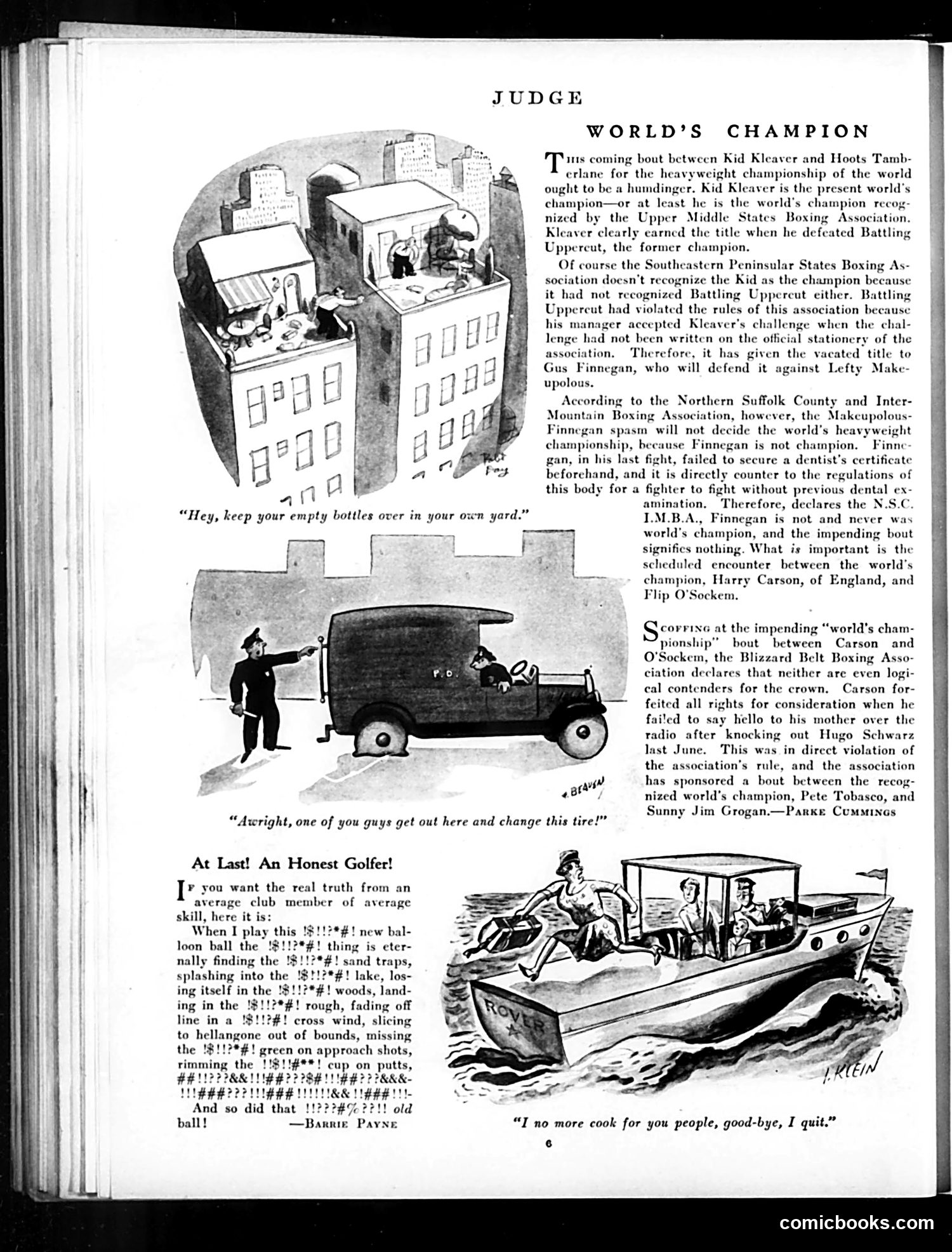
# Judge Magazine Page Analysis This page satirizes competing claims to boxing titles and incompetent authority figures in 1920s boxing. **Top Section ("Judge - World's Champion"):** Mocks rival boxing associations' conflicting claims about heavyweight champion status. Kid Kleaver allegedly holds the "world's champion" title, but multiple organizations dispute this—the Southeastern Peninsular States Boxing Association, Northern Suffolk County and Inter-Mountain Boxing Association, and N.S.C.I.M.B.A. each claim different champions (Gus Finnegan, Pete Tobasco, Sunny Jim Grogan). The cartoon's illustration of buildings stacked absurdly emphasizes the ridiculous layer upon layer of competing, overlapping authorities. **Lower Sections:** Two brief humor pieces—one about golf excuses, another about a boat cook quitting. The satire targets boxing's fragmented governance and the absurdity of multiple organizations claiming exclusive title recognition.
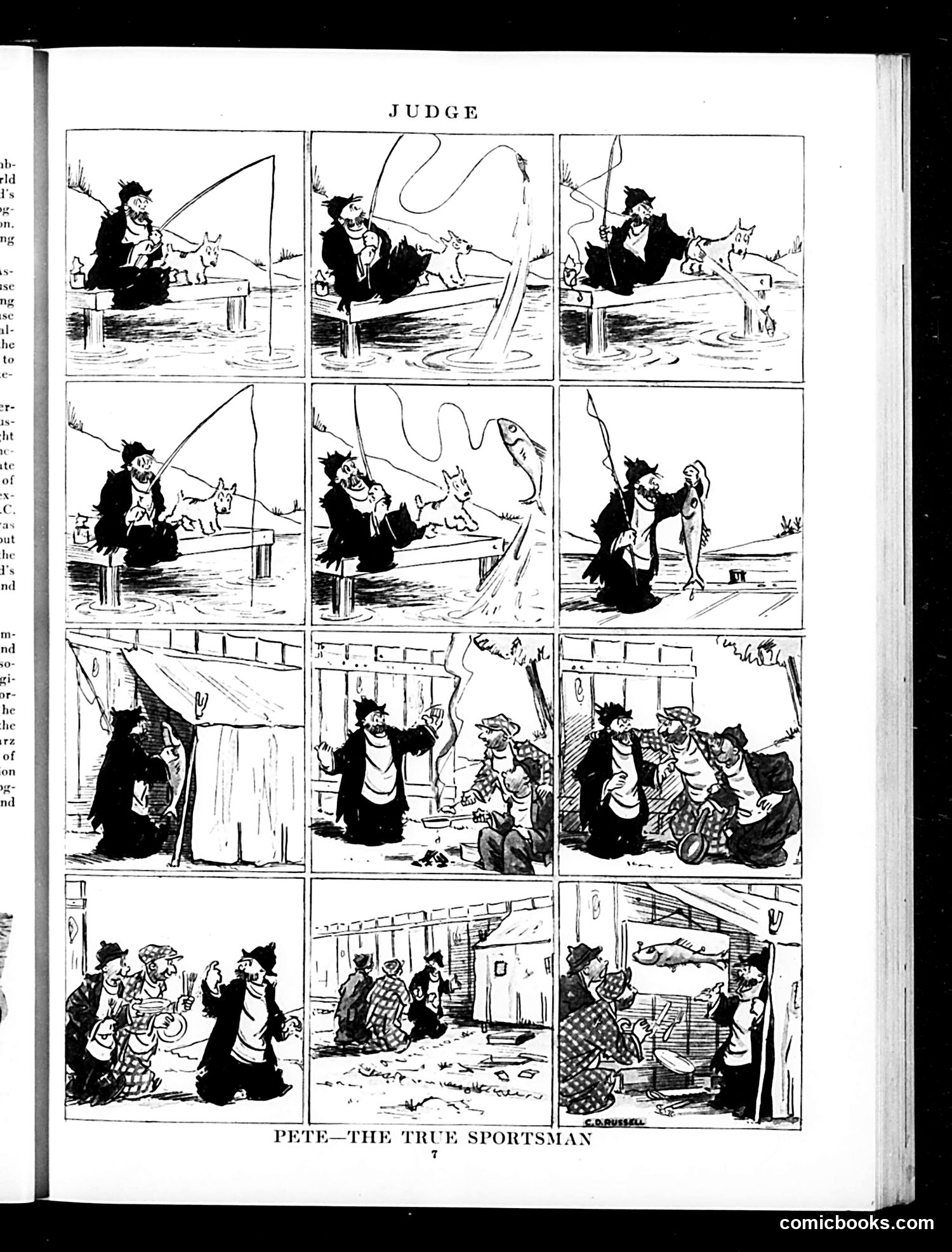
# Judge Page Analysis: "Pete—The True Sportsman" This is a 12-panel comic strip following a character named Pete through a fishing expedition. The narrative begins with Pete fishing peacefully, then progresses through increasingly chaotic scenes: his catch appears to grow, he struggles with his line, and the later panels shift to what appears to be a courtroom or institutional setting with multiple figures. The title "The True Sportsman" suggests ironic commentary on sporting ethics. However, without additional context about Pete's identity or the specific historical moment, the exact satirical target remains unclear. The shift from fishing scenes to crowded indoor scenes implies the strip may be commenting on how someone's sporting conduct—or lack thereof—has legal or social consequences. The comic's point likely critiques either unsportsmanlike fishing practices or Pete's character more broadly.
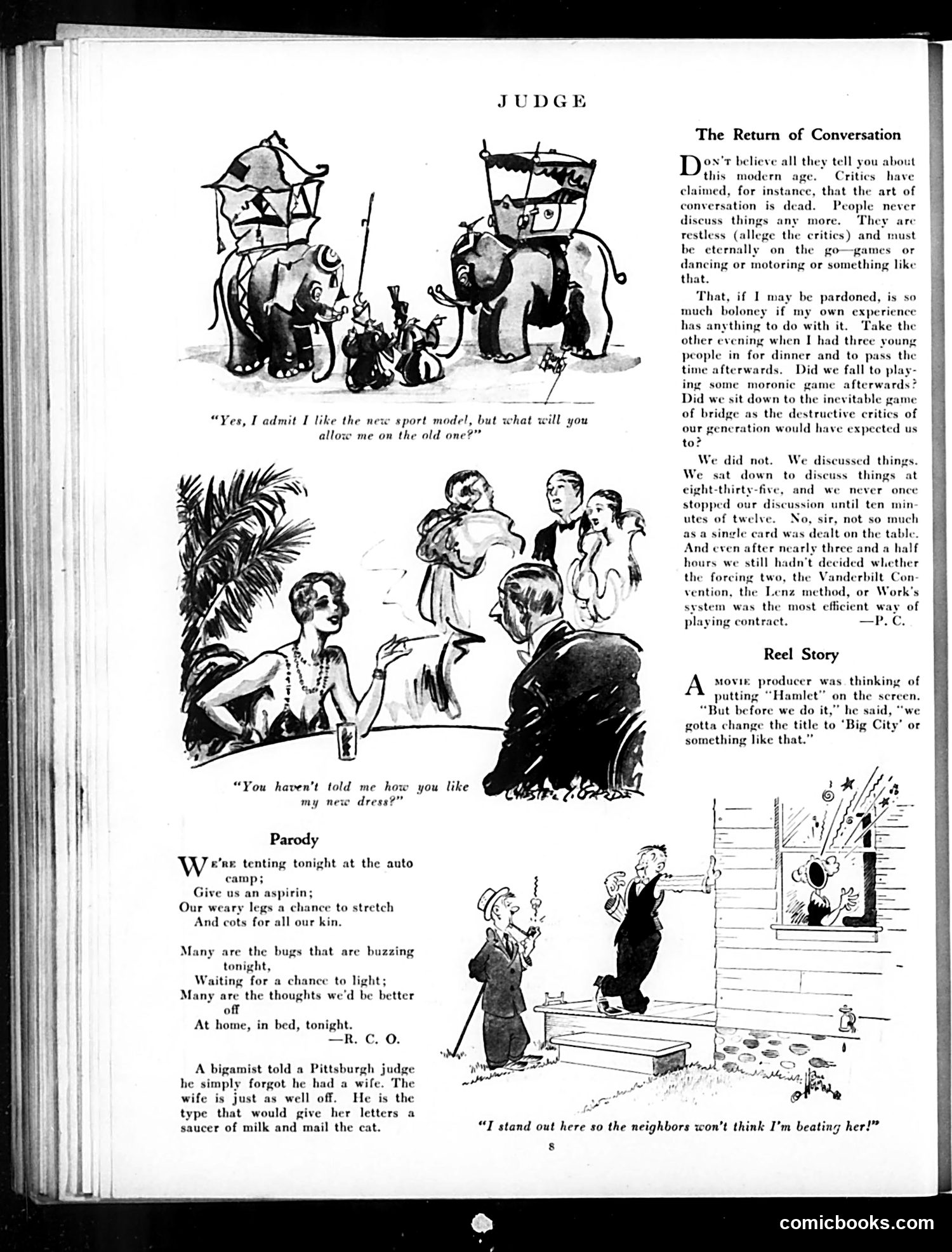
# Judge Magazine Page Analysis This page from *Judge* contains several pieces of social satire typical of the 1920s-30s era: **Top cartoons:** Mock modern consumerism and changing gender dynamics. The first shows a couple negotiating trade-in value on an automobile (suggesting materialism); the second depicts a woman demanding compliments on her new dress—both gently ribbing contemporary consumer culture and evolving social roles. **"Parody" poem:** Satirizes the popular "auto camp" vacation trend, mocking the discomfort of camping (bugs, hard cots) versus home comfort. The aspirin reference suggests travelers' complaints. **Bigamist anecdote:** A crude joke about a man forgetting his wife, implying indifference to marriage and domestic responsibility. **"Return of Conversation":** Defends conversation as still alive, using a lengthy bridge-game discussion as evidence—ironically proving critics' point that "conversation" now means debating contract bridge rules rather than meaningful dialogue. **Bottom cartoon:** Darkly jokes about domestic violence, with a man standing outside to avoid *appearing* to beat his wife—satirizing both hypocrisy and social pretense. The overall tone reflects period anxieties about modernization, changing social norms, and moral decline.
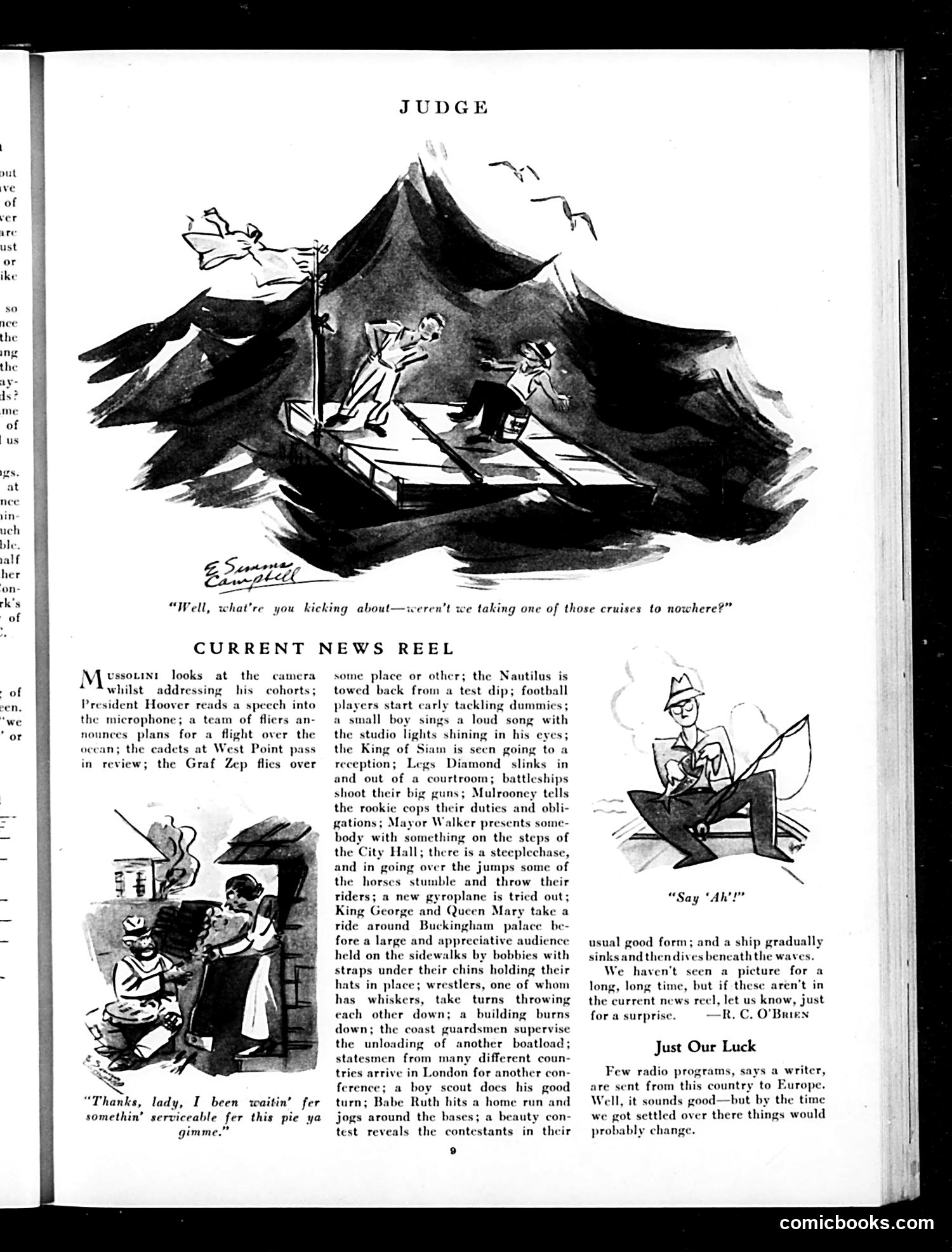
# Judge Magazine Cartoon Analysis **Top Cartoon ("Judge"):** A couple argues in a rowboat during what appears to be rough seas. The husband dismisses his wife's concerns, sarcastically asking why she's complaining—after all, weren't they taking a cruise "to nowhere?" The joke satirizes the absurdity of Depression-era tourism: couples were taking pleasure cruises to literal "nowhere" (pointless destinations), yet still experiencing buyer's remorse and marital discord. **"Current News Reel":** This section is a rapid-fire satirical summary of contemporary news items from what appears to be the late 1920s or early 1930s, including Mussolini, President Hoover, the Graf Zeppelin airship, gangster Legs Diamond, King George, Babe Ruth, and various other celebrities and events. It's mocking the relentless, shallow parade of news stories that dominated the era's newsreels. **"Just Our Luck":** A brief joke about American radio programs being unavailable in Europe—suggesting America's cultural reach was limited internationally.
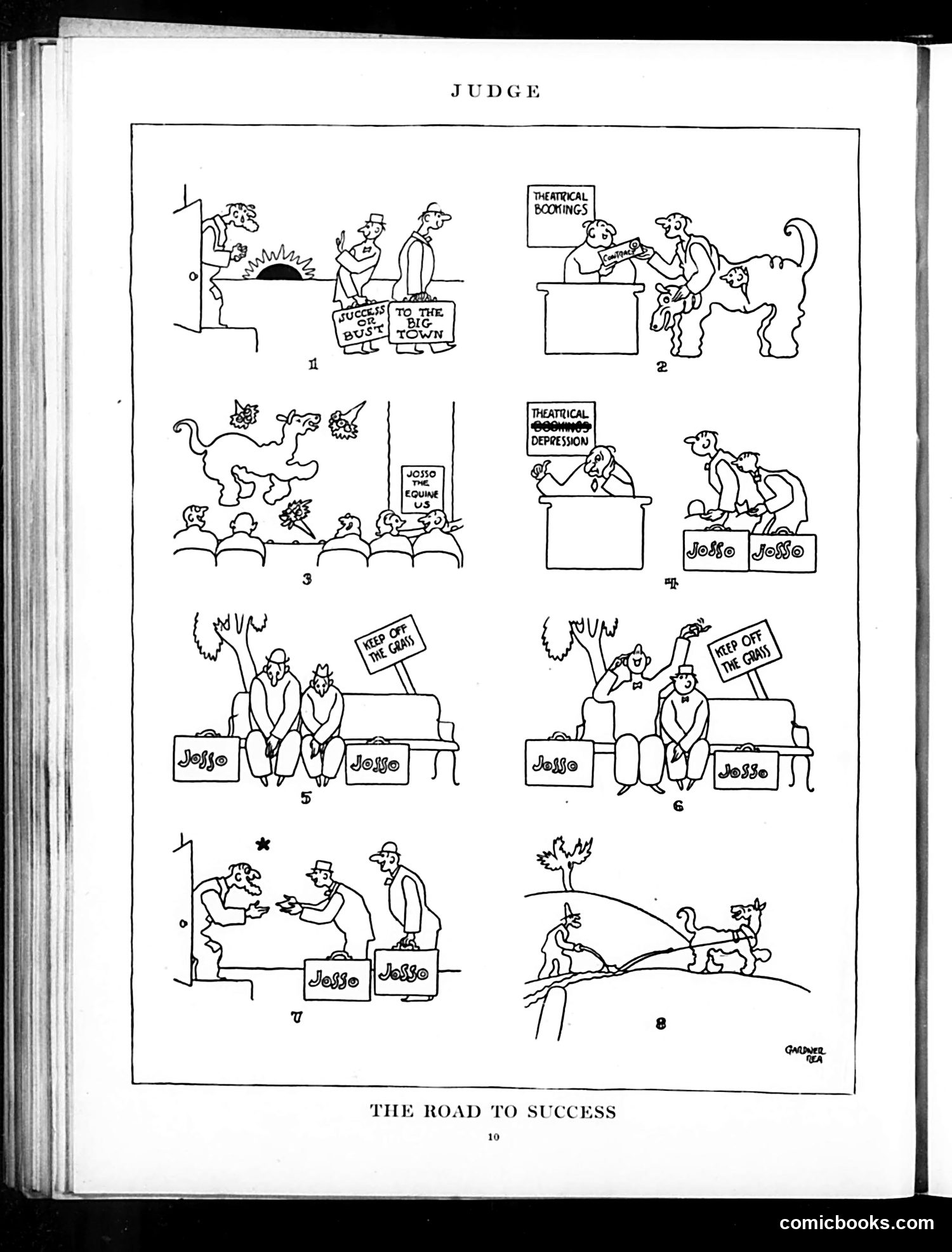
# "The Road to Success" - Judge Magazine Cartoon This comic strip satirizes theatrical success through eight panels depicting the journey of aspiring performers. Panel 1 shows hopeful actors arriving in "the big town" with dreams. Panels 2-4 illustrate their struggles: theatrical bookings, economic depression, and chaotic auditions labeled "chaos at the theater." Panels 5-6 show dejected performers sitting on benches marked "Jello" (likely product placement or sponsorship), holding signs reading "Keep off the Grass." Panels 7-8 depict the final outcome: reduced circumstances, with performers apparently abandoned or in dire straits. The cartoon mocks the harsh realities facing theatrical hopefuls—the contrast between glamorous dreams and disappointing economic realities in show business. It critiques both the industry's exploitation and performers' naive optimism about achieving stardom.