
Judge, 1931-08-15 · page 24 of 36
Judge — August 15, 1931 — page 24: what you’re looking at
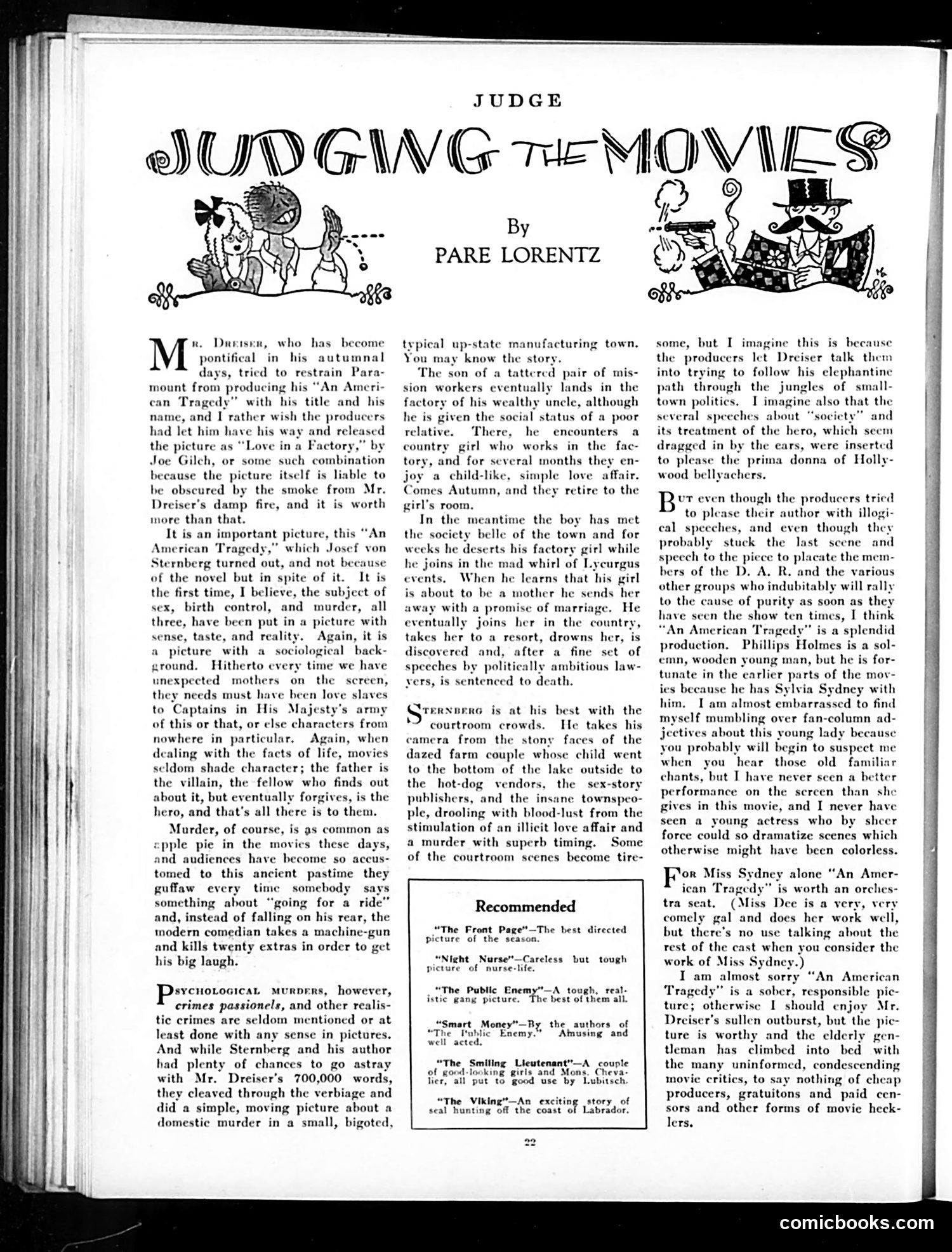
A restored page from Judge, 1931-08-15. Page through the whole issue in the reader above.
📄 Transcribed text from this page (OCR, searchable)
Machine-transcribed from the original scan — historical spelling and the odd misread are preserved.
nr. Dreiser, who has become M pontifical in his autumnal days, tried to restr: Para- mount from producing his “An Ameri- can Tragedy” with his title and his name, and I rather wish the producers had let him have his way and rel the picture as “Love in a Factory Joe Gilch, or some such combi n because the picture itself is liable to be obscured by the smoke from Mr. Dreiser's damp fire, and it is worth more than that. nportant picture, this “An American Tragedy,” which Josef von Sternberg turned out, and not because of the novel but in spite of it. It is the first time, I believe, the subject of sex, birth control, and murder, all three, have been put in a picture with sense, taste, and reality. Again, it is a picture with a sociological back- xround. Hitherto every time we have unexpected mothers on the screen, they needs must have been love slaves to Captains in His Majesty's army of this or that, or else characters from nowhere in particular. Again, when dealing with the facts of life, movies seldom shade character; the father is the villain, the fellow who finds out about it, but eventually forgives, is the hero, and that’s all there is to them. Murder, of course, is as common as zpple pie in the movies these days and audiences have become so accu: tomed to this ancient pastime they guffaw every time somebody say something about “going for a ride and, instead of falling on his rear, the modern comedian a machine-gun and kills twenty extras in order to get his big laugh. used by Prrenovcarcat murpers, however, crimes passionels, and other realis- tic crimes are seldom mentioned or at least done with any sense in pictures. And while Sternberg and his author had plenty of chances to go astray with Mr. Dreiser's 700,000 words, they cleaved through the verbiage and did a simple, moving picture about a domestic murder in a small, bigoted, JUDGE THe VI By typical up-state manufacturing town. You may know the story. The son of a tattered p: sion workers eventually lands in the factory of his wealthy uncle, although he is given the social status of a poor relative. There, he encounters a country gitl who works in the fa tory, and for several months they en- joy a child-like, simple love affai Comes Autumn, and they retire to the girl’s room. In the meantime the boy ha the society belle of the town and for weeks he deserts his factory girl while he joins in the mad whirl of Lycurgus events. When he learns that his girl is about to be a mother he sends her away with a promise of marriage. He eventually joins her in the country, takes her to a resort, drowns her, is discovered and, after a fine set of speeches by politically ambitious law- Yers, is sentenced to death. r of mis- met Srrerxpeno is at his best with the courtroom crowds. He takes his camera from the stony faces of the dazed farm couple whose child went to the bottom of the lake outside to the hot-dog vendors, the sex-story publishers, and the insane townspeo- ple, drooling with blood-lust from the stimulation of an illicit love affair and a murder with superb timing. Some of the courtroom scenes become tire- ‘ Recommended “The Front Page”—The best directed picture of the season. “Night Nurse”—Careless but tough picture of nurse-life. “The Public Enemy”—A tough, real- istic gang picture. The best of them all. mart Money"—Ry the authors of ne Public Enemy.” Atnusing and well acted. he Smiling Lieutenan of good-looking girls and M. lier, all put to good use by Lubitsch. “The Viking”—An exciting story of seal hunting off the coast of Labrador. ov I-& (26 oe some, but I imagine this is because the producers let Dreiser talk them into trying to follow his clephantine path through the jungles of small- town polities. Ii several speeches about “societ its treatment of the hero, which seem dragged in by the ears, were inserted to please the prima donna of Holly- wood bellyachers. ut even though the producers tried to please their author with illogi cal speeches, and even though they probably stuck the last scene and speech to the piece to placate the mem- bers of the D. A. R. and the various other groups who indubitably will rally to the cause of purity as soon as they have seen the show ten times, I think “An American dy a splendid production. Phillips Holmes is a sol- emn, wooden young man, but he is for- tunate in the carlier parts of the mov- ies because he has Sylvia Sydney with him. I am almost embarrassed to find myself mumbling over fan-column ad- jectives about this young lady because you probably will begin to suspect me when you h those old fami chants, but I have never scen a better performance on the sereen than she gives in this movie, and I never have seen a young actress who by sheer force could so dramatize scenes which otherwise might have been colorless. or Miss Sydn ican Tragedy tra si y alone “An Amer- s worth an orches- t. (Miss Dee is a very, very comely gal and docs her work well, but there’s no use talking about the rest of the cast when you consider the work of Miss Sydney.) I am almost sorry “An American is a sober, responsible pic- ture; otherwise I should enjoy Mr. sullen outburst, but the pic- ture is worthy and the elderly gen- tleman has climbed into bed with the many uninformed, condescending movie critics, to say nothing of cheap producers, gratuitons and paid cen- sors and other forms of movie heck- lers, comicbooks.com