
Judge, 1931-08-15 · page 18 of 36
Judge — August 15, 1931 — page 18: what you’re looking at
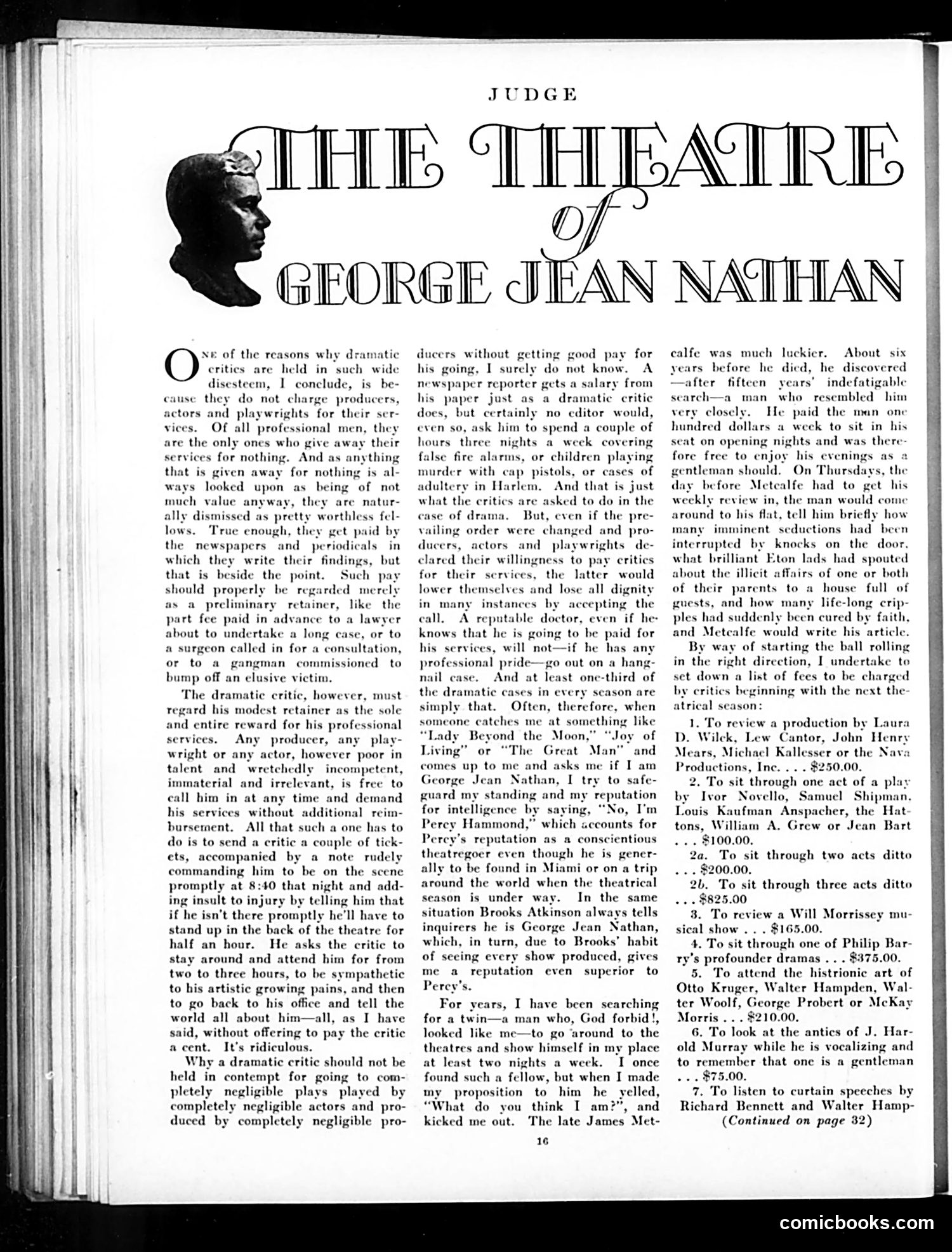
A restored page from Judge, 1931-08-15. Page through the whole issue in the reader above.
📄 Transcribed text from this page (OCR, searchable)
Machine-transcribed from the original scan — historical spelling and the odd misread are preserved.
as ———=— Nr of the reasons why dramatic critics are held in such wide disesteem, I conclude, is be- cause they do not charge producers, yw its for their ser- they actors and play vices. Of all professional men, are the only services f nothing. anything that is given away for nothing is al- ys looked upon as being of not much value anyway, they are natur- ally dismissed as pretty worthless fel- lows. True enough, they get paid by the newspapers and periodicals in which they write their findings, but that is beside the point. Such pay should properly regarded merely as a preliminary retainer, like the part fee paid Ivance to about to undertake a long casi a surgeon called in for a consultation, or to a an commissioned to bump off an elusive victim. The dramatic criti regard his modest and serv , however, must iner as the sole ntire reward for his professional es. Any producer, any play- wright or any actor, however poor in talent and wretchedly incompetent, immaterial and irrelevant, is free to call him in at any and demand his services without additional reim- bursement. All that such a one has to do is to send a critic a couple of tick- ets, accompanied by a note rudely commanding him to be on the scene promptly at 8:40 that night and add- ing insult to injury by telling him that if he isn't there promptly he'll have to stand up in the back of the theatre for half an hour. He asks the critic to stay around and attend him for from two to three hours, to be sympathetic to his artistic growing pains, and then to go back to his office and tell the world all about him—all, as I ha said, without offering to pay the critic acent. It's ridiculous. Why a dramatic critic should not be held in contempt for going to com- pletely negligible plays played by completely negligible actors and pro- duced by completely negligible pro- JUDGE 0 ducers without getting good pay for his going, I surely do not know. A newspaper reporter gets a salary from his paper just a dramatic critic does, but certainly no editor would, even so, ask him to spend a couple of hours three nights a week covering larms, or children playing murder with cap pistols, or cases of adultery in Harlem. And that is just what the critics are as to do in the cof drama. But, even if the pre- vailing order were changed and pro- ducers, actors and playwrights de- clared their willingness to pay crities for their services, the latter would lower themselves and lose all dignity in many instances by accepting the call, A reput knows that he is going to be paid for his services, will not—if he has any professional pride—go out on a han nail ca at least hird of the dramatic cases in every season are simply that. Often, therefore, when tches me at something like Beyond the Moon,” “Joy of or “The Great Man” and nes up to me and asks me if Iam George Jean Nathan, I try to safe- guard my standing and my reputation for intelligence by saying, “No, I'm Perey Hammond, which accounts for Percy’s reputation as a conscientious theatregoer even though he is gener- ally to be found in Miami or on a trip around the world when the theatrical season under w In the same situation Brooks Atkinson always tells inquirers he is George Jean Nathan, which, in turn, due to Brooks’ habit of seeing every show produced, gives me a reputation even superior to Percy's. as false fire ca For years, I have been searching for a man who, God forbid !, looked like me—to go ‘around to the theatres and show himself in my place at least two nights a week. I once found such a fellow, but when I made my proposition to him he yelled, “What do you kicked me out. think I am?”, and The late James Met- 16 ‘le doctor, even if he Is MADEACIRIE GEORGE J much luckier. About six re he died, he discovered fter fifteen years’ indefatigable search—a man who resembled him very closely. He paid the man one hundred dollars a week to sit in his seat on opening nights and was there- fore free to enjoy his evenings as 2 gentleman should. On Thursdays, the : before Metealfe had to get his weekly review in, the man would come around to his flat, tell him briefly how many imminent seductions had interrupted by knocks on the door. what brilliant Eton lads 1 spouted about the illicit affairs of one or both of their parents to a house full of guests, and how many life-long crip- ples had suddenly been cured by faith, and Metcalfe would write his article. By way of starting the ball rolling in the right direction, I undertake to set down a list of fees to be charged by critics beginning with the next the atrical s 1. To review a production by Laura D. Wilek, Lew Cantor, John Henry Mears, Michacl Kallesser or the Nava Productions, Inc. . . 0.00. To sit through one act of a play by Ivor Novello, Samuel Shipm Louis Kaufman Anspacher, the Hat tons, William A. Grew or Jean Bart + « - $100.00, To sit through two acts ditto - « $200.00, 2b. To sit through three acts ditto 5.00 "8. To review Fi Will Morrissey mu- sical show . . . $165.00. 4 To sit through one of Philip Bar- ty’s profounder dramas . . . $375.00. 5. To attend the histrionic art of Otto Kruger, Walter Hampden, Wal- ter Woolf, George Probert or McKay Morris . . . $210.00, 6. To look at the antics of J. Har- old Murray while he is vocalizing and to remember that one is a gentleman 7. To listen to curtain speeches by Richard Bennett and Walter Hamp- (Continued on page 32) comicbooks.com