A complete issue · 36 pages · 1930
Judge — August 30, 1930
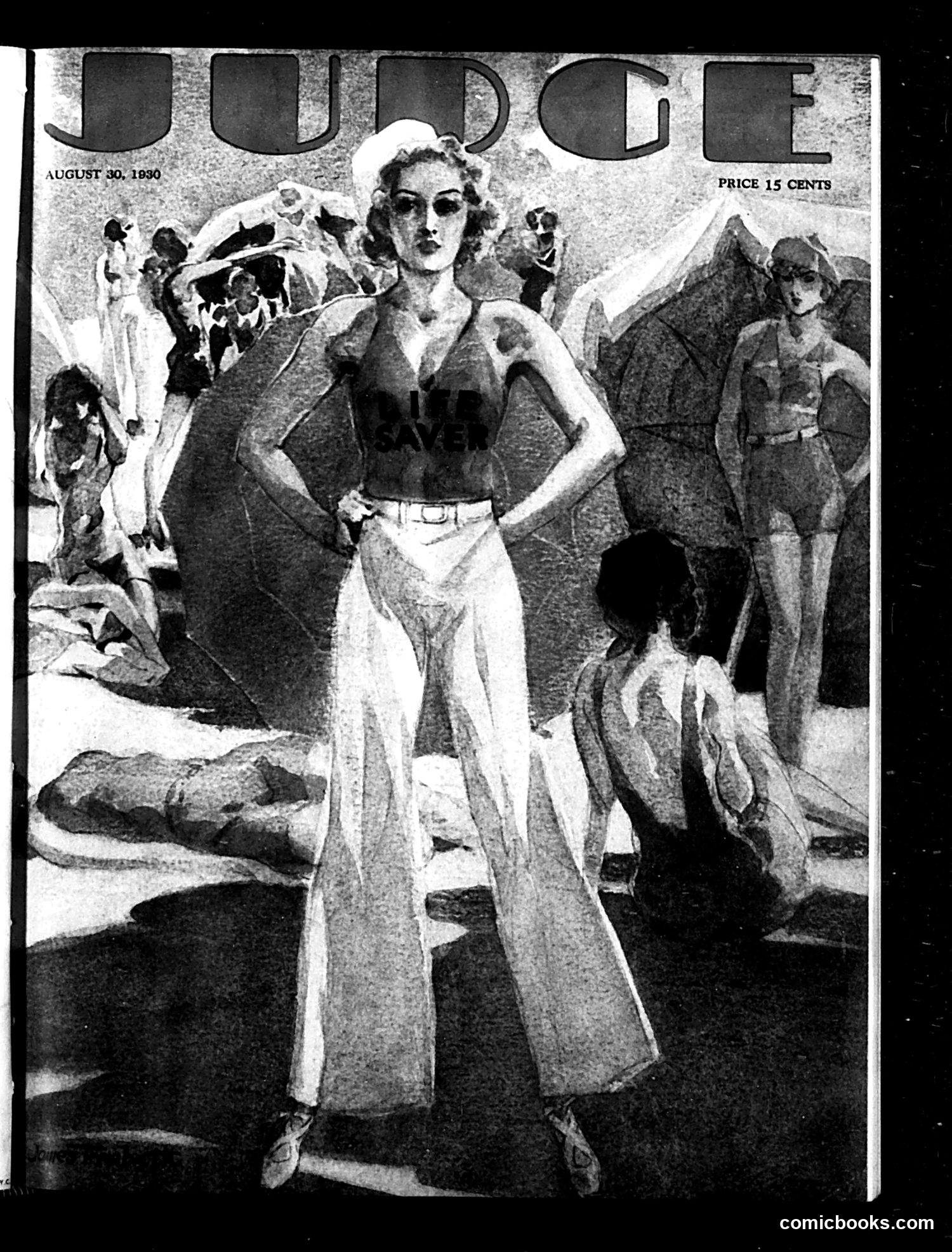
# Analysis This is the cover of *Judge* magazine from August 30, 1890. The image depicts a woman in exotic/orientalist costume (bare-midriff top, harem pants) posed centrally, surrounded by other figures in various theatrical or "exotic" dress in what appears to be a desert setting. Without legible article titles or accompanying text visible in this OCR, I cannot definitively identify the specific satire or its subject. The styling suggests it likely lampoons either: contemporary theatrical productions (possibly featuring orientalist themes popular in 1890s entertainment), American colonial/imperial attitudes, or a specific public figure's fashion choices or scandal. The cover price of 15 cents and the theatrical composition indicate this addresses contemporary entertainment or social commentary, but the precise target remains unclear from the image alone.
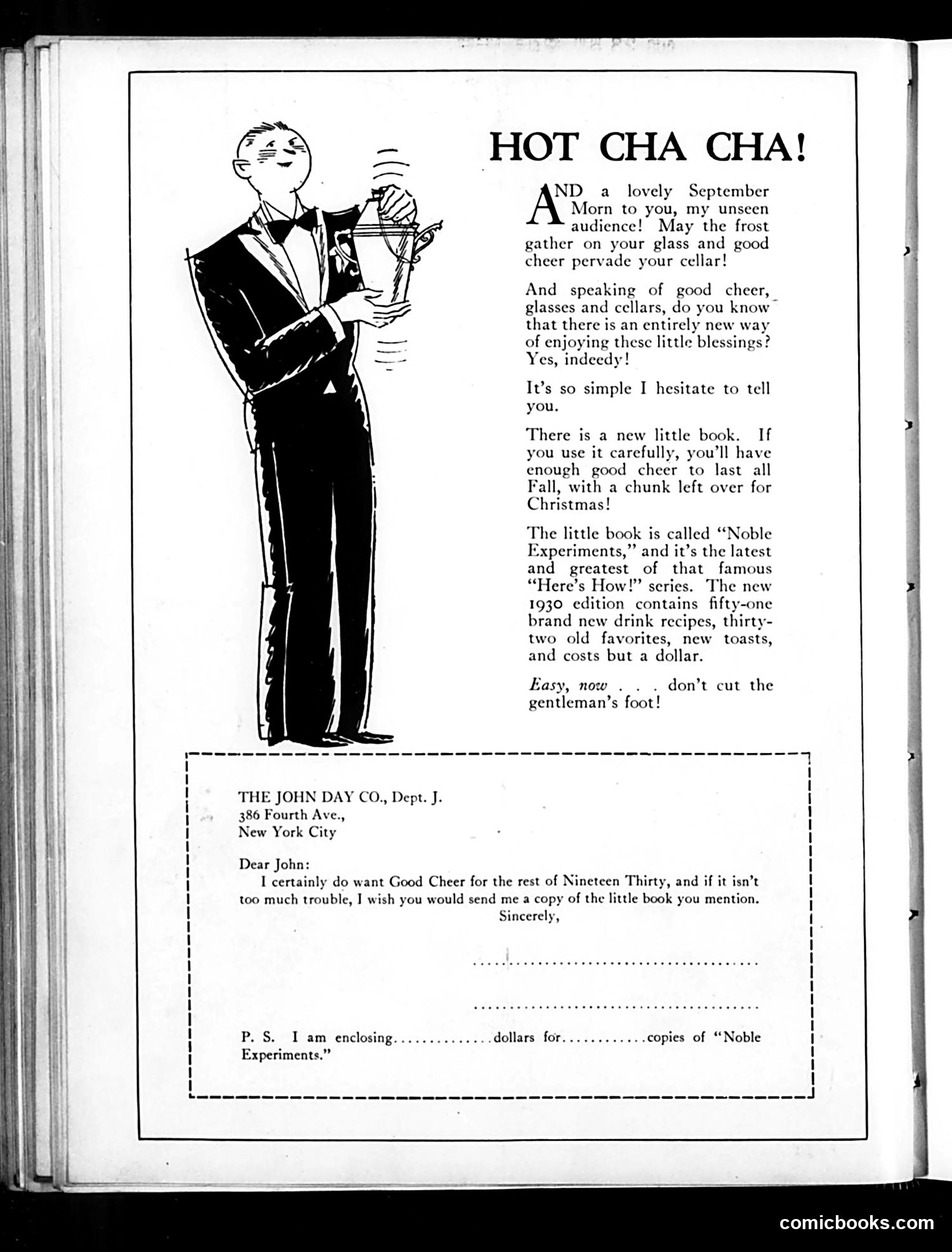
# Analysis This page is primarily **advertising content** rather than political satire. It promotes "Noble Experiments," a cocktail recipe book from The John Day Company (1939 edition), positioned as part of the "Here's How!" series. The illustration shows a formally-dressed gentleman raising a drink, accompanying the headline "HOT CHA CHA!" The ad plays on 1930s slang and assumes readers desire cocktail recipes during Prohibition's end (repealed 1933). The humor is gentle—phrases like "don't cut the gentleman's foot!" reference clumsy bartending. The inclusion of a reply card suggests this appeared in magazines to drive direct book sales. The dollar cost and promise of "good cheer" reflect Depression-era marketing targeting middle-class readers seeking affordable entertainment and social sophistication through home bartending.
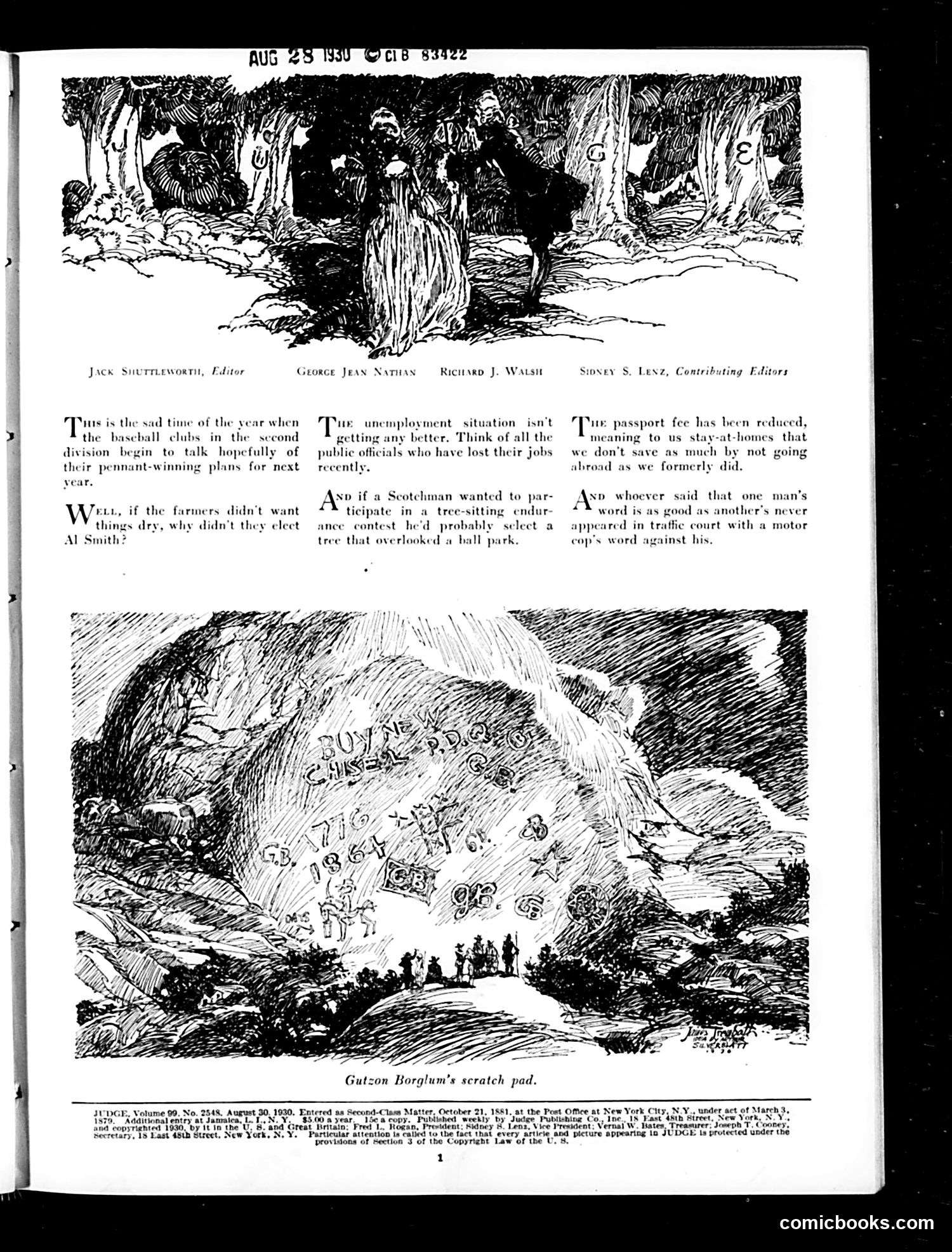
# Analysis of Judge Magazine Page (August 29, 1930) This page contains editorial commentary on three contemporary crises during the Great Depression: 1. **Baseball clubs** complaining about pennant-winning plans—likely referencing owners' concerns as the economic crisis worsened. 2. **Unemployment and Scottish tree-sitting contests**—satirizing public officials' indifference to job losses by comparing their priorities to absurd entertainment (a Scotsman in a tree-sitting endurance contest overlooking a ballpark). 3. **Passport fees and traffic court credibility**—mocking government cost-cutting while noting that a motorist's word carries less weight than a police officer's in traffic court. The bottom illustration, "Gutzon Borglam's scratch pad," appears to reference the sculptor's monumental Mount Rushmore project, showing carved presidential profiles—suggesting commentary on grand public works amid economic hardship.
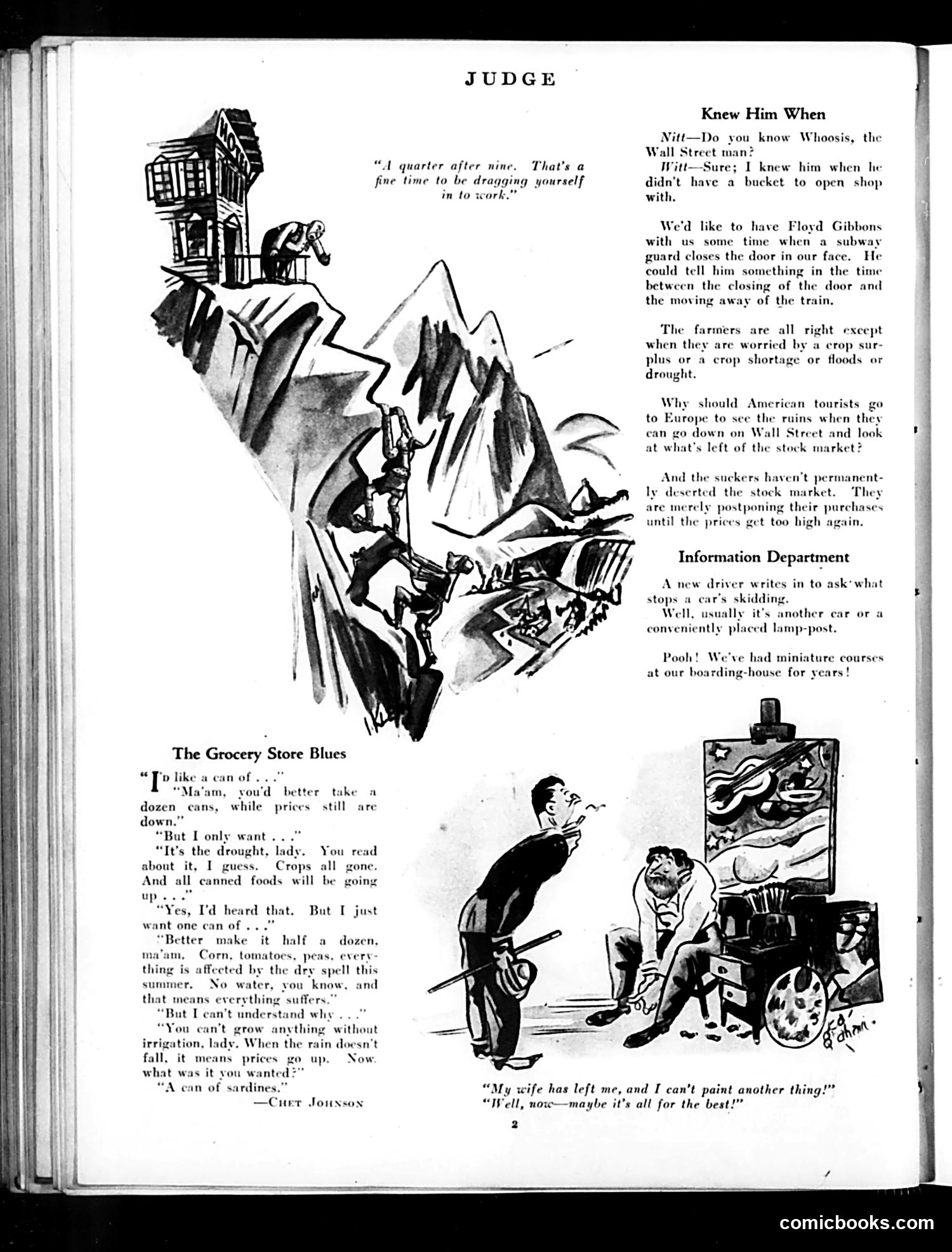
# Analysis of Judge Magazine Page **"The Grocery Store Blues"** (left cartoon): This satirizes drought conditions and agricultural crisis affecting food prices. A grocer denies a customer's request for affordable canned goods, citing crop failures from drought. The dialogue reflects real Depression-era economic anxiety about scarcity and inflation—farmers' problems cascading to consumers facing empty shelves and rising prices. **Right cartoon**: A frustrated artist complains his wife left him, preventing him from painting "another thing." The visual gag shows art supplies scattered nearby, playing on the double meaning of "thing" (artwork/relationship). **"Knew Him When" section**: Gossip-style commentary on Wall Street figures and market conditions, including sardonic observations about tourists, farmers, and stock market speculation—typical Judge satire of financial and social pretension.
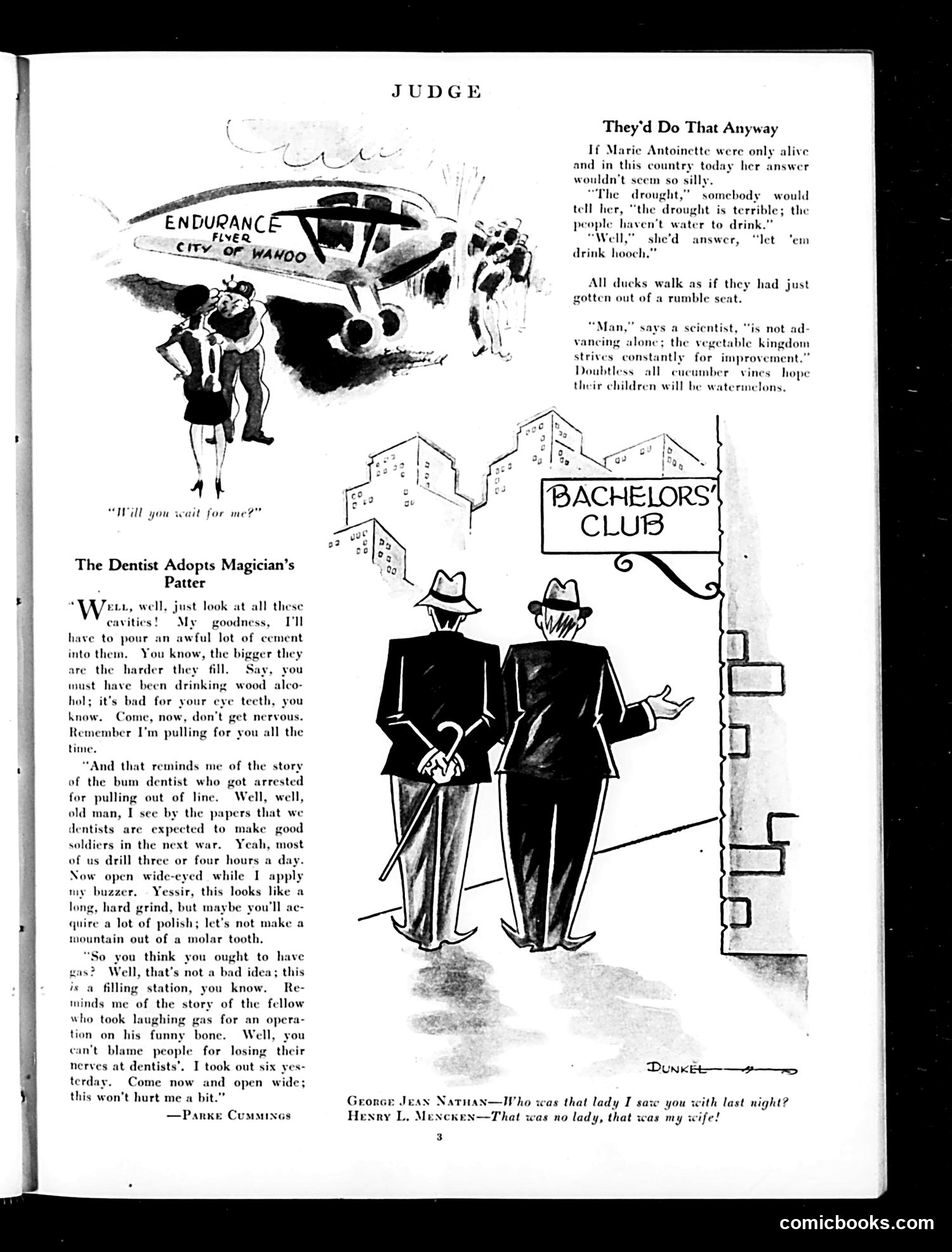
# Judge Magazine Page Analysis This page contains three distinct humor pieces: 1. **"They'd Do That Anyway"** (top): A satirical comment on drought conditions, imagining Marie Antoinette's response to water shortage with her infamous "let them drink" quote. The airplane labeled "Endurance" and "City of Wando" suggests this references a contemporary aviation record or flight attempt, likely 1920s-era. 2. **"The Dentist Adopts Magician's Patter"** (left): A dentist's humorous monologue using a magician's reassuring patter while performing dental work, mocking both professions' tendency toward theatrical confidence-building language. 3. **"Bachelors' Club"** (bottom): A cartoon of two men outside a club, with an accompanying joke about mistaken identity—a wife masquerading as a companion. All reflect typical Judge magazine satire: social commentary wrapped in light humor targeting contemporary urban life and professions.
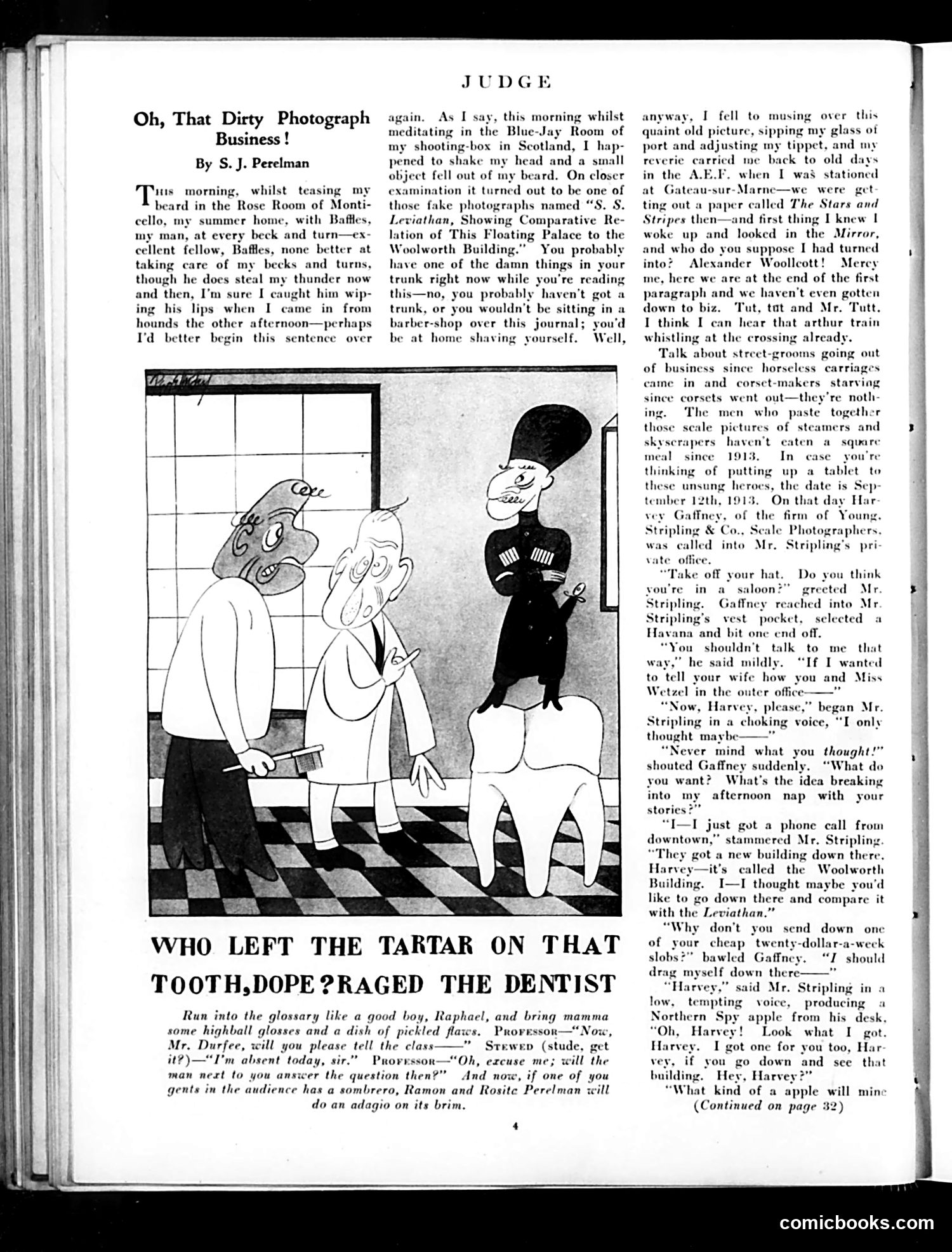
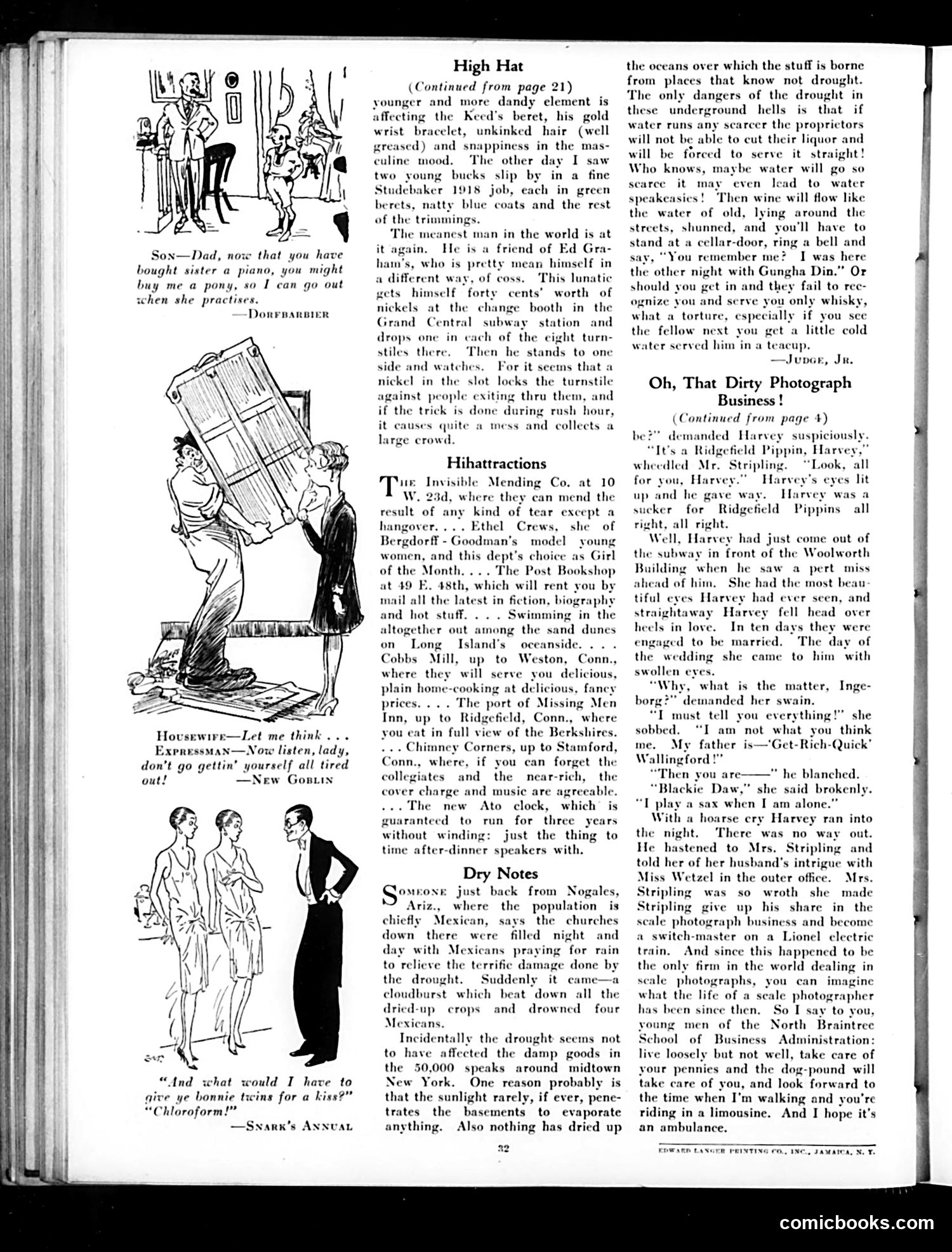
# Analysis of Judge Magazine Page This page contains two elements: a humorous short story titled "Oh, That Dirty Photograph Business!" and a cartoon titled "Who Left the Tartar on That Tooth, Dope? Raged the Dentist." The cartoon depicts a dentist confronting a patient about poor dental hygiene (tartar buildup). The exaggerated caricatures and the dentist's angry reaction create comedy through the implied embarrassment of the situation. The visual style employs period-typical satirical exaggeration. The accompanying story involves office gossip and a misunderstanding about compromising photographs—a common satirical trope of the era suggesting workplace scandal. The humor relies on period-specific social anxieties about reputation and propriety in professional settings. The exact date and specific reference remain unclear from the text alone, but the content reflects early 20th-century American middle-class social concerns.
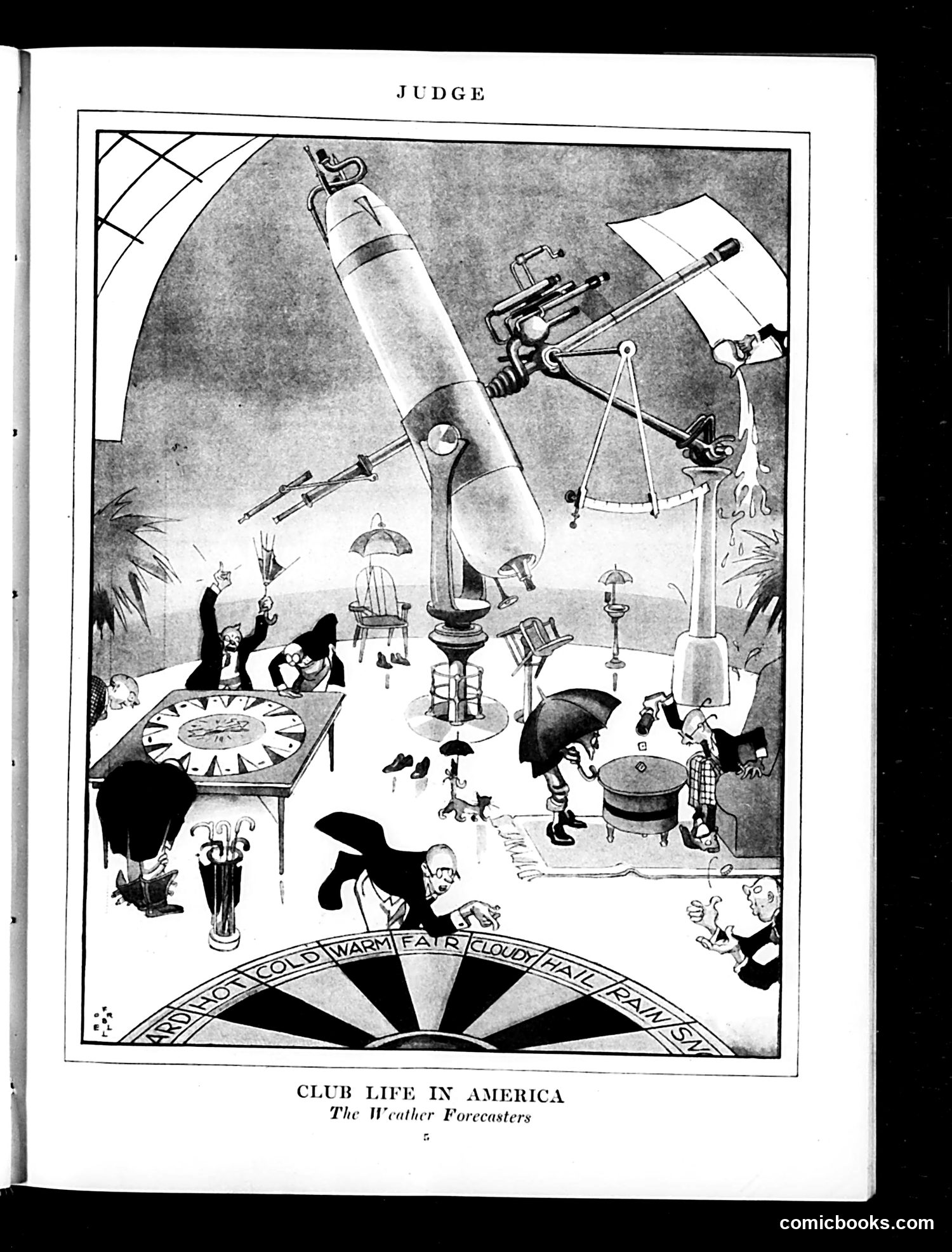
# "Club Life in America: The Weather Forecasters" This satirical cartoon mocks weather forecasters' unreliability. The elaborate scene depicts a gentleman (likely representing a meteorologist or forecaster) operating massive scientific instruments—telescopes, barometers, and other devices—in what appears to be a club setting. Despite this sophisticated equipment, the semicircular gauge at bottom reads "COLD HOT WARM FAIR CLOUDY HAIL RAIN SNOW"—essentially covering all weather possibilities. The joke: weather forecasters claim scientific precision but actually guess, producing contradictory or useless predictions. The fancy instruments and formal club atmosphere satirize how forecasters present themselves authoritatively while their predictions remain essentially random. This reflects early-20th-century skepticism about meteorological science's actual predictive power.
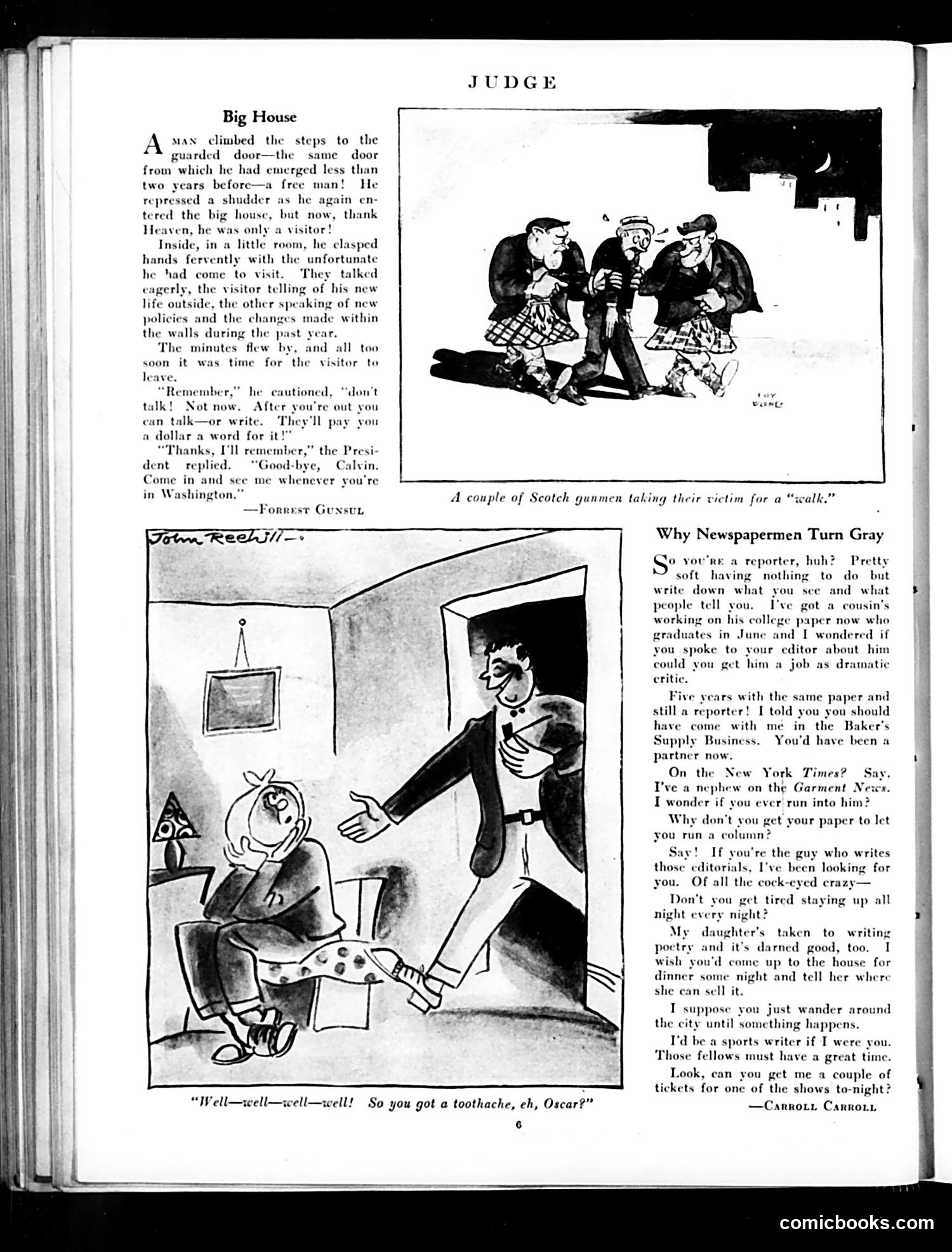
# Analysis of Judge Page **"Big House"** (top left): A satirical story by Forrest Gunsel about a freed prisoner returning to visit the penitentiary. The joke relies on the irony that prison—a place of confinement—becomes a kind of home, and freedom feels disorienting. The warning about not speaking or writing suggests censorship or surveillance concerns of the era. **"Well—well—well—well! So you got a toothache, eh, Oscar?"** (bottom): A cartoon by John Reed showing a dentist extracting a tooth. The humor appears to derive from the patient's exaggerated distress and the dentist's sardonic bedside manner—typical slapstick medical humor. **"Why Newspapermen Turn Gray"** (right): A humorous essay listing various demands editors and colleagues make on reporters, satirizing the profession's chaos and unrealistic expectations.
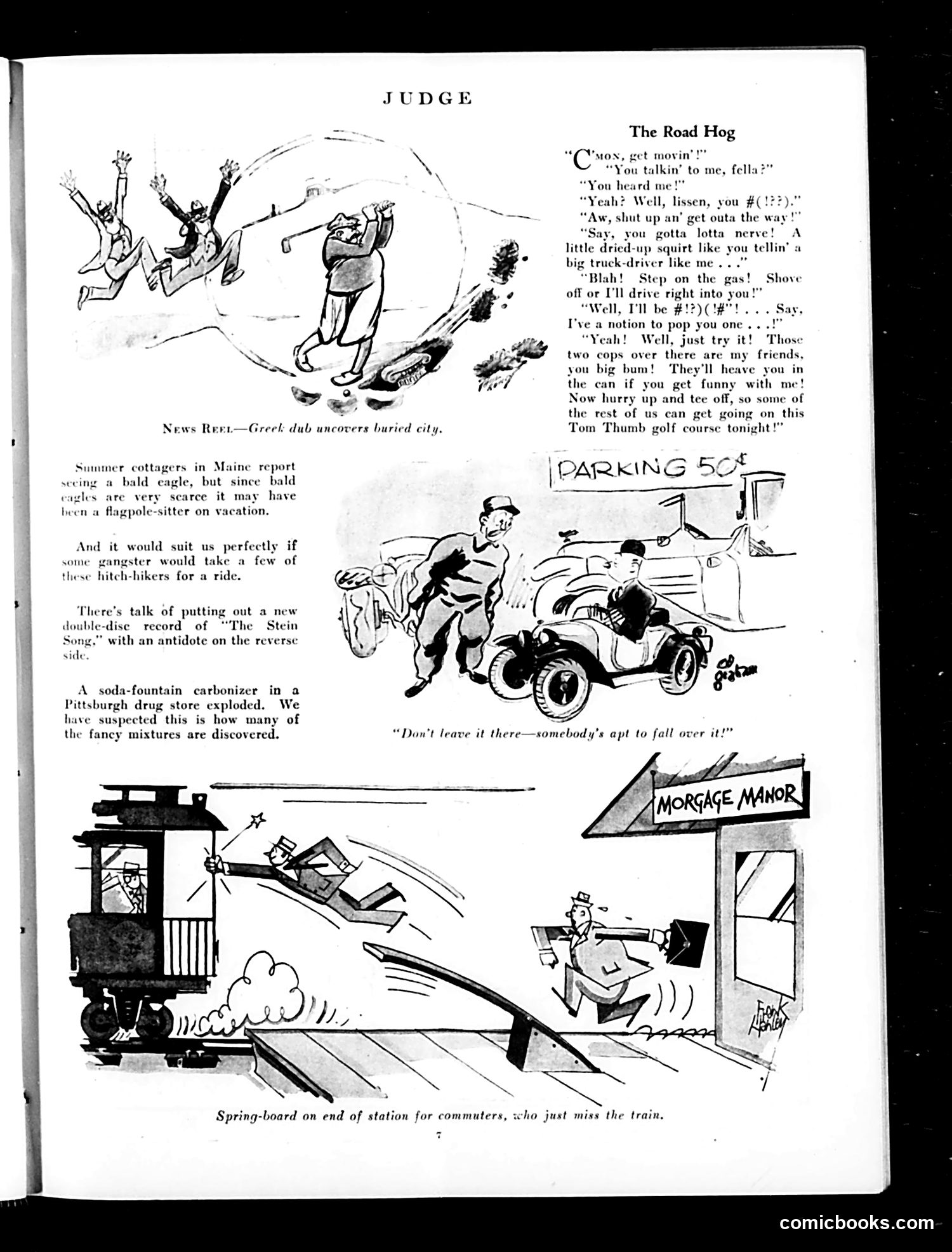
# Satirical Content from Judge Magazine This page contains multiple humorous cartoons mocking 1920s-30s American social behavior: **"The Road Hog"**: A crude argument between a motorist and an aggressive truck driver at what appears to be a miniature golf course ("Tom Thumb golf course"). The satire targets reckless drivers and road rage—the truck driver threatens violence, name-drops corrupt police friendships, and displays aggressive masculinity. This reflects contemporary concerns about dangerous driving and uncivil public behavior. **"Parking 50¢"**: Shows a comically tiny car parked in an oversized space, joking about parking lot fees. **"Morgage Manor"**: Depicts a man catapulted from a springboard at a train station, missing his commuter train. It satirizes the frantic pace of commuter life and perhaps the desperation of those struggling with mortgages during economic uncertainty. The page's scattered text jokes reference minor news items (buried cities, bald eagles, soda fountain explosions)—typical filler humor for the satirical magazine.
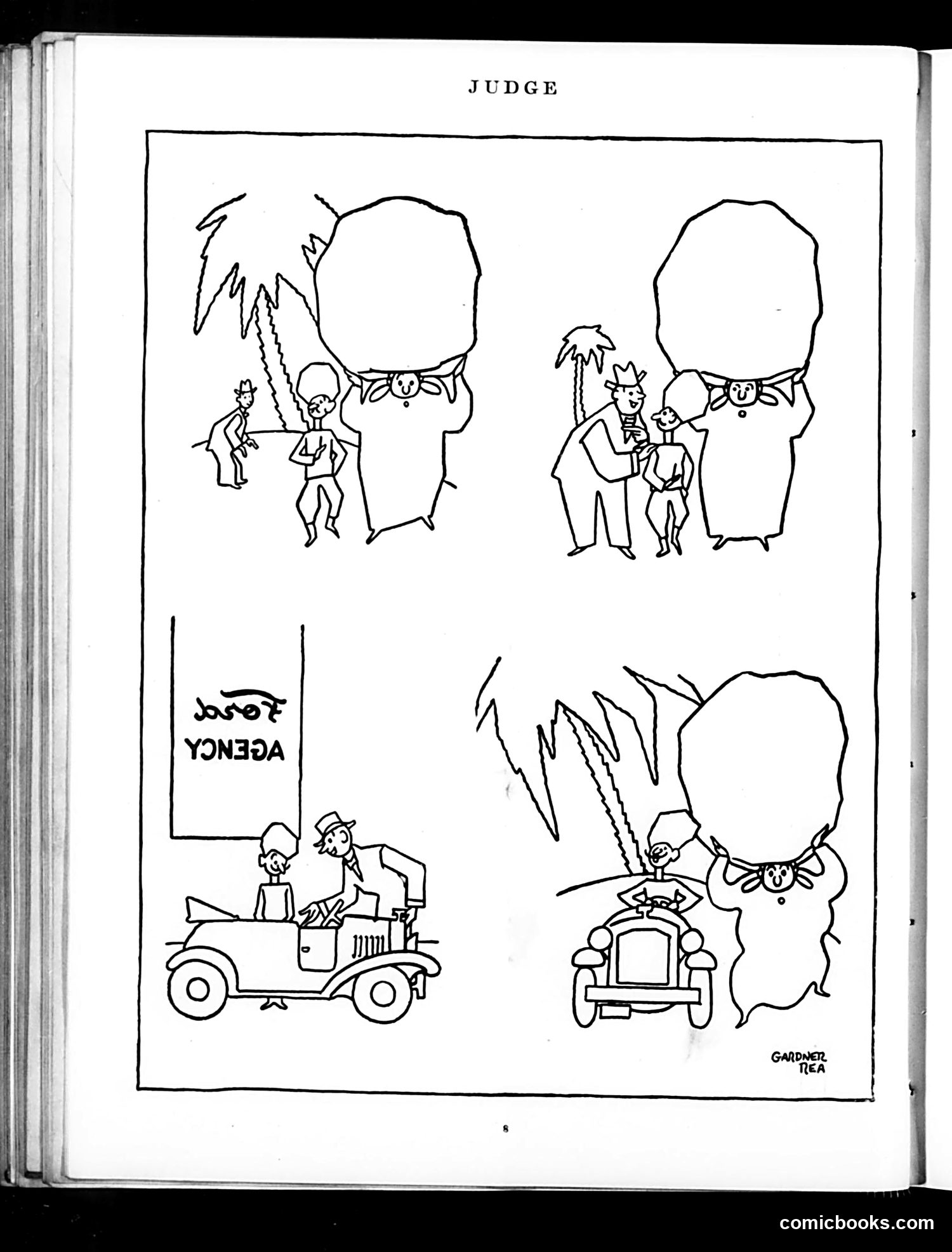
# Judge Magazine Political Cartoon: "Judge" This page contains a four-panel cartoon by Gardner Tlea satirizing judicial authority and public deference. Each panel depicts large, faceless figures labeled "JUDGE" with small citizens conducting business before them—presenting petitions, arriving in vehicles, or otherwise deferring to judicial power. The satire suggests the enormous, seemingly arbitrary power judges wielded over ordinary people's affairs. The blank, featureless judge faces emphasize how impersonal and imposing the judicial system appeared to common citizens. The recurring motif of small figures before towering authority critiques the power imbalance in the legal system and possibly judges' role in enforcement of laws affecting everyday life. Without a specific date visible, the exact political context remains unclear, though the cartoon likely references broader Progressive-era concerns about judicial overreach or inconsistency.
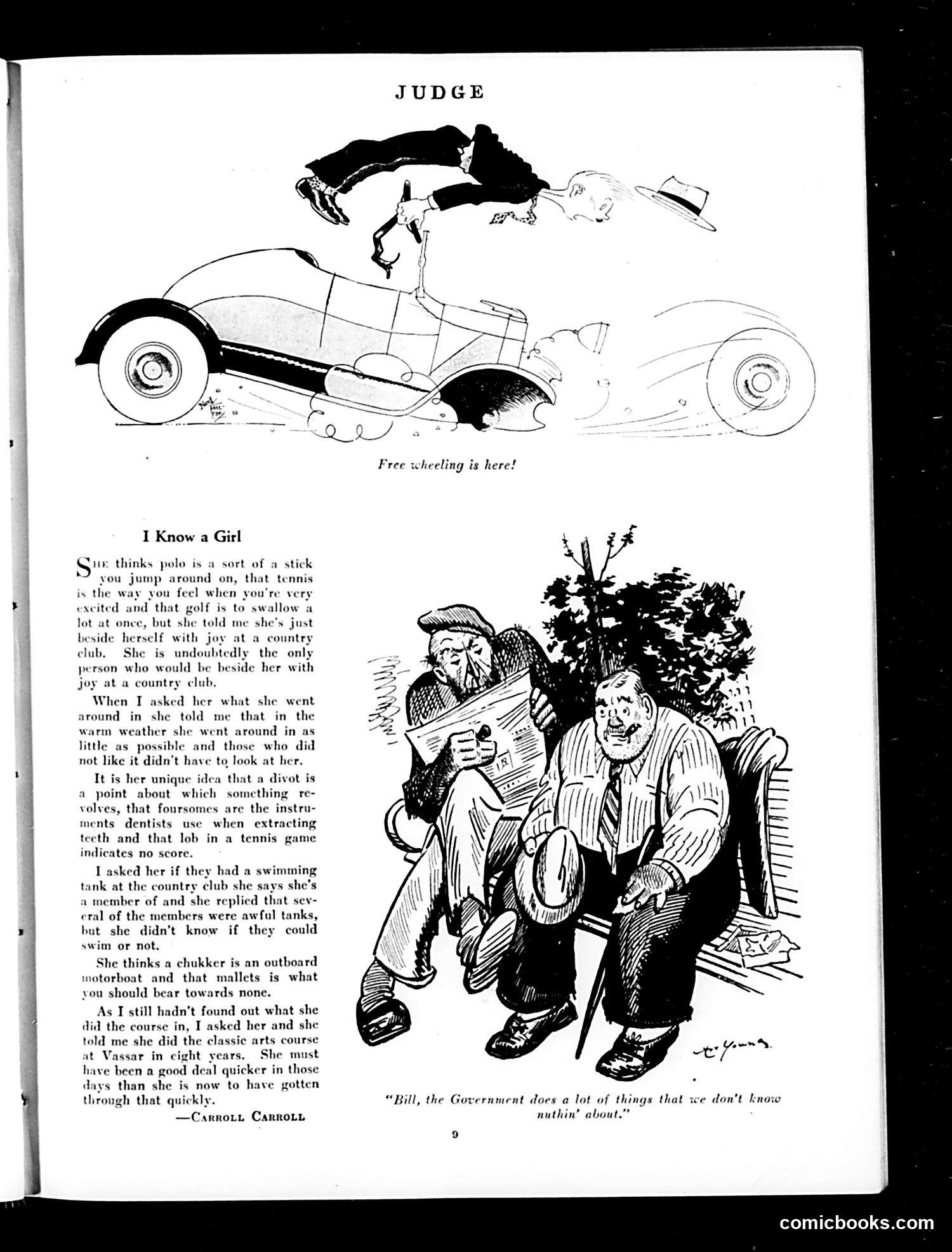
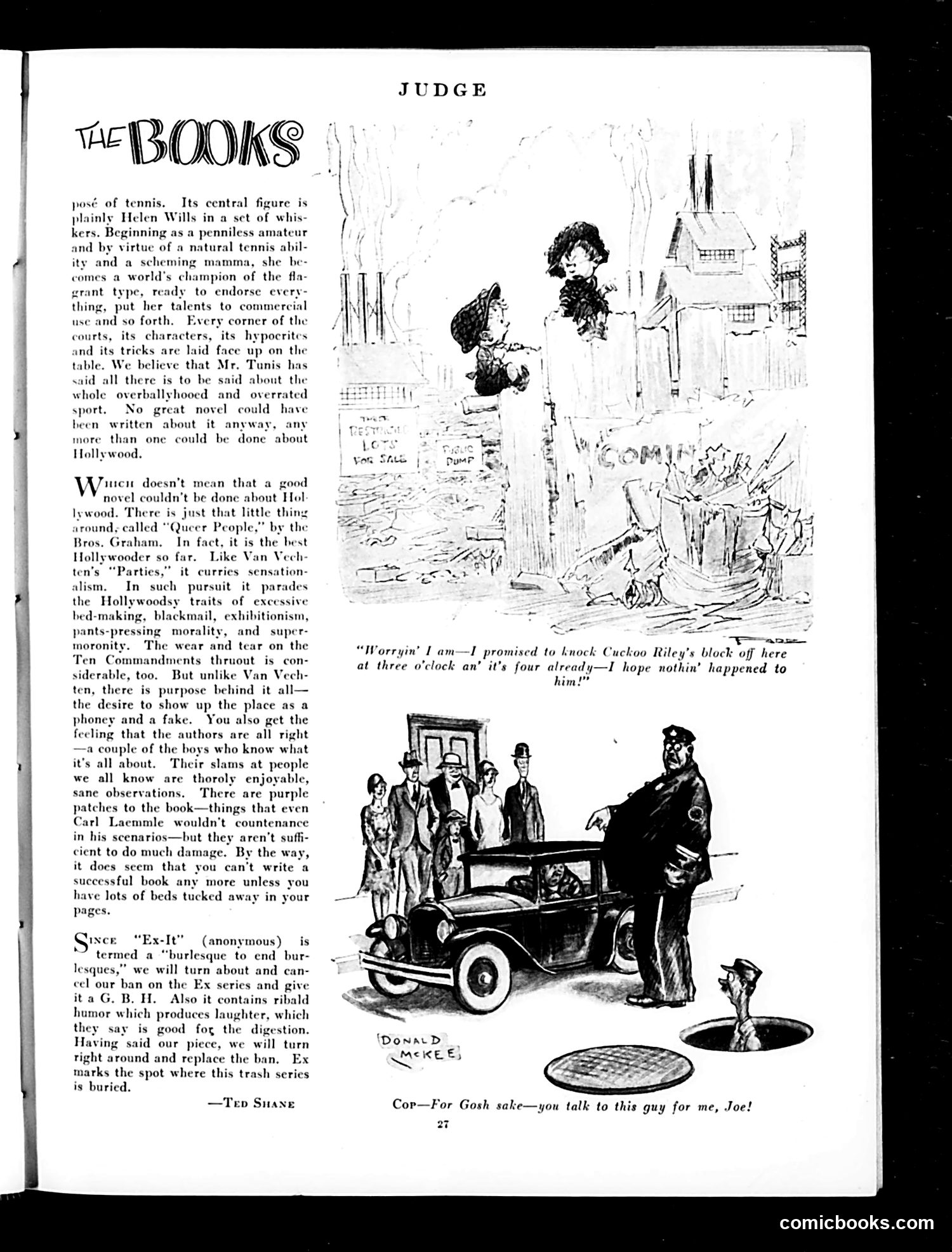
# Judge Magazine Page Analysis The top cartoon satirizes reckless driving. A judge figure flies through the air as a car crashes beneath him, with the caption "Free wheeling is here!" This mocks the 1920s trend of dangerous, unregulated automobile driving—"free wheeling" refers to both literal automotive negligence and the era's general social permissiveness. The judge's airborne predicament suggests that even authority figures cannot escape the chaos of modern, irresponsible motoring. The lower illustration and Carroll Carroll's essay mock a woman's profound ignorance of upper-class leisure activities (polo, tennis, golf, country clubs, swimming). She attended Vassar yet misunderstands basic sporting terminology—thinking a "divot" relates to revolutions, "foursomes" are dental tools, and "chukker" is a motorboat. The satire targets both female incompetence at genteel pastimes and the pretense surrounding country-club culture itself. The final caption shows two working-class men discussing governmental secrecy, suggesting irony about what "respectable" society doesn't understand either.
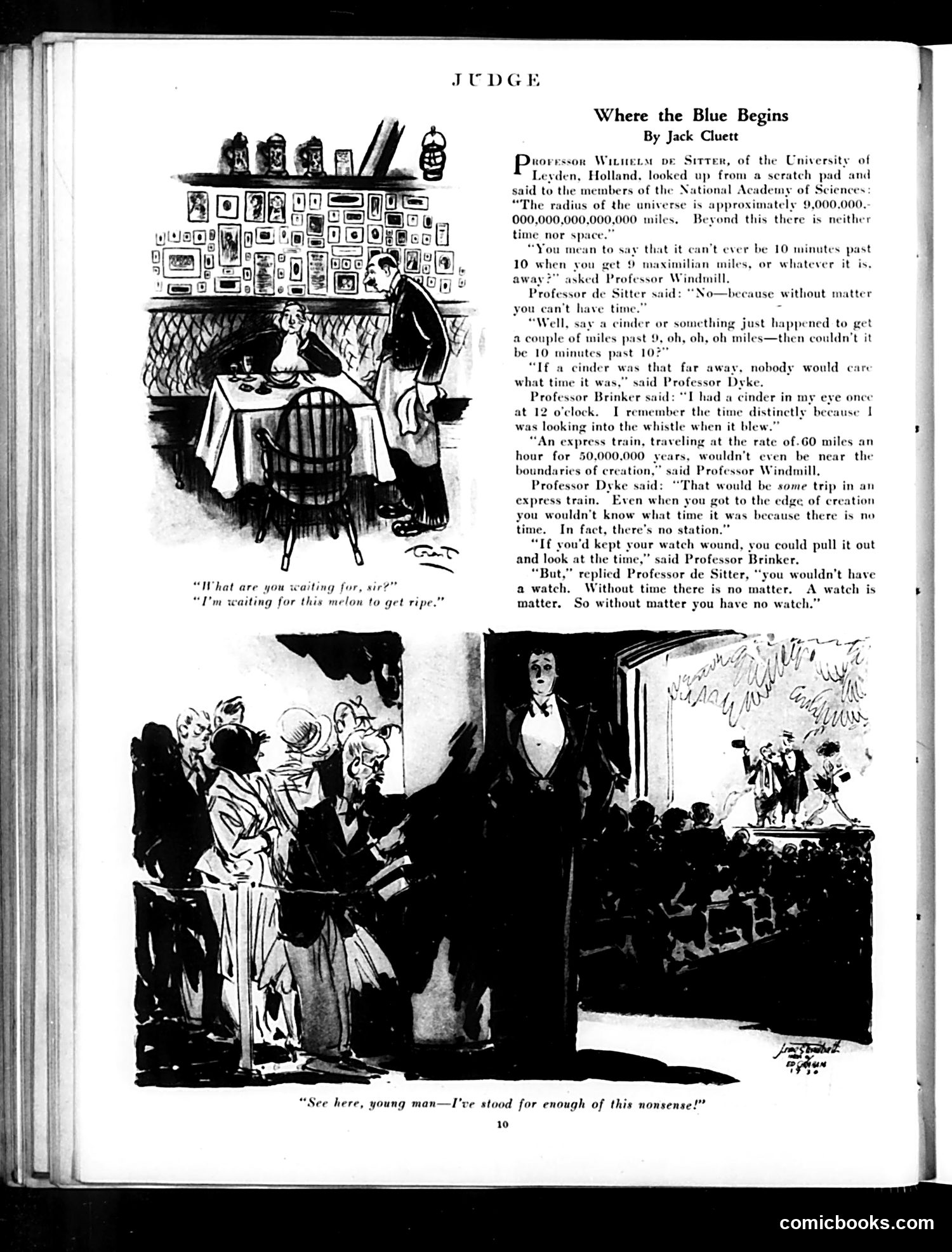
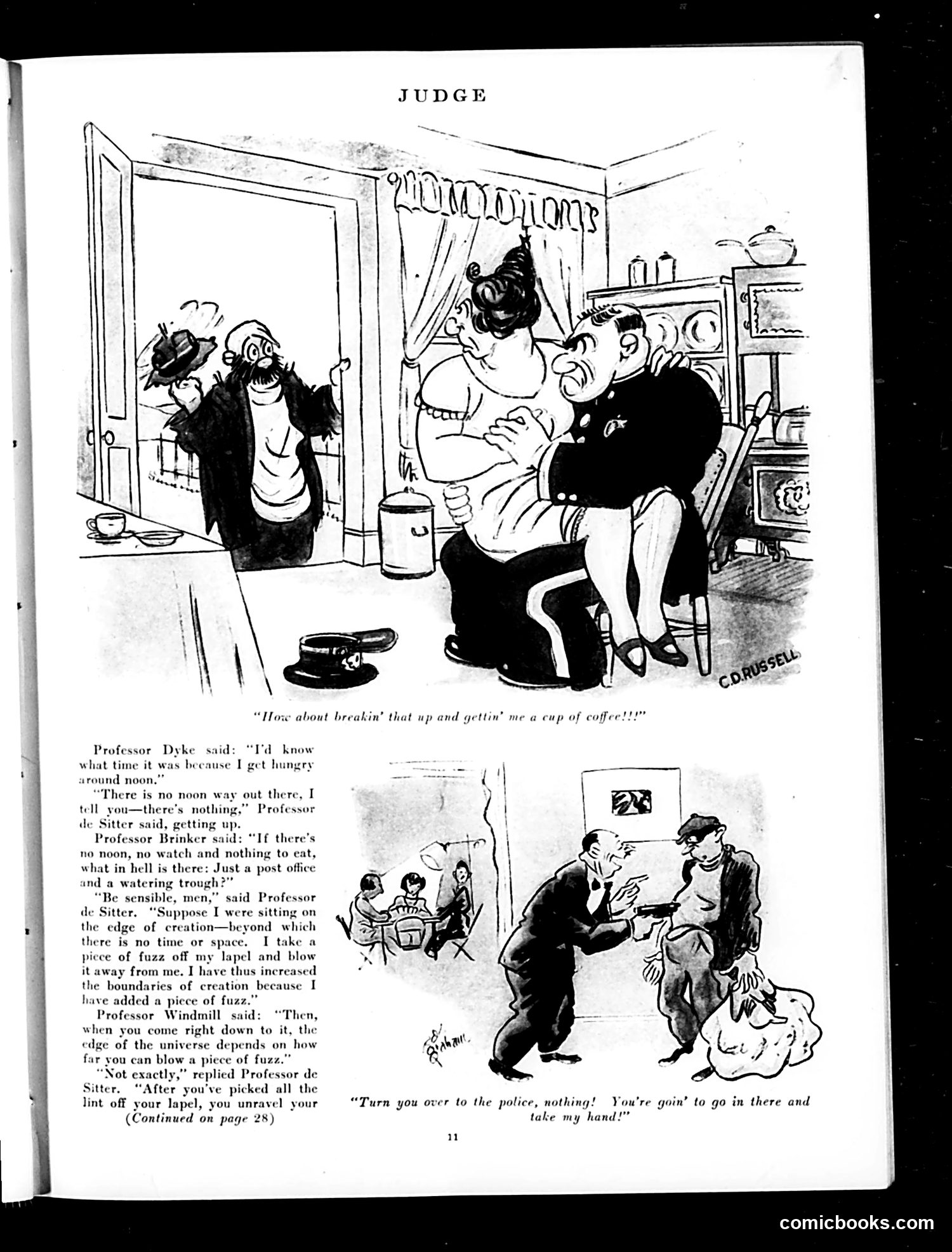
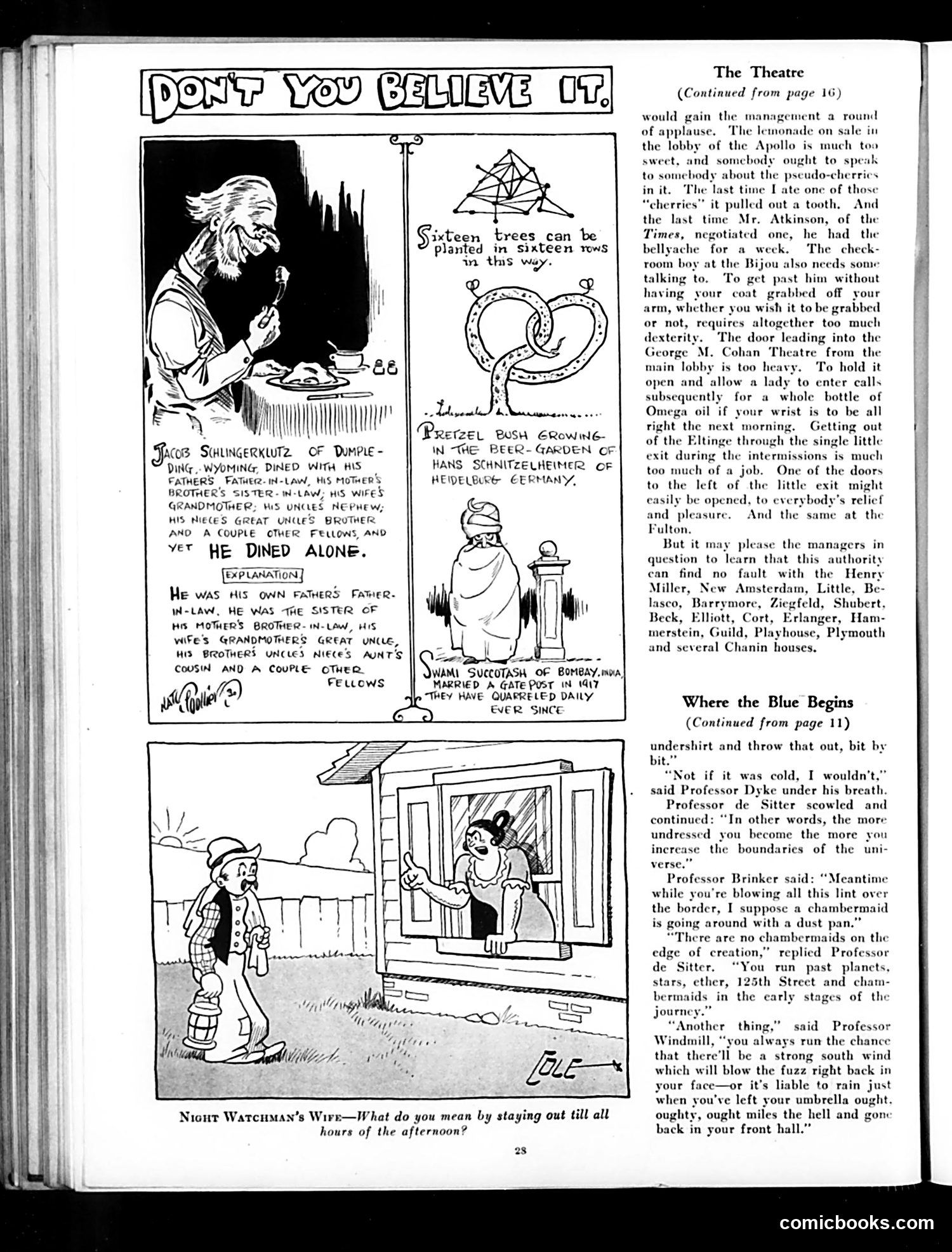
# "Where the Blue Begins" - Judge Magazine Comic This is a humorous fictional dialogue among fictional professors (de Sitter, Windmill, Dyke, Brinker) debating cosmological concepts—specifically the nature of time and space at the universe's boundaries. The satire targets academic pretension and abstract philosophy. The professors engage in increasingly absurd logical loops, discussing whether time exists beyond the universe's edge, whether a cinder could travel faster than time, and whether a watch matters without time. Their circular reasoning spirals into nonsense. The accompanying cartoons illustrate the comedic contrast: the top shows an impatient woman waiting for a melon to ripen (mundane reality), while the bottom depicts a theatrical performance—suggesting the professors' debate is equally performative and removed from practical life. The joke: learned men tie themselves in philosophical knots over unanswerable cosmic questions while missing simple truths about everyday existence.