
Judge, 1930-08-30 · page 18 of 36
Judge — August 30, 1930 — page 18: what you’re looking at
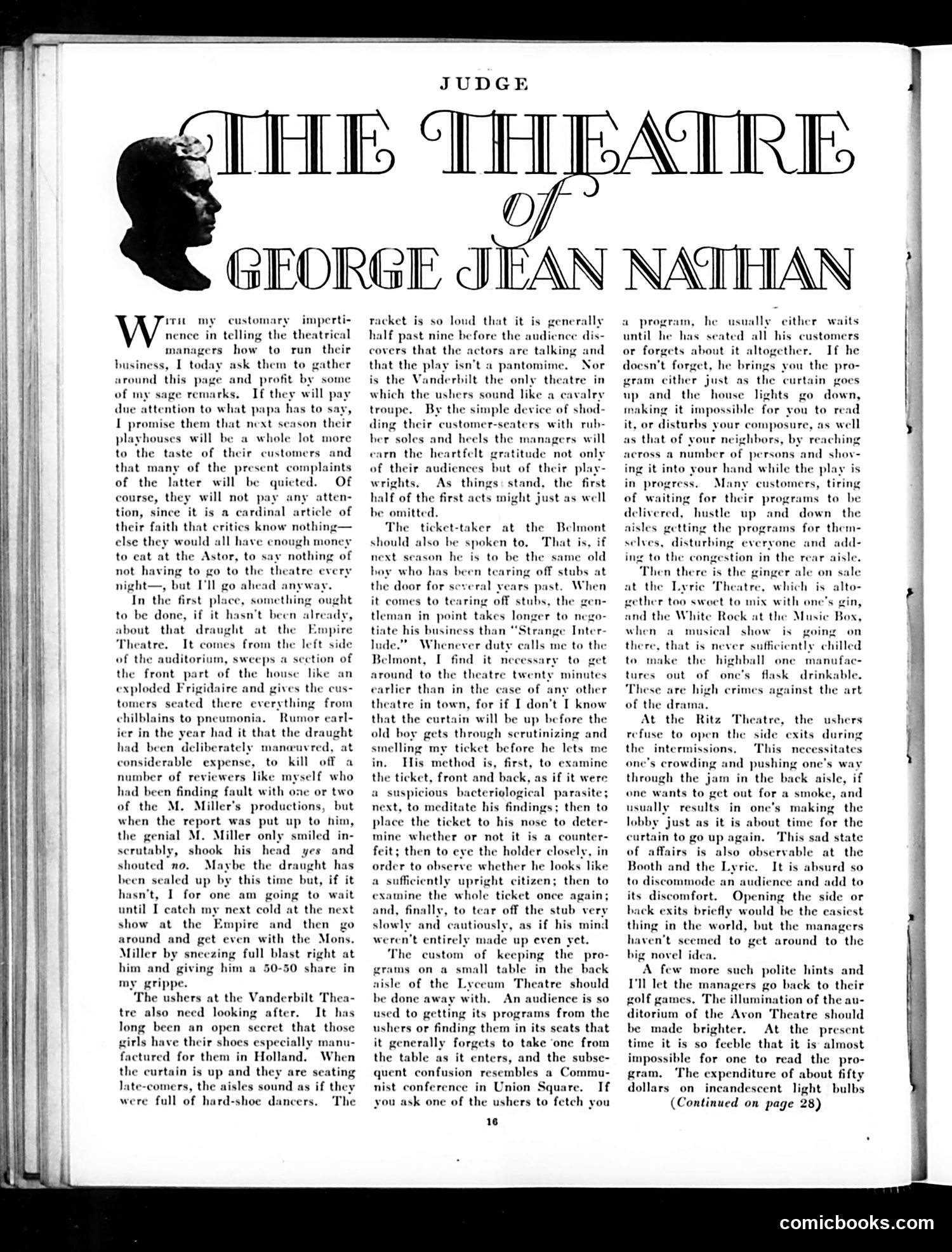
A restored page from Judge, 1930-08-30. Page through the whole issue in the reader above.
📄 Transcribed text from this page (OCR, searchable)
Machine-transcribed from the original scan — historical spelling and the odd misread are preserved.
my customary imperti- ce in telling the theatrical agers how to run their business, I today ask them to gather around this page and profit by some of my si irks. If they will pay due attention to what papa has to sa I promise them that next season their playhouses will be a whole lot more to the taste of their customers and that many of the present complaints of the latter will be quicted. Of course, they will not pay any atten- tion, sine article of their faith that crit ow nothing— y would all have enough money t the Astor, to say nothing of not having to go to the theatre every t—, but I'll go ahead anyway. In the first place, something ought to be done, if it hasn't been already, rer about that draught at the Empire Theatre. It comes from the left side of the auditorium, sweeps a section of the front part of the house like an exploded Frigidaire and gives the cus- tomers seated there everything from chilblains to pneumonia. “Rumor earl- ier in the year had it that the draught had been deliberately manauvred, considerable expense, to kill off a number of reviewers like myself who had been finding fault with one or two of the M. Miller's productions, but when the report was put up to him, the genial M. Miller only smiled in- serutably, shook head yes and shouted no. Maybe the draught has been sealed up by this time but, if it hasn't, I for one am going to wait until I catch my next cold at the next show at the Empire and then around and get even with the Mons. Miller by sneezing full blast right at him and giving him a 50-50 share in my grippe. The ushers at the Vanderbilt Th tre also need looking after. It has long been an open secret that those girls have their shoes especially manu- factured for them in Holland. When the curtain is up and they are seating Jate-comers, the aisles sound as if they were full of hard-shoe dancers. The © GEORGE J racket is so loud that it is generally half past nine before the audience d covers that the actors are talking and that the pls pantomime. r is the Vanderbilt the only theatre in which the ushers sound like a cavalry troupe. By the simple device of shod- ding their customer-seaters with rub- her soles and heels the managers will earn the heartfelt gratitude not onl of their audiences but of their play wrights. As things: stand, the first half of the first acts might just as well be omitted. The ticket-taker at the Belmont should also be spoken to. That is, if next season he is to be the same old boy who has been tearing off stubs « the door for several rs past. Wh it comes to tearing off stubs, the tleman in point takes Ic er tor tiate his business than “Strange Inter- lude.” Whenever duty calls me to the Belmont, I find it necessary to get around to the theatre twenty minutes earlier than in the case of any other theatre in town, for if I don’t I know that the curtain will be up before the old boy gets through scrutinizing and smelling my ticket before he lets me in. His method is, first, to examine the ticket, front and as if it were a suspicious bacteriological parasite; next, to meditate his findings; then to place the ticket to his nose to deter- mine whether or not it is a counter- feit; then to eye the holder closely order to observe whether he looks like a sufficiently upright ci n; then to examine the whole ticket once again; and, finally, to tear off the stub very slowly and cautiously, as if his mind weren't entirely made up even yet. rhe custom of keeping the pro- grams on a small table in the back aisle of the Lyceum Theatre should be done away with, An audience is so used to getting its programs from the ushers or finding them in its seats that it generally forgets to take ‘one from the table as it enters, and the subse- quent confusion resembles a Commu- nist conference in Union Square. If you ask one of the ushers to fetch you 16 ACIIR ES NATHAN he usually cither waits » has seated all his customers or forgets about it altogether. If he docsn't forget, he brings you the pro- gram cither just as the curtain up and the house lights go down, making it impossible for you to read it, or disturbs your composure, as well as that of your neighbors, by reaching neross a number of persons and shov- ing it into your hand while the play is in progress. customers, tiring of waiting for their programs to be delivered, hustle up and down the aisles getting the programs for them- selves, disturbing everyone and add- ing to the congestion in the re: sle. Then there is the ginger ale on sale at the Lyric Theatre, which is alto- gether too swoet to mix with one’s gin, and the White Rock at the Musie Box, when a musical show is going on there, that is never sufficiently chilled to make the highball one manuf: tures out of one’s flask drinkable. These are high crimes against the art of the drama. At the Ritz Theatre, the ushers refuse to open the side exits during the intermissions, This necessitates one’s crowding and pushing one’s way through the jam in the back aisle, if one wants to get out for a smoke, and usually results in one's making the lobby just as it is about time for the in to go up again. ‘This sad state irs is also observable at the di the Lyric. It is absurd so to discommode idience and add to its discomfort. Opening the side or back exits briefly would be athe: asiest "A few more such polite hints and I'll let the managers go back to their golf games. The illumination of the au- ditorium of the Avon Theatre should be made brighter. At the present time it is so feeble that it is almost impossible for one to read the pro- gram. The expenditure of about fifty dollars on incandescent light bulbs (Continued on page 28) ~ comicbooks.com