
Judge, 1930-08-30 · page 25 of 36
Judge — August 30, 1930 — page 25: what you’re looking at
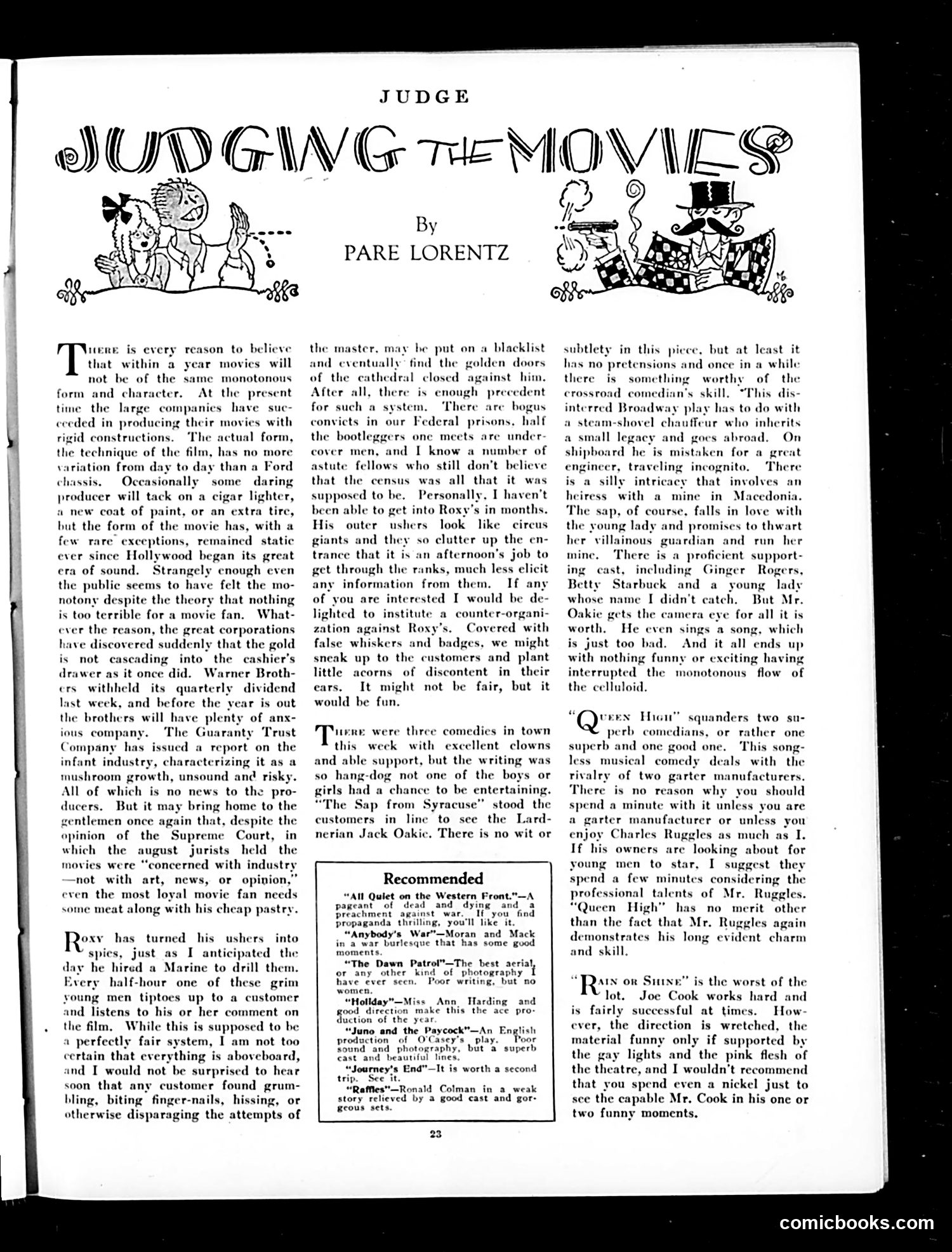
A restored page from Judge, 1930-08-30. Page through the whole issue in the reader above.
📄 Transcribed text from this page (OCR, searchable)
Machine-transcribed from the original scan — historical spelling and the odd misread are preserved.
iene is every reason to believe that within a year movies will not be of the same monotonous form and character, At the present time the large companies h ceeded in producing their movies with id constructions. The actual form, the technique of the film, has no more variation from day to day than a Ford chassis. Oceasionally “some producer will tack on a cigar lighter, a new coat of paint, or an extra tire, but the form of the movie has, with a few rare execptions, remained static ever since Hollywood began its great era of sound. Strangely enough even the public seems to have felt the mo- notony despite the theory that nothing is too terrible for a movie fa What- ever the reason, the great corporations have discovered suddenly that the gold is not cascading into the cashier's drawer as it once did. Warner Broth- ers withheld its quarterly dividend last week, and before the year is out the brothers will have plenty of anx- ious company. The ¢ nty ‘Trust Company issued a report on the infant industry, characterizing it as a mushroom growth, unsound a All of which is no news to the pro- ducers. But it may bring home to the gentlemen once again that, despite the inion of the Supreme Court, in which the august jurists held the movies were “concerned with industry -not with art, news, or opinion,” even the most loyal movie fan needs some meat along with his cheap pastry. suc- has turned his ushers into just as I anticipated the he hired a Marine to drill them. ery half-hour one of these grim young men tiptoes up to a customer ind listens to his or her comment on the film, While this is supposed to be 1 perfectly fair system, I am not too certain that everything is aboveboard, ind I would not be surprised to hear soon that any customer found grum- bling, biting finger-nails, hissing, or otherwise disparaging the attempts of JUDGE JUVGING TEM By PARE LORENTZ the master, m and ev of the ¢ y he put on a blacklist Iv" tind the golden doors thedral closed him. After all, there is enough precedent for such a system. ‘There are bogus convicts in our Federal prisons, half the bootleggers one meets are under cover men, and I know a number of astute fellows who still don’t believe that the census was all that it was supposed to be. Personally, I haven't been able to get into Roxy’s in months. His outer ushers look like circus giants and they so clutter up the ¢ trance that it is an afternoon's job t get through the ranks, much less elicit any information from them. If any ou are interested I would be de d to institute a counter-organi- zation against Roxy’s. Covered with false whiskers and badges, we might sneak up to the customers and plant little acorns of discontent in’ their ears. It might not be fair, but it would be fun. Turre were three comedies in town this week with excellent clowns and able support, but the writing was so hang-dog not one of the boys or girls had a chance to be entertaining. “The Sap from Syracuse” stood the customers in line to see the Lard- nerian ‘k Oakic. There is no wit or against Recommended “All Quiet on the Western Front."—A pageant of dead and dying and a preachment against war. If you find propaganda thrilling, you'll like it. “Anybody’s War’—Moran and Mack in a war burlesque that has some good moments. “The Dawn Patrol"—The best aerial, or any other kind of photography f have ever seen. Poor writing, but no women. “Hollday"—Miss Ann. Harding and good direction make this the ace pro- duction of the year “Juno and the Paycock”—An production of O'Casey’s | play. found and photography, but a superb cast and beautiful lines. ind”—It is worth a second trip. “RafMes”—Ronald Colman in a weak story relieved by a good cast and gor- geous sets. if ? subtlety in this piece, but has no pretensions and onc there is something crossroad comed interred Broad t least it na while worthy of the n’s skill, “This dis- play has to do with auffeur who inherits d goes abroad. On for a great neognito. There silly intricacy that involves an heiress with a mine in Macedonia. The sap, of course, falls in love with the young lady and promises to thwart her villainous guardian mine. There is a proficient support- ing cast, including Ginger Rogers, Betty Starbuck and a young lady whose name I didn’t catch. But Mr. Oakie gets the camera eye for all it is worth. He even sings a song, which is just too bad. And it all ends up with nothing funny or exciting having interrupted the monotonous flow of the celluloid. ‘Q' rex Haw’ squanders two su- perb comedians, or rather one superb nd run her a d one good one. This song- musical comedy deals with the rivalry of two garter manufacturers. There is no reason why you should spend a minute with it unless you are a garter manufacturer or unless enjoy Charles Ruggles as much a If his owners are looking about for young men to star, I suggest they spend a few minutes considering the professional talents of Mr. Ruggles. “Queen High” has no merit other than the fact that Mr. Ruggles a demonstrates his long evident charm and skill. “Res or Sune” is the worst of the lot. Joe Cook works hard and is fairly successful at times. How- ever, the direction is wretched, the material funny only if supported by the gay lights and the pink flesh of the theatre, and I wouldn't recommend that you spend even a nickel just to see the capable Mr. Cook in his one or two funny moments, comicbooks.com