A complete issue · 36 pages · 1930
Judge — June 7, 1930
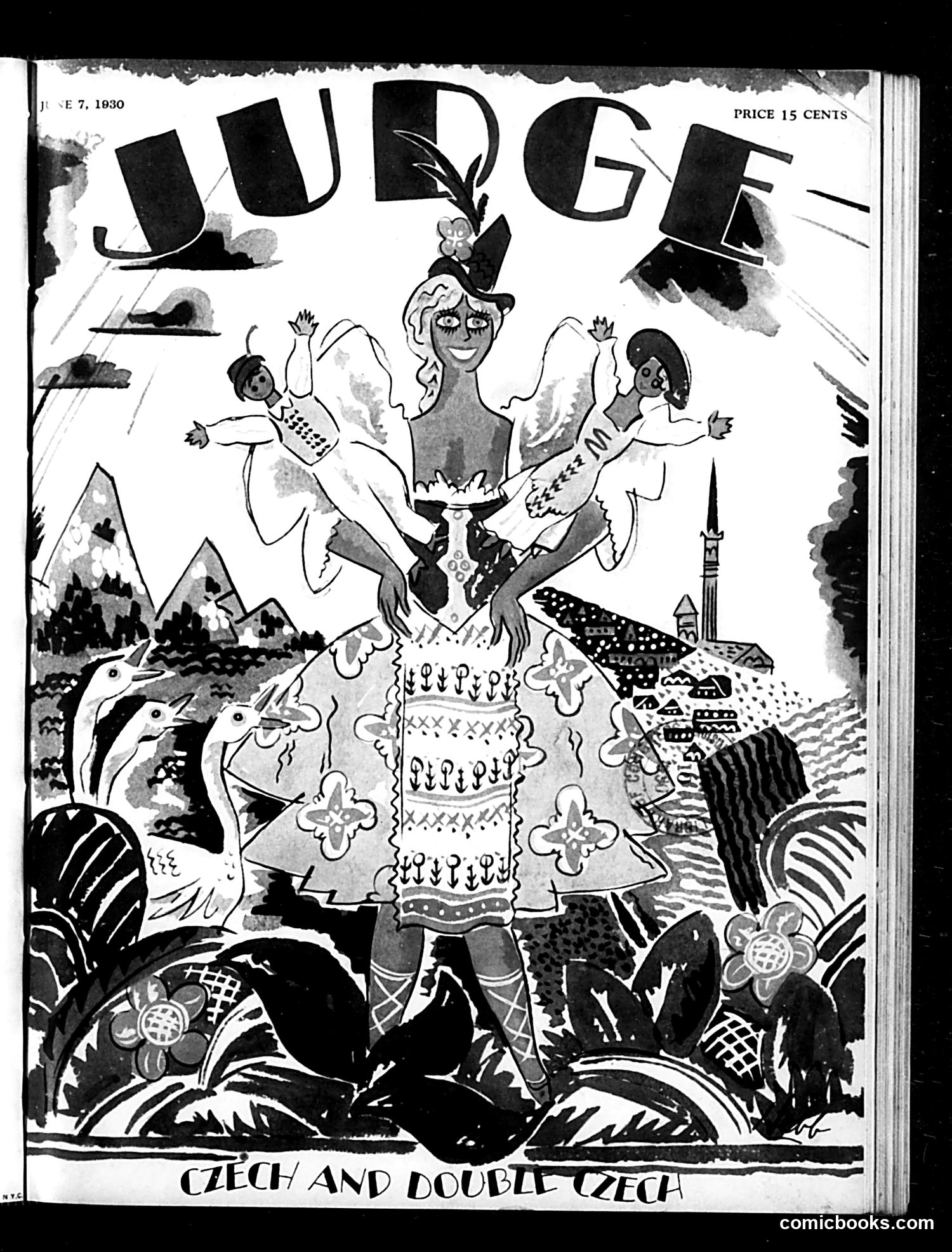
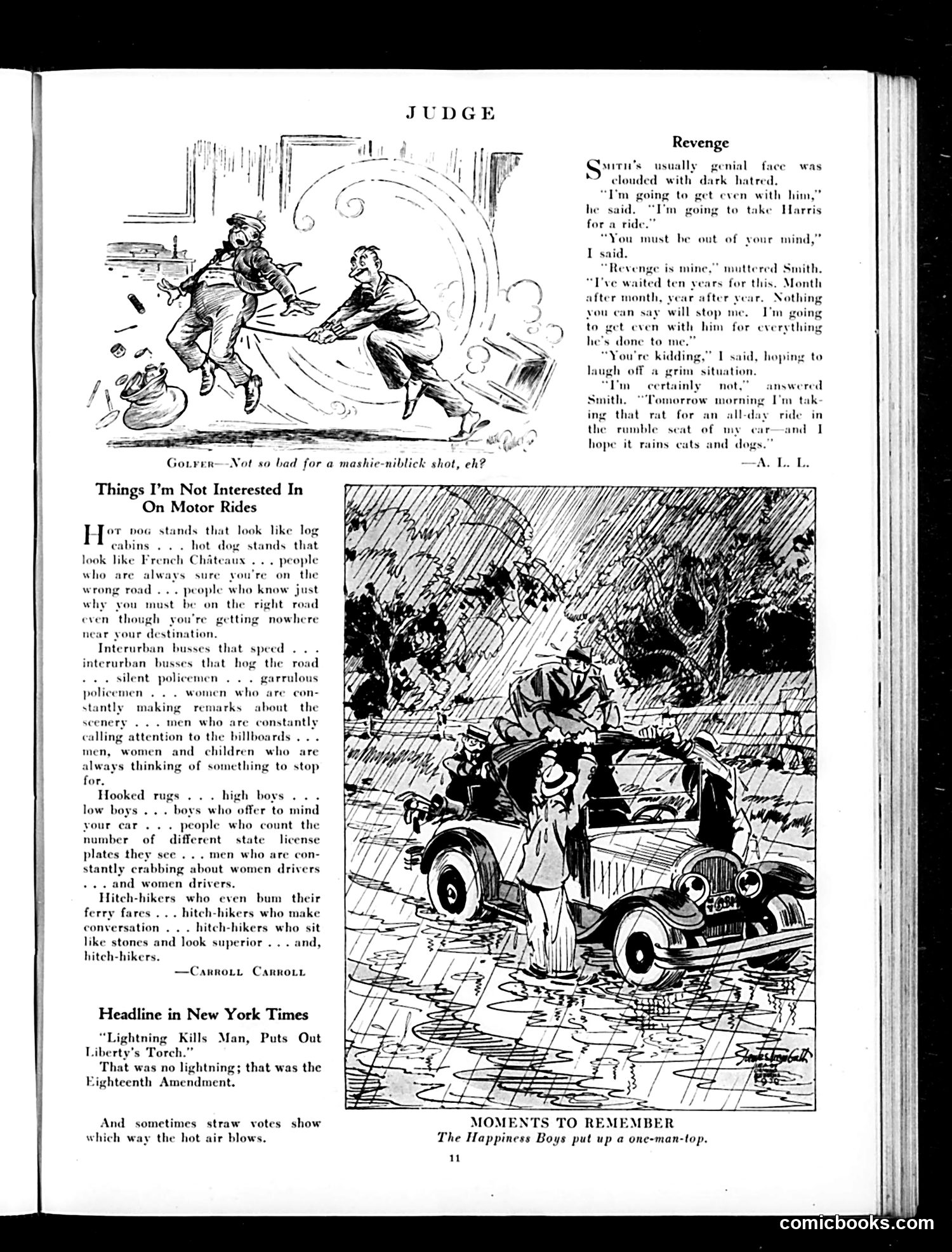
# Analysis of Judge Magazine Cover (June 7, 1930) This cover satirizes **Czech-Soviet relations** during the Cold War era, as indicated by the caption "Czech and Double Czech." The central figure appears to be a personified representation of Czechoslovakia—depicted as a woman in traditional/ornate dress holding two children, surrounded by surreal imagery including stylized animals and architectural elements representing different regions or powers. The "double Czech" wordplay suggests deception or duplicity in Czech political dealings, likely referencing tensions between Western democratic interests and Soviet communist influence over Czechoslovakia. The whimsical, nightmarish composition implies the instability and conflicting pressures the nation faced geographically positioned between Western Europe and the Soviet sphere. This reflects genuine 1930s anxieties about Eastern European political alignment.
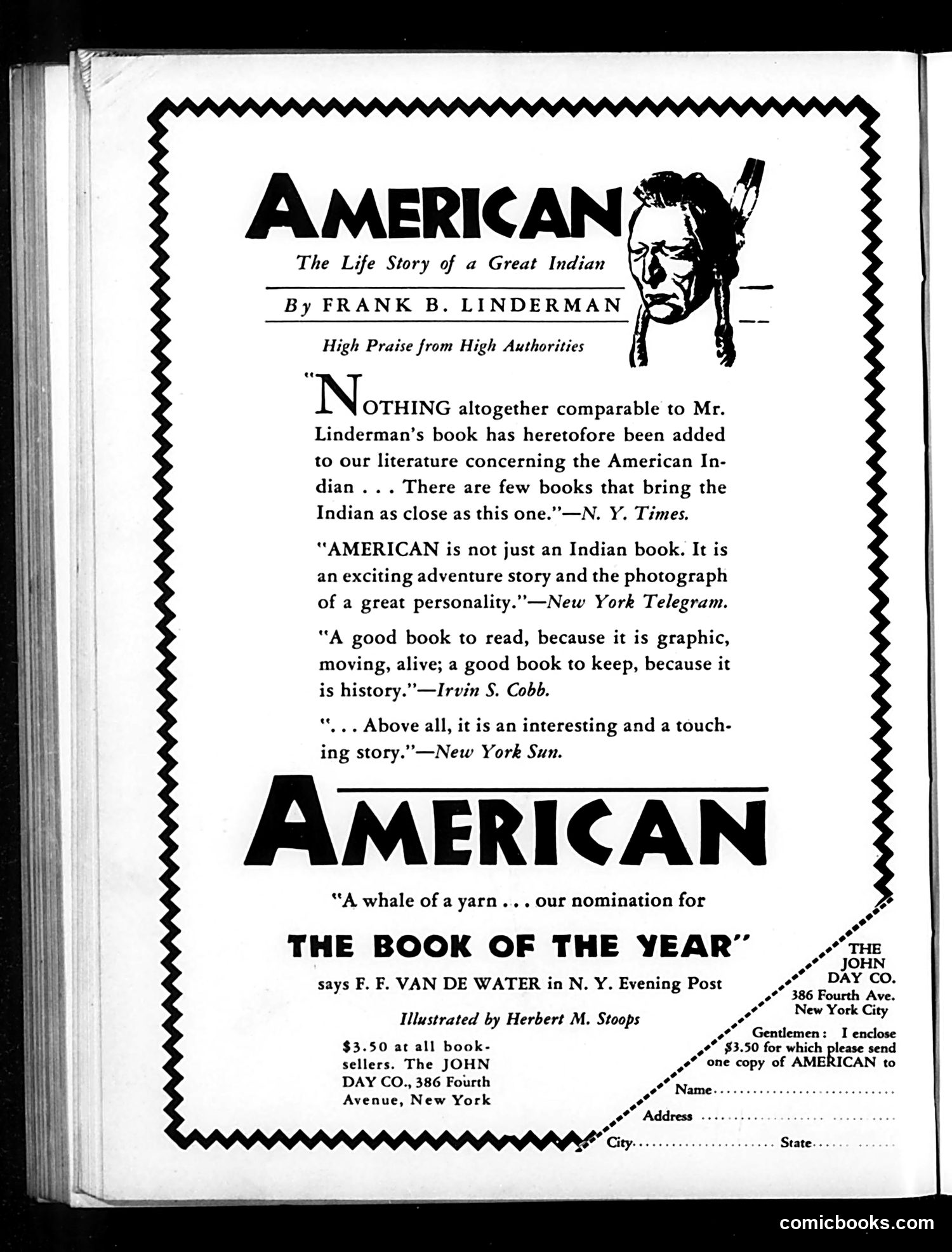
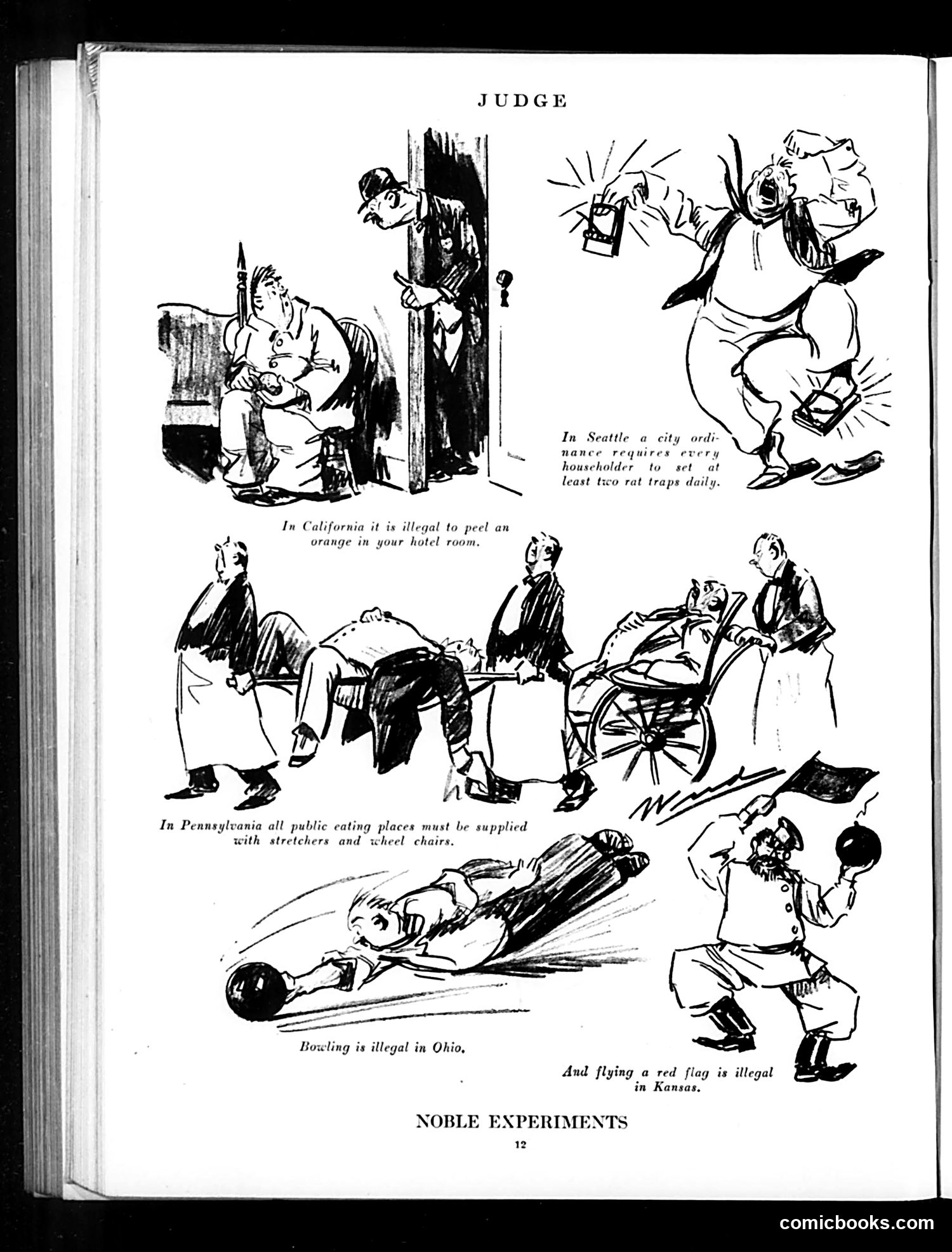
# Analysis This page is **entirely an advertisement**, not satirical content. It promotes Frank B. Linderman's biography "American: The Life Story of a Great Indian," published by John Day Co. The book features a portrait of what appears to be a Native American man with traditional styling (feathered hair). The ad includes endorsements from major newspapers (New York Times, New York Telegraph, New York Sun, N.Y. Evening Post) praising the work as an important historical account—"graphic, moving, alive." The book sold for $3.50 and was illustrated by Herbert M. Stoops. A tear-off coupon at bottom-right allowed readers to order directly from the publisher at 386 Fourth Avenue, New York City. This represents 1930s-era book marketing to Judge's educated readership.
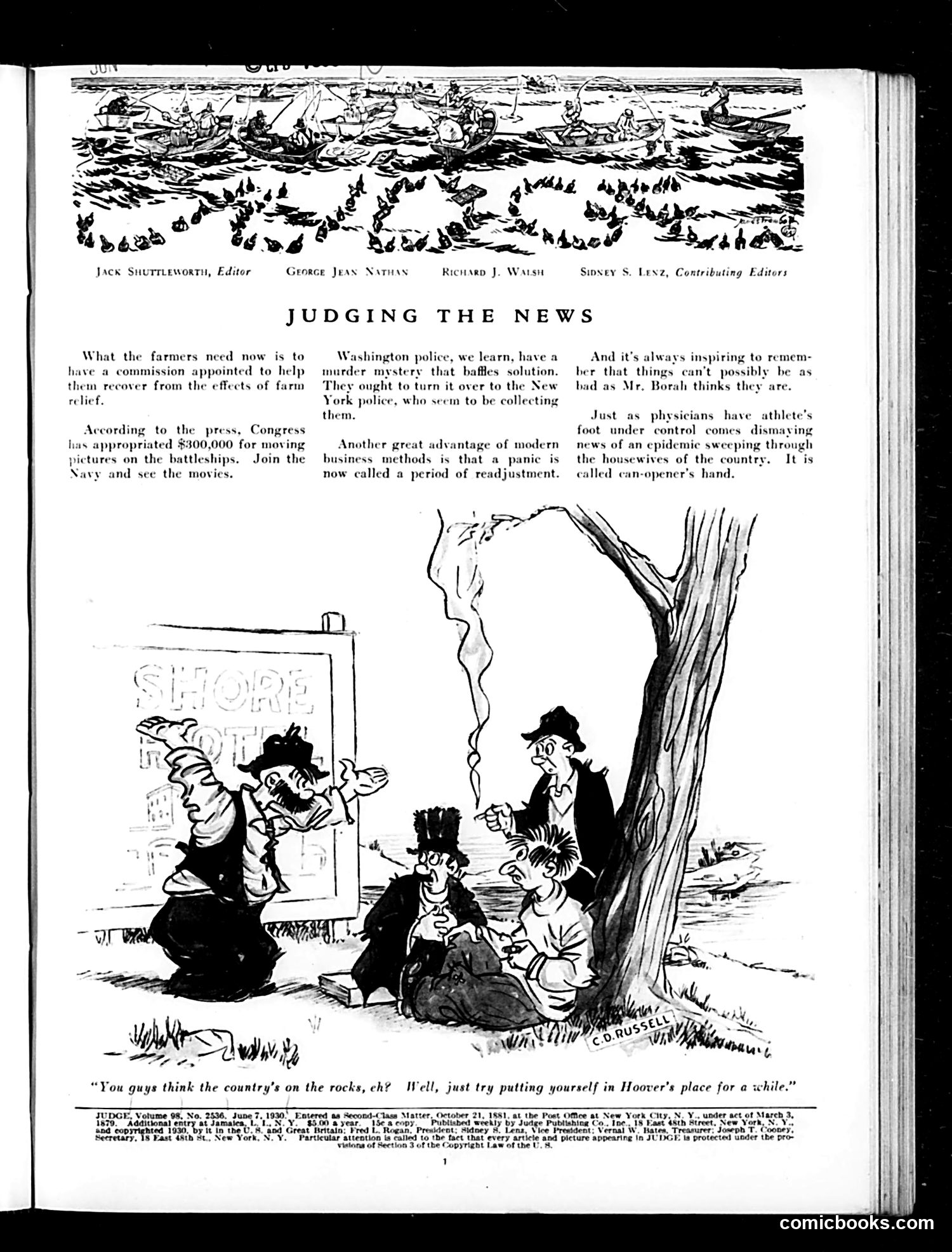
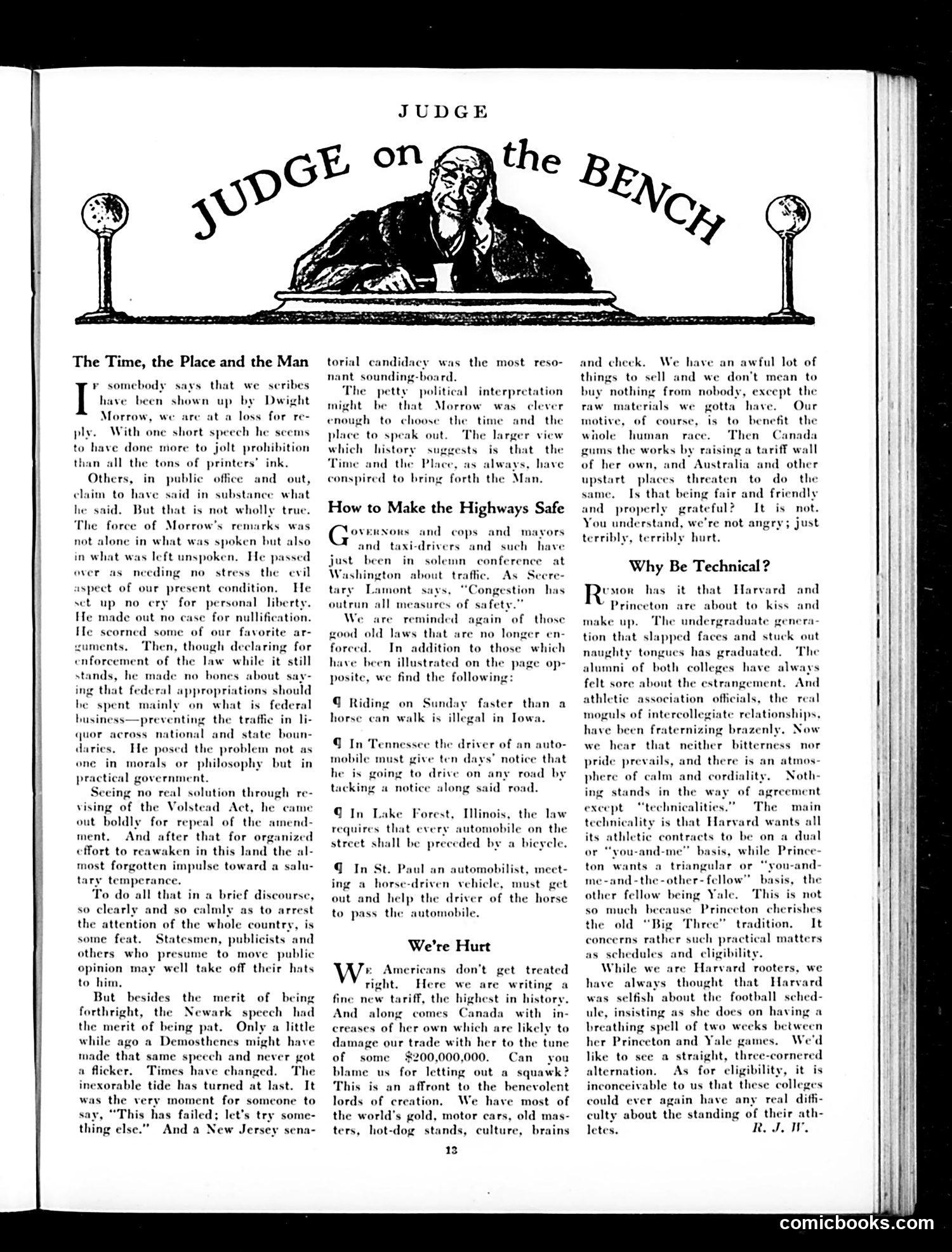
# Analysis of Judge Magazine Cartoon (June 7, 1930) The cartoon satirizes the Great Depression's economic hardship. Four impoverished figures huddle under a tree near a "Shops Closed" sign, representing widespread unemployment and business failure. The caption—"You gotta think the country's on the rocks, eh? Well, just try putting yourself in Hoover's place for a while"—mocks President Herbert Hoover's optimistic messaging during the Depression's early stages. While ordinary citizens faced destitution, Hoover maintained that prosperity was "just around the corner" and resisted federal intervention. The cartoon's point: the disconnect between Hoover's reassurances and Americans' actual suffering. By sarcastically suggesting empathy with Hoover's position, Judge critiques his failure to acknowledge or adequately address the crisis affecting millions of citizens.
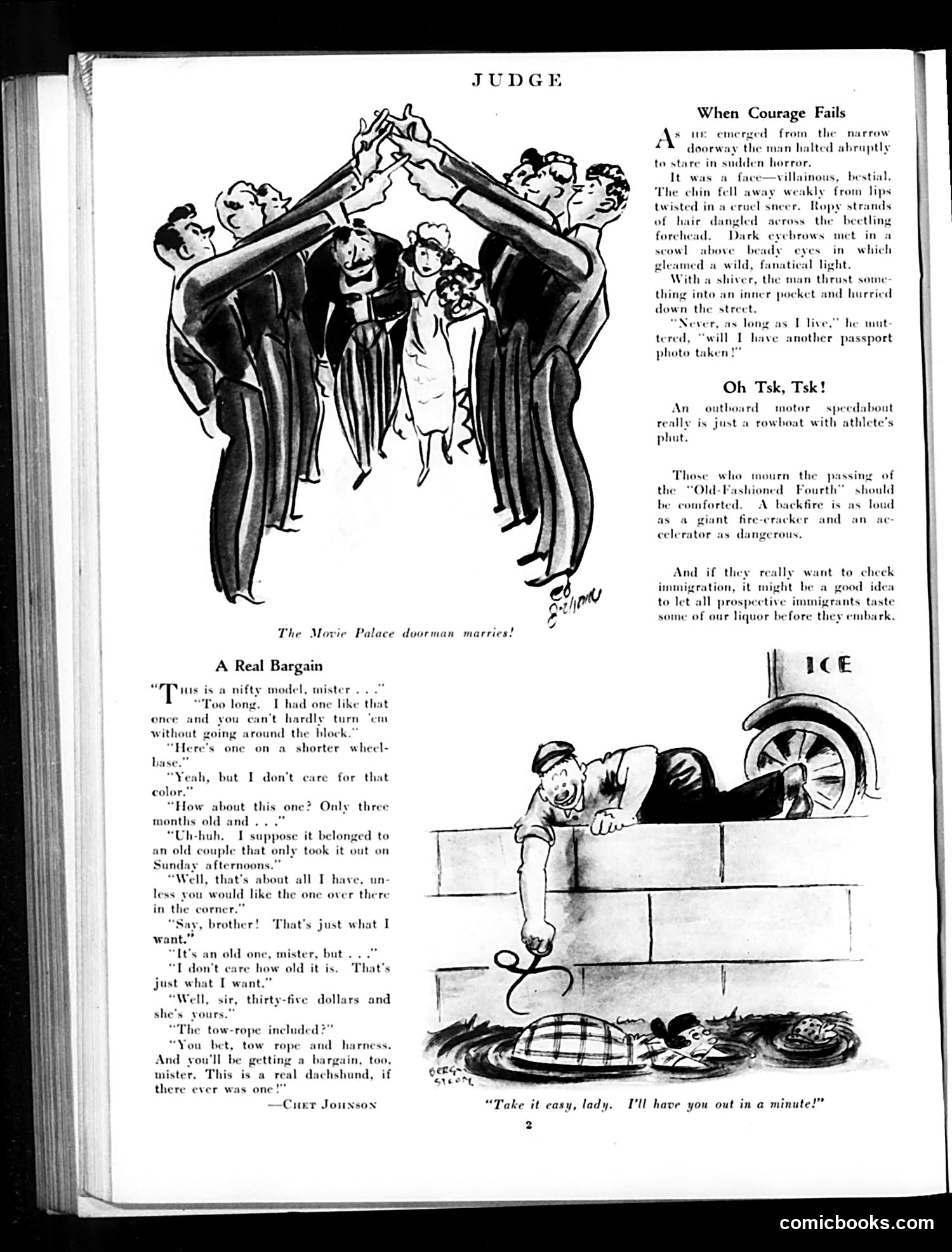
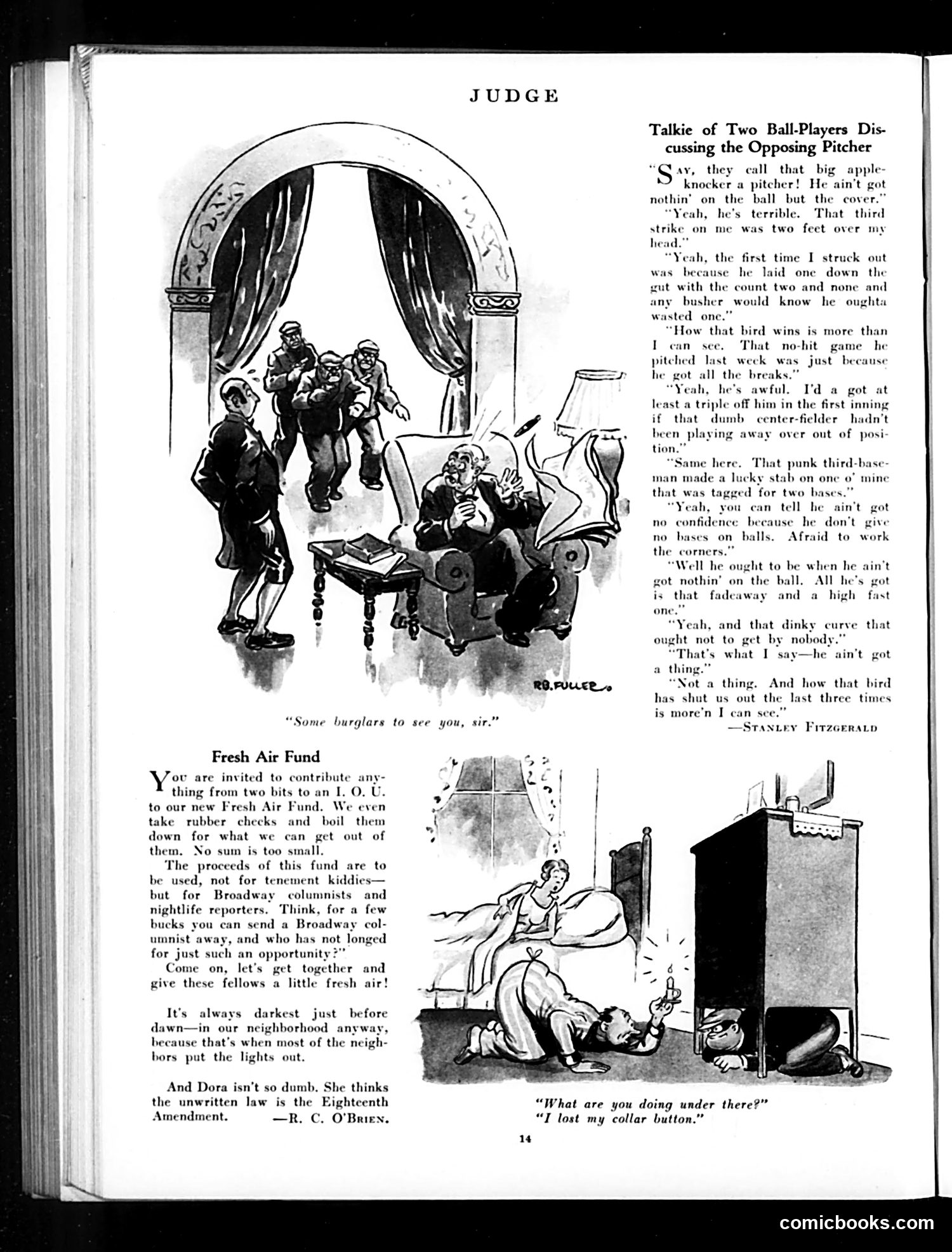
# "Judge" Page Analysis This page contains three separate satirical pieces: 1. **"When Courage Fails"** mocks an immigrant's fear upon encountering what appears to be a threatening figure. The satire criticizes both the immigrant's cowardice and American street life's dangers. 2. **"A Real Bargain"** depicts a used-car salesman's patter—a dialogue where he persuades a customer to buy an old automobile by downplaying its age and condition. This satirizes both deceptive sales tactics and gullible buyers. 3. **"Ice"** shows a deliveryman struggling to carry a large block of ice down exterior stairs while a woman urges him to hurry. The humor derives from the physical comedy of the situation and the deliveryman's evident difficulty. The page reflects early-20th-century American urban life, consumer culture, and class dynamics through humor.
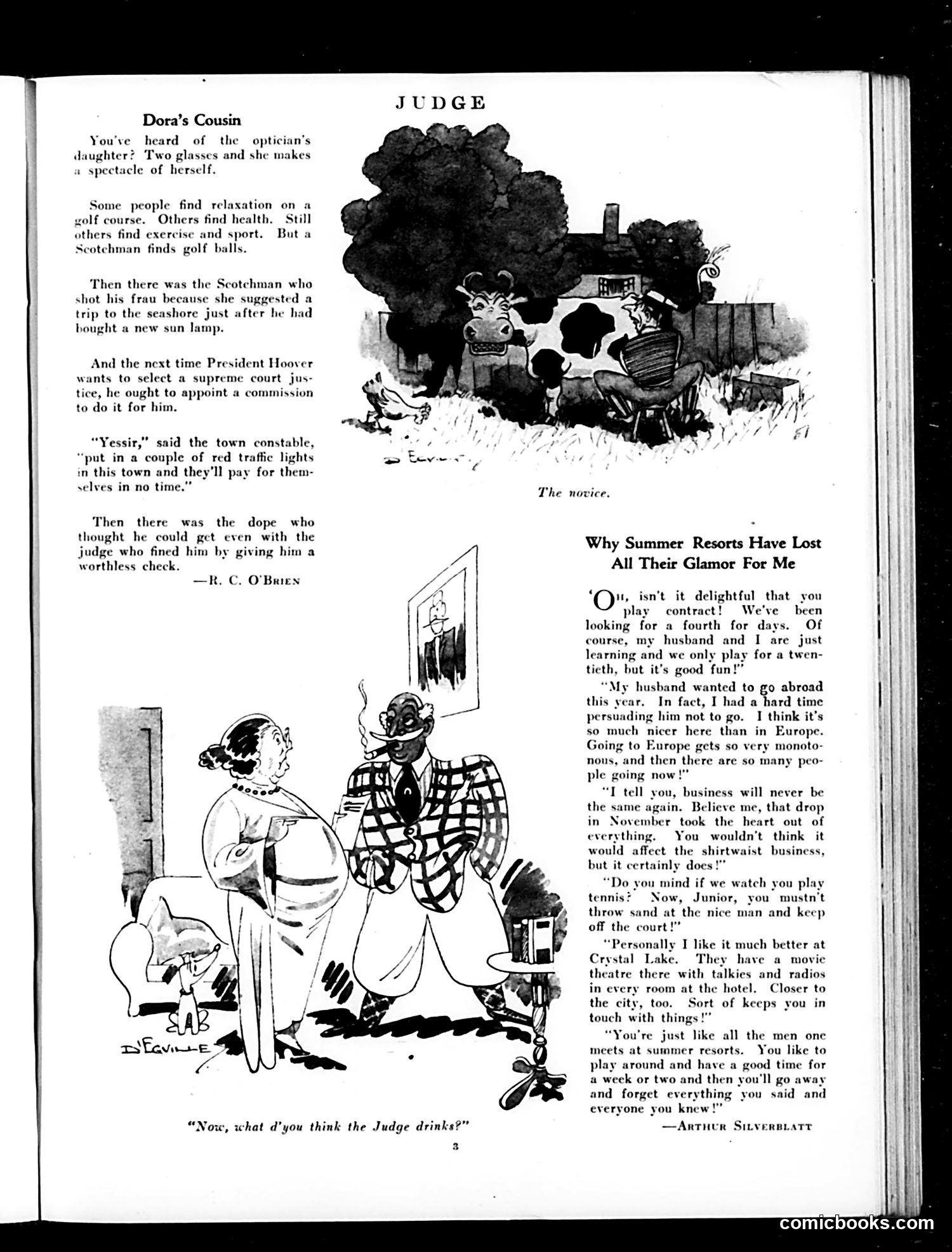
# Analysis of Judge Magazine Page This page contains two distinct pieces: **"Judge" (top section):** A series of brief humorous anecdotes by R.C. O'Brien mocking various social types—opticians' daughters, Scotsmen obsessed with golf, and someone attempting to bribe a judge. The humor relies on ethnic stereotyping (the Scotsman) and class-based ridicule common to 1920s-era satire. **"Why Summer Resorts Have Lost All Their Glamor For Me" (bottom):** An illustrated article by Arthur Silverblatt critiquing how summer vacation behavior has become standardized and superficial. The accompanying cartoon shows a woman in elaborate dress speaking to a fashionably-dressed man, with the caption "Now, what d'you think the Judge drinks?"—likely satirizing pretentious social posturing at resorts. The overall theme reflects 1920s anxieties about commercialization and authenticity in leisure culture.
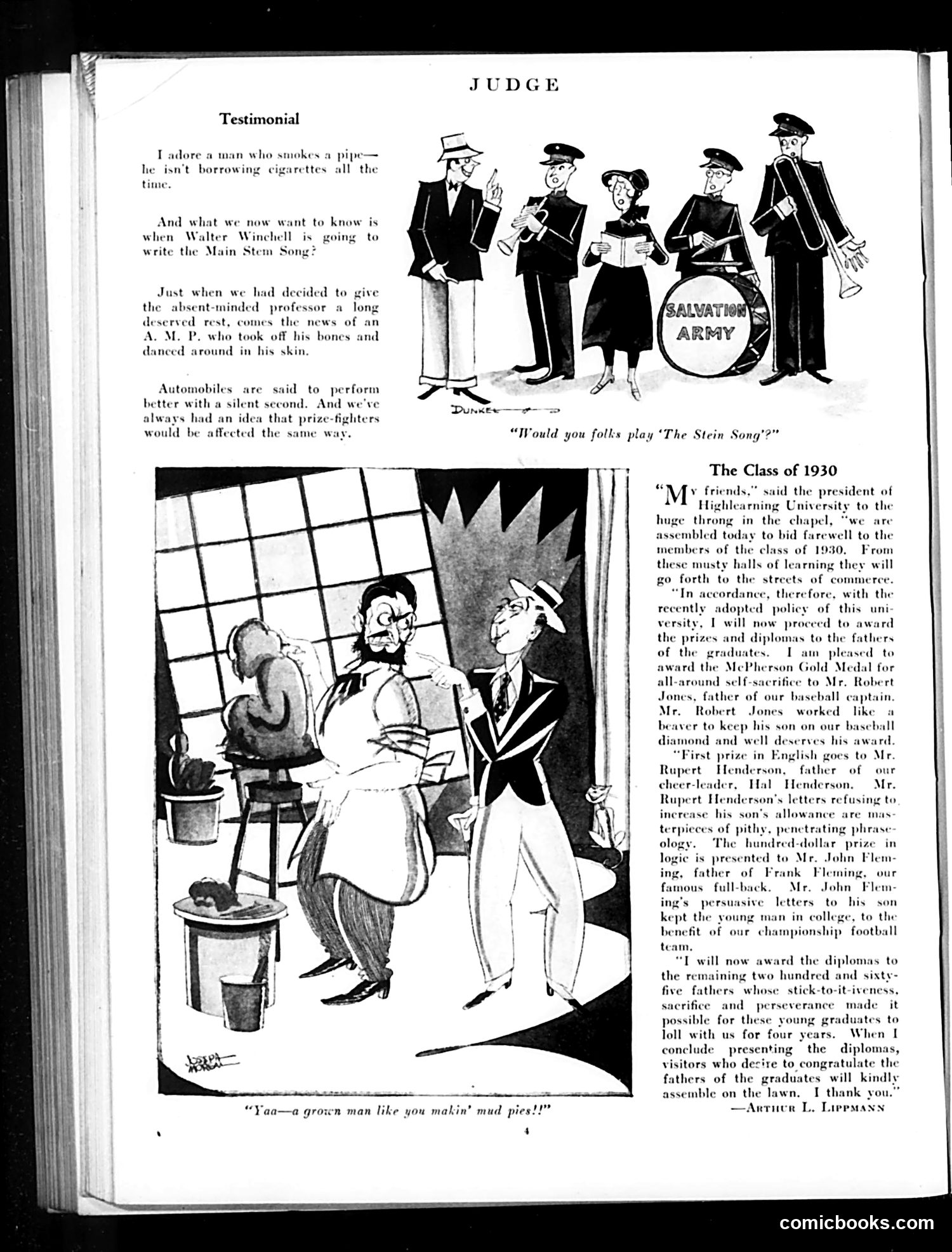
# Analysis of Judge Magazine Page **Top Cartoon ("Testimonial")**: A Salvation Army band is asked to play "The Stein Song." The joke appears to mock the incongruity of a religious/temperance organization performing a drinking song—likely a reference to the popular "Stein Song," associated with beer and revelry. The humor relies on the assumption that the Salvation Army would find this request inappropriate or contradictory to their values. **Bottom Cartoon**: A man confronts another about making "mud pies," likely a euphemism for some undesirable behavior. The exact reference is unclear without additional context. **"The Class of 1930" Section**: A commencement address parody awarding humorous prizes to graduating students' fathers based on their contributions to university life (athletic support, financial persistence, etc.). This satirizes typical graduation ceremonies and parental involvement.
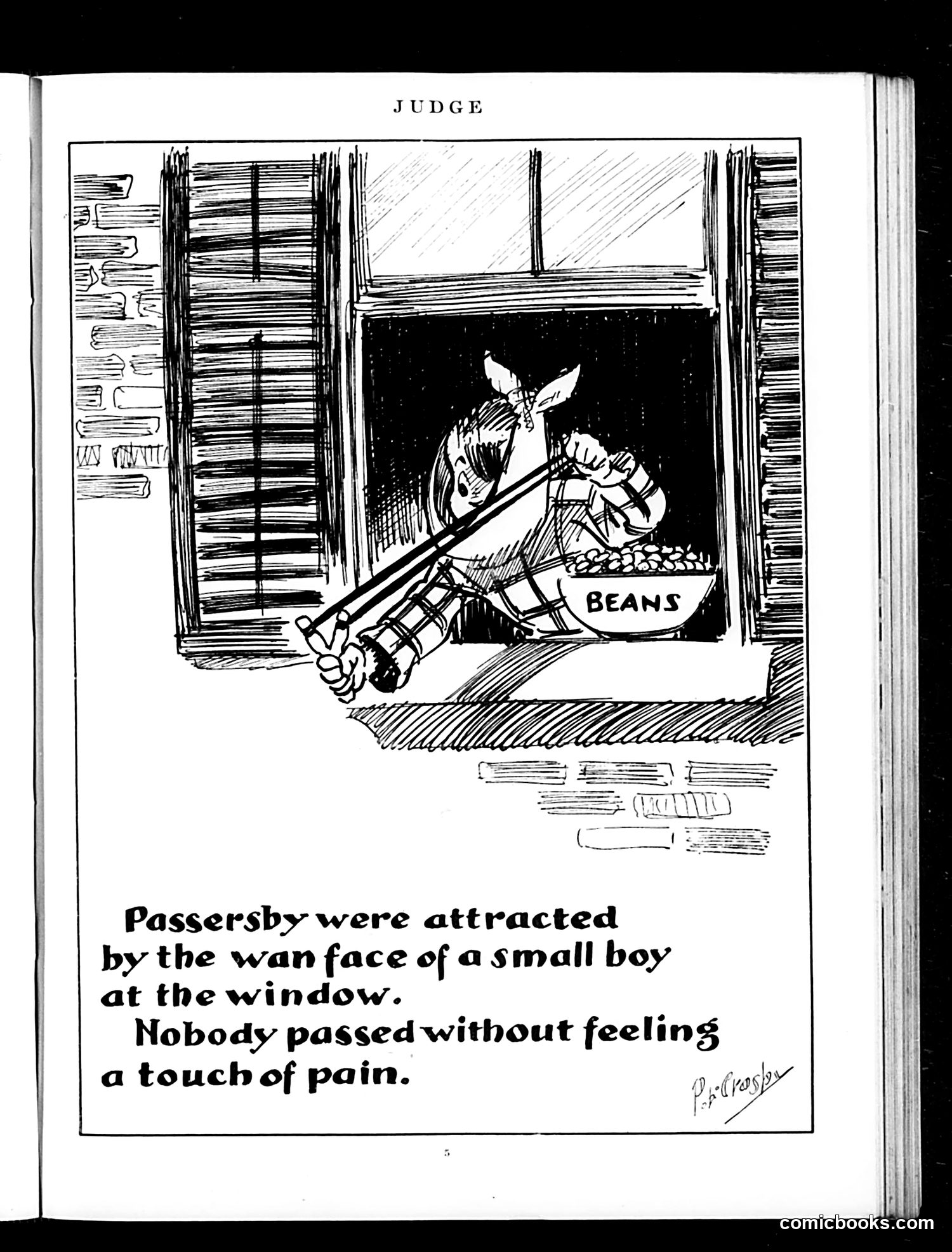
# Analysis of Judge Magazine Cartoon This cartoon depicts a poignant social commentary on urban poverty. A small boy peers hungrily from a window at a donkey carrying sacks labeled "BEANS"—apparently food supplies. The accompanying text explains that passersby were moved by the child's "wan face" at the window, feeling emotional pain witnessing his obvious hunger and deprivation. The satire appears to target either society's indifference to child poverty or, conversely, people's performative sympathy—they "feel pain" seeing the hungry child but presumably do little to help. The rifle-wielding figure in the foreground may represent authority or a gatekeeper. Judge magazine frequently critiqued social inequality and working-class suffering in Gilded Age America, making child hunger a recurring subject of moral outrage.
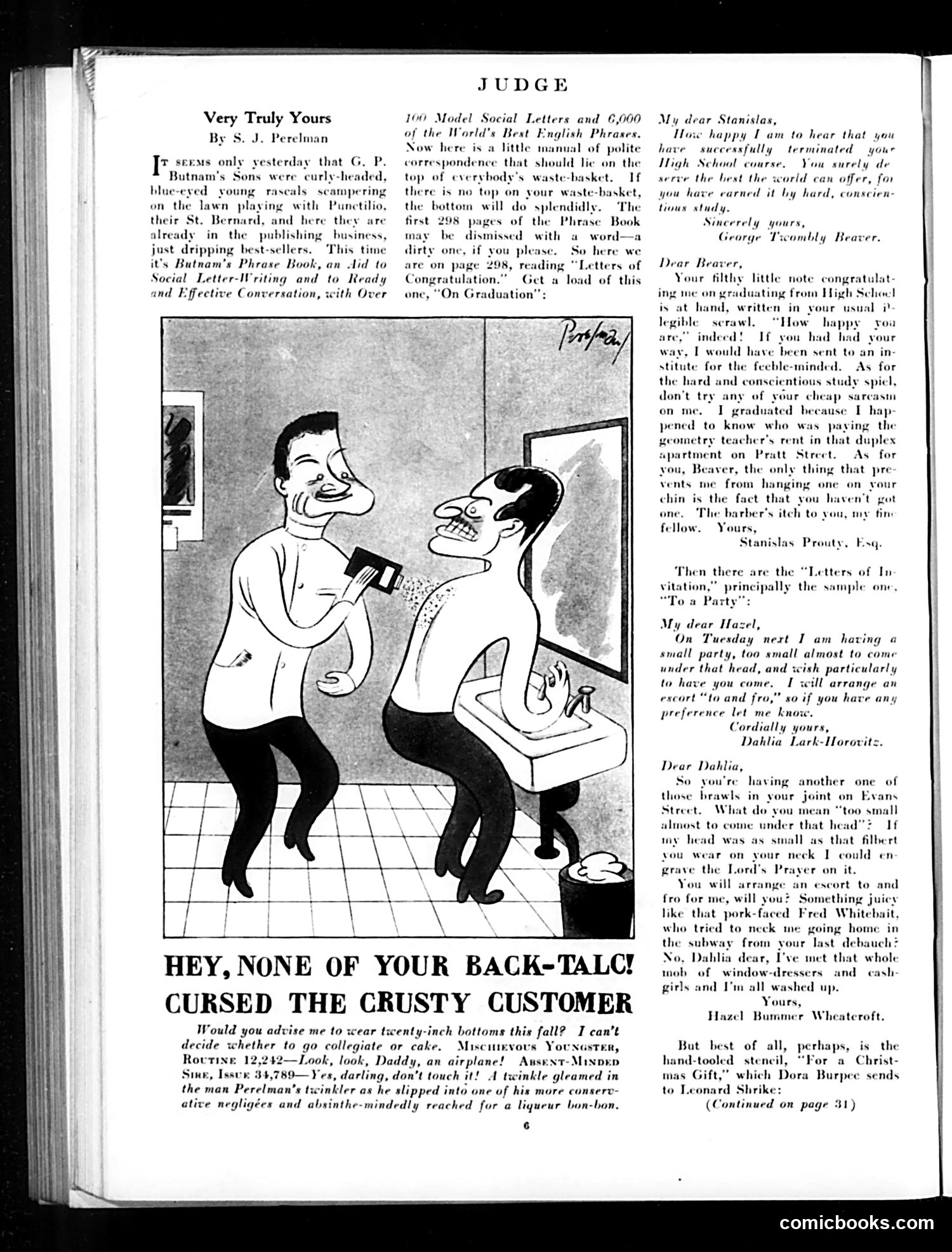
# Analysis of "Judge" Magazine Page This page features social satire typical of Judge magazine's humor. The main cartoon depicts two men in what appears to be a barber shop or similar service establishment, with exaggerated facial features and body language suggesting physical comedy or slapstick. The caption "Hey, None of Your Back-Talc! Cursed the Crusty Customer" references a dispute over grooming products—likely "talc" (talcum powder), a common barber shop item. The humor appears to derive from a customer's irritation at being advised about proper grooming or appearance. The right column contains humorous "social letters" mimicking formal correspondence—satirizing pretentious social etiquette and mannered communication styles of the era. The tone suggests gentle mockery of upper-class affectations and overly formal letter-writing conventions.
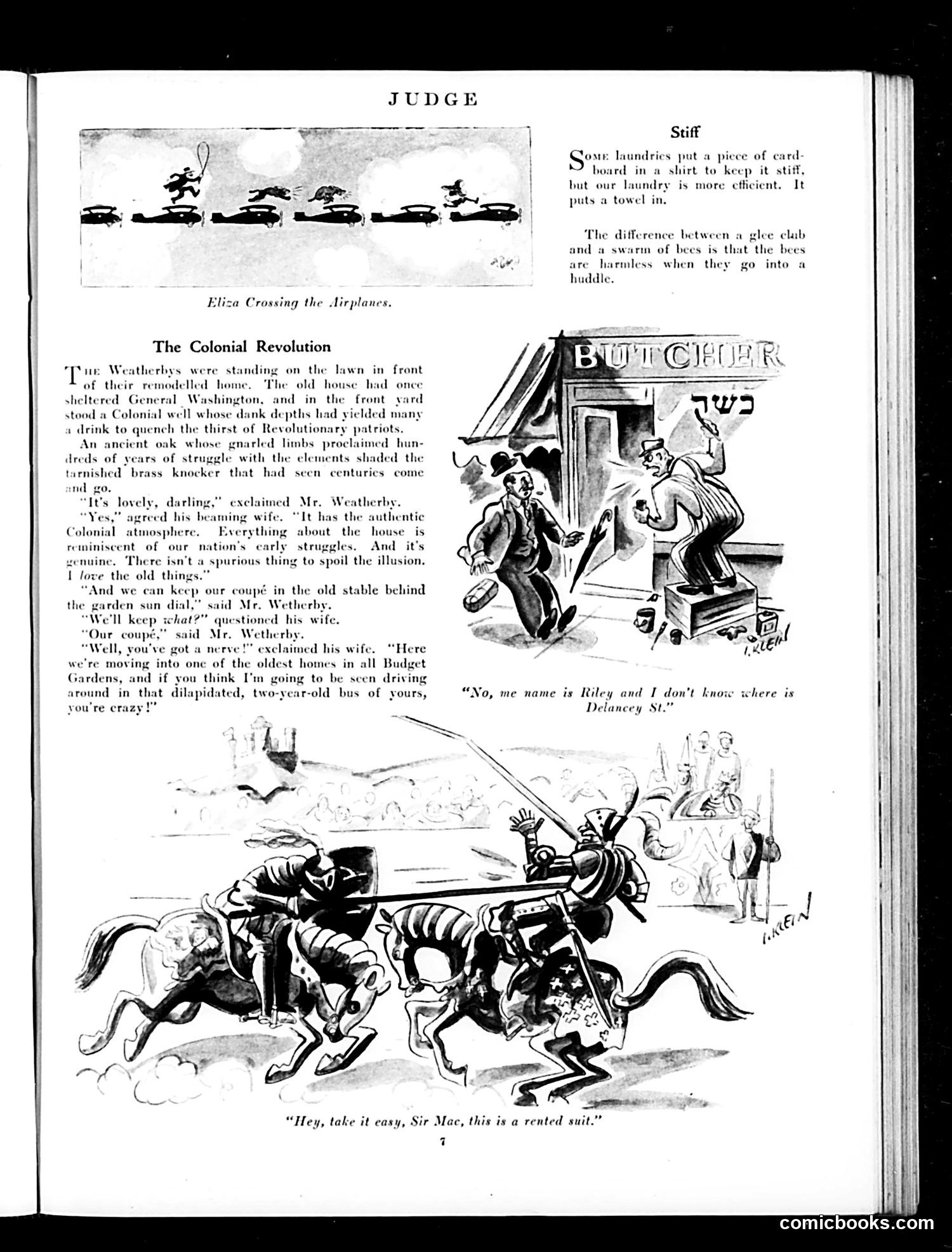
# "The Colonial Revolution" This satire mocks wealthy Americans' superficial nostalgia for Colonial history. The Weatherbys have purchased an authentically old house (once sheltering George Washington) in a fashionable neighborhood called "Budget Gardens," but their enthusiasm for historical authenticity is hollow—Mr. Weatherby wants to park his modern automobile in the colonial stable, prompting his wife's outrage that she'd be *seen* in their shabby two-year-old car. The joke: they cherish the appearance of Colonial virtue and struggle while remaining thoroughly modern and materialistic. The phrase "I love the old things" rings empty when contradicted by status anxiety about automobiles. The other cartoons (butcher shop, horsemen) appear unrelated brief gags typical of Judge's format.
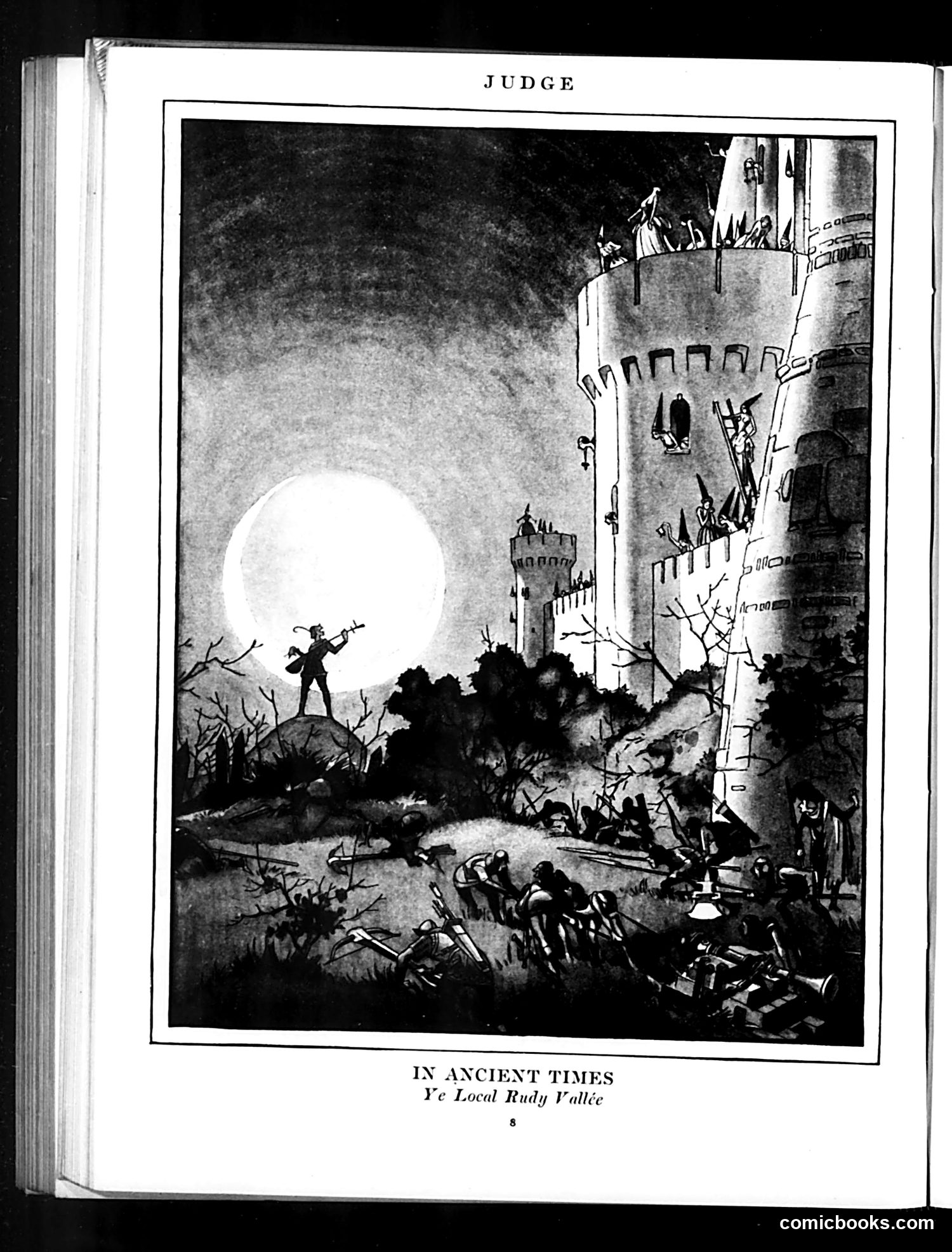
This illustration from *Judge* magazine depicts a medieval castle siege scene with a figure standing prominently on a moonlit hill, appearing to sing or perform with raised arms. The caption "Ye Local Rudy Vallée" references Rudy Vallée, a famous 1920s-30s crooner and entertainer known for his distinctive singing style and megaphone-aided vocal delivery. The satire appears to mock someone's pretensions to entertainment or performance, comparing them humorously to the celebrated Vallée. The "ancient times" framing suggests ironic contrast—presenting an ordinary local performer as if he were as significant as a legendary entertainer, or perhaps mocking overwrought theatrical ambitions. The castle siege setting adds absurdist humor, elevating a mere local act to mock-heroic proportions. Without more context, the specific target figure remains unclear.
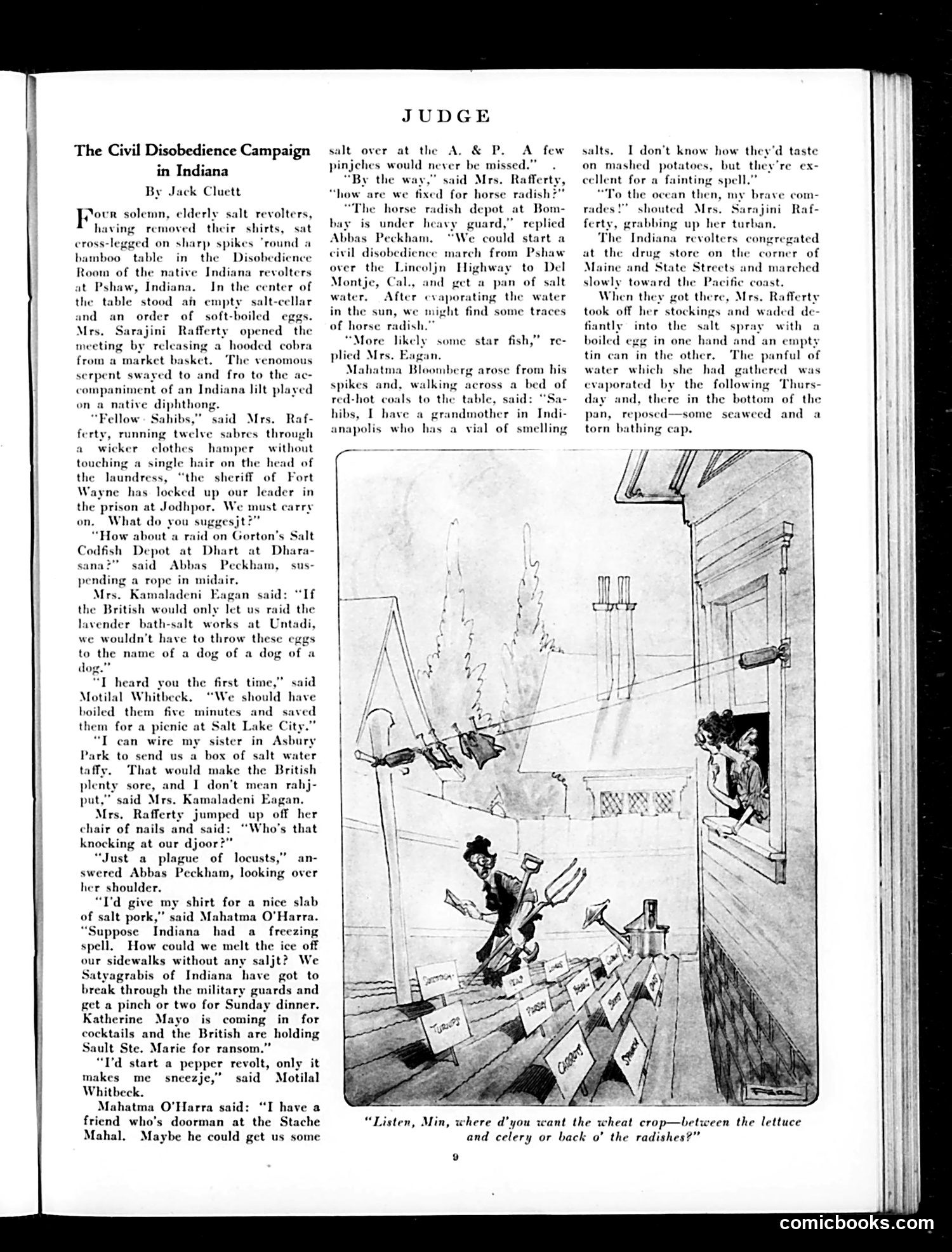
# Explanation for Modern Readers This satirical piece mocks Gandhi's salt march and civil disobedience movement by transplanting it absurdly to Indiana with comically Americanized characters bearing Indian-sounding names (Mahatma O'Harra, Mrs. Sarajini Rafferty). The joke: serious Indian independence activists are reduced to bumbling Midwesterners obsessing over salt acquisition through ridiculous schemes involving horse radish depots, salt water taffy, and smelling salts—treating Gandhi's political protest as mere salt procurement. The cartoon illustration shows the "revolters" attempting their own version of the salt march, wading into water with boiled eggs and tin cans. The satire suggests that transplanting Gandhi's movement to America reveals its impracticality or absurdity, or mocks Americans attempting to mimic Indian resistance while remaining fundamentally disconnected from its purpose. This reflects 1930s American skepticism toward Indian independence movements and Gandhi's methods.
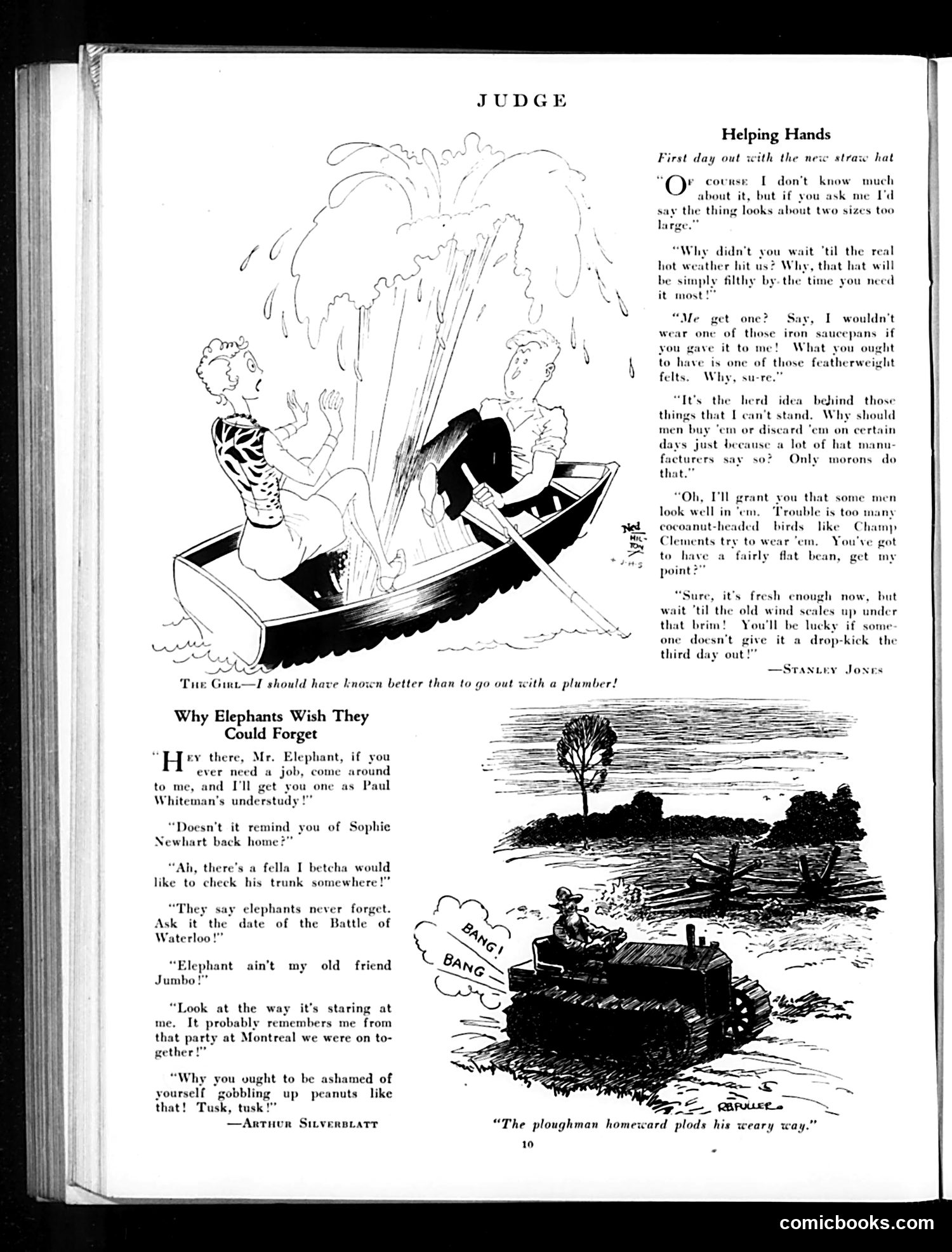
# Explanation for Modern Readers This Judge magazine page contains two separate humorous pieces: **"Why Elephants Wish They Could Forget"** satirizes the common saying that "an elephant never forgets." The joke presents various people making embarrassing references to the elephant (Sophie Newhart, a Montreal party, eating peanuts) while the elephant stares at them—playing on the anxiety that it remembers these awkward moments. The reference to "Paul Whiteman's understudy" alludes to the famous bandleader Paul Whiteman, popular in the 1920s-30s. **"Helping Hands"** depicts a man receiving unwanted advice about his new straw hat. Friends nitpick it relentlessly: it's too large, will get filthy, unsuitable timing, and will blow away. The satire mocks how people eagerly offer harsh "helpful" criticism rather than genuine support. The title is ironic—these hands aren't helpful at all. Both pieces use everyday social situations to poke fun at human behavior: anxiety about being remembered and the tendency to tear down others under the guise of friendship.