
Judge, 1930-06-07 · page 15 of 36
Judge — June 7, 1930 — page 15: what you’re looking at
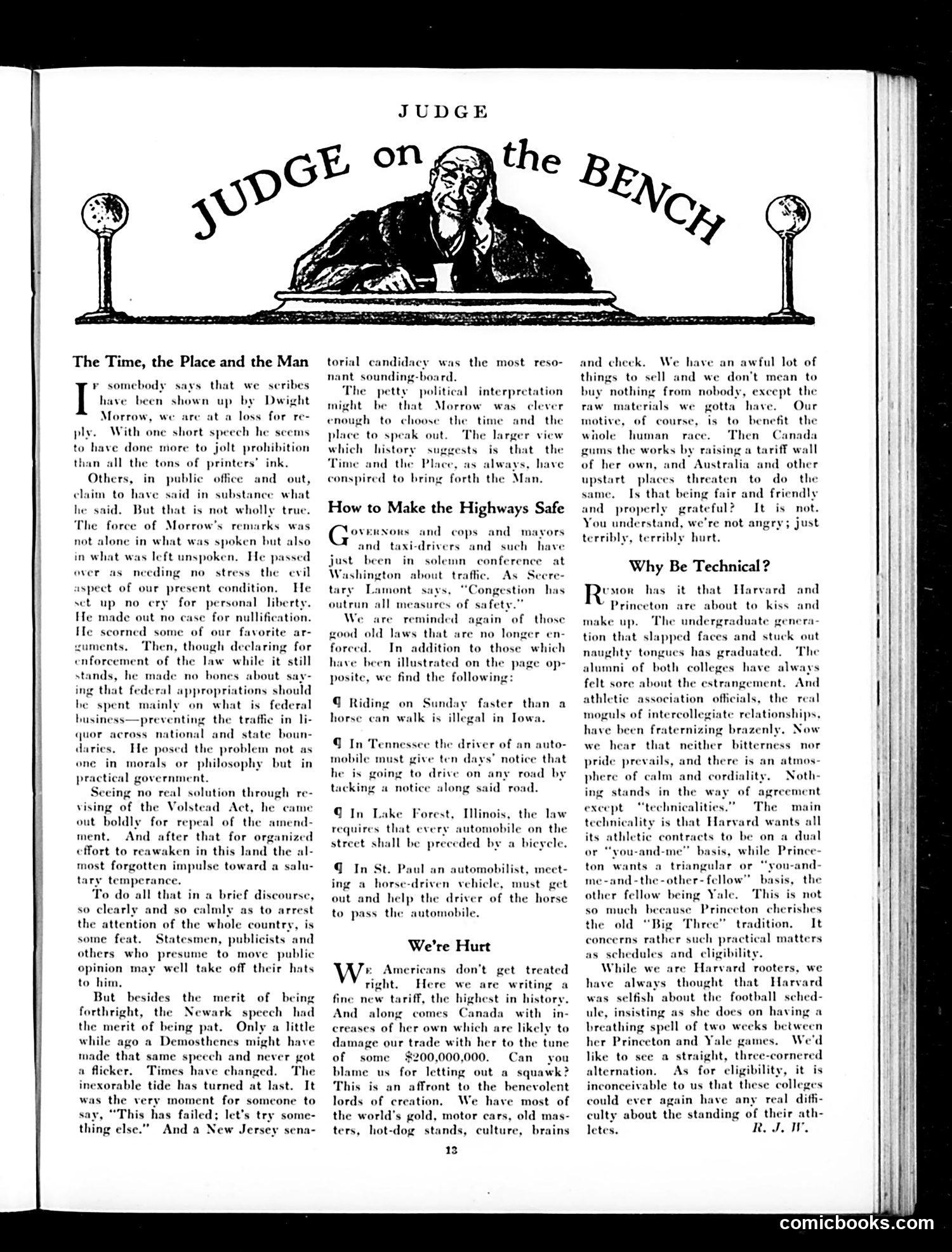
A restored page from Judge, 1930-06-07. Page through the whole issue in the reader above.
📄 Transcribed text from this page (OCR, searchable)
Machine-transcribed from the original scan — historical spelling and the odd misread are preserved.
The Time, the Place and the Man F somebody says that we scribes I have been shown up by Dwight Morrow, we are at a loss for re- ply. With one short speech he seems to have done more to jolt prohibition than all the tons of printers’ ink. Others, in’ public office and out, claim to have said in substance what he said. But that is not wholly true. The force of Morrow’s remarks was not alone in what was spoken but also in what was left unspoken. He passed over as needing no. stress the evil uspect of our present condition. He set up no ery for 1 liberty. He made out no case for nullification. He scorned some of our favorite ar- suments. Then, though de ing for enforcement of the law while it still stands, he made no bones about say- hat federal appropriations should he spent mainly on what is federal business—preventing the traffic in li- que and state boun- He posed the problem not as in morals or philosophy but in tical government. Seeing no real solution through re- vising of the Volstead Act, he came out boldly for repeal of the amend- ment. And after that for organized effort to reawaken in this land the al- most forgotten impulse toward a salu- tary temperance. To do all that in a brief discourse, so clearly and so calmly as to arrest the attention of the whole country, is some feat. Statesmen, publicists and others who presume to move public opinion may well take off their hats to him. But besides the forthright, the Newark speech had the merit of being pat. Only a little while ago a Demosthenes might have made that same speech and never got a flicker. Times have changed. The inexorable tide has turned at last. It was the very moment for someone to This has failed; let's try some- thing else.” And a New Jersey sena- perse daries. merit of being JUDGE was the most reso- ard. political torial candida: nant sounding The petty interpretation might be that Morrow) was clever enough to choose the time and the place to speak out. The larger view which history suggests is Time and the 1 conspired to bring forth the How to Make the Highways Safe ( voy rRNons and and taxi-drivers just been in’ solemn conference Yushington about traffic. As tary Lamont. says, “Congestion has outrun : _ that the ays, have Man. and ow and cops such I measures of safe reminded again of those ure no longer en- 1. In addition to those which - been illustrated on the page op- posite, we find the followin @ Riding horse can on Sunday faster than a walk is illegal in Iowa. G In Tennessce the driver of ¢ mobile must give ten days’ notic auto- that he is going to drive on any road by tacking a notice along said road. @ In Lake Illinois, the law requires that every automobile on the street shall be preceded by a bicyele. Forest, @ In St. Paul an automobilist, meet- ing a horse-driven vehicle, must gi out and help the driver of the horse to pass the automobile. We're Hurt Americans don't get treated WwW: right. Here we are writing a fine new tariff, the highest in history. And along comes Canada with in- creases of her own which are likely to damage our trade with her to the tune of some 200,000,000. Can you blame us for letting out a squawk? This is an affront to the benevolent lords of creation, We have most of the world’s gold, motor cars, old mas- ters, hot-dog nds, culture, brains 13 and cheek. We have an awful lot of things to sell and we don’t mean to buy nothing from nobody, except the raw materials we gotta have. Our motive, of course, is to benefit: the human rac Then Canada gums the works by raising a tariff wall of her own, and Aust ind other upstart places threaten to do the ame. Is that being fair and friendly and properly grateful? It is not. You understand, we're not angry; just terribly, terribly hurt. Why Be Technical ? R' Mor it that) Harvard Princeton are about to. kiss whole and nd has make up. The undergraduate genera tion that slapped faces and stuck out The © always naughty tongues has graduated. alumni of both colleges he felt sore about the estrangement, And ion officials, the real uls of intercolle > relationships, nly, Now athletic assoc ve been fratern that pride prevails we hear neither bitterness nor n atinos- phere of calm and cordiality. Noth- ing stands the way of agreement except “techni The m technicality is t Harvard wants all its athletic contracts to be on a dus or “you-and-me” basis, while Pri ton wants a triangula nd - the -other- fellow other fellow being Yale. ‘This is not so much because Princeton cherishes the old “Big Three” tradition. It concerns rather such pract tters as schedules and cligibility While we are F rd rooters, we have always thought that Harvard was selfish about the football sched- ule, insisting as she does on having a breathing spell of two weeks betw her Princeton and Yale games. W like to see a straight, three-corne alternation. As for cligibility, it is inconceivable to us that these colleges could ever again have any real diffi- culty about the standing of their ath- letes. RJILW. me t comicbooks.com