
Judge, 1930-06-07 · page 25 of 36
Judge — June 7, 1930 — page 25: what you’re looking at
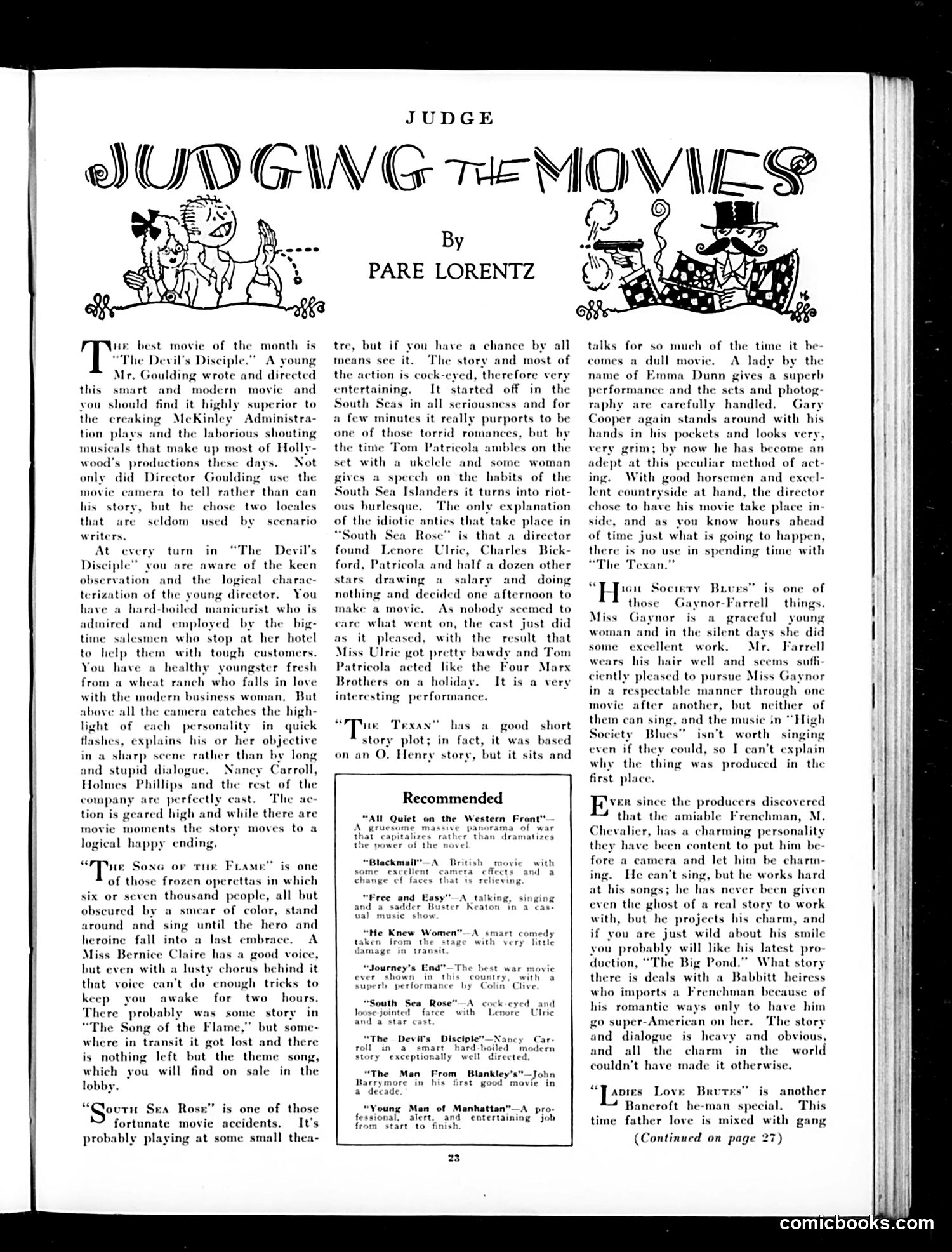
A restored page from Judge, 1930-06-07. Page through the whole issue in the reader above.
📄 Transcribed text from this page (OCR, searchable)
Machine-transcribed from the original scan — historical spelling and the odd misread are preserved.
ur best movie of the month is The Devil's Disciple.” A young Mr. Goulding wrote and directed this smart and modern movie and vou should find it highly superior to the creaking McKinley’ Administra- tion | and the laborious shouting musicals that make up most of Holly- wood's productions these . Not only did Director Goulding use the movie camera to tell rather than his story, but he chose two lo that are seldom used by writers. At every turn in “The Devil's Disciple” you are aware of the keen observation and the logical charac- terization of the young director. You have a hard-boiled manicurist who is admired and employed by the bi time salesmen who stop at her hotel scenario to help them with tough customers. You have a healthy youngster fresh from a wheat ranch who falls in love with the modern business woman. But ibove all the camera catches the high light of each personality in quick flashes, explains his or her objective in a sharp scene rather than by long and stupid dialogue. Nancy Carroll, Holmes Phillips and the rest of the © perfectly cast. The red high and while there are movie moments the story moves to a logical happy ending. “T Sone or tur Frame” is one f those frozen operettas in which six or seven thousand people, all but obscured by a smear of color, stand around and sing until the hero and heroine fall into a last embrace. A Miss Bernice Claire has a good voice, but even with a lusty chorus behind it that voice can't do enough tricks to keep you awake for two hours. There probably was some story in “The Song of the Flame,” but some- where in transit it got lost and there is nothing left but the theme song, which you will find on sale in the lobby. “Govt Sea Rosr” is one of those fortunate movie accidents. It’s probably playing at some small thea- JUDGE tre, but if you have a chance by all means see it. The story and most of the action is cock-eyed, therefore very entertaining. It started off in_ the South Seas in all seriousness and for a few minutes it really purports to be one of those torrid romances, but by the tine Tom Patricola ambles on the set with ukelele and some woman gives a speech on the habits of the South Sea Islanders it turns into riot- ous burlesque. The only expl: of the idiotic antics that take pl “South Sea Rose” is that a director found Lenore Ulric, Charles Bick- ford, Patricola and half a dozen other stars drawing ary and doing nothing and decided one afternoon to As nobody seemed to care what went on, the cast just did as it pleased, with the result that Miss Ulric got pretty bawdy and Tom Patricola acted like the Four Marx Brothers on a holiday. It is a very interesting performance. “Tue Texan” has a good short story plot; in fact, it was based onan O. Henry story, but it sits and [ ] Recommended “AM Quiet A. gruc that cay the Western Front*— panorama of war ft than dramatizes “Blackmail” xcellent change ef faces that ts relieving “Free and Easy"—A talking, sir ter Keaton in a “He Knew Women” rt comedy taken from th very little Journey's Sea Rose”—A farce with Lenor “The Devil's Disciple"—Nancy roll in a smart hard-boiled Story. exceptionally well direct “The Man From Blankley’: Barrymore in his first good a decade “Young Man of Manhatta fessional, alert, and talks for so much of the time it be- comes a dull movie. A lady by the Dunn gives a superb performance and the sets and photog- raphy are carefully handled. Gary Cooper again stands around with his hands in his pockets and looks very, very grim; by now he name of Emm. as become an method of act- With good horsemen and excel- lent countryside at hand, the director chose to have his movie take place in- side, and as you know hours ahead of time just what is going to happen, there is ‘no use in spending time with “The Texan.” “Fen Soctery Burs” is one of those Gaynor-Farrell things. Miss Gaynor is graceful young wotnan and in the silent days she did some excellent. work. Mr. Farrell wears his hair well and scems. suffi- ciently pleased to pursue Miss Gaynor in a respec manner through’ one movie fter another, but neither of them can sing, and the music in “High Society Blues’ isn’t’ worth si even if they could, so I can’t exy why the thing was produced in the first place. Be since thi that the Chevalier, producers discovered niable Frenchman, M. a charming personality mnitent to put him be- 1 and let him be charm- but he works hard at his songs; he has never been given even the ghost of a real story to work with, but he projects his charm, and if you are just wild about his smile you probably will like his latest pro- duction, “The Big Pond.” What story there is deals with a Babbitt heiress who imports a Frenchman because of to have him go super-American on her. The story and dialogue is heavy and obvious, and all the charm in’ the world couldn't have made it otherwise. his romantic ways onl “Lanes Love Brvtes” is another Bancroft he-man special. This time father love is mixed with gang (Continued on page 27) comicbooks.com