A complete issue · 36 pages · 1930
Judge — February 15, 1930
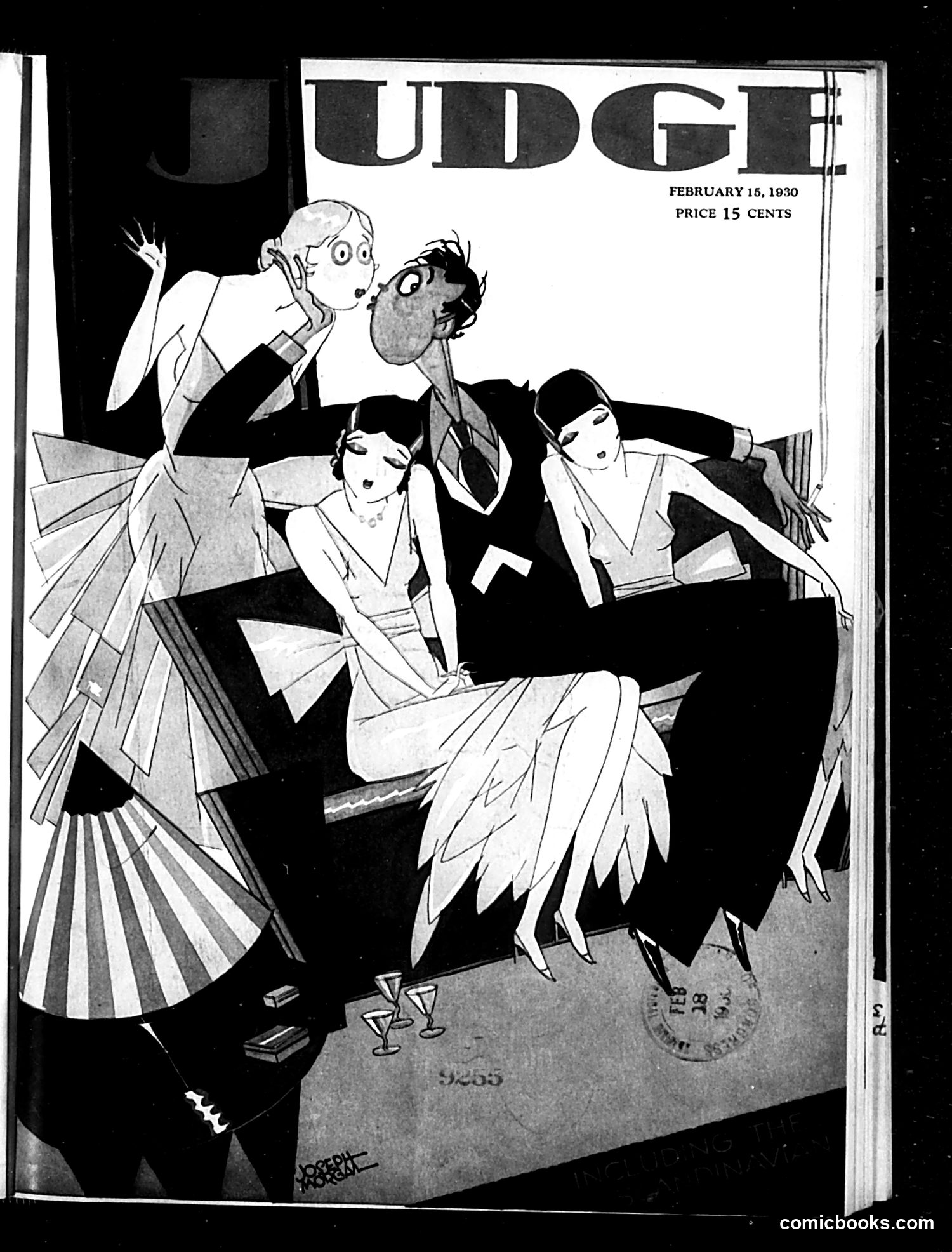
# Judge Magazine Cover, February 15, 1930 This cover depicts a lively party scene with exaggerated, caricatured figures in 1920s evening wear—flapper dresses with dramatic pleats and a man in a tuxedo. The artistic style employs the grotesque facial exaggeration typical of satirical magazines of this era. The specific satire is unclear without additional context or visible text identifying the figures. However, given Judge's focus on social commentary, this likely mocks either: - High society's excess during the economic prosperity of the late 1920s (just months before the 1929 stock market crash's full consequences became apparent) - Contemporary entertainment or nightlife culture - Fashion trends of the period The cartoonist's signature appears at bottom left. The cover price of 15 cents reflects 1930 economics.
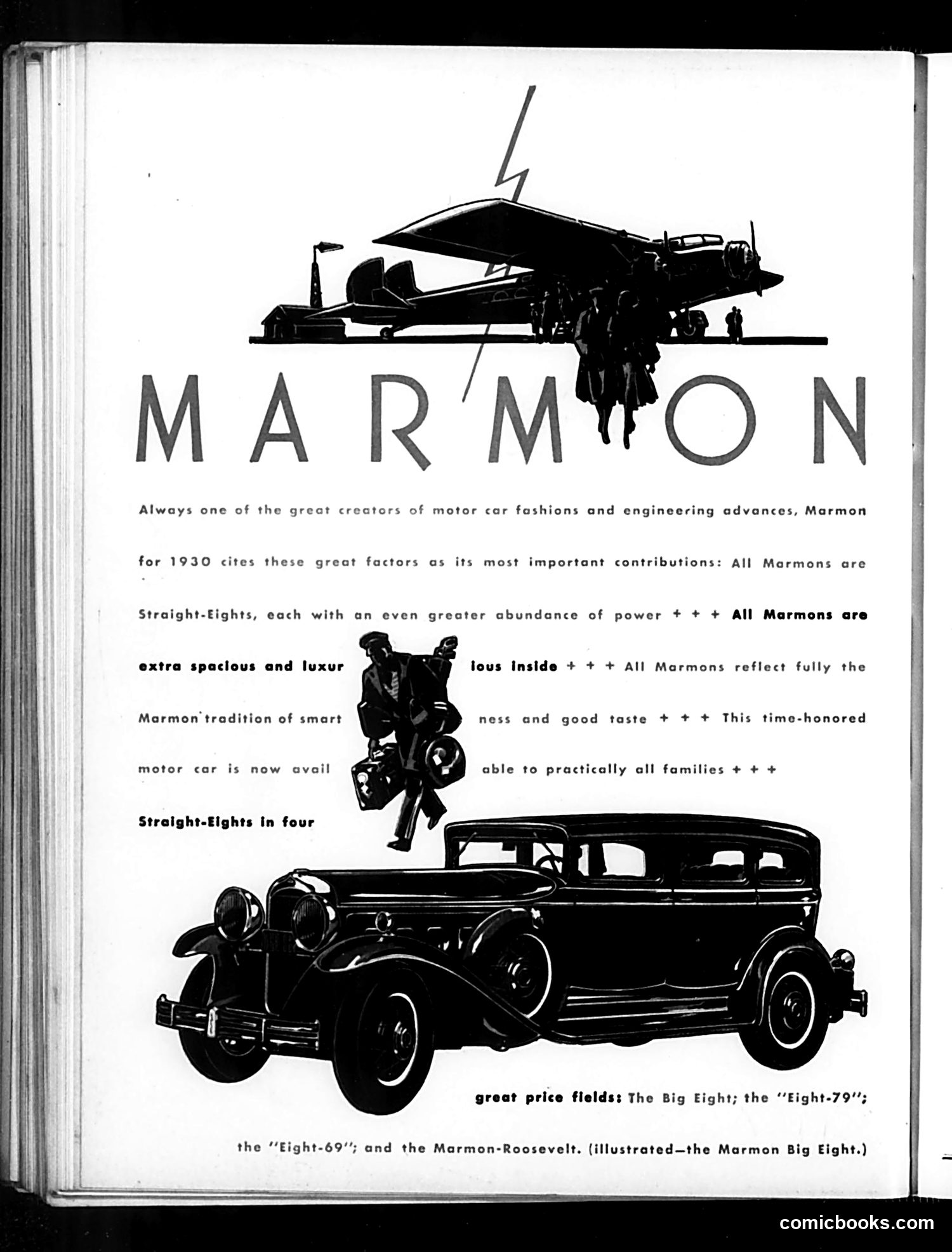
# Marmon Automobile Advertisement This page is primarily **advertising content rather than satire or political commentary**. It promotes Marmon automobiles for 1930, emphasizing engineering advances and luxury features. The imagery includes a stylized airplane at the top (suggesting modernity and speed) and a 1930s sedan below, accompanied by illustrations of fashionably dressed figures. The text highlights Marmon's reputation as "one of the great creators of motor car fashions and engineering advances," touting straight-eight engines with increased power, spaciousness, and luxury as the brand's key selling points. The advertisement references several models: the Big Eight, Eight-79, Eight-69, and Marmon-Roosevelt, positioning these vehicles as accessible to "practically all families" while maintaining the brand's tradition of "smartness and good taste."
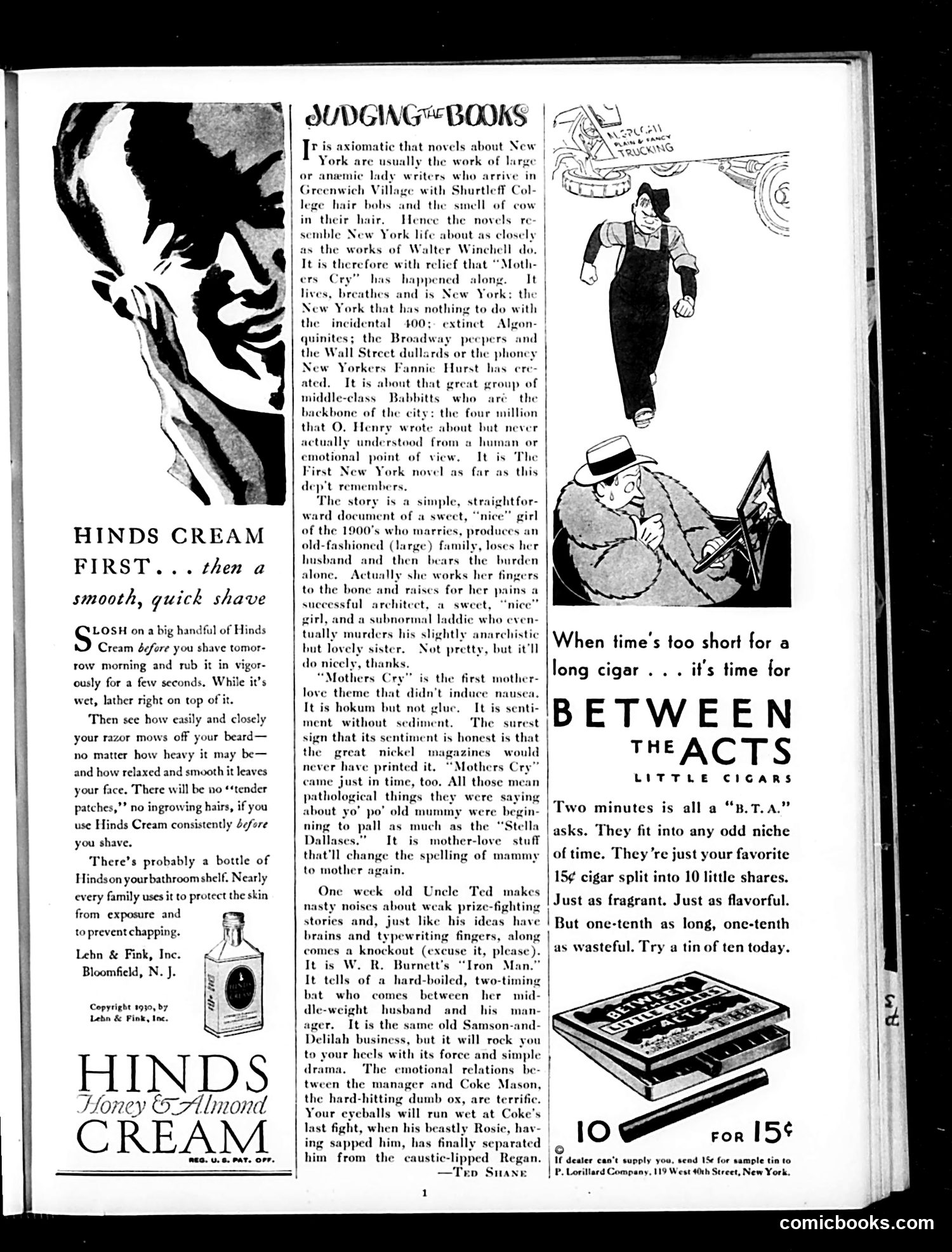
# "Judging the Books" - Book Review Page This page is primarily **book reviews and advertising** rather than political satire. The main content is a column titled "Judging the Books" that critiques novels about New York life. The reviewer discusses "Mothers Cry," praising it as an honest portrayal of working-class family struggles—notably the first mother-love story the reviewer claims didn't induce nausea. Other books mentioned include works featuring "weak prize-fighting stories" and a tale comparing a manager-boxer relationship to the biblical Samson and Delilah story. The page includes advertisements for Hinds Cream (shaving product) and Between the Acts Little Cigars (10 for 15¢). These ads use period-appropriate marketing appeals rather than satire.
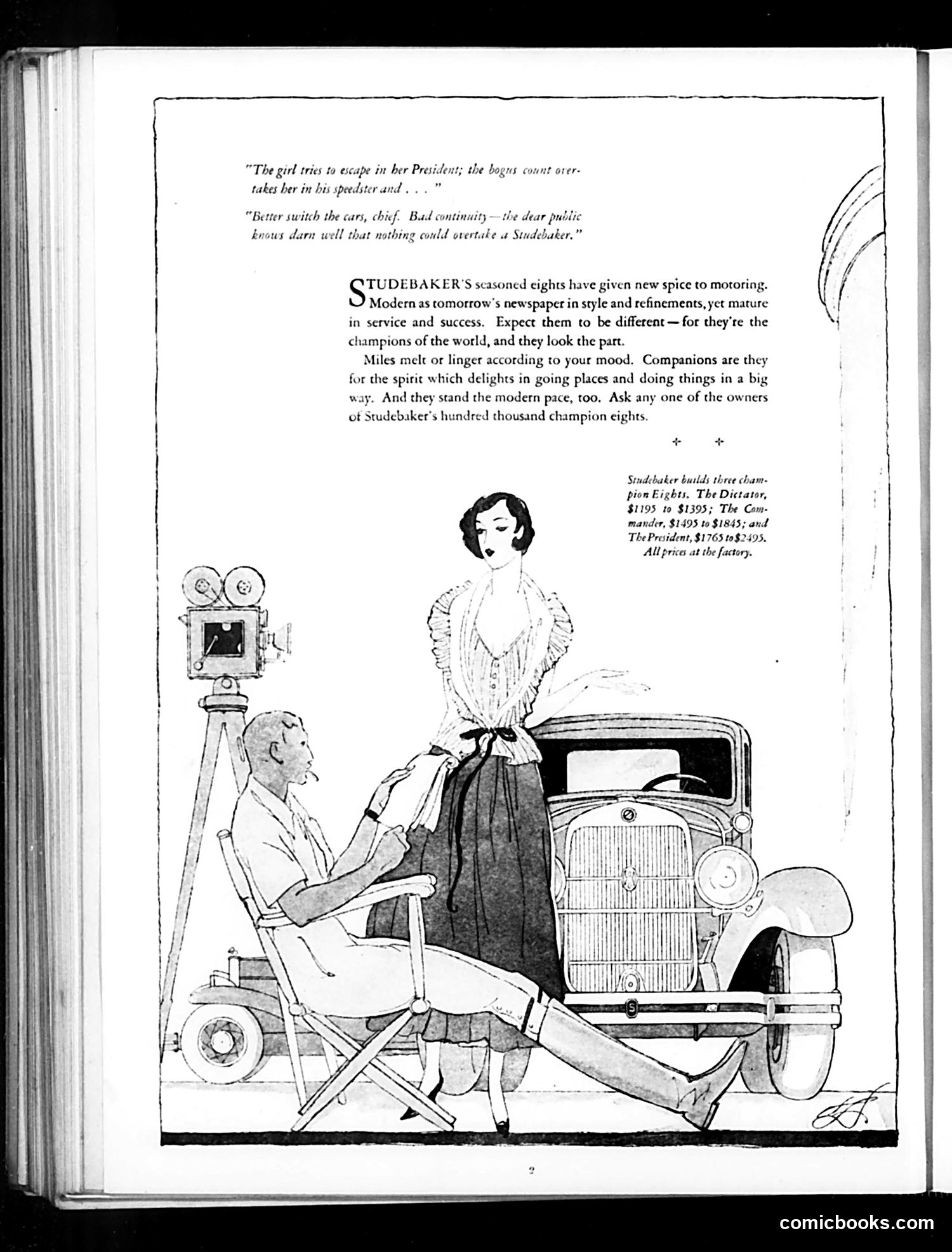
# Analysis This appears to be a **Studebaker automobile advertisement** disguised as editorial content in *Judge* magazine. The text praises Studebaker's "seasoned eights" as modern, successful vehicles for sophisticated owners who appreciate quality and performance. The illustration depicts a film production scene: a cameraman films a woman posing next to a Studebaker automobile. The satire likely works on two levels—both celebrating Studebaker's appeal to wealthy, glamorous consumers and gently mocking the advertising industry's use of attractive women and cinematic spectacle to sell products. The quoted dialogue at top references "the President" and appears unrelated to the car content, suggesting this was assembled from multiple magazine pieces. This mixed-media approach was common in early 20th-century magazine advertising.
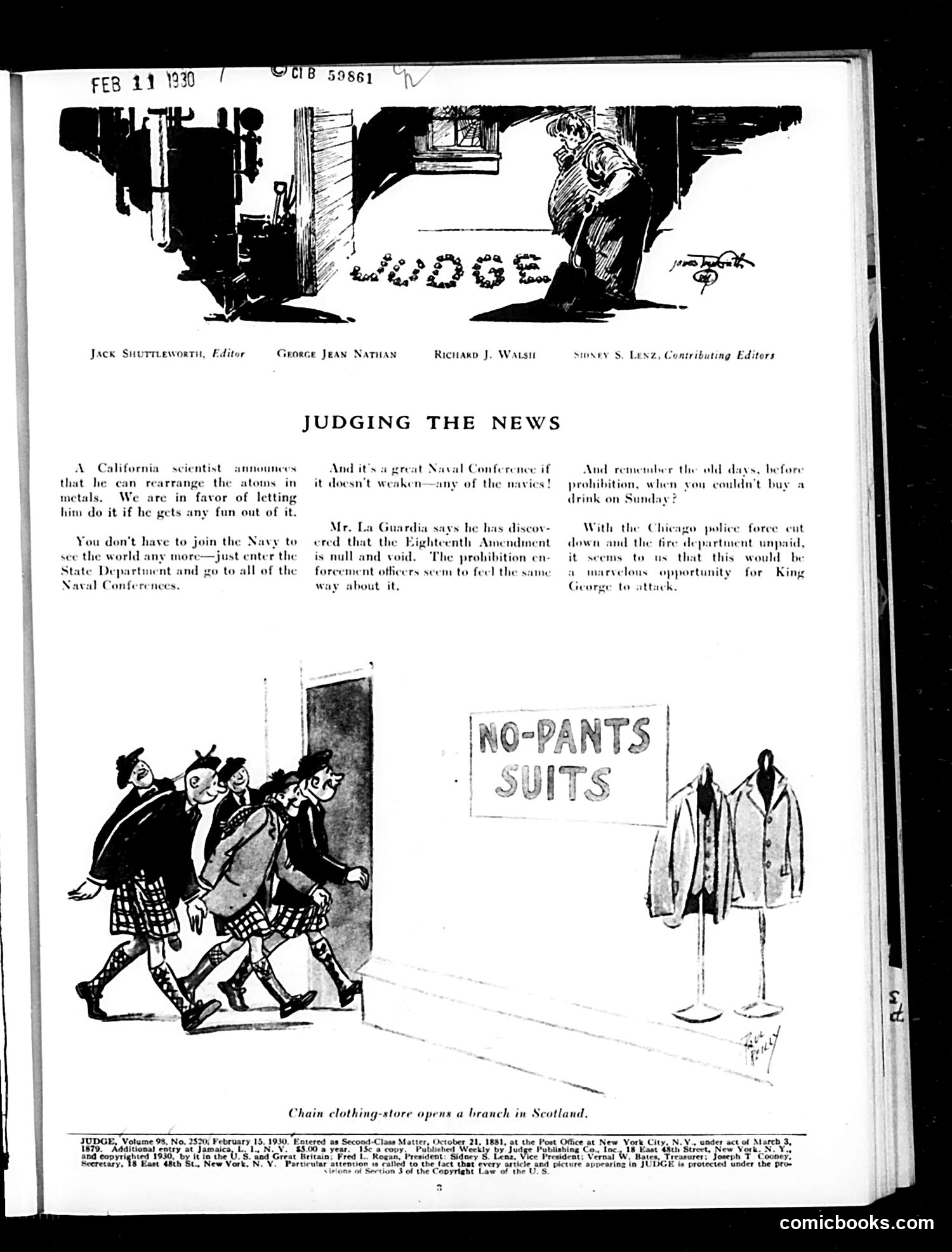
# "Judging the News" - February 11, 1930 This satirical column comments on contemporary events. The main cartoon depicts Scottish men in kilts entering a "No-Pants Suits" clothing store—a visual pun playing on the Scots' traditional dress. The joke references a chain clothing store opening a Scottish branch, with the irony being that kilts are the Scottish national garment, making "no-pants suits" redundant or absurd for that market. The text above discusses a California scientist's atomic theory, Naval Conferences, Prohibition enforcement (referencing Chicago police and King George), and Mr. La Guardia's views on the Eighteenth Amendment. These represent typical early 1930s American concerns: scientific advancement, military policy, and alcohol prohibition debates.
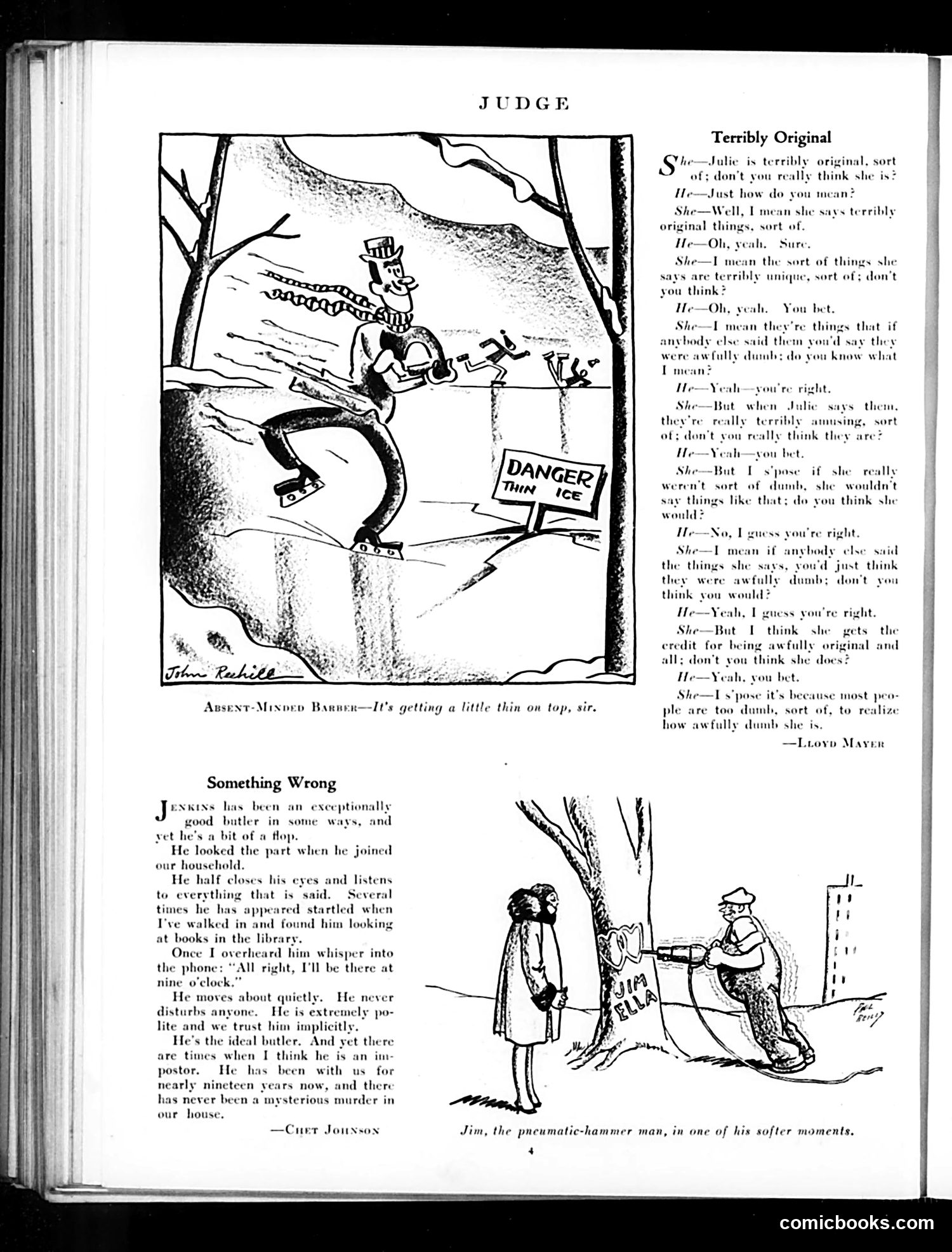
# Judge Magazine Page Analysis **Top Cartoon - "Terribly Original"**: A dialogue between a man and woman debating whether a woman named Julie is genuinely original or merely says outlandish things. The joke satirizes intellectual pretension—the couple questions whether Julie's "terribly original things" are actually clever or just deliberately absurd statements designed to seem unique. The humor targets people who confuse shocking behavior with genuine originality. **Bottom Section - "Something Wrong"**: An anecdote about Jenkins, described as an "exceptionally good butler" who appears suspiciously perfect—he's observant, quiet, trustworthy, and has served nearly nineteen years without incident. The joke's implication: his flawless behavior seems suspicious, suggesting he may be hiding something criminal. The accompanying cartoon shows "Jim, the pneumatic-hammer man" in a softer domestic moment.
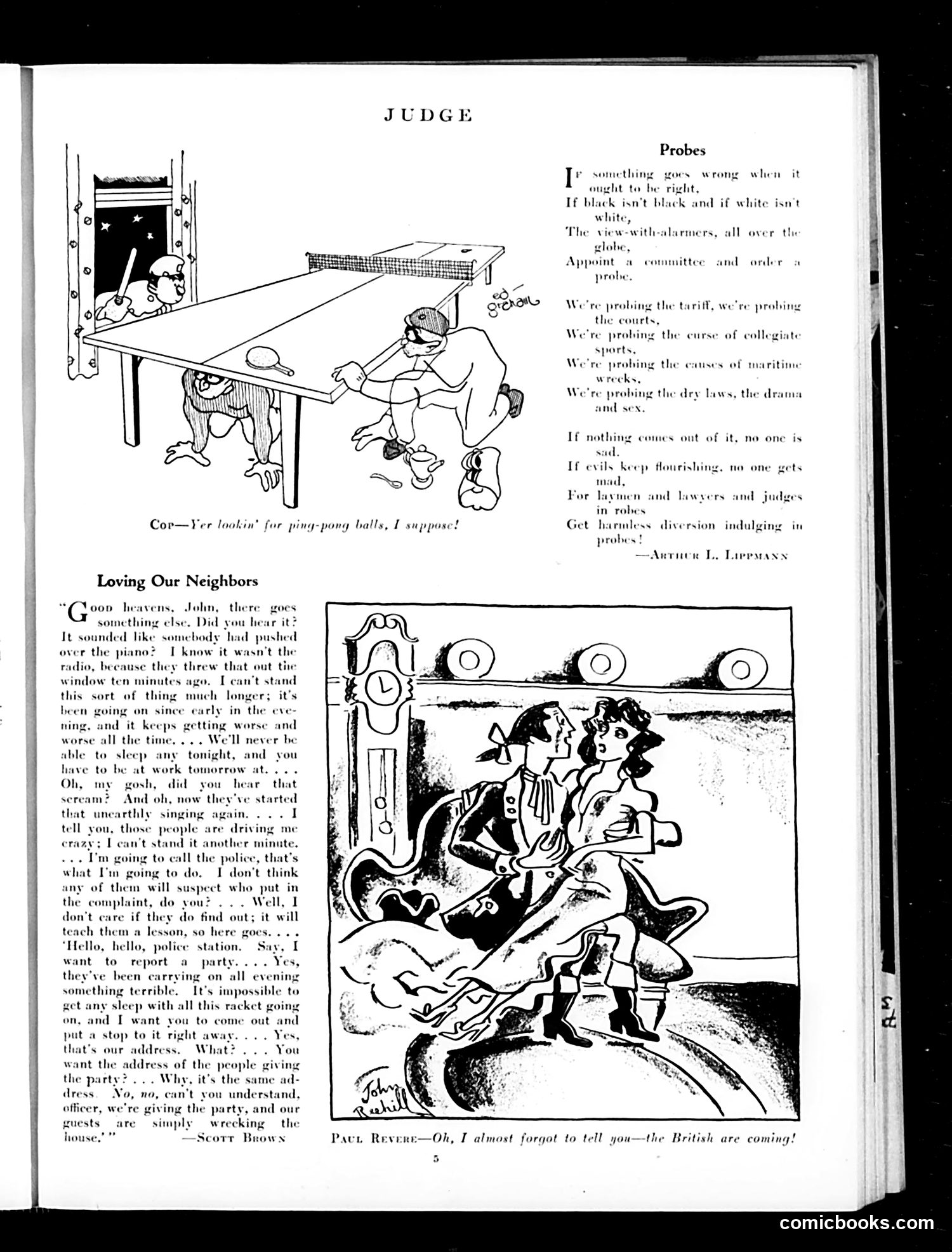
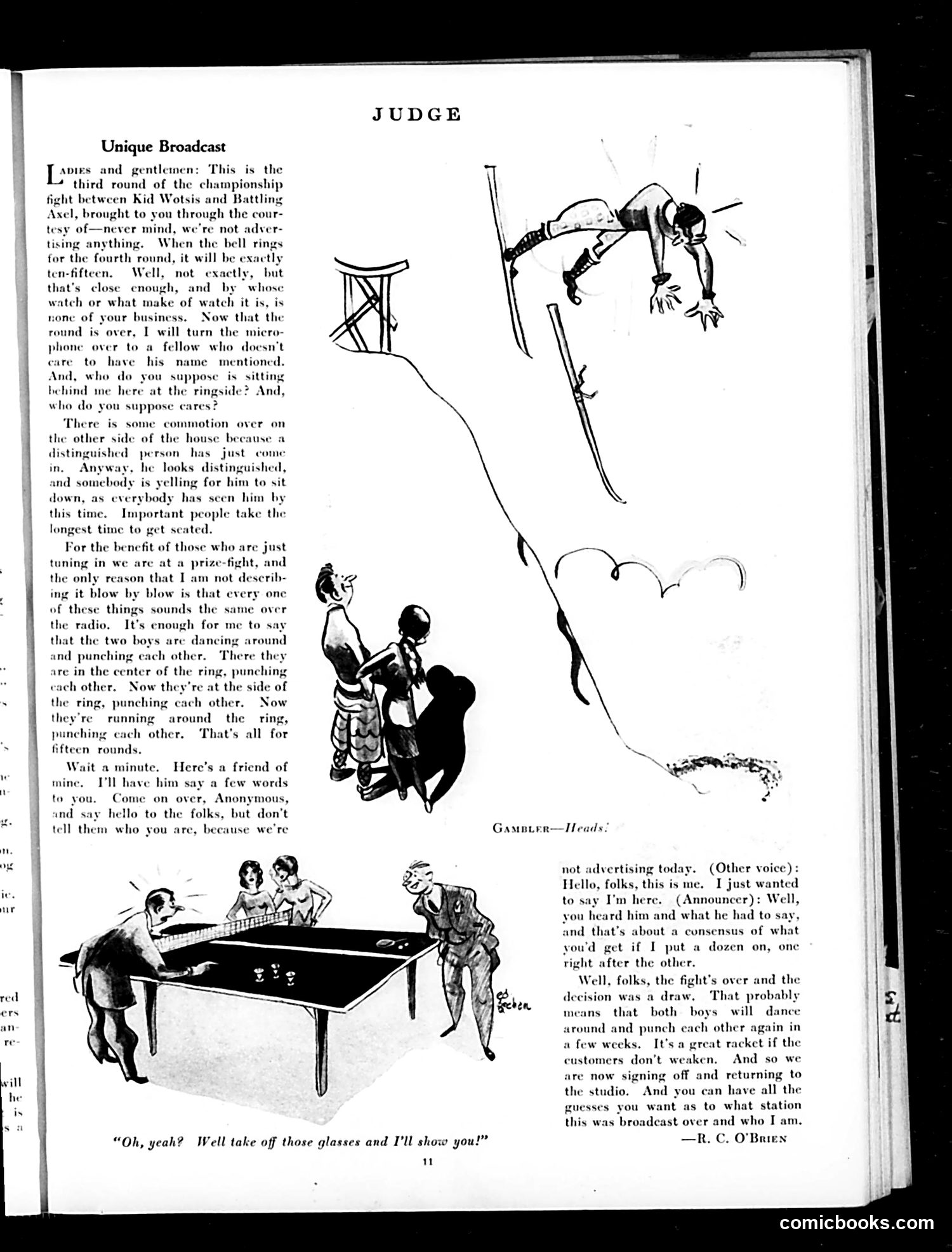
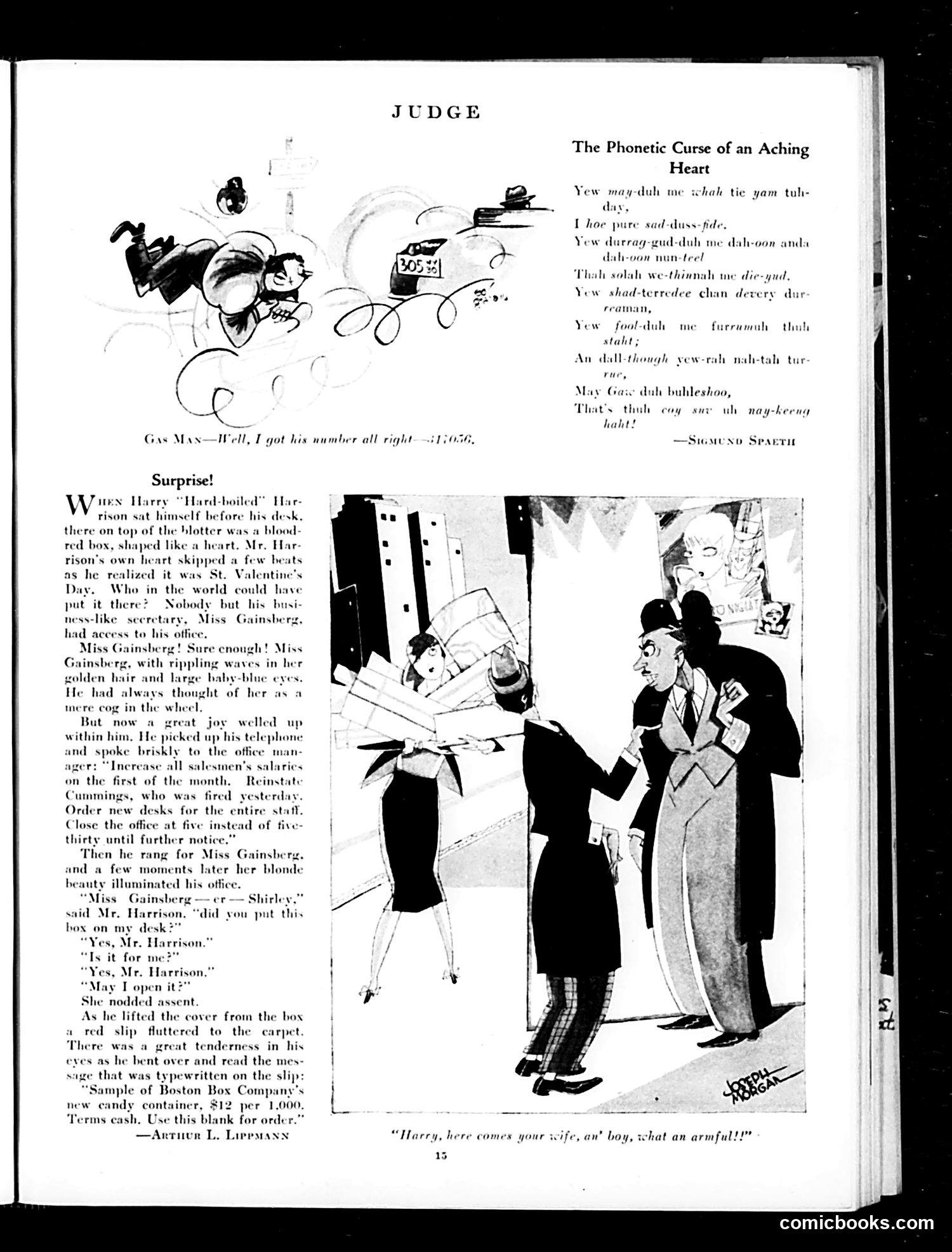
# Analysis **"Judge" was a prominent American satirical magazine, and this page contains two separate items:** **Top: "Probes"** - A poem by Arthur L. Lippmann mocking Congressional investigations ("probes"). The accompanying cartoon shows figures at a ping-pong table with someone peering through a window—likely satirizing how investigations become public spectacles or distract from substantive governance. **Bottom: "Loving Our Neighbors"** - A dialogue by Scott Brown where an exasperated neighbor complains about a noisy party next door. The cartoon illustrates two people relaxing indoors while chaos erupts outside their window, with cars visible. The final caption references "the British are coming," suggesting this is wartime satire—likely WWI era—where citizens struggle with domestic annoyances while military concerns dominate. The humor stems from mundane complaints during serious times.
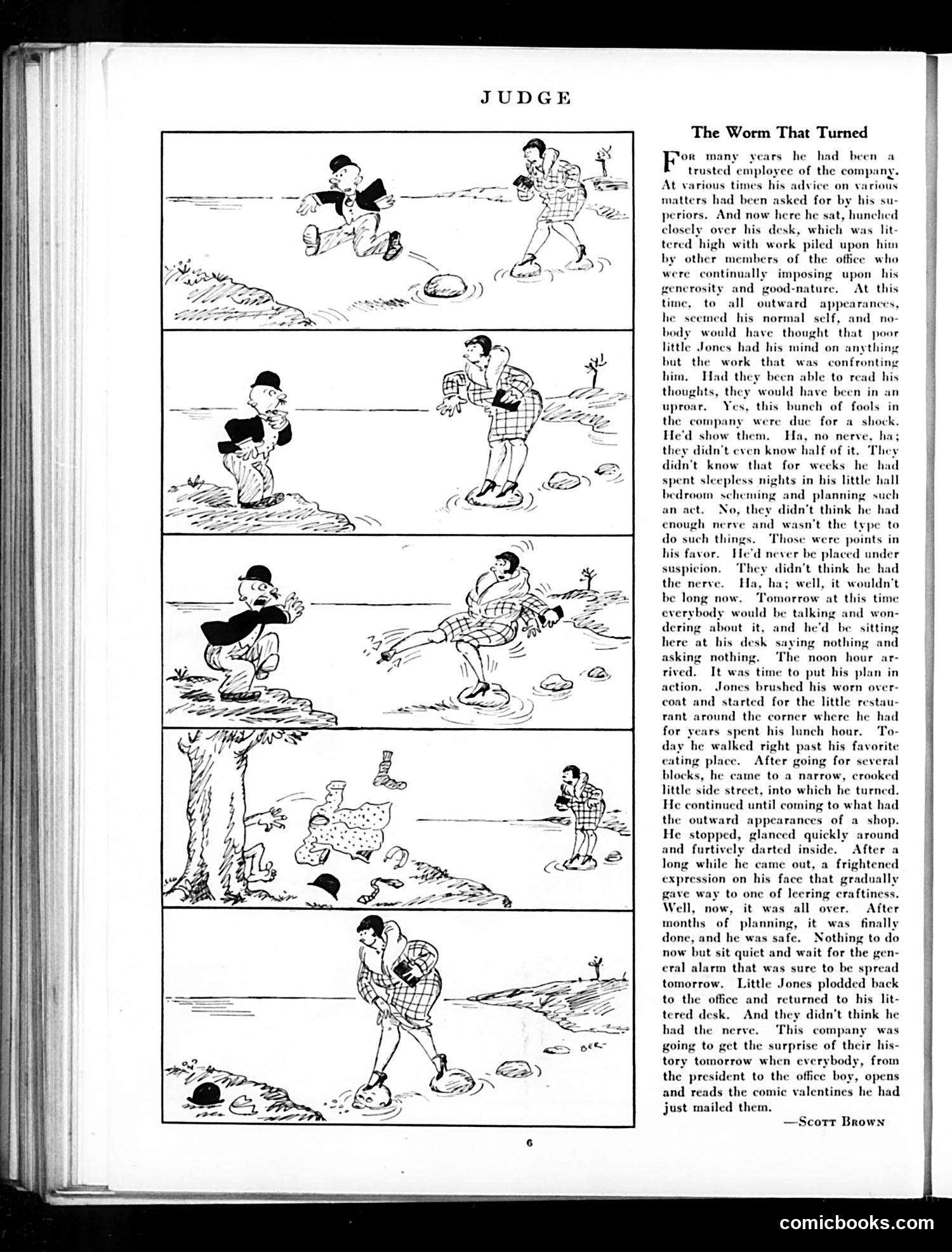
# "The Worm That Turned" by Scott Brown This comic strip depicts an office employee's revenge fantasy. A long-suffering, mild-mannered worker (Little Jones) endures years of being overlooked and imposed upon by colleagues who take advantage of his good nature. The narrative shows Jones planning an elaborate prank: he sneaks out during lunch, goes to a side street, and appears to commit suicide by jumping from a tree. His coworkers discover his apparent body. The satire mocks both the exploited employee and his callous coworkers. The "worm" (Jones) finally "turns"—turning tables through an elaborate hoax meant to shock those who never appreciated him. It's a darkly humorous commentary on workplace dynamics and the resentment built through years of being taken for granted, culminating in a revenge fantasy.
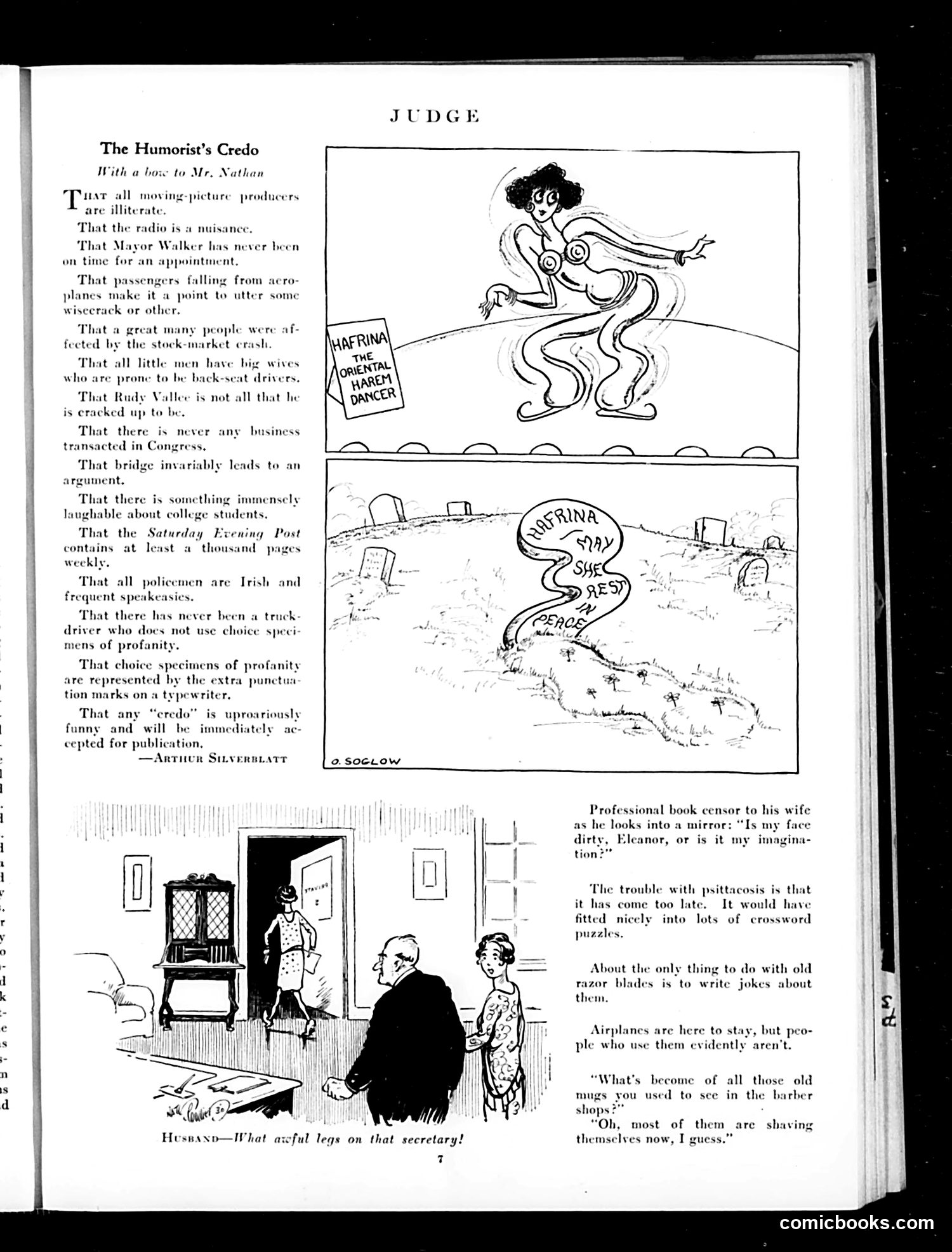
# Judge Magazine Page Analysis This page contains satirical commentary on 1920s-30s American life. "The Humorist's Credo" by Arthur Silverblatt mockingly lists tired clichés that humorists rely on: illiterate movie producers, radio as nuisance, Mayor Walker's tardiness (a NYC political figure), the stock market crash's effects, and stereotypes about policemen and truck drivers using profanity. The cartoons include two surreal strips featuring "Marfina the Oriental Harem Dancer" (likely spoofing exotic dance fads) and several one-liner jokes about contemporary concerns—psittacosis (a disease), old barber shop mugs, and secretaries' legs. The "professional book censor" joke references 1920s censorship debates. Overall, the page satirizes both mass entertainment formulas and modern anxieties about technology (radio, airplanes), morality, and social change, while gently mocking the magazine's own reliance on predictable humor.
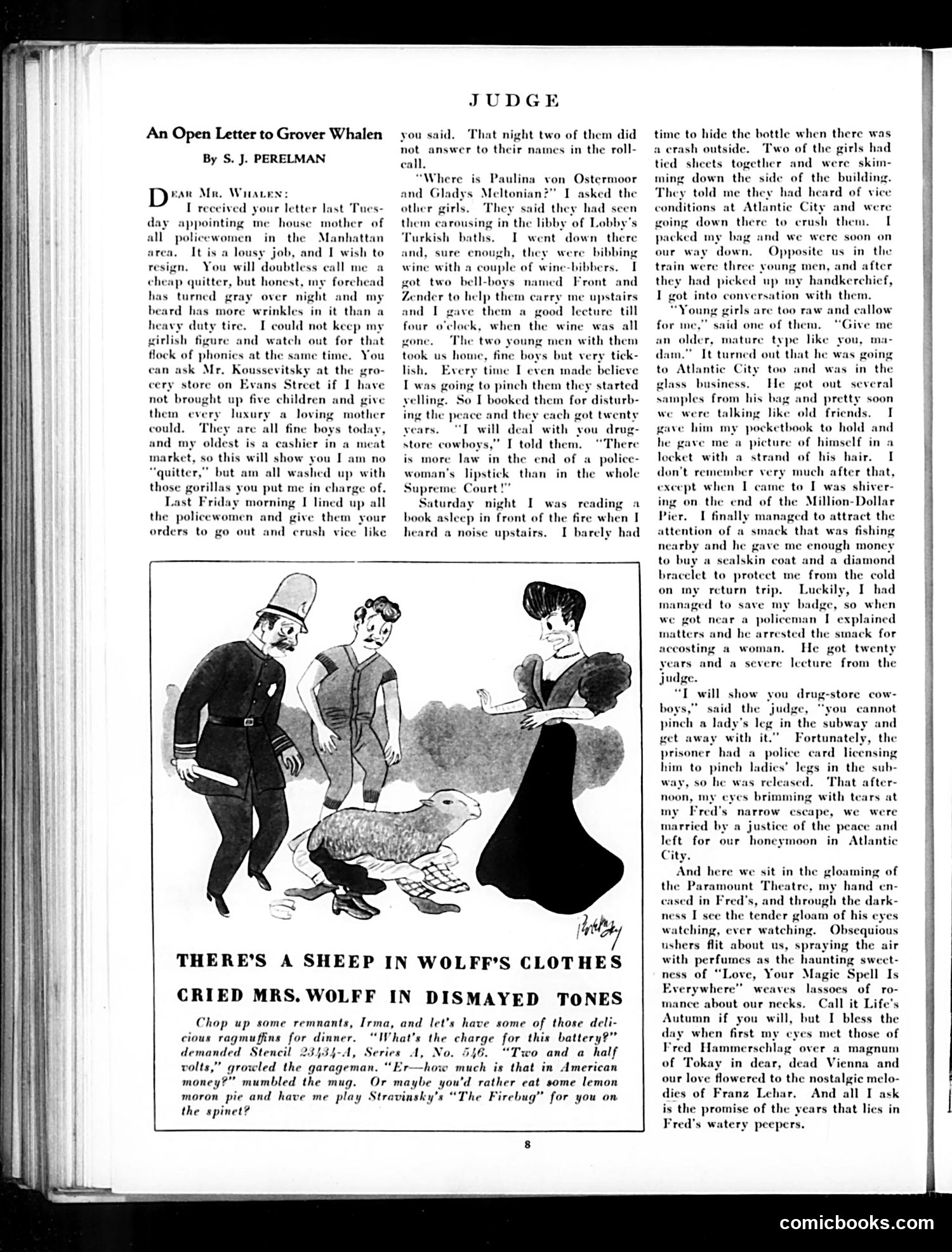
# Judge Magazine Satire Analysis This page satirizes **Grover Whalen**, New York City's public relations figure and police commissioner, through a mock "open letter" by humorist S.J. Perelman. The joke: Whalen appointed Perelman as "house mother" overseeing policewomen tasked with "crushing vice" in Manhattan. Perelman's letter describes comical chaos—policewomen getting drunk in Turkish baths, young men tickling officers (resulting in 20-year sentences), and Perelman herself being seduced and robbed by a smooth-talking confidence man ("the smack"). **The satire targets:** - Whalen's aggressive moral policing campaigns of the era - The absurdity of treating grown policewomen like unruly children needing supervision - The ineffectiveness of crusades against urban vice—criminals outwit the enforcers - Gender dynamics: the "house mother" framing undermines female officers' authority The accompanying cartoon shows an elegant woman lecturing three figures (likely representing police/authority), reinforcing the theme of ineffectual moralizing. The text's embedded advertisements parody prohibition-era prudishness, asking whether to serve "lemon moron pie" instead of alcohol.
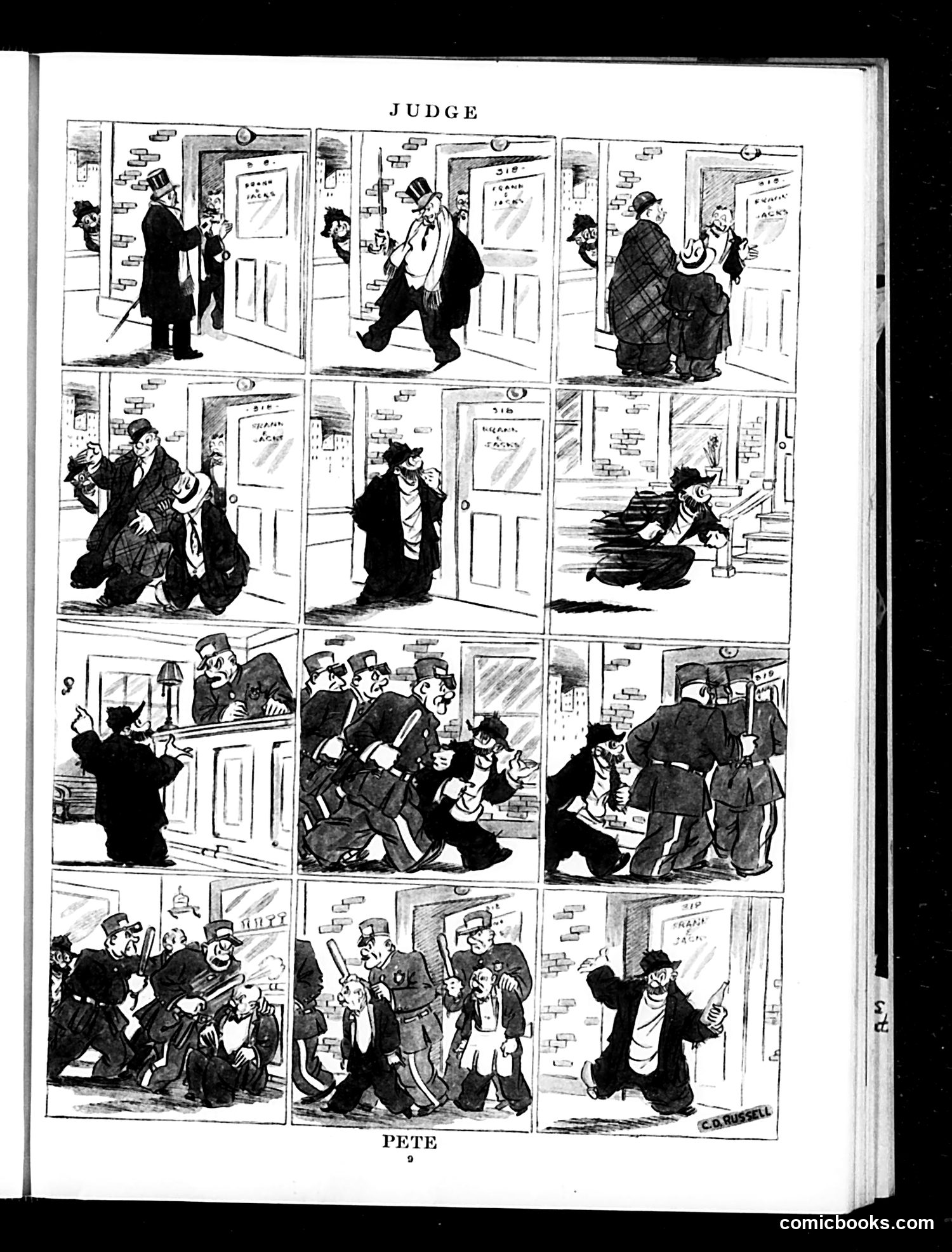
# "Judge" - "Pete" Comic Strip This is a multi-panel comic strip titled "PETE" (credited to C.B. Russell) depicting a man's chaotic encounters at what appears to be a government building, likely a courthouse or judge's office (given the "JUDGE" header). The narrative shows Pete repeatedly entering and exiting through doors marked with office numbers, creating escalating comedic situations. Other men in suits and hats—appearing to be officials, lawyers, or clerks—react with confusion and alarm to his presence. The comedy derives from Pete's apparent inability to locate the correct office or navigate bureaucratic spaces, resulting in physical comedy and collisions. The satire likely mocks the frustrations of navigating government bureaucracy in early 20th-century America, a common theme in Judge magazine's satirical humor.
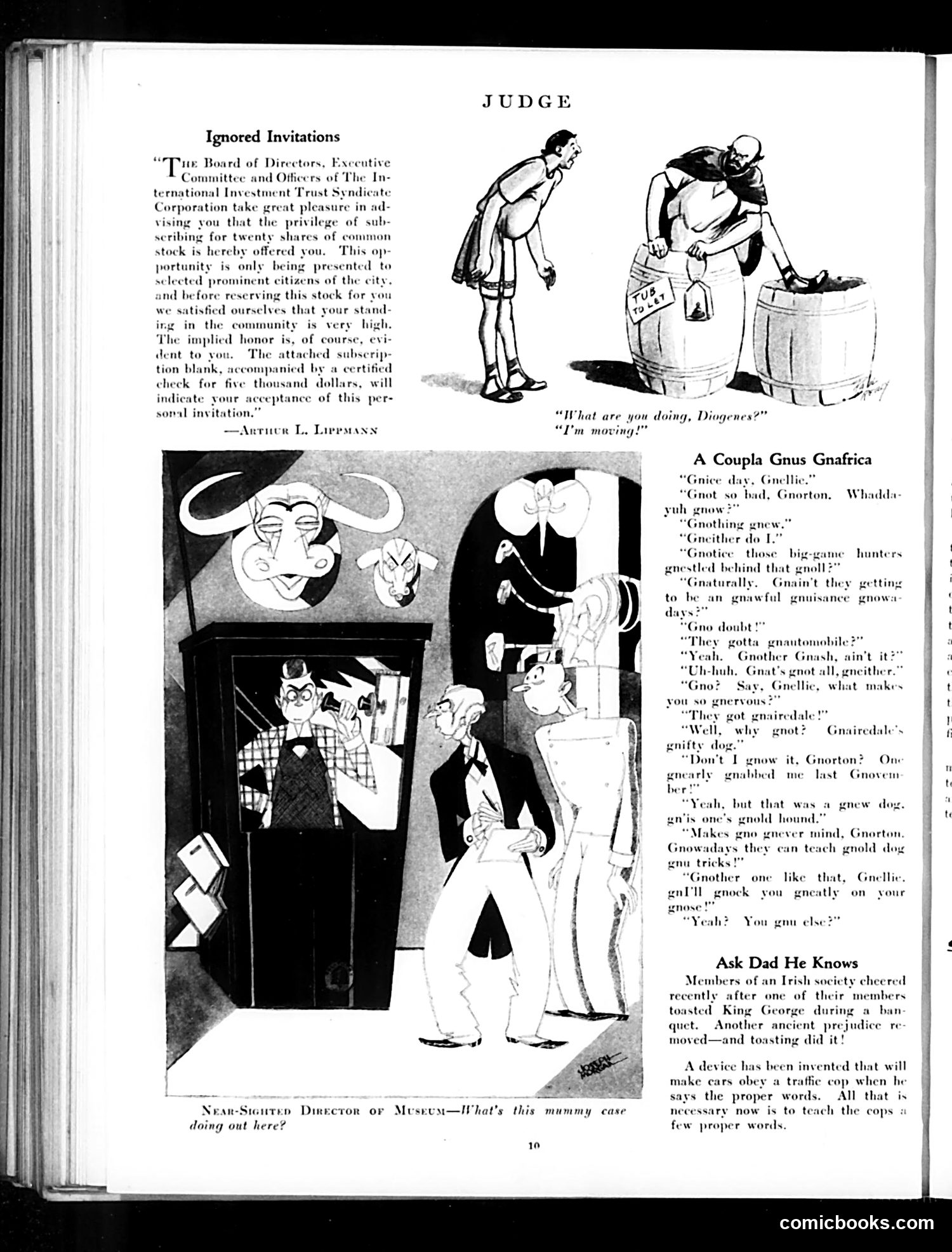
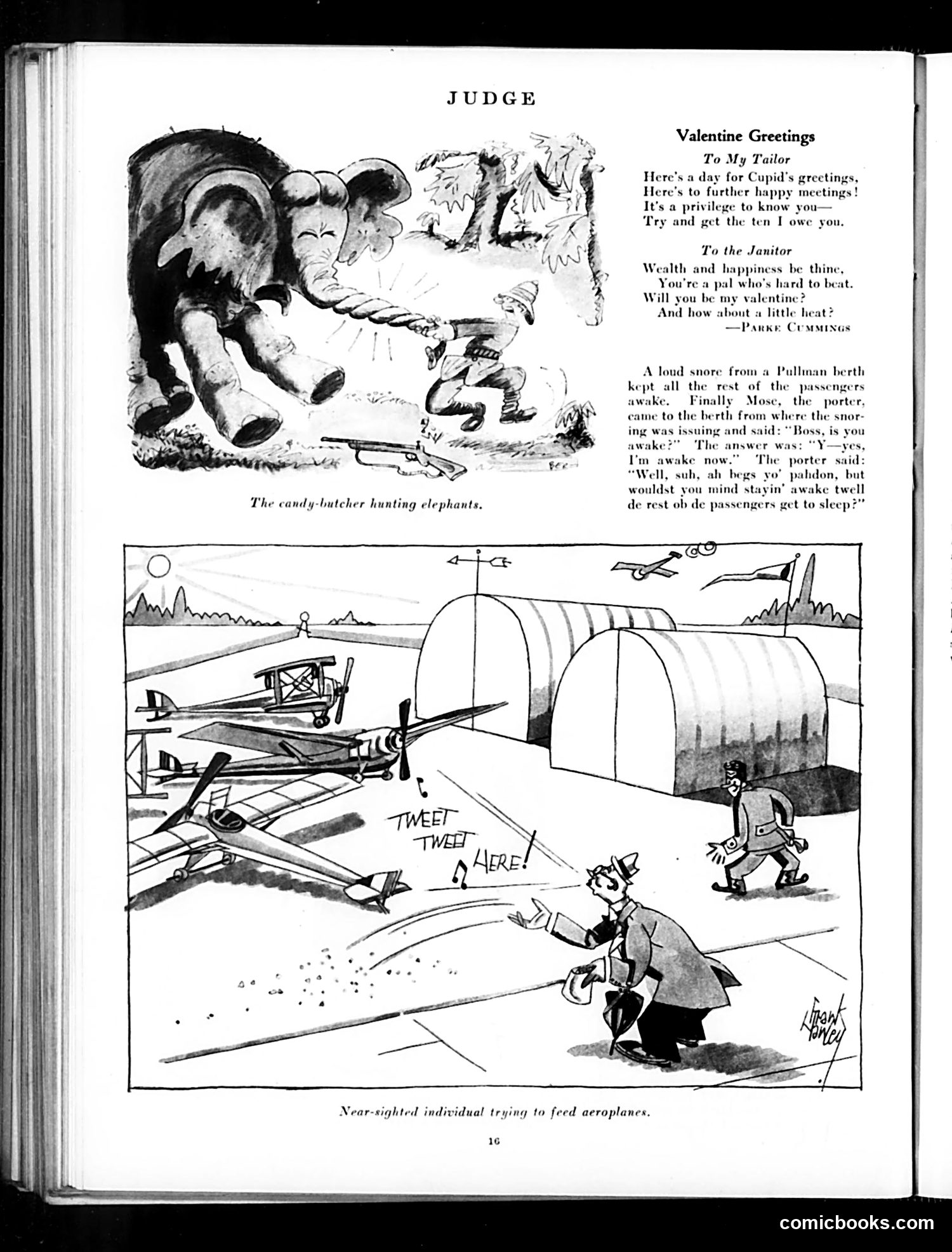
# Judge Magazine Page Analysis **Top Cartoon: "Ignored Invitations"** This satirizes aggressive investment solicitation. A well-dressed man presents stock subscription offers to prominent citizens, using flattery about their standing in the community. The humor lies in the transparent sales tactic—the "honor" is clearly just targeting wealthy marks. The accompanying text by Arthur L. Lippmann mocks how such invitations exploit vanity. **Middle Cartoon: "Near-Sighted Director of Museum"** Shows a museum director confused by what appears to be a mummy case, asking "What's this mummy case doing out here?" The humor derives from his apparent obliviousness to his own museum's contents—a joke about absent-minded authority figures or poor administrative oversight. **Right Column: "A Coupla Gnus Gnafrica"** A pun-heavy dialogue between two gnu characters using forced "gn-" sound wordplay ("gnew," "gnaw," etc.). This is primarily a joke vehicle for phonetic humor rather than social satire. **"Ask Dad He Knows"** A brief item noting an Irish society toasted King George, suggesting prejudice was overcome. It concludes with a joke about needing to teach police "proper words"—likely an ethnic stereotype about Irish speech.