
Judge, 1930-02-15 · page 15 of 36
Judge — February 15, 1930 — page 15: what you’re looking at
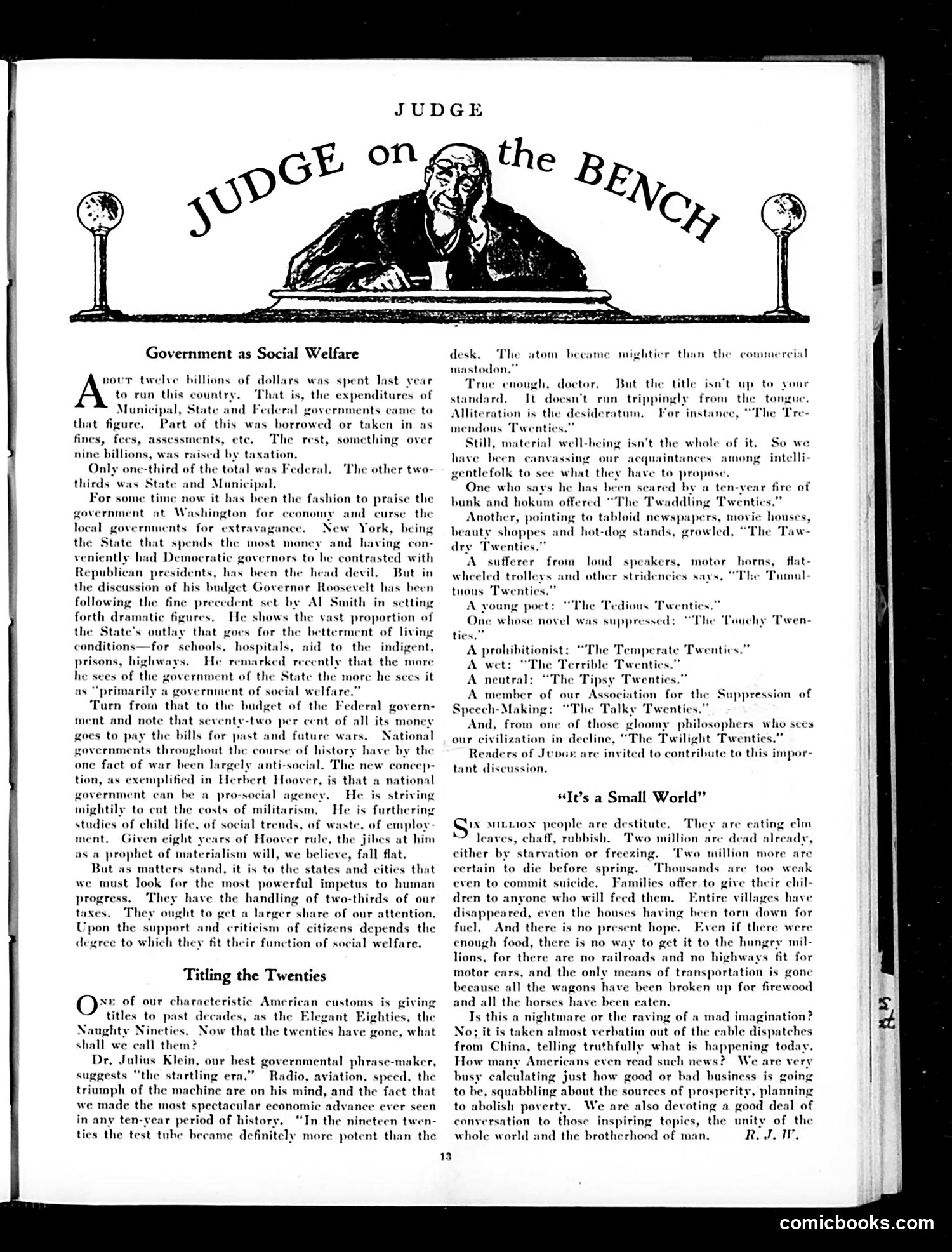
A restored page from Judge, 1930-02-15. Page through the whole issue in the reader above.
📄 Transcribed text from this page (OCR, searchable)
Machine-transcribed from the original scan — historical spelling and the odd misread are preserved.
JUDGE Government as Social Welfare nour twelve billions of dollars was spent last year to run this country, That is, the expenditures of Munic 1, 1 Federal governments came to that figure. Part of this was borrowed or ts fines, fees, assessments, ete. The nine billions, was raised ation, Only one-third of the total was Federal. thirds was State and Municipal. For some time now it has been the fashion to praise the government local governments for extravag: New the State that spends the most money veniently had Democratic governors to be contrasted with Republican presidents, has been the head devil. But in the discussion of his budget Governor Roosevelt has been following the fine precedent set by Al Smith in. setting forth dramatic figures. He shows the vast proportion of the State's outlay that goes for the betterment of living conditions—for schools, hospitals, aid to the indigent, prisons, highways. He remarked recently that the more he sees of th ernment of the State the more he sees it as “primarily a government of social welfare.” Turn from that to the budget of the ment and note that seventy-two per cent of goes to pay the billy for past and future wars. governments throughout the course of history 1 one fact of war been largely anti-soc tion, as exemplified in Herbert Hoov government can be a pro-social agency. He is: striving mightily to cut the costs of militarism. He is furthering studies of child life, of social trends, of waste, of employ ment. Given eight years of Hoover rule, the jibes at him prophet of materialism will, we believe, fall flat. But as matters stand, it is to the states and cities that we must look for the most powerful impetus to human They have the handling of two-thirds of our They ought to gi rger share of our attention, Upon the support and criticism of citizens depends the degree to which they fit their function of social welfare. en in as rest, something over The other two- at Washington for ¢ and curse the York, being d having con- onomy Jeral_govern- all its money National ve by th 1. The new concep- r. is that a national ass Titling the Twenties O™ of our characteristic Ameri titles to ades, as the E Naught shall we call Dr. Julius Klein, our best governmental phrase-maker, suggests “the startling era.” Radio, aviation, speed, the triumph of the machine are on his mind, and the fact that we made the most spectacular economic advance ever seen in any ten-year period of history. “In the nin twen- ties the test tube became definitely more potent than the n customs is giving hties, the s have gone, what desk, The mastodon,” True enough, doctor. But the title isnt up to ve dard. It run trip| Alliteration is the desideratum, mendous Twenties.” Still, material well-being isn't the whole of it. have been canvassing our a gentlefolk to see what the One who says he has | nd hokum offered inting to tabloid newspa nd hot-dog stands, growled, atom beeame mightier than the commercial doesn't aly fron For instance So we among. intelli- rar fire of Twenties.” s, movie houses, The Taw- dry Twent A sufferer from loud speaker wheeled trolleys and other strid tuous Twenties. roung poct: whose novel was suppressed: The flat- mul- motor ries Says The Tedious Twenties.” achy ‘Twen- ate Twenties.” The Terrible Twenties.” : “The Tipsy Twenties.” ition for th ky Twentic somy philosophers who sees The ight Twenties.” ¢ invited to contribute to this impor- A prohibitionist: “The Tem A wet A neutrs A me Speech-Ma And, from onc zation in decline aders of Jupcr tant discussion. Suppression of those “It’s a Small World” They are eating elm Two million are dead ion or freezing. IX MILLION people are destitute. : T, rubbish. cither by starva certain to die before spring even to commit suicide. dren to anyone who will fe x disappeared, even the hou already, ‘Two million more are Thousands are too weak Families offer to give their chi Entire villages have ig bee down for fuel, And there is no present hope. Even if there were enough food, there is no way to get it to the hungry mi lions, for there are no railroads and no highways fit for motor cars, and the only means of transportation is gone because all the wagons have been broken up for firewoo and all the horses Is this a nightmare or the raving of a mad imagination? No; it is taken almost verbatim out of the cable dispate! from China, telling truthfully what is happening toc How many Americans even read such news? We are vi busy calculating just how good or bad business is going to be, squabbling about the sources of prosperity, planning to abolish poverty. We are also devoting a good deal of conversation to those inspiring topics, the unity of the whole world and the brotherhood of man, R.ILW. ve been eaten. comicbooks.com