
Judge, 1930-02-15 · page 30 of 36
Judge — February 15, 1930 — page 30: what you’re looking at
A restored page from Judge, 1930-02-15. Page through the whole issue in the reader above.
📄 Transcribed text from this page (OCR, searchable)
Machine-transcribed from the original scan — historical spelling and the odd misread are preserved.
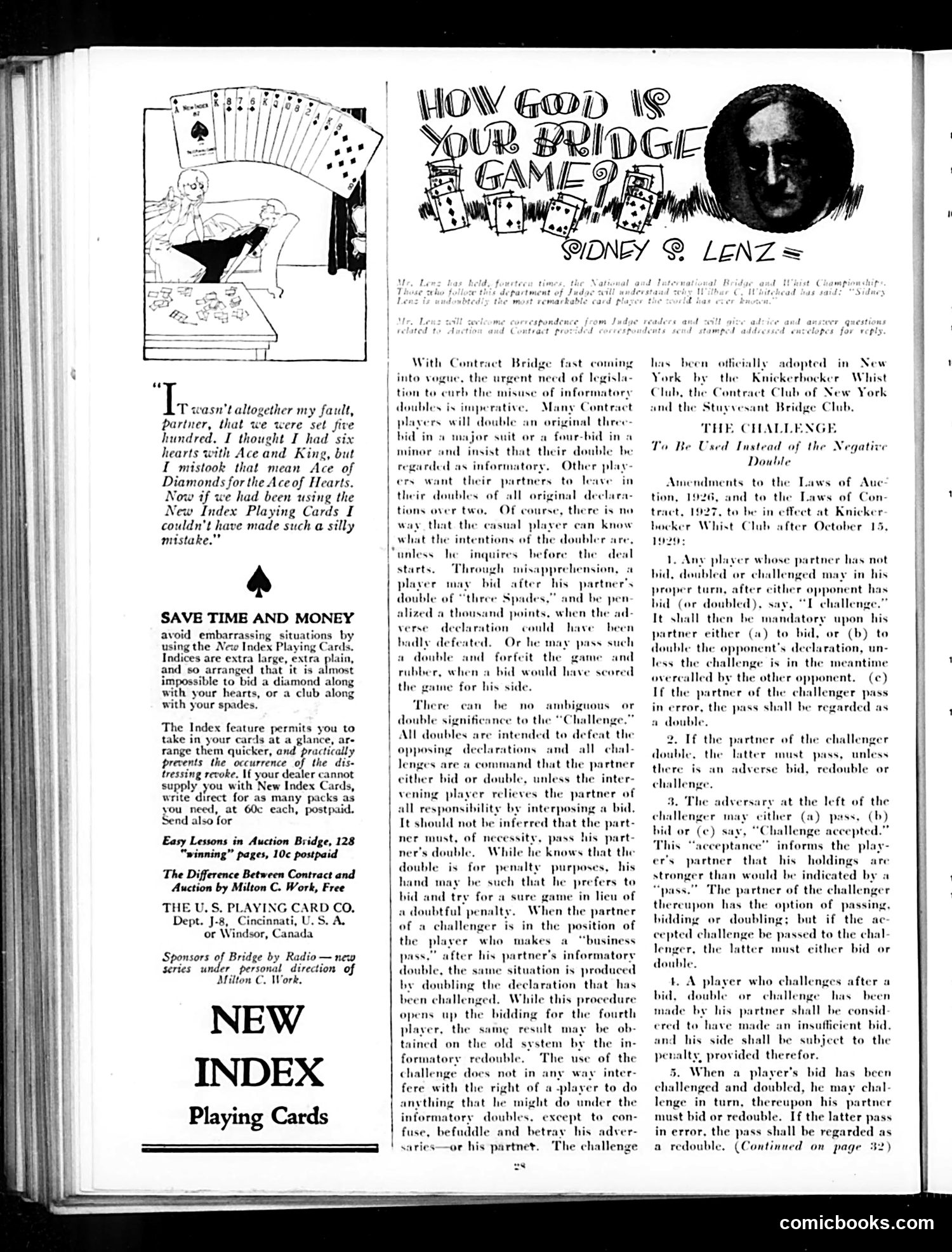
L wasn'taltogether my fault, Partner, that we were set five hundred. I thought I had six hearts with Ace and King, but I mistook that mean Ace of Diamonds for the Ace of Hearts. Now if we had been using the New Index Playing Cards I couldn't have made such a silly mistake.” SAVE TIME AND MONEY avoid embarrassing situations by using the New Index Playing Cards, Indices are extra large, plain, and so arranged tha nost impossible to bid a diamond along with your hearts, or a club along with your spades, The Index feature permits you to take in your cards at a glance, ar- range them quicker, and practically prevents the occurrence of the dis- tressing revoke. If your dealer cannot supply you with New Index Cards, write direct for as many packs as you need, at 60c each, postpaid. Send also for Easy Lessons in Auction Bridge, 128 “winning” pages, 10c postpaid The Difference Between Contract and Auction by Milton C. Work, Free THE U.S, PLAYING CARD CO, Dept. J-8, Cincinnati, U.S. A. or Windsor, Canada Sponsors of Bridge by Radio — new fe series under personal direction of Milton C. Work. NEW INDEX Playing Cards = “unless he inqu opposing With Contract Bei t need of legisl rh the misuse of informa *. the urg rig three- or suit ora four-bid ina nsist that their ; regarded as informatory. Other ers want their partners to their doubles of all orig’ tions over two. Of course, there is no way that the casual player can know what the inten publer are, the deal pprebension, a his partner's starts. Through 1 player may bid double of “three a thousand p nts. when the tion could have fh ed. Or he may pass such and forfeit: the rubber, when a bid would have scored the game for his side. ame and There can be no ambiguous or double sign ance to the All dito t the all chal- the partner cither bid or double, unless the inter- vening player relieves the partner of all responsibility by interposing a bid. It should not be inferred that the part- ner must, of necessity, pass his part- ner's While he knows that the double ix. for penalty hand tay be such tl bid and try a doubtful p of a chall the } nges are purposes, his t he prefers to sure in lieu of When the partner nger is in the position of rt who makes a “business fter his partner's informatory double, the same situation is produced by doubling the tion that has been challenged. this procedure opens up the bidding for the fourth rr, the same result may be ob- don the old system by the in- formatory redouble. The use of the challenge docs not in any way inter- fere with the right of a-player to do anything that he might do under the informatory doubles, except to con- | fuse, befuddle and betray his adver- saries—or his partnet. The challenge HOW GD \e ou PRI IDGE has been officially adopted in’ New York by the Knickerbocker Whist Club, the Contract Club of New York and the Stuyvesant Bridge Club, THE CHALLENGE To Be Used Instead of the Negative Double Amendments to the Laws of Aue tion, 1926, and to the Laws of Con- tract, I in effect at Kn hocker Whist Club after Octo! 1. Any player whose partner has not hid, doubled ‘or challenged may in his proper turn bid (or doubled), s: It shall then he upon his or (b) to un- less the cl ntime overealle (ce) If the partner of the challenger pass in error, the pass shall be regarded as a double. 2. If the partner of the challenger double, the there is x latter must pass, unless idverse bid, redouble or (a) ¥ “Challenge accepted.” " informs the pk "dings! “pass.” The partner of the challenger upon has the option of passing, bidding or doubling; but if the a cepted challenge be ’ lenger, the latter must either bid or double. A player who chi bid, double or challe made by his partner s\ consid cred t dean insufficient bid. and his side shall be subject to the penalty, provided therefor. Henges after a » has been When a player's bid has been challenged and doubled, he may chal lenge in turn, thereupon his partner must bid or redouble. If the latter pass in error, the pass shall be regarded as a redouble. (Continued on page 32) comicbooks.com