A complete issue · 38 pages · 1929
Judge — July 27, 1929
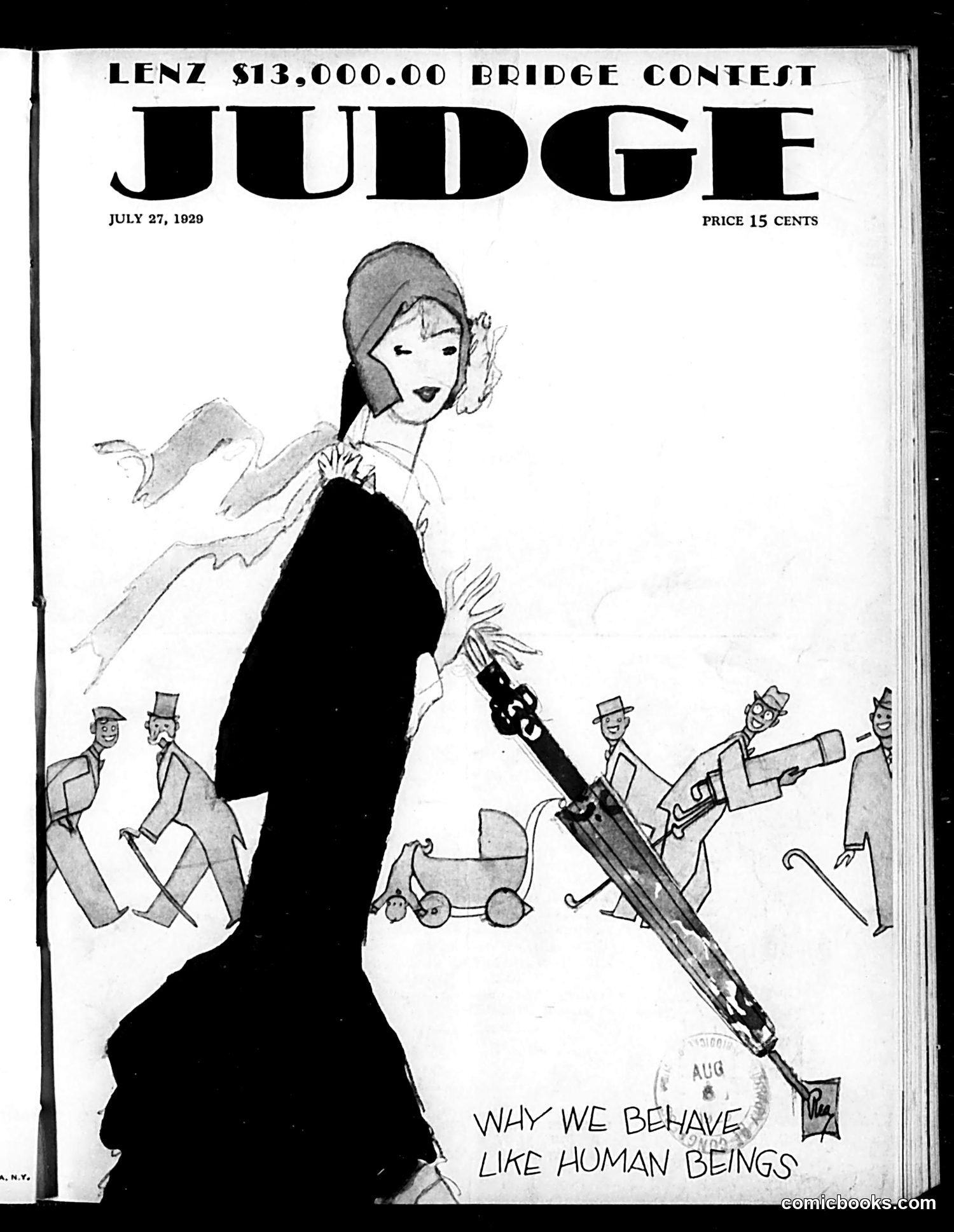
# Judge Magazine Cover Analysis This July 27, 1929 cover satirizes human behavior through the figure of an elegant woman in fashionable 1920s dress holding a rifle, surrounded by small men in top hats engaged in various activities (walking, carrying items, using umbrellas). The title "Why We Behave Like Human Beings" suggests social commentary on human nature. The woman with the gun appears to represent a dominant or controlling force, while the diminished men suggest male subservience or emasculation—likely satirizing contemporary gender dynamics or power relations. The heading "Lenz $13,000.00 Bridge Contest" indicates this relates to a specific news story or competition, though the connection between the cover illustration and that contest is unclear from the image alone.
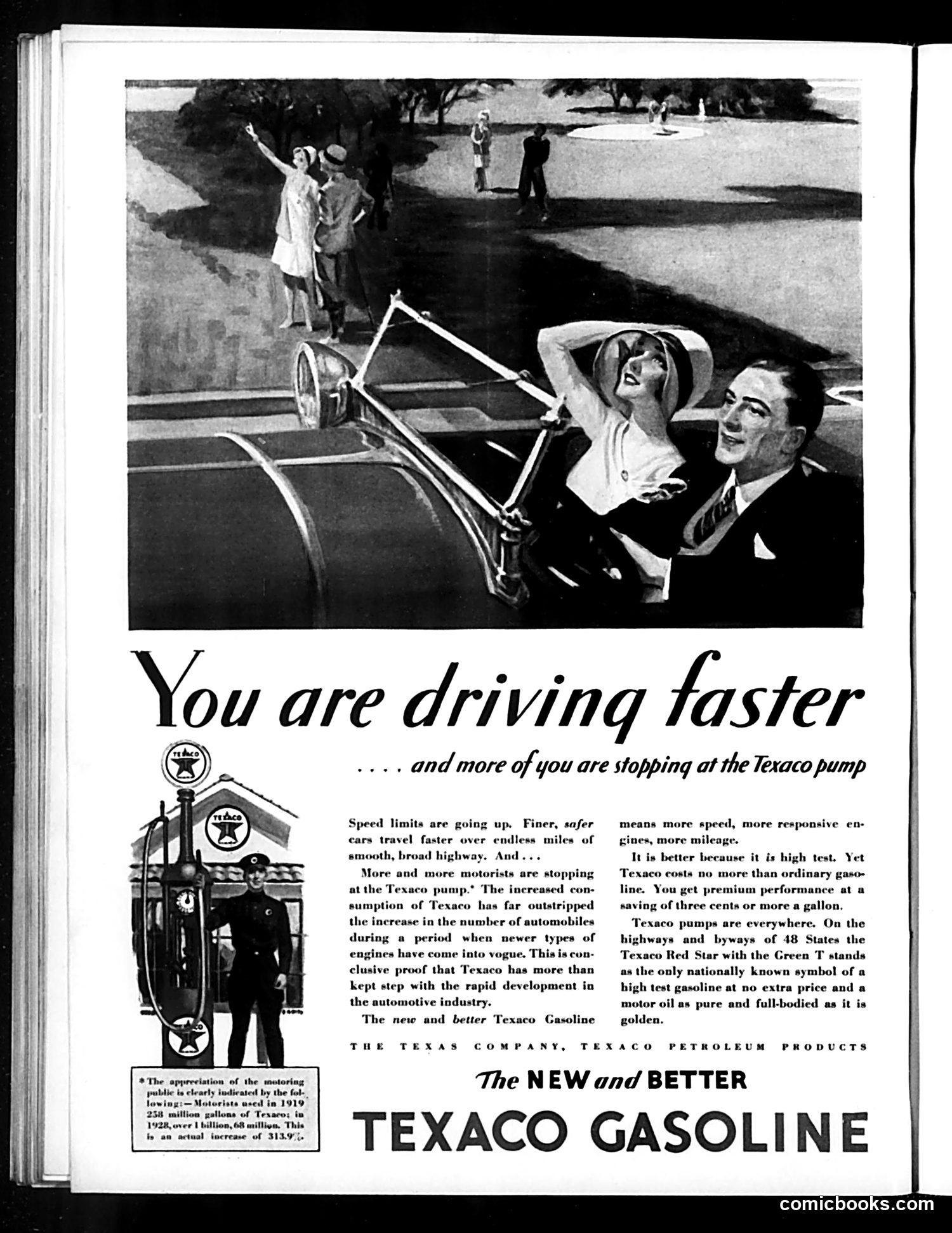
# Analysis This page is primarily a **Texaco gasoline advertisement**, not political satire. The ad's headline "You are driving faster" appeals to 1920s motorists by connecting higher speeds with modern progress and Texaco's improved fuel. The image shows a couple in an open car passing slower vehicles, suggesting Texaco's gasoline enables better performance. The accompanying text emphasizes that Texaco has kept pace with automotive industry developments, offering superior engines better responsiveness and mileage. The small statistical note credits motorists' appreciation for the motoring industry's growth, citing consumption increases from 1919 to 1928. This reflects the era's automobile enthusiasm and consumer marketing focused on technological advancement and speed as desirable modern virtues—not satirical commentary.
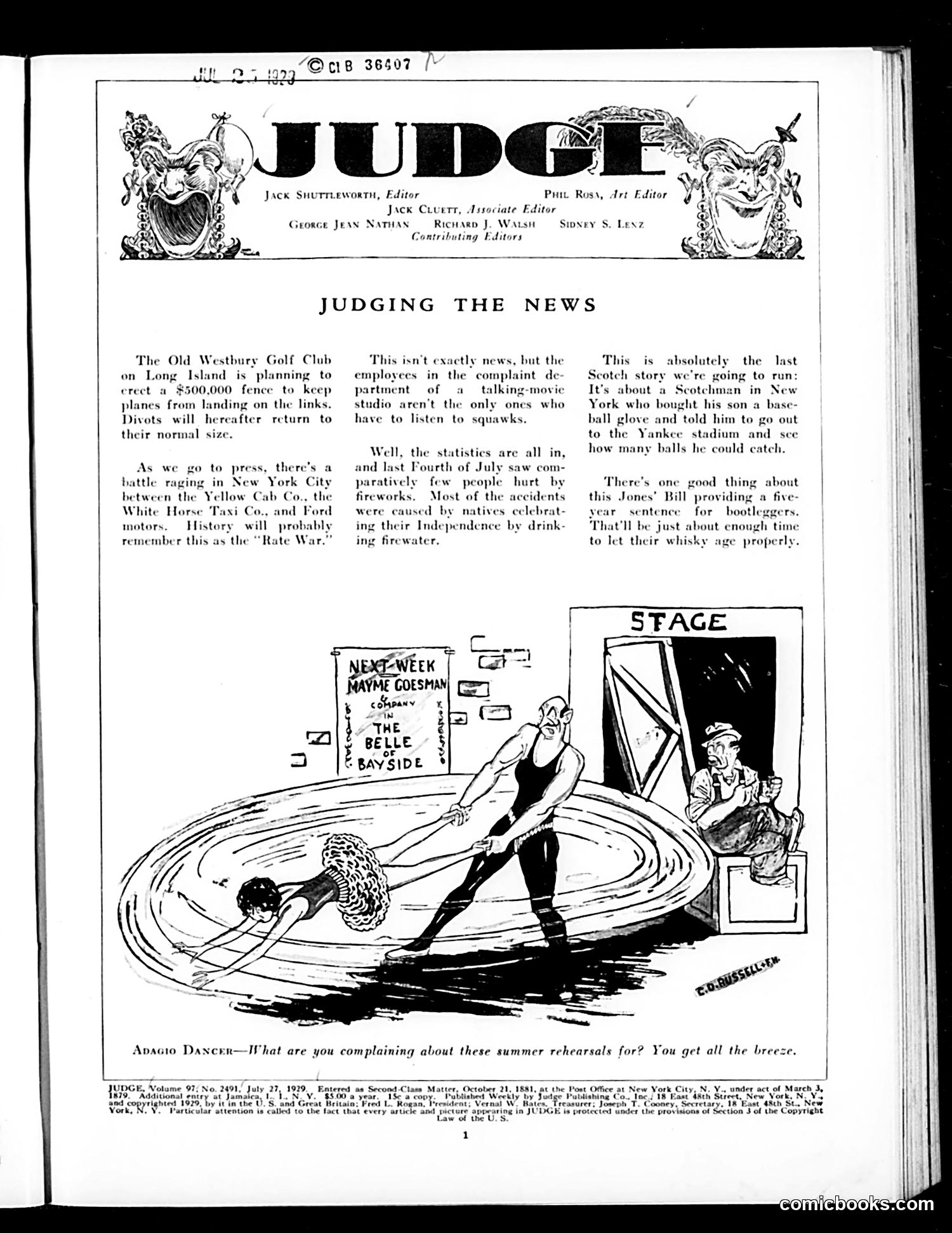
# Analysis of Judge Magazine Page (July 27, 1929) The main cartoon satirizes theatrical productions. It depicts an "Adagio Dancer" performing an energetic routine on stage, while a stagehand or director (visible at right) watches. The caption reads: "What are you complaining about these summer rehearsals for? You get all the breeze." The joke mocks summer theater rehearsals as physically exhausting work, with the complaint that at least performers get air circulation from their vigorous movements—a weak consolation for grueling rehearsal conditions in pre-air-conditioning theaters. The adjacent advertisement references "The Belle of the Bayside," promoting next week's theatrical offering with Maybie Goesman. The "Judging the News" section above comments on contemporary events: a golf club fence project, a taxi company rivalry ("Rate War"), Fourth of July fireworks accidents, and a Scotsman's baseball exploits.
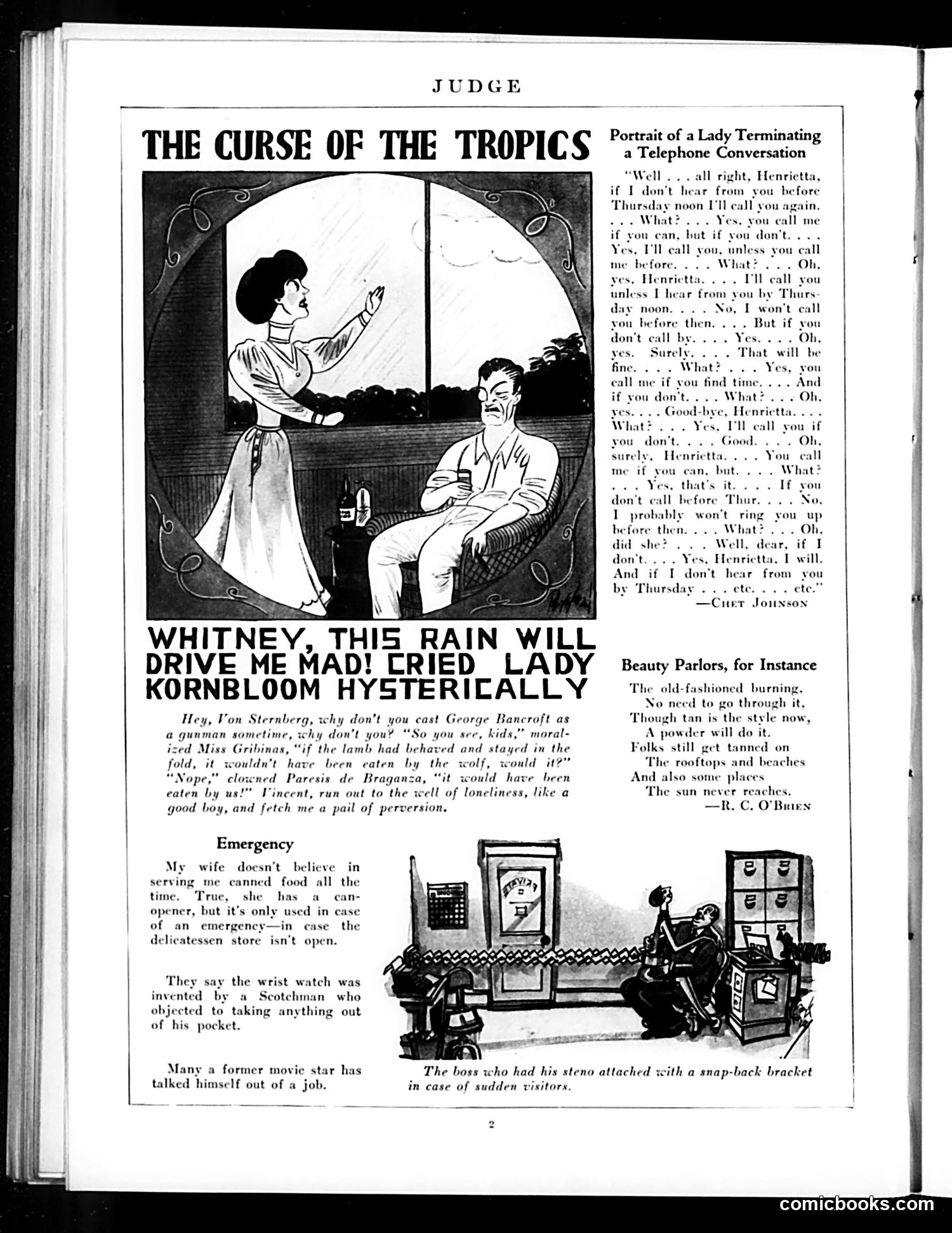
# "The Curse of the Tropics" Analysis The main cartoon depicts a woman at a window during rain, gesturing dramatically toward a man sitting indoors. The caption suggests the woman is "driven mad" by tropical rain, implying weather-induced hysteria. The accompanying text references actress Miss Gribmas and suggests that tropical climates cause psychological instability in women—a period stereotype about female emotional fragility. The other items on the page are brief humor pieces: one mocks overly elaborate feminine beauty routines, another jokes about wives using emergency canned goods, and a final quip about Hollywood actors reinventing themselves. These reflect early 20th-century Judge magazine's satirical take on contemporary social anxieties about gender, modernity, and geography—all presented as humorous observations.
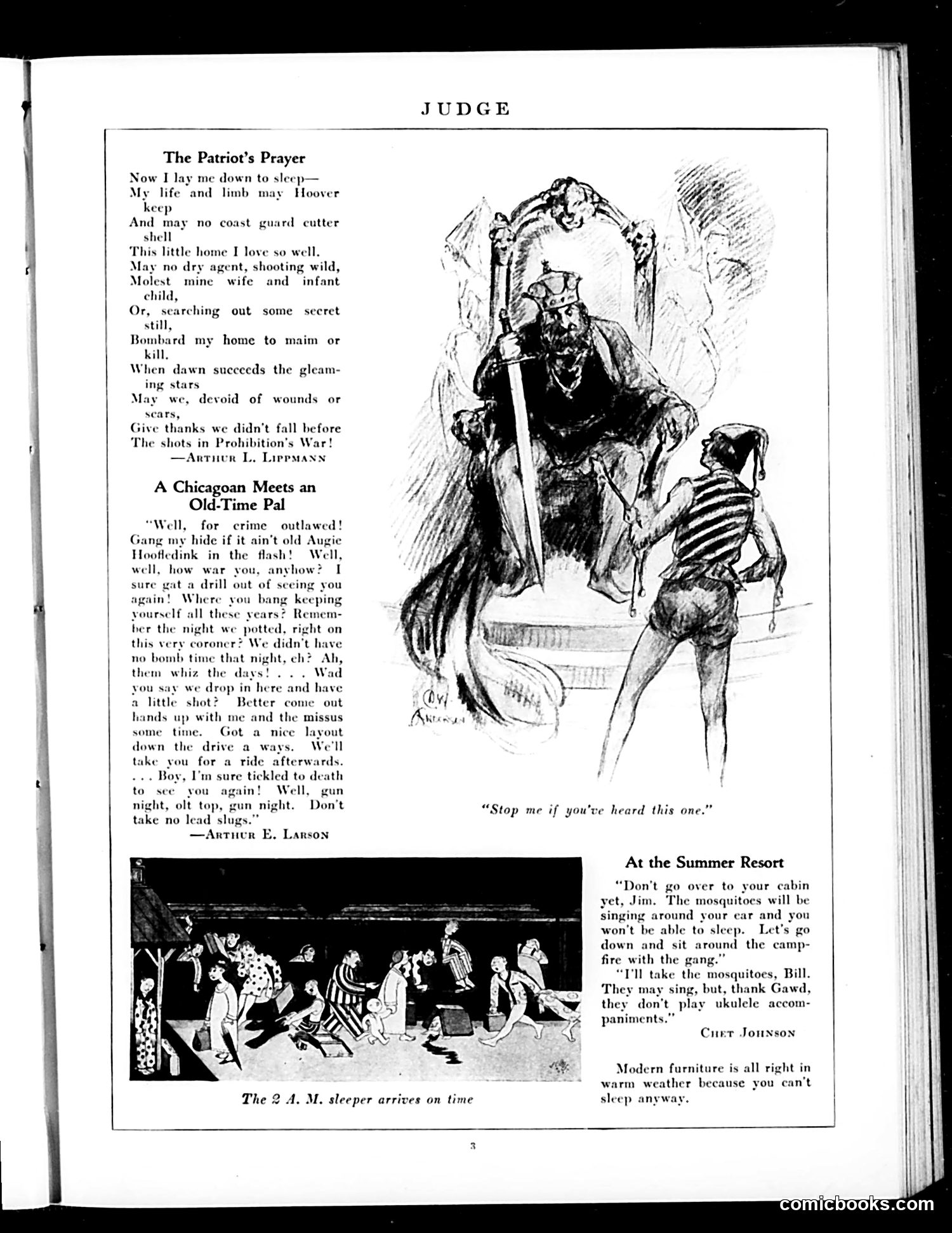
# Analysis of Judge Magazine Page This page contains three separate humor pieces rather than interconnected political cartoons. **"The Patriot's Prayer"** is a WWI-era poem by Arthur L. Lippmann expressing anxiety about protecting home and family during wartime—reflecting genuine civilian concerns during the conflict. **"A Chicagoan Meets an Old-Time Pal"** by Arthur E. Larson depicts a reunion between two men, one recently returned from prison ("crime outlawed"), joking about Chicago's criminal underworld and Prohibition-era violence. The humor relies on knowing Chicago's reputation for organized crime. **The remaining items** are brief comedic quotes about summer resort life and modern furniture, with an accompanying illustration of campers. The page reflects early 20th-century American anxieties: wartime safety, urban crime, and leisure culture.
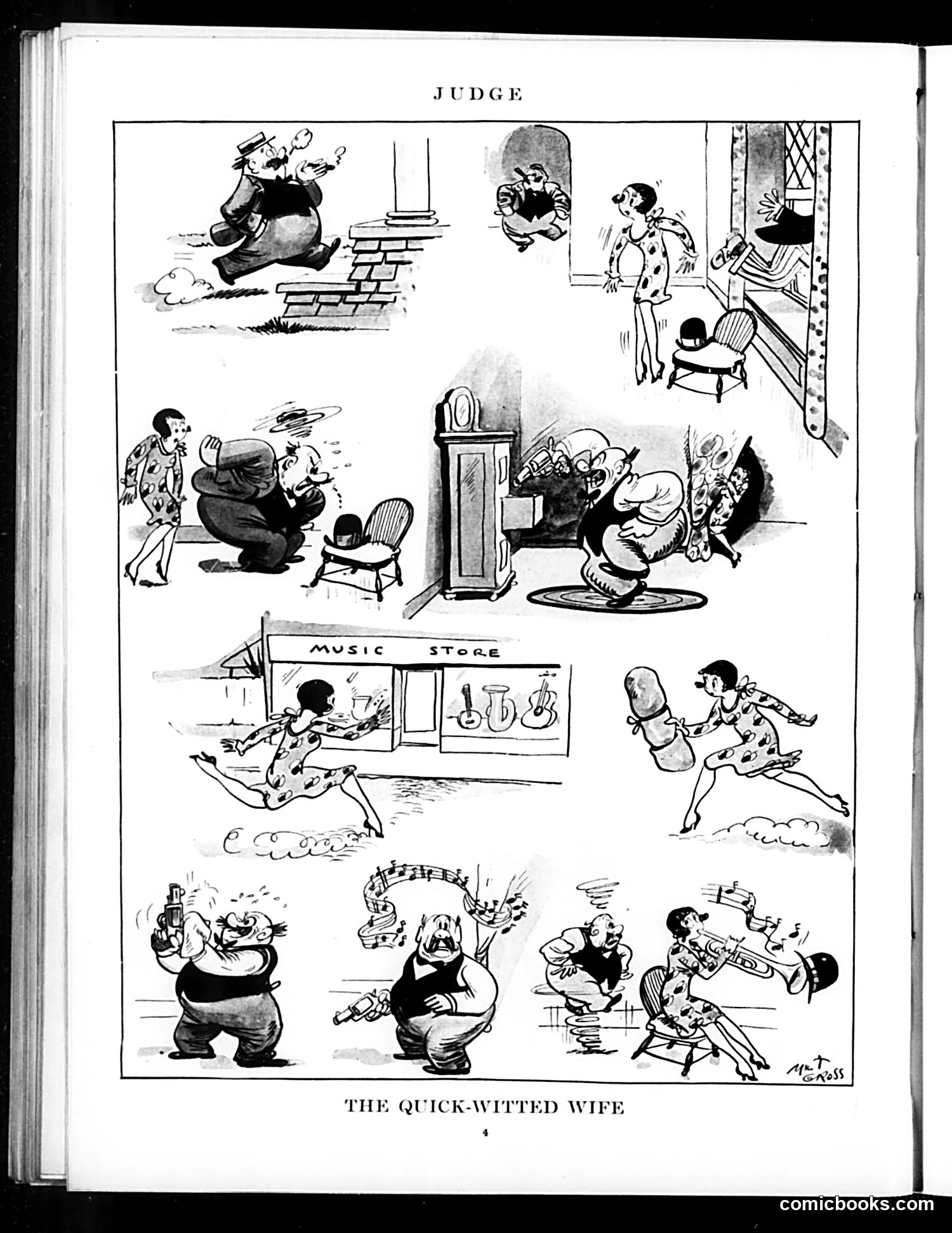
# "The Quick-Witted Wife" - Judge Magazine This page presents a comic strip titled "The Quick-Witted Wife," depicting humorous domestic scenarios involving a married couple and their interactions with various people and situations. The strip shows a woman demonstrating cleverness and resourcefulness across multiple panels: evading a burglar, managing household chaos, dealing with a judge or authority figure, and handling musical instrument mishaps at a music store. The cartoons satirize the "clever woman" trope popular in early 20th-century humor—portraying wives as quick-thinking problem-solvers who outwit others through wit rather than brute force. The humor relies on slapstick visual gags and role-reversal scenarios typical of Judge magazine's satirical approach to gender dynamics and domestic life during this era.
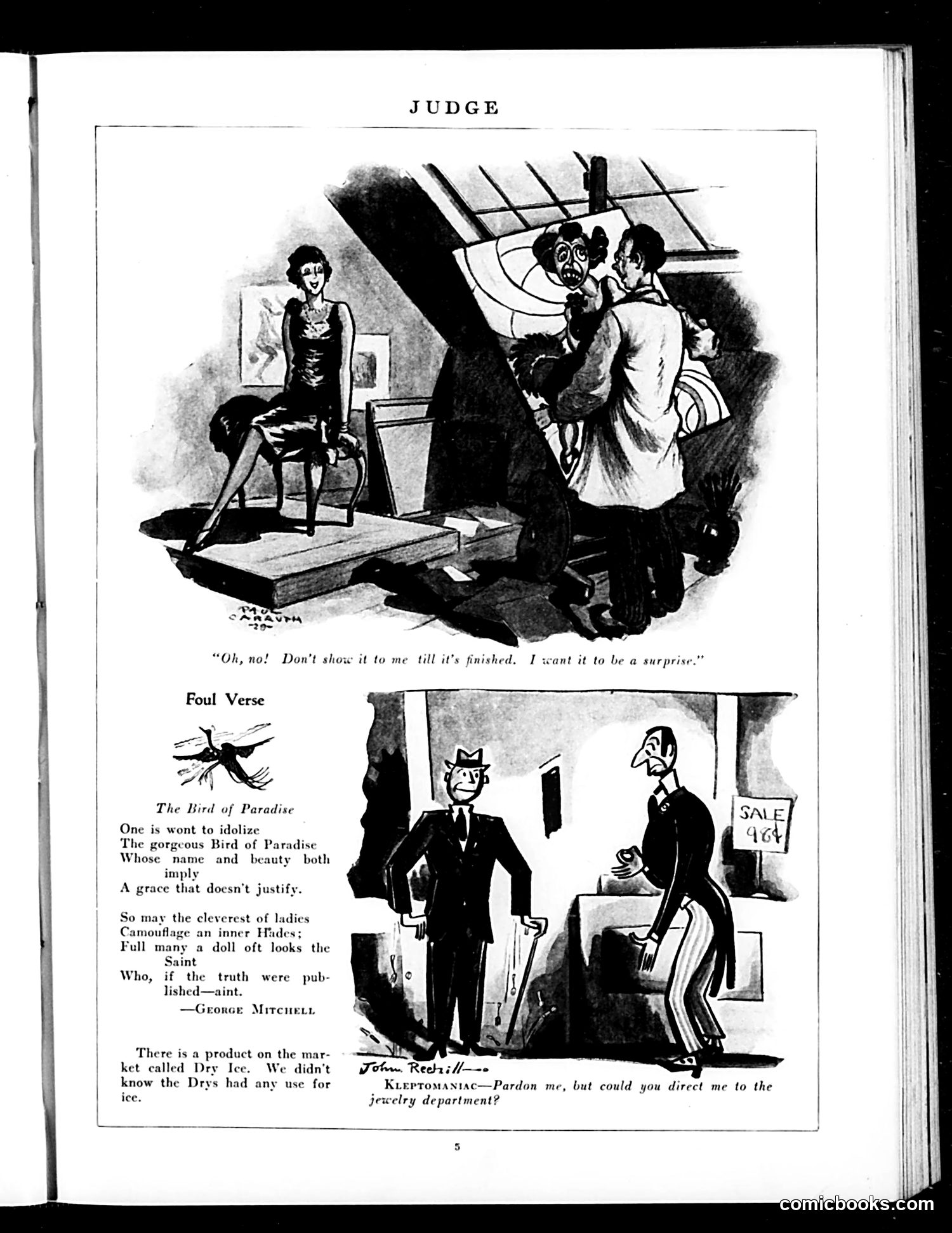
# Analysis of Judge Page **Top Cartoon:** A woman being shown artwork by what appears to be an artist or gallery owner, with the caption "Oh, no! Don't show it to me till it's finished. I want it to be a surprise." This satirizes vanity—the woman wants her portrait completed without seeing it, presumably hoping the artist will flatter her appearance. **"Foul Verse" Section:** Includes a poem mocking pretension, attributed to George Mitchell, about ladies using "camouflage" to hide their true nature. **Bottom Cartoon:** A store customer asking a salesman for directions to the jewelry department, with a "Sale 16¢" sign visible. The humor appears to mock either the absurdly low sale price or the customer's misdirected priorities in a department store. The page emphasizes social satire on vanity and consumerism.
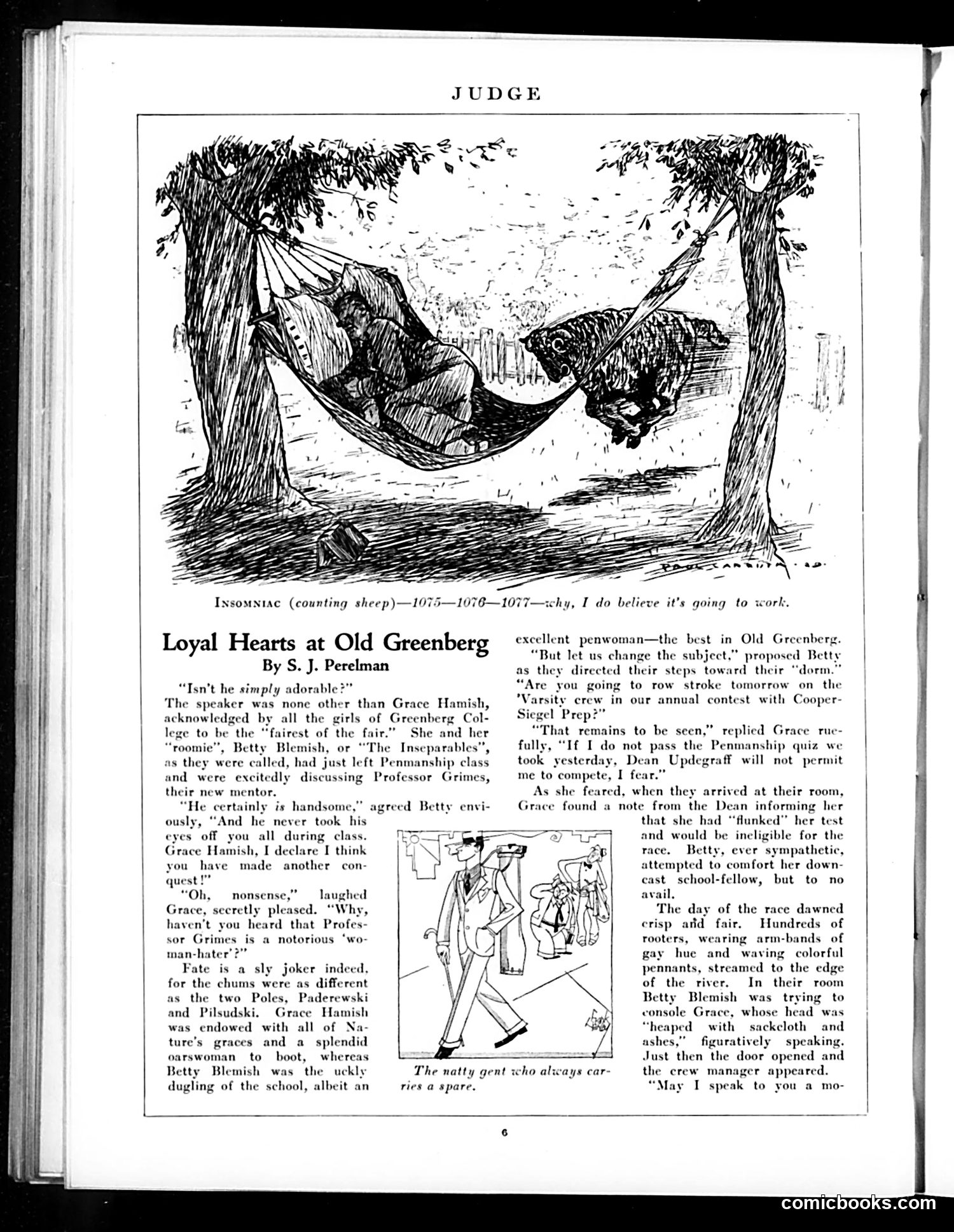
# Analysis of "Judge" Magazine Page This page contains a short story titled "Loyal Hearts at Old Greenberg" rather than political satire. The top cartoon shows a man in a hammock counting sheep (labeled "1075—1076—1077") while unable to sleep—a visual pun on the common insomnia remedy of "counting sheep." The story discusses Grace Hamish and Betty Blemish, students at Old Greenberg College, competing in a rowing race. The text satirizes academic pretension and social hierarchies among schoolgirls, with the "natty gent who always carries a spare" pictured below representing a vain male character. The satire targets college social life, female competitiveness, and romantic entanglements rather than political issues. It's light social humor typical of *Judge's* general interest content circa this era.
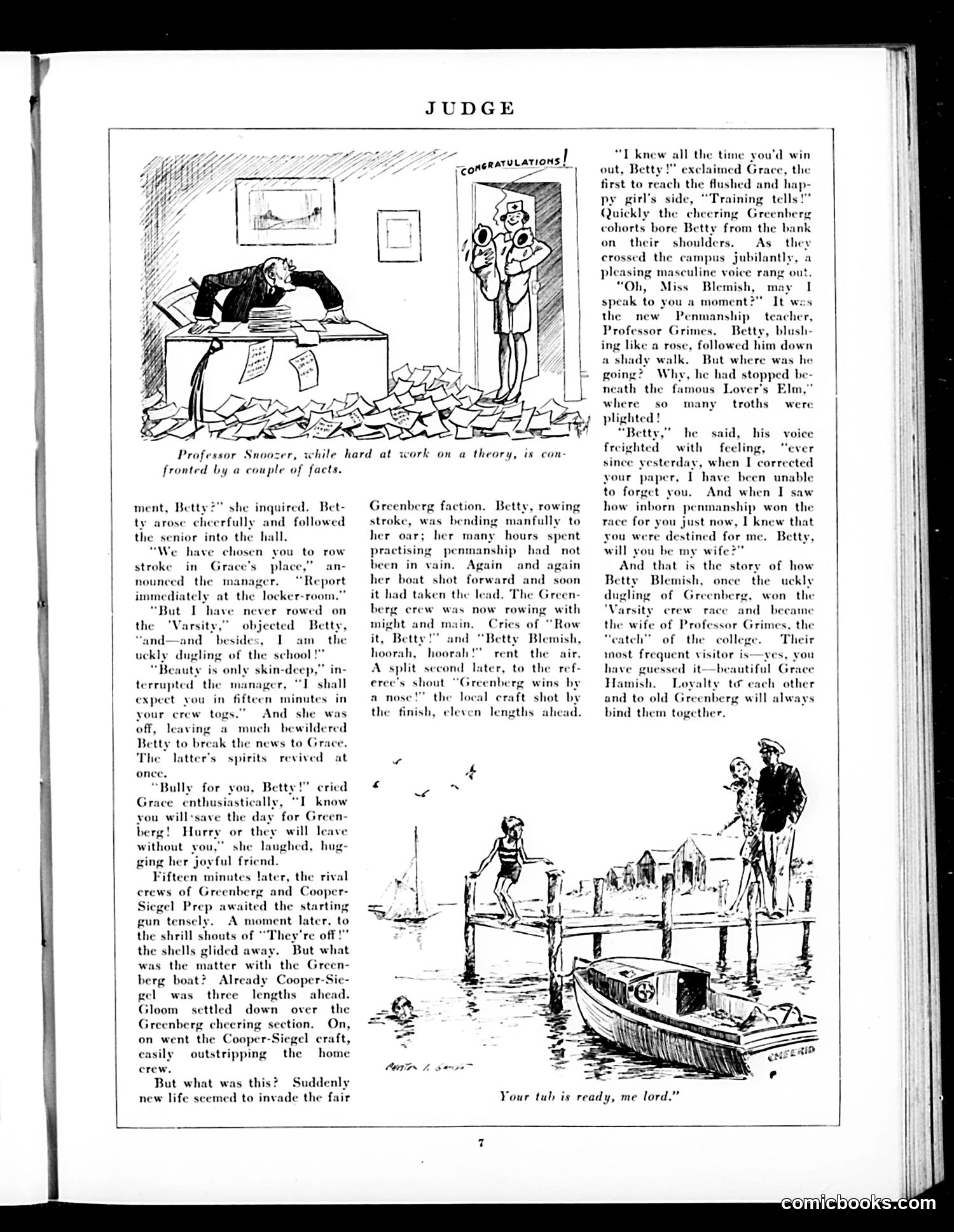
# Analysis of "Judge" Page This is a serialized romance story in Judge magazine, not primarily political satire. The narrative follows Betty Blemish, a student at Greenberg (appears to be a school or college) who becomes a rowing stroke despite having no experience. Her penmanship training mysteriously translates to athletic prowess, allowing her to single-handedly win a boat race against rival Cooper-Siegel Prep. The satire targets academic pretension and romantic clichés: Betty's success leads to her being swept off campus by admiring students, only to be intercepted by the new penmanship teacher, Professor Grimes, who proposes beneath "Lover's Elm." The humor lies in the absurdity—that penmanship skill determines both athletic ability and romantic destiny—and the melodramatic romance conventions of the era. The cartoons illustrate the story's key moments: a distracted professor, the rowing race, and the romantic conclusion.
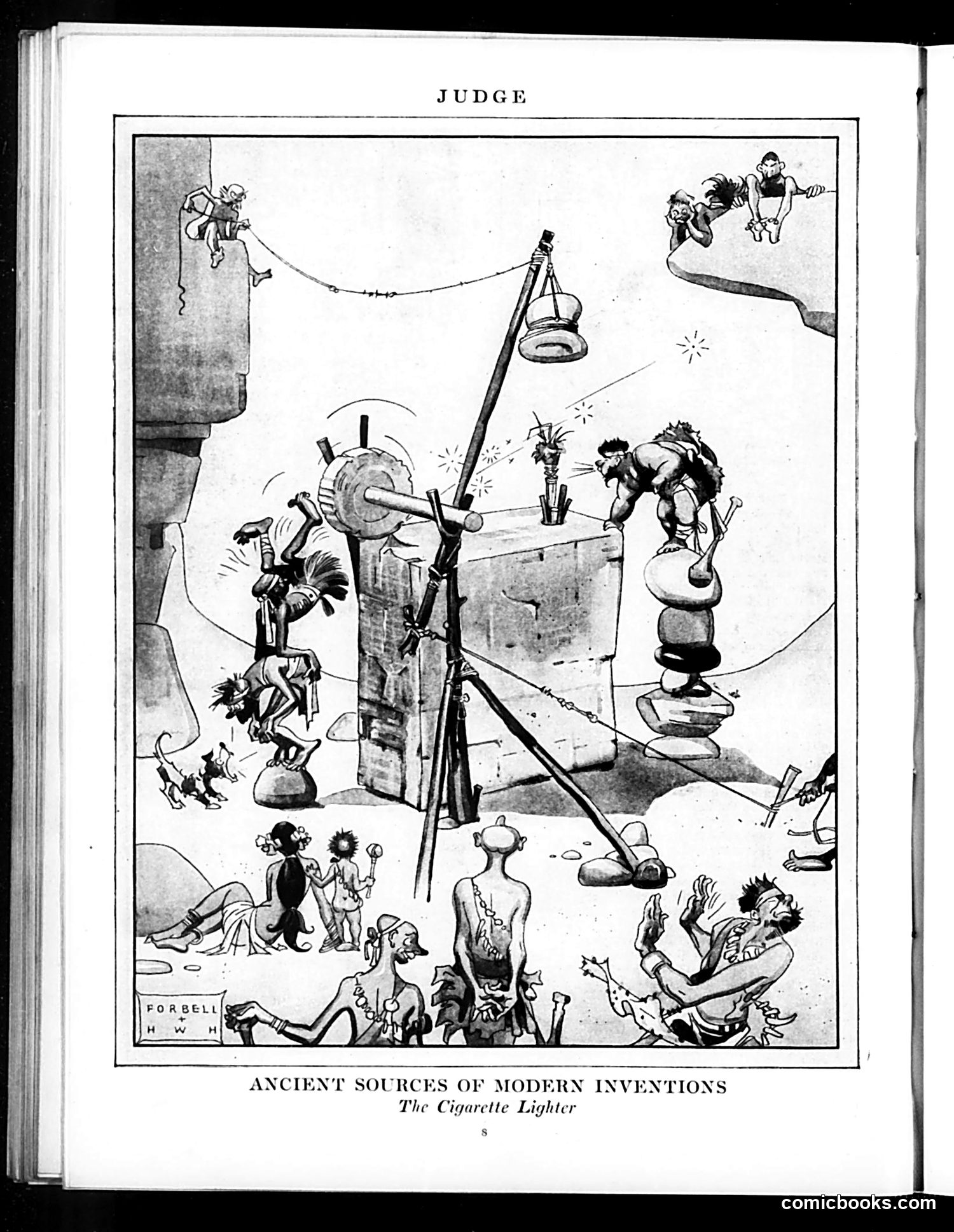
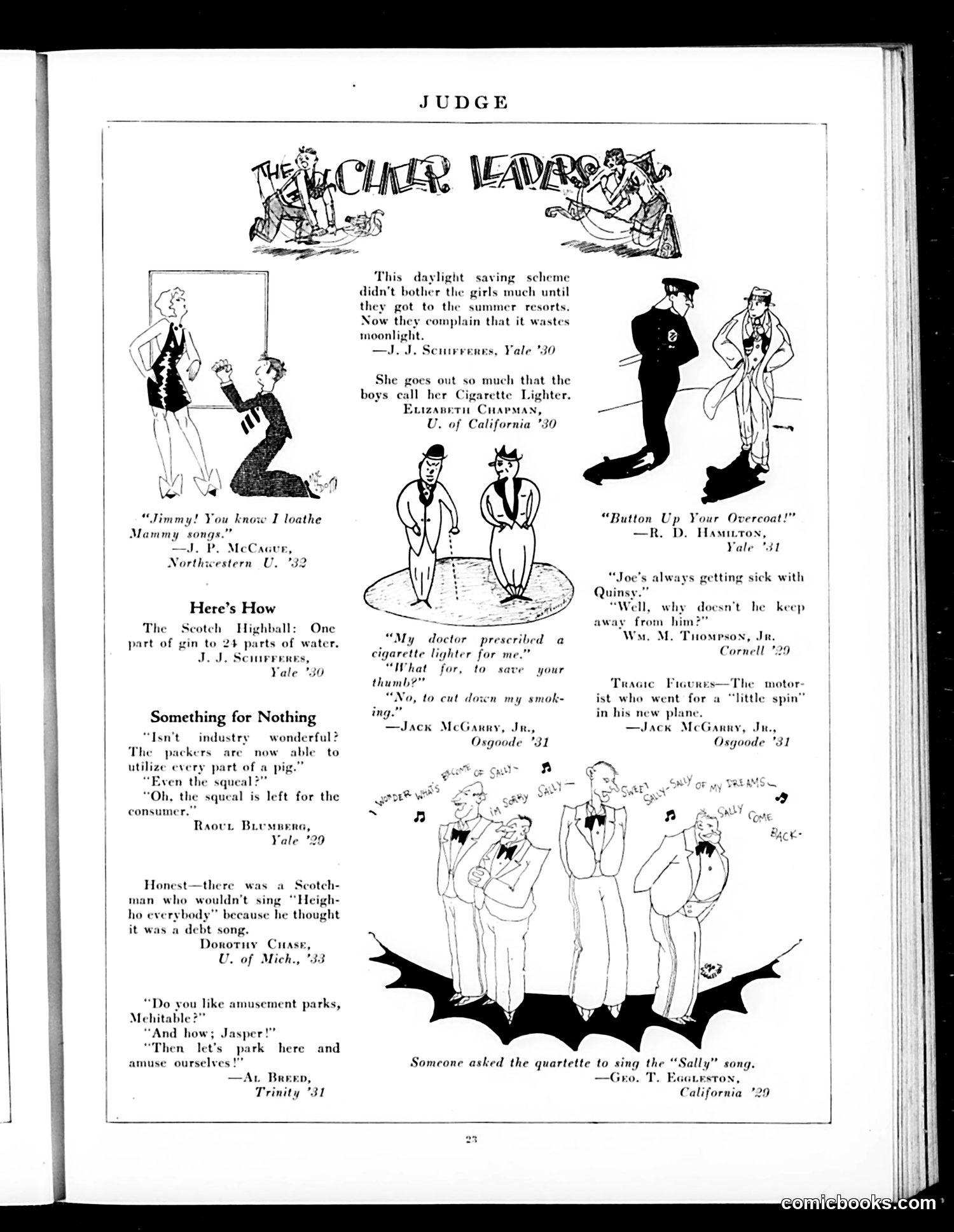
# "Ancient Sources of Modern Inventions: The Cigarette Lighter" This satirical cartoon from Judge magazine humorously traces the cigarette lighter back to mythological and ancient sources. The central structure resembles a complex machine or contraption, with figures from classical mythology and history positioned around it—appearing to operate or interact with the apparatus. The joke plays on the popular "ancient sources" concept, suggesting that modern conveniences have precedents in classical civilization. By depicting mythological figures (likely including gods and legendary characters) struggling with an elaborate mechanical device to produce fire or light, the cartoon satirizes both the pretension of tracing modern inventions to ancient wisdom and the absurdity of imagining ancients engineering such contraptions. The artist is Cesare Forbell (credited as "Forbell").
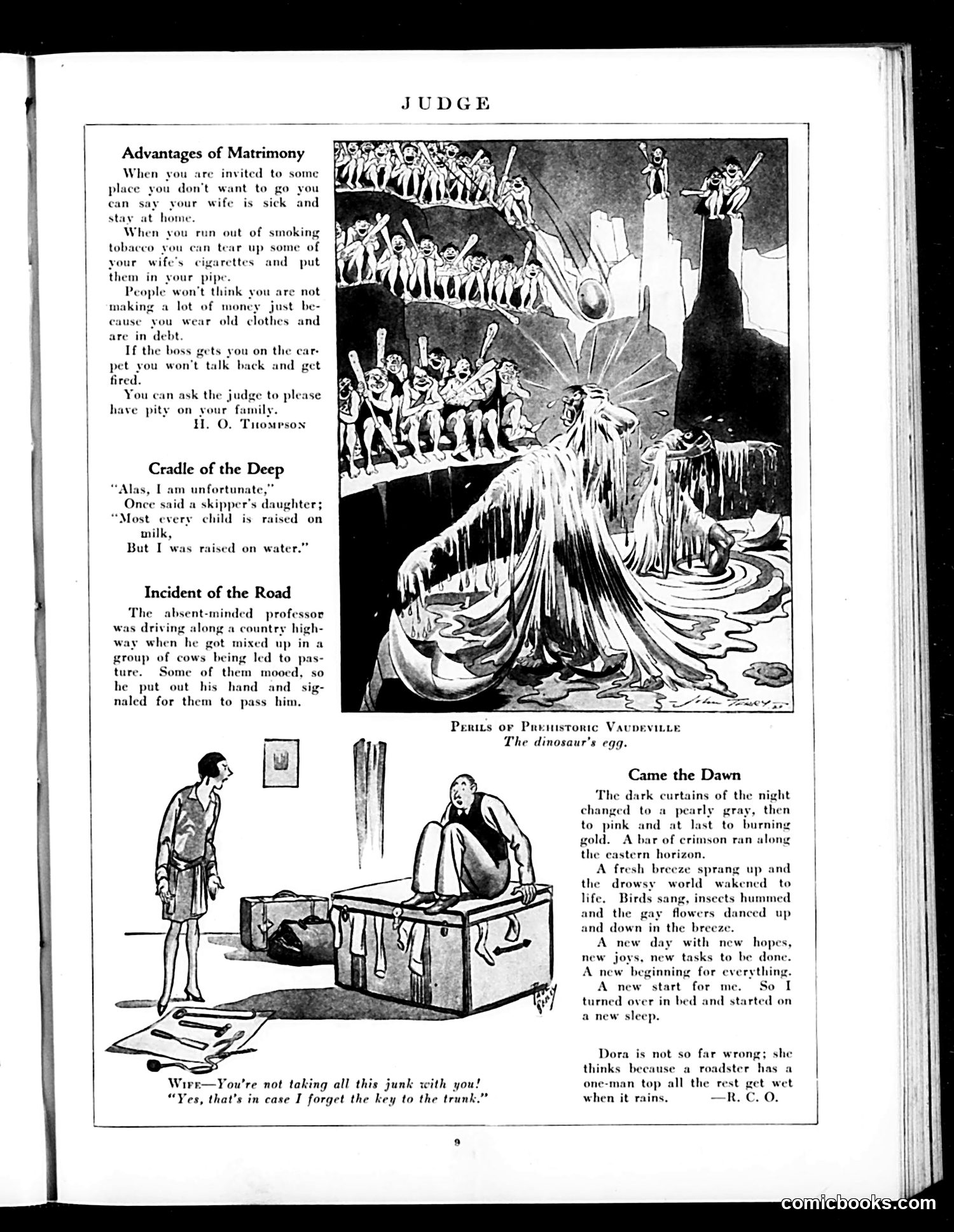
# Judge Magazine Page Analysis This page contains several humorous sketches typical of early 20th-century American satire: **"Advantages of Matrimony"** humorously lists benefits of marriage to men—using a wife's absence as an excuse to avoid social obligations, smoking her cigarettes, appearing poor without judgment, and invoking family sympathy when in trouble with employers. **"Incident of the Road"** jokes about an absent-minded professor signaling cows to pass like traffic, playing on the stereotype of intellectuals being disconnected from practical reality. **"Came the Dawn"** satirizes overly sentimental, flowery nature writing popular in the era, then undercuts it with the protagonist simply rolling over to sleep. **The trunk cartoon** shows a departing wife and husband arguing about luggage; he claims he needs the junk in case he forgets the trunk key—absurd male logic presented as marital comedy. The page reflects early-1900s gender dynamics and satirizes contemporary literary trends and domestic relations.
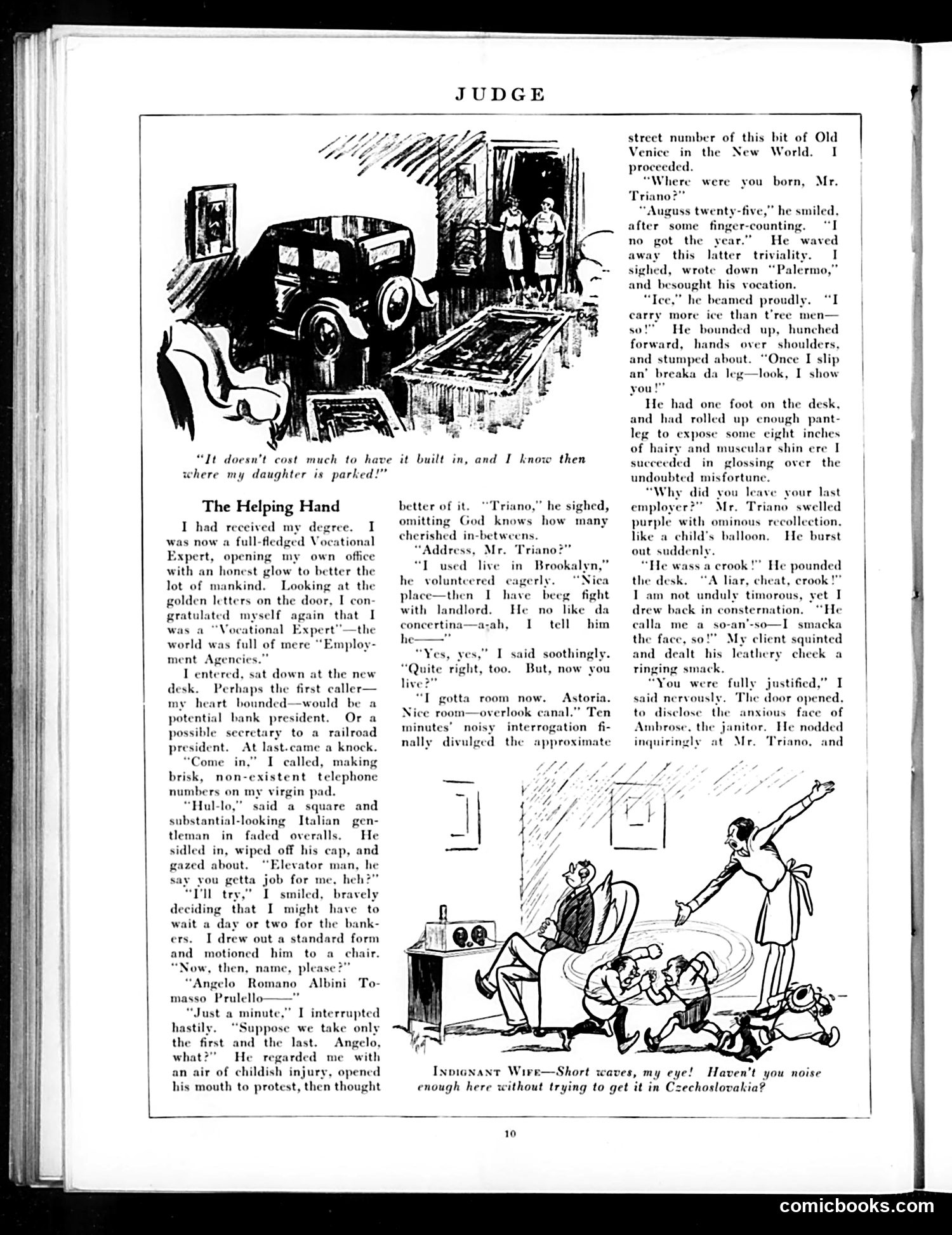
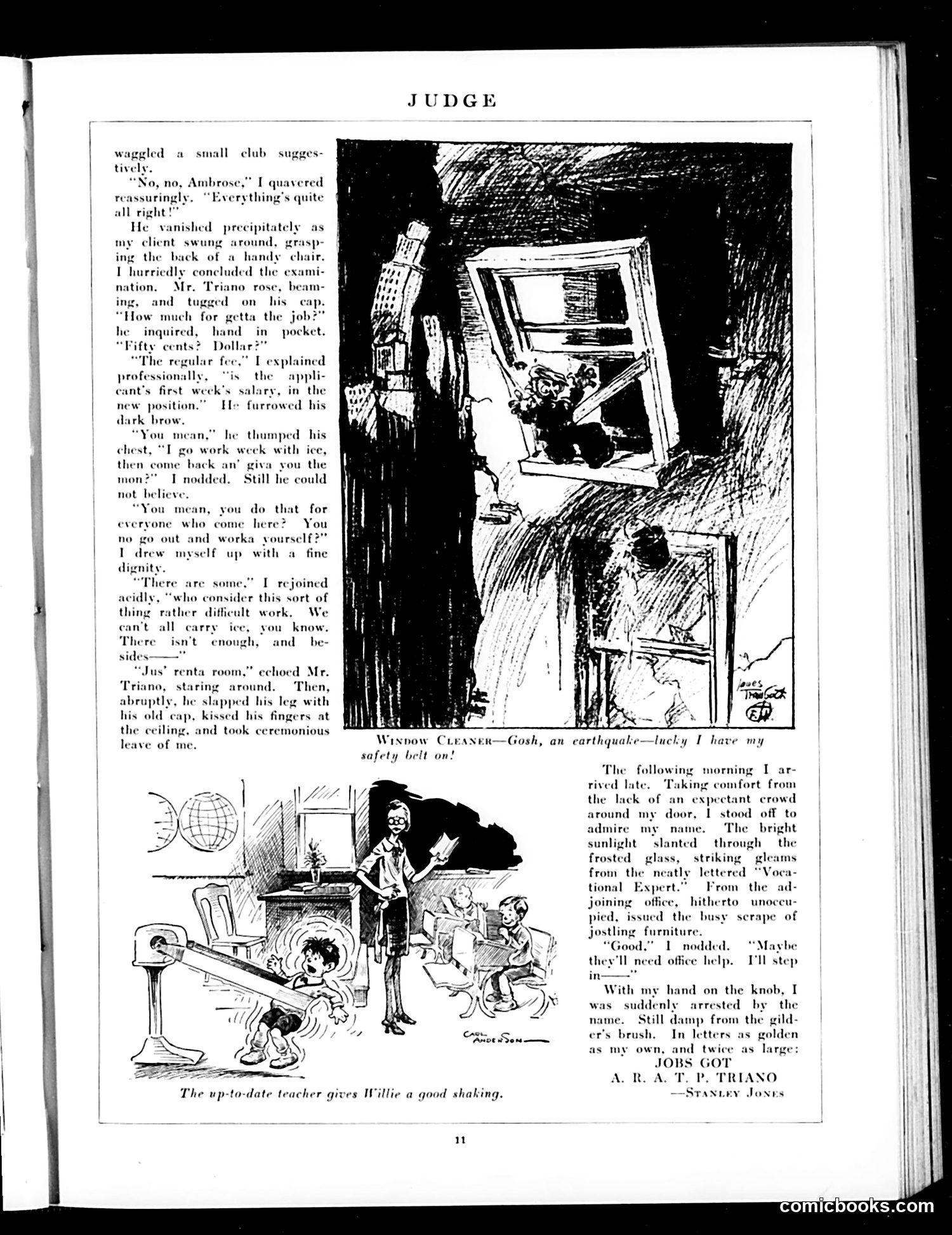
# "The Helping Hand" - Judge Magazine Satire This story satirizes early 20th-century American employment agencies and immigrant workers. The narrator, a newly credentialed "Vocational Expert," receives his first client: Angelo Romano Albini Tomasso Prulello (shortened dismissively to "Triano"), an Italian immigrant ice-carrier with a thick accent. The satire targets the narrator's condescension toward working-class immigrants—he's impatient with Angelo's full name, dismissive of details, and visibly uncomfortable when Angelo enthusiastically demonstrates his muscular physique and recounts punching his former boss in the face. The top cartoon mocks middle-class car owners concerned with tracking their daughters' whereabouts via built-in parking locators—suggesting anxiety about young women's independence. The bottom cartoon (captioned "Indignant Wife") satirizes radio technology crazes, with a wife complaining about noisy radio interference from international broadcasts—likely a reference to 1930s radio mania.