
Judge, 1929-07-27 · page 15 of 38
Judge — July 27, 1929 — page 15: what you’re looking at
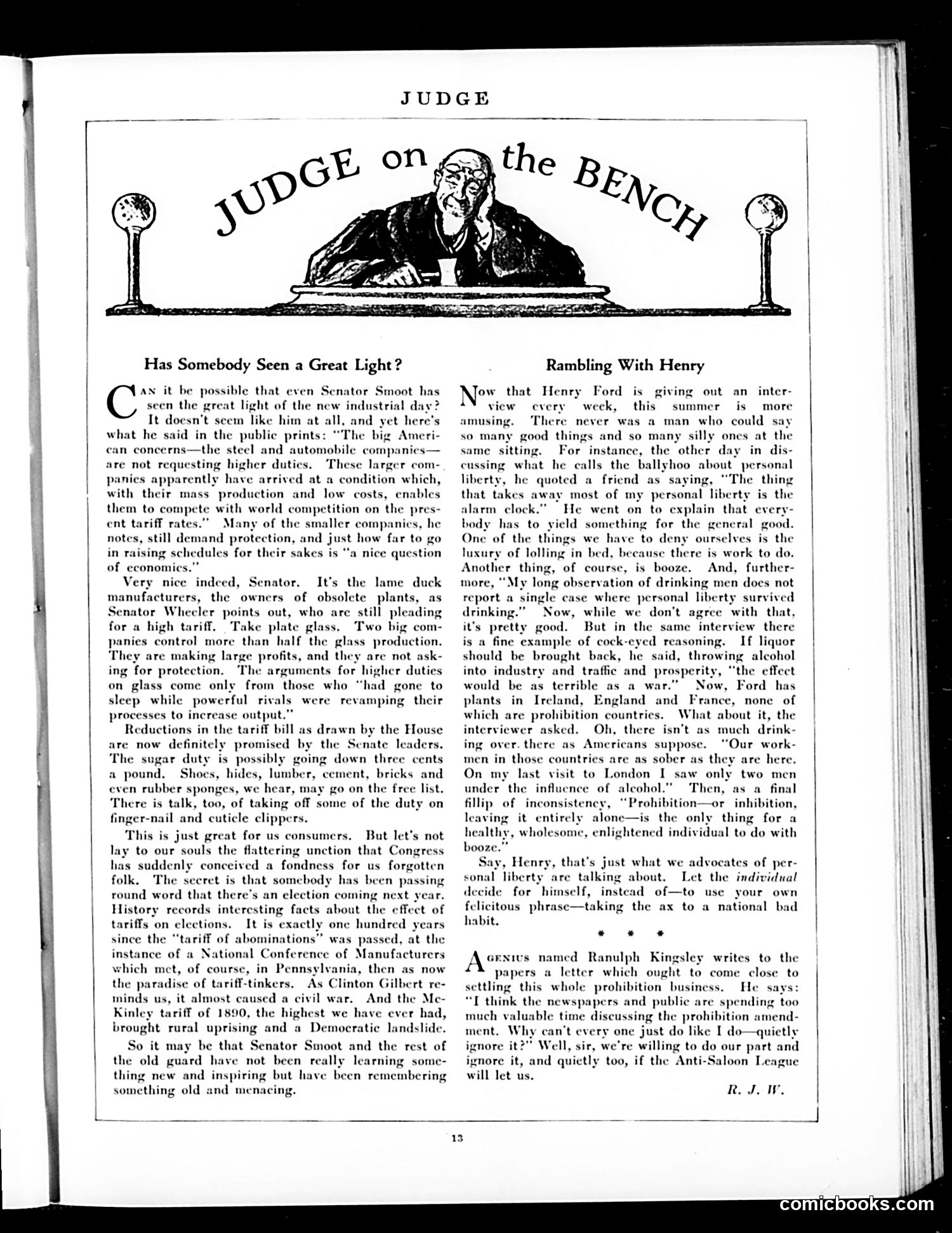
A restored page from Judge, 1929-07-27. Page through the whole issue in the reader above.
📄 Transcribed text from this page (OCR, searchable)
Machine-transcribed from the original scan — historical spelling and the odd misread are preserved.
' i Has Somebody Seen a Great Light ? AN it be possible that even Senator Smoot has C seen the great light of the new industrial d It doesn’t seem like him at all, and yet he what he said in the public prints: “The big Ameri- can concerns—the steel and automobile are not requesting ds npanies— higher duties. These larger com- nies apparently have arrived at a condition which, with their mass production and low costs, enables them to compete with world competition on the pres- ff rate Many of the smaller companies, he still demand protection, and just how far to go in raising schedules for their sakes is “a nice question of economics.” Very nice indeed, Senator. It’s the lame duck manufacturers, the owners of obsolete plants, as Senator Whecler points out, who are still ples for a high tariff. Take p' panies control more than f the glass production. They are making large profits, and they are not ask- ing for protection. The arguments for higher duties on glass come only from those who “had gone to sleep while powerful rivals were revamping their processes to increase output. Reductions in the tariff bill as drawn by the House are now definitely promised by the Senate leaders. The sugar duty is possibly going down three cents a pound. Shoes, hides, lumber, cement, bricks and even rubber sponges, we hear, may go on the free list. There is talk, too, of taking off some of the duty on finger-nail and cuticle clippers. ng te glass. Two big com- This is just great for us consumers. But let's not lay to our souls the flattering unction that Congress has suddenly conceived a fondness for us forgotten folk. The secret is that somebody has been passing round word that there’s an election coming next year. History records interesting facts about the effect of tariffs on elections. It is exactly one hundred yi since the “tariff of abominations” was passed, at the instance of a National Conference of Manufacturers which met, of course, in Pennsylvania, then as now the paradise of tariff-tinkers. As Clinton Gilbert re- minds us, it almost caused a civil war. And the Me- Kinley tariff of 1890, the highest we have ever had, brought rural uprising and a Democratic landslide. So it may be that Senator Smoot and the rest of the old guard have not been really learning some- thing new and inspiring but have been remembering something old and menacing. c Rambling With Henry Ne that Henry Ford is giving out an_inter- NY every week, this summer is more amusing. There never was a man who could say so many good things and so many silly ones at the same sitting. For instance, the other day dis- cussing what he calls the ballyhoo about’ personal liberty, he quoted a friend as saying, “The thing that takes away most of my personal liberty is the alarm clock.” He went on to explain that every- body has to yield something for the general good. One of the things we have to deny ourselves is the luxury of lolling in bed, because there is work to do. Another thing, of course, is booze. And, further- more, “My long observation of drinking men does not report a single case where personal liberty survived drinking.” Now, while we don’t agree with that, it's pretty good. But in the same interview there is a fine example of cock-eyed reasoning. If liquor should be brought back, he said, throwing alcohol into industry and traffic and prosperity, “the effect would be as terrible as a war.” ow, Ford has plants in Ireland, England and France, none of which are prohibition countries. What about it, the interviewer asked. Oh, there isn’t as much drink- ing over. there as Americans suppose. “Our work- men in those countries are as sober as they are here. On my last visit to London I saw only two men under the influence of alcohol.” Then, as a final fillip of inconsistency, ‘“Prohibition—or inhibition, caving it entirely alone—is the only thing for a ’, Wholesome, enlightened individual to do with Henry, that’s just what we advocates of per- liberty are talking about. Let the individual ide for himself, instead of—to us felicitous phrase—taking the ax to « habit. A orxivs named Ranulph Kingsley writes to the f vers a letter which ought to come close to settling this whole prohibition business. He s “I think the newspapers and public are spending too much valuable time discussing the prohibition amend- ment, Why can't every one just do like I do—quietly ignore it?” Well, sir, we're willing to do our part and ignore it, and quietly too, if the An will let us. our own onal bad * * «* comicbooks.com