A complete issue · 36 pages · 1929
Judge — July 20, 1929
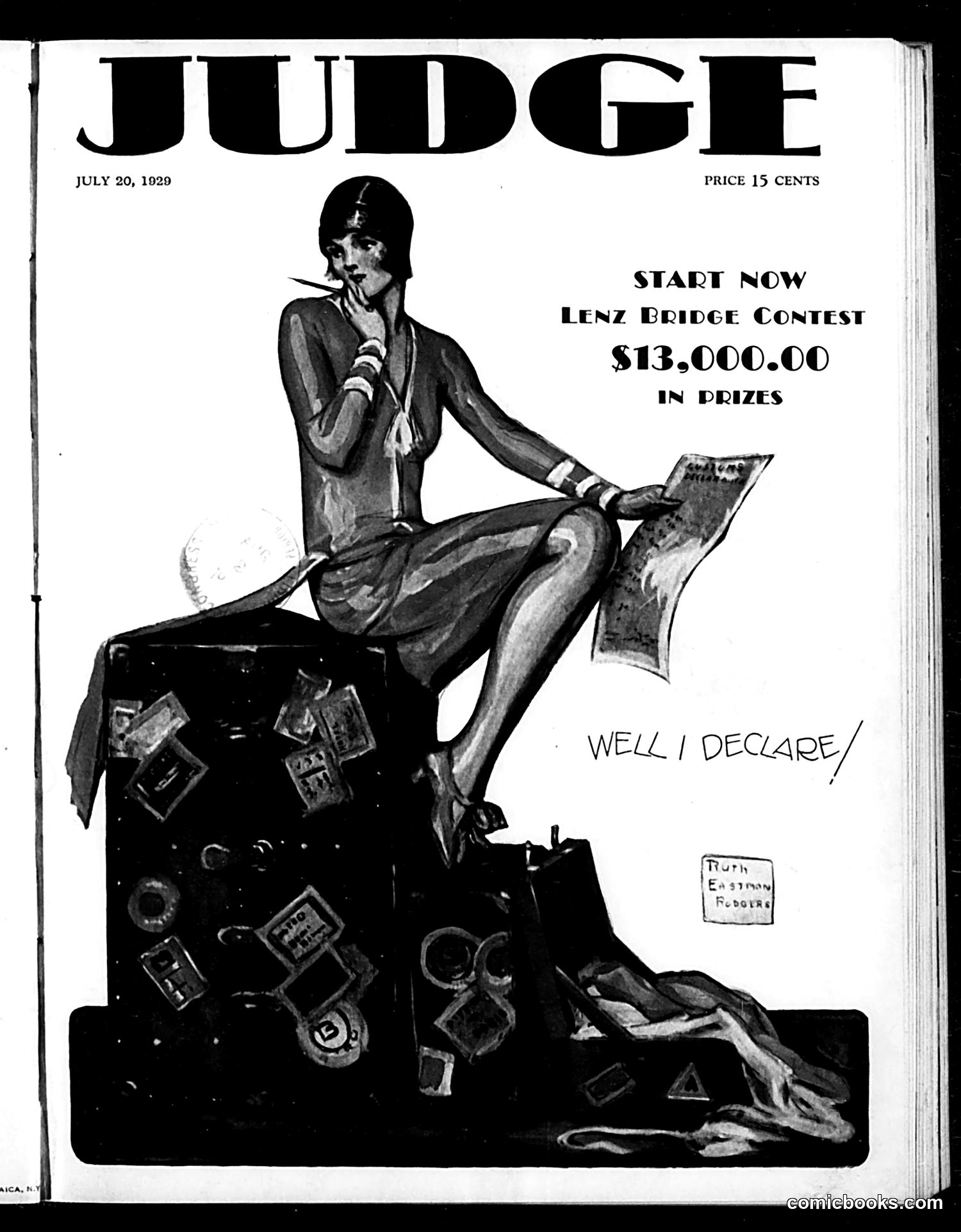
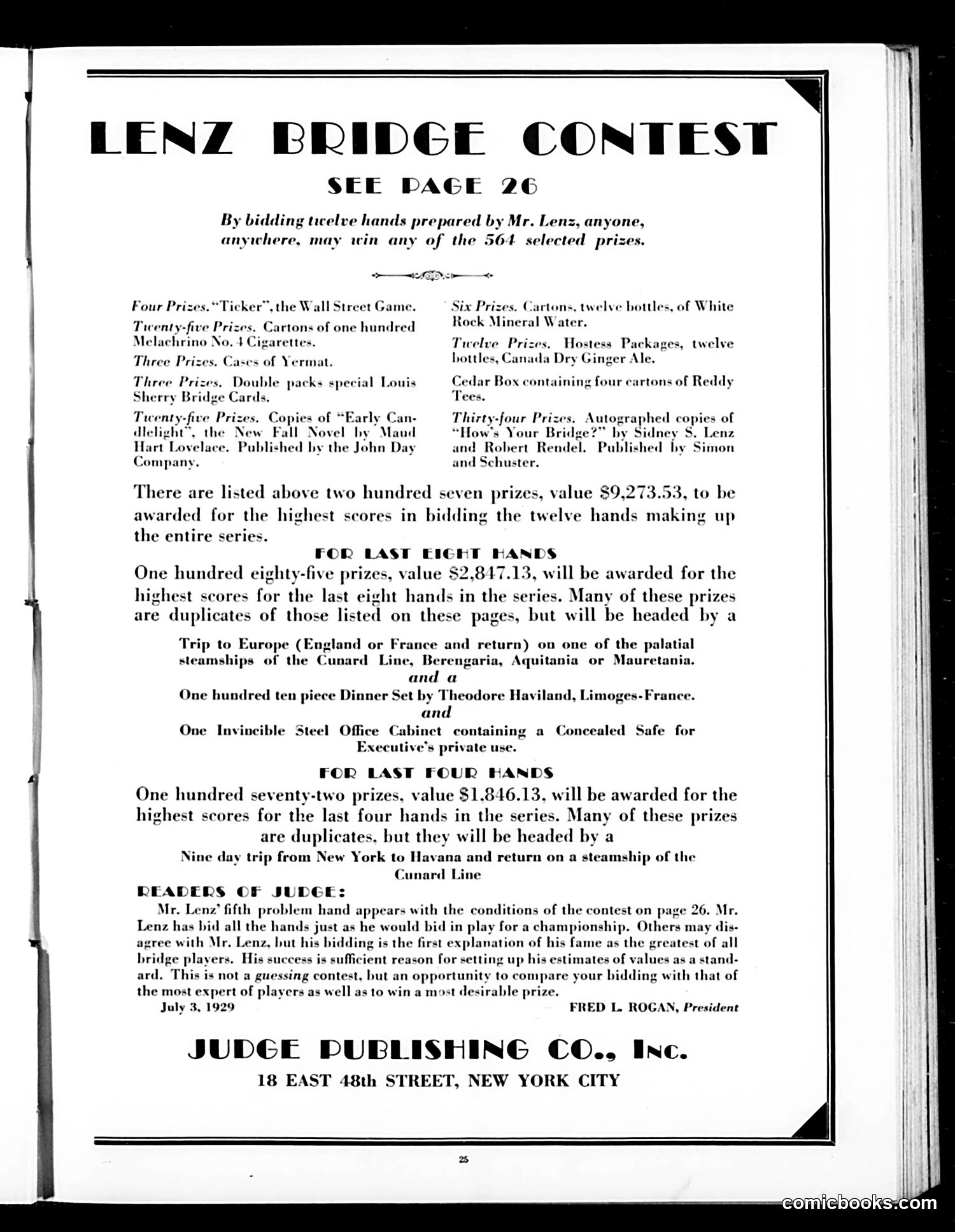
# Judge Magazine Cover Analysis (July 20, 1929) This cover satirizes wealth and financial excess during the Jazz Age, just weeks before the October 1929 stock market crash. A fashionably dressed woman sits atop an overflowing suitcase of money, appearing confident and carefree while declaring "Well I declare!" The scattered currency and financial documents suggest abundant riches carelessly displayed. The "Lenz Bridge Contest" advertisement promoting $13,000 in prizes appears coincidentally ironic—offering substantial prize money at precisely the moment American prosperity was about to collapse catastrophically. The illustration critiques the era's conspicuous consumption and complacency regarding wealth. The woman's relaxed posture and declaration seem to mock the obliviousness of the wealthy elite to economic warning signs, making this cover an inadvertently prophetic commentary on impending financial disaster.
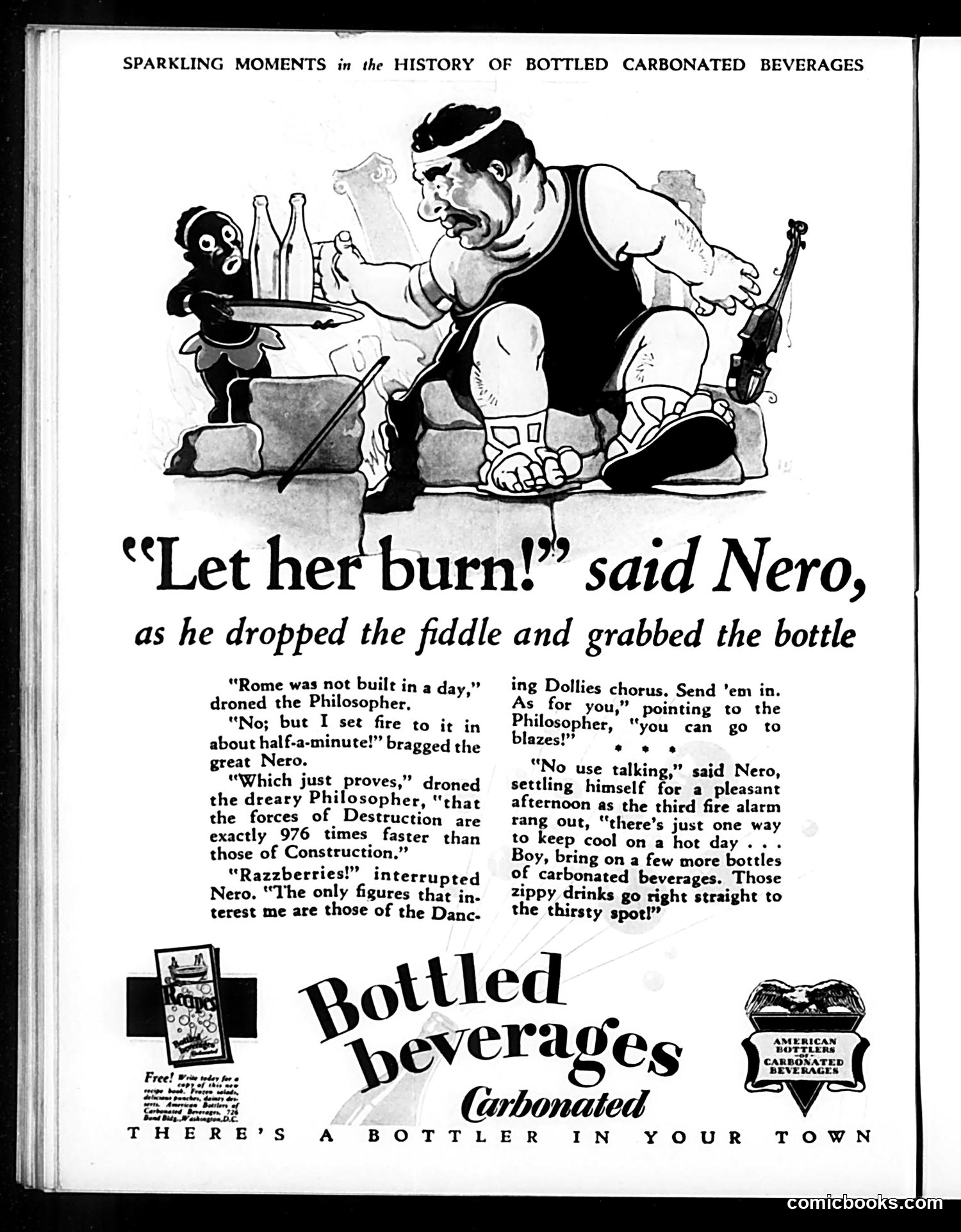
# Analysis This is primarily **advertising content**, not political satire. The page promotes bottled carbonated beverages using a humorous historical framing device. The central image depicts **Nero**, the Roman emperor, portrayed as a comically violent figure. The advertisement uses Nero as a joke vehicle: when a Philosopher pedantically notes "Rome was not built in a day," Nero dismisses philosophy and reaches for a carbonated beverage instead, declaring it the best way to "keep cool on a hot day." The satire is mild—it's simply poking fun at Nero's historical reputation for excess and cruelty by reimagining him as an impatient, thirst-driven character. The advertisement's core message: carbonated beverages provide refreshment on hot days, endorsed by an absurdist historical reference. The American Bottlers of Carbonated Beverages logo appears at bottom right.
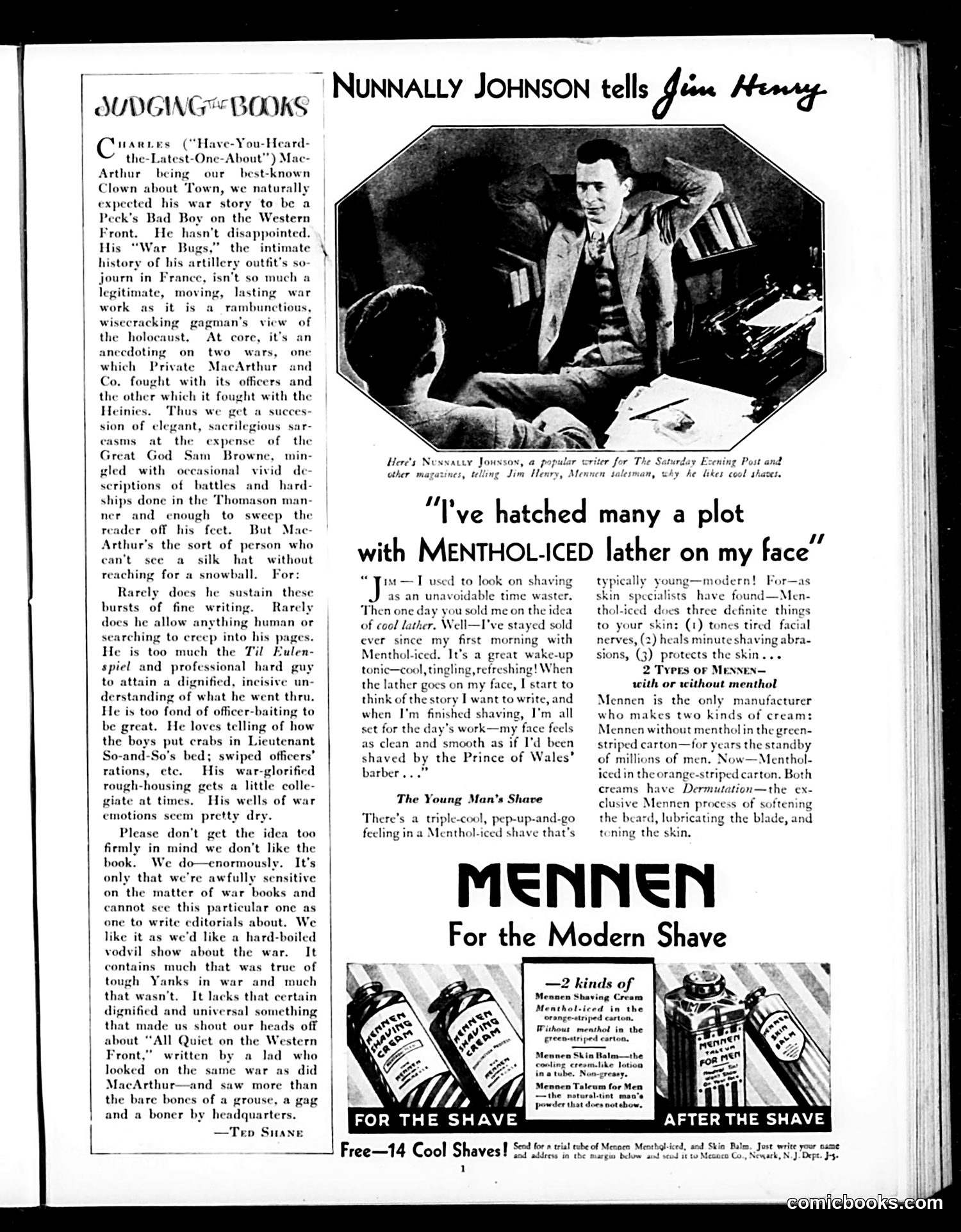
# Content Analysis This page is primarily a **Mennen shaving cream advertisement**, not political satire. The "Judging the Books" column on the left reviews Charles MacArthur's war memoir about an artillery unit in France, criticizing it as somewhat rambling but appreciative of its irreverent humor and authentic soldier perspective. Reviewer Ted Shane praises the book's unsentimental approach to WWI. The dominant content is the Mennen advertisement featuring writer Nunnally Johnson endorsing their mentholated lather. Johnson describes how the cooling shaving cream helps him think clearly while writing stories. The ad emphasizes Mennen's "Dermalization" process for softening facial hair. No political cartoons or satire appear on this page—it's primarily commercial advertising with a brief book review.
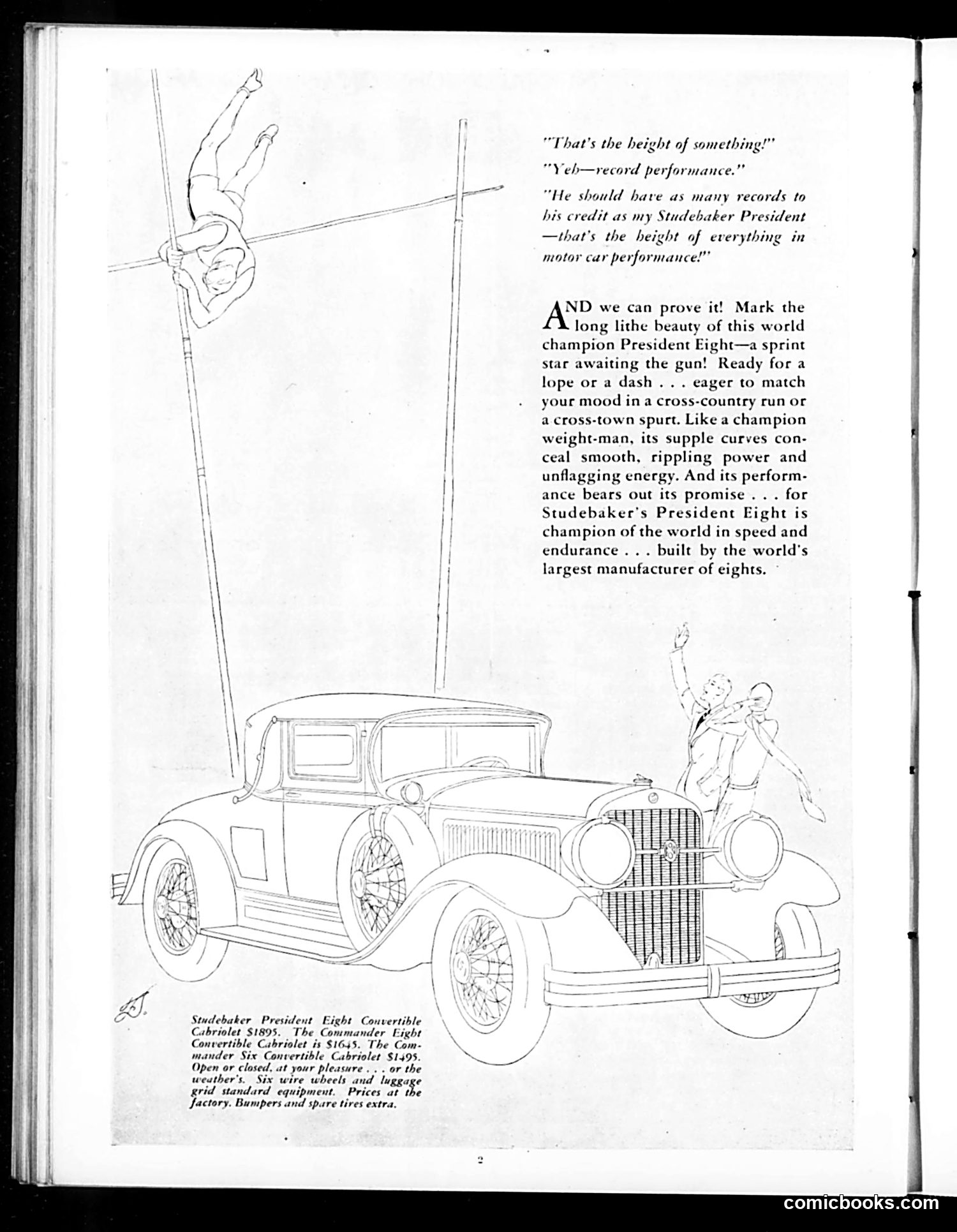
# Analysis of This Judge Magazine Advertisement Page This is primarily a **Studebaker automobile advertisement** rather than political satire. The page promotes the "President Eight" model, a luxury car manufactured by Studebaker. The text uses hyperbolic language comparing the car's performance to athletic achievement—specifically referencing a "Studebaker President" with records rivaling a "Studebaker President Eight" in motor car performance. The illustration shows the convertible cabriolet model with stylized figures celebrating its capabilities. The "height of everything" phrasing suggests this advertisement aims to position Studebaker as the pinnacle of automotive engineering and prestige. The dramatic line drawings and enthusiastic copy reflect 1920s-era advertising style. This represents commercial promotion rather than political commentary or satire.
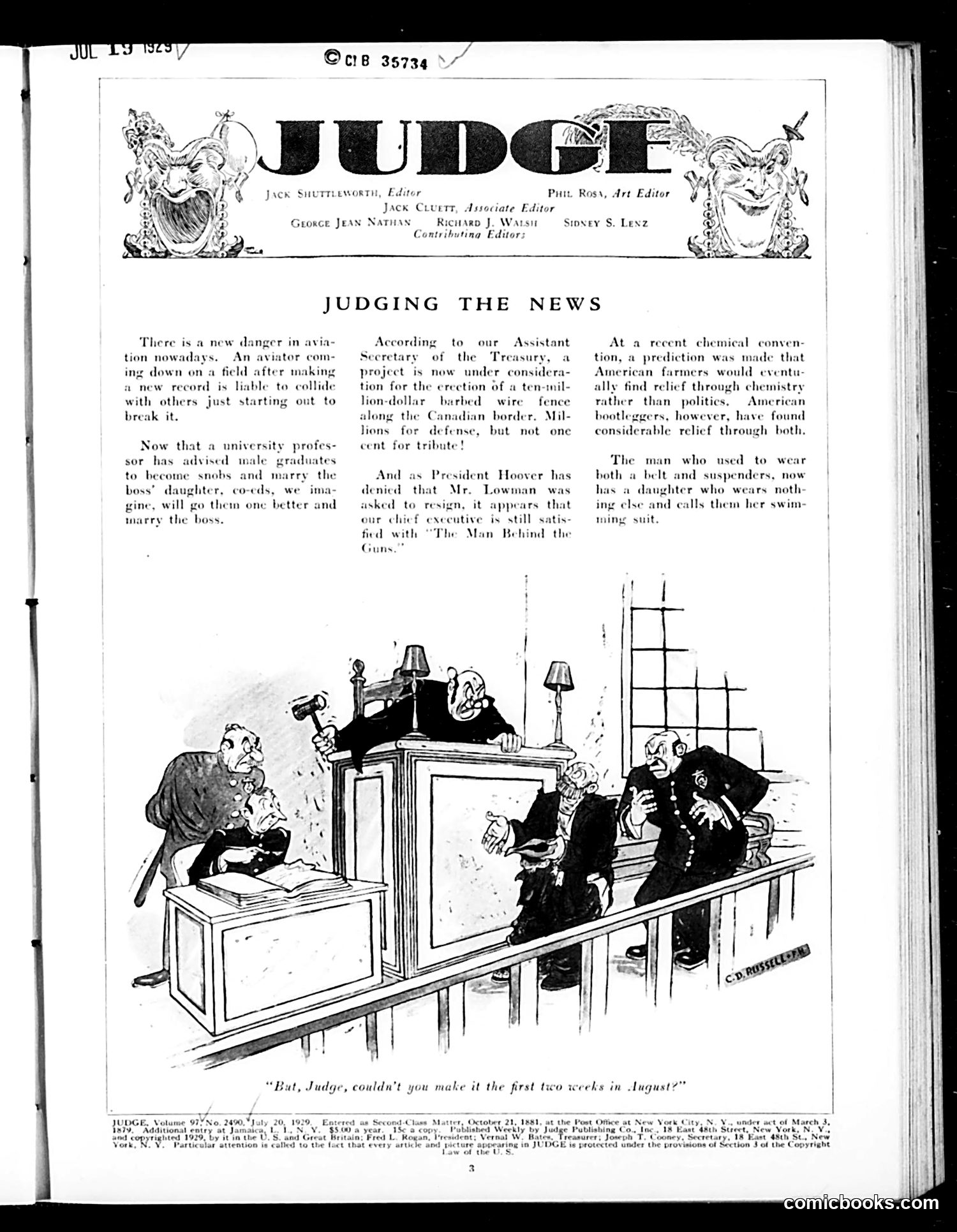
# Analysis of Judge Magazine Page (July 19, 1929) The main cartoon satirizes judicial proceedings. A judge sits elevated at the bench while attorneys argue below, with the caption: "But, Judge, couldn't you make it the first two weeks in August?" This appears to reference frustration with court scheduling—likely attorneys requesting to delay proceedings until August, presumably for summer vacation or recess. The joke mocks the judicial system's accommodation of convenience over justice. The editorial section above, "Judging the News," contains brief satirical commentary on contemporary issues: aviation safety, university marriages, and chemical agriculture. One item references President Hoover and someone named Lowman resigning, though details remain unclear without additional historical context. The overall tone critiques both legal inefficiency and current political/social matters through humor.
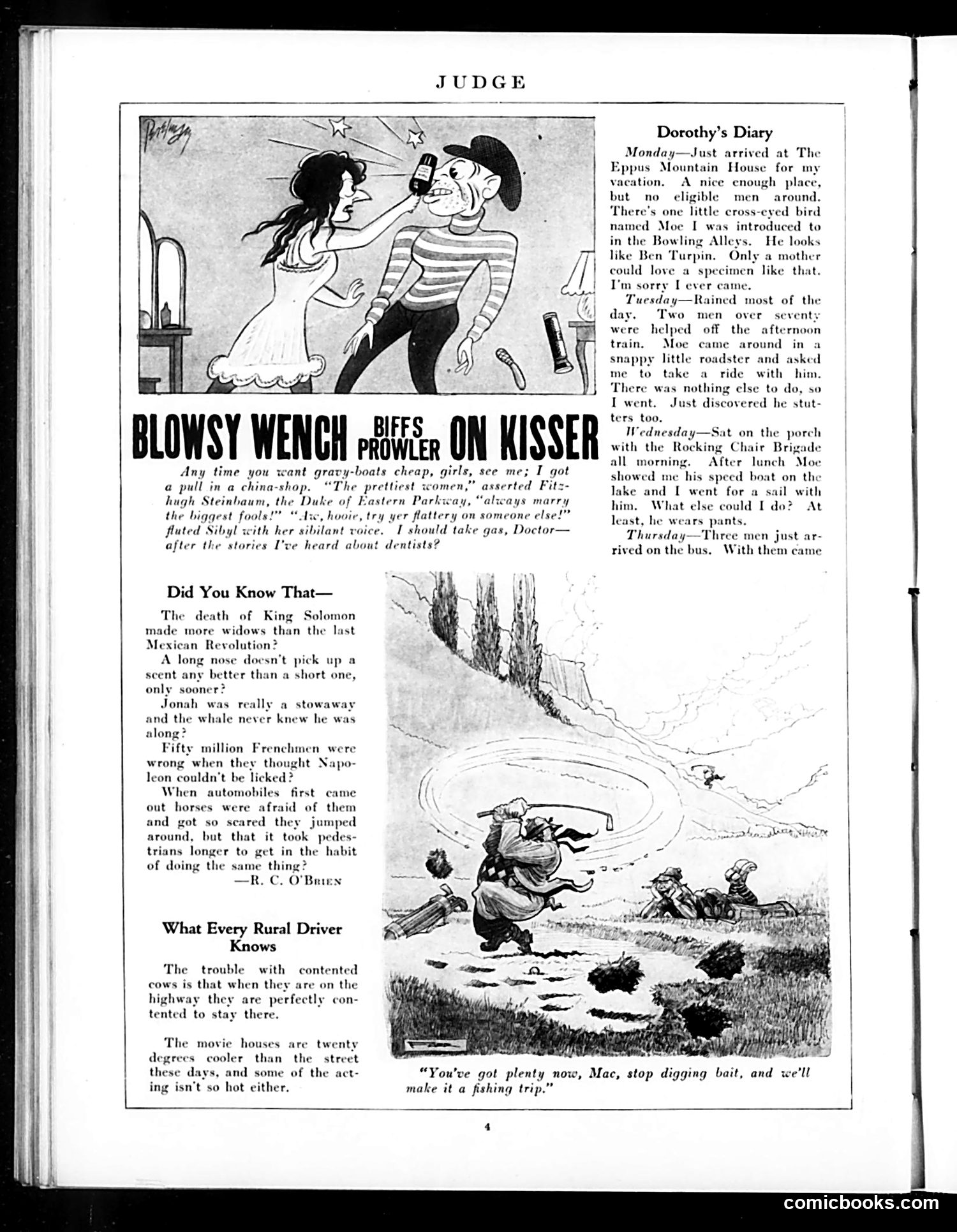
# Analysis of Judge Magazine Page The main cartoon "Blowsy Wench Biffs Powder on Kisser" depicts a woman striking a man's face, satirizing domestic conflict. The accompanying dialogue mocks both parties—the woman complains about "eligible men" and unflattering comparisons, while the man defensively boasts about his accomplishments. The humor relies on exaggerated gender stereotypes of the era: the vain, quarrelsome wife and the defensive, boastful husband. The page also includes "Dorothy's Diary," a humorous column describing a woman's vacation encounters with unappealing men, and miscellaneous trivia in "Did You Know That" and "What Every Rural Driver Knows" sections. These are typical filler content for Judge, emphasizing social commentary through humor about courtship, rural life, and domestic relations.
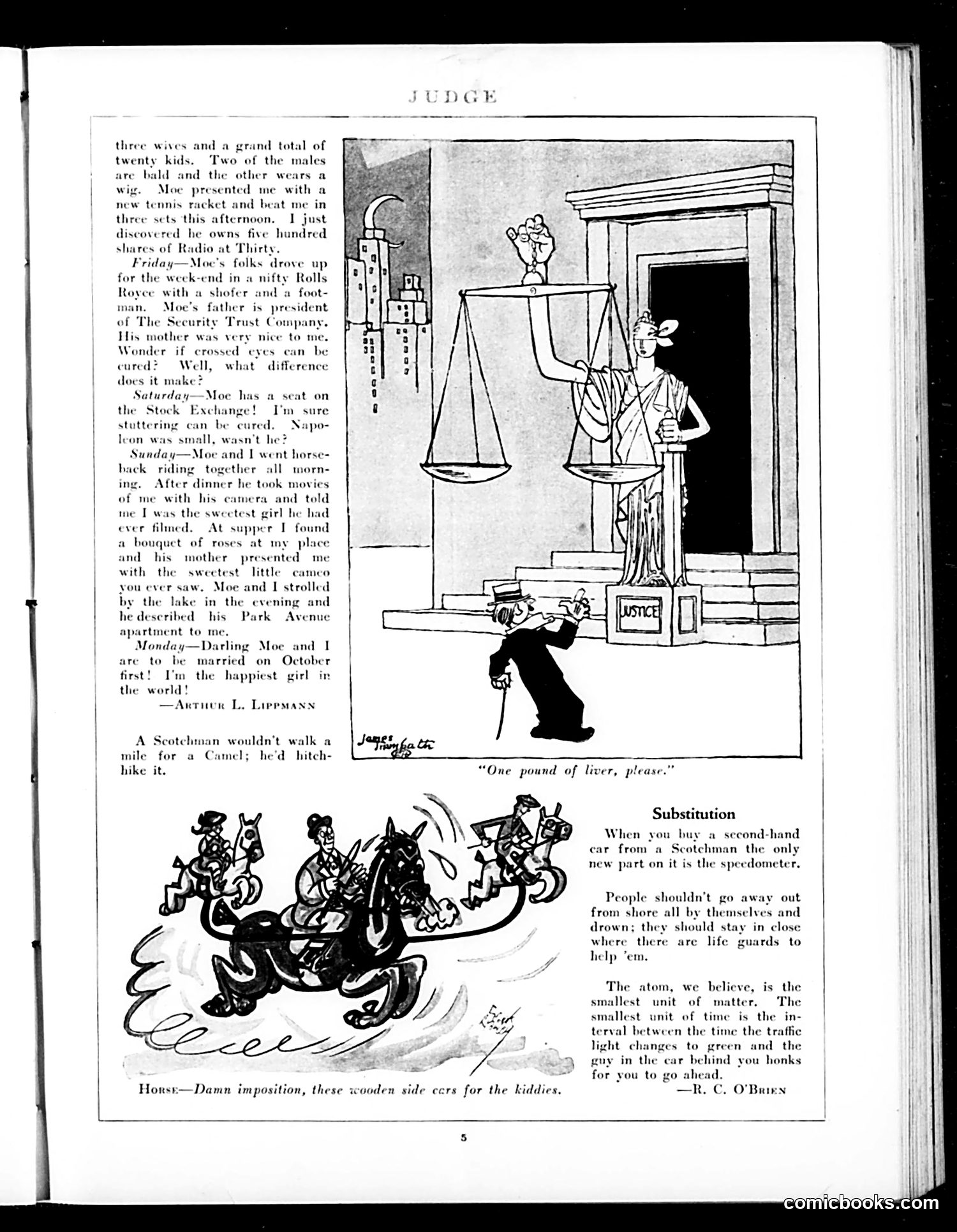
# Analysis of Judge Magazine Page **Main Cartoon ("One pound of liver, please"):** A man in formal attire addresses a female judge on the bench. The satire appears to mock either judicial incompetence or absurdity—the gentleman's request for "one pound of liver" in a courtroom setting is nonsensical. This likely critiques confused or inappropriate judicial proceedings, though the specific reference is unclear without additional context. **Secondary Content:** - A brief personal account from Arthur L. Lippmann about romantic outings with "Moe" - A joke about Scotsmen and Camels (automobiles) - A cartoon showing children on a horse-drawn contraption, captioned "Damn imposition, these wooden side cars for the kiddies" The page primarily contains humorous social commentary typical of early 20th-century Judge magazine's satirical style.
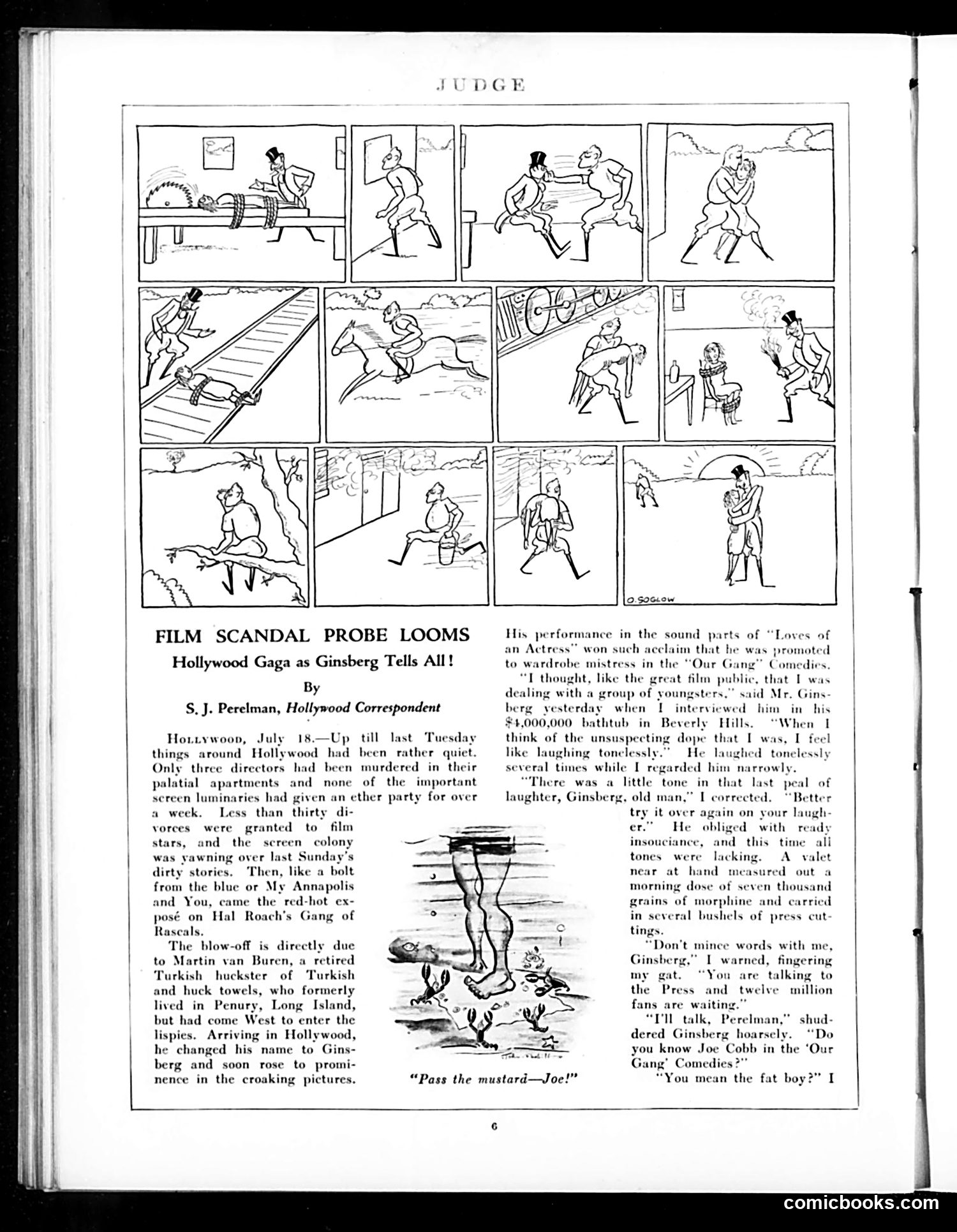
# "Judge" Page Analysis: Hollywood Scandal Probe This page satirizes early 1920s Hollywood scandals through a comic strip titled "Judge," which depicts slapstick scenes of physical comedy and mayhem—pratfalls, chasing, collapsing furniture. The accompanying article by S.J. Perelman discusses a scandal involving actor Gaginsberg (likely a pseudonym), whom the writer interviewed. The piece mocks Hollywood's moral hypocrisy: three film directors faced "dirty stories," and the industry's reputation suffered. The article suggests Ginsberg's promotion to "wardrobe mistress" was suspicious, and references his involvement in questionable conduct. The humor targets Hollywood's attempts to manage scandalous behavior while maintaining public respectability—a recurring theme in 1920s satirical commentary on the film industry's moral standards.
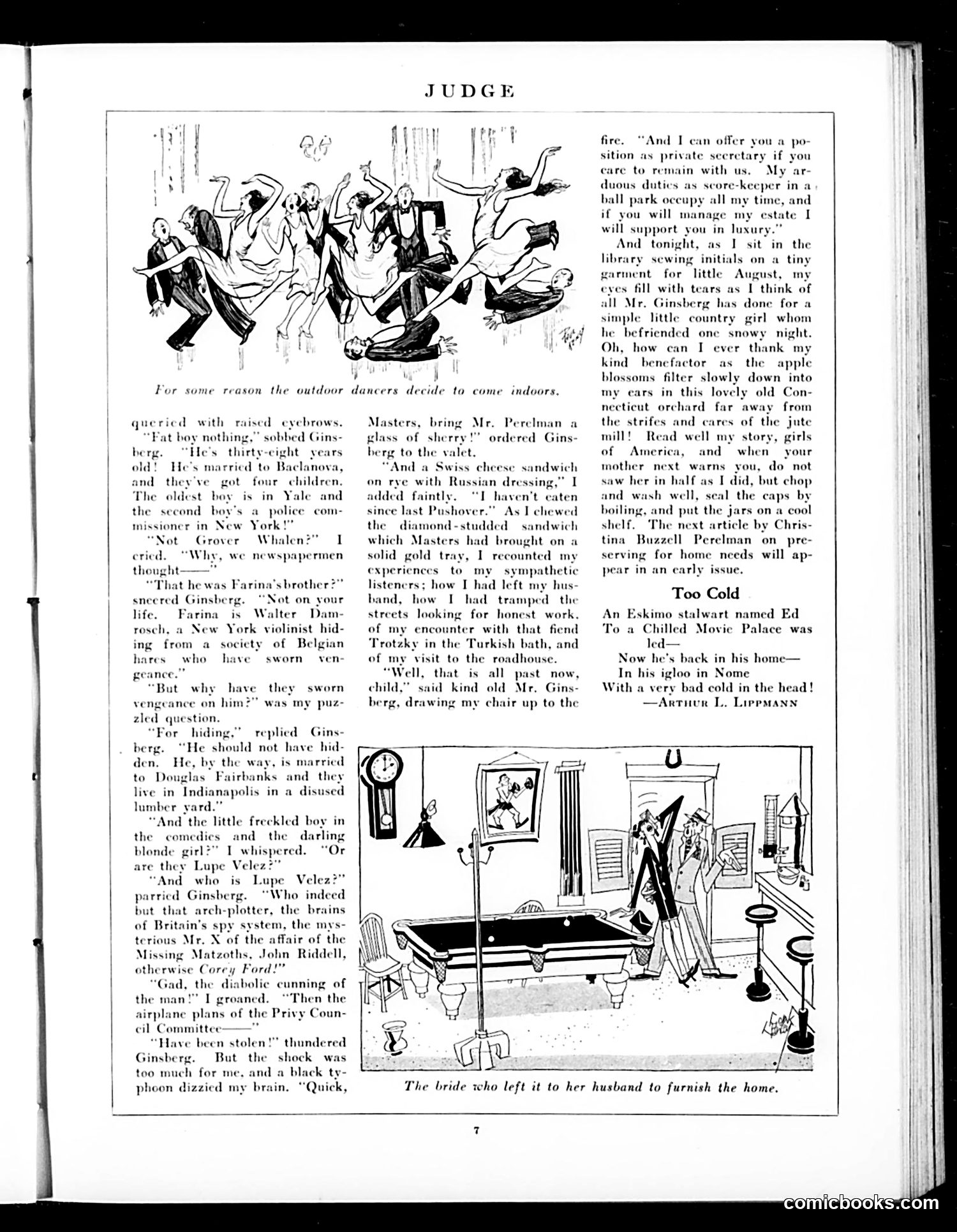
# "Judge" Page Analysis This page contains two satirical pieces typical of 1920s humor magazine fare. **Top Section:** A rambling monologue mocking Hollywood's mystique. A character named Ginsberg spins absurd false identities for silent film actors—claiming they're actually famous people like conductor Walter Damrosch or spy-thriller villain "Mr. X." The joke satirizes how little the public actually knew about movie stars' real lives, and how willing audiences were to accept fabricated backstories. References to "Farina," "Lupe Velez," and others suggest obscure silent-era performers. **Bottom Section:** A cartoon and accompanying story about a bride left to furnish her home, played for domestic comedy—likely mocking newlyweds' struggles or gender expectations around homemaking. The smaller poem "Too Cold" is mere filler verse about an Eskimo with a head cold. Overall, the page reflects 1920s popular culture obsession with Hollywood gossip and domestic humor typical of Judge's target audience.
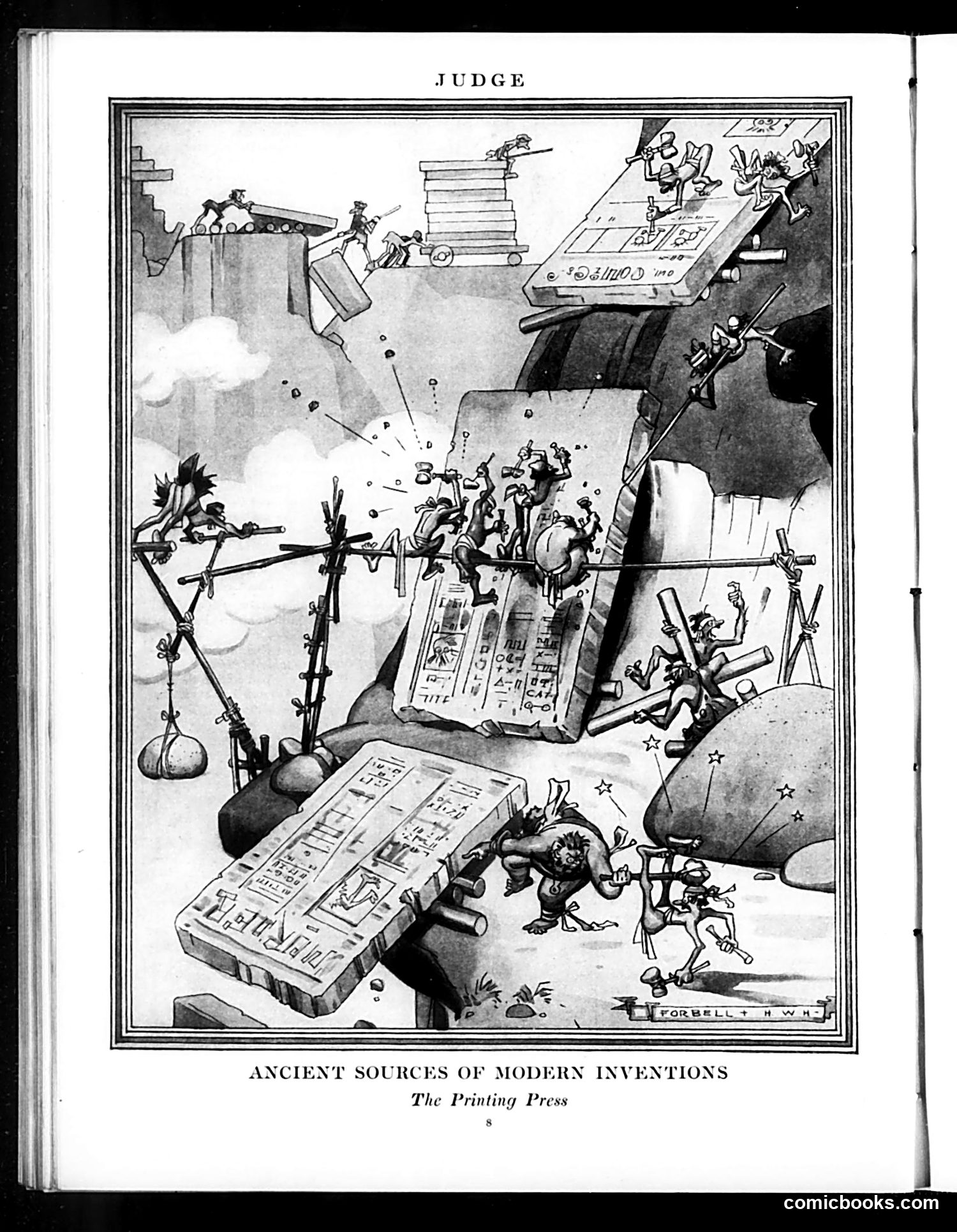
# Analysis: "Ancient Sources of Modern Inventions - The Printing Press" This satirical illustration depicts the printing press's origins in ancient times. The cartoon shows primitive figures operating an elaborate, absurdly complex printing apparatus in a fantastical landscape filled with gears, pulleys, and mechanical contraptions. The humor lies in the visual contradiction: it presents anachronistic ancient peoples somehow possessing modern mechanical technology, suggesting that supposedly "modern" inventions actually derive from ancient ingenuity. The elaborate, chaotic machinery emphasizes how complicated the printing press is—treating its invention as if primitive civilizations engineered sophisticated technology. The artist (signed "Forbell") uses this fantastical scenario to satirize contemporary ideas about invention and progress, likely poking fun at historical claims about ancient technological sophistication or challenging notions of "modern" innovation as truly original.
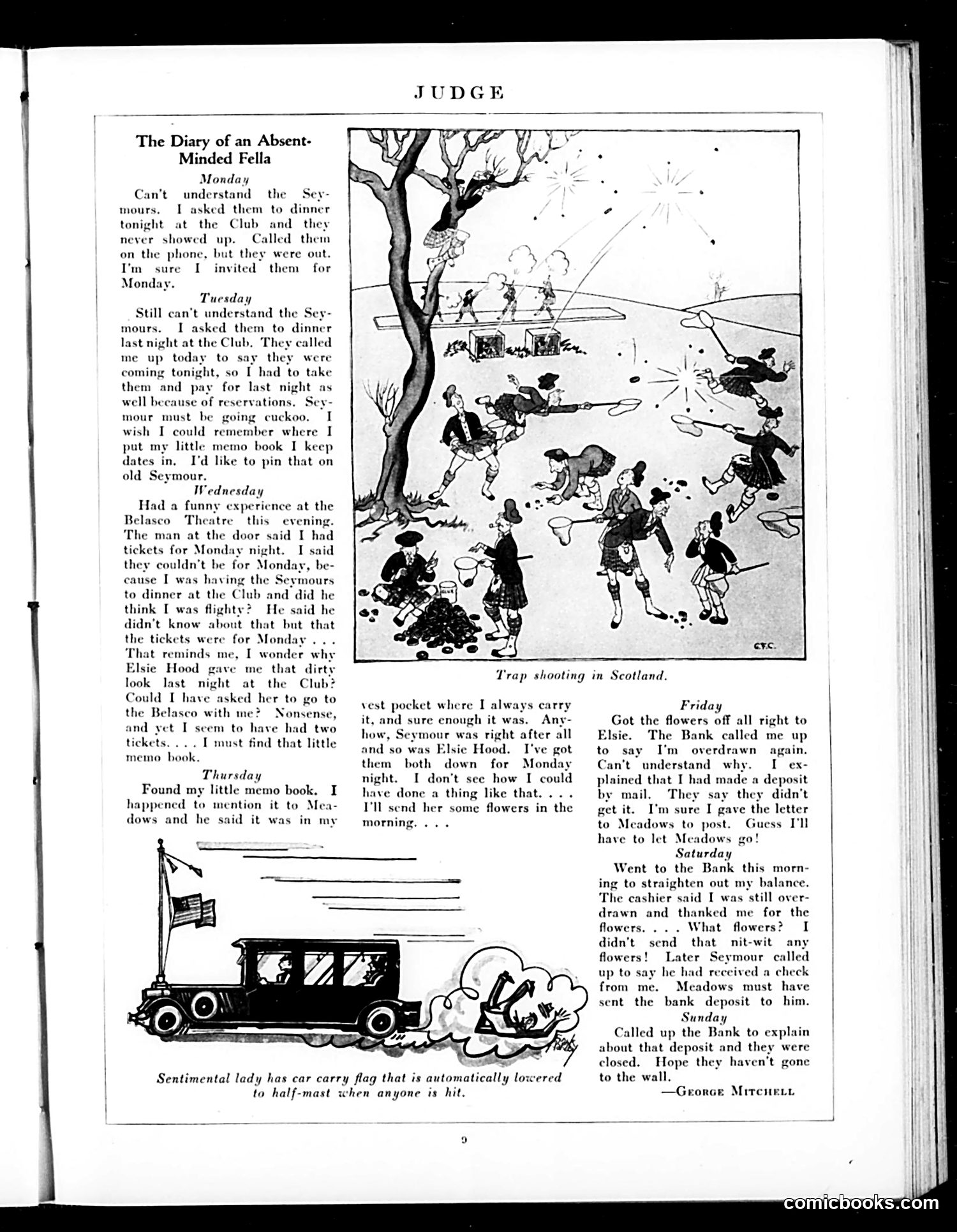
# "The Diary of an Absent-Minded Fella" This humorous diary by George Mitchell depicts a wealthy, scatterbrained protagonist whose organizational chaos cascades into social and financial mishaps. The joke centers on his reliance on a memo book to track social obligations—he's so forgetful he double-books dinner invitations to both the Seymours and Elsie Hood for the same Monday night. His incompetence extends to banking: he claims to have mailed a deposit that never arrives, then discovers his secretary Meadows mistakenly sent it to Seymour instead. He attempts damage control by sending flowers to Elsie (whom he offended), but these too go astray. The accompanying cartoon shows "trap shooting in Scotland"—likely illustrating the chaos of upper-class leisure activities. The separate small cartoon mocks sentimental pretension: a woman's car flag automatically lowers to half-mast when hit—absurd conspicuous consumption. The satire targets careless wealthy men dependent on servants and social clubs, whose bumbling incompetence creates unnecessary drama among their social circle.
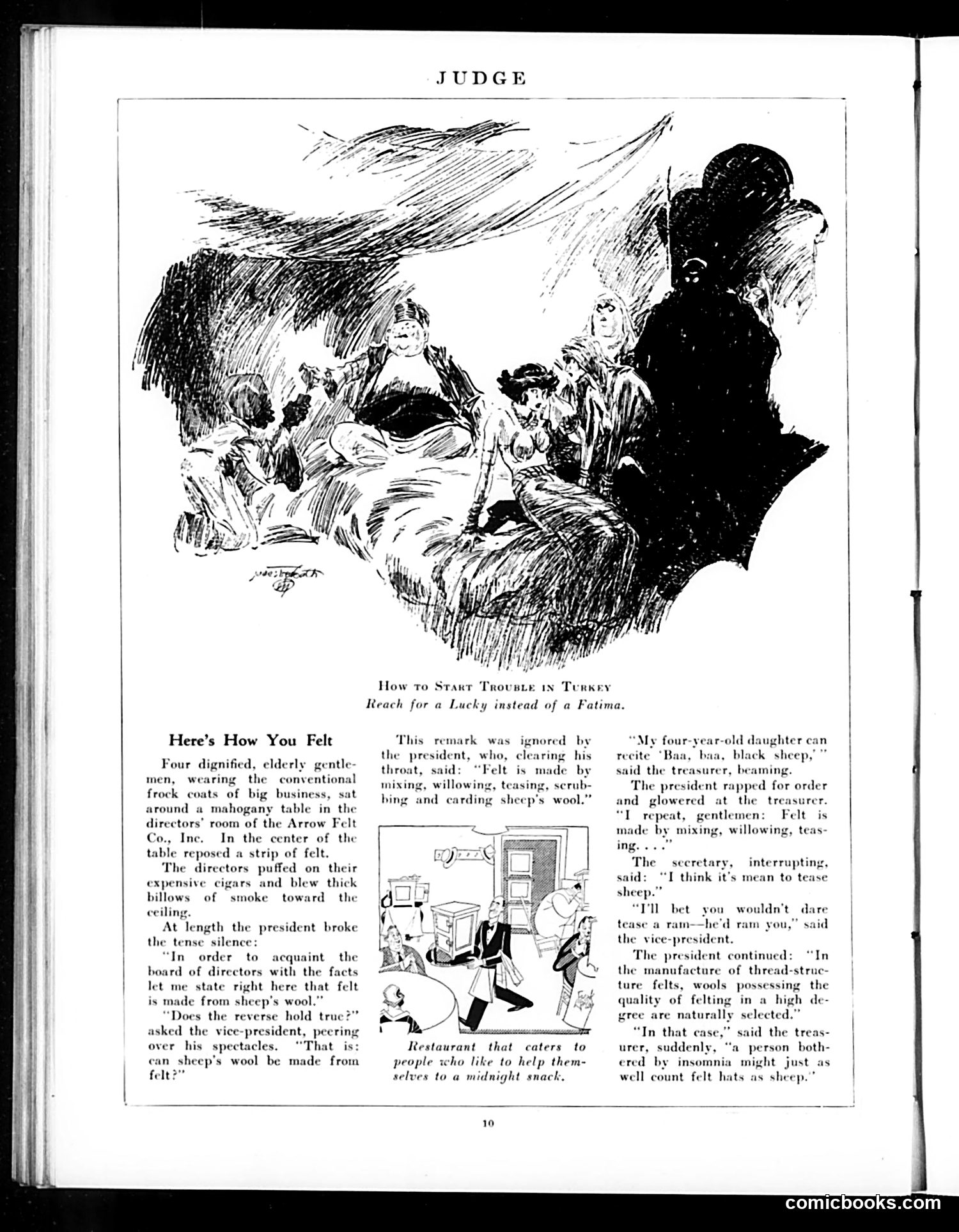
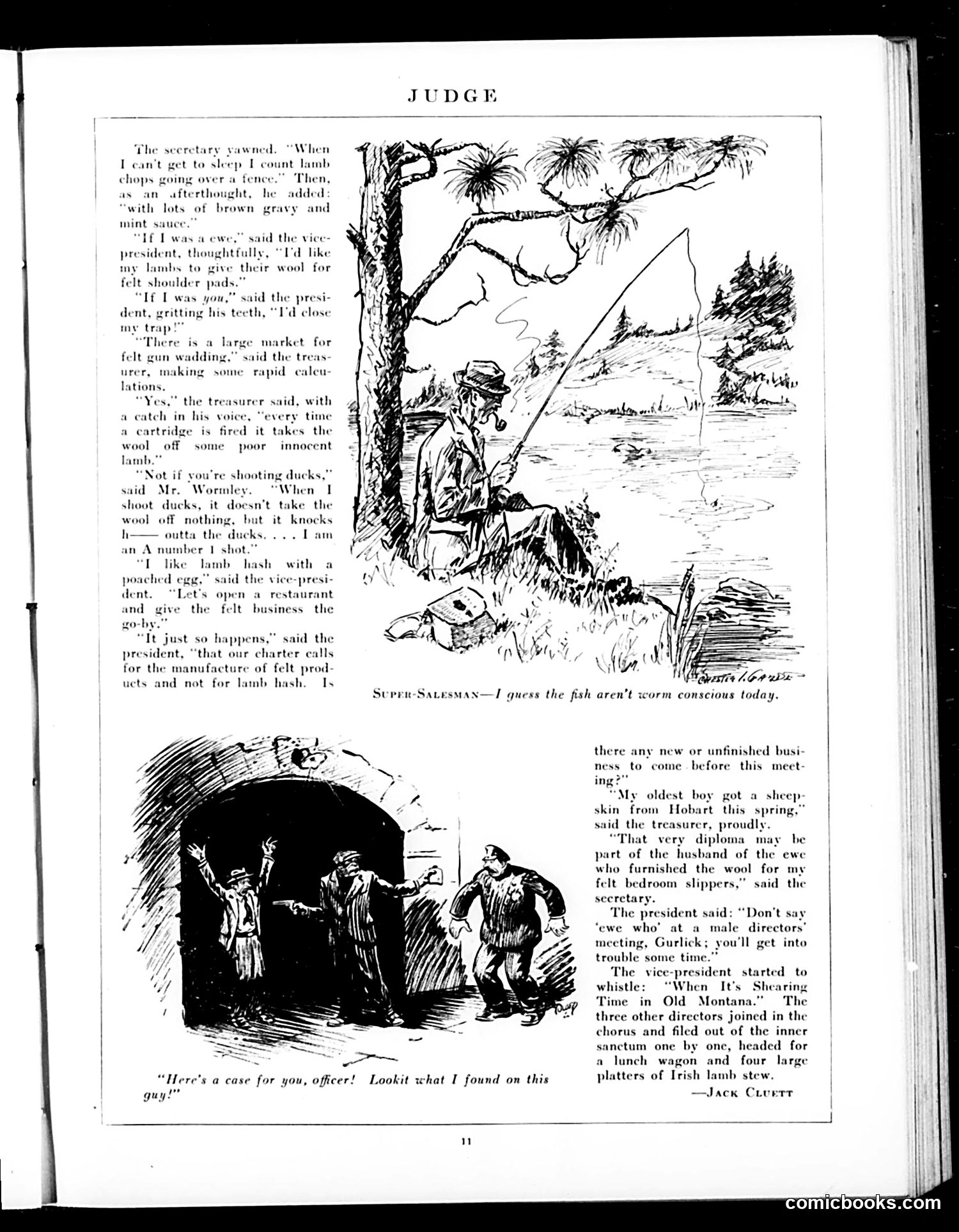
# Explaining This Judge Magazine Page This page contains two satirical pieces: **"Here's How You Felt"** mocks pompous business executives. Four dignified felt company directors sit solemnly discussing wool and felt manufacturing, but keep getting distracted by absurd tangents—a daughter reciting "Baa Baa Black Sheep," whether rams would retaliate if teased, whether insomniacs could count felt hats instead of sheep. The humor lies in how these serious businessmen descend into childish nonsense while attempting to sound authoritative about industrial processes. **"How to Start Trouble in Turkey"** (top illustration) is a separate political cartoon about Turkish affairs, likely referencing early 20th-century diplomatic tensions. The caption's cynical advice—"Reach for a Lucky instead of a Fatima" (cigarette brands)—suggests international friction could be sparked casually. The page also includes an advertisement for a restaurant catering to late-night appetites. The overall tone is satirical commentary on American business pretension and international relations.