
A complete issue · 36 pages · 1929
Judge — April 13, 1929
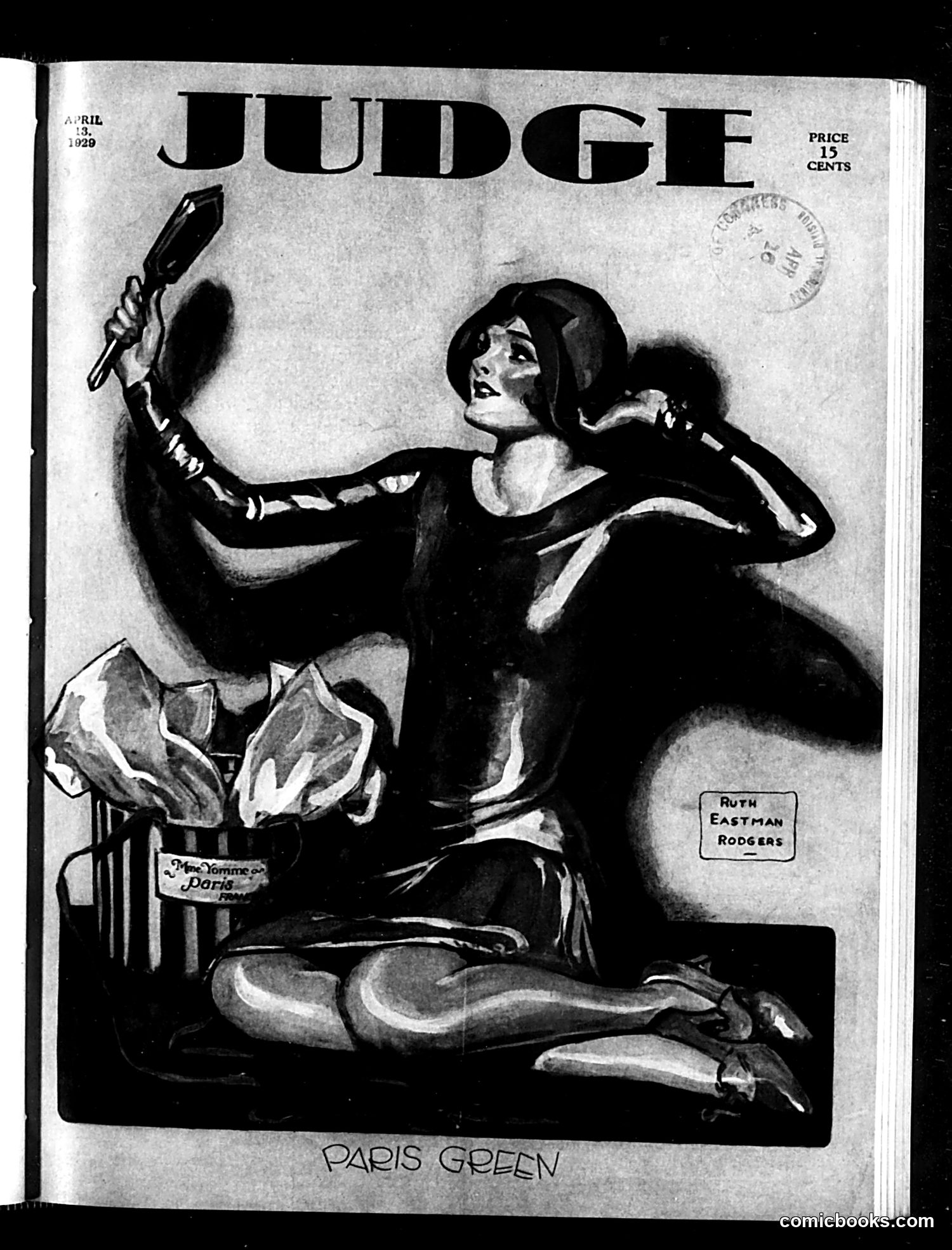
This cover features "Paris Green," a satirical illustration by Ruth Eastman Rodgers showing a fashionable woman in 1920s attire holding a mirror and striking a dramatic pose. The title references both the Parisian fashion scene and "Paris Green," a toxic arsenic compound historically used as pesticide. The satire likely mocks the vanity and superficiality of 1920s society women obsessed with Parisian fashion trends and their own appearance. The woman's exaggerated, self-absorbed gesture—gazing at her reflection while holding cosmetics—suggests criticism of materialism and narcissism among the wealthy during the Jazz Age. The poisonous double meaning of "Paris Green" may imply that this frivolous lifestyle is spiritually or morally toxic.
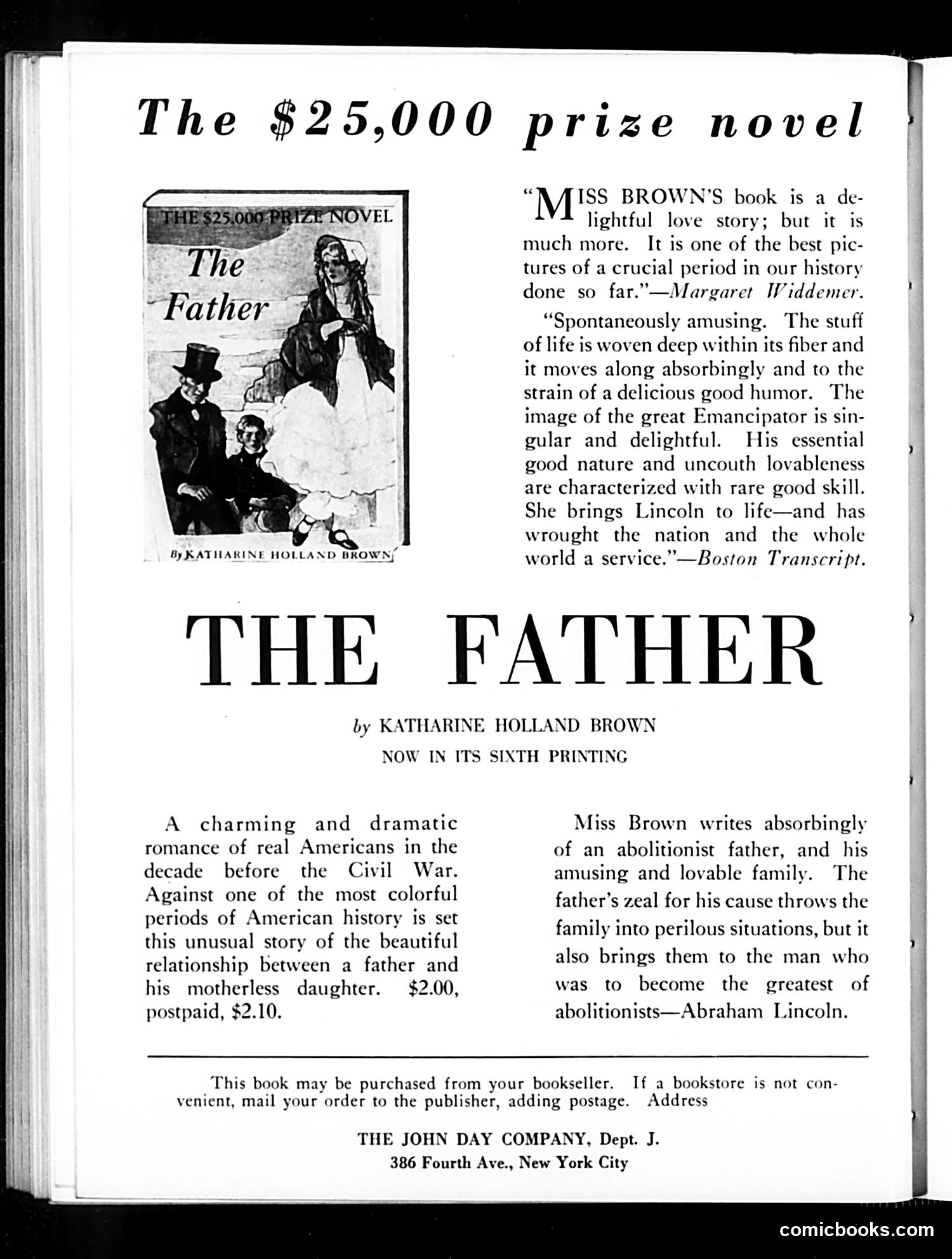
This page is primarily a **book advertisement**, not satirical content. It promotes "The Father" by Katharine Holland Brown, winner of a $25,000 prize novel competition. The advertisement includes: - **Book cover image**: Shows three figures—a man in a top hat, a woman in a white dress, and a child—representing the "father and his motherless daughter" mentioned in the text. - **Historical context**: The novel is set in the pre-Civil War era and centers on an abolitionist father and his family's relationship with Abraham Lincoln. - **Publisher**: The John Day Company, New York City - **Price**: $2.00 (postpaid $2.10) - **Status**: Already in its sixth printing, suggesting commercial success The quotes praise the book's portrayal of Lincoln and historical period accuracy. This is straightforward period advertising, not satire.
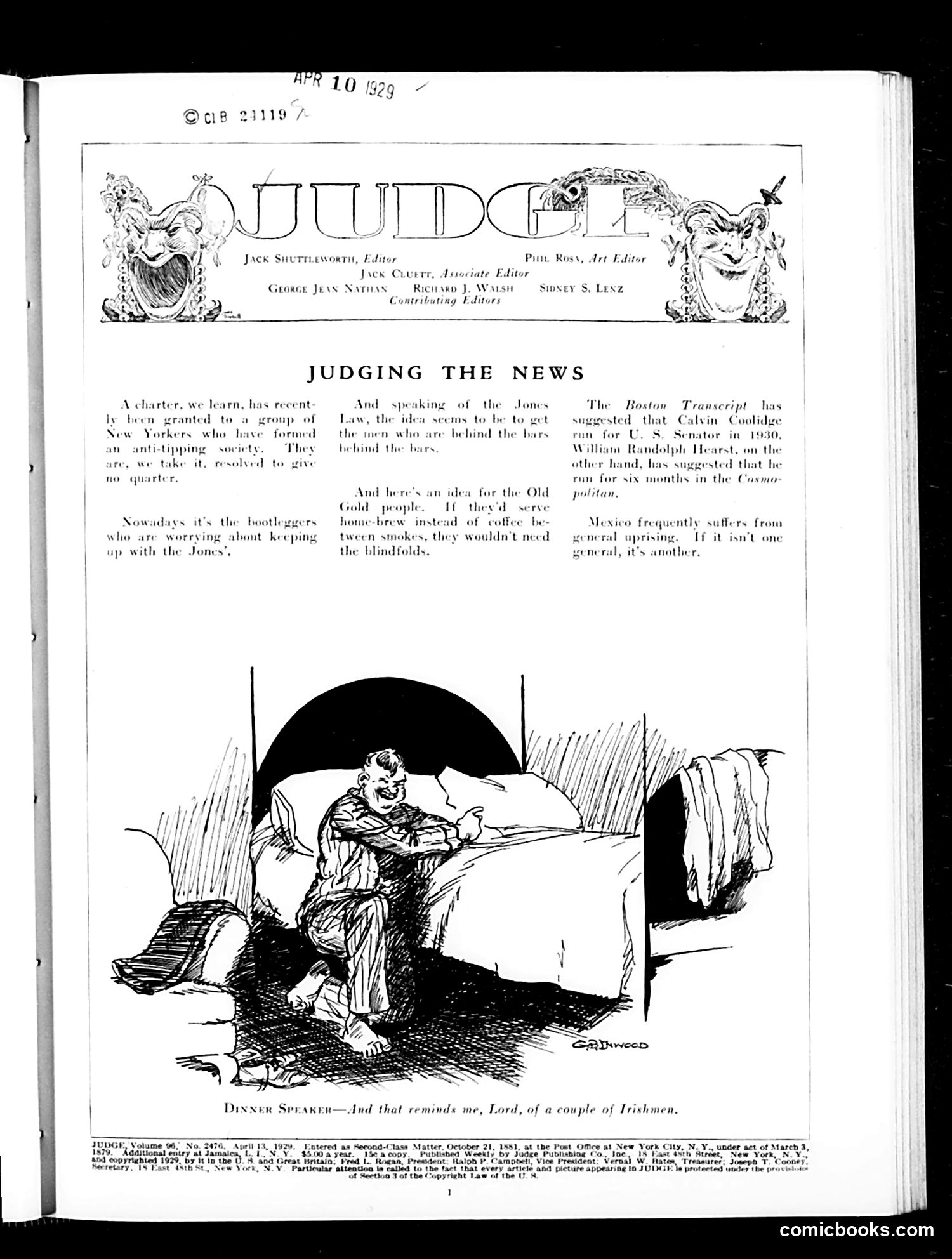
This page contains satirical commentary on current events rather than a single cartoon. The main illustration depicts a disheveled couple in bed, captioned "Dinner Speaker—And that reminds me, Lord, of a couple of Irishmen." The commentary above references: - A charter granted to anti-tipping societies (social commentary on tipping culture) - "Bootleggers" worrying about keeping up with the "Joneses" (Prohibition-era humor) - The James Law (likely criminal legislation) - Jokes about Old Gold people and coffee/blindfolds (unclear reference, possibly advertising-related) - Calvin Coolidge's potential run for U.S. Senator - Mexico's political instability ("general uprising") The bed illustration appears to be a generic joke about dinner conversation rather than commentary on specific figures, typical of Judge's light humor filler content.
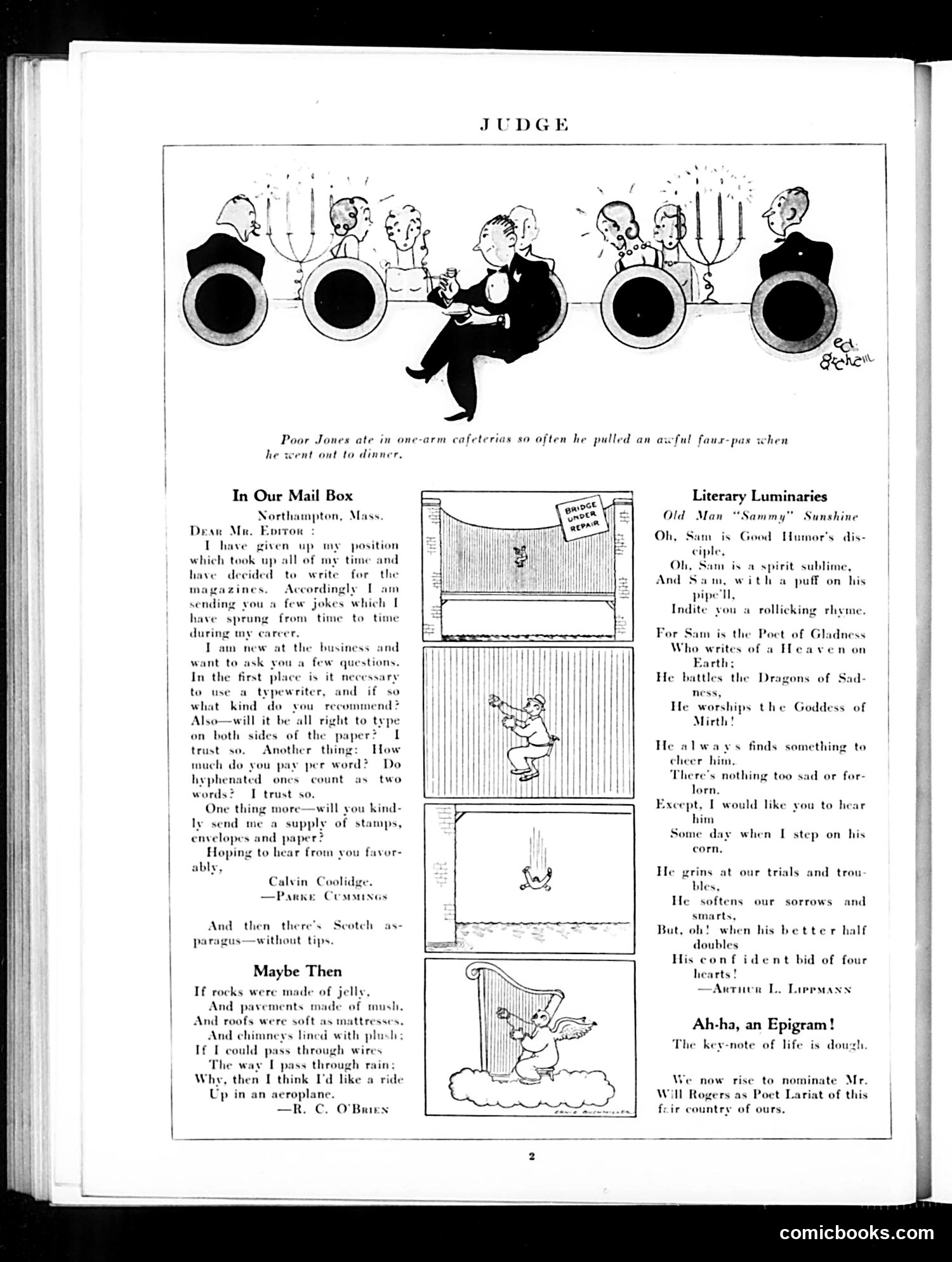
The top cartoon satirizes judicial proceedings, showing a judge being repeatedly pulled by process servers summoning him to dinner—suggesting judges were so overworked that even social obligations interfered with their duties. The caption notes "Poor Jones ate in one-arm cafeterias so often he pulled an awful faux-pas when he went out to dinner," indicating Jones adapted so completely to quick meals that he forgot proper dining etiquette. The rest of the page contains reader letters, poetry tributes to "Sam" (likely a magazine contributor), and humorous verse about hypothetical scenarios (rocks as jelly, roads as mattresses). This appears to be a typical Judge magazine letters/humor section rather than political satire. The specific historical context of the judicial workload commentary remains unclear without dating information.
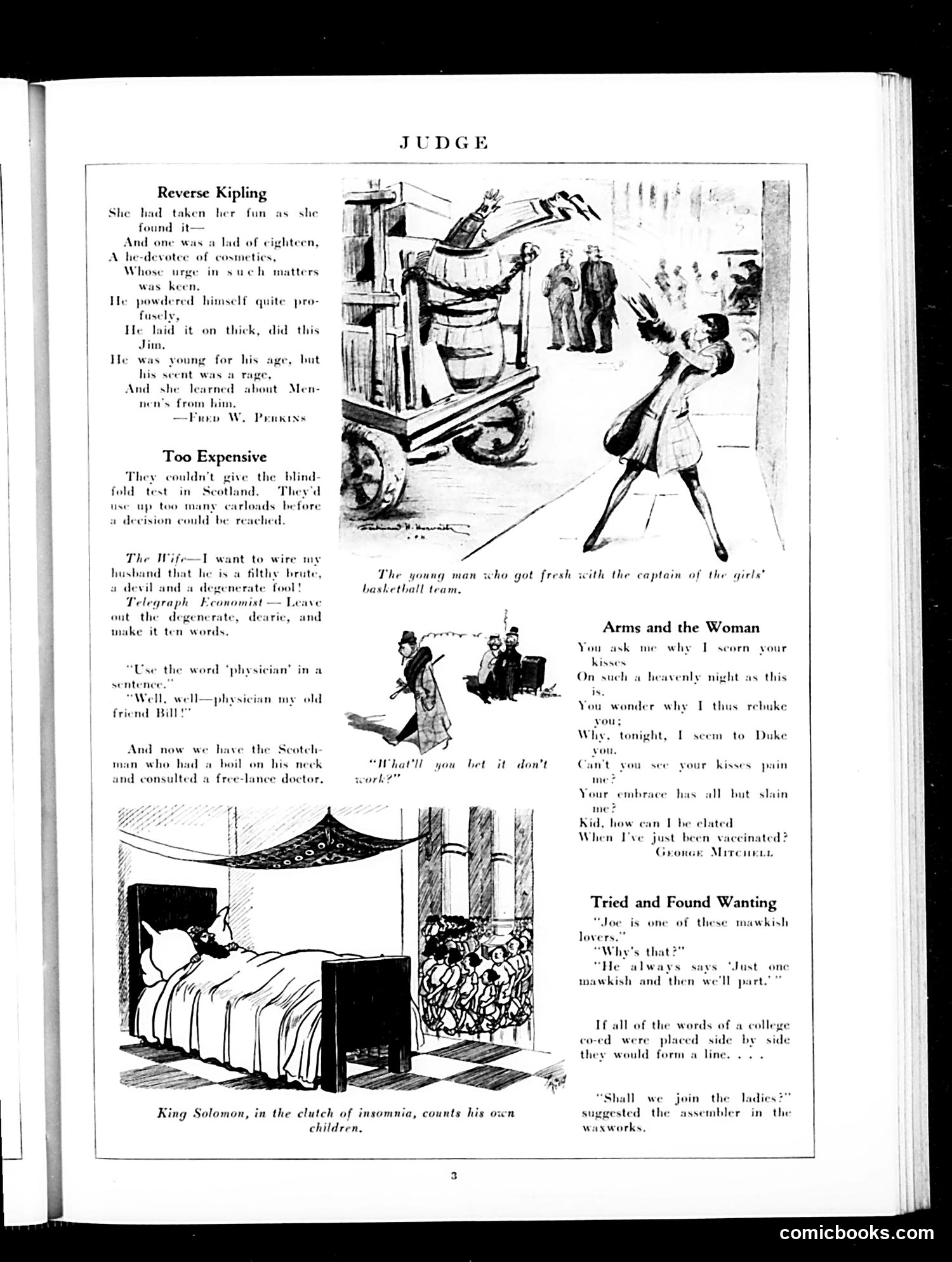
This page contains several humor pieces and cartoons typical of early 20th-century satirical magazines: **"Reverse Kipling"** and **"Too Expensive"** are brief written jokes poking fun at social pretensions and bureaucratic inefficiency (the Scotland story about a boil consultation). **The main cartoon** depicts a young man being ejected from or confronted at a basketball team's venue, captioned "The young man who got fresh with the captain of the girls' basketball team." This is straightforward slapstick humor about sexual harassment/boundary-crossing, with the woman physically rejecting unwanted advances. **"Arms and the Woman"** is a poem about romantic rejection following vaccination (the woman refuses kisses because of arm soreness from a vaccine). **"King Solomon" illustration** shows a man in bed counting—a joke about having many children, referencing Solomon's biblical reputation for numerous offspring. The humor is typical of period comedy: domestic, romantic mishaps, and physical farce.
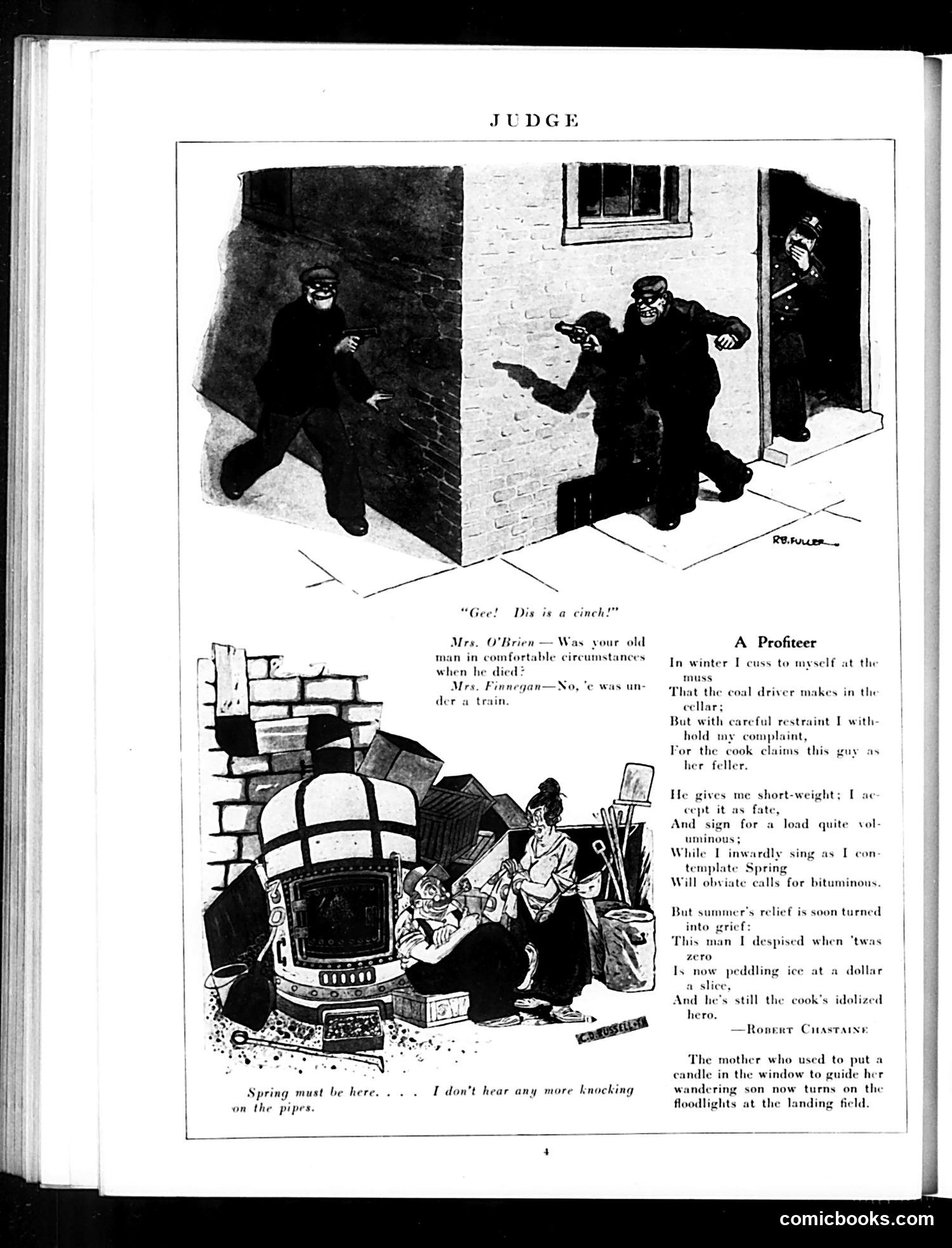
**Top cartoon**: Shows two figures in an alley confrontation with the caption "Gee! Dis is a cinch!" The dialogue below—between "Mrs. O'Brien" and "Mrs. Finnegan"—discusses a man's death circumstances. Mrs. O'Brien notes her old man died "under a train," while Mrs. Finnegan clarifies hers was not a train accident. This appears to be dark humor about working-class Irish immigrant deaths, likely referencing industrial accidents or tragic circumstances common in early 20th-century urban America. **Lower cartoon and poem**: "A Profiteer" criticizes wartime profiteering—a merchant who overcharges and provides short weight to customers. The accompanying verse by Robert Chastaine satirizes this figure's exploitation of consumers, particularly regarding coal delivery and ice sales across seasons. The page combines visual and written satire targeting class issues and wartime economic abuse.
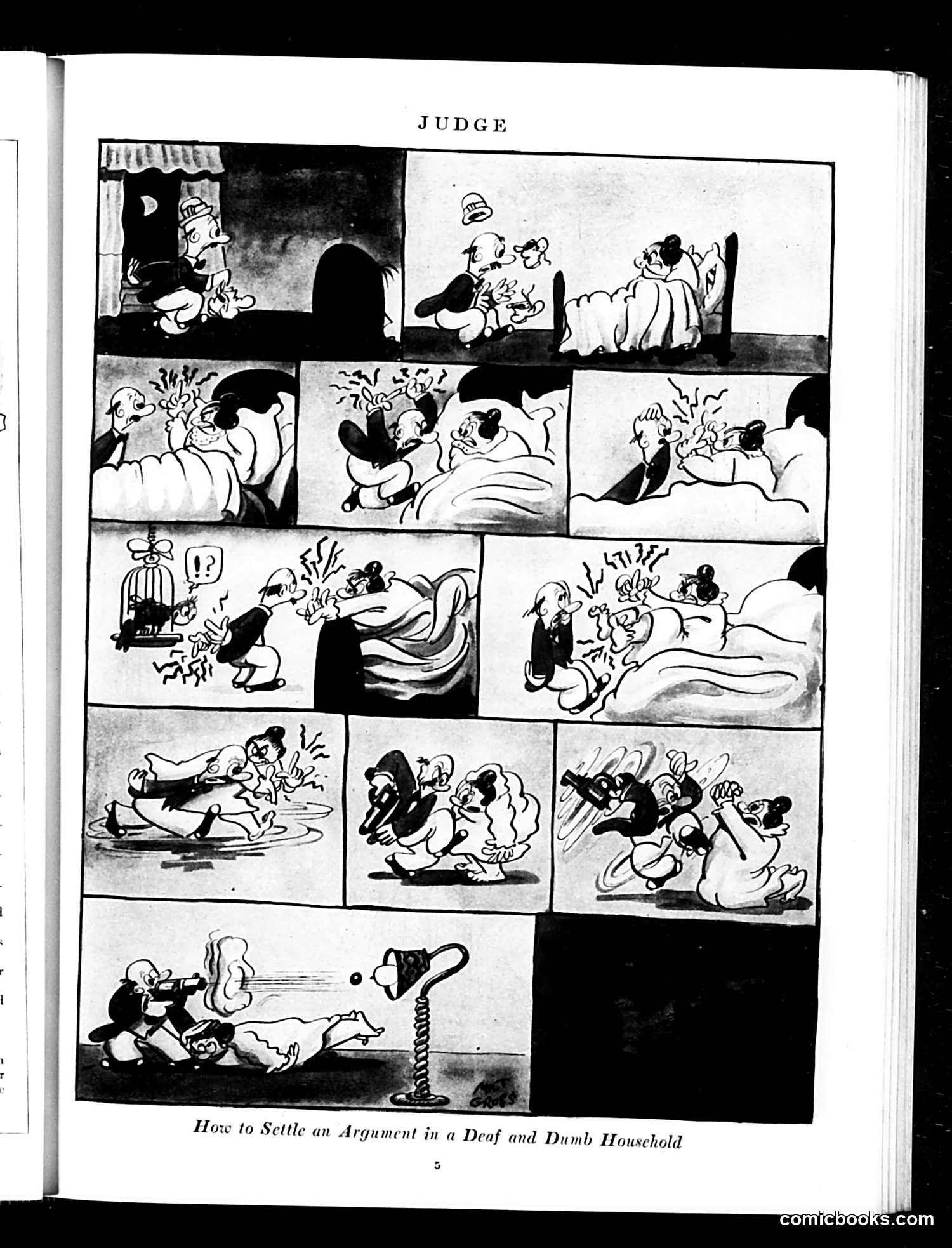
This satirical comic titled "How to Settle an Argument in a Deaf and Dumb Household" uses disability as the basis for humor—a common but offensive comedic trope of the era. The strip depicts a domestic dispute between what appear to be a husband and wife, both deaf and unable to speak. The humor relies on physical comedy and visual exaggeration: characters gesture wildly, engage in slapstick violence, and create chaos. The final panel shows them literally fighting over a telephone or speaking device, the irony being that such communication tools would be useless to deaf individuals. By modern standards, this represents deeply problematic stereotyping that mocks disability rather than engaging with deaf community experiences respectfully.
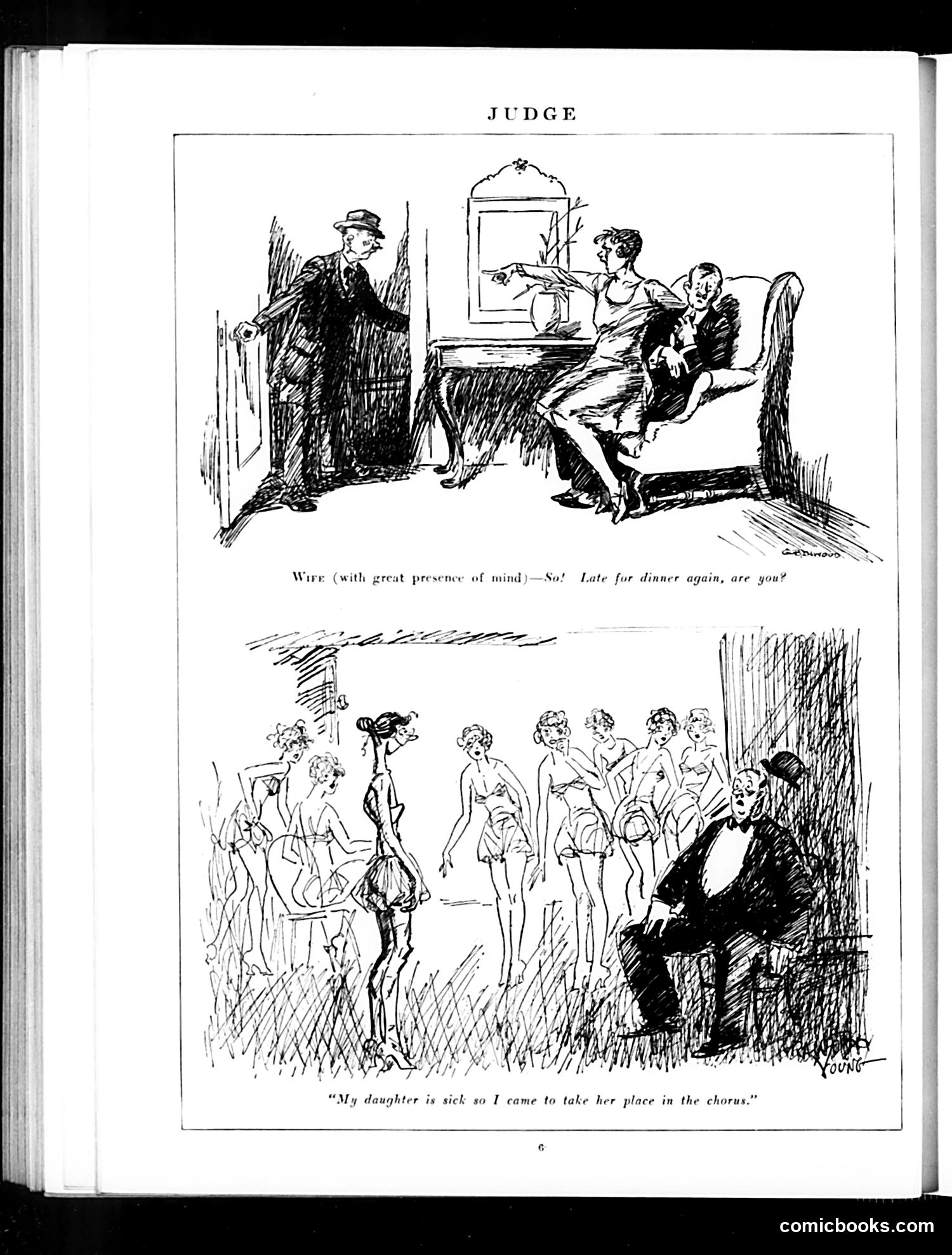
This page contains two satirical cartoons mocking marital infidelity and social hypocrisy among the wealthy. **Top cartoon**: A wife confronts her husband about being late for dinner "again," displaying "great presence of mind." The satire targets men who neglect their wives with flimsy excuses. **Bottom cartoon**: A man sits watching a chorus line, claiming he substituted for his sick daughter in the performance. The absurdity—a grown man in a chorus—is the joke's point. The satire mocks both male dishonesty about affairs and the hypocrisy of respectable gentlemen frequenting theatrical performances (which carried moral suspicion in this era). Both cartoons target upper-class masculine deception and the gap between Victorian propriety and actual behavior. The humor relies on readers recognizing these as common domestic and social hypocrisies of the period.
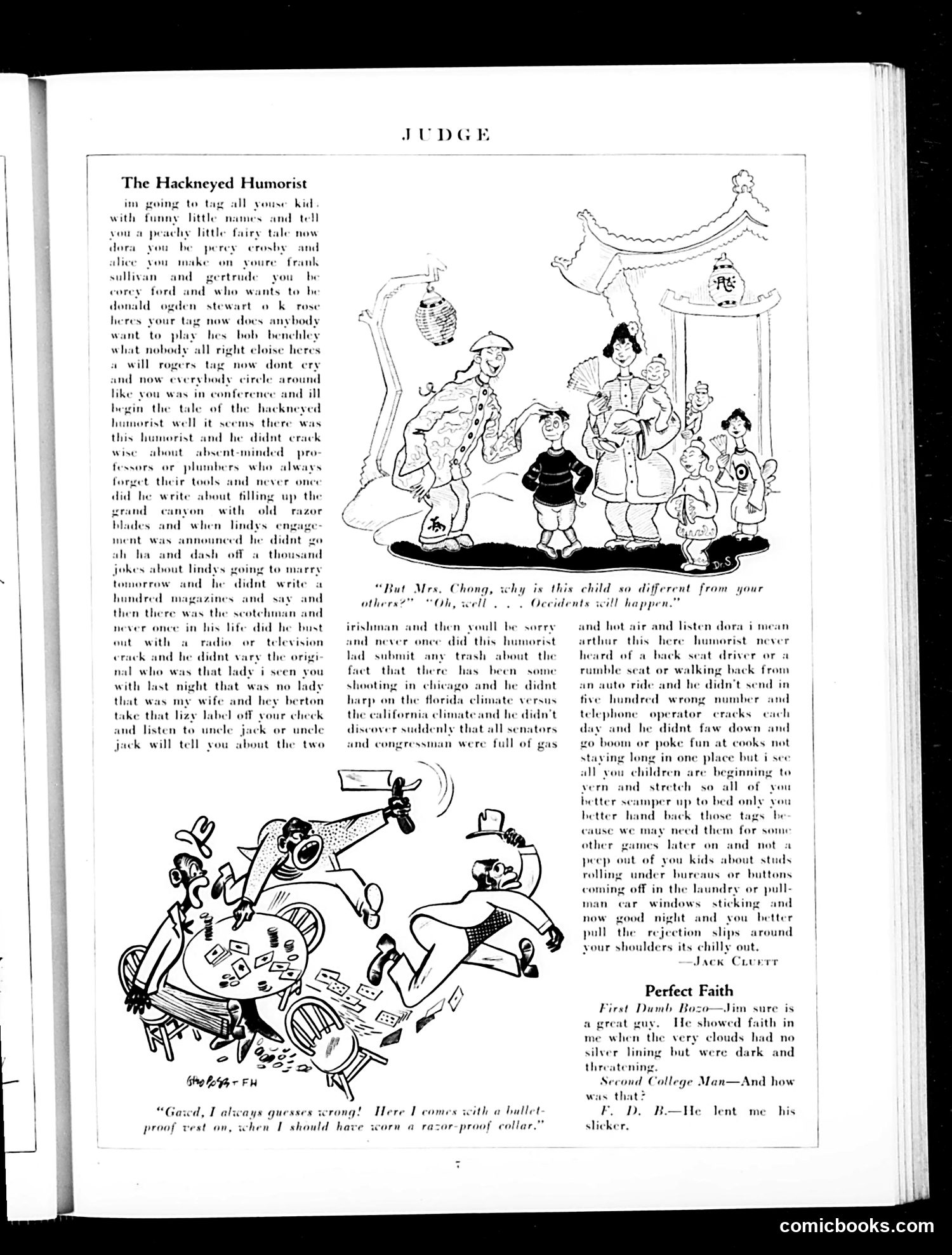
This page satirizes a tired, formulaic humor writer who relies obsessively on clichéd jokes and subjects. The main article mocks a humorist who constantly recycles the same tired material: jokes about plumbers losing tools, Lindbergh's engagement, radio/television gags, the "was that my wife?" joke, Chicago shootings, climate comparisons, senators' incompetence, backseat drivers, rumble seats, wrong numbers, and stuck car windows. The satire references actual popular humorists of the era (likely 1920s-30s based on references to Lindbergh), suggesting they all mined identical subject matter. The piece ridicules how this writer never innovates, always retreating to predictable territory. The accompanying cartoons—showing the humorist's chaotic process and a domestic scene about children's name-tags—visually reinforce the complaint: mindless, repetitive formula masquerading as wit. The brief "Perfect Faith" joke below offers contrast: genuine, understated humor without forced punchlines.
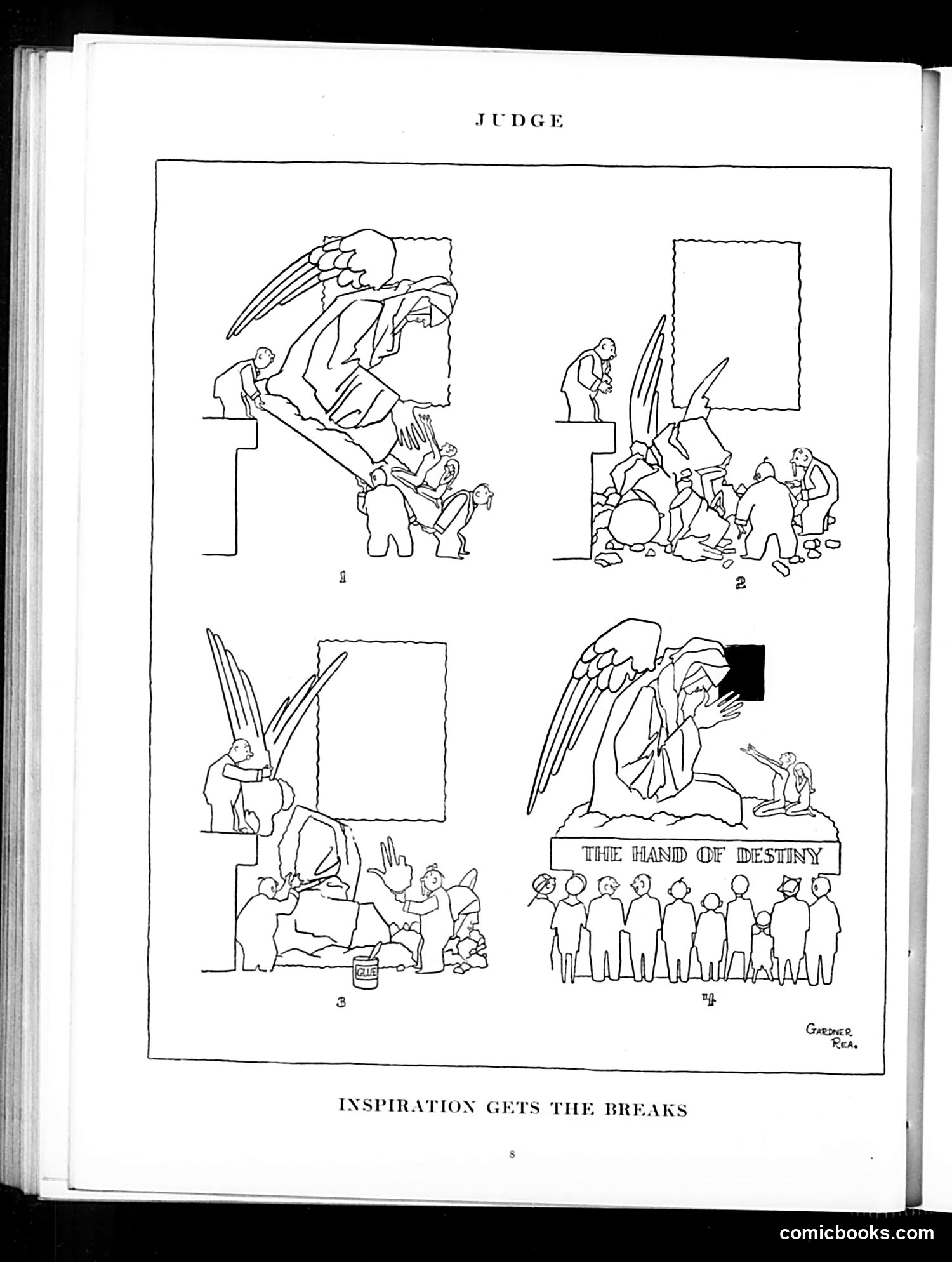
This satirical cartoon from *Judge* magazine depicts "Inspiration" (represented as an angelic winged figure) being repeatedly knocked down and mistreated by various earthly forces and obstacles. In panel 1, Inspiration is literally crushed by a massive weight. Panel 2 shows her surrounded by indifferent or hostile figures. Panel 3 depicts further struggle. Panel 4, labeled "The Hand of Destiny," shows Inspiration cowering before what appears to be fate or larger forces, while common people stand below watching. The satire critiques how inspiration—the creative spark necessary for art, innovation, and progress—is systematically defeated by practical circumstances, public indifference, institutional resistance, or blind fate. The cartoon suggests that creative ambition faces insurmountable odds in the real world, despite being essential to human achievement.
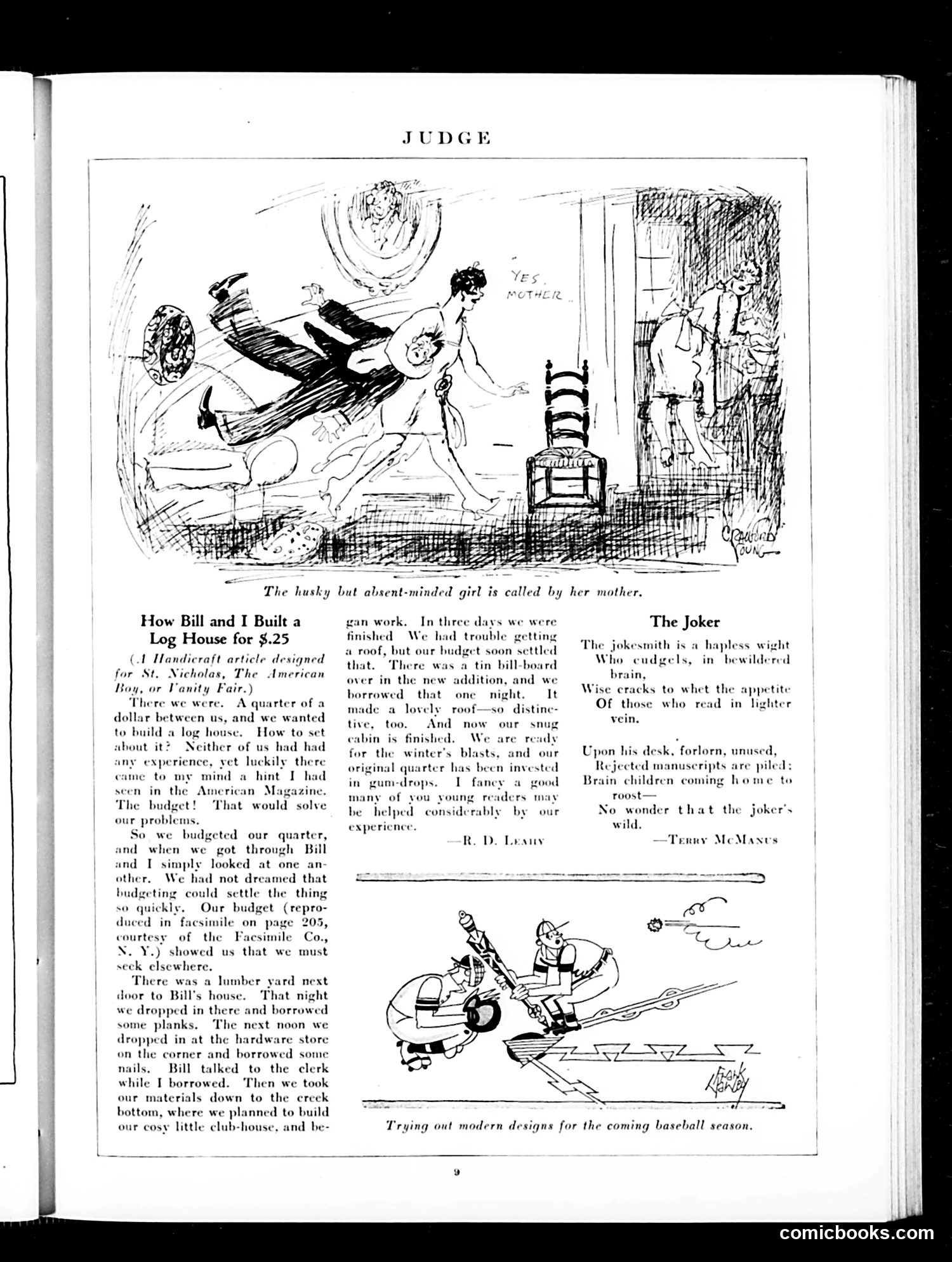
This page contains three distinct pieces of humor targeting early 20th-century American culture: **Top cartoon**: Satirizes absent-minded young women. A distracted girl, being called by her mother, is so preoccupied she's literally floating/levitating while playing a musical instrument—visual comedy about female inattentiveness. **Left article**: Parodies self-help and budget-conscious living trends. The "article" mocks how people borrowed materials (lumber, nails, tin signs) while claiming to build a house for 25 cents—satirizing both the DIY magazine craze and the gap between budgeting advice and actual financial reality. The humor lies in pretending borrowing equals building cheaply. **Right poems**: "The Joker" mocks struggling comedy writers with rejected manuscripts piling up, while "The Joker" witticizes about jokesmith incompetence. **Bottom cartoon**: Lighthearted baseball satire showing absurd modern equipment designs for the upcoming season. Overall, the page satirizes contemporary trends: budget-conscious living, self-help culture, and the entertainment industry's struggles.
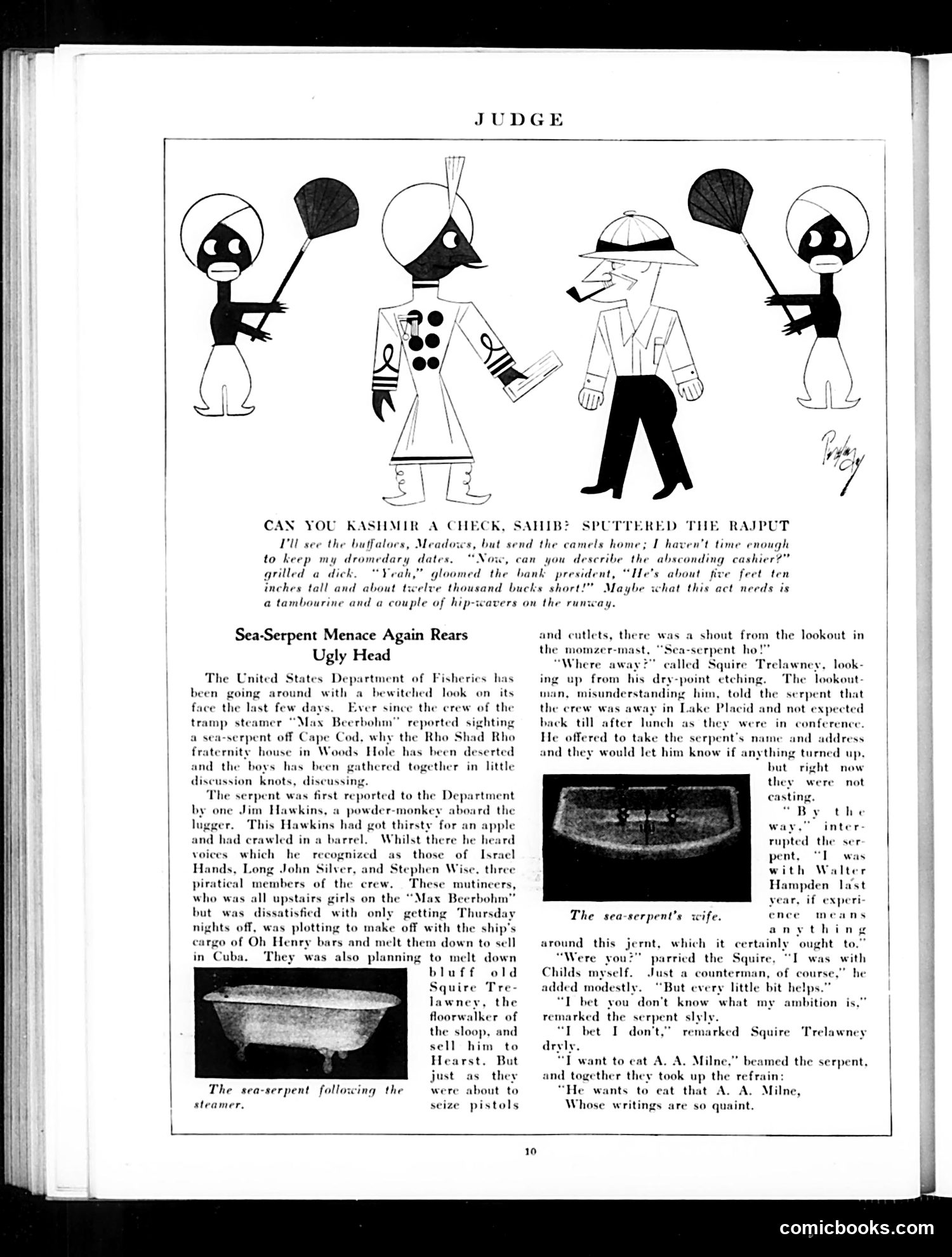
The top cartoon satirizes absconding bank cashiers during what appears to be a period of embezzlement scandals. The joke plays on the bank president's absurdly precise description ("twelve thousand bucks short") while suggesting the real problem is the bank's lack of entertainment—it needs "a tambourine and a couple of hip-wavers on the runway" to compete with modern attractions. This mocks both corporate incompetence and the era's obsession with novelty entertainment. The lower section, "Sea-Serpent Menace Again Rears Ugly Head," is a humorous tall tale referencing a sea-serpent sighting off Cape Cod that allegedly caused panic at Woods Hole (a marine research center). The narrative parodies adventure fiction by having the serpent claim friendships with celebrities like Walter Hampden and A.A. Milne, subverting the monster-threat premise into absurdist comedy about the serpent's show-business aspirations.
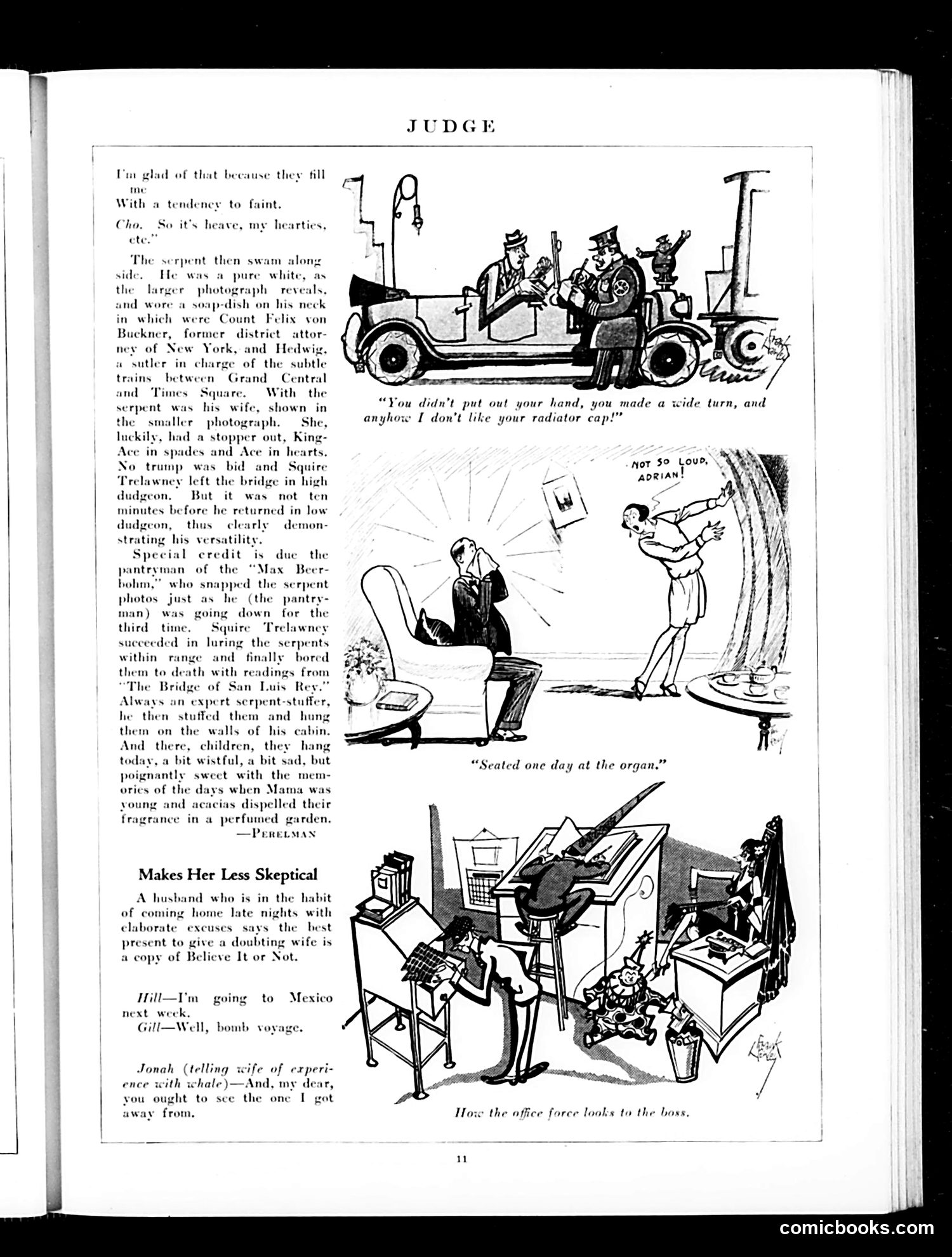
This page contains three unrelated satirical cartoons typical of 1920s-30s humor magazine format: 1. **Top cartoon**: A serpent-themed tall tale mocking elaborate excuses. References "Count Felix von Buckner, former district attorney of New York" and "Hedwig," apparently real figures used as joke subjects. The absurdist narrative (serpent playing cards, readings from "The Bridge of San Luis Rey") satirizes tall-tale storytelling itself. 2. **Middle cartoon ("Makes Her Less Skeptical")**: A husband's solution to a skeptical wife—giving her a "Believe It or Not" book (likely referring to Robert Ripley's popular odditorium series). The joke: if she reads impossible stories, she'll believe his excuses. 3. **Bottom cartoon**: Domestic comedy about a husband's poor driving, with the wife criticizing his traffic manners and car appearance—typical marital bickering humor. The page satirizes everyday American domestic life and male behavior through exaggeration and absurdist scenarios. No clear political content is evident.
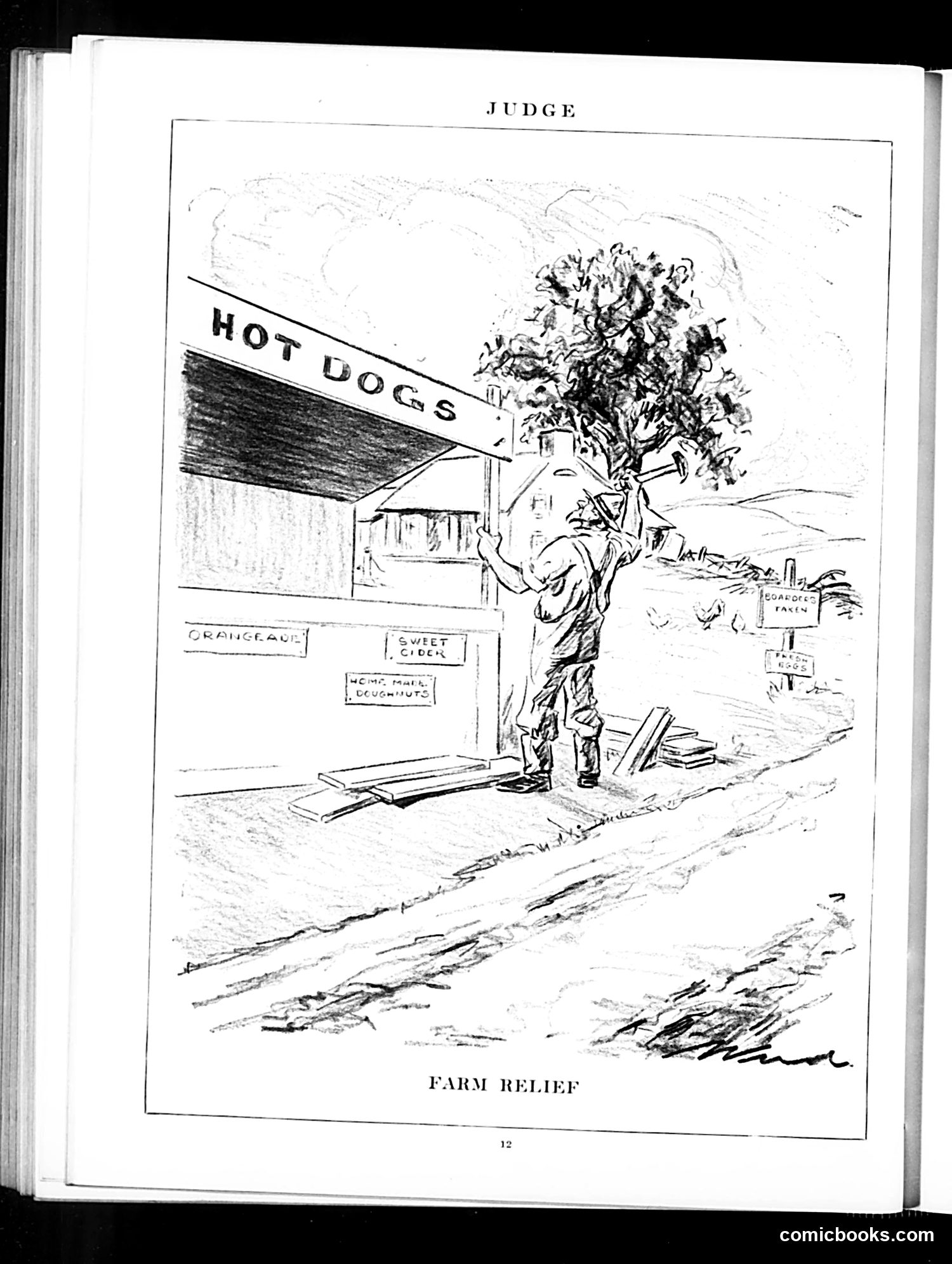
This Judge magazine cartoon titled "Farm Relief" depicts a farmer standing before a "Hot Dogs" stand, with various signs visible including "Orangeade," "Sweet Cider," and "Hemp Plant Legalize?" The satire criticizes government farm relief programs by showing a struggling farmer reduced to operating a roadside hot dog stand—suggesting that official farm aid is inadequate. The various signs and labels indicate this is a tourist-trap concession stand, implying farmers were forced into such marginal enterprises rather than receiving meaningful agricultural assistance. The cartoon likely dates to the Depression era when farm relief was a major political issue. It sarcastically suggests that government solutions left farmers economically devastated, forced to pursue survival through tourist commerce rather than receiving substantive agricultural support.
This editorial supports Marietta Johnson's progressive educational reform proposal. Johnson, who ran the famous Fairhope School (established in Alabama and known in Europe), advocates eliminating college entrance requirements and standardized testing. The piece argues that rigid entrance standards create a "blight" cascading downward through all education—kindergarten through high school become mere preparation rather than valuable in themselves. The satire critiques how millions of secondary students study subjects solely because colleges *require* them, not for inherent value. Johnson's alternative: open college doors to any normal 18-year-old, regardless of Latin or trigonometry knowledge. Education would emphasize discussion over lectures, with stern but humane discipline. Crucially, "no child shall ever fail"—responsibility for failure rests with teaching systems, not students. This reflects early 20th-century progressive education debates challenging traditional academic gatekeeping in favor of student-centered, experiential learning.
This is a theater review column, not a political cartoon. Nathan critiques "Buckaroo," a theatrical production at the Erlanger Theatre directed by Hamilton MacFadden. The satire targets the show's incompetent staging: despite featuring a full rodeo arena with horses, mules, cowboys, Indians, and numerous extras, the director fails to make theatrical use of these elements. Nathan compares MacFadden unfavorably to producer David Belasco, implying the former lacks Belasco's skill at creating atmospheric drama. The core complaint: the plot (a cowboy, his sweetheart, and a scheming Chicago woman) is "tripe," and all the spectacle merely distracts from the play's weakness rather than compensating for it. Nathan argues drama requires actual dramatic content—not just elaborate staging. The review praises only a few performers (Ruth Easton, Nydia Westman, Clyde Dilson, Dell Cleveland) while dismissing the production as cluttered and poorly directed.
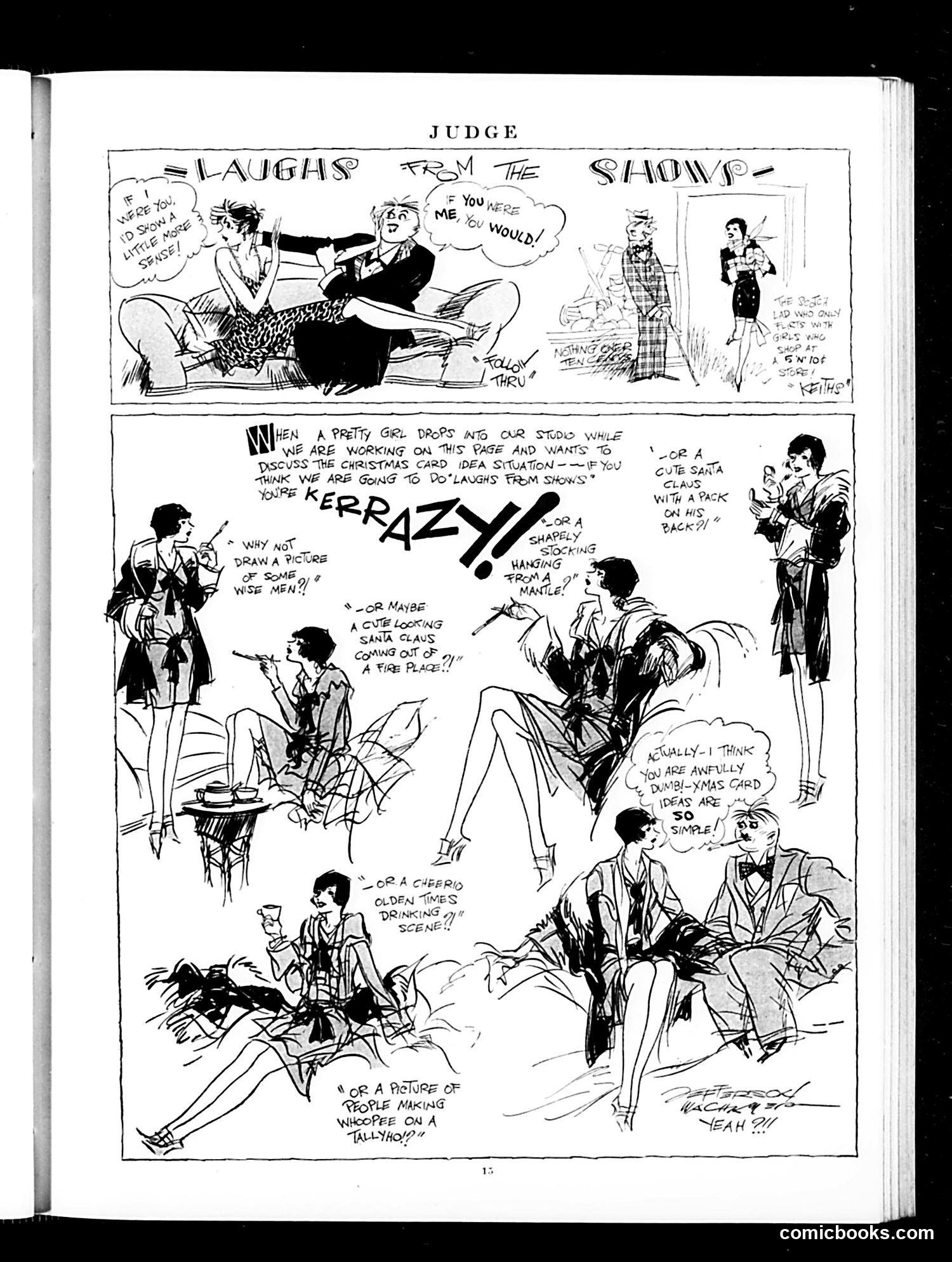
This is a meta-comic about Christmas card design ideas. The top panel shows a judge figure being physically jostled by a woman while he's working, with the caption explaining that when "a pretty girl drops by our studio" to discuss Christmas card concepts, they're expected to produce "laughs from shows." The larger panel below depicts brainstorming sessions where multiple people suggest increasingly clichéd holiday imagery: Santa coming from a fireplace, cute Santa with a pack, people making "whoopee" on a sleigh, and old-fashioned drinking scenes. The word "KERRAZY!" dominates the center, emphasizing the absurdity of these tired, repetitive ideas. The satire targets the commercialization of Christmas and the creative exhaustion of producing seasonal content—mocking how publishers recycle the same hackneyed visual tropes year after year. The exasperated tone suggests frustration with both the banality of holiday imagery and the pressure to manufacture novelty from inherently stale material.
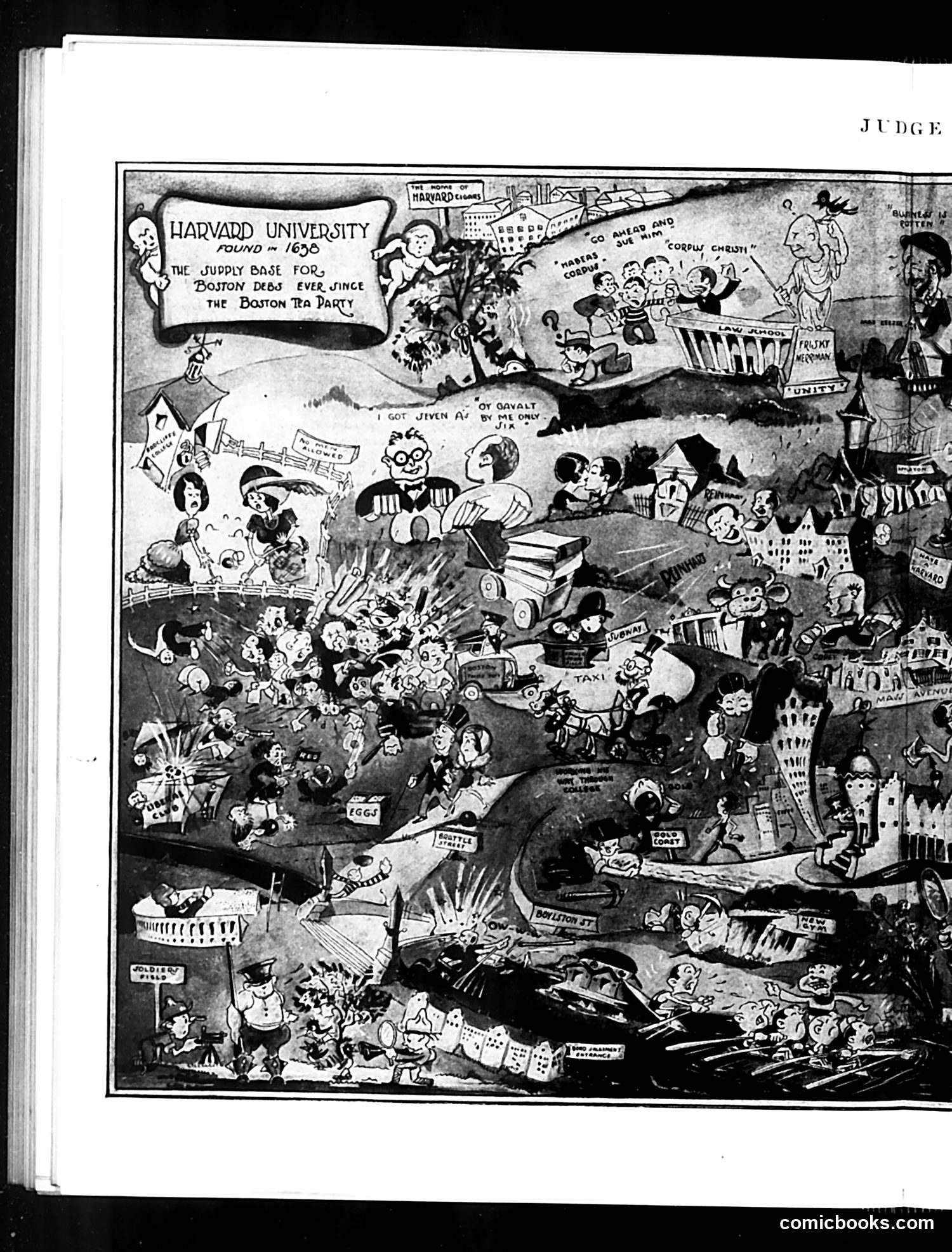
This satirical cartoon mocks Harvard University as essentially a "supply base" for wealthy Boston debutantes—young upper-class women making their social debut. The joke references the "Boston Tea Party" with a pun, suggesting Harvard functions primarily to produce suitable male companions for elite Boston society women rather than serving serious academic purposes. The chaotic illustration depicts Harvard's campus as a madcap scene of socializing, flirtation, and frivolous activity rather than scholarship. The cartoon satirizes both the institution's apparent social function among the Boston elite and the priorities of wealthy families who valued matrimonial prospects and social standing over education. This reflects early-20th-century class anxiety and mockery of Ivy League institutions as playgrounds for the wealthy rather than true centers of learning.
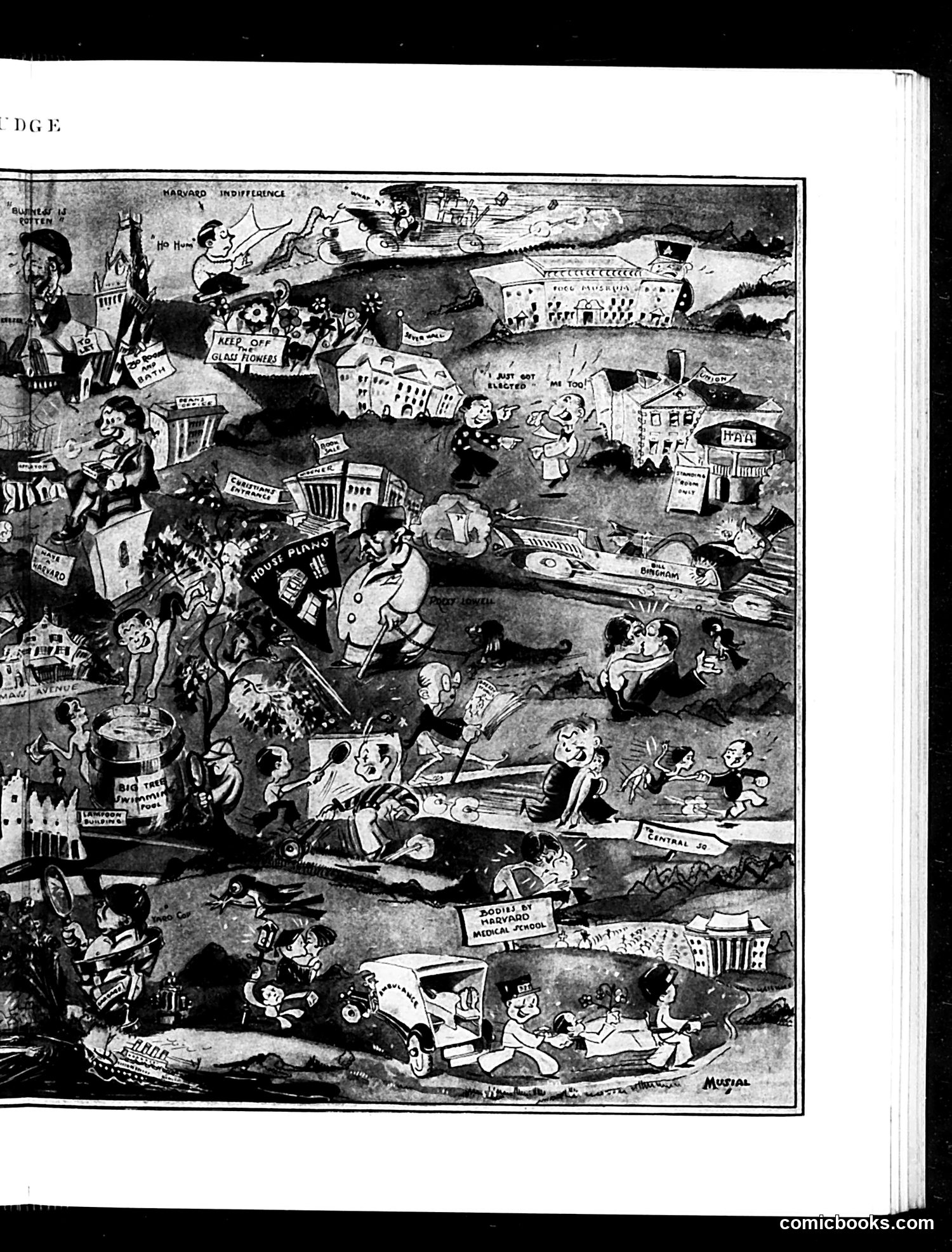
This is a densely packed satirical cartoon from *Judge* magazine depicting urban chaos and social disorder. The illustration shows a crowded street scene with numerous caricatured figures engaged in various chaotic activities—fighting, fleeing, and creating mayhem. Labels visible include references to "Harvard," "Medical School," and various institutional buildings, suggesting commentary on educational institutions. The cartoon appears to satirize crime, poverty, and social breakdown in American cities, with exaggerated character types representing different social classes and criminals. The specific politicians or events referenced are unclear from the visible text, but the overall message criticizes urban disorder and institutional failures. The style and density suggest this is a complex multi-layered satire typical of *Judge's* approach to contemporary social problems, though determining the exact historical moment requires additional context.
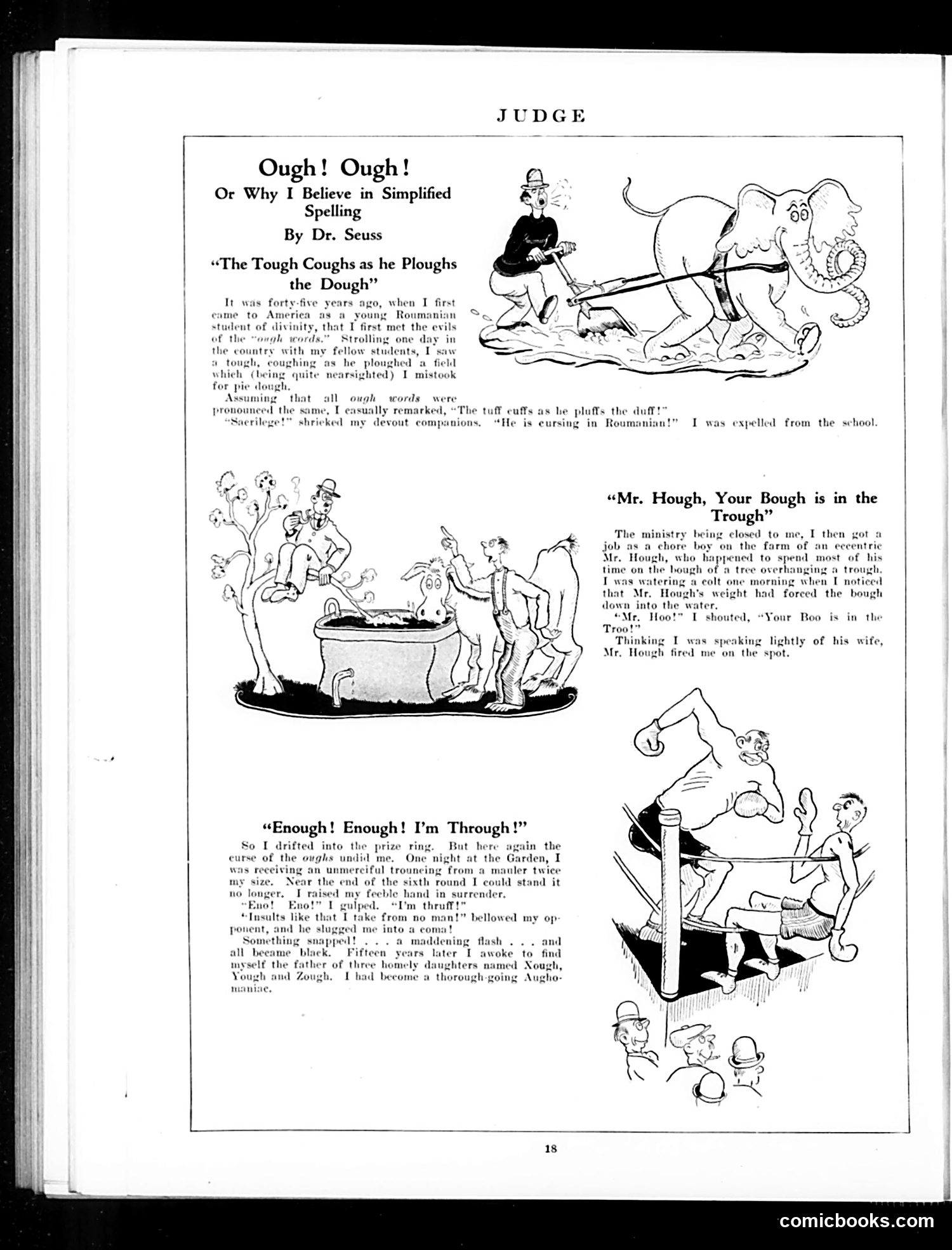
This is a humorous article by Dr. Seuss advocating for simplified spelling reform. The narrative follows a young man whose repeated mispronunciations of words containing "ough" (tough, plough, dough, bough, trough) create comic misunderstandings that derail his life. The satire mocks both the complexity of English spelling and the protagonist's obtuseness. Each section shows him fired from different positions due to homophone confusion—mistaking "ough" pronunciations causes him to insult a clergyman, nearly drown a farmer's ox, and offend a farmer's wife. The cartoons illustrate these absurd scenarios. The piece supports spelling reform by exaggerating how irrational English pronunciation rules create genuine problems, making simplified spelling seem reasonable. It's lighthearted advocacy disguised as comic narrative—typical of early 20th-century Judge magazine's approach to contemporary issues.
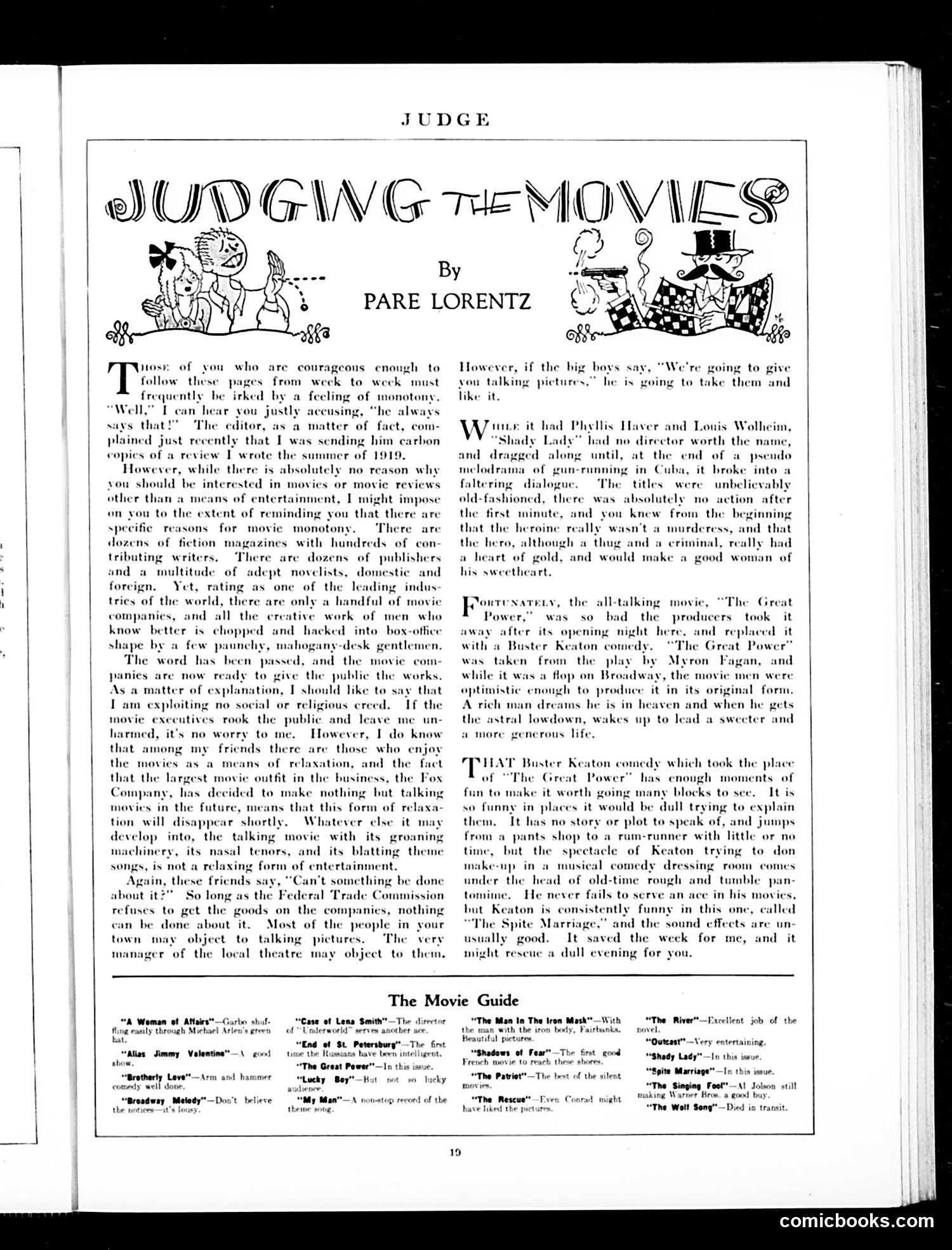
This is a film criticism column by Pare Lorentz, a prominent movie critic of the era. The essay defends film reviewing against reader complaints about monotony, arguing that while there are dozens of fiction magazines and novelists, only a handful of major movie studios exist—making film criticism essential given their monopolistic control over entertainment. Lorentz criticizes the emerging "talking pictures" (early sound films), claiming they're inherently unrelaxing. He reviews three specific films: a melodrama with Phyllis Haver about gun-running in Cuba (tedious); "The Great Power" (so bad it was pulled from theaters), and a Buster Keaton comedy that replaced it (genuinely funny, though plotless). The satire targets both the film industry's consolidation and the public's limited choice when studios dictate what audiences must watch.
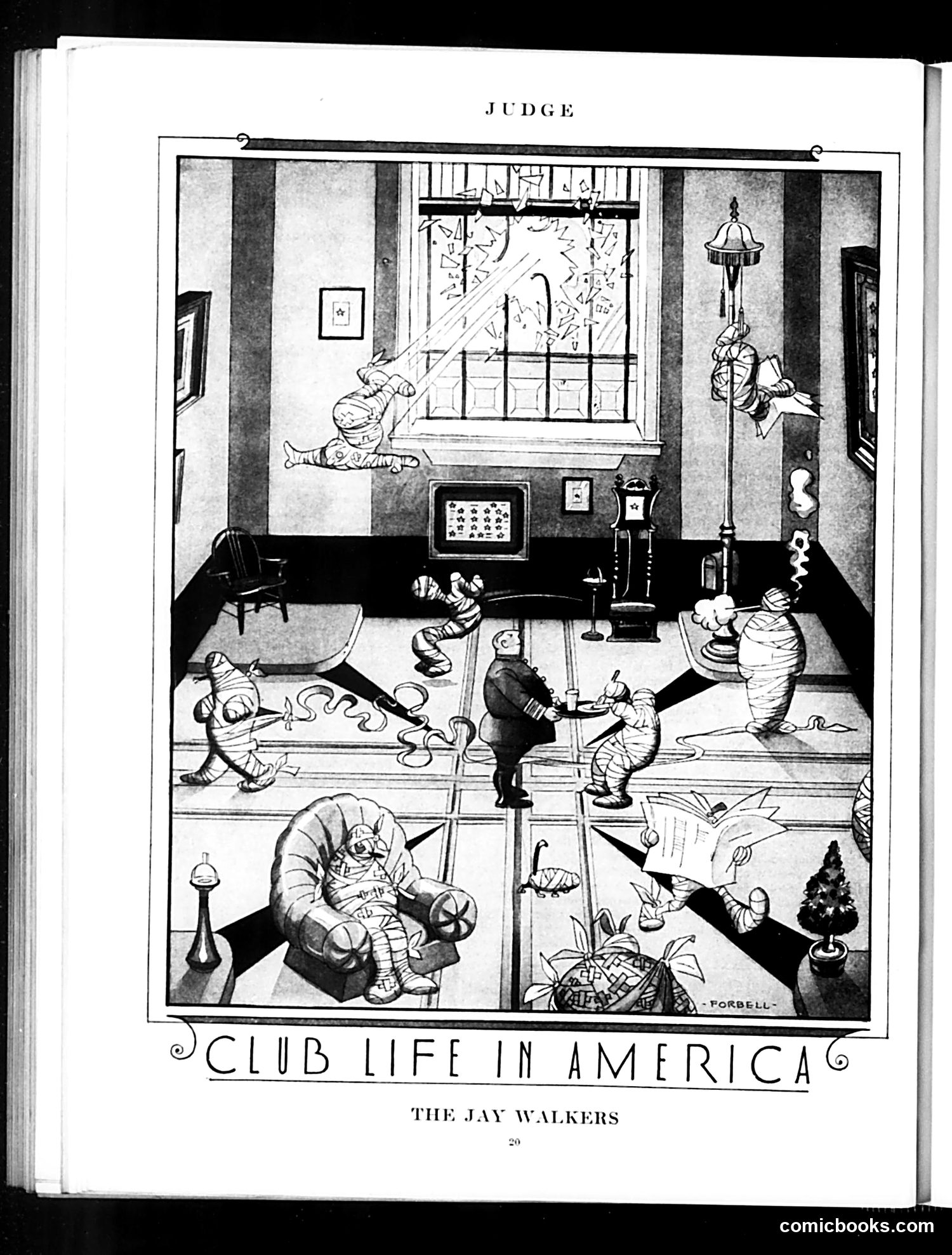
This is a satirical illustration titled "Club Life in America" depicting "The Jay Walkers"—a play on words combining "jay walker" (someone who crosses streets illegally) with "club" membership. The cartoon shows various mummy-wrapped figures in a domestic interior, appearing to engage in club activities. The satire likely mocks either: 1. A specific 1920s-era club or social group known for peculiar behavior 2. The general absurdity of exclusive American club culture and its arbitrary rules/customs The mummy costumes suggest either Halloween celebration or that club members are portrayed as comically stiff, lifeless, or ridiculous. The window shows pedestrians outside, contrasting normal street life with the bizarre indoor "club" activities. Without additional context about which specific club or event is referenced, the precise target remains unclear, though the humor derives from treating eccentric club behavior as worthy of social satire.
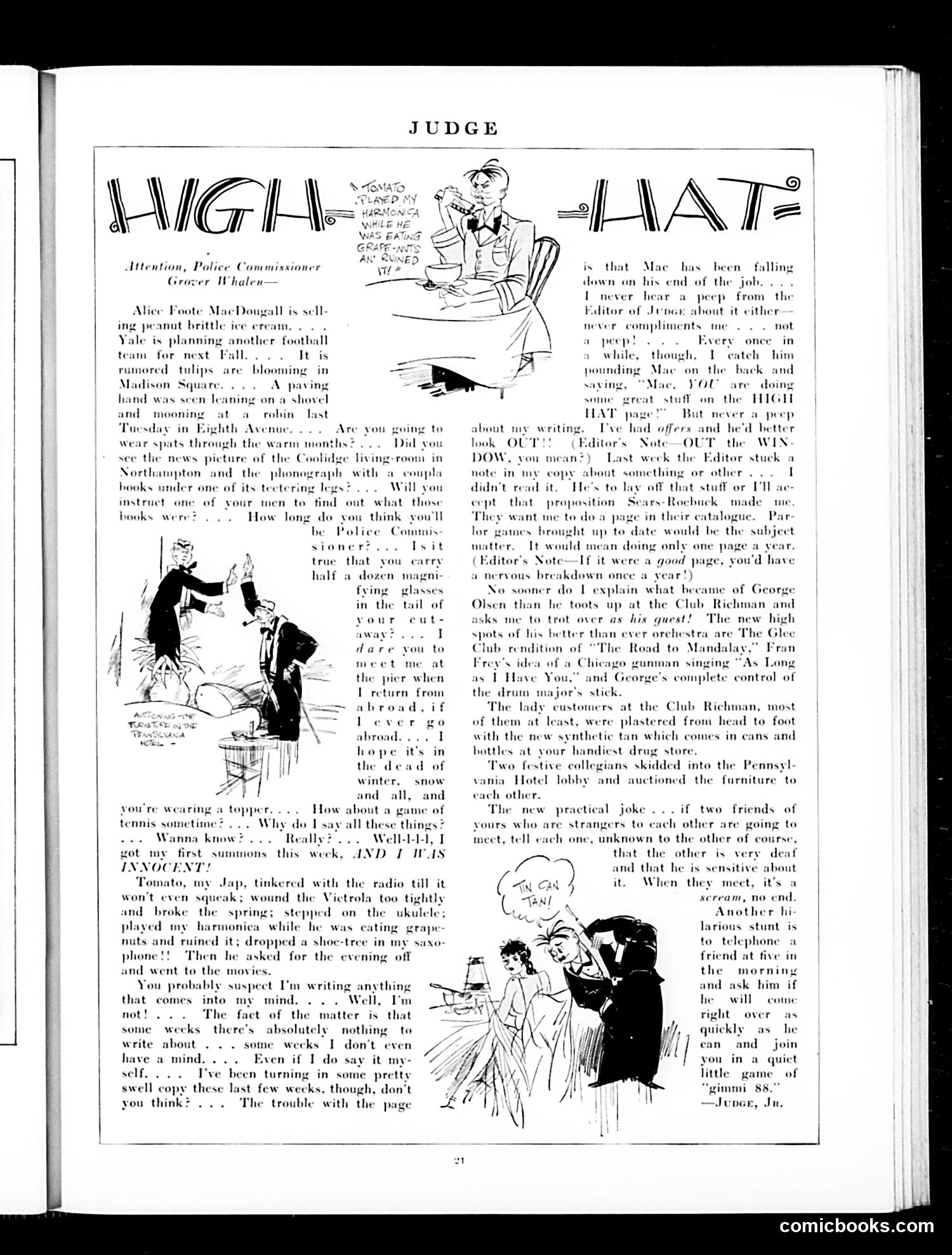
This page from Judge magazine is a humorous column addressing Police Commissioner Grover Whalen. The writer rambles through observations about New York City social life—Alice Foote MacDougall's ice cream venture, Yale planning a football team, rumored tulips blooming in Madison Square, and fashion trends like wearing spats. The column's main joke involves the writer's frustration with their editor "Mae," who apparently fails to acknowledge their work while praising others. The writer sarcastically catalogs absurd complaints to the Police Commissioner (paving hands leaning on shovels, teetering bookshelf legs) to explain why they're making unfocused observations: they're annoyed about workplace recognition. Secondary humor includes anecdotes about a Japanese servant ("Tomato") destroying household items, Club Richman patrons with artificial tans, and practical jokes involving telephone calls at inconvenient hours. The cartoons illustrate the police commissioner receiving these complaints and the writer's various grievances. The satire targets both workplace dynamics and 1920s social pretensions.
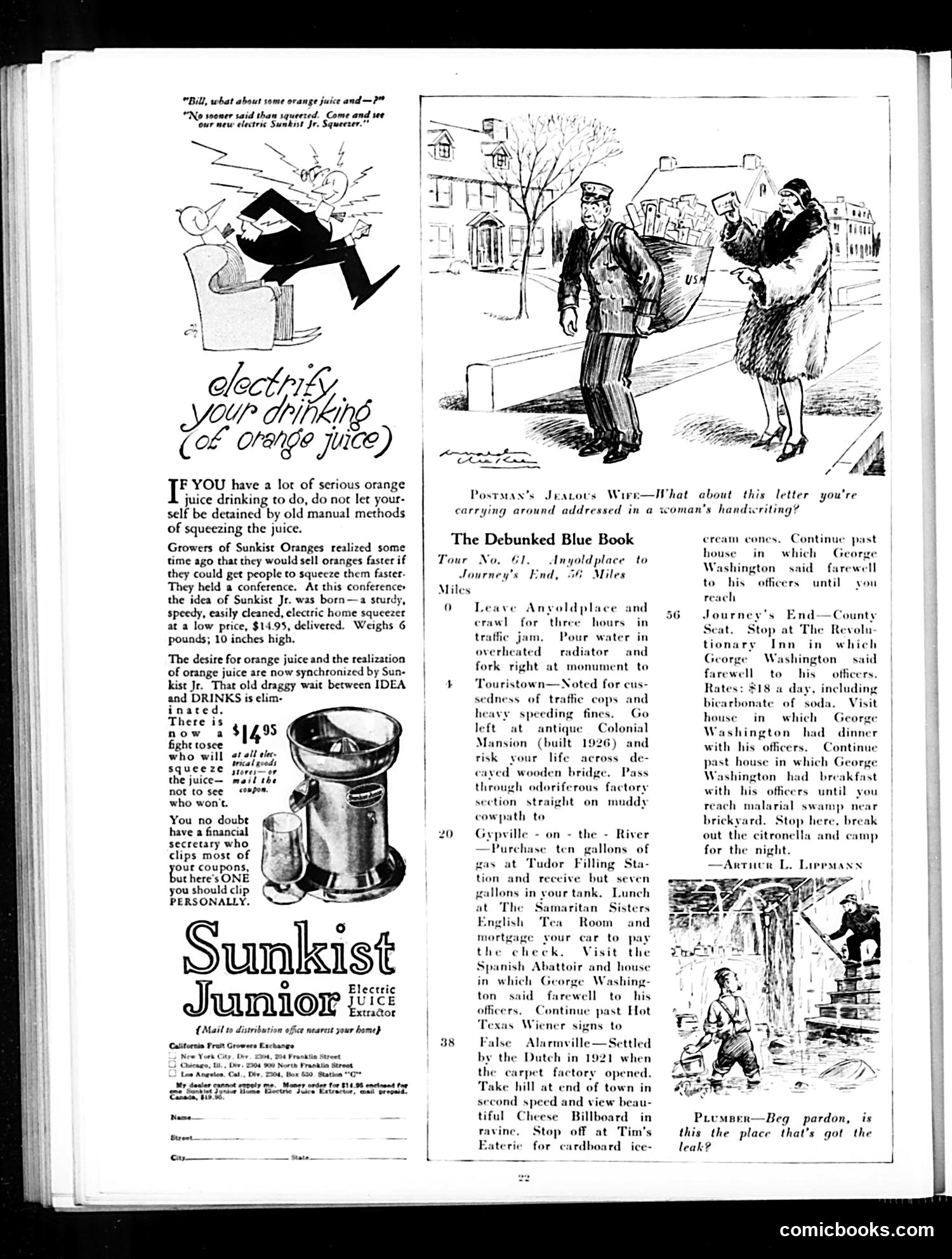
The left page is a straightforward **advertisement** for the Sunkist Jr. electric orange juicer ($14.95). The cartoon illustrates the product's speed: a man in a chair is launched backward by the force of juice being squeezed, with the caption joking that the machine works so fast the juice appears before you finish asking for it. The ad emphasizes convenience—eliminating the "draggy wait" between wanting juice and drinking it. The right page contains two unrelated items: a cartoon about a postman questioning a woman's suspicious letter, and a humorous travel guide called "The Debunked Blue Book" that mocks tourist destinations by giving them deliberately unflattering names (False Alarmville, Touristown) and cynical descriptions. The postman cartoon plays on marital suspicion tropes common to period humor.
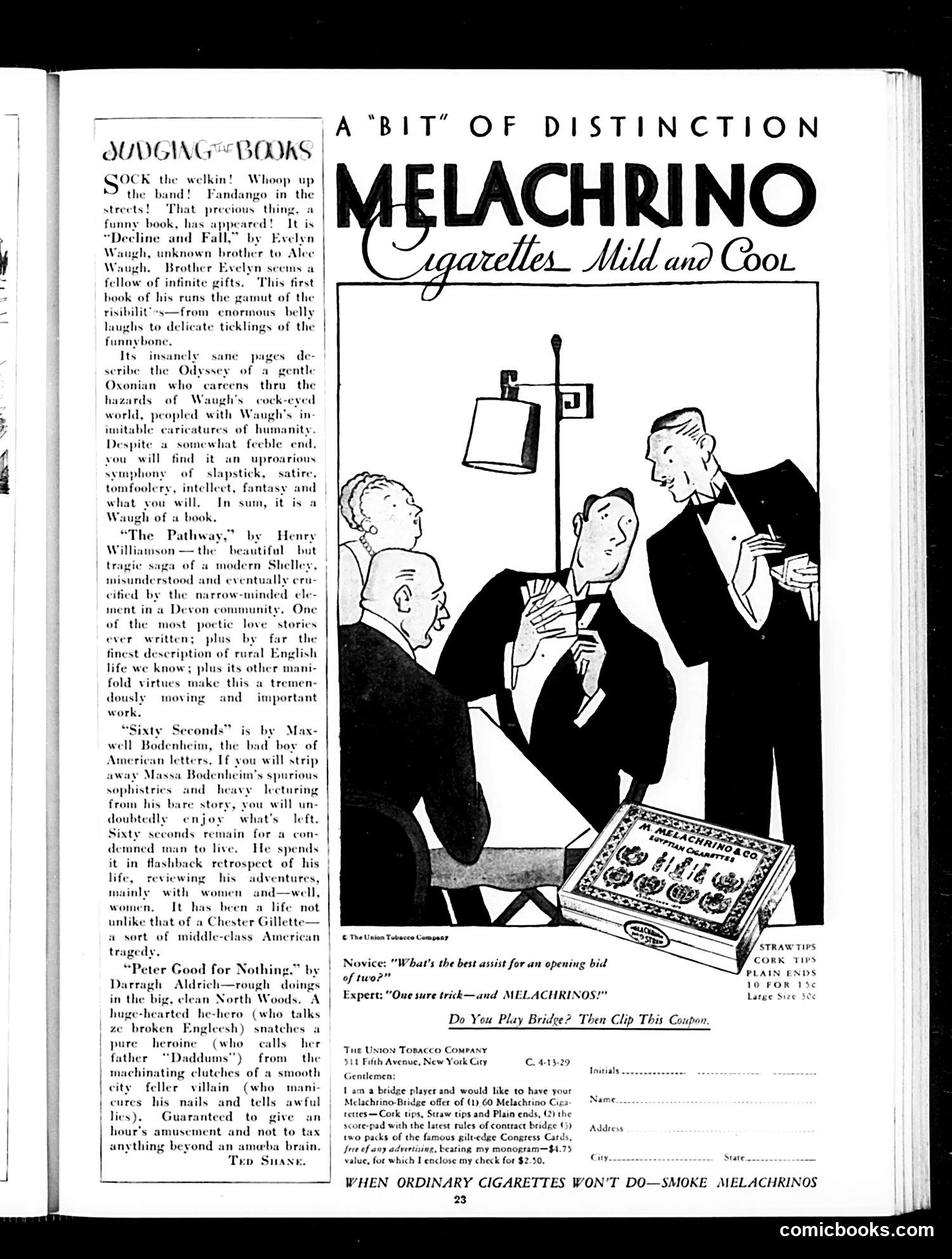
This page is primarily a **cigarette advertisement** disguised as editorial content in Judge magazine. The main illustration shows three well-dressed men in suits examining a cigarette box, with one holding a cigarette—a visual appeal to aspirational masculinity and sophistication. The satirical hook: a fake "bridge player's coupon" presents smoking Melachrinos as the solution to winning at contract bridge. The exchange ("What's the best assist?" / "One sure trick—MELACHRINOS!") jokes that cigarettes provide a competitive advantage, playing on both the game and the product's supposed distinction. The left column reviews new books (by Evelyn Waugh, Henry Williamson, Maxwell Bodenheim, Darragh Aldrich), offering intellectual credibility to the magazine's audience—implying that refined readers of serious literature naturally smoke premium cigarettes. **The message**: Melachrino cigarettes signal good taste, intelligence, and social status among educated, leisure-class men.
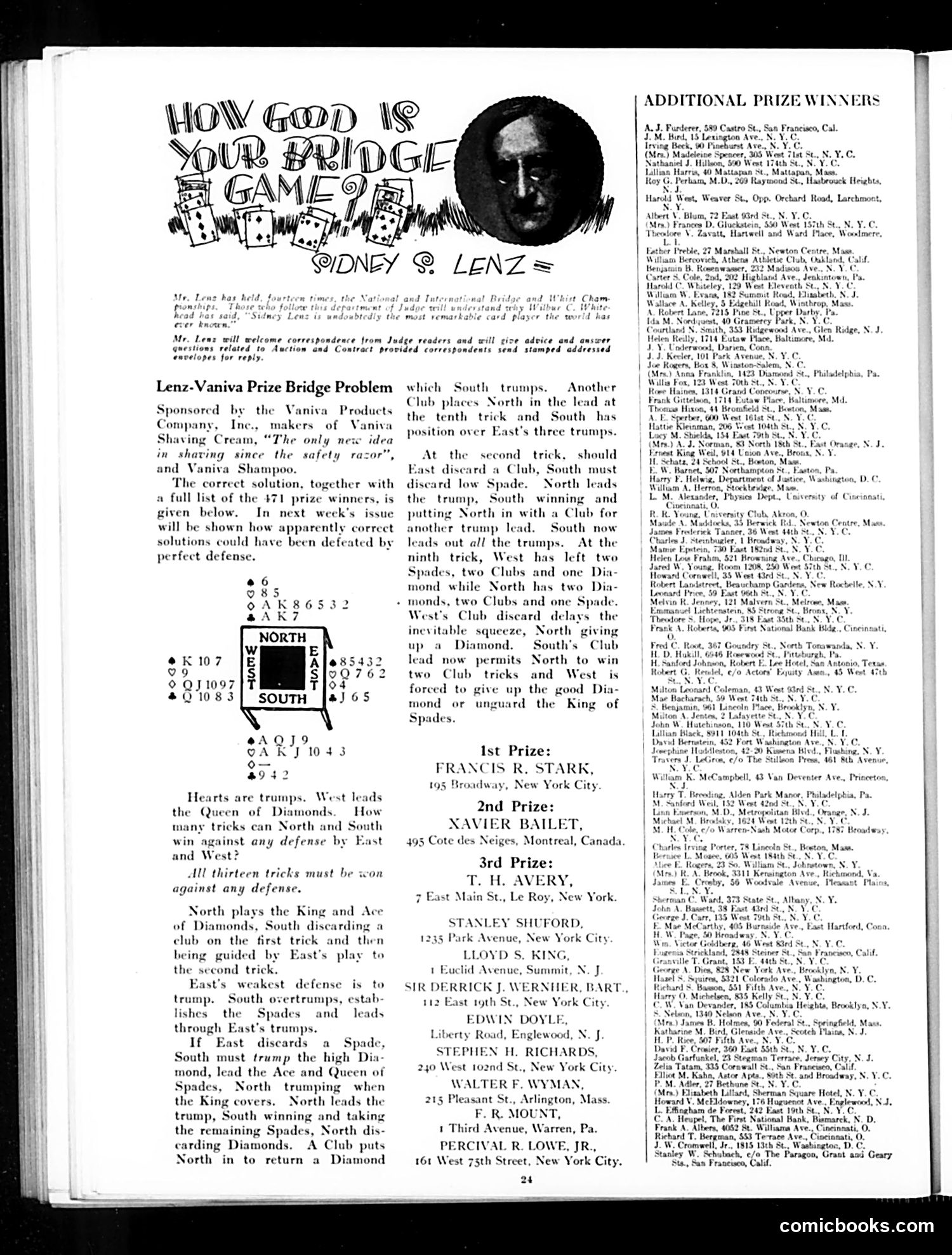
This page combines a bridge card game puzzle with a list of prize winners for a sponsored contest. **The Main Content:** The "Lenz-Vaniva Prize Bridge Problem" is a instructional bridge puzzle sponsored by Vaniva shaving and hair products. It presents a specific card hand and asks readers to determine how many tricks North and South can win in hearts. The solution explains a complex sequence of plays involving trump management and "the squeeze"—a classic bridge technique. **The Context:** Contract bridge was hugely popular in early 20th-century America, and magazines like *Judge* regularly featured bridge problems to engage readers. The sponsorship by Vaniva Products—claiming to offer "the only new idea in shaving since the safety razor"—demonstrates how consumer brands used puzzle content as advertising vehicles. **For Modern Readers:** Today, this reflects an era when magazine puzzles served as both entertainment and marketing, and when bridge was aspirational leisure activity for educated urban audiences. The technical bridge explanation assumes readers had sophisticated knowledge of the game.
This page is primarily a **subscriber or contributor list** rather than editorial content. The names and addresses fill most of the page in small print, appearing to be a roster of Judge magazine readers or contest winners from across the United States (with one Paris address). On the right side is a **Santa Fe Railway advertisement** promoting an "Out-West Outing" featuring "The Indian-detour" visiting the Grand Canyon, Natural Park, Colorado Rockies, and California. The ad includes a caricatured Native American face and encourages tourists to experience "real, live Indians." **Historical context for modern readers**: This advertisement reflects early-20th-century tourism's commodification of Native Americans—framing Indigenous peoples as exotic attractions for Eastern tourists, with the patronizing language ("real, live Indians") treating them as curiosities rather than contemporary people. The imagery and marketing approach would be considered deeply offensive today. The page itself contains no political cartoon or satire—it's primarily administrative/commercial content.
This page is primarily **advertising and directory listings** rather than political cartoon content. The main elements are: 1. **Dragon Smokers ad** (left): Product advertisement for a decorative smoking stand with an extinguishing mechanism. 2. **Hotel Montclair ad** (right): NYC hotel advertisement emphasizing 800 rooms with modern amenities (tubs, showers, radio). 3. **"Savoy" and "Detroit" hotel ads** (center): Competing lodging promotions. 4. **Einstein theory joke** (bottom right): A satirical advertisement claiming "IF you are one of the 12 men who understand the Einstein theory, don't buy next week's JUDGE — You Won't Understand It." This is meta-humor mocking Judge's own satirical complexity and the public's confusion over Einstein's newly-famous relativity theories (circa 1920s). 5. **Miscellaneous ads**: Vittel Water, Ginger Ale, and other consumer products. The page lacks significant political satire, instead showcasing the commercial nature of Judge magazine's revenue model.
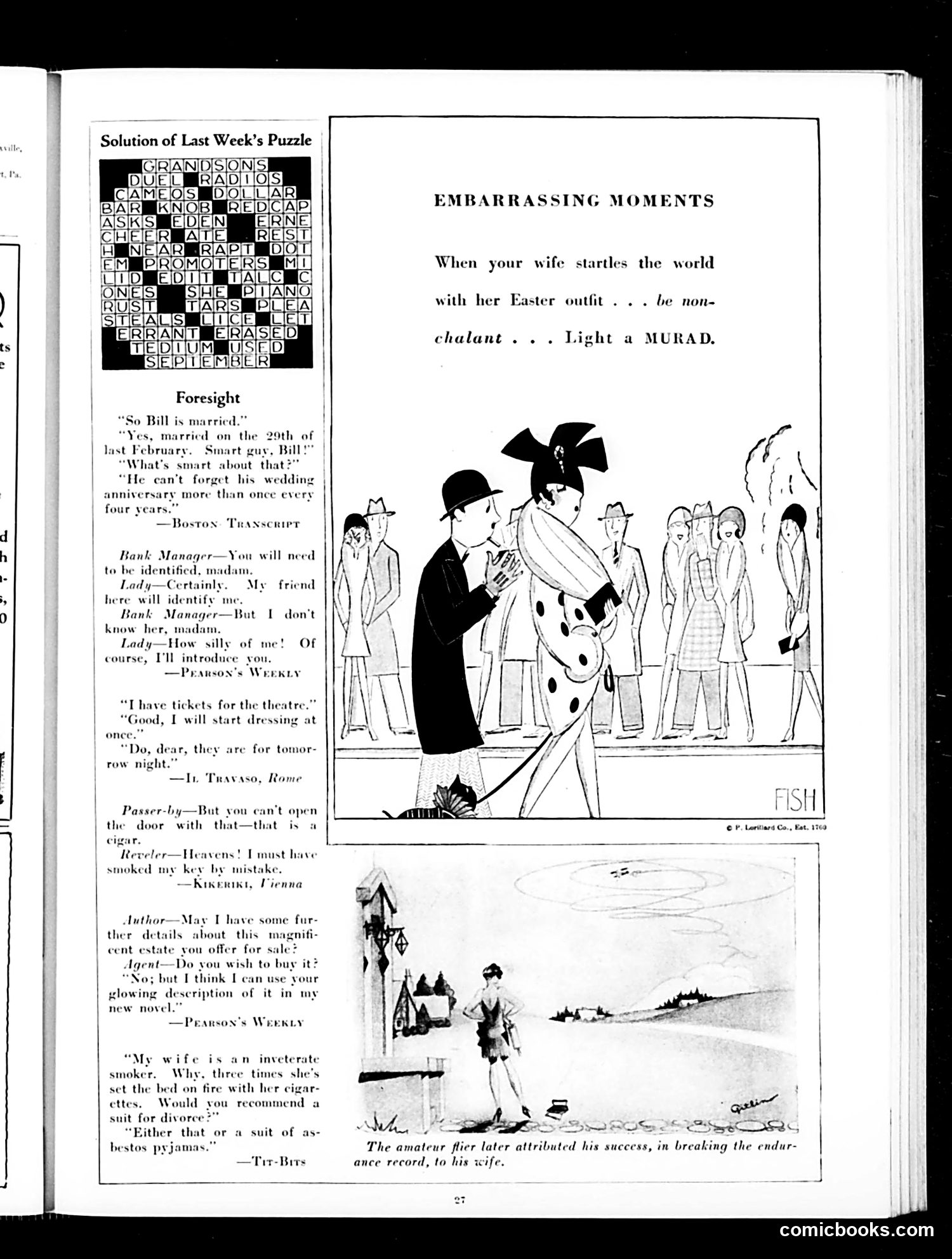
This page contains two distinct sections: **Left side**: A collection of brief humorous anecdotes ("Embarrassing Moments") satirizing domestic life and social situations. The jokes mock marital forgetfulness, banking procedures, gender confusion, and spousal incompatibility—typical early 20th-century humor targeting middle-class anxieties. **Right side**: Two cartoon illustrations. The top cartoon shows a fashionably-dressed woman in an elaborate Easter outfit startling onlookers on a street, with a MURAD cigarette advertisement integrated into the joke. The bottom cartoon depicts an amateur aviator taking off, with a caption crediting his wife's support for his flying record success. The satire reflects period attitudes: wives as sources of both embarrassment and inspiration, smoking as casual/comedic, and aviation as a novel achievement worthy of marital partnership. The ads are seamlessly woven into the editorial content—typical of early Judge magazine's revenue model.
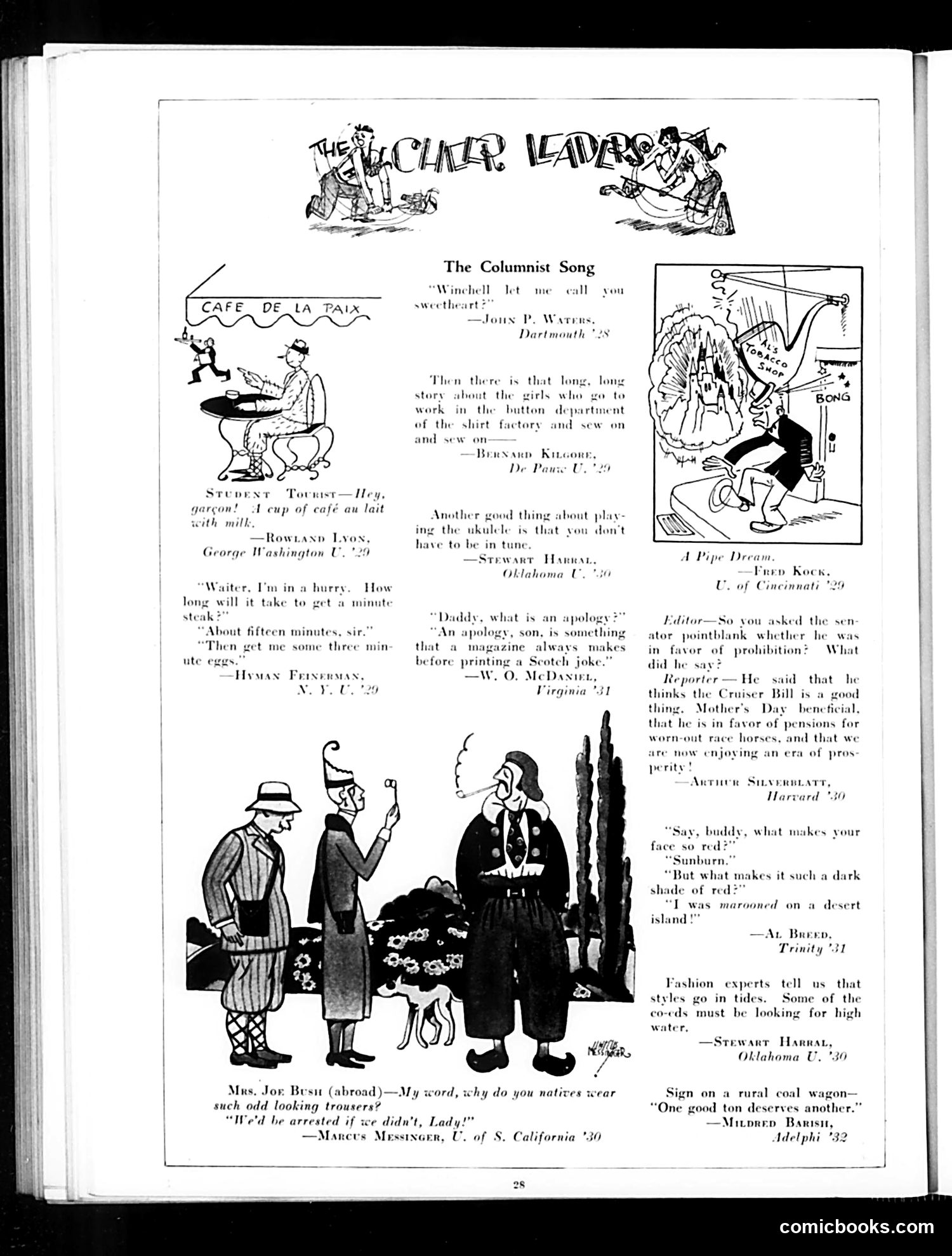
This page collects student humor and short jokes from various American colleges (circa 1929-1932), presented as a "Columnist Song" feature. The content reflects 1920s-30s college culture and social attitudes. The cartoons and quips mock contemporary issues: a Café de la Paix scene jokes about waiter service; fashion commentary ridicules women's trousers and hemlines ("co-eds looking for high water"); there's ribaldry about marriage and prohibition. One cartoon shows a woman abroad criticized for "odd looking trousers"—suggesting American fashion shocked European sensibilities. References include Walter Winchell (famous gossip columnist), ukulele playing (popular fad), and newspaper apologies before "Scotch jokes" (ethnic humor was standard). A "Cruiser Bill" reference suggests contemporary naval/military politics. The overall tone is lighthearted campus humor typical of Judge's college-oriented content, mixing romance jokes, fashion satire, and gentle social commentary aimed at educated readers. Nothing appears deeply political—it's primarily social satire about youth, fashion, and modern manners.
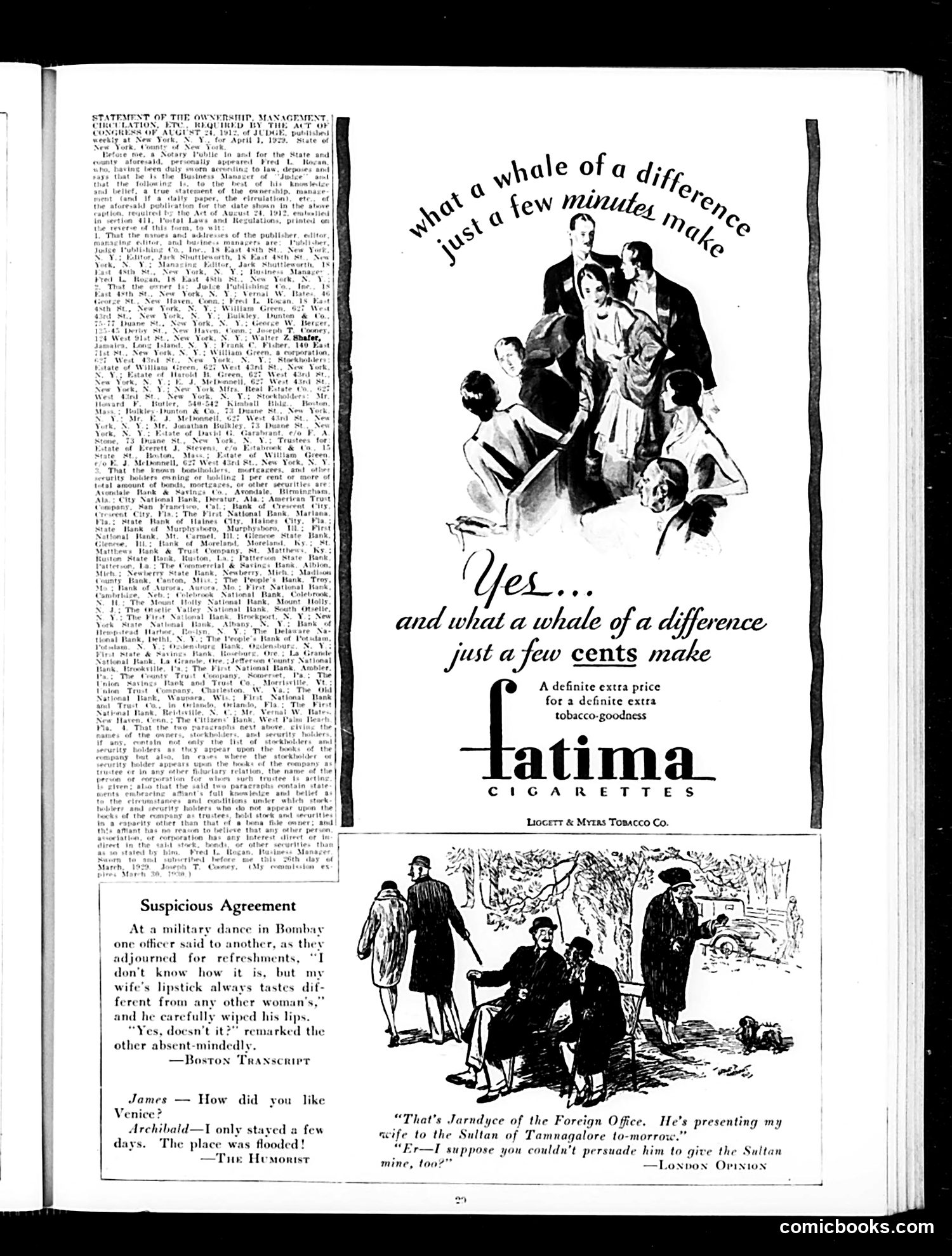
This page from *Judge* magazine contains three separate humor items: 1. **Latima Cigarettes Advertisement** (top): A full-page ad claiming cigarettes differ meaningfully based on price—a sales pitch suggesting consumers get what they pay for in "tobacco-goodness." 2. **"Suspicious Agreement"** (bottom left): A joke about a military officer in Bombay complimenting another's wife's lipstick taste, implying infidelity. The humor relies on the second officer's casual agreement, suggesting he's unknowingly validated the flirtation. 3. **Colonial Satire** (bottom right): A brief exchange where "Archibald" mentions Venice flooding, followed by a cartoon about a Foreign Office official presenting someone's wife to an Indian Sultan ("Tamnagalore"). The wife apparently asks the Sultan to convince her husband to give her to the Sultan instead—satirizing both colonial condescension toward non-European rulers and marital discord. The page emphasizes period concerns: advertising claims, infidelity humor, and British imperial attitudes toward colonial subjects.
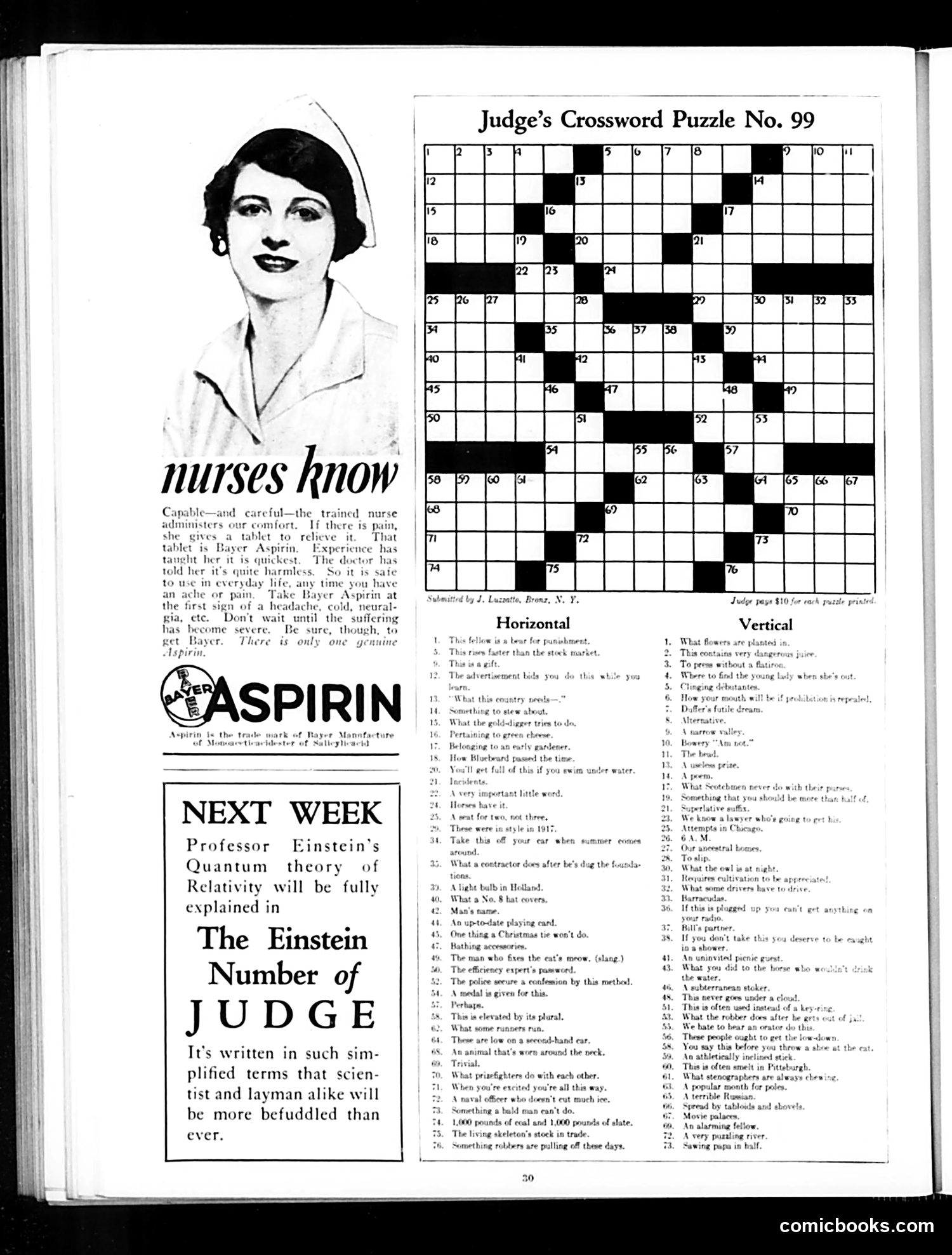
This page combines advertising with a crossword puzzle. The main content is an **Aspirin advertisement** featuring a nurse, capitalizing on the professional authority of trained medical staff to endorse Bayer Aspirin for pain relief—a common marketing tactic of the era. Below the ad, **"Next Week" promotion** announces that Judge will explain Einstein's theory of relativity in simplified terms, sarcastically suggesting that even scientists and laymen will be "more befuddled than ever." This is humor about the contemporary public confusion surrounding Einstein's groundbreaking but notoriously difficult-to-understand physics theories, which fascinated and mystified the American public in the 1920s-30s. The **Judge's Crossword Puzzle No. 99** occupies the right side—a standard feature of magazines in this era, when crosswords were a major entertainment craze following their popularization in the 1920s. The page reflects Depression-era or interwar American popular culture: faith in medical expertise, fascination with cutting-edge science, and the crossword puzzle phenomenon.
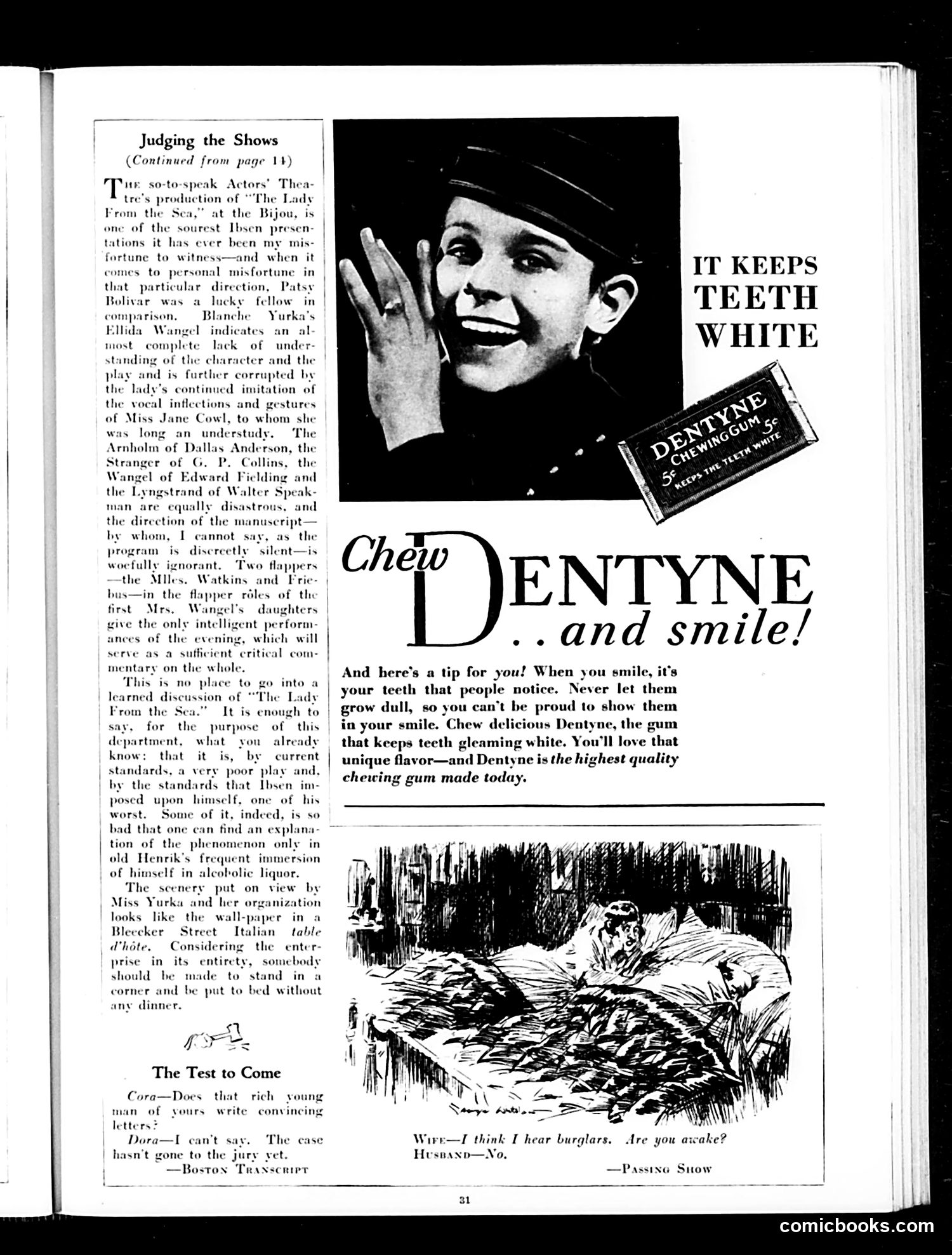
This page contains two distinct elements: a theater review and a Dentyne chewing gum advertisement. **The Theater Review** critiques a production of Ibsen's "The Lady From the Sea" at the Bijou theater. The critic savagely attacks the performance, particularly actress Blanche Yurka's portrayal of Ellida Wangel, calling it a "sour" and nearly incomprehensible staging. He accuses Yurka of imitating actress Jane Cowl's mannerisms rather than understanding the character, and criticizes the entire cast and direction as "disastrous." The review concludes by mocking the scenery as cheap "wall-paper." **The Advertisement** uses a woman's smile to pitch Dentyne gum, emphasizing that visible teeth are crucial to social presentation. The ad promises the gum keeps teeth "gleaming white" and touts it as the "highest quality chewing gum made today"—a typical early 20th-century marketing claim. The page reflects Judge magazine's dual function: sophisticated cultural criticism alongside consumer advertising.
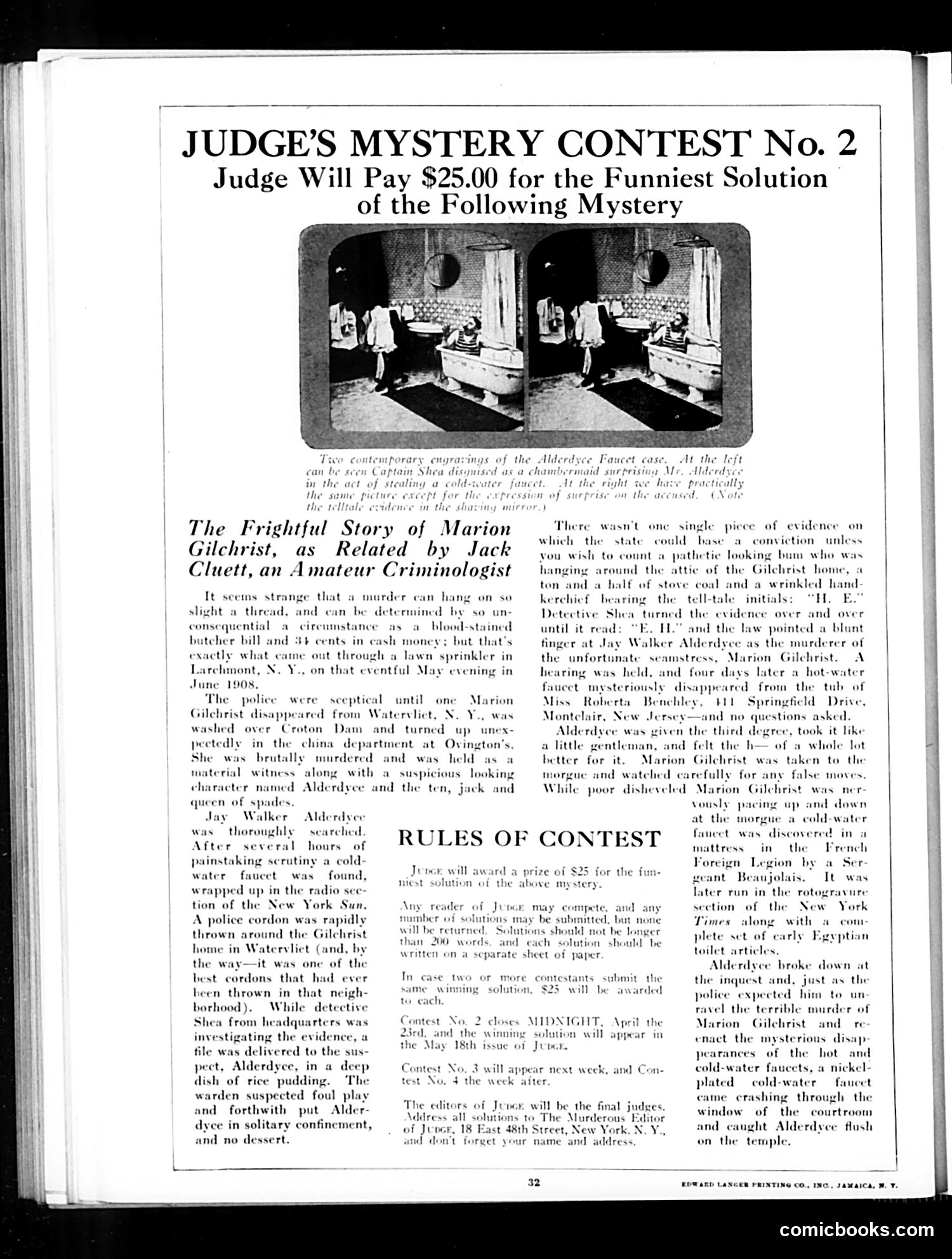
This page presents a humorous murder mystery puzzle, inviting readers to submit "the funniest solution." The setup is deliberately absurd: Marion Gilchrist is murdered, and detective work hinges on finding a blood-stained butcher bill and 34 cents—plus a monogrammed handkerchief reading "H.E."—discovered in a lawn sprinkler. The prime suspect, Jay Walker Alderdyce, is arrested based on this flimsy evidence. The joke's premise appears to mock the era's detective fiction and police procedures: the mystery becomes increasingly ridiculous (a handkerchief found in a sprinkler, a faucet disappearing from a bathtub, pudding served as evidence), suggesting incompetence in both investigation and criminal behavior. The contest invited readers to provide humorous alternative solutions, rewarding the funniest for $25—a substantial sum in this era. This reflects Judge magazine's typical interactive humor, turning readers into collaborative satirists while poking fun at popular mystery narratives.
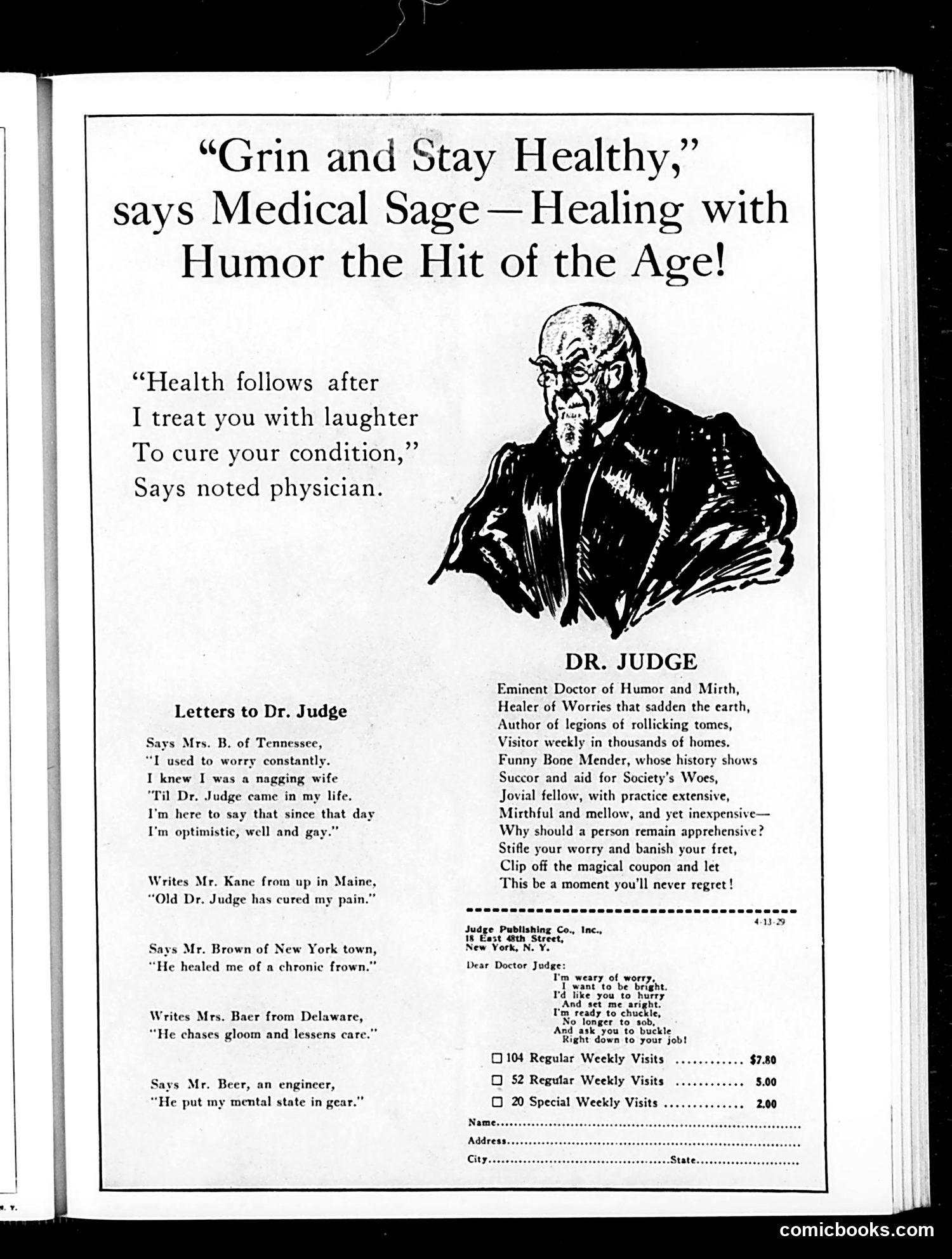
This page advertises a fictional character, "Dr. Judge," who offers cure-through-humor as medical treatment. The satire targets early 20th-century American optimism about self-improvement and wellness trends. **The premise:** Dr. Judge is a "physician" who heals worries, chronic frowns, and mental distress through laughter and positive thinking rather than medicine. Testimonial letters from patients (Mrs. B., Mr. Kane, etc.) claim miraculous recoveries from depression and anxiety. **The joke:** The page parodies both medical quackery and the era's burgeoning self-help culture. It mocks the belief that happiness can be prescribed like medicine, offered in subscription packages ("104 Regular Weekly Visits—$7.80"). **Context:** This reflects Judge magazine's satirical stance against pseudoscience and fad wellness treatments while also reflecting genuine contemporary anxiety about mental health and emotional well-being in industrial America. The humor lies in treating joviality as a purchasable commodity with measurable results.
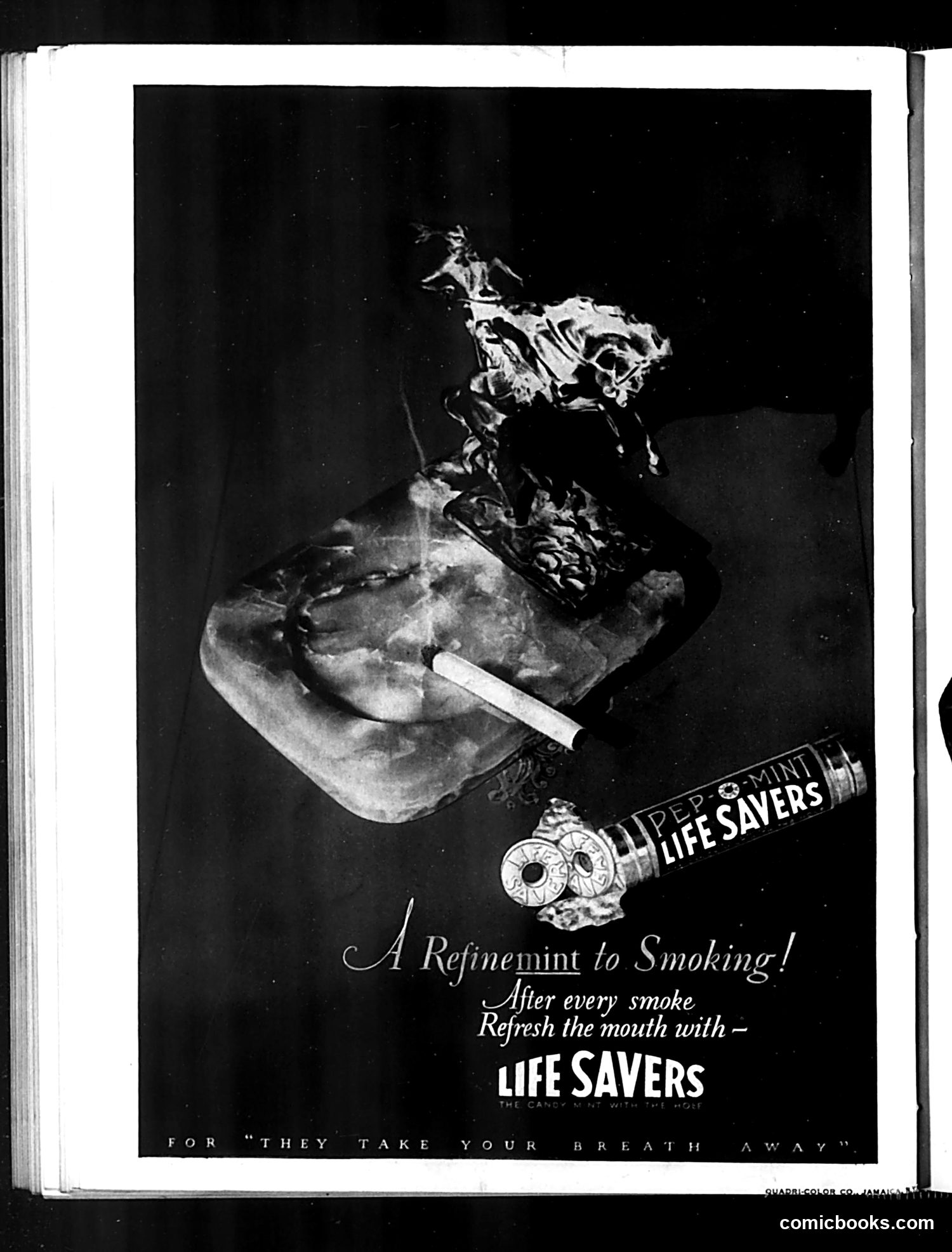
This is a Life Savers candy advertisement, not a political cartoon. It uses visual wordplay to market the product to smokers. The ad shows a cigarette next to Life Savers mints and decorative objects, with the tagline "A Refinemint to Smoking!" (pun on "refinement"). The slogan "They Take Your Breath Away" appears at the bottom. The advertisement exploits a common mid-20th century marketing strategy: positioning candy as a solution to smoking's unpleasant effects (bad breath, stale taste). Rather than discouraging smoking, it simply sells Life Savers as a complementary product. This reflects the era's casual attitudes toward tobacco before widespread health warnings were mandated.