
Judge, 1929-04-13 · page 15 of 36
Judge — April 13, 1929 — page 15: what you’re looking at
What you’re looking at
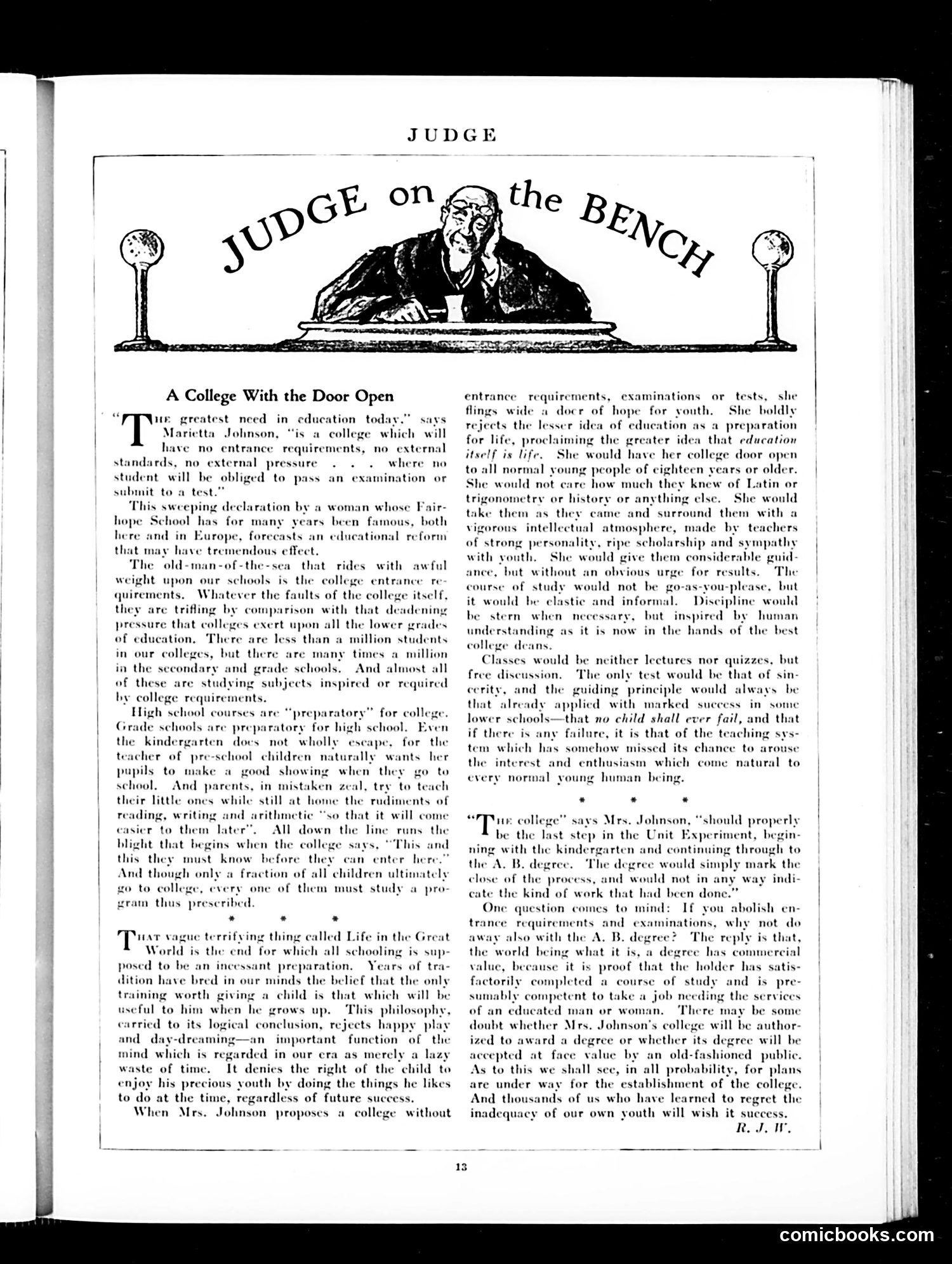
This editorial supports Marietta Johnson's progressive educational reform proposal. Johnson, who ran the famous Fairhope School (established in Alabama and known in Europe), advocates eliminating college entrance requirements and standardized testing. The piece argues that rigid entrance standards create a "blight" cascading downward through all education—kindergarten through high school become mere preparation rather than valuable in themselves. The satire critiques how millions of secondary students study subjects solely because colleges *require* them, not for inherent value. Johnson's alternative: open college doors to any normal 18-year-old, regardless of Latin or trigonometry knowledge. Education would emphasize discussion over lectures, with stern but humane discipline. Crucially, "no child shall ever fail"—responsibility for failure rests with teaching systems, not students. This reflects early 20th-century progressive education debates challenging traditional academic gatekeeping in favor of student-centered, experiential learning.
📄 Transcribed text from this page (OCR, searchable)
Machine-transcribed from the original scan — historical spelling and the odd misread are preserved.
A College With the Door Open « ue greatest need in education today.” says | I Marietta Johnson, “is a college which will have no entrance requirements, no external standards, no extern: student will be obl submit to a test.” This sweeping declaration by a woman whose Fair- hope School has for many. y« here and in Europe, forecasts an educatio that may have tremendous effect. The old-man-of-the-sea that rides with awful weight upon our schools is the college entrance re quirements. Whatever the faults of the college itself, they are trifling by comparison with that « pressure that of education. There are Jess than a million students in our colleges, but there in the secondary pressure...) where no dto pass an examination or rs been famous, both al reform adening pHeges exert upon all the lower grades are many times a million and grade schools, And almost all of these are studying subjects inspired or required hy college requirements. | High seh re “preparatory” for college. Grade schools are preparatory for high school. Even the kindergarten does not wholly escape. for the te pupils to make a good showing when they go to school, And parents, in mistaken zeal, try to teach | their little ones while still at home the rudiments of | reading, writing and arithmetic “so that it will come easier to them later’, All down the line runs. the blight that begins when the college says, “This and this they must know before they can enter here.” And though only a fraction of all children ultimately to college, every one of them must study a pro- un thus. preseribed. * * * Te vague terrifying thing called Life in the Great World is the end for which all schooling is sup- posed to be an incessant preparation. Years of tra- dition have bred in our minds the belief that the only training worth giving a child is that which will be useful to him when he grows up. This philosophy, carried to its logical conclusion, rejects happy play and day-dreaming—an important function of the mind which is regarded in our era as merely a lazy | waste of time. It denies the right of the child to enjoy his precious youth by doing the things he likes to do at the time, regardless of future success. When Mrs. Johnson proposes a college without 1 courses ¢ cher of pre-school children naturally wants he entrance requirements, examinations or tests, she flings wide a docr of hope for youth, She boldly rejects the lesser idea of education as a preparation for life, proclaiming the greater i that education itself is life. She would have her college door open to all normal young people of eighteen years or older. She would not how much they knew of Latin or trigonometry or history or anything else. She would take them ‘ » and surround them with a vigorous intellectual atmosphere, made by. ted rhers of strong personality, ripe scholarship and sympathy with youth. would give them considerable guid- ance, but without an obvious urge for results. The course of study would not be go-as-you-please, but it would be elastic and informal. Discipline would be stern when necessary, but’ inspired by human understanding as it is now in the hands of the best coll deans. Classes would be neither lectures nor quizzes, but free discussion. The only test would be that of sin- cerity, and the guiding principle would always be that already applied with marked success in” some lower schools—that no child shall ever fail, and that if there is any failure, it is that of the teachin tem which has somehow missed its chance to d sys- ose the interest and enthusiasm which come natural to every normal young human being. * * * “Prue college” says Mrs. Johnson, “should properly be the last step in the Unit Experiment, b ning with the kindergarten and continuing through to the close of the process, and would not in any way indi- cate the kind of work that had been done.” » question comes to mind: If you abolish en- requirements and examinations, why not do away also with the A. B. di The reply is tl the world being what it is. re has commercial value, because it is proof that the holder has satis- factorily completed a course of study and is pre- A.B. degree. ‘The degree would simply mark the competent to take a job needing the services n. ‘There may be some doubt whether Mrs, Johnson's college will be author- zed to award a degree or whether its de will be ccepted at face value by an old-fashioned public. As to this we sh pility, for plans are under way for the est nt of the college. And thousands of us who have learned to regret the inadequacy of our own youth will wish it success. Re Fol n educated man or wor comicbooks.com