
A complete issue · 36 pages · 1929
Judge — February 23, 1929
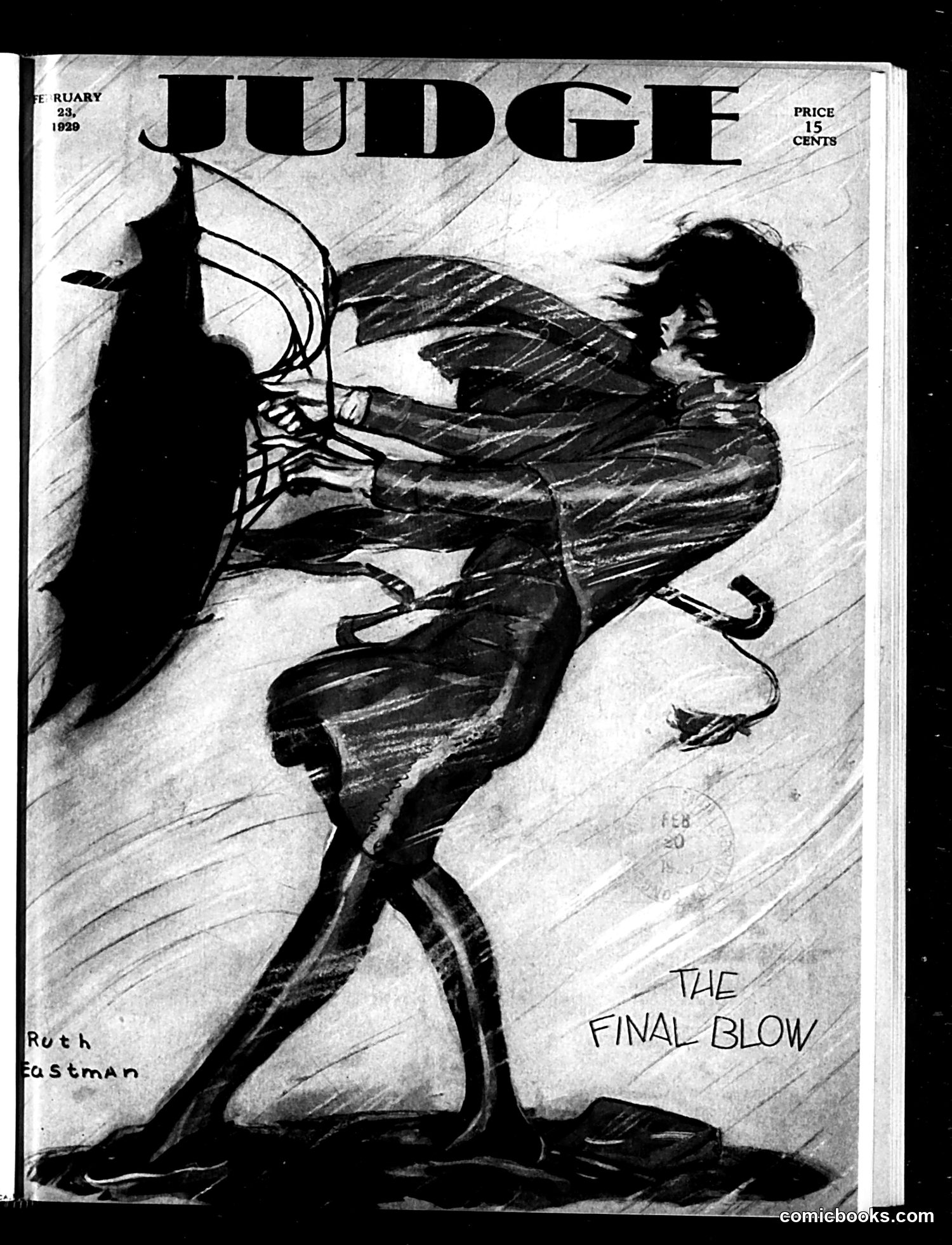
This February 23, 1929 *Judge* cover by Ruth Eastman depicts a woman in dark clothing striking forcefully at a silhouetted male figure with an umbrella. The title "The Final Blow" suggests a decisive, concluding action. Without additional context from the magazine's text, the specific identity of the figures remains unclear. However, given *Judge*'s satirical nature and 1929 timing, this likely references a contemporary political or social controversy. The woman's aggressive pose and the dramatic composition suggest either a commentary on women's increasing political power (the 1920s saw women gaining voting rights) or a specific scandal or conflict between public figures. The artist's signature and magazine branding are visible.

This page is primarily **advertising copy, not satire**. It promotes Listerine mouthwash/gargle as a cold and sore throat remedy. The main image shows people in crowded public transit (likely a bus or train), depicting the "crowded, drafty places" where sore throats supposedly spread. The advertisement claims Listerine gargling kills typhoid germs in 15 seconds and prevents colds. A sidebar ad for "Listerine Shaving Cream" asks "JOINED YET?" promoting membership in some product circle. This reflects **early 20th-century marketing**, when antiseptics were heavily promoted for illness prevention and germs were newly understood but often overstated as threats. The advertisement's claims—particularly about typhoid prevention through gargling—would be considered exaggerated by modern medical standards.
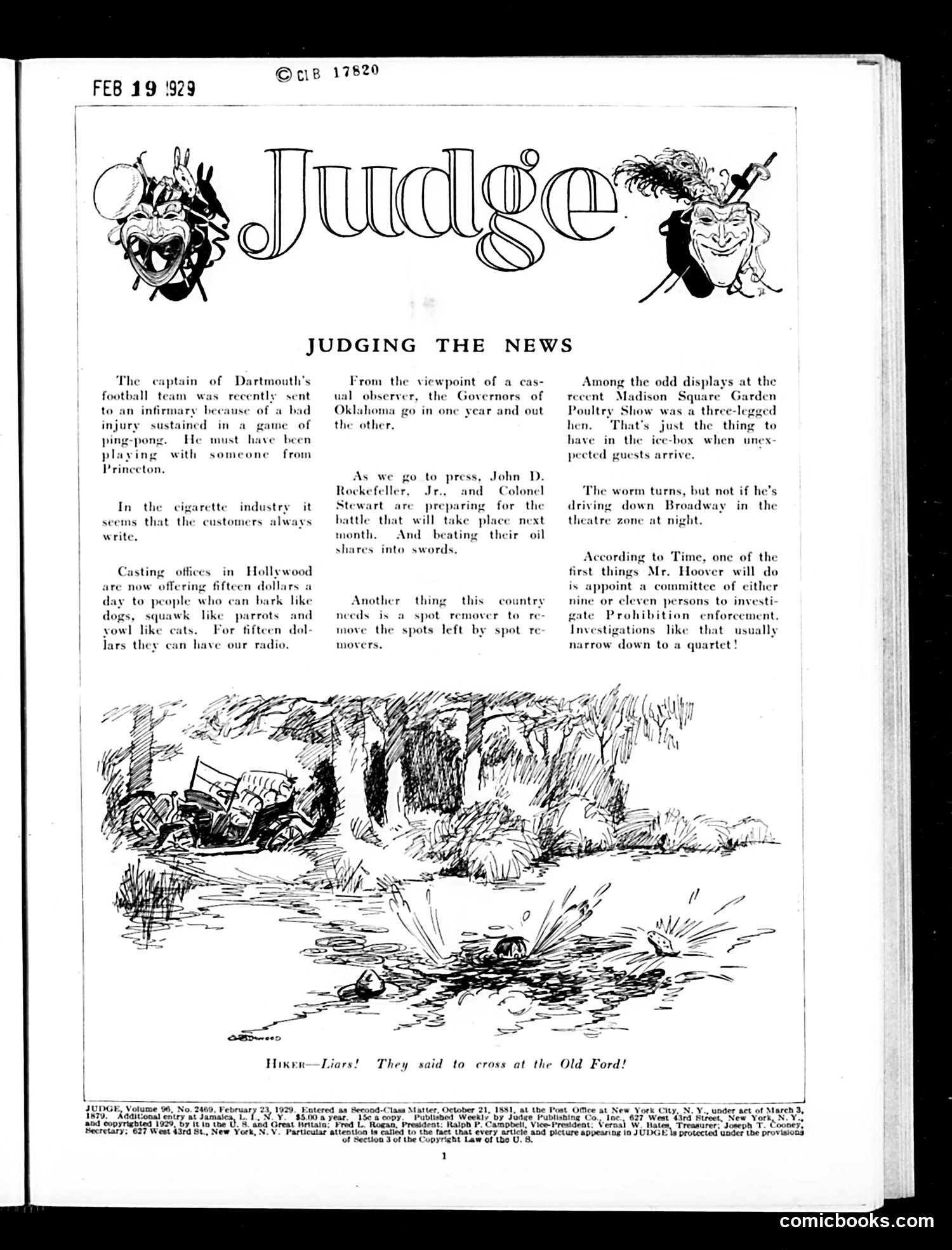
This page is titled "Judging the News" and consists of brief satirical commentary on current events rather than a political cartoon. The main illustration shows a car stuck in a ford (shallow river crossing) with occupants splashing through water. The caption reads "Hiker—Lions! They said to cross at the Old Ford!" This is a visual pun: the hikers were directed to "cross at the Old Ford" (a safe crossing point), but instead encountered an actual ford (geological feature) where their automobile became stuck. The brief news items above comment on topics including: Dartmouth football injuries, cigarette industry practices, Hollywood casting offices offering money for people with unusual pets, and references to Prohibition enforcement under what appears to be Herbert Hoover's administration. These are standard satirical jabs at contemporary institutions and policies.
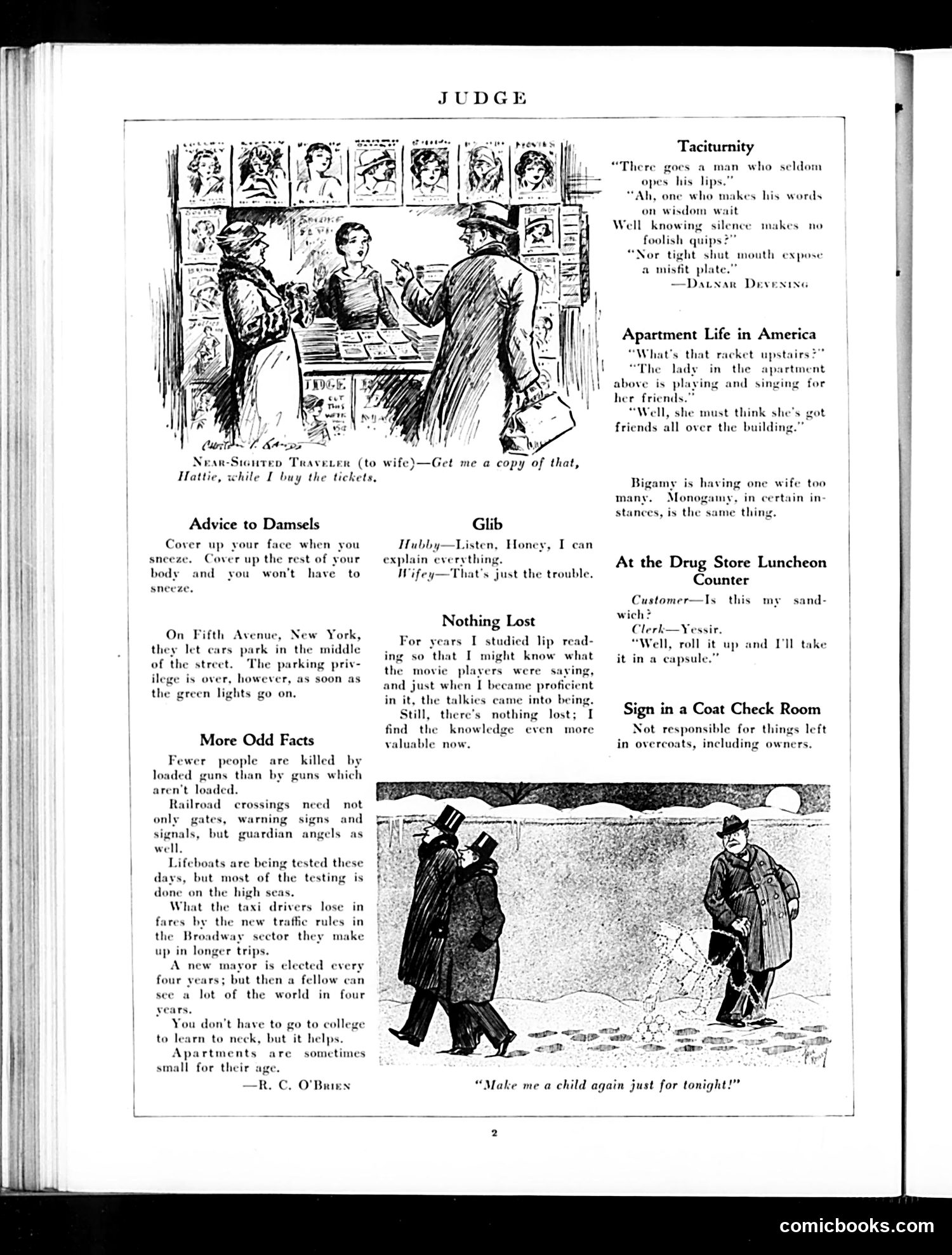
This page contains humor columns and two cartoons. The top cartoon depicts a man asking a ticket agent for a map while buying theater tickets—satirizing tourists' lack of knowledge about New York City geography. The bottom cartoon shows two figures at what appears to be a coat check, with one saying "Make me a child again just for tonight!"—likely satirizing the escapism people seek at entertainment venues or social outings. The text sections include humorous observations: "Taciturnity" quotes Dalsae Devensing on silence, "Apartment Life in America" jokes about noisy upstairs neighbors, and "More Odd Facts" presents absurd statistics (fewer people killed by unloaded guns, etc.). These are typical Judge satirical commentary on American urban life and social pretensions of the early-to-mid 20th century.
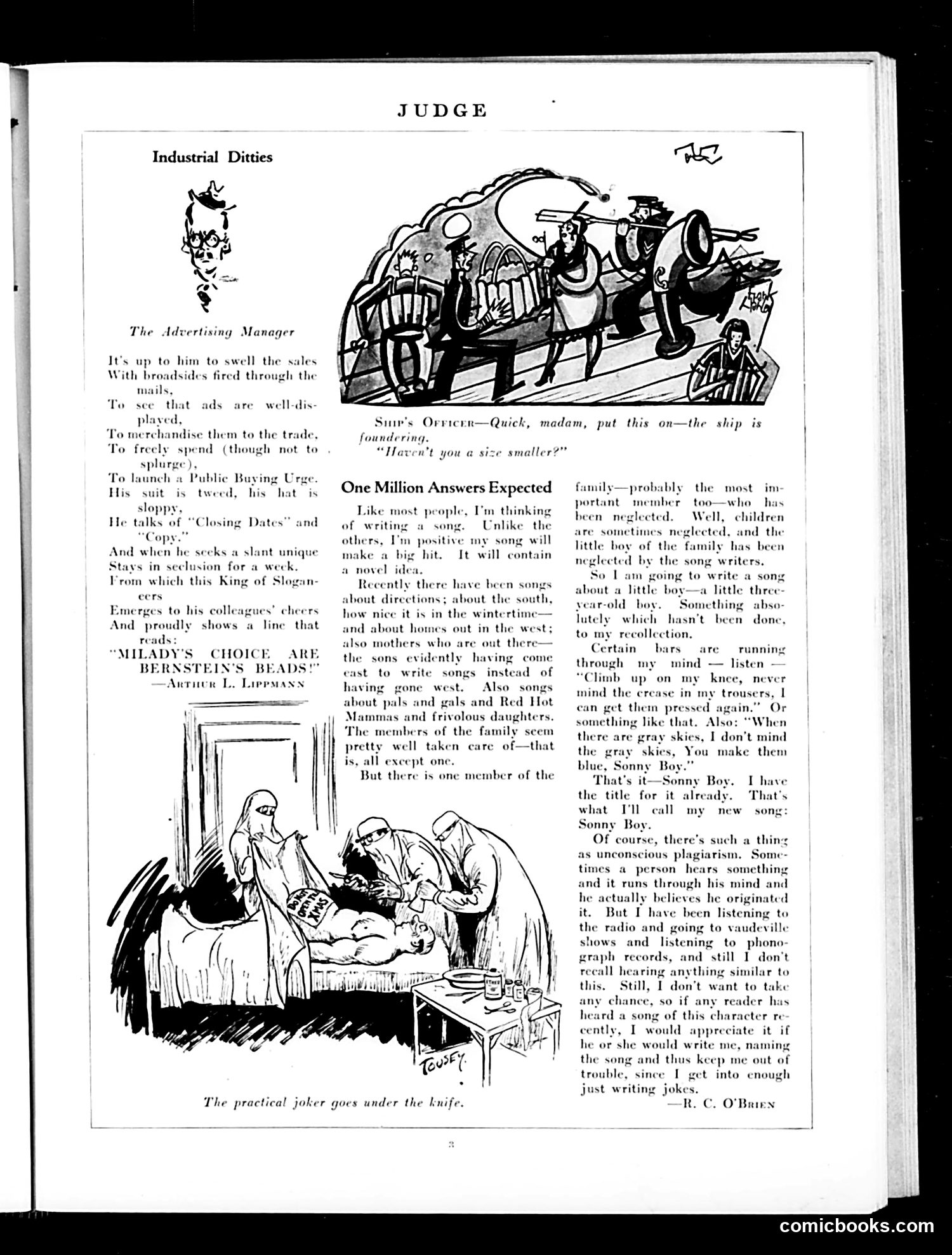
**Top Cartoon ("Industrial Duties"):** This satirizes an advertising manager's job through exaggerated tasks: placing ads, promoting merchandise, launching "Public Buying Urge," creating slogans, and competing with colleagues. The humor lies in depicting advertising work as chaotic and performative—the manager appears frazzled while juggling multiple responsibilities simultaneously. **Bottom Section:** R.C. O'Brien's essay "One Million Answers Expected" discusses songwriting. He describes writing a song titled "Sonny Boy" and addresses concerns about unconscious plagiarism—noting he's heard similar ideas through radio, vaudeville, and phonograph records. The accompanying cartoon shows a practical joker "going under the knife," illustrating the article's ironic tone about creative anxiety. Both items reflect 1920s-30s popular culture anxieties about commercialism and originality.
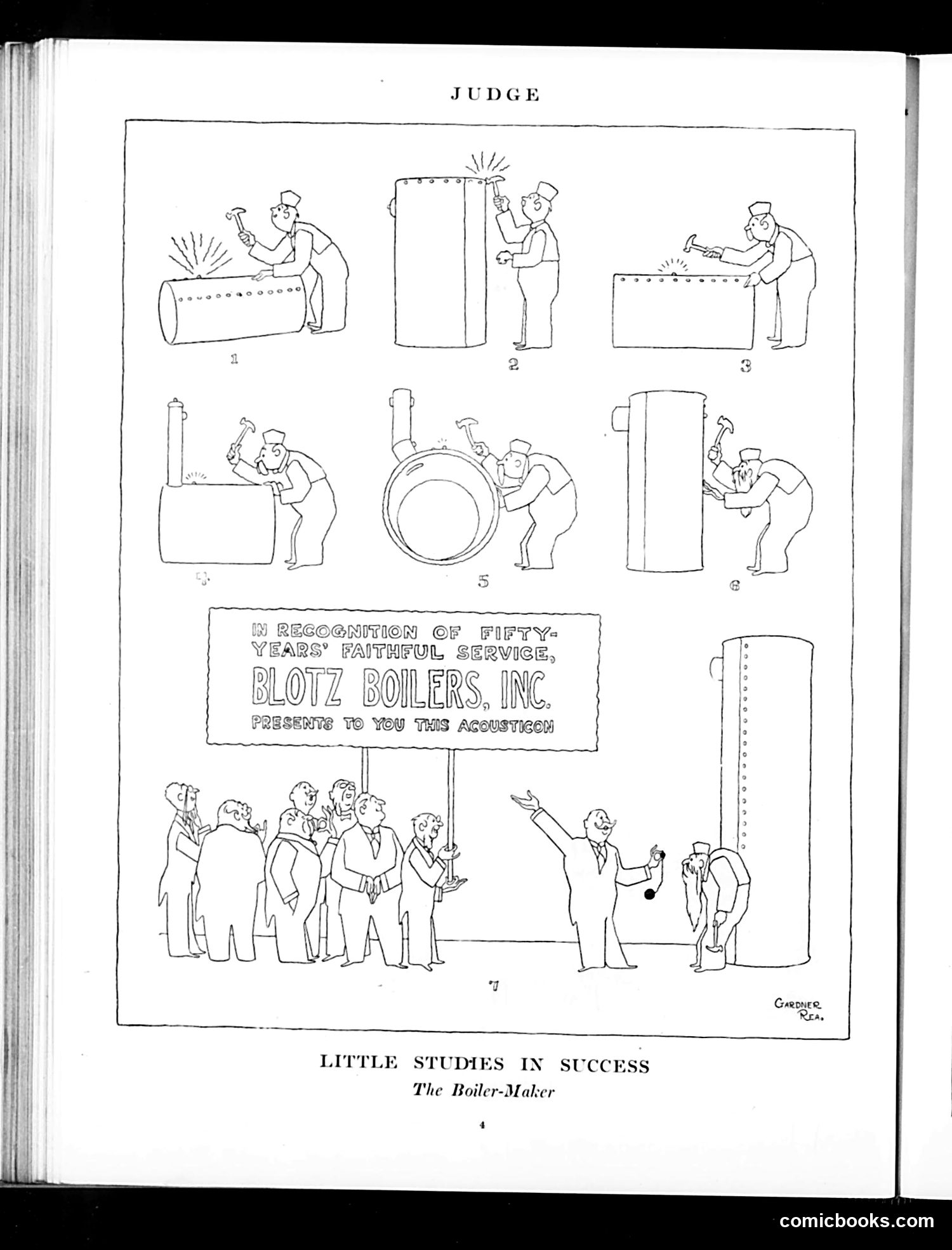
This page is primarily an **advertisement disguised as editorial content**, not political satire. It presents a humorous six-panel instructional sequence (panels 1-6) demonstrating boiler construction techniques, followed by a presentation scene (panel 7). The "joke" is visual and conceptual: a man methodically builds a boiler using a hammer and rivets—a straightforward industrial process rendered absurdly theatrical. Panel 7 shows Blotz Boilers, Inc. presenting this boiler as an achievement worthy of formal recognition ("in recognition of fifty years' faithful service"). The satire appears gentle: **celebrating industrial competence through exaggerated formality**. The cartoonist (Gardner Rea, per signature) mocks corporate self-congratulation while legitimately advertising Blotz boilers' quality and durability. This blends commercial messaging with light mockery of corporate pageantry—typical Judge magazine practice of the early 20th century.
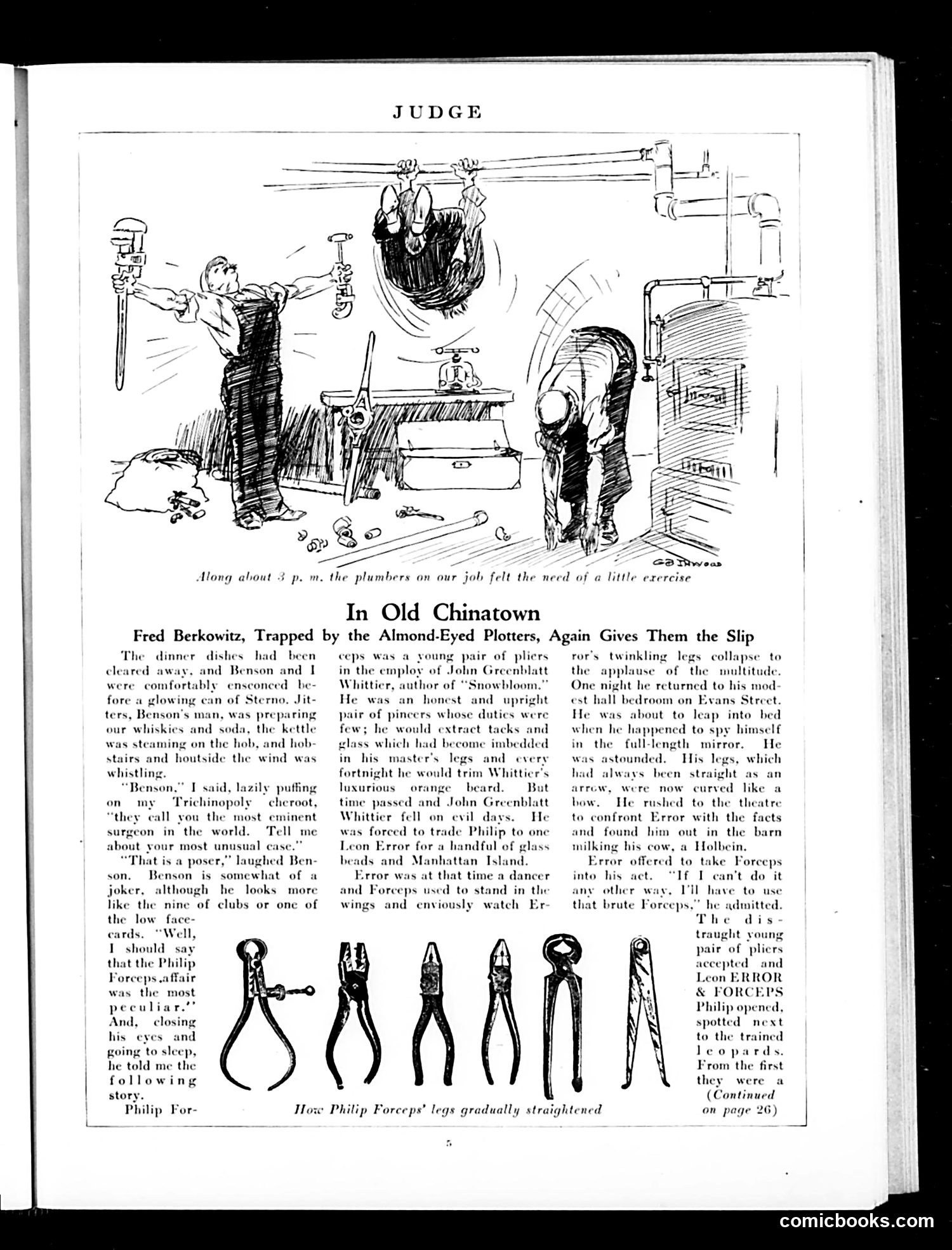
This Judge magazine page contains a humorous story about Fred Berkowitz, trapped by "almond-eyed plotters" in San Francisco's Chinatown. The narrative mocks him through ethnic stereotyping common to early 20th-century American satire. The story involves characters named John Greenblatt Whittier, Philip Forceps (a dancer), and Leon Error—names that appear to be playful puns rather than references to real people. The plot hinges on Berkowitz witnessing something compromising, then being coerced to keep silent. The bottom illustration shows Philip Forceps's legs "gradually straightened"—apparently the story's comedic climax, suggesting physical torture or manipulation as "humor." The content relies entirely on period-typical racism, ethnic caricature, and casual violence presented as comedy—attitudes largely abandoned in modern satirical journalism.
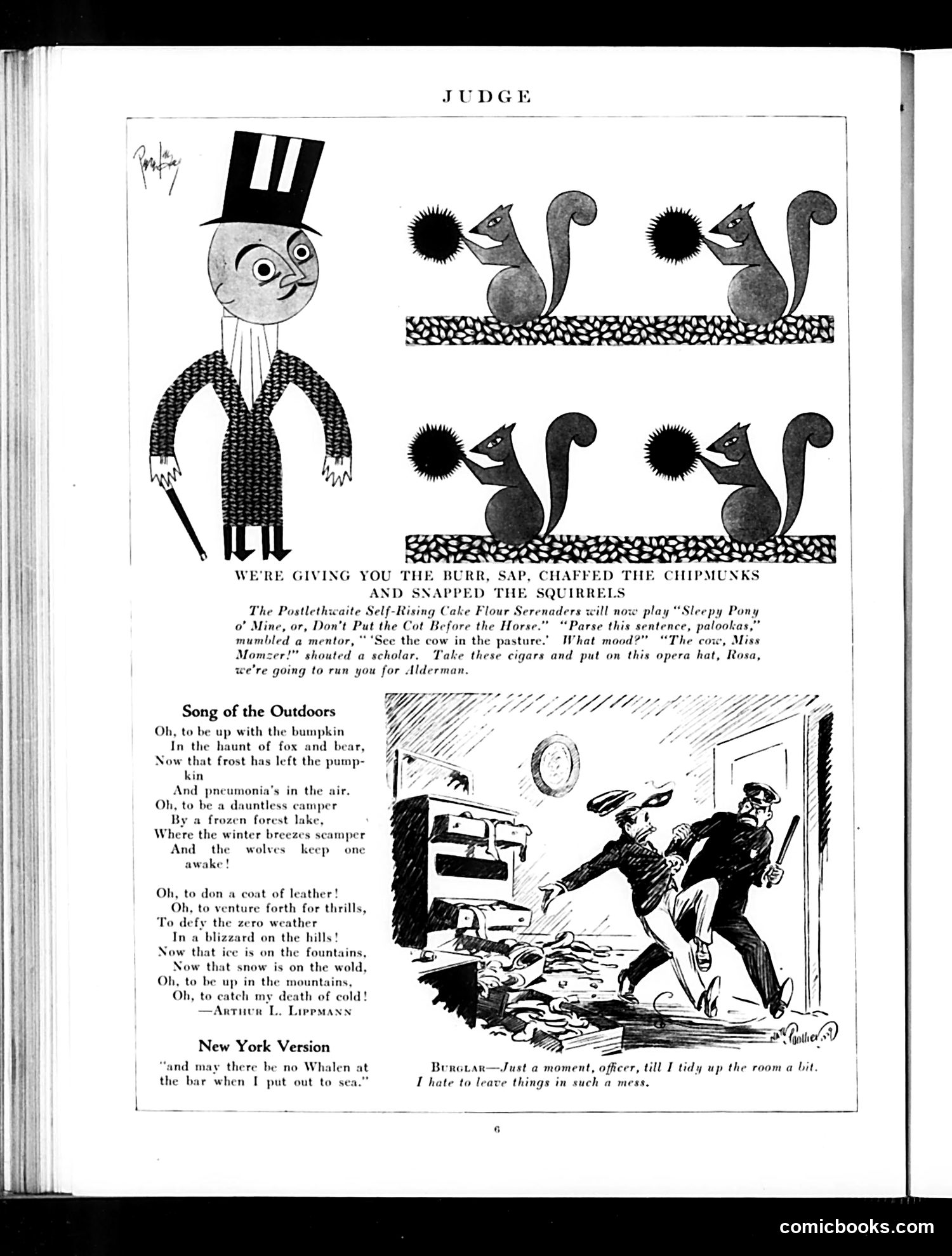
This page contains satirical content mocking political figures through absurdist humor. The top cartoon depicts a pompous gentleman in a top hat addressing squirrels and chipmunks, with text referencing "the burr, sap, chaffed the chipmunks and snapped the squirrels." This appears to be satirizing a political opponent through animal metaphors—likely criticizing someone's failed policies or embarrassing public statements using wordplay. Below is "Song of the Outdoors," a poem by Arthur L. Lippmann celebrating wilderness activities. The right illustration shows a burglar caught by a homeowner, with dialogue about tidying up—likely a humorous take on crime or domestic life. The "New York Version" reference at bottom suggests regional political or cultural commentary, though specifics remain unclear without additional context about Judge's publication date.
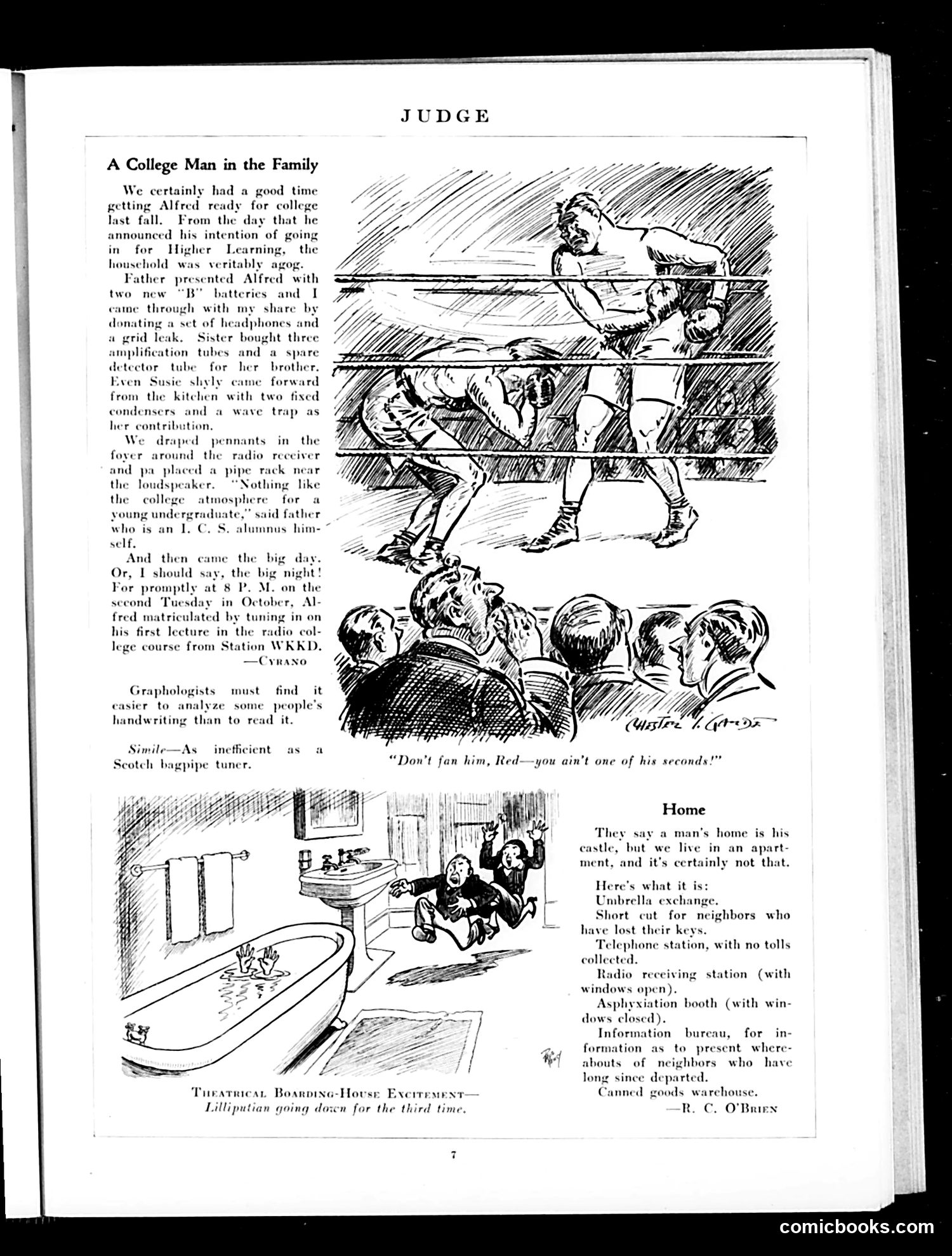
This 1920s Judge magazine page satirizes two American domestic trends: **"A College Man in the Family"** mocks the radio craze and correspondence education fad. Alfred's family excitedly prepares him for "college" by gifting radio components (batteries, tubes, condensers)—he'll actually attend via radio broadcast from Station WKKD, not a physical campus. The satire targets how radio was marketed as revolutionary education while the family treats it as a status symbol, much like actual college preparation. The boxing cartoon below jokes that radio lectures are so boring listeners need reviving between rounds. **"Home"** is a humorous list redefining a modern apartment. It's a commentary on cramped urban living: an umbrella lost-and-found, a telephone exchange, a radio station, alternately suffocating (windows closed) or freezing (windows open), and an information bureau about missing neighbors. This reflects post-WWI American urbanization and apartment-dwelling becoming common, treated here with gentle complaints about lack of privacy and space. Both pieces use gentle satire to comment on modern conveniences disrupting traditional family and home life.
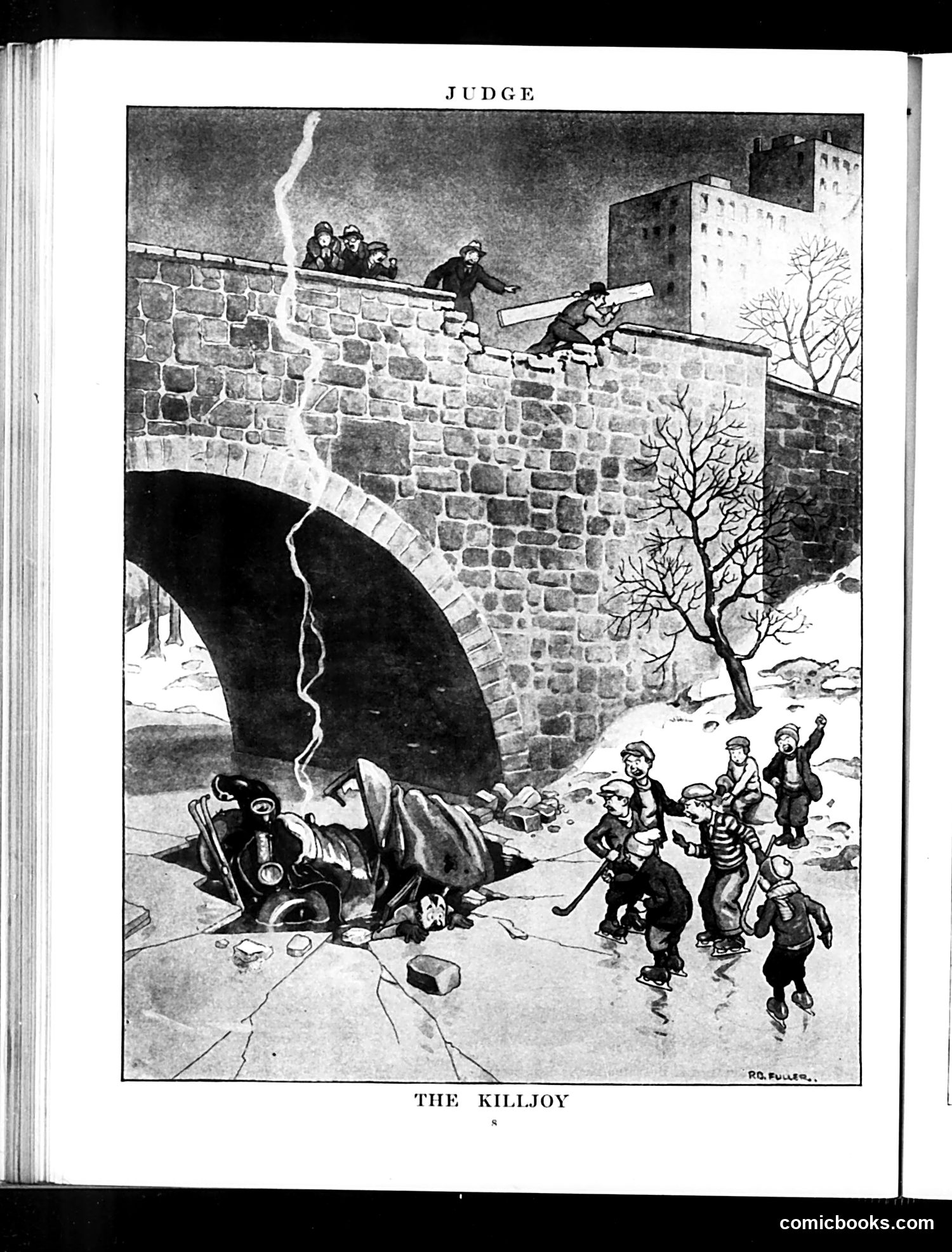
This cartoon depicts a dramatic scene of destruction beneath a stone bridge. A large bomb or explosive device lies detonated at ground level, while children play nearby in the snow. Above the bridge, armed figures appear to be firing weapons down at the scene. The title "The Killjoy" suggests dark irony—the cartoon likely satirizes either: 1. **War's impact on civilian life**, showing how armed conflict destroys children's innocence and play, or 2. **Prohibition or restrictive policies** that literally and figuratively "kill" innocent joy and recreation. The composition contrasts the carefree children below with the violence above, emphasizing how destructive forces (whether warfare or oppressive regulation) intrude upon everyday life. Without a visible date, the specific historical reference remains unclear, though the style and subject matter suggest early 20th-century American concerns.
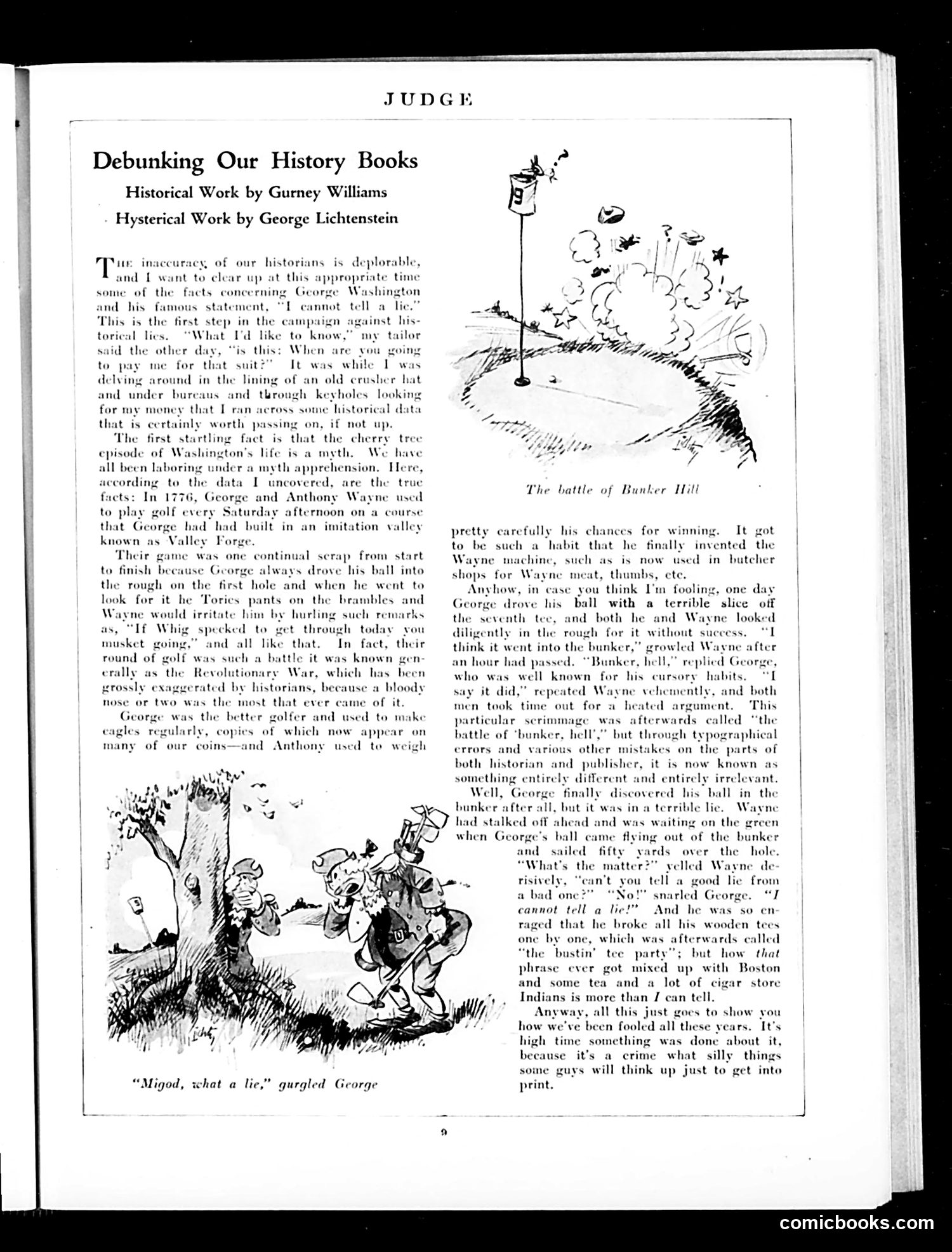
This satirical piece mocks inaccurate historical accounts by presenting deliberately absurd "corrections" to American history. The article claims that the famous George Washington cherry-tree myth is false, and substitutes an equally implausible story: Washington and Anthony Wayne played golf at Valley Forge, where their arguments over a lost ball in a bunker became mythologized as the "Battle of Bunker Hill." The humor lies in treating this ridiculous golf anecdote with the same scholarly gravity as real history. The cartoons (showing Washington saying "Bygod, what a lie" and the battle scene) reinforce the satire's point: historians have so thoroughly distorted actual events that correcting one myth with an equally fantastic tale seems plausible. The piece ultimately critiques both historical inaccuracy and how easily false narratives become accepted as fact.
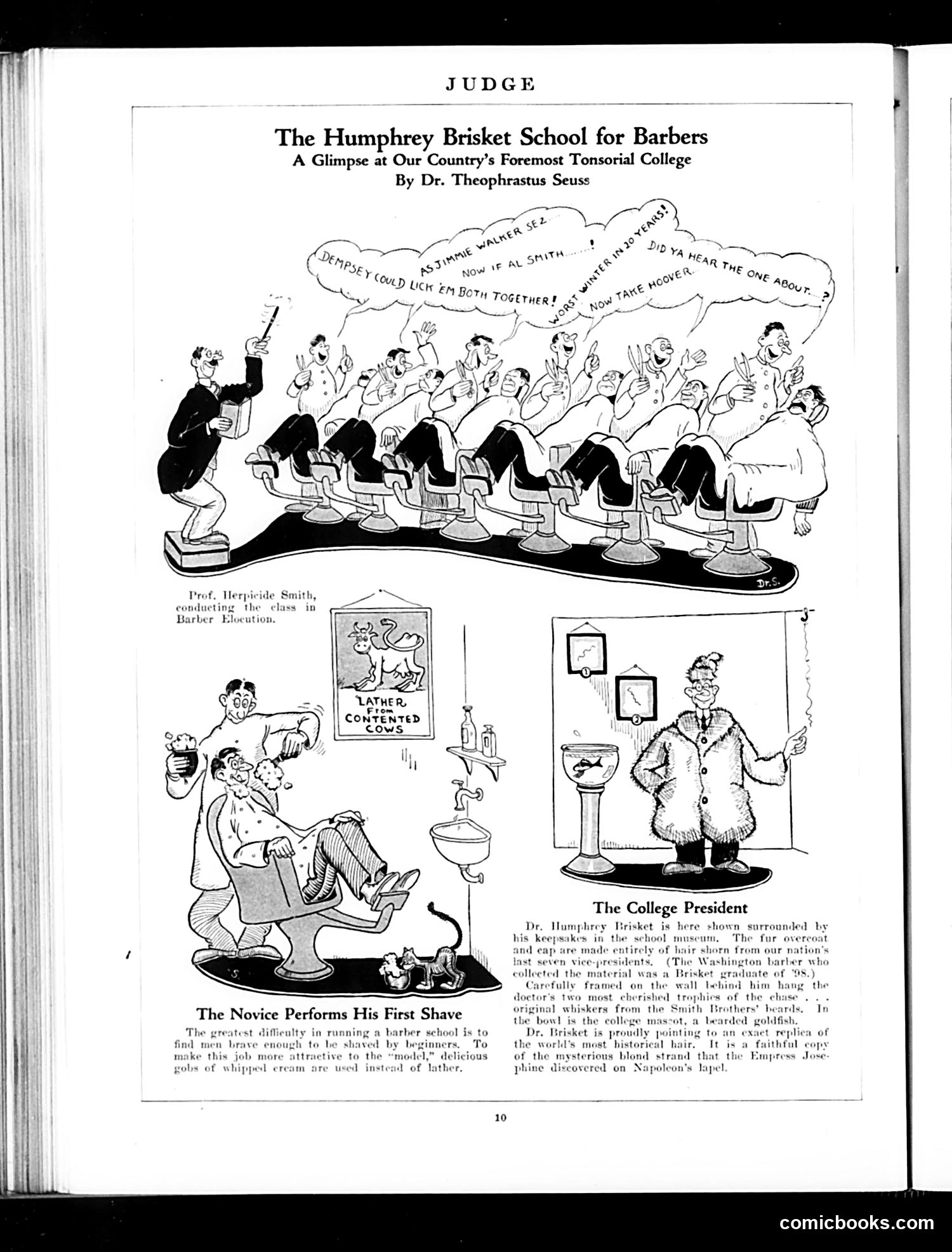
This is a humorous satire by "Dr. Theophrastus Seuss" (the pen name used by Dr. Seuss in Judge magazine) mocking a fictitious barber college. The cartoon depicts three scenes: **Top panel**: Professor Herpicide Smith teaches a class of students in barber chairs, with speech bubbles containing nonsensical barbering jargon—pure absurdist humor about vocational education. **Bottom left**: "The Novice Performs His First Shave" shows a trainee barber with a nervous customer, satirizing how difficult and dangerous amateur barbers are. **Bottom right**: "The College President," Dr. Humphrey Brisket, displays absurd trophies including Napoleon's hair and the "Empress Josephine's blond strand"—mocking how institutions inflate their prestige with dubious historical artifacts. The overall joke targets the pretension of trade schools and their claims of legitimacy through fake historical credibility. It's lighthearted satire of American educational vanity and the barber profession itself.
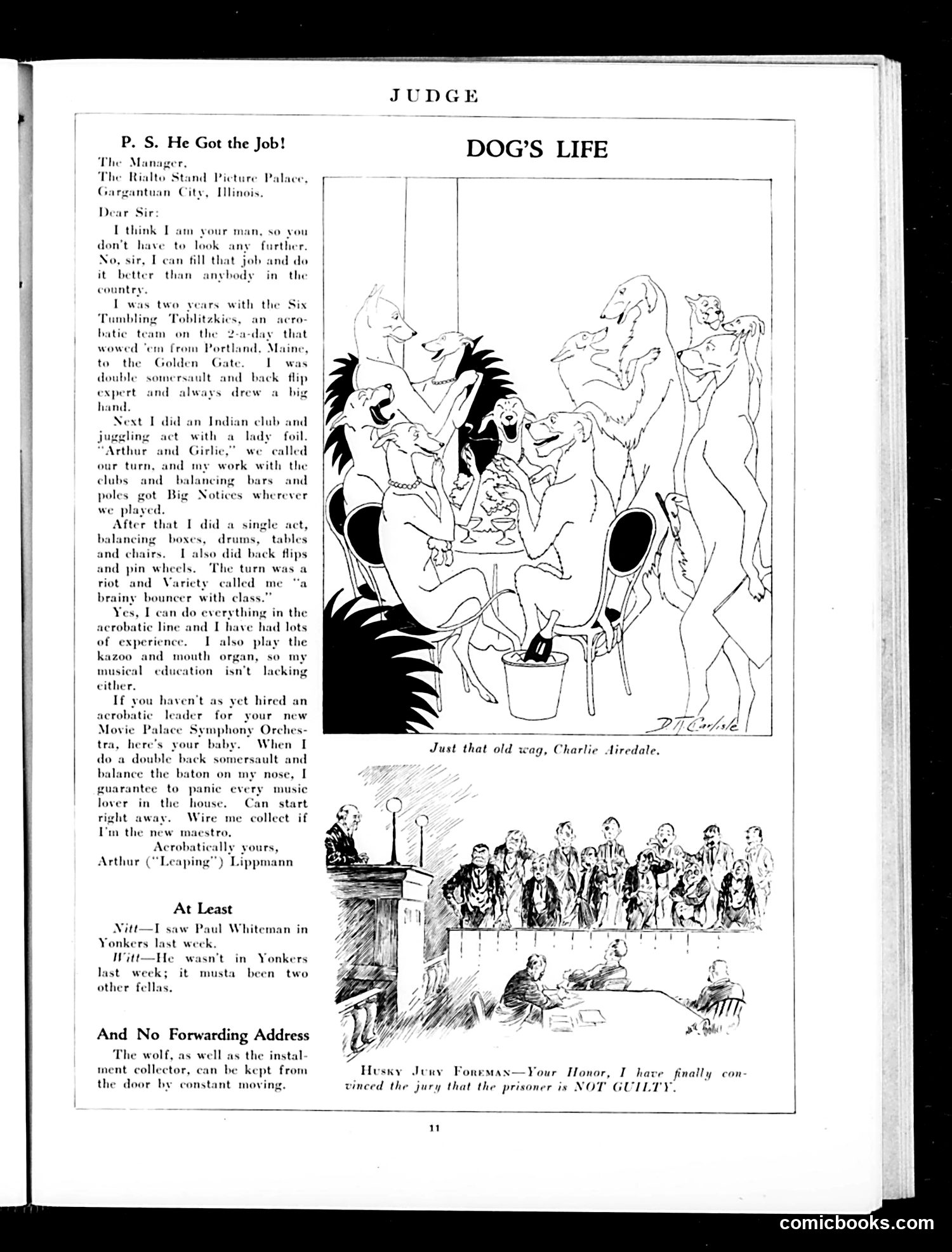
This Judge magazine page contains two satirical pieces about employment and justice. **"P.S. He Got the Job!"** mocks the desperation of the unemployed during what appears to be the Great Depression. A vaudeville performer named Arthur Lippmann writes to a movie theater manager, listing his acrobatic credentials (tumbling acts, juggling, balancing) while pitching himself as capable of playing kazoo and mouth organ. The satire is that he's wildly overqualified yet desperate enough to take any job, and his bizarre skills are entirely useless for a theater manager's needs. The title suggests he got hired anyway—the joke being on how low standards had fallen. **"Dog's Life"** (cartoon) shows a trial scene where a jury foreman announces they've acquitted a prisoner. The caption sardonically suggests it took great effort to convince the jury of innocence—implying either the justice system is rigged or juries are unreasonably harsh, making acquittal nearly impossible. The minor jokes ("At Least," "And No Forwarding Address") offer quick social commentary about mistaken identity and avoiding debt collectors through constant relocation.
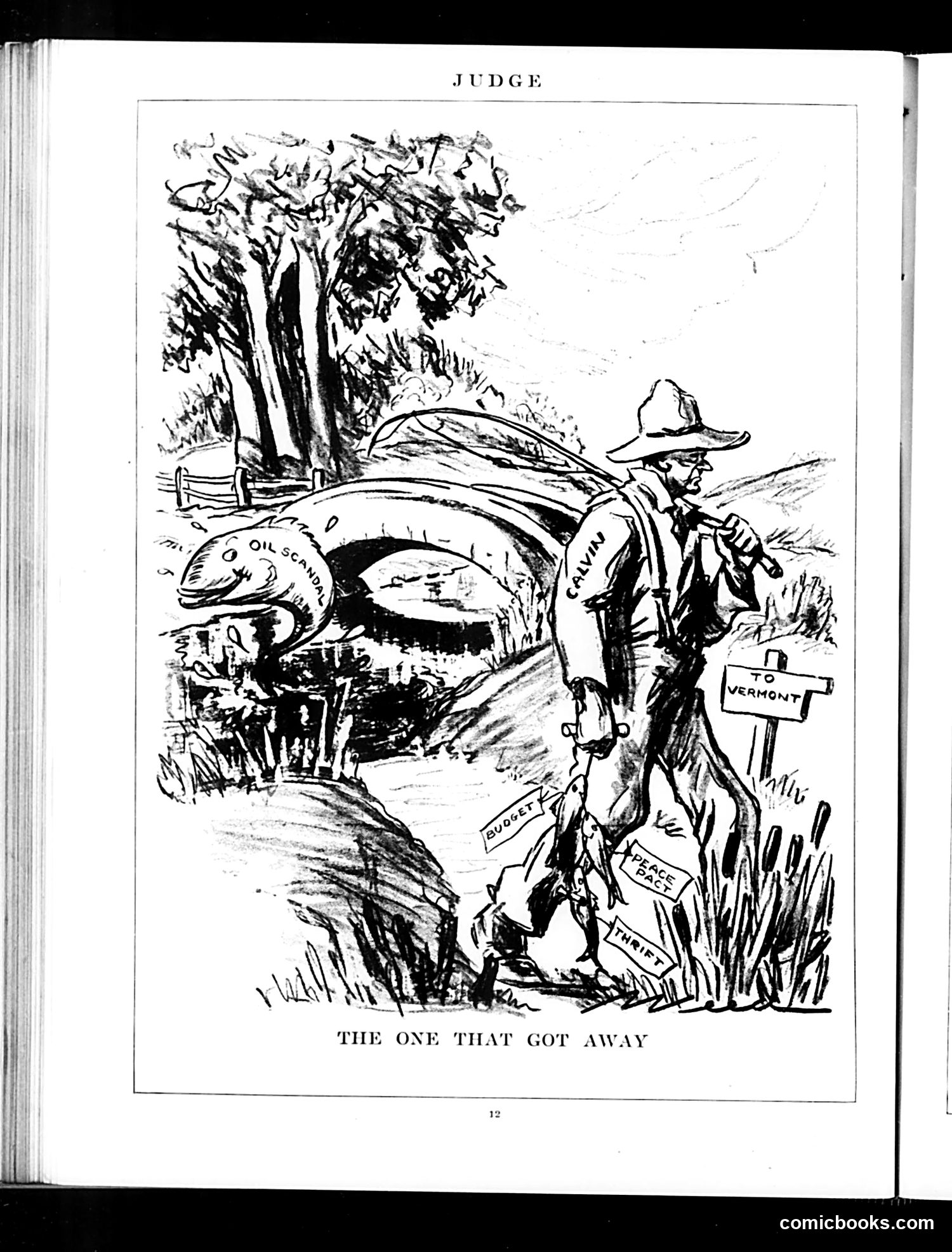
This political cartoon depicts a fisherman in Vermont who has caught what appears to be a large "Oil Scandal" (labeled on the fish). The figure represents Vermont state politics or governance. The satirical point criticizes Vermont's apparent escape from or avoidance of an oil-related scandal that afflicted other regions—"the one that got away" being the scandal Vermont managed to sidestep. The cartoon references early 20th-century oil industry controversies (likely the Teapot Dome scandal era, though the exact date isn't visible). The fisherman's triumphant pose suggests Vermont escaped financial or political corruption involving oil interests that ensnared other states. The fishing metaphor equates political scandals with catches—some slip away.
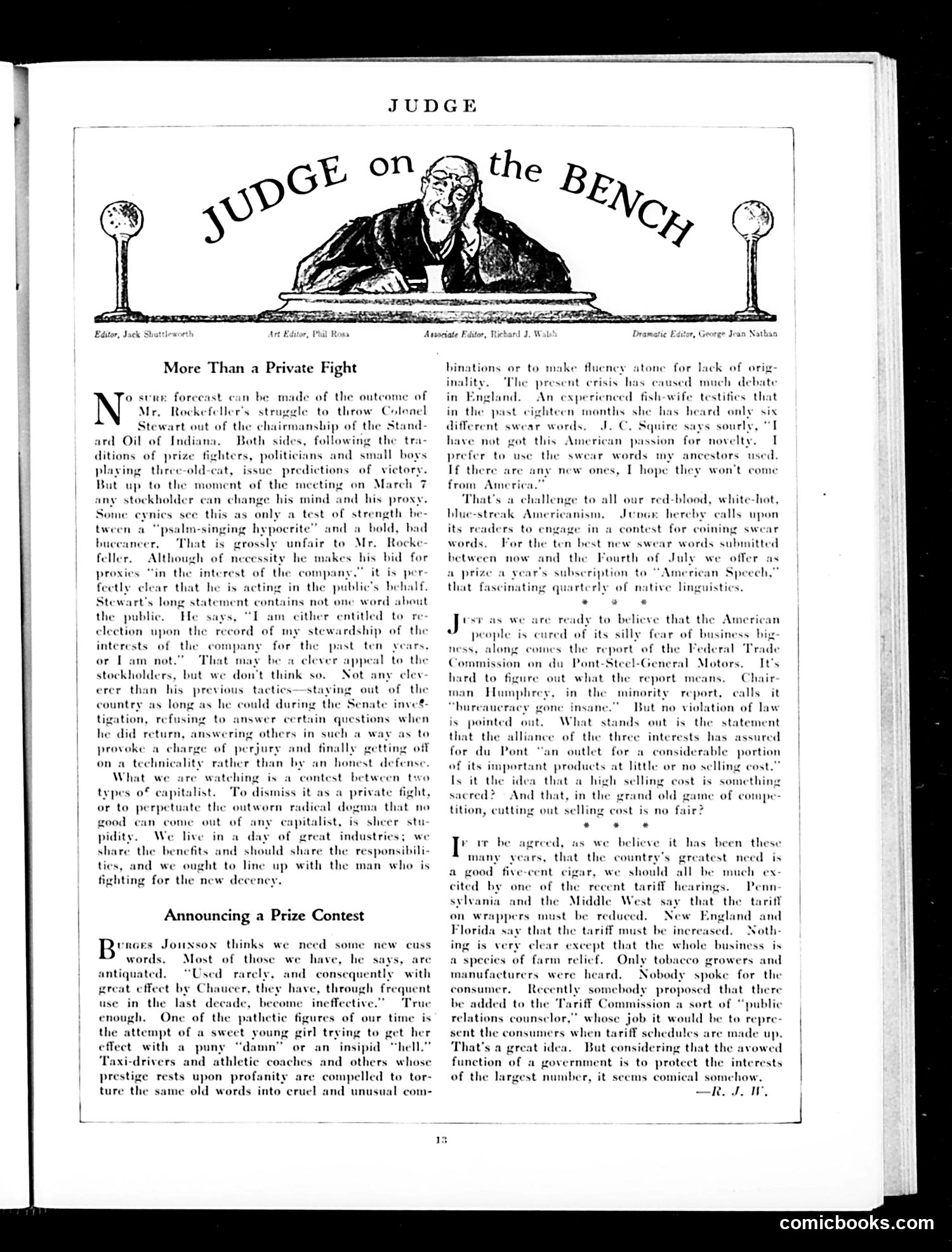
This page discusses two separate topics within Judge's satirical framework: **Main Article: "More Than a Private Fight"** The editorial covers John D. Rockefeller Sr.'s attempt to remove Colonel Stewart from leadership of Standard Oil of Indiana, with a March 7 stockholder meeting looming. Judge argues this isn't merely corporate infighting but a contest between two capitalist philosophies: Rockefeller acting in the "public's behalf" versus Stewart's self-interested record (the text references his evasion during Senate investigations). The satire suggests Stewart represents "old" ruthless capitalism while Rockefeller represents "new decency"—a remarkable position today but reflecting 1920s Progressive reformism. **"Announcing a Prize Contest"** A humorous piece mocking the exhaustion of traditional English profanity through overuse in recent decades. Judge challenges American readers to invent "new swear words," offering a subscription prize—satirizing both linguistic creativity and American boosterism while subtly critiquing coarse speech's prevalence.
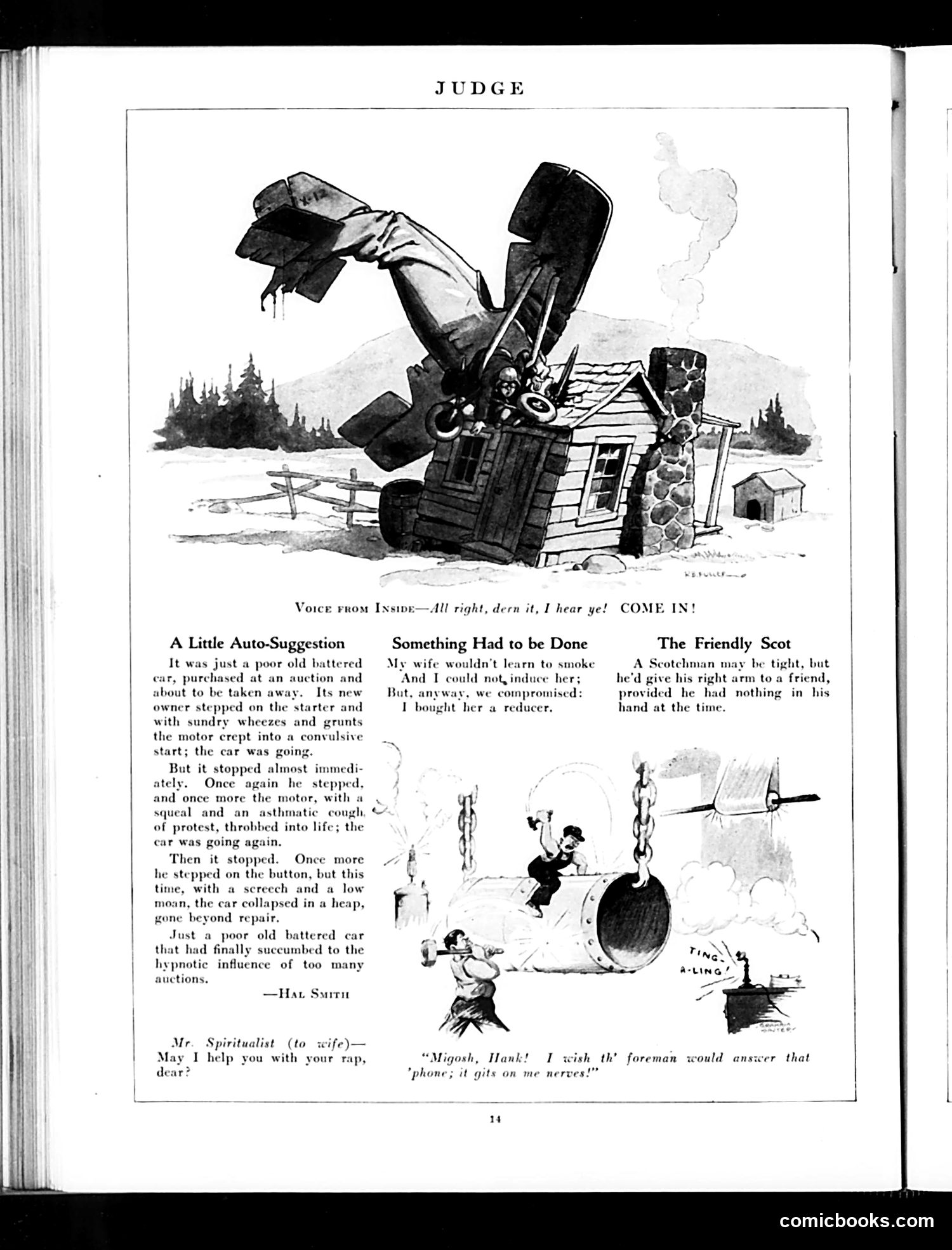
This page contains three separate humorous pieces satirizing early 20th-century American life: **"A Little Auto-Suggestion"** (by Hal Smith): Mocks the unreliability of cheap used automobiles sold at auction. The joke: a decrepit car keeps stalling despite the owner's repeated attempts to restart it, finally collapsing entirely—suggesting the car had been subjected to too many auctions to function. **"Something Had to be Done"**: A brief marital joke about a husband buying his non-smoking wife a "reducer" (diet device) as a compromise when he couldn't convince her to smoke. **"The Friendly Scot"**: A stereotypical ethnic joke playing on Scottish stinginess—claiming a Scotsman would generously give his right arm to a friend, but only if his hands were already occupied (implying he wouldn't part with anything otherwise). The top illustration shows an upended house with a figure emerging, accompanying a caption about spiritualism and a rap session—likely referencing séance parlor entertainment popular in that era.
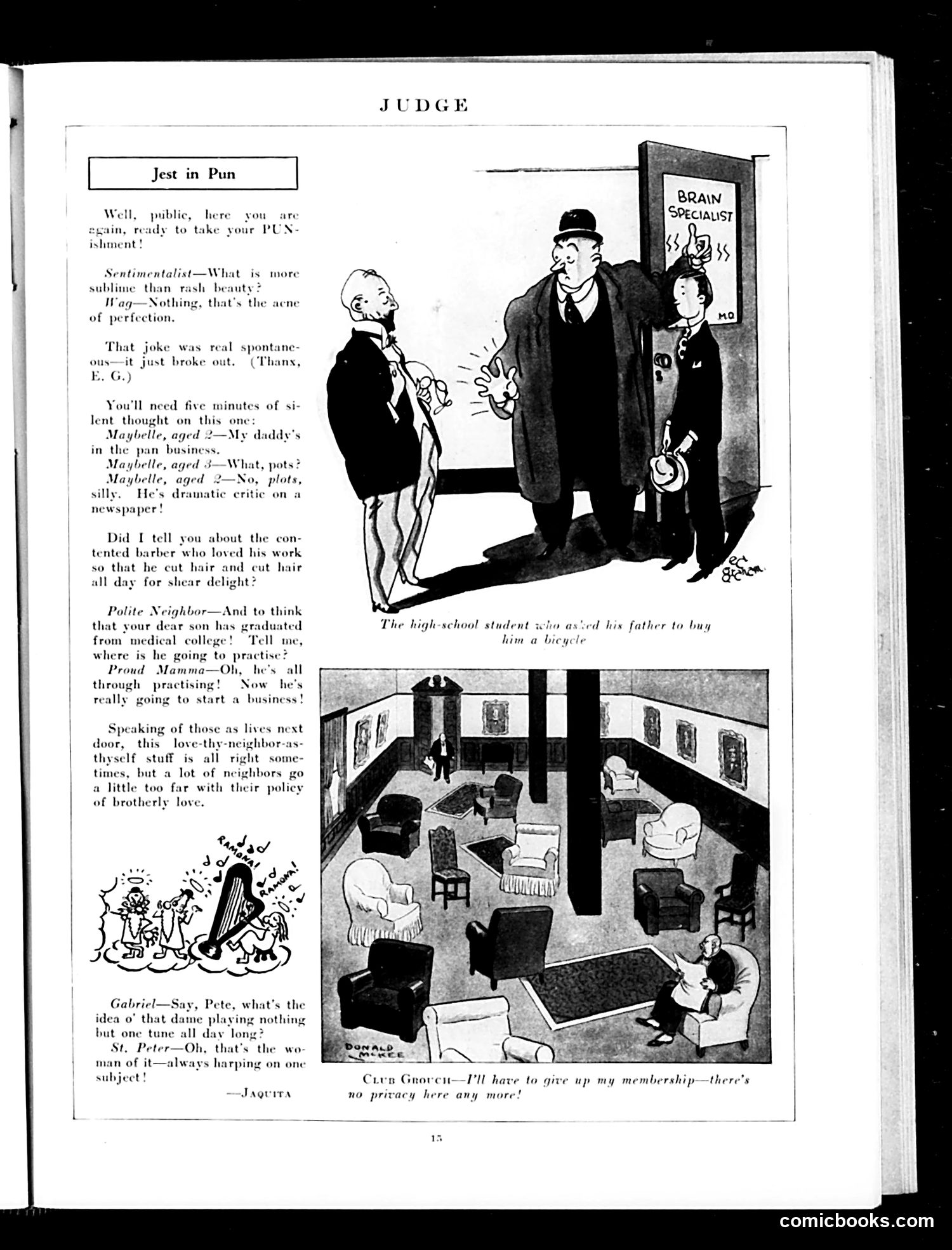
This page from Judge magazine collects short jokes and cartoon gags typical of early 20th-century American humor. The satirical content includes: **"Jest in Pun"** section: A collection of wordplay and puns—jokes about a "dramatic critic" working in the "pan business" (theater pans/criticism), a barber's "shear delight," and medical school graduates going into business rather than practice. **Top cartoon**: Shows a "Brain Specialist" office where a high school student asks his father to buy him a bicycle—likely mocking parental indulgence or the emerging consumer culture. **Bottom cartoon**: Depicts a crowded club where a member complains about loss of privacy, satirizing how social clubs had become overpopulated gathering spaces. **Heaven dialogue**: Gabriel and St. Peter joke that a nagging woman ("harping on one subject") represents typical spousal behavior. The humor targets professional pretension, parental overindulgence, and domestic stereotypes characteristic of period comedy.
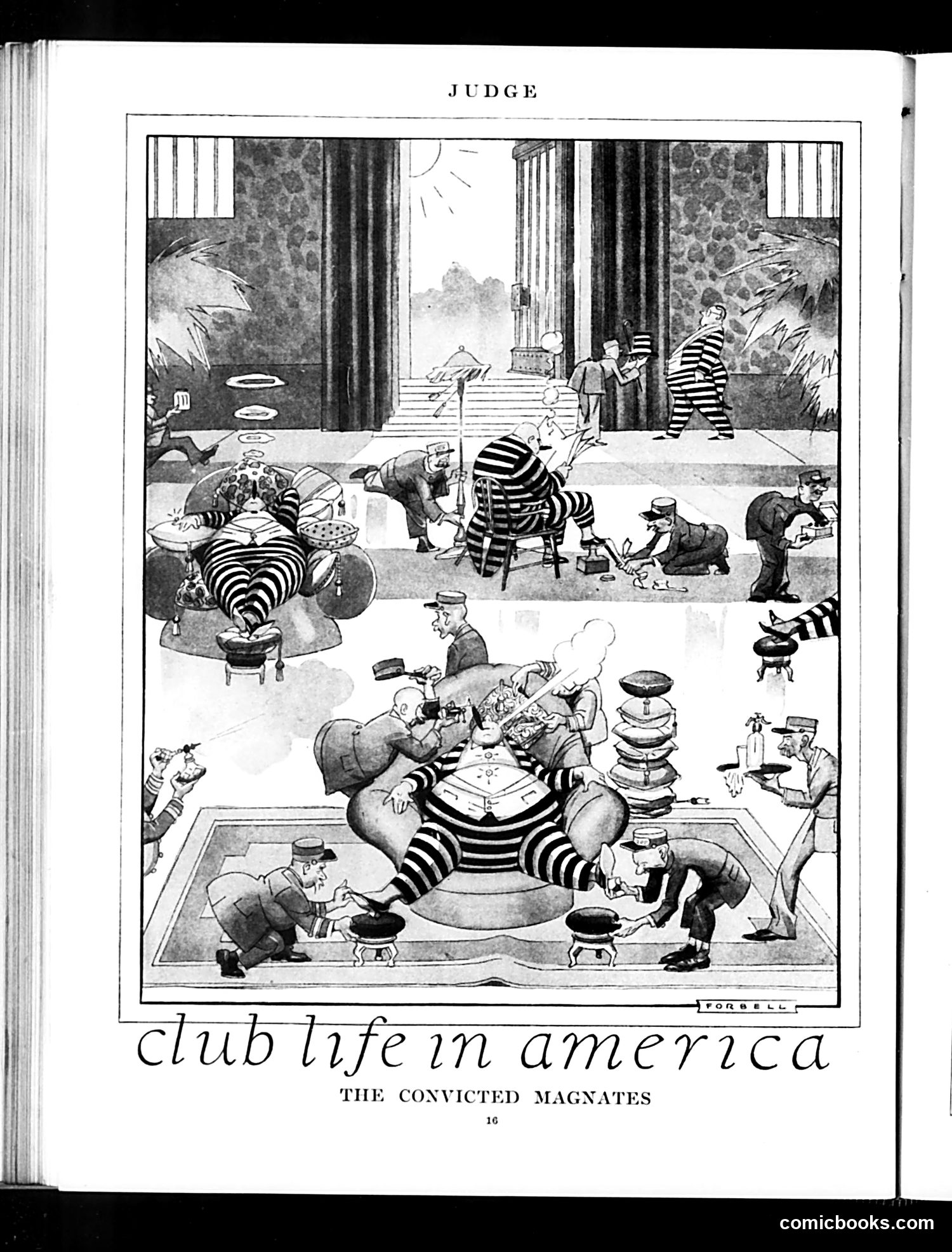
This satirical cartoon depicts wealthy businessmen ("magnates") as imprisoned convicts in striped prison uniforms, relaxing luxuriously in an ornate clubhouse setting. The image sarcastically suggests that despite legal convictions, these wealthy figures continue enjoying lavish club life—dining, socializing, and conducting business as usual. The satire likely references a period when prominent American industrialists or financiers faced prosecution but faced minimal real consequences due to wealth and influence. By literally dressing them in prison stripes while showing them in opulent surroundings, the cartoonist mocks the gap between legal conviction and actual punishment for the rich—implying their "prison time" amounts to continued privilege. The specific magnates remain unclear without additional context, but the commentary targets wealthy elites escaping genuine accountability.
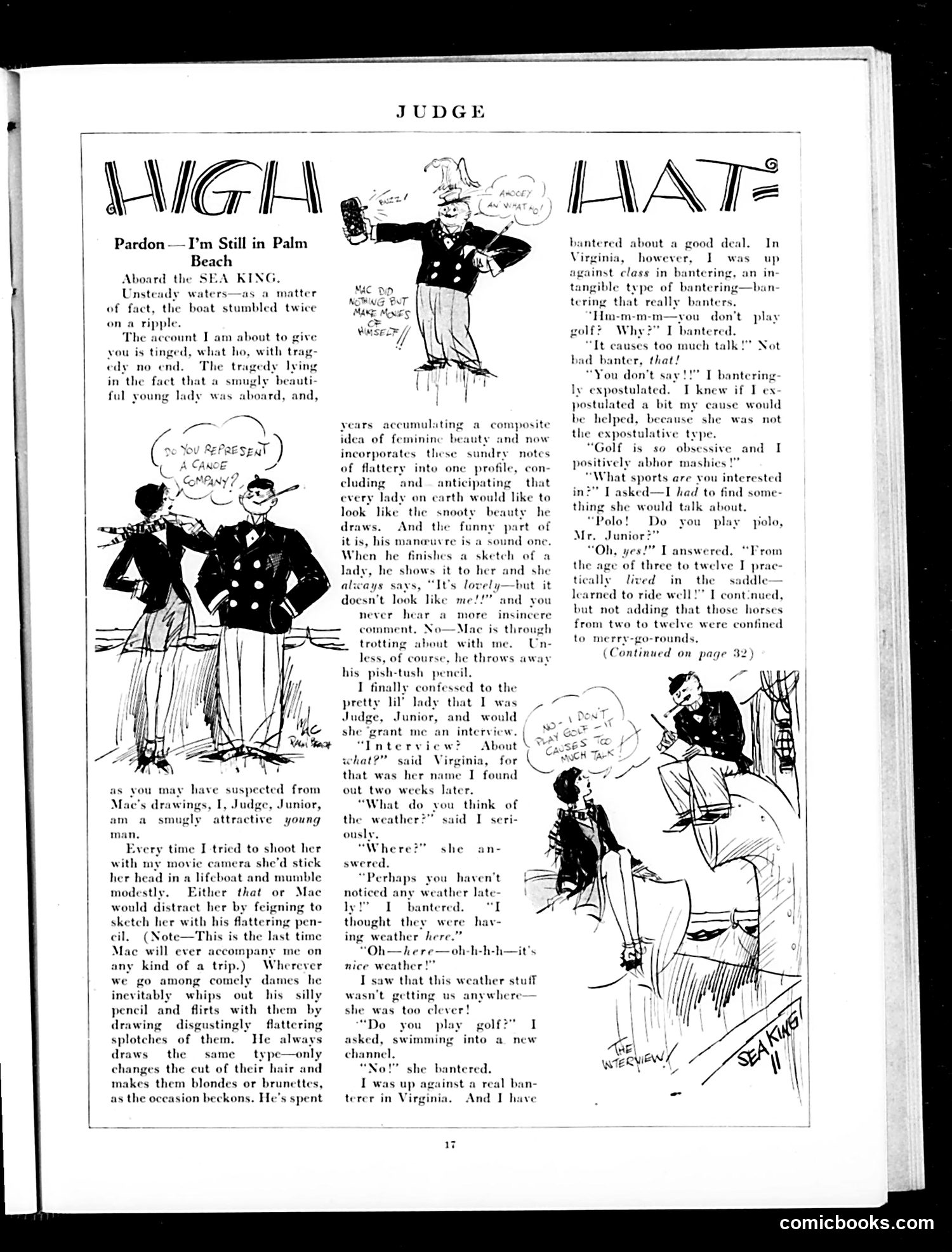
This page is a humorous first-person narrative by "Judge, Junior" about attempting to court a woman named Virginia while aboard a yacht in Palm Beach. The satire targets masculine vanity and failed seduction tactics. The protagonist is portrayed as smugly self-assured but repeatedly outmaneuvered. Virginia, depicted as intelligent and witty, consistently deflates his attempts at clever banter about weather and sports. When he claims polo expertise from ages three to twelve, the joke's implication—that he rode children's toys, not real horses—undermines his credibility. The accompanying sketches show the narrator's frustration as Virginia remains unimpressed by both his charm and his companion Mac's flattering portrait sketches. The satire mocks the narrator's transparent attempts at sophistication while celebrating the woman's refusal to be easily manipulated by conventional masculine tactics. The tone suggests early 20th-century gender dynamics where women were beginning to resist traditional seduction strategies.
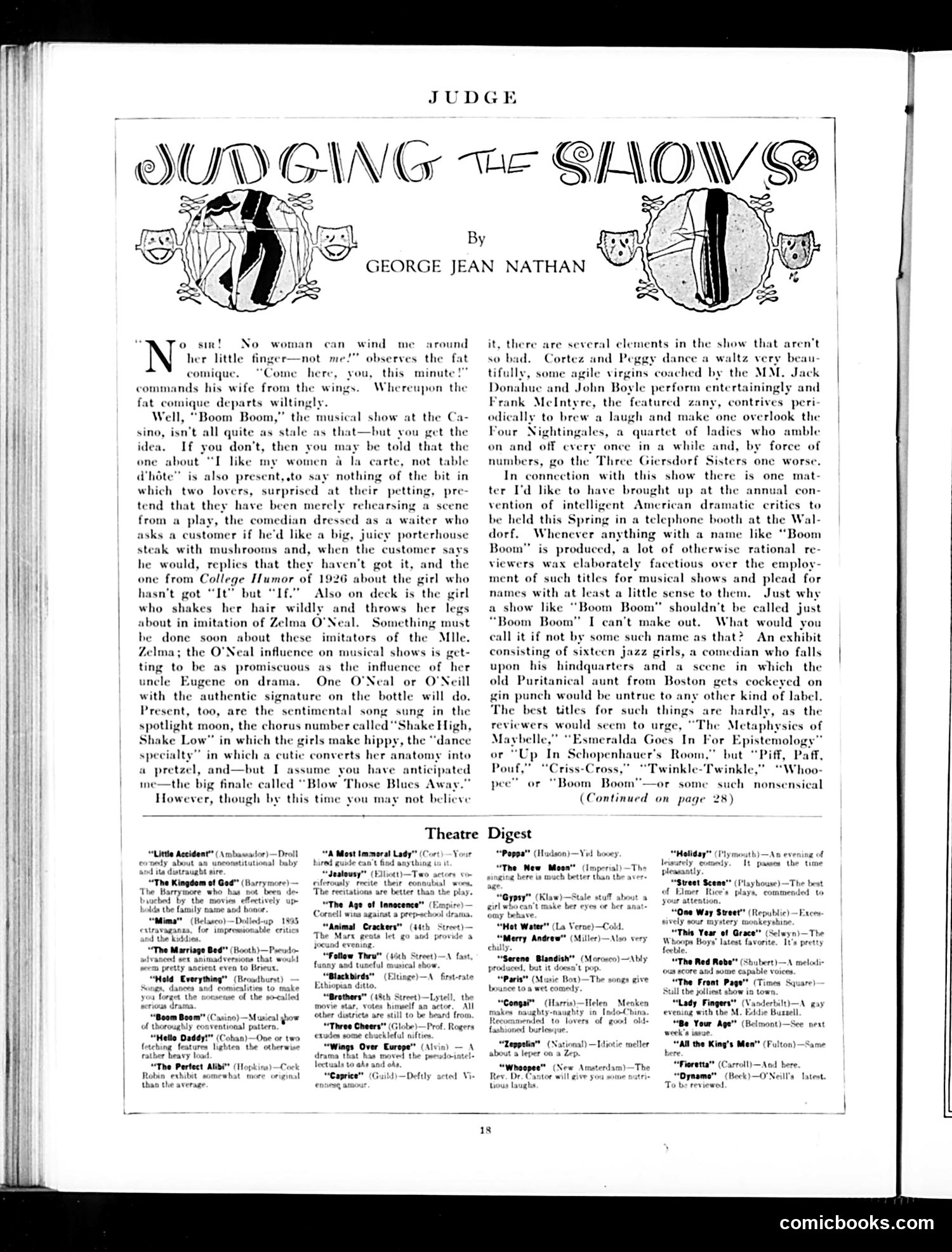
This page reviews "Boom Boom," a musical comedy at the Casino theater. The critique is satirical: the show recycles tired vaudeville jokes (a henpecked husband, double entendres about à la carte dining, a girl imitating actress Zelma O'Neal) alongside predictable musical theater elements (sentimental songs, dance numbers, a finale called "Blow Those Blues Away"). The author mocks critics who object to silly titles like "Boom Boom," arguing the name actually fits: the show consists of "sixteen jazz girls, a comedian who falls upon his hindquarters and a scene in which the old Puritanical aunt from Boston gets cockeyed on gin punch." Why pretend something so frivolous deserves a serious name? The page also includes a "Theatre Digest" listing brief reviews of other shows, offering Judge magazine's typical theatrical commentary for leisure readers interested in Broadway entertainment circa the 1920s.
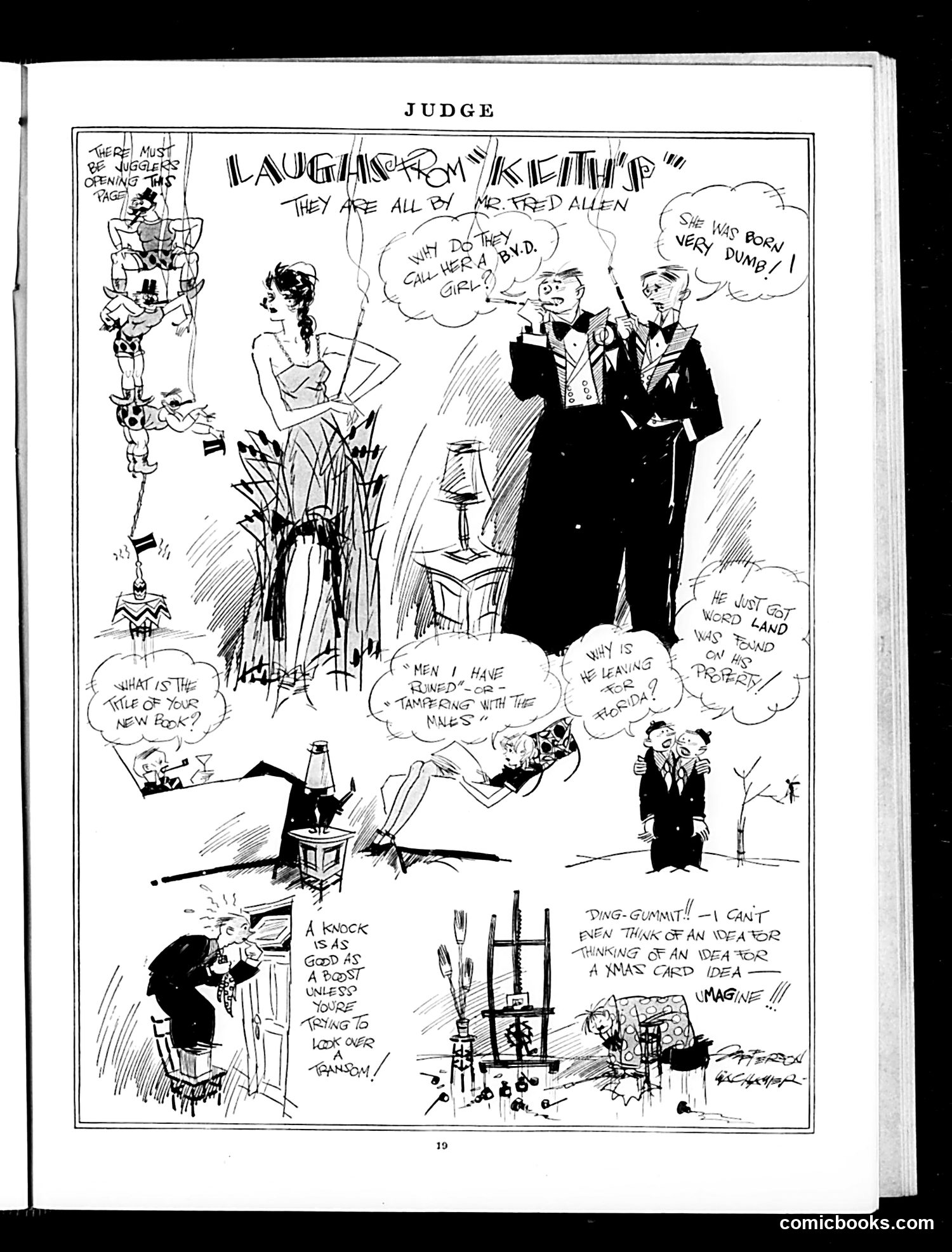
This page satirizes Fred Allen's comedy shorts called "Laugh from Kempf's" (all produced by Allen, per the title). The cartoon mocks the films' apparent lack of originality and quality. The central figures appear to be film industry executives or critics discussing Allen's work. Speech bubbles reveal their complaints: the title is unoriginal ("call her a b.v.d. girl"), the plots are tampered-with copies of existing material, and the films themselves lack creativity ("he just got word land was rented on property"). The left panel shows a towering stack of failed ideas or rejected scripts. The bottom scene depicts a chaotic film set, with someone exclaiming frustration about creating Christmas card ideas—suggesting the productions are thoughtlessly derivative. The satire targets both Allen's film ventures and broader Hollywood's recycling of tired comedic formulas during this era.
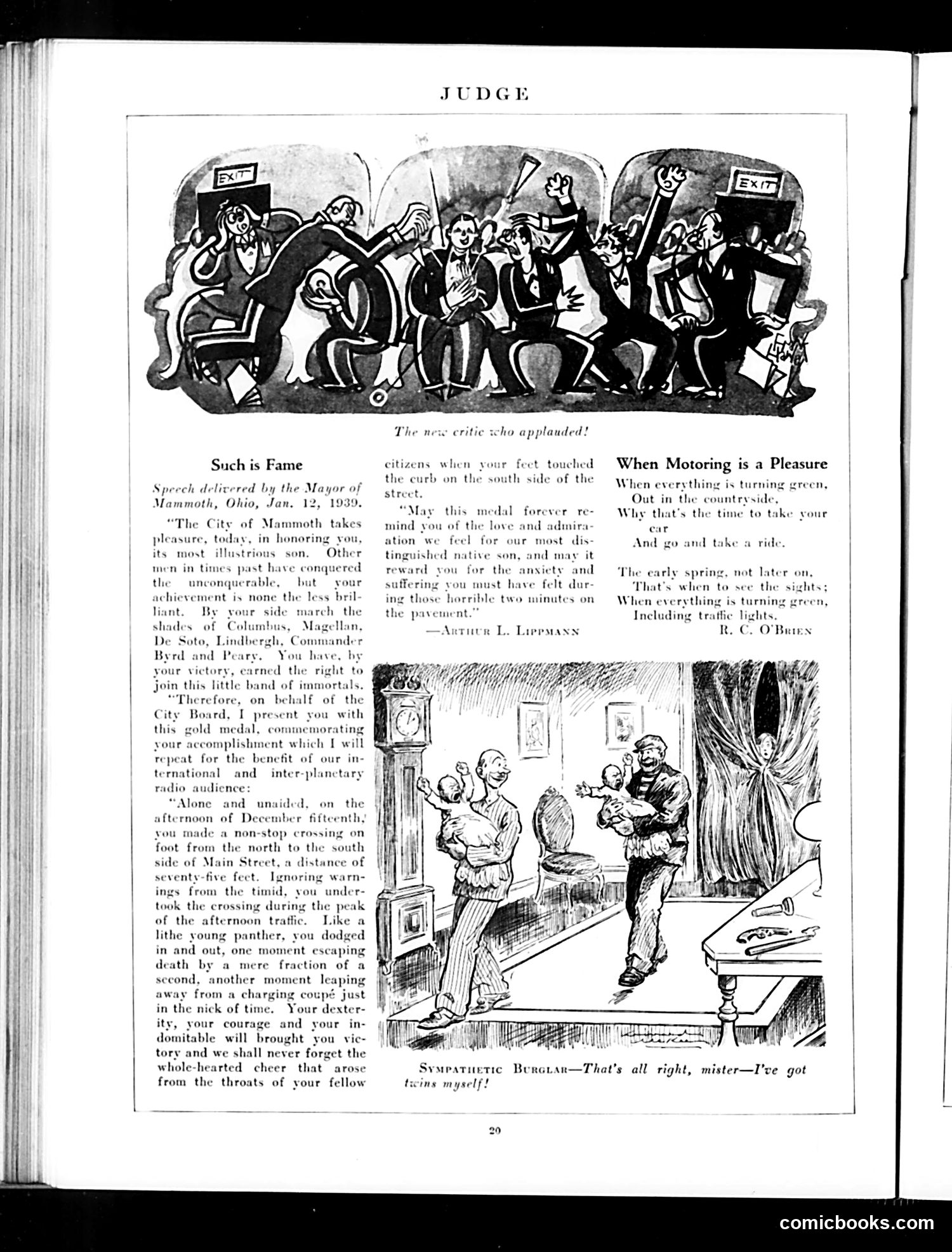
This page contains two separate pieces of satire from Judge magazine (dated January 12, 1939). **"Such is Fame"** mocks inflated civic pride and empty honors. The Mayor of Mammoth, Ohio delivers a grandiose speech comparing an ordinary citizen's mundane achievement—safely crossing Main Street during traffic—to legendary explorers like Columbus and Lindbergh. The joke is that the town is absurdly celebrating something trivial (a 75-foot pedestrian crossing) with the rhetoric reserved for genuine heroism. The speech's earnest tone about "two minutes" of "suffering" on the pavement emphasizes how ridiculous the hyperbole is. **"When Motoring is a Pleasure"** is a brief poem encouraging spring drives. The cartoon at bottom ("Sympathetic Burglars") shows a burglar reassuring his nervous partner during a break-in, saying he also has "twitches"—humanizing criminals through shared nervous habits. It's gentle humor about criminal anxieties. Together, these pieces represent Judge's characteristic satirical approach: deflating pretension and finding humor in everyday absurdities.
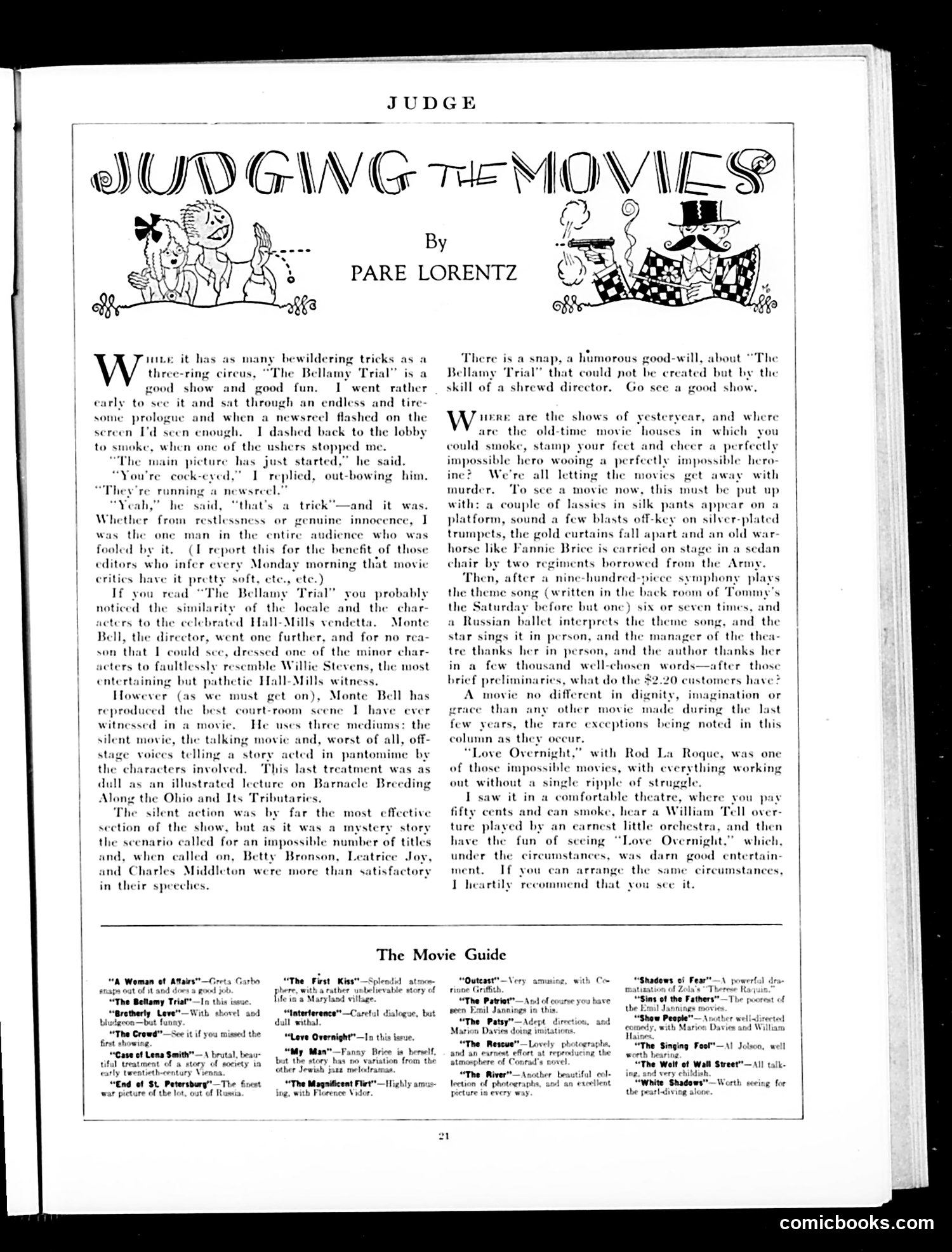
This is a film review column by Pare Lorentz critiquing "The Bellamy Trial," a recent movie mixing silent film, dialogue, and off-stage narration. Lorentz complains that this hybrid approach—using all three mediums simultaneously—is unnecessarily confusing and pretentious. His core complaint: modern movie theaters have become overly elaborate, forcing audiences to endure absurdly extended preambles (newsreels, orchestral symphonies, Russian ballet interludes) before the main feature begins. He laments that filmmakers use excessive production spectacle to compensate for weak storytelling, making even genuinely entertaining movies feel bloated. Lorentz praises "The Bellamy Trial" for its court-room scenes and cast (Betty Bronson, Leatrice Joy), and recommends "Love Overnight" as an example of a film that succeeds *despite* theatrical pretension when viewed in the right atmosphere. The implicit satire: 1920s cinema is strangling itself with over-production and technological novelty, forgetting that good direction and storytelling matter more than elaborate framing devices.
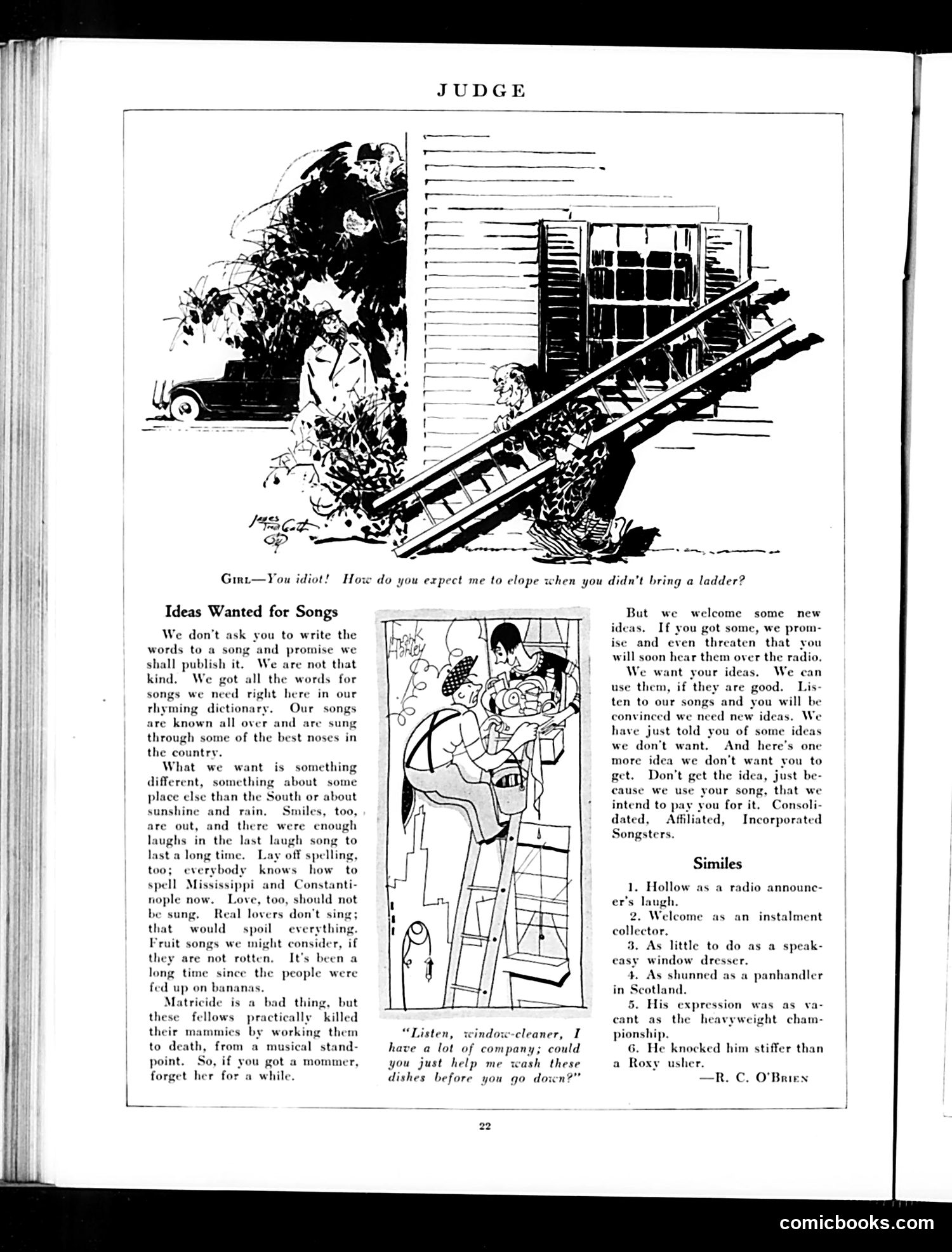
The top cartoon shows a couple attempting an elopement—the woman scolds the man for forgetting a ladder, implying they're escaping from a building (likely her parents' house). This is a standard romantic-comedy gag about young lovers circumventing parental authority. The main article satirizes popular songwriting of the era. Judge mocks the formula-driven, clichéd nature of commercial songs—criticizing overused themes (sunshine, rain, "Smiles," love songs, spelling songs like "Mississippi"). The magazine claims to receive constant song pitches yet refuses to pay contributors, turning the tables on songwriters seeking publication. The "Similes" section offers humorous comparisons reflecting 1920s-30s culture: radio announcers as insincere, installment collectors as unwelcome, speakeasies operating covertly, and the "Roxy usher" (referencing the famous Roxy theater chain's famously aggressive ushers). The satire targets both mass-media mediocrity and commercial exploitation of creative work.
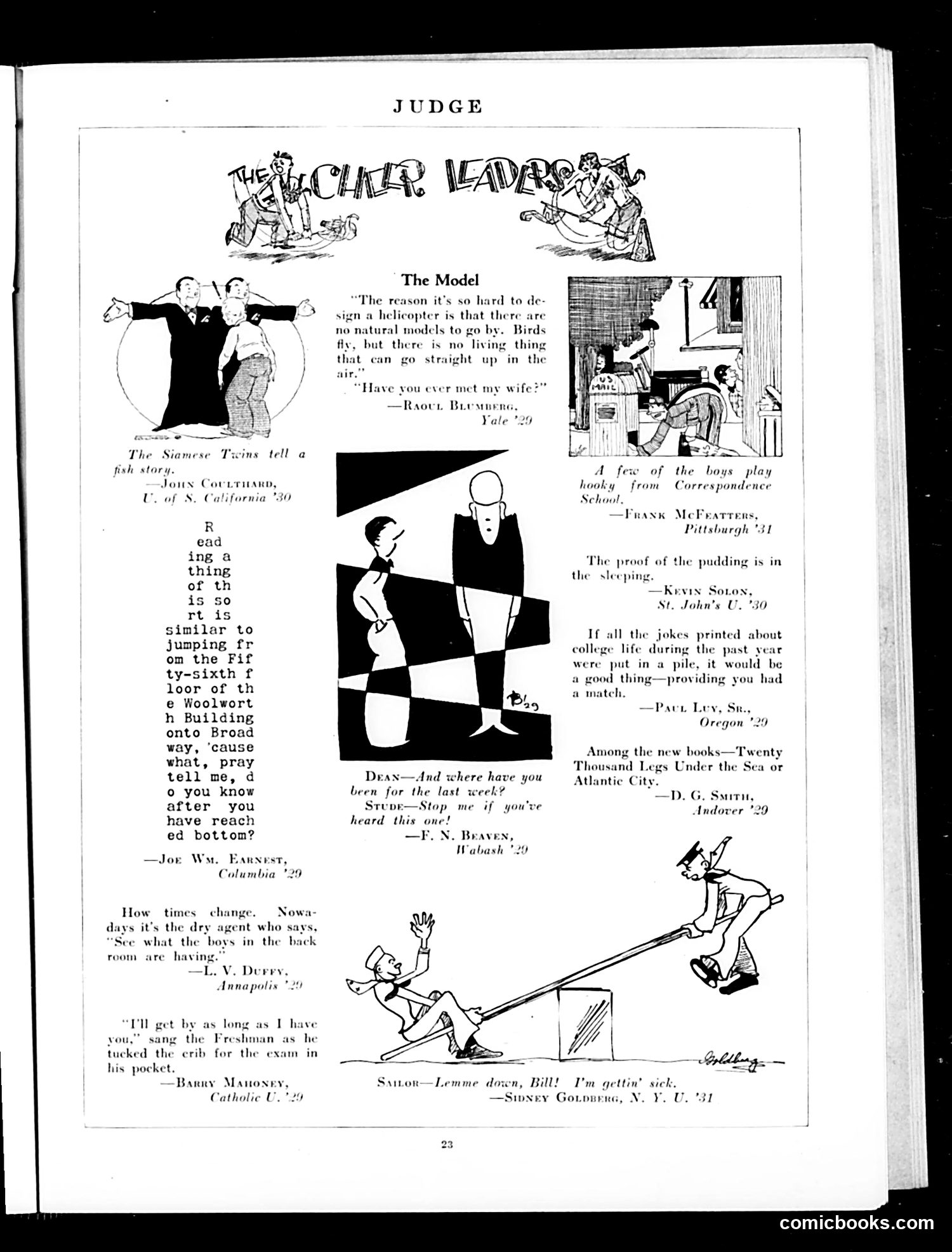
This is a humor collection page from Judge magazine featuring jokes and cartoons aimed at college audiences. The content reflects 1920s student life and concerns: **Main themes:** - College stereotypes: cheating ("tucking the crib for the exam"), skipping class ("hooky"), drinking (Prohibition-era references to "dry agents") - Academic struggles and romantic pursuits - Physical comedy and slapstick (the sailor illustration shows two men on a seesaw) **Notable elements:** - "The Model" discusses helicopter design, apparently referencing contemporary aviation debates - Multiple attributions to colleges (Yale, Columbia, Catholic U., etc.) suggest this was a college-focused publication - The "Siamese Twins" reference appears to be a fishing story joke - The final cartoon depicts physical comedy with the caption "Lemme down, Bill! I'm gettin' sick" **Tone:** Lighthearted, self-deprecating humor about undergraduate life, with no apparent political commentary—purely entertainment for the college demographic.
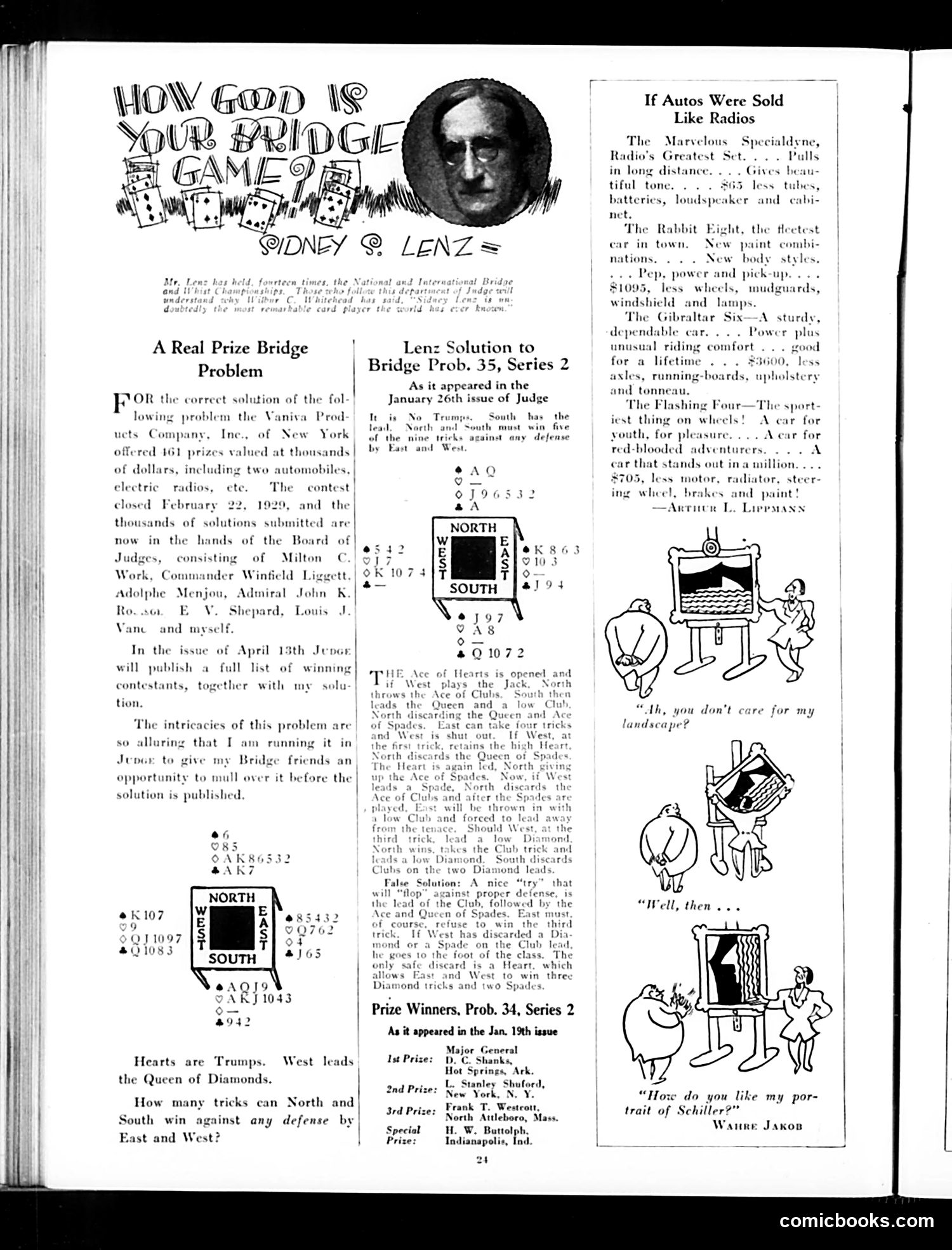
This satirical advertisement parodies 1920s radio marketing by imagining automobiles marketed the same way. At the time, radios were sold with misleading or incomplete specifications—listing attractive features while omitting essential (and costly) components like batteries, tubes, and cabinets. The joke applies this deceptive practice to cars: "The Rabbit Eight" advertises at $1,095 but excludes wheels, mudguards, windshield, and lamps. "The Gibraltar Six" costs $5,600 but omits crucial parts. By highlighting the absurdity of selling complete machines piecemeal with hidden costs, the satire critiques predatory radio sales tactics of the era—a common consumer complaint during the radio boom. The cartoon targets the gap between advertised prices and actual consumer expenses in emerging consumer industries.
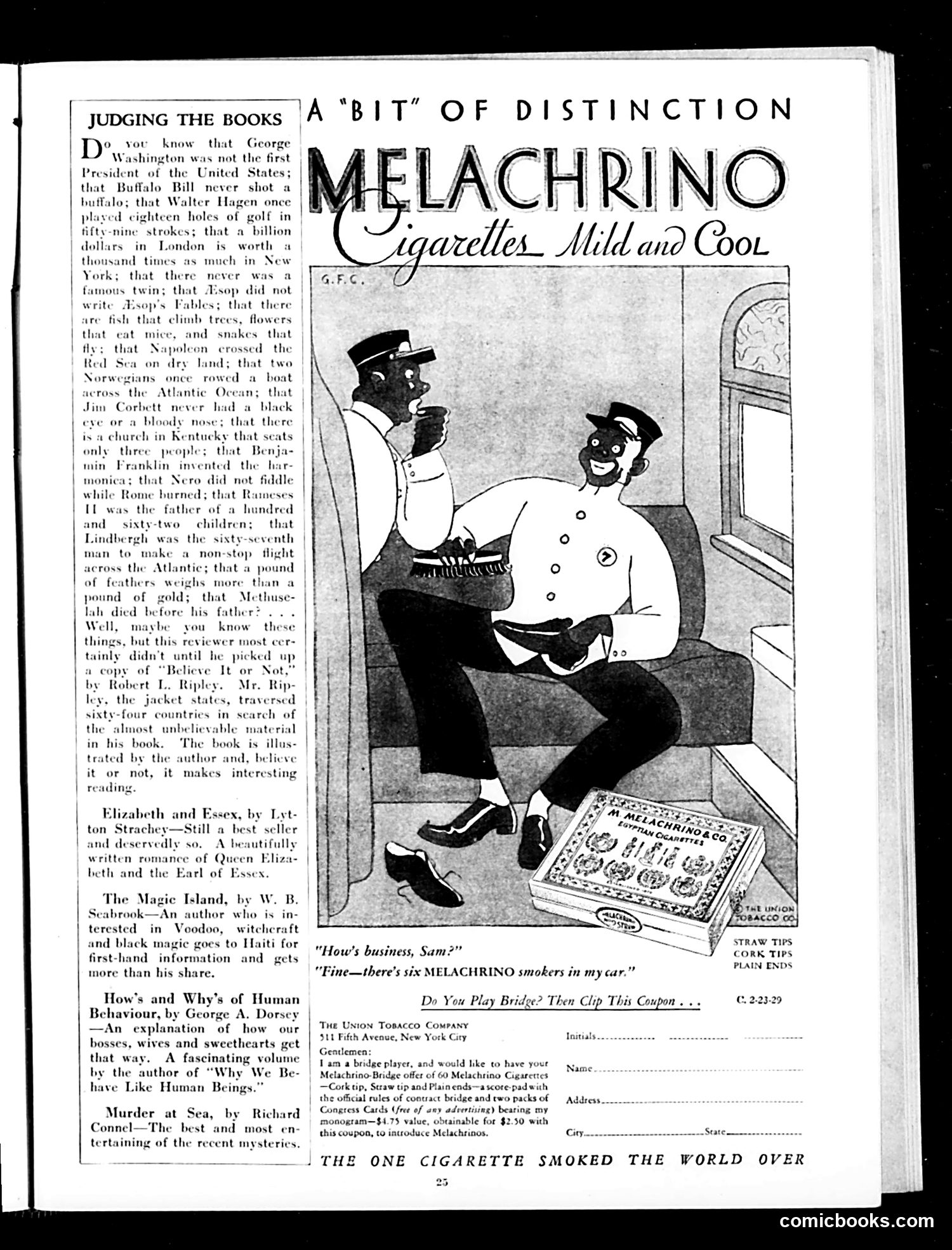
This page is primarily a **cigarette advertisement** for Melachrino brand, disguised as a book review section. The main illustration depicts two figures in a car—one appears to be a white man smoking, the other a Black man rendered in the offensive blackface caricature style common to early 20th-century advertising. The caption reads: "Fine—there's six MELACHRINO smokers in my car," suggesting the cigarettes' supposed popularity. The image uses racial stereotyping typical of the era to market the product. The left column reviews books including Robert Ripley's "Believe It or Not," positioning the ad within legitimate editorial content. Below is a coupon offering bridge players a discounted deal on Melachrino cigarettes with bridge scoring supplies. **Context for modern readers**: This reflects the casual racism embedded in mainstream American advertising before mid-20th century, where Black caricatures were used routinely to sell consumer products.
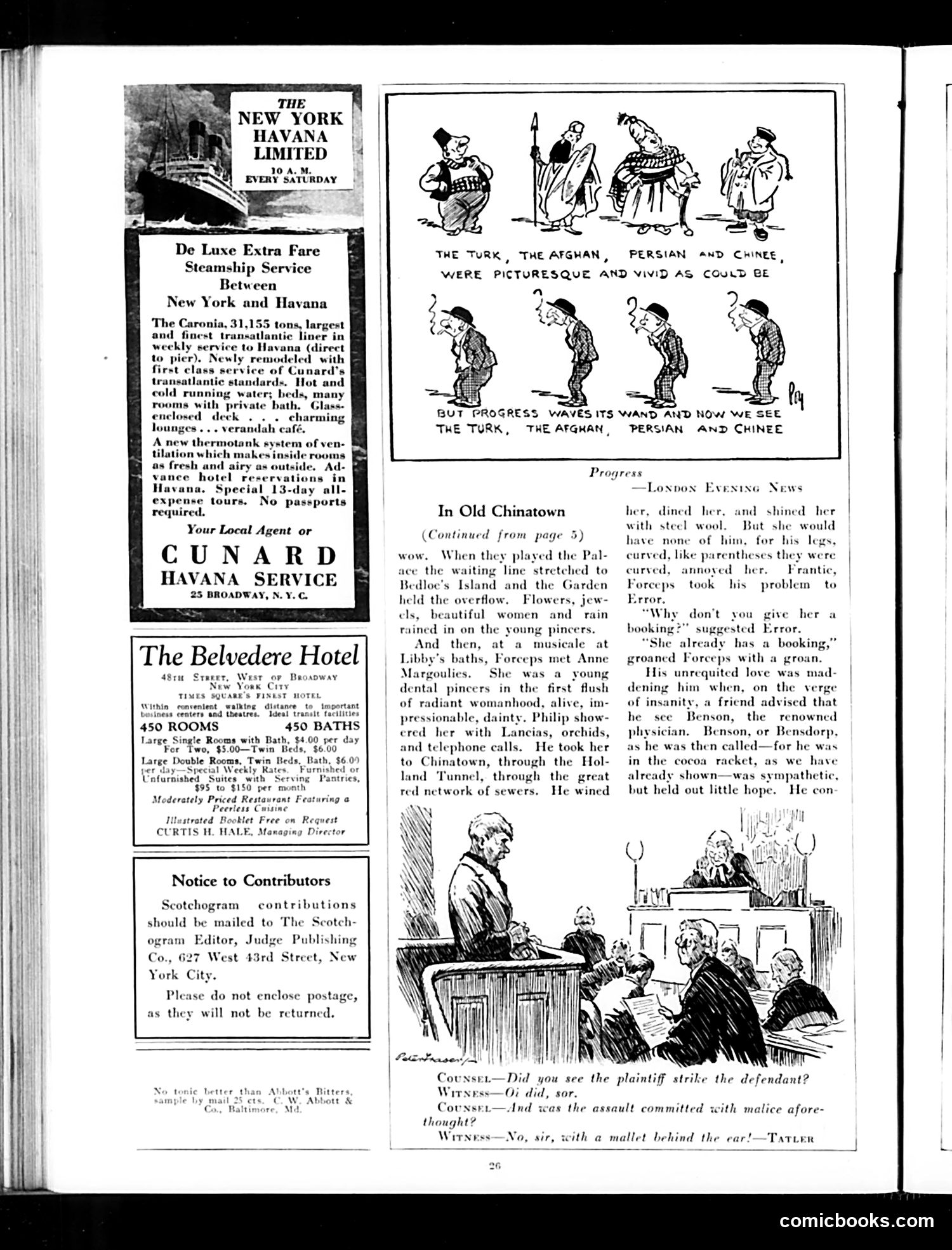
This page contains primarily **advertisements** (steamship service, hotels) and two unrelated pieces of content: **Top Cartoon:** A satirical four-panel strip about cultural "progress." It depicts four ethnic figures (labeled "The Turk, The Afghan, Persian and Chinese") first shown as "picturesque and vivid," then progressively bowing lower in subsequent panels as "progress waves its wand." The joke criticizes how modernization strips away cultural distinctiveness—these formerly colorful peoples are homogenized into uniform, diminished forms by Western progress. **Main Story & Cartoon:** A serialized fiction piece titled "In Old Chinatown" (continuing from page 5). The accompanying courtroom sketch is a separate joke: a witness testifies about an assault, revealing the weapon was "a mallet behind the ear"—a pun playing on legal terminology ("malice aforethought"). The page reflects early 20th-century attitudes toward non-Western cultures and immigration, viewing cultural assimilation through modernization as both inevitable and comedic.
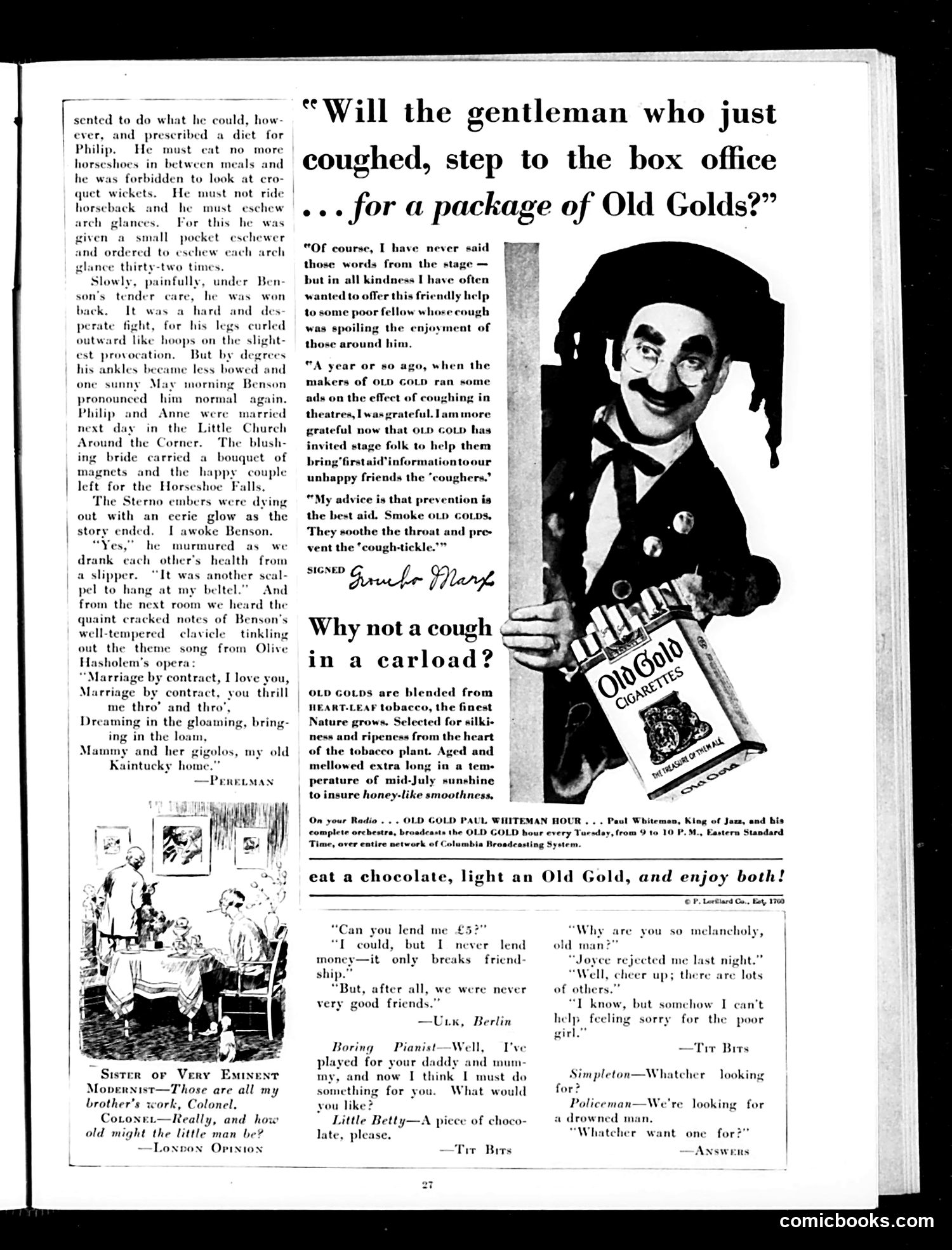
This page is primarily **advertising for Old Gold cigarettes**, framed as editorial content typical of early 20th-century magazines. The main "story" on the left is a humorous narrative about a man named Philip whose legs curved inward like horseshoes—a contrived setup that's essentially a joke framework. The centerpiece is a **testimonial advertisement** featuring what appears to be a stage performer (signed "Groucho Marx" based on the distinctive mustache and formal attire in the illustration). The celebrity endorsement claims Old Gold cigarettes helped prevent coughs in theaters—addressing a real social problem where audience members' coughing disrupted performances. The ad emphasizes that Old Gold is "blended from heart-leaf tobacco" for "smoothness," designed to soothe throats and prevent "cough-tickle." **The satire**: The entire premise is absurd—selling cigarettes as a *solution* to coughing caused by cigarettes. The euphemism "cough-tickle" is particularly comedic to modern eyes. The page includes humorous shorts and jokes below, standard Judge magazine filler content.
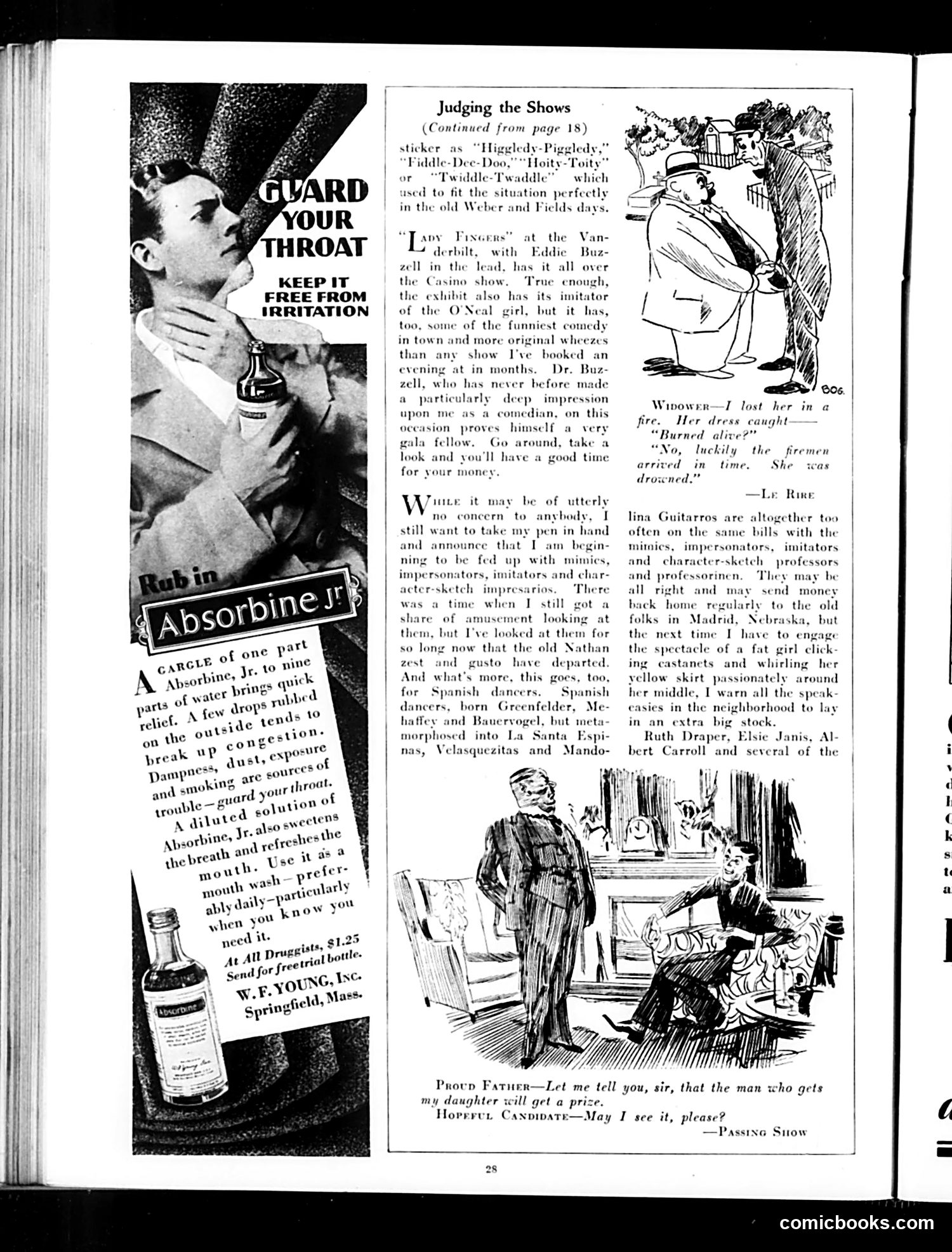
This page from *Judge* magazine contains theatrical criticism and advertising. The main content is "Judging the Shows," a theater review column critiquing Broadway productions. The reviewer praises "Lady Fingers" at the Vanderbilt theatre, starring Eddie Buzzell, calling it genuinely funny. However, he expresses exhaustion with impersonators, mimics, and especially Spanish dancers—noting these acts (often performed by non-Spanish performers with stage names like "La Santa Espinas") appear repeatedly on bills. He singles out fat Spanish dancers doing castanets as particularly tiresome. The cartoons illustrate theatrical humor: one depicts a fire where a widow lost her daughter (dress caught fire, but she drowned instead—dark comedy typical of the era). Another shows a proud father and hopeful candidate discussing prize eligibility. The left-side advertisement promotes Absorbine Jr., a patent medicine claiming to soothe throat irritation—representative of the dubious medicinal products commonly advertised in period magazines. The overall tone reflects early 20th-century theatrical culture and period advertising practices.
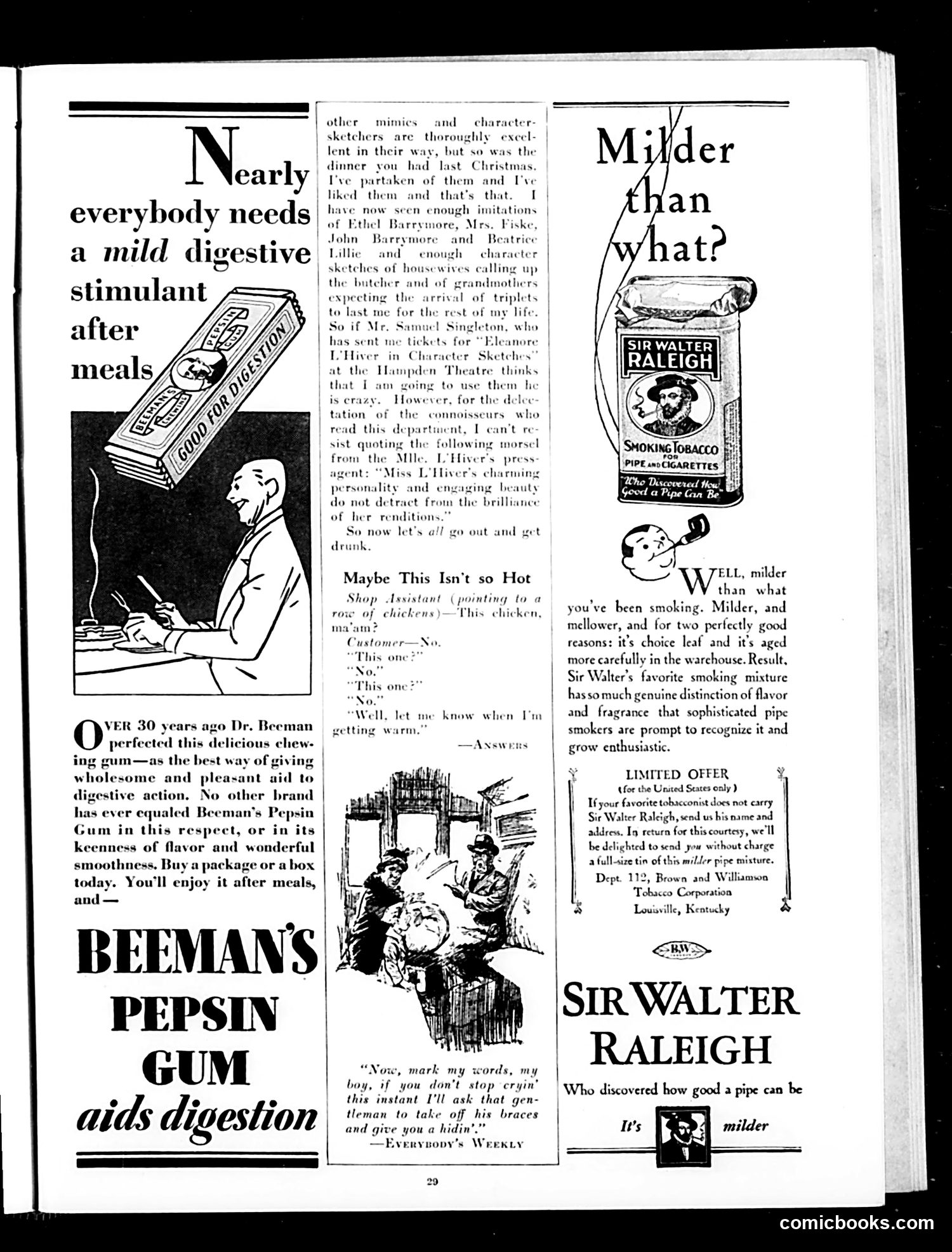
This page contains **three separate advertisements** rather than satirical cartoons. **Left side:** Beeman's Pepsin Gum ad features a digestive aid pitch claiming superiority over competitors. The accompanying cartoon shows a man at a desk, likely referencing Dr. Beeman's supposed 30-year-old formula. **Center:** A brief joke about a shop assistant and customer arguing over chicken selection—unrelated advertising filler typical of the era. **Right side:** Sir Walter Raleigh smoking tobacco advertisement, the dominant ad. It emphasizes the product as "milder" than competitors, highlighting aged leaf and "choice" quality. Includes a limited promotional offer for pipe mixture samples. The page demonstrates how early 20th-century Judge magazine mixed editorial content with advertising revenue. None of these ads contain political satire—they're straightforward product promotions using period-typical claims about digestive aids and tobacco quality that would be heavily regulated or banned today.
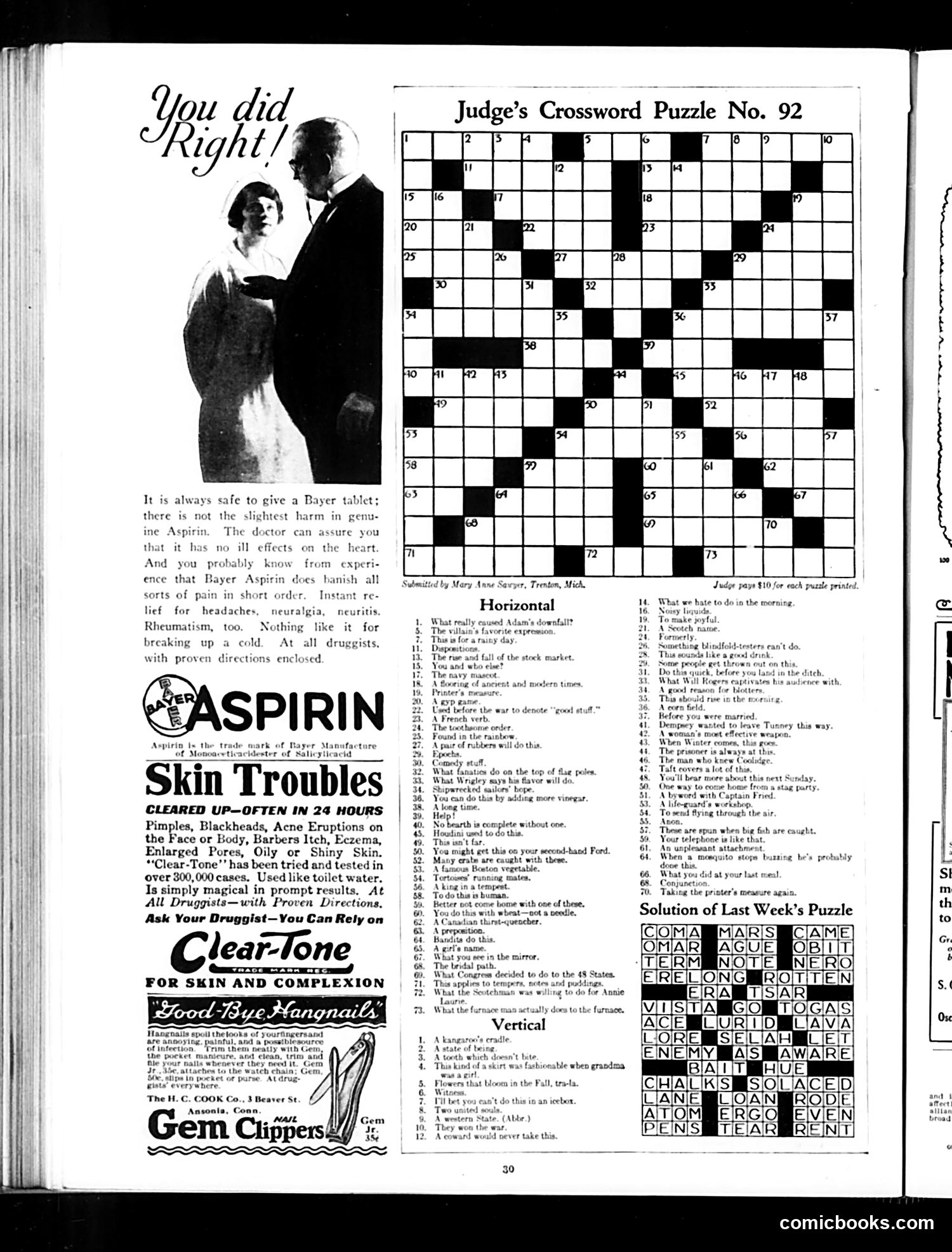
This is primarily a **advertising and puzzle page**, not a political cartoon. The page features: **Main Content:** - A small illustration titled "You did Right!" showing a couple, accompanying an Bayer Aspirin advertisement emphasizing the safety and effectiveness of aspirin for various ailments (headaches, rheumatism, colds) - A "Clear-Tone" skin treatment advertisement claiming to cure acne, pimples, and eczema in 24 hours - A "Gem Clippers" advertisement for nail clippers - **Judge's Crossword Puzzle No. 92** with horizontal and vertical clues - The solution to the previous week's puzzle **Historical Context for Modern Readers:** This reflects early 20th-century advertising before strict FDA regulations. Claims about aspirin's universal safety and "Clear-Tone" curing skin conditions in 24 hours would be illegal today. The ads target common complaints and position products as miracle solutions—typical of the era's largely unregulated patent medicine marketing.
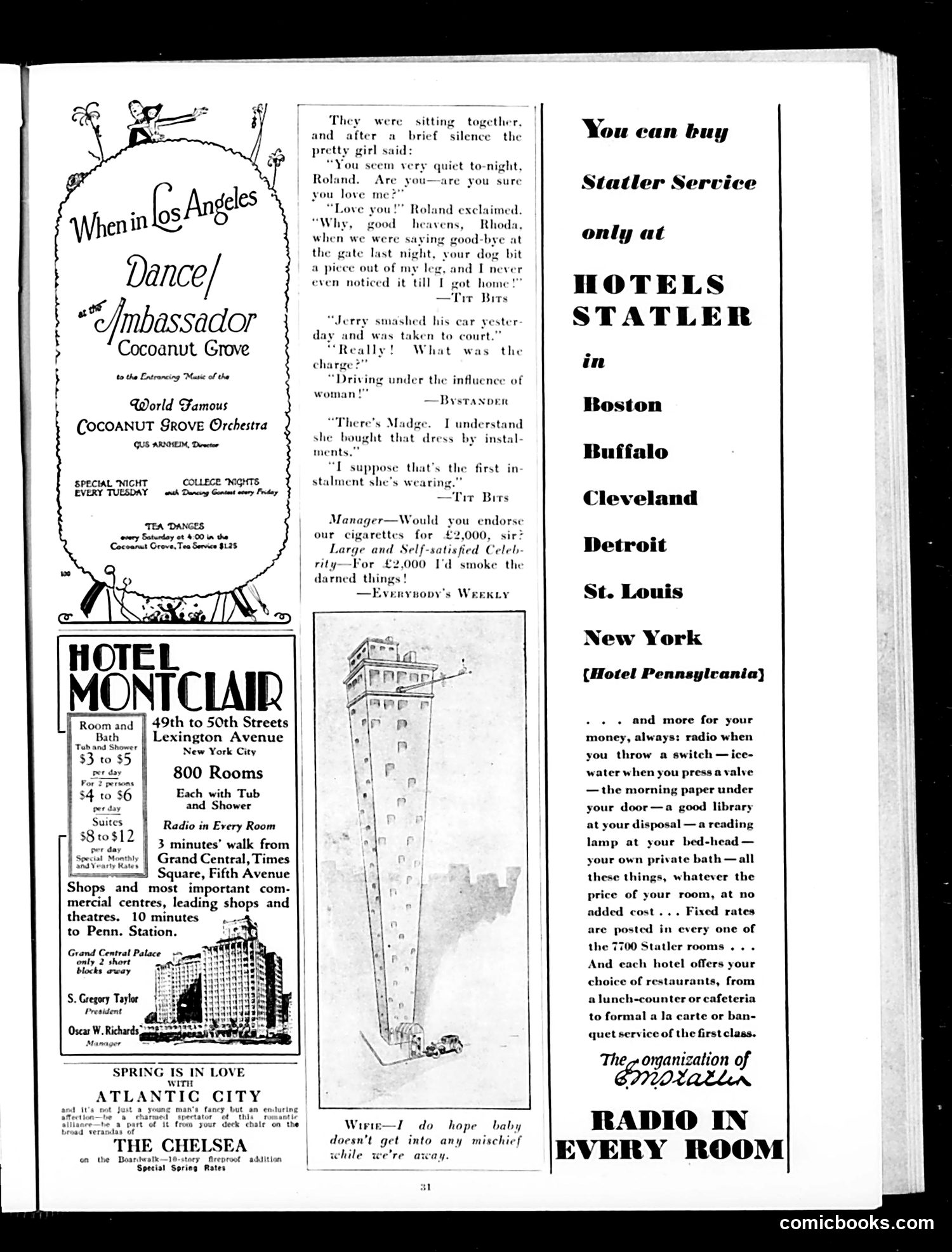
This page is primarily **advertising**, not satirical cartoons. The layout features hotel and entertainment promotions from what appears to be the 1920s-1930s era. The left side advertises the **Ambassador Cocoanut Grove**, a dance venue in Los Angeles featuring the "Cocoanut Grove Orchestra" under conductor Gus Arnheim—a real, popular jazz venue of that era. It also promotes the **Hotel Montclair** in New York (800 rooms with "Radio in Every Room"—then a luxury amenity). The right side advertises **Hotels Statler**, a chain emphasizing modern conveniences: radios, ice water on demand, private bathrooms, and morning newspapers—features that represented cutting-edge hospitality at the time. The scattered jokes and brief stories in the center (about romance, car accidents, installment purchases) are filler content typical of Judge magazine, offering light humor rather than political satire. The "Wife" cartoon at bottom makes a mild domestic joke.
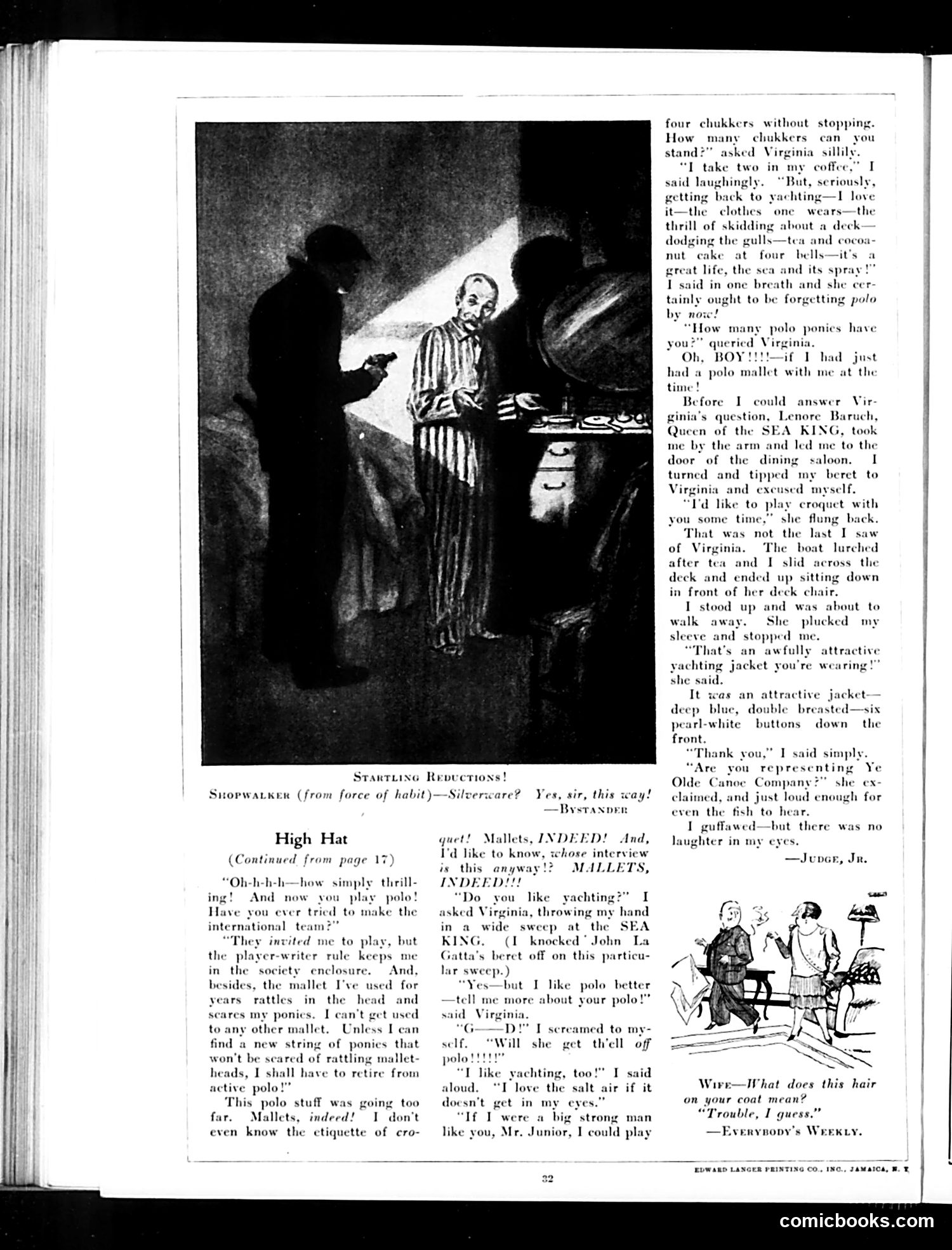
This is a humorous narrative story (not a political cartoon) from *Judge* magazine titled "High Hat," satirizing social pretension among the wealthy elite. The unnamed male narrator, a guest on a yacht called the SEA KING, is repeatedly buttonholed by a woman named Virginia who obsessively asks about polo—a sport associated with the ultra-rich. He attempts to discuss yachting, but she keeps redirecting conversation back to polo and his polo ponies, frustrating him deeply. The satire targets: - **Social climbing**: Virginia's fixation on polo signals her desperation to appear part of high society - **One-track snobbery**: Her inability to discuss anything but polo reveals shallow social awareness - **Class anxiety**: The narrator's irritation suggests even wealthy people find polo-obsession tiresome The cartoon below illustrates a related joke: a woman asking about mysterious hair on a man's coat; his answer "Trouble, I guess" suggests he's been caught in a compromising situation—typical *Judge* humor about marital indiscretion.
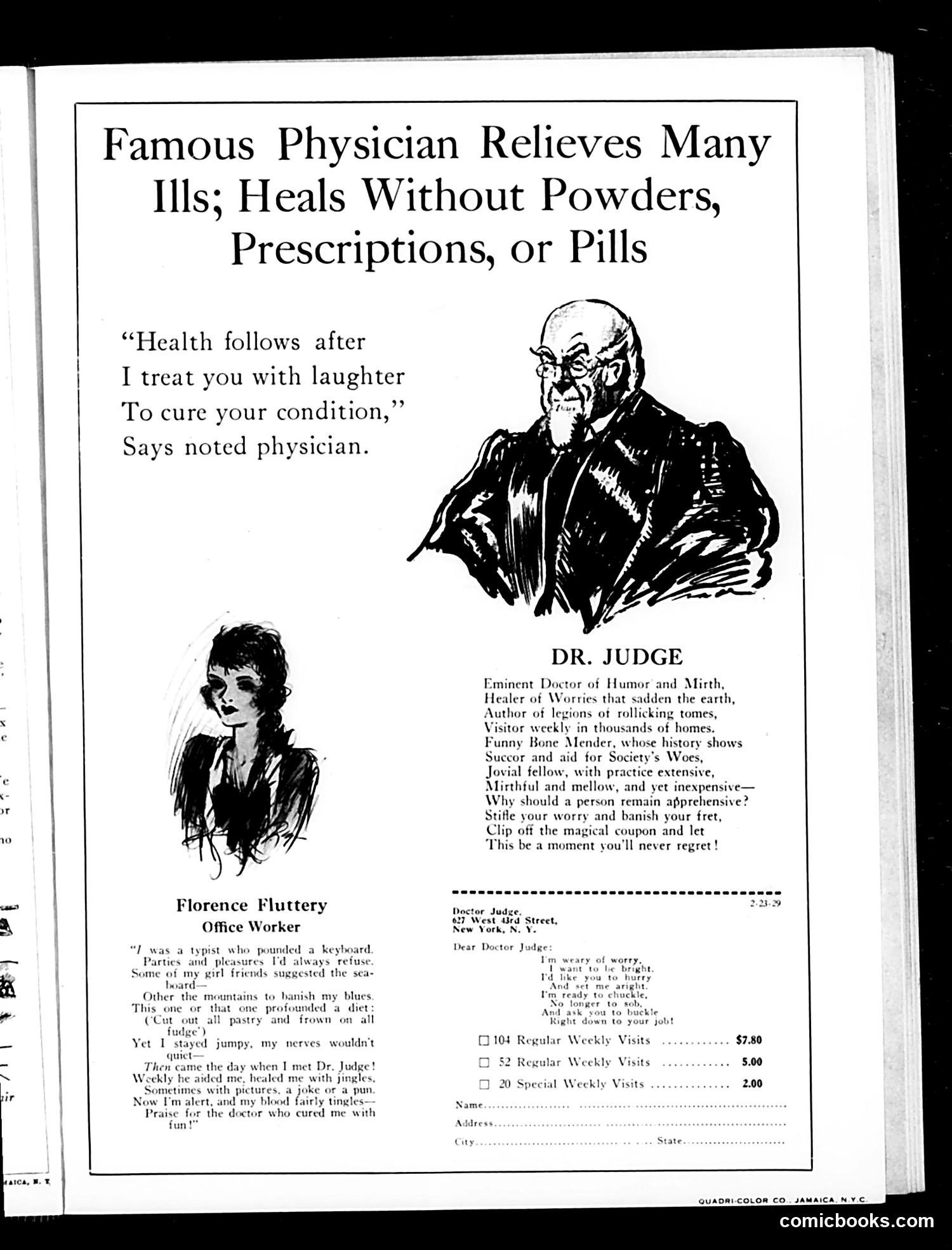
This is a full-page advertisement for *Judge* magazine itself, disguised as satirical content. The page promotes a subscription by personifying the magazine as "Dr. Judge," a physician who heals ailments through humor and laughter rather than medicine. The satire plays on early 20th-century quack medicine advertising—the exaggerated claims of miraculous cures without pills or prescriptions. Here, *Judge* ironically positions itself as the cure, claiming its humorous content relieves worry, nervousness, and melancholy. The testimonial from "Florence Fluttery," an office worker cured of anxiety through reading the magazine's jokes and pictures, reinforces this mock-medical pitch. The subscription rates listed at bottom ($7.80 for 104 weekly visits, etc.) complete the parody by treating magazine subscriptions like medical treatment plans. The joke: *Judge* is literally advertising itself as medicine for modern anxieties—implying satire and humor are therapeutic, while simultaneously mocking both medical hucksterism and readers' desperation for relief.
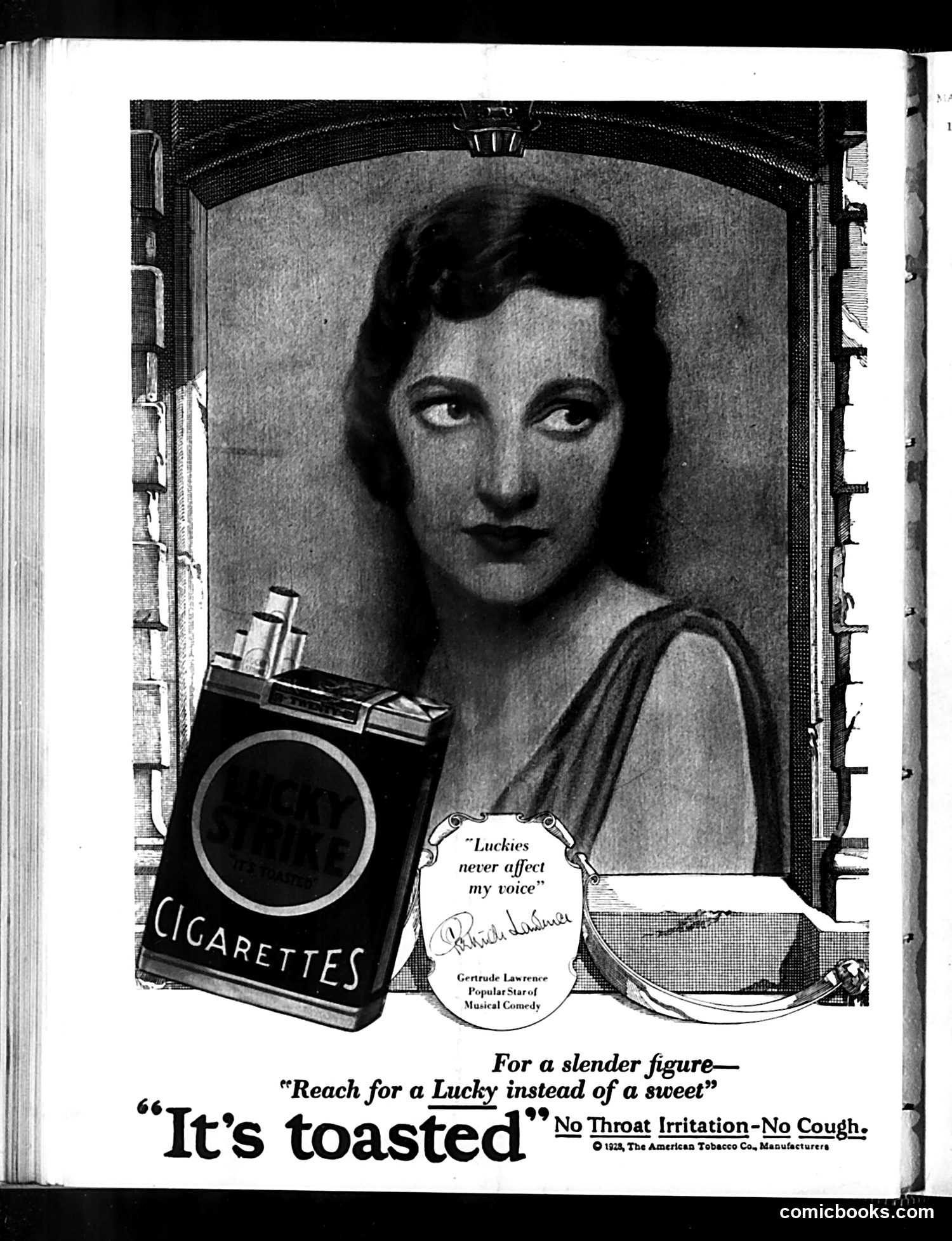
This is a cigarette advertisement, not satire or political content. It features a woman identified as "Gertrude Lawrence" (visible signature), described as a "Popular Stage Musical Comedy" performer. The ad promotes Lucky Strike cigarettes with two marketing claims: that smoking won't damage one's voice (important for a stage performer) and that cigarettes are a diet aid—"Reach for a Lucky instead of a sweet" to maintain "a slender figure." This represents a historical advertising approach now recognized as deeply problematic: linking cigarettes to health benefits, weight control, and professional success. The endorsement by a recognizable entertainment figure was a common marketing tactic. Such claims are now illegal in cigarette advertising.