
A complete issue · 36 pages · 1926
Judge — May 1, 1926
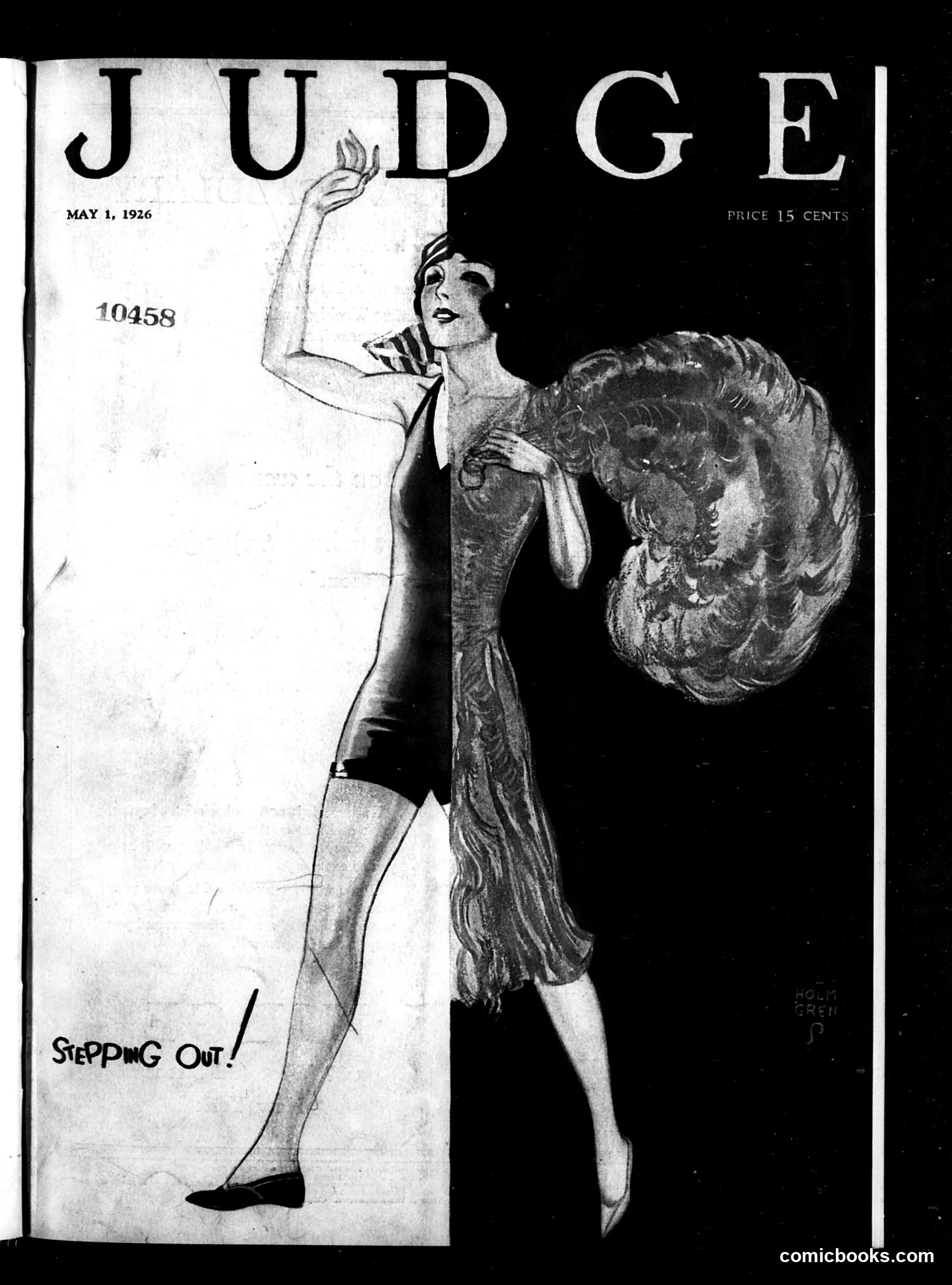
This May 1, 1926 Judge magazine cover depicts a woman in fashionable 1920s attire—short hemline, decorative wrap, and cloche hat—striking a dynamic pose with one arm raised. The caption reads "Stepping Out!" The image celebrates the modern "flapper" woman of the Jazz Age. The figure's exposed legs, active posture, and glamorous styling represent the New Woman of the 1920s who challenged Victorian conventions through shorter skirts, bobbed hair, and increased social freedom. "Stepping Out" likely references both literal dancing/nightlife participation and metaphorical social liberation. The ornate wrap she holds suggests luxury and sophistication. This cover reflects Judge's satirical take on contemporary social changes—simultaneously celebrating and gently mocking the era's dramatic shifts in women's fashion and behavior.
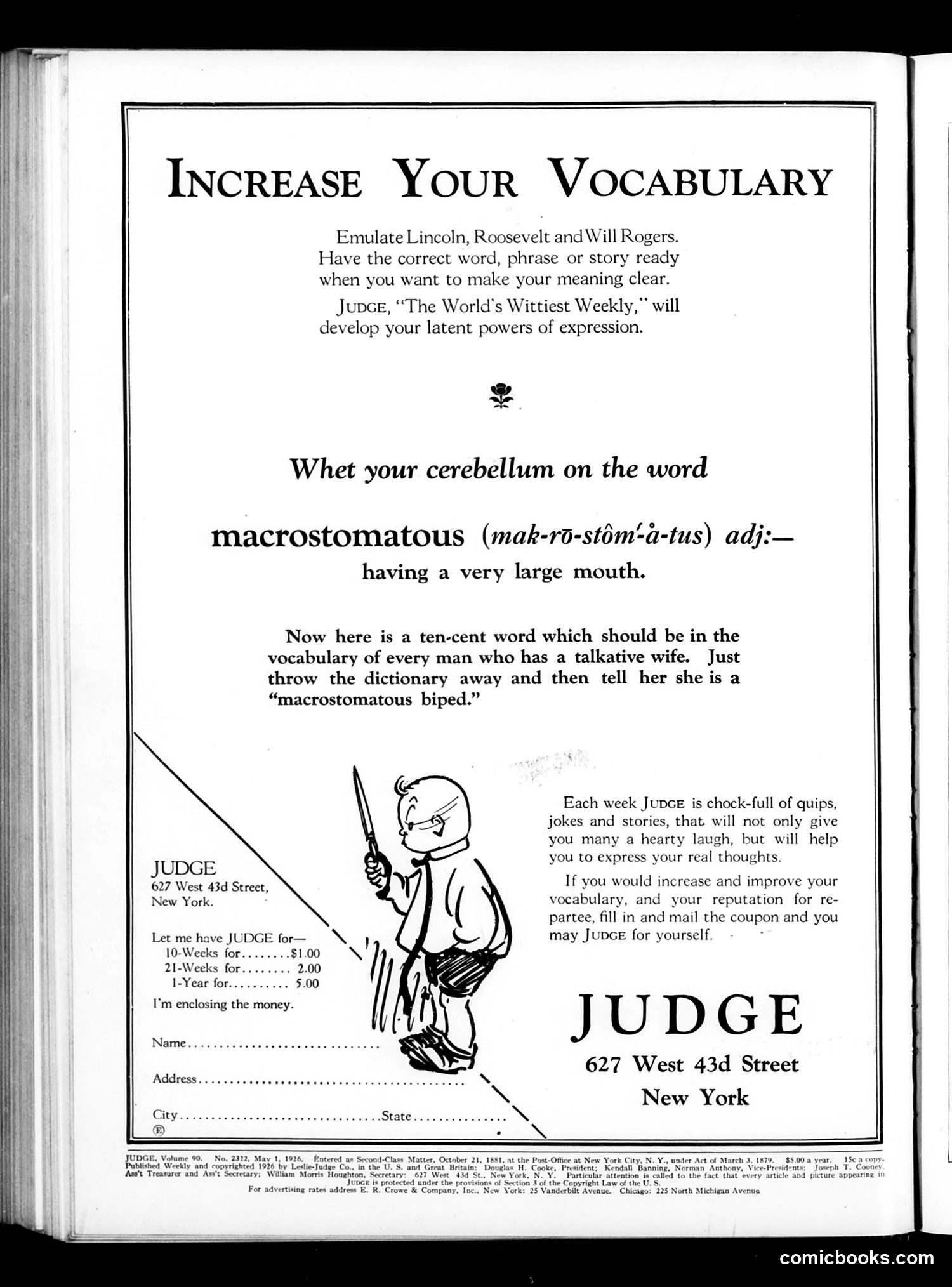
This page is primarily an **advertisement for Judge magazine's subscription service**, not political satire. The content teaches readers a vocabulary word—"macrostomatous" (having a very large mouth)—and includes a humorous application: the suggestion that men with talkative wives should call them "macrostomatous bipeds." The illustration shows a **cartoonish figure wielding a sword or knife**, likely representing a frustrated husband, implying marital conflict over excessive talking. This reflects early 20th-century domestic humor stereotypes common in American magazines. The ad promotes Judge's weekly content featuring "quips, jokes and stories" designed to entertain readers while expanding their vocabulary and "powers of expression." Subscription prices range from $1.00 for 10 weeks to $5.00 annually.
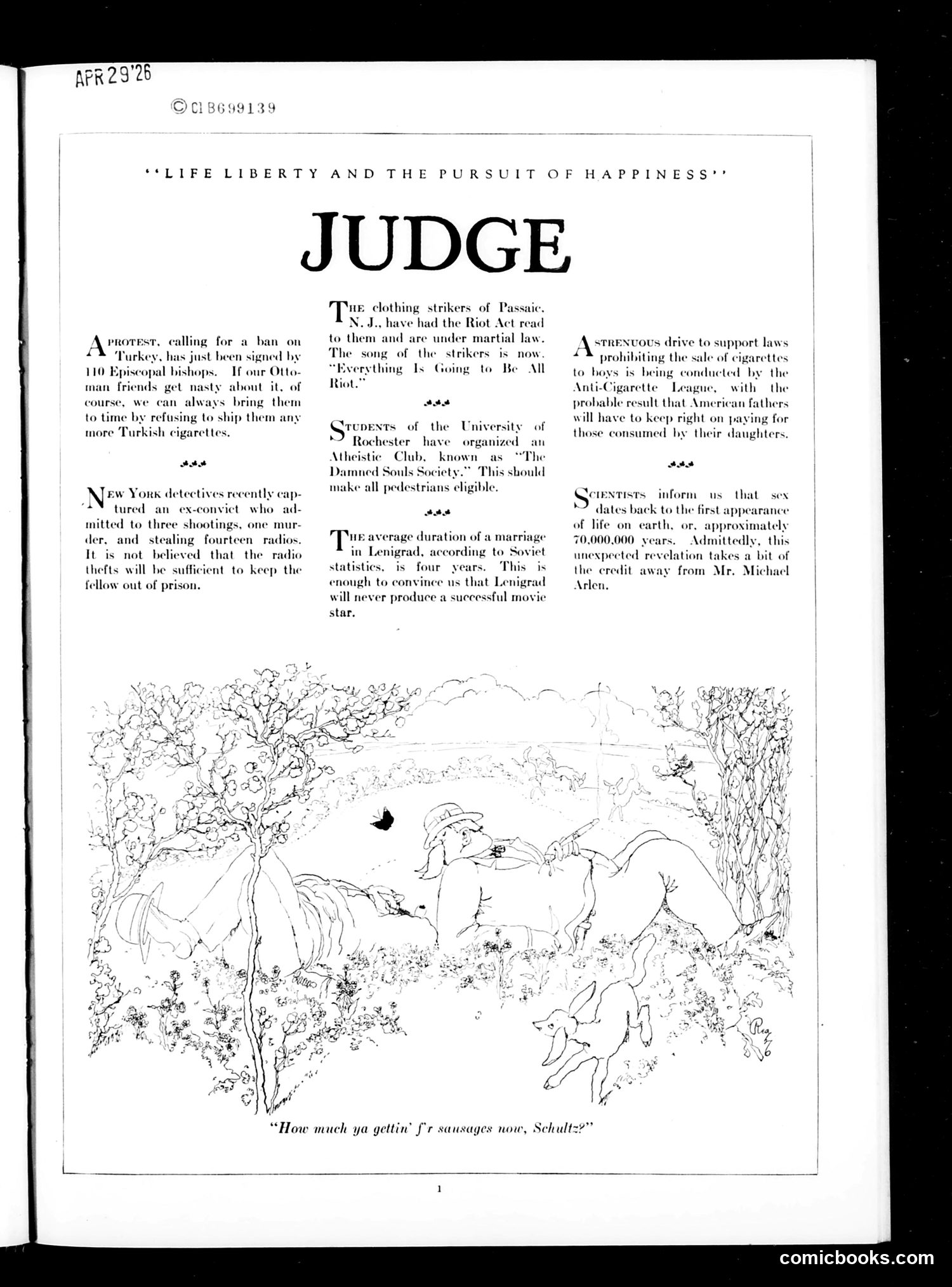
This Judge magazine page contains several brief satirical items and a cartoon. The main topics are: **Content items:** - A jab at Turkish cigarette importers and an Ottoman protester - Mockery of Rochester University's "Atheistic Club" (called "The Damned Souls Society"), suggesting it would make pedestrians eligible [for something—the joke is unclear] - A police note about a captured ex-convict and radio thefts - Commentary on Soviet marriage statistics in Leningrad, sarcastically claiming the short four-year average duration proves Leningrad won't produce successful movie stars - A claim that sex originated 70 million years ago, crediting Michael Arlen (likely a contemporary writer being satirized) **The cartoon** shows a rural/farm scene with anthropomorphic animals and someone asking "How much ya gettin' fr sausages now, Schultz?" The humor appears to involve dark implications about the fate of farm animals. The page dates to **April 29, 1926**.
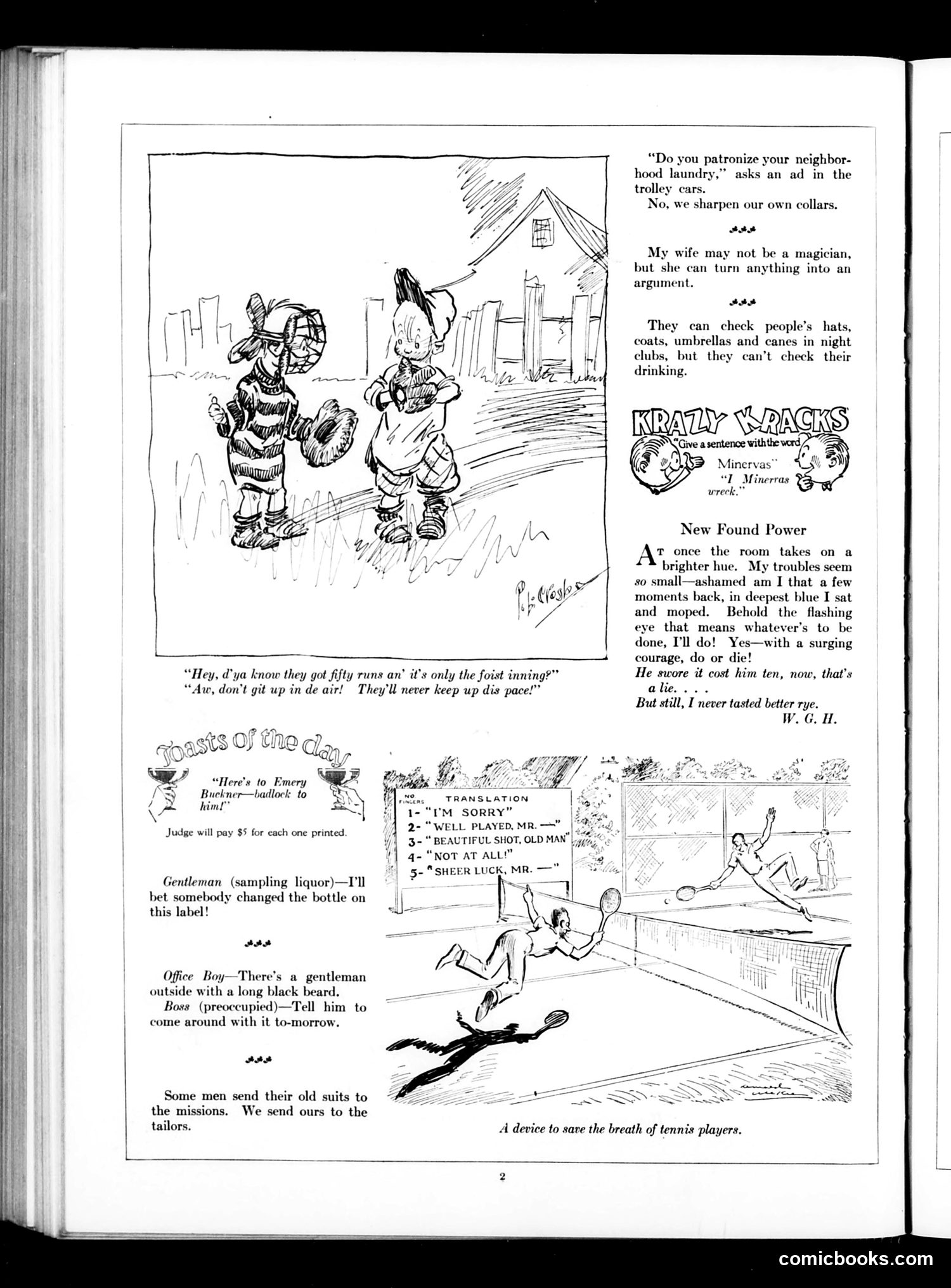
This page contains several humor pieces typical of Judge magazine's satirical style. **Top cartoon**: Two characters discuss baseball's "fifty runs" in "the foist inning"—using exaggerated working-class dialect ("foist" for "first"). The joke mocks both poor grammar and implausibly high baseball scores. **"Krazy Khacks"**: A brief wordplay section playing on the word "Minervas" (likely referencing Minerva, goddess of wisdom). **"New Found Power"**: A poem about someone gaining confidence and newfound determination, using somewhat melodramatic language typical of period humor. **"Costs of the Day"**: Jokes about everyday expenses and social observations—one about changing liquor bottle labels, another about a bearded gentleman, and commentary on sending worn clothing to tailors versus missions. **Bottom cartoon**: Depicts tennis players with a "translation" key of German exclamations, satirizing foreign athletes or the popularity of tennis among certain social groups.
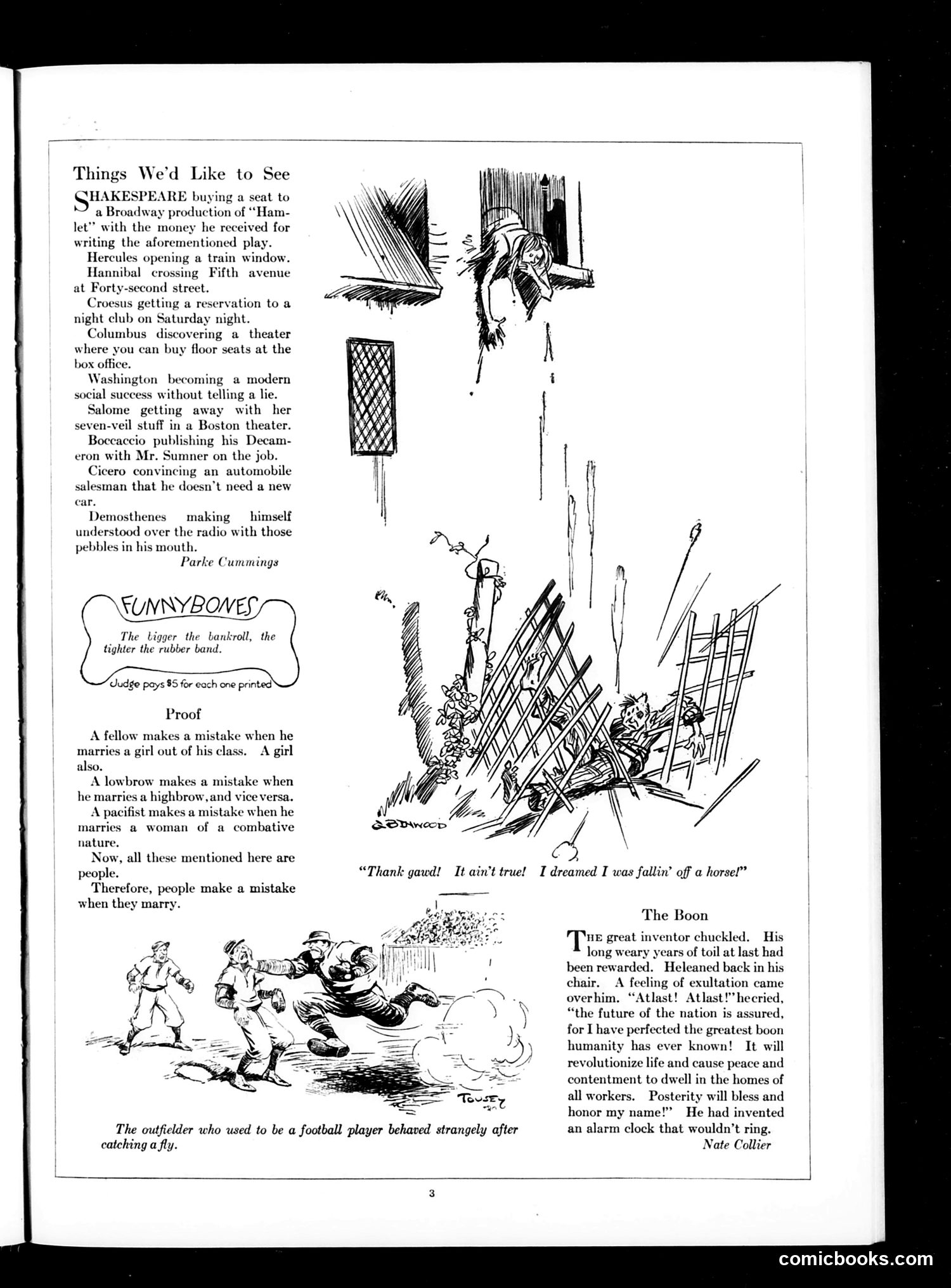
This page contains several unrelated humor pieces rather than a unified political cartoon. **"Things We'd Like to See"** lists satirical wishes (Shakespeare buying Broadway seats, Hercules opening train windows), mocking contemporary urban frustrations. **"Funny Bones"** presents a visual joke about tight bankrolls and rubber bands. **"Proof"** is a logical wordplay piece about who makes mistakes when marrying. **The baseball illustration** shows an old football player behaving oddly after catching a fly—a sports humor joke about confusion between games. **"The Boon"** tells of an inventor celebrating his "greatest" invention: an alarm clock that won't ring—satirizing impractical innovations claiming to improve workers' lives. The page demonstrates Judge's mixed approach: combining social satire with lighthearted wordplay and visual gags.
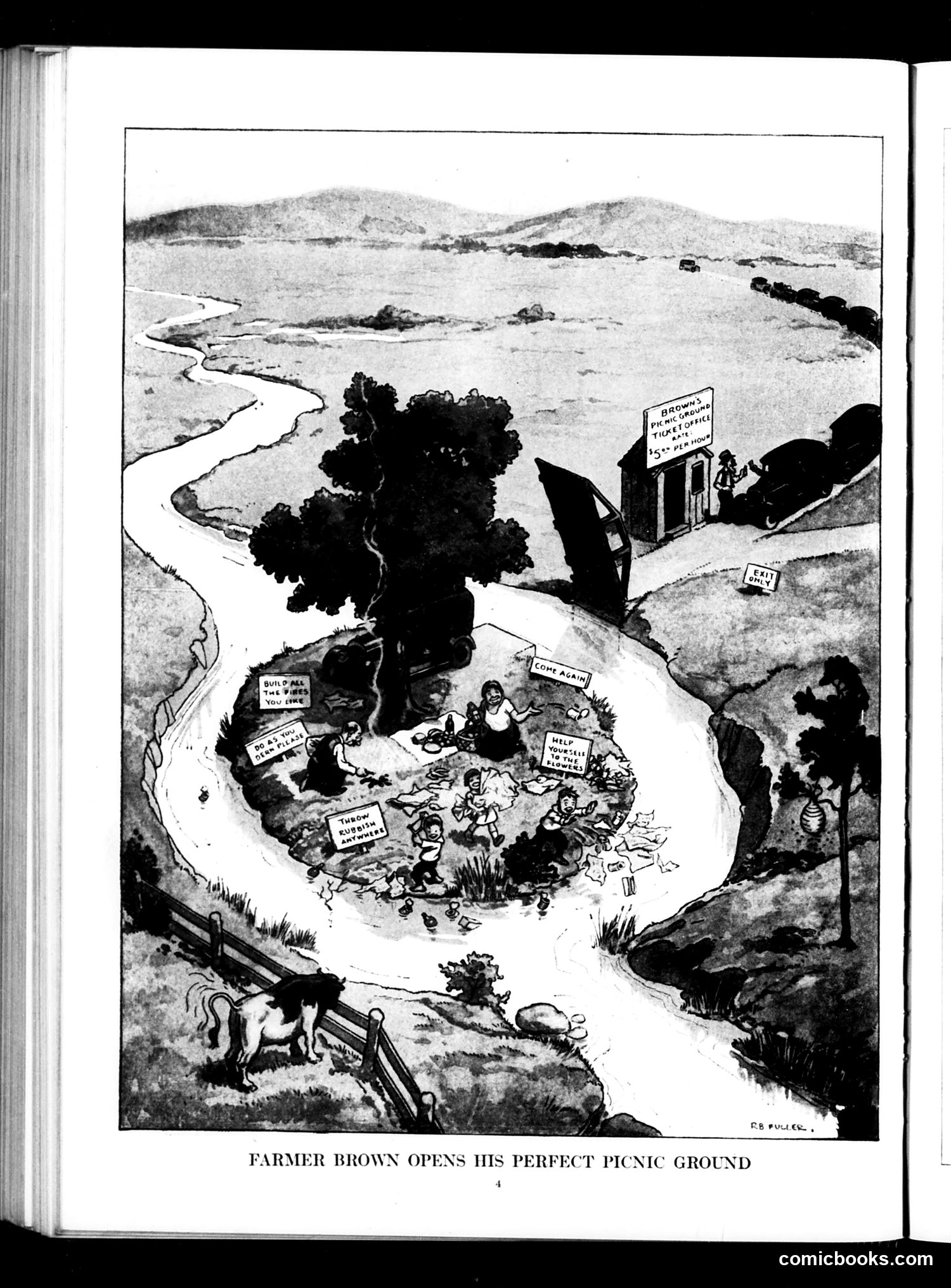
This appears to be a satirical cartoon depicting a farmer who has opened his land as a public picnic area. The image shows numerous visitors enjoying themselves around a tree near a winding stream, with signs indicating various attractions or amenities the farmer has provided. The satire likely critiques either the commercialization of rural spaces or the chaos that ensues when farmers attempt to profit from public recreation. The scattered crowds, multiple signage, and somewhat chaotic composition suggest the farmer's well-intentioned effort has resulted in overcrowding and disorder rather than the "perfect" picnic ground promised by the title. Without clearer text on individual signs, the specific targets remain unclear, but the cartoon satirizes rural enterprise and leisure culture.
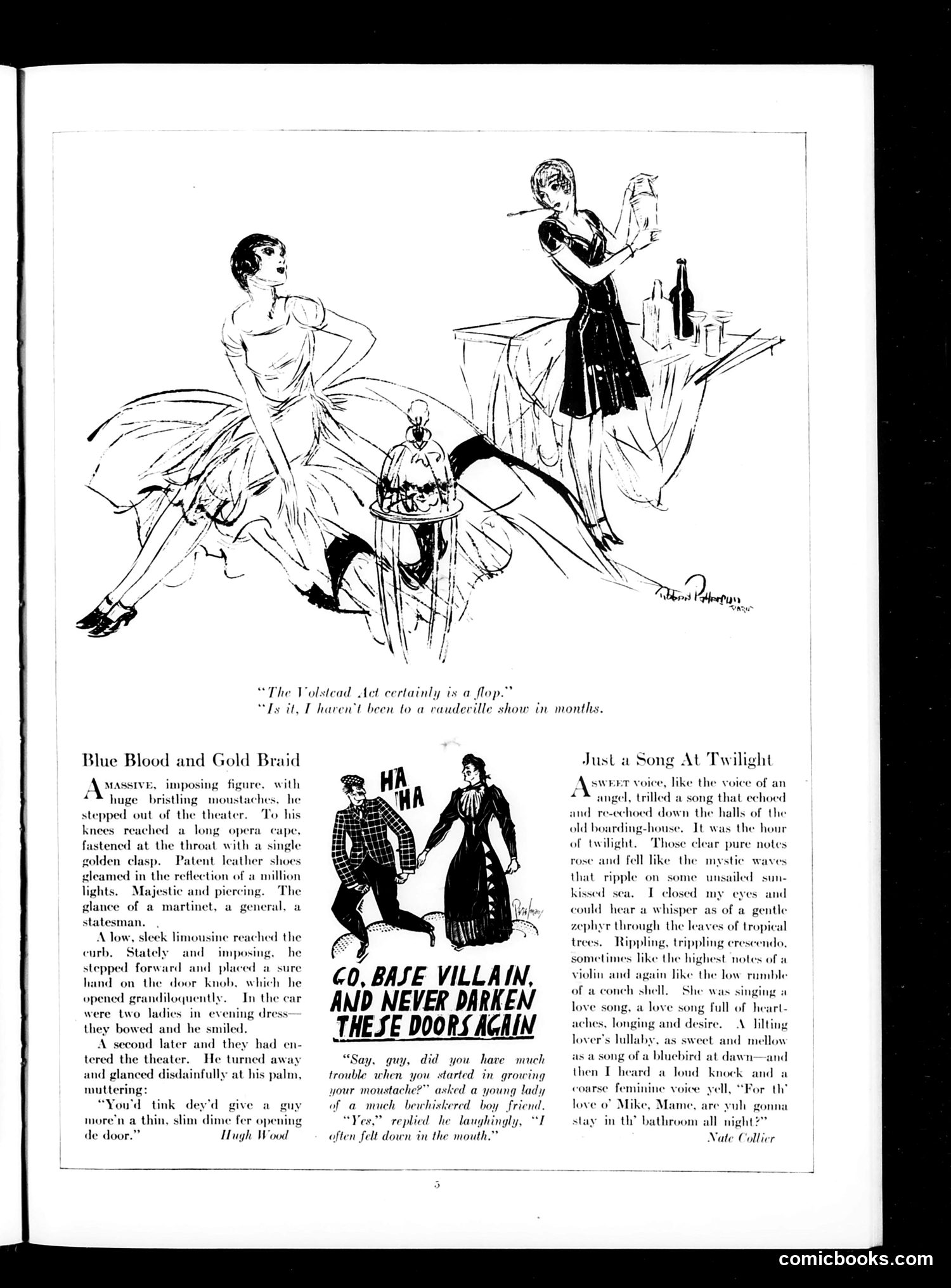
This page contains theater reviews and satirical commentary typical of Judge's entertainment coverage. The top cartoon mocks a theatrical production called "The Vaudeville Act," suggesting it's a flop and the reviewer hasn't attended a vaudeville show in months—a jab at the show's quality or relevance. Below are two reviews: "Blue Blood and Gold Braid" criticizes an overly imposing lead actor and a slow-moving plot, with Hugh Wood sarcastically suggesting the theater owner should charge admission just to watch patrons leave. "Just a Song At Twilight" praises a female performer's angelic voice, describing her singing as transportive and romantic—a stark contrast to the negative review above. The page represents Judge's function as a satirical entertainment arbiter, mixing genuine critique with comedic barbs aimed at theatrical productions of the era.
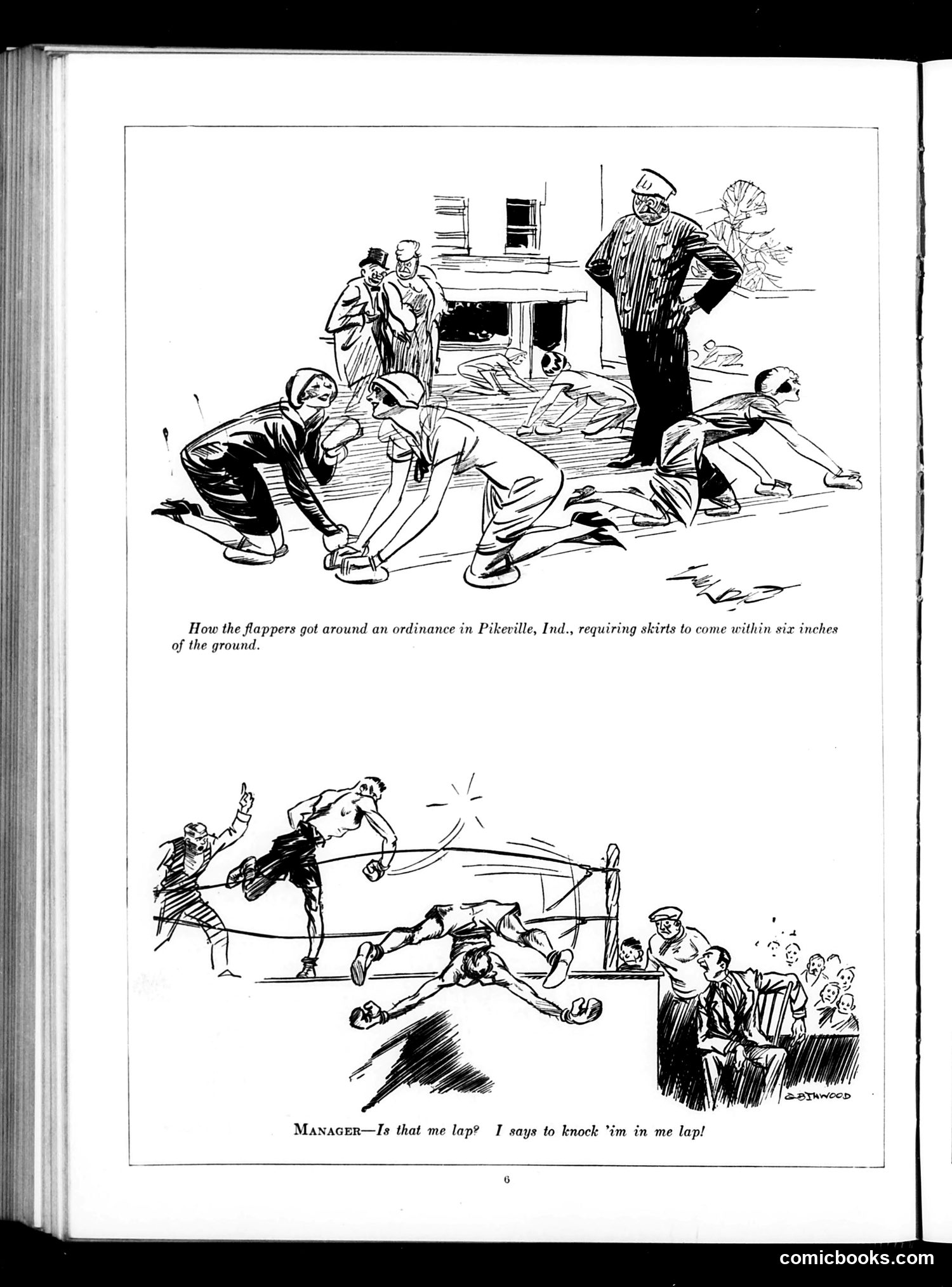
This page contains two satirical cartoons about 1920s "flappers"—young women known for defying social conventions through shorter skirts and modern behavior. **Top cartoon:** Depicts women in Pikeville, Indiana circumventing a local ordinance requiring skirts to be within six inches of the ground. The women are shown crawling or crouching to comply technically while exposing their legs—mocking both the restrictive law and the flappers' creative defiance. **Bottom cartoon:** Shows a boxing scene where a manager shouts "Is that me lap? I says to knock 'im in me lap!"—apparently depicting a female boxer, further satirizing flappers as women abandoning traditional femininity for masculine activities. Both cartoons express *Judge* magazine's satirical commentary on the cultural clash between conservative communities enforcing dress codes and the emerging liberated "flapper" generation rejecting those restrictions.
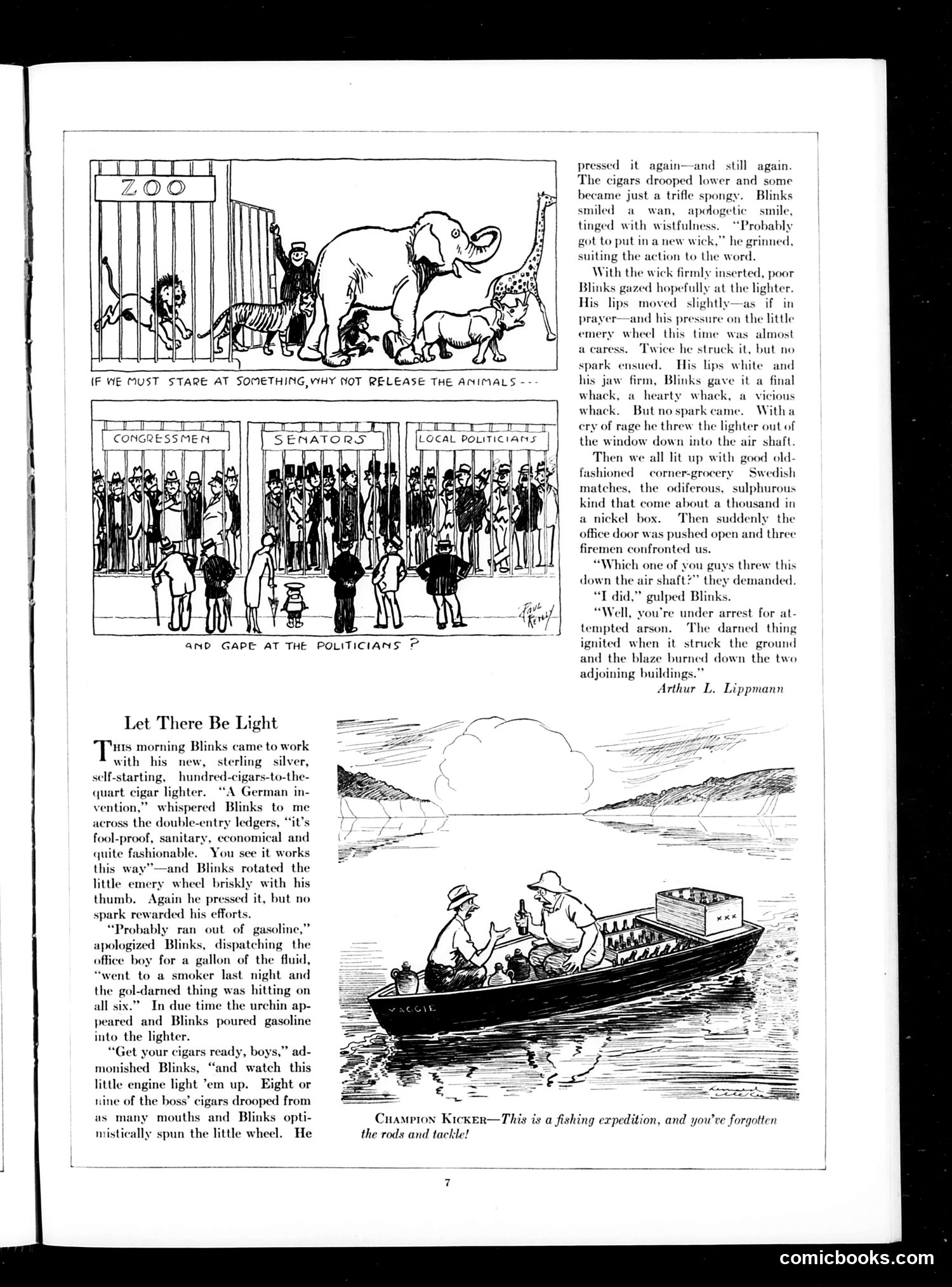
This page contains two distinct pieces: **Top cartoon**: A two-panel satirical commentary on politics. The first panel shows a zoo with the caption "IF WE MUST STARE AT SOMETHING, WHY NOT RELEASE THE ANIMALS?" The second panel depicts caged crowds labeled "CONGRESSMAN," "SENATORS," and "LOCAL POLITICIANS," with the caption "AND GAPE AT THE POLITICIANS?" The satire equates politicians with dangerous animals—suggesting they're less worthy of public attention than actual zoo creatures, or conversely, that politicians deserve to be caged like beasts. This reflects public cynicism about political institutions. **Main story**: "Let There Be Light" by Arthur L. Lippmann is a comedic narrative about an office worker named Blinks whose faulty German cigar lighter malfunction becomes catastrophic—he throws it out a window, it ignites on impact, and burns down two adjacent buildings. He's arrested for arson. The humor derives from the gap between the lighter's advertised reliability ("fool-proof") and its dangerous failure, satirizing both overhyped consumer products and German engineering claims popular in the era.
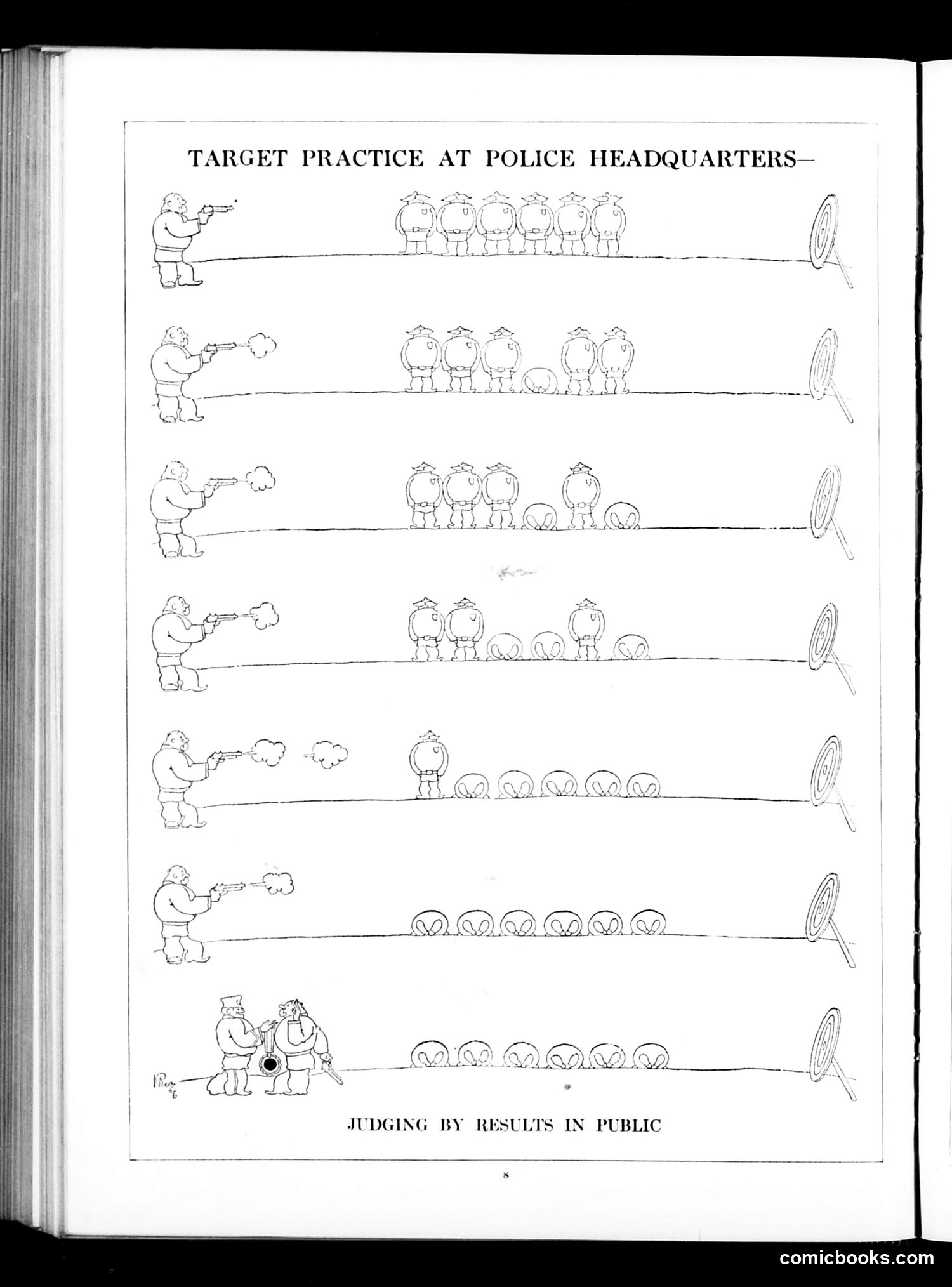
This political cartoon satirizes police marksmanship and public safety. The sequential panels show a police officer at a shooting range, progressively missing his target while innocent bystanders (represented as round-headed figures) are struck instead. The joke operates on two levels: it criticizes both police accuracy and the collateral damage of law enforcement practices. The subtitle "Judging by Results in Public" suggests the cartoon is commenting on actual police shooting incidents affecting civilians. The cartoon likely references early-20th-century concerns about police incompetence or recklessness in urban environments. By showing bystanders increasingly harmed while the intended target remains untouched, the cartoonist mocks police training and accountability—implying law enforcement cannot reliably distinguish targets and endanger the public they're meant to protect.
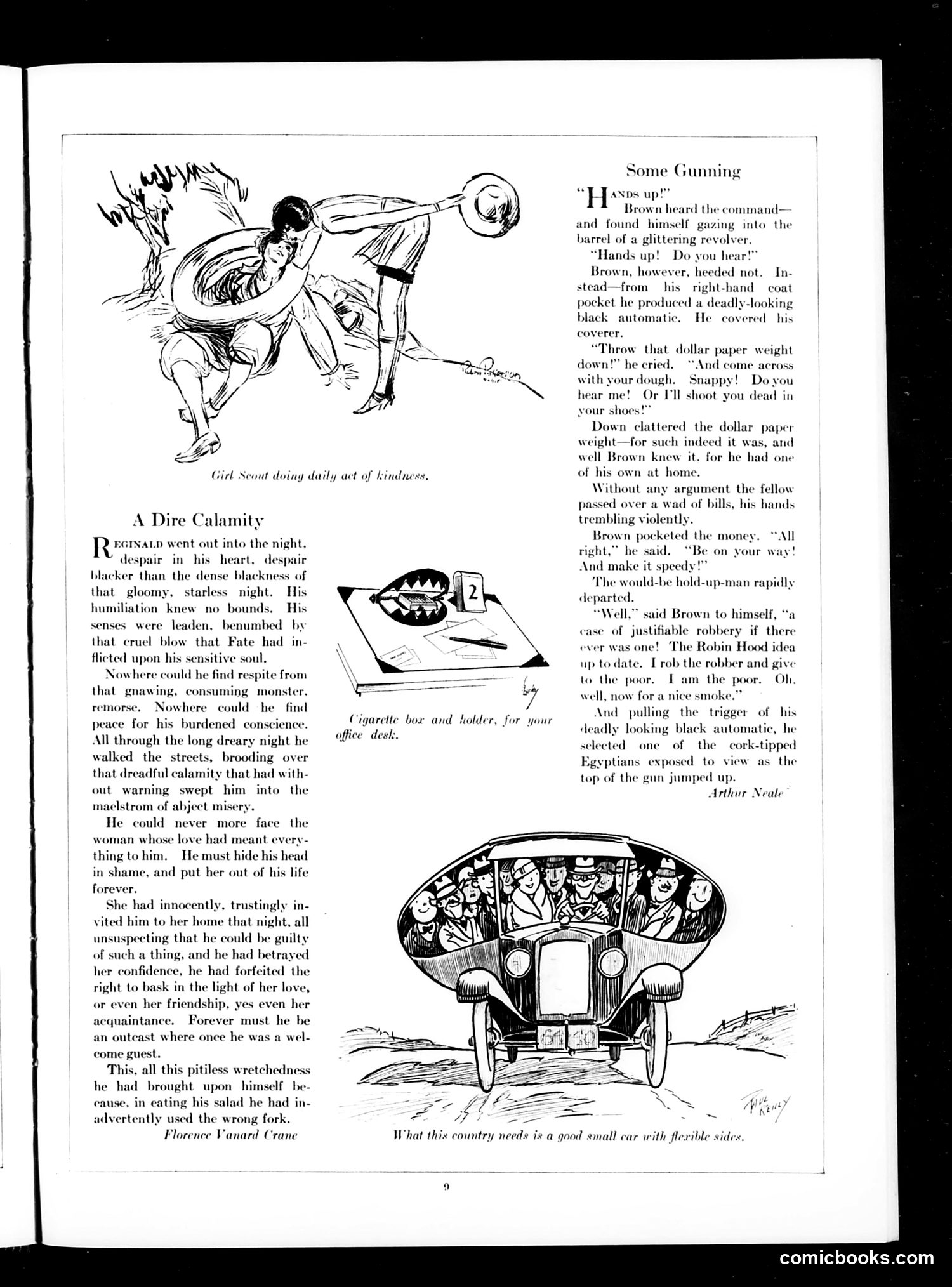
This page contains three separate pieces of satire from *Judge* magazine: 1. **"A Dire Calamity"**: A mock-tragic story by Florence Vanard Crane satirizing social anxiety and etiquette obsession. A man despairs because he committed a minor breach of dining etiquette—using the wrong fork at dinner—treating it as an irredeemable social catastrophe. This mocks the rigid formality and class consciousness of early 20th-century society. 2. **"Some Gunning"** by Arthur Neale: A comedic crime story where two armed robbers unknowingly confront each other. The twist: the "robber" Brown shoots is actually a gun-shaped cigarette lighter, and the "holdup man" intended the same. The satire mocks hold-ups and glorifies petty theft dressed up as Robin Hood-style "justice to the poor." 3. **Girl Scout illustration**: Shows humor in the earnest wholesomeness of Girl Scout activities. The humor relies on exaggeration, situational irony, and contemporary concerns about social propriety and urban crime.
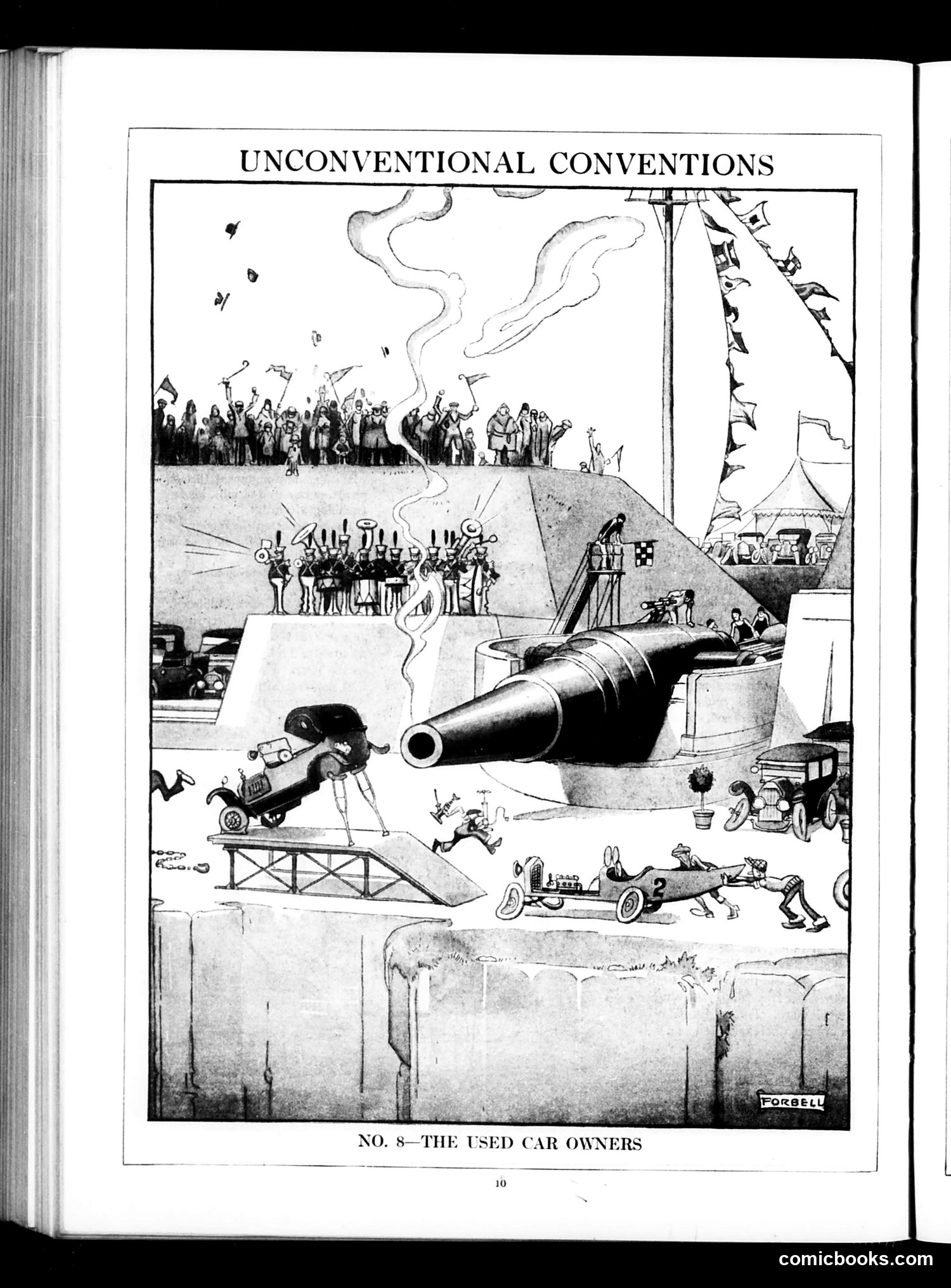
This satirical cartoon, titled "The Used Car Owners," depicts a chaotic military-style scene where used car dealers conduct an absurd "convention." The large cannon in the center appears to represent the aggressive sales tactics of used car dealers, while toy vehicles and mechanics scatter below in disarray. The satire mocks used car owners and dealers as unconventional, disorganized, and militaristic in their business practices. Crowds gather above, suggesting public spectacle. The "Unconventional Conventions" series header indicates this is one in a recurring feature satirizing different American groups. The joke targets the notorious reputation of used car salesmen for deceptive practices and high-pressure selling—a stereotype well-established by the early 20th century. The exaggerated military imagery humorously equates their business tactics with warfare.
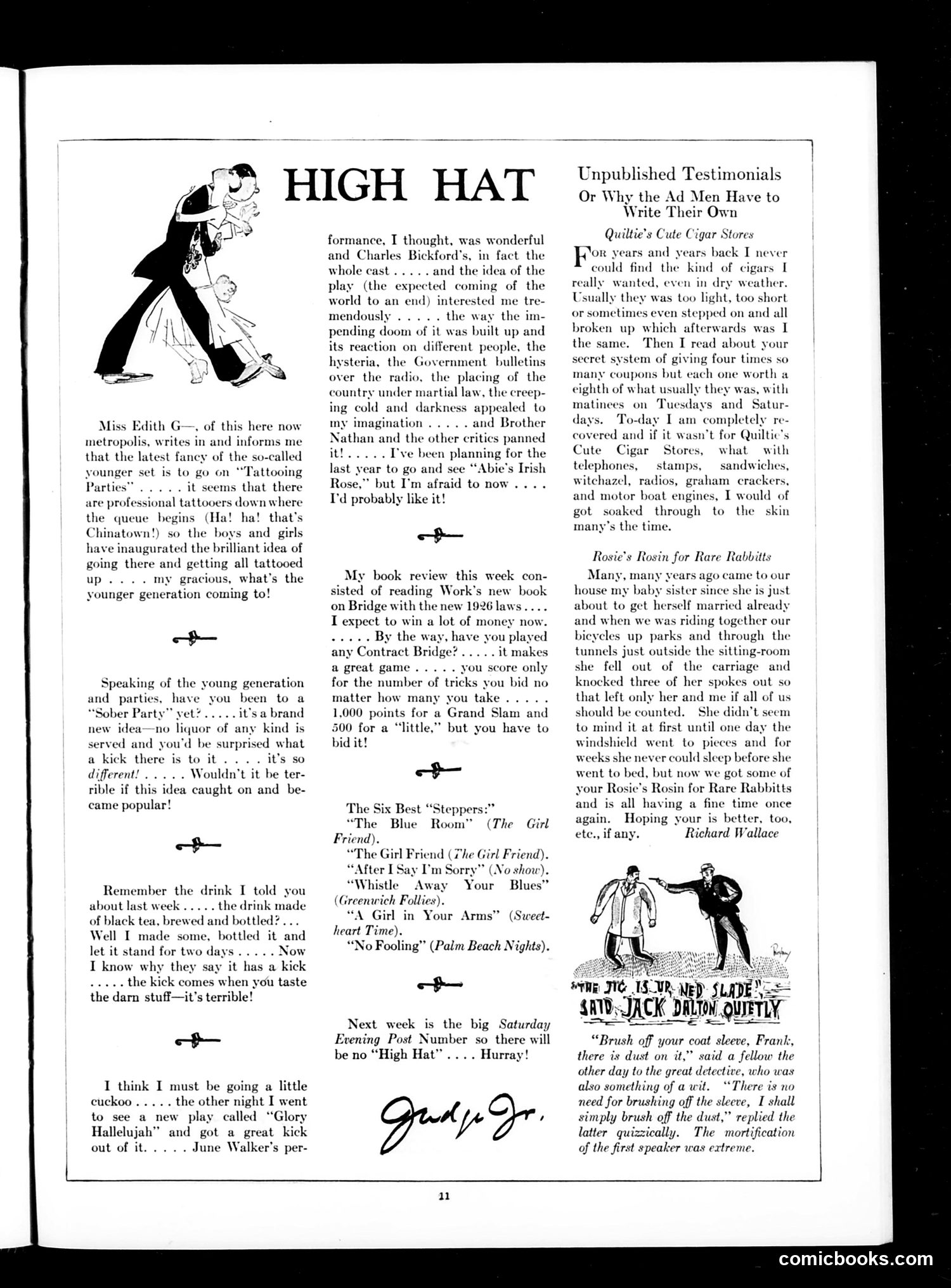
This is primarily a humorous gossip/opinion column rather than a political cartoon. The author satirizes 1920s youth culture and social trends: **Main targets:** - **Tattooing parties in Chinatown**: Mocks young people's fashionable slumming and adoption of exotic trends - **"Sober parties"**: Ironically criticizes Prohibition-era social events where no alcohol is served, presented as absurdly trendy - **Theater reviews**: Comments on the play "Hallelujah" (about apocalypse) and expresses frustration that critics ("Brother Nathan") dismissed it - **Bridge card game**: References new 1926 rule changes **The satire's point**: The "High Hat" column affects world-weary sophistication while chronicling how the younger generation chases frivolous fads. The fake testimonials below parody absurd advertising claims. The small illustration shows a couple in formal dress—typical 1920s social commentary imagery. The overall tone is affectionate mockery of Jazz Age excess and changing social mores.
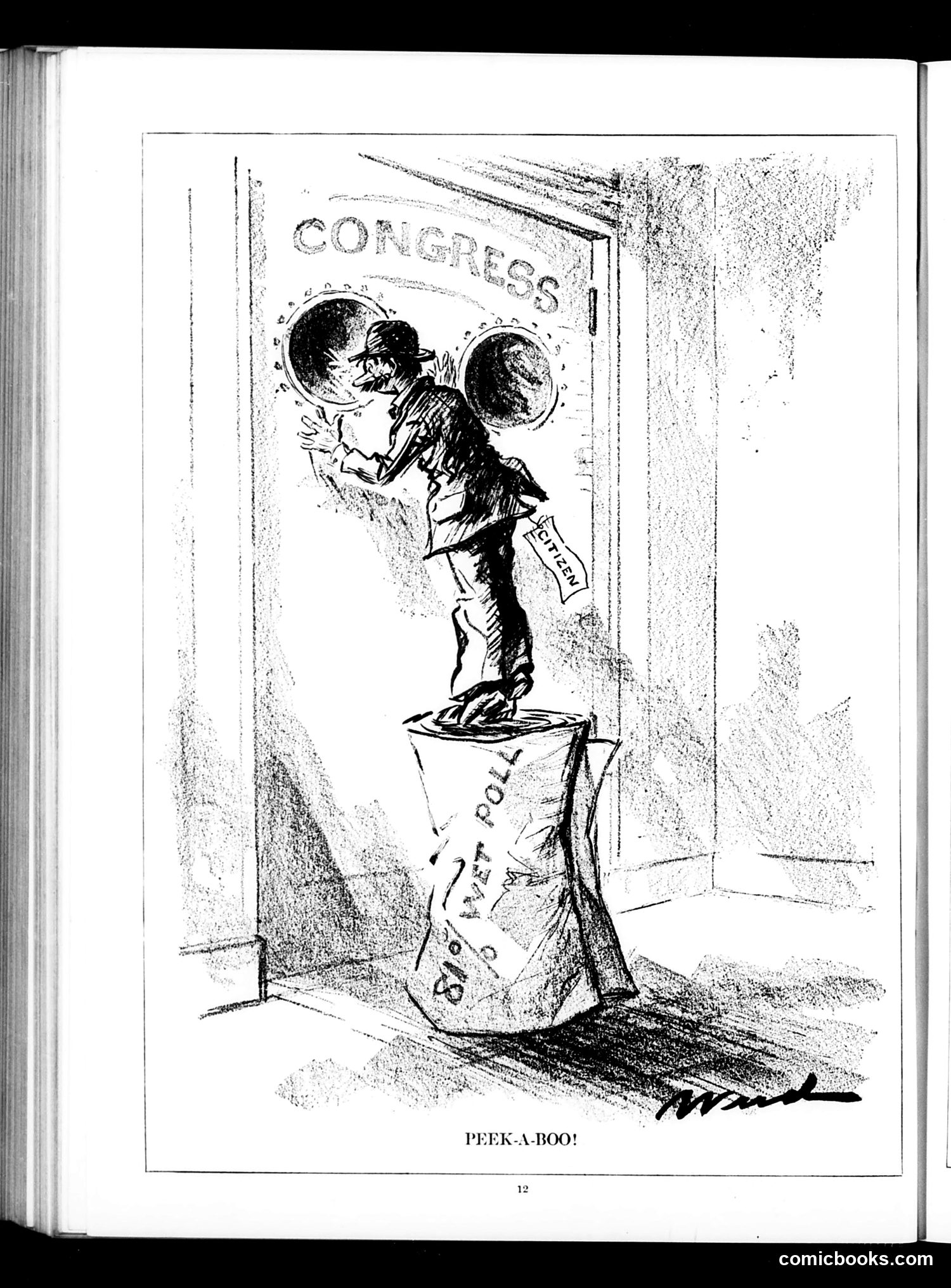
This cartoon depicts a figure emerging from a large pot labeled "BOILED DOWN CONGRESS," juggling two spheres labeled "CONGRESS." The pot sits within a doorway marked "CONGRESS." The satire appears to criticize Congress itself—specifically its tendency toward internal manipulation or self-referential politics. The "boiled down" imagery suggests Congress has been reduced to its essential, perhaps corrupt elements. The figure (likely representing a politician or political operator) juggling duplicate "Congress" spheres suggests either redundancy, circular reasoning, or a magician's trick meant to distract the public. The title "Peek-a-Boo!" implies the public is being deceived or shown illusions rather than genuine governance. This reflects common Judge magazine critiques of political theater and congressional dysfunction.
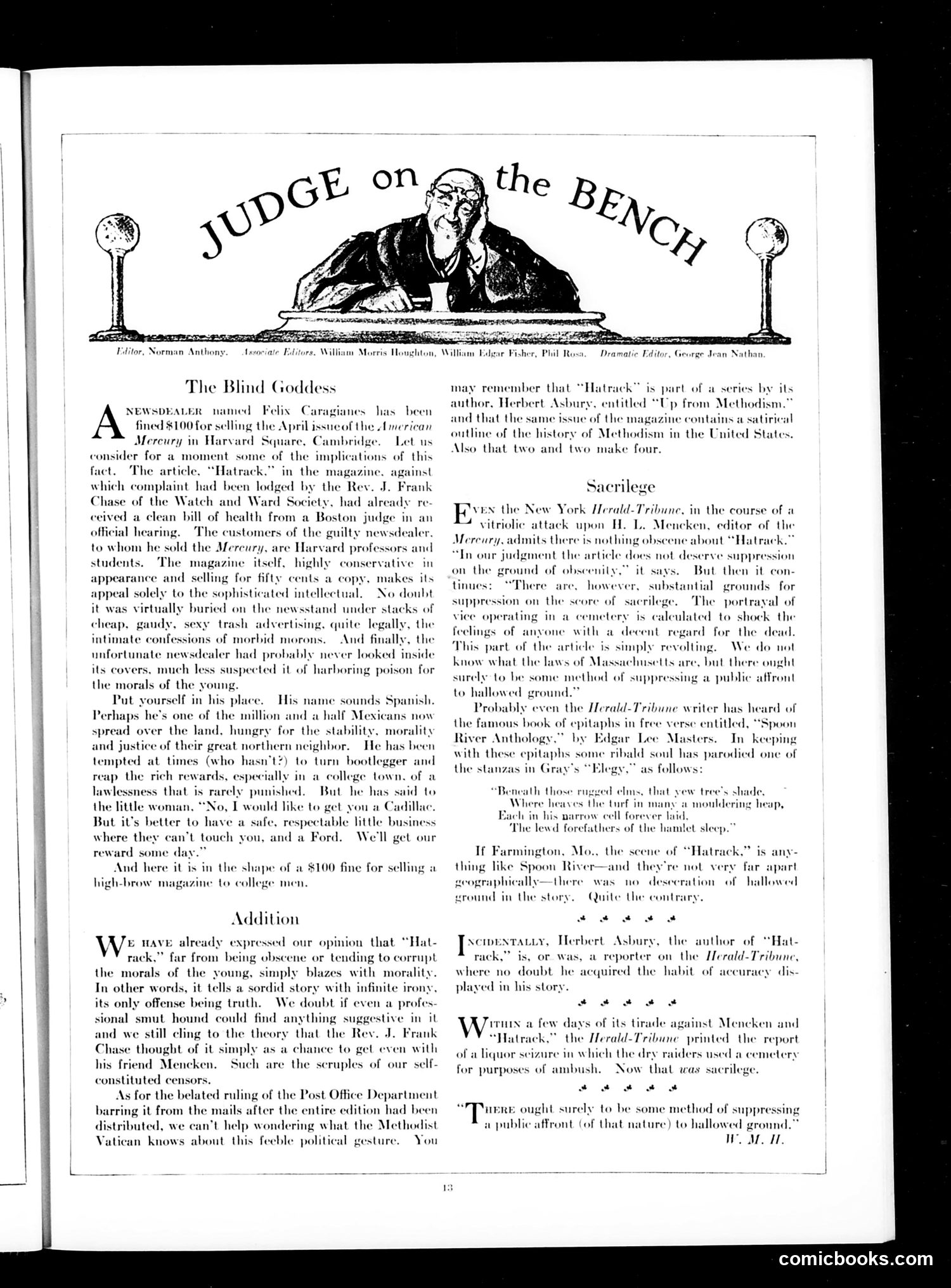
This page satirizes the censorship of H.L. Mencken's *American Mercury* magazine. In April, a Boston newsdealer named Felix Caragianes was fined $100 for selling the issue containing "Hatrack," a story by Herbert Asbury about a prostitute. The article had offended Rev. J. Frank Chase of the Watch and Ward Society. Judge's editorial argues the censorship is absurd and hypocritical. The magazine itself is intelligent and moral; the real offense appears to be that the story satirizes Methodism ("Up from Methodism"), suggesting Chase sought revenge against Mencken personally rather than protecting morality. The cartoon shows "Justice" (the blind goddess) asleep on the bench—implying the legal system has abandoned impartiality. The satire targets both the self-righteous censors and the Post Office's complicity in suppressing literary content based on religious sensitivity rather than actual obscenity.
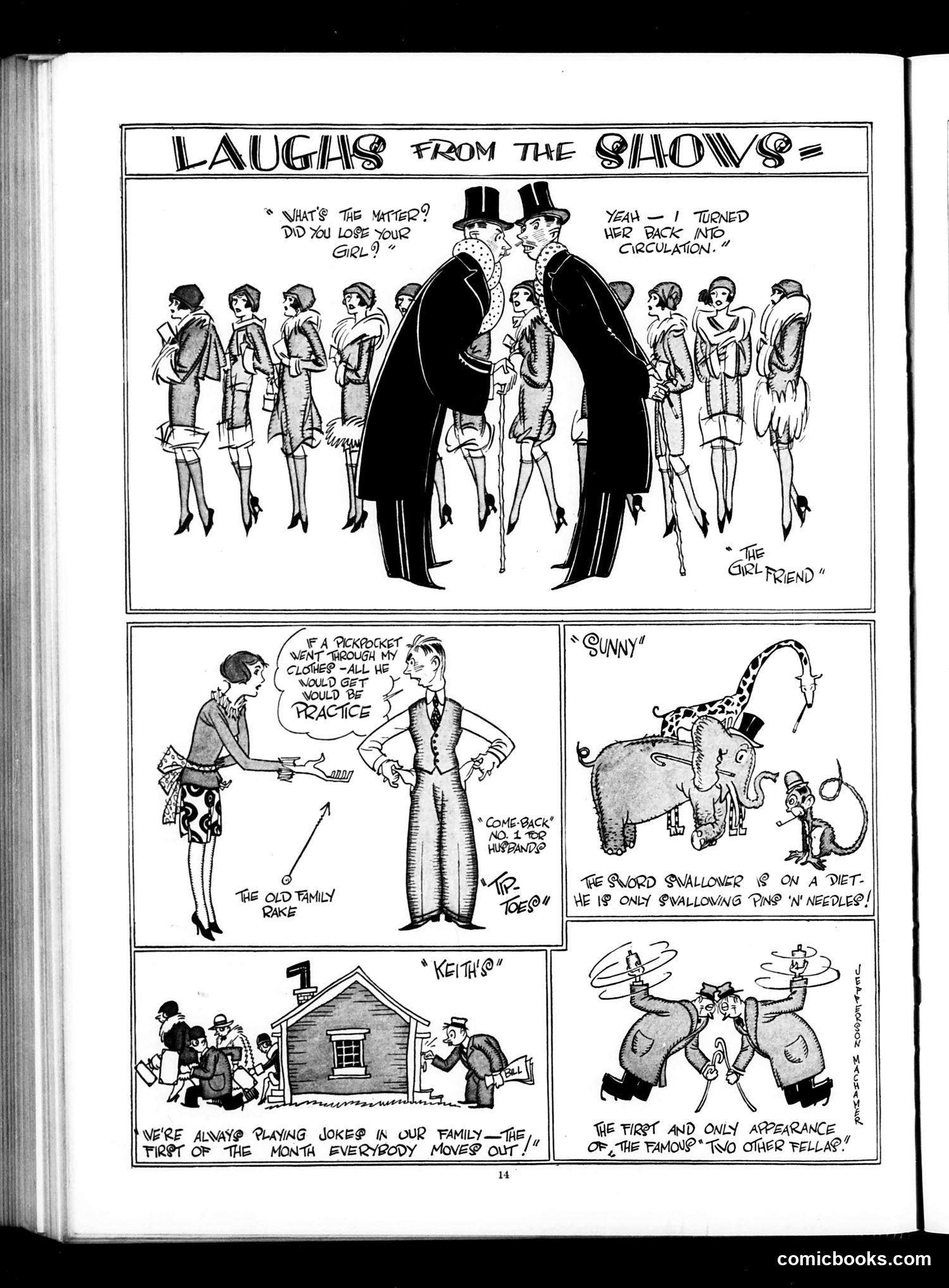
This page collects jokes from theatrical performances, a common Judge magazine feature. The top panel shows two well-dressed men discussing losing a girlfriend by "turning her back into circulation"—a cynical joke about treating women as interchangeable commodities. The middle panels present vaudeville-style humor: one depicts "the old family rake" (a dissolute relative) as a clichéd theatrical character; another jokes about "Sunny," a sword-swallowing circus act who survives only on "pins 'n' needles." The bottom panels reference stage stereotypes—a family known for perpetual practical jokes, and "the famous two other fellas," apparently a recurring comedy duo whose sole notable appearance was on stage. The satire targets theatrical clichés and the tired material recycled nightly in vaudeville and stage shows—suggesting that these jokes represent the exhausted, formulaic comedy of early 20th-century popular entertainment.
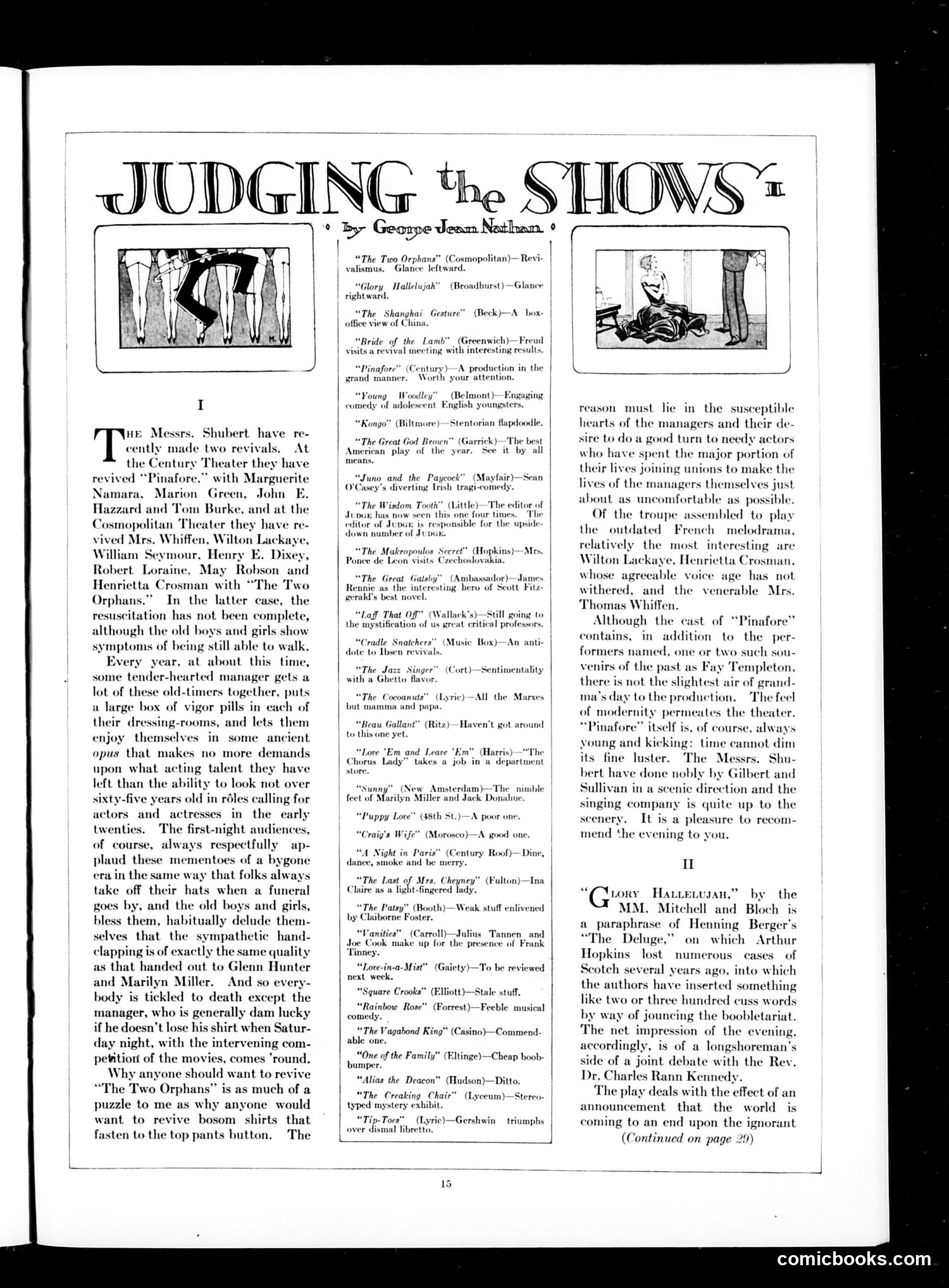
This is a theater review column covering Broadway productions, not a political cartoon. The page discusses recent theatrical revivals by the Shubert brothers, particularly criticizing their revival of "The Two Orphans" and "H.M.S. Pinafore" featuring aging performers. Nathan satirizes the annual theatrical tradition where managers resurrect old plays with veteran actors, supplying them "vigor pills" to appear functional. He mocks both the sentimental audiences who applaud out of nostalgia and the financially struggling managers hoping to profit from revivals of outdated material—comparing the trend to reviving old-fashioned "bosom shirts." The right column briefly reviews "Glory Hallelujah," a satirical paraphrase of Henning Berger's work about a world-ending announcement debated by Rev. Dr. Charles Rann Kennedy. The list of theater productions provides contemporary Broadway context for 1920s entertainment.
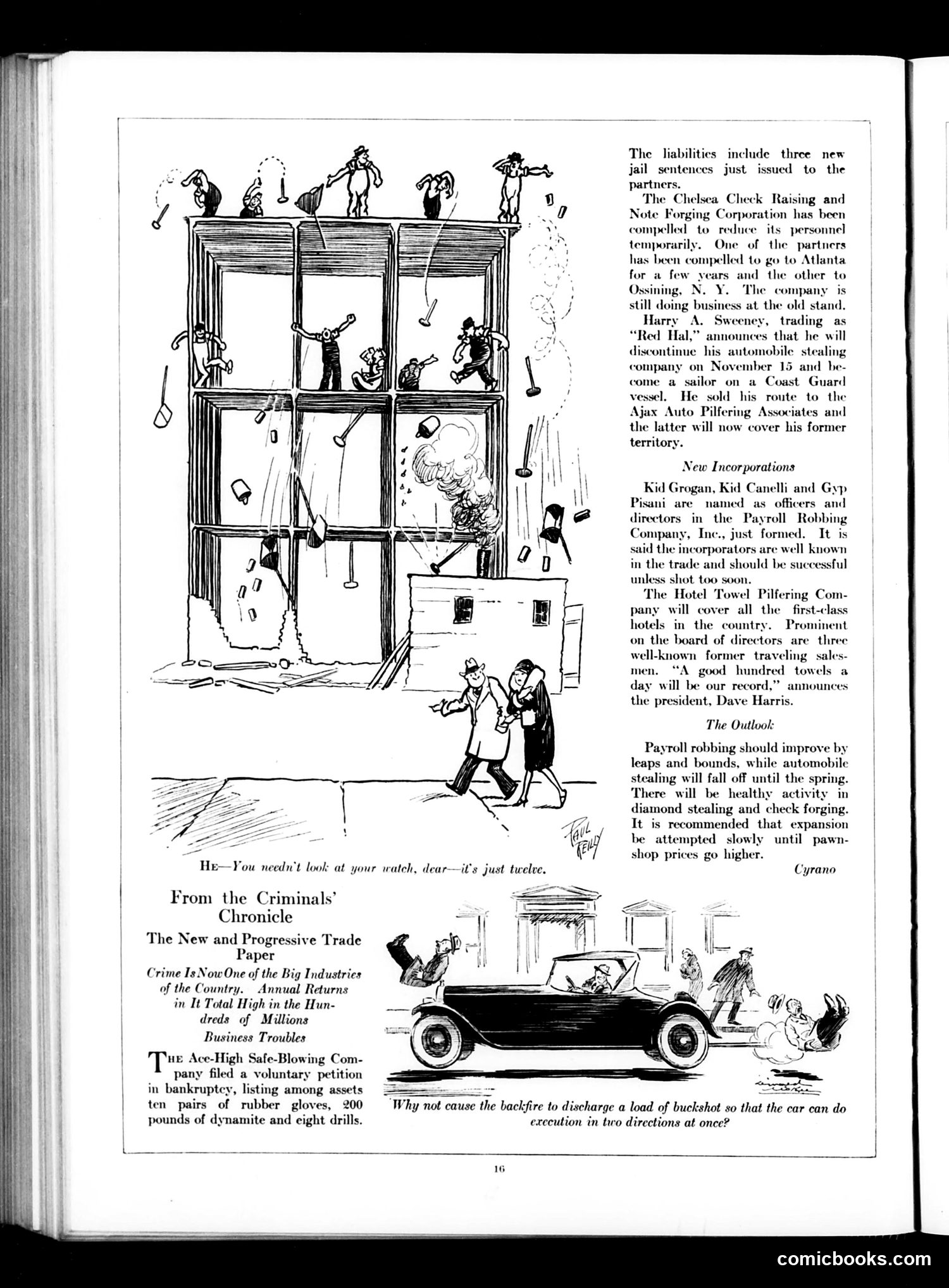
This page satirizes organized crime as a legitimate business sector. The top cartoon shows a chaotic multi-story building where criminals conduct various illegal activities—depicted as commonplace work. The text parodies business journalism, presenting criminal enterprises as "New Incorporations" and industrial operations: the "Payroll Robbing Company," "Hotel Towel Pilfering Company," and "Chelsea Check Raising and Note Forging Corporation" are treated like actual corporations with officers, directors, and business strategies. The satire works by applying legitimate business language and structure to crime. References to bankruptcy filings, personnel transfers (to prisons like Ossining and Atlanta), and market forecasts ("Payroll robbing should improve by leaps and bounds") mock both organized crime's scale and the era's business reporting. The bottom cartoon jokes about car theft as criminal entrepreneurs solve technical problems—a wry commentary on how sophisticated criminal operations had become. The overall message: organized crime had become so established and systematized it functioned like legitimate industry, a pointed criticism of law enforcement's inability to control it.
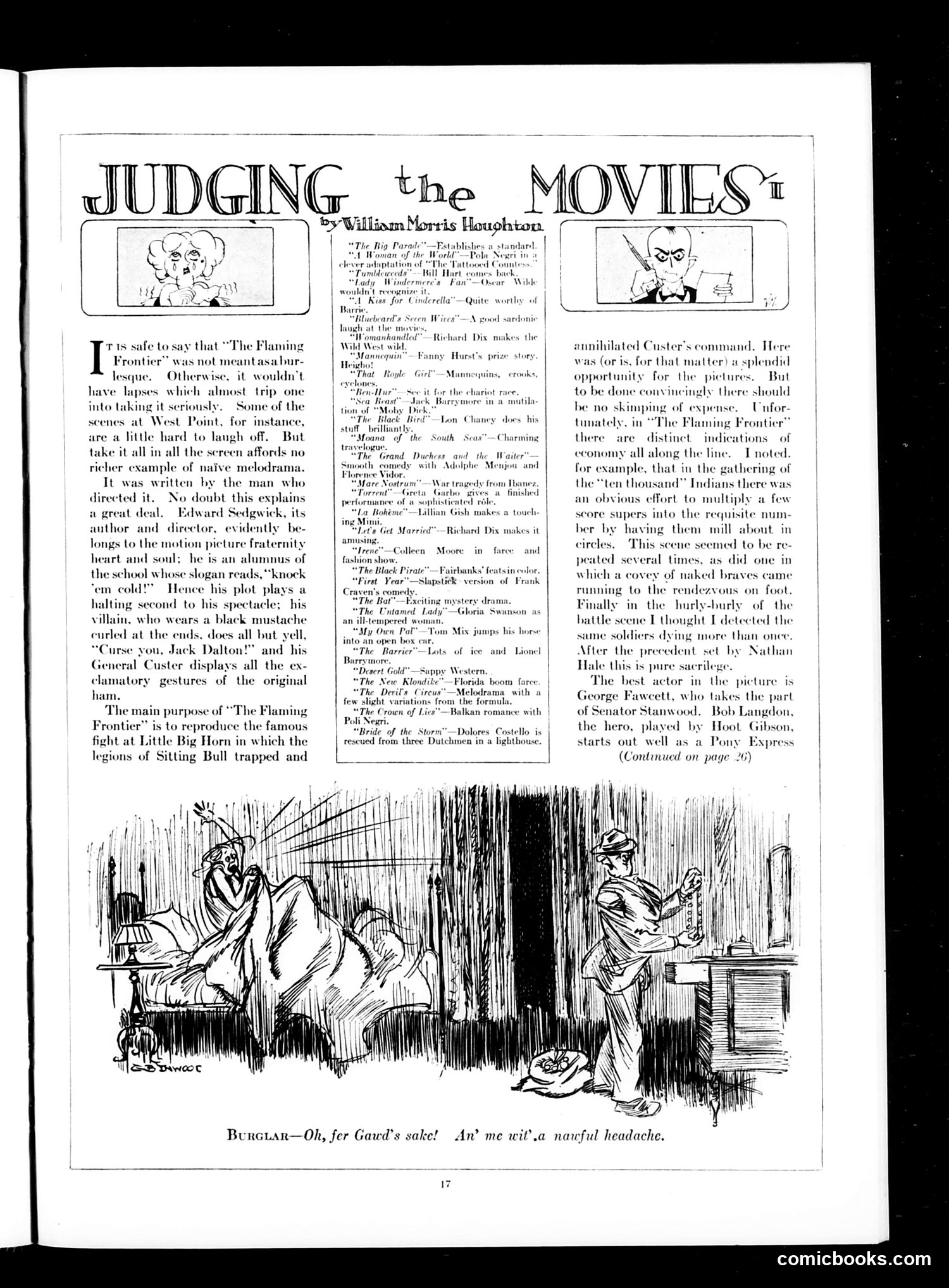
This is a film review column by William Morris Houghton critiquing "The Flaming Frontier," a Western picture about Custer's Last Stand. The review is largely negative, criticizing the film as "naive melodrama" with overwrought acting and lazy production values. The main satire targets the film's attempt to recreate the famous battle while cutting corners: the reviewer notes that to film the "ten thousand" Indians convincingly, they recycled the same soldiers repeatedly, having a small group of extras "mill about in circles" multiple times. He even claims to spot identical soldiers "dying more than once" in different scenes. The bottom cartoon shows a burglar complaining of a headache—likely satirizing how the overwrought film performance (probably by the lead actor) causes audience suffering. The review names actors like Hoot Gibson (the hero) and George Faweett but finds most performances hammy and unconvincing.
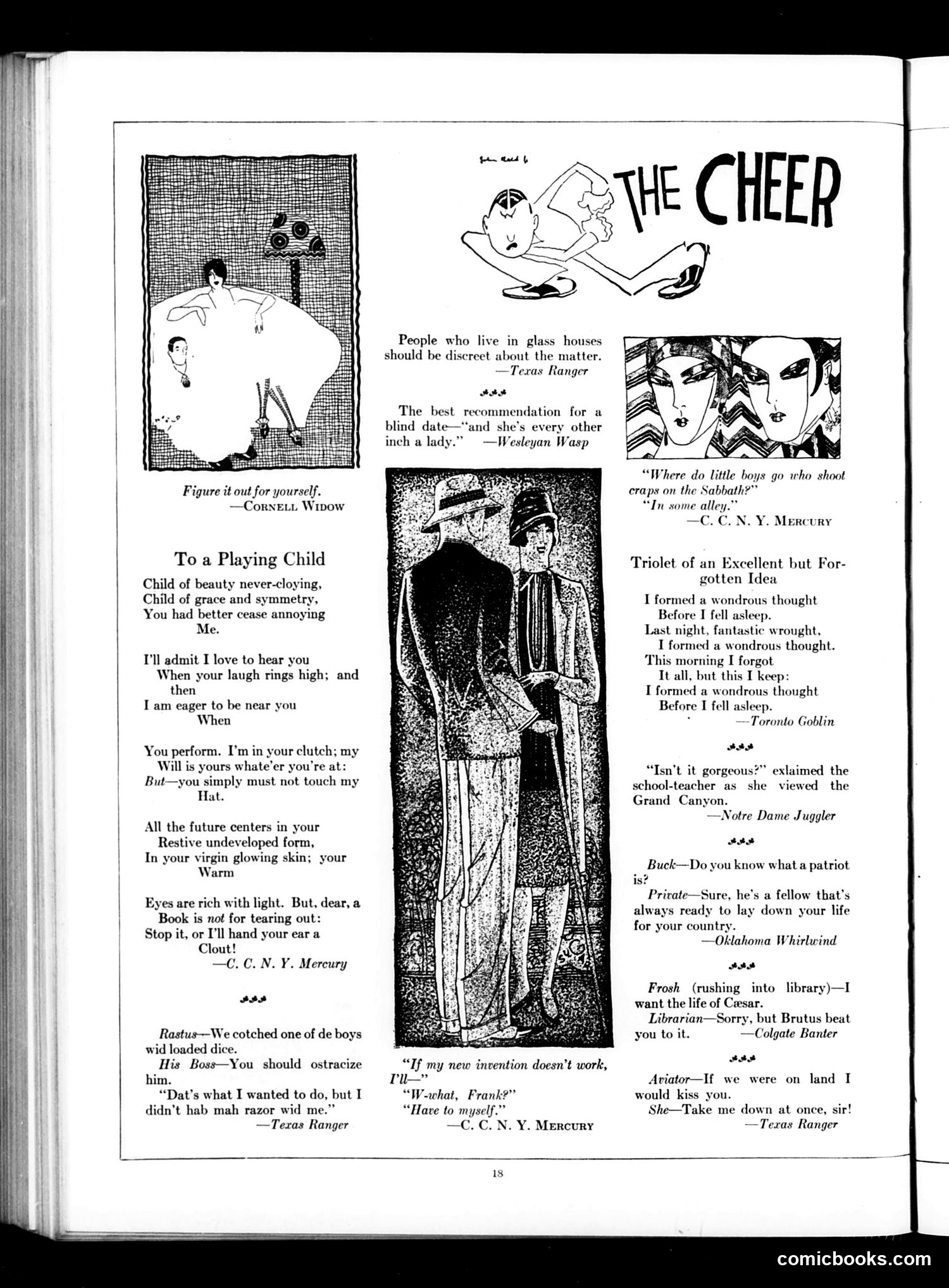
This is a humor compilation page from Judge magazine featuring jokes and light verse rather than political cartoons. The content reflects early 20th-century American humor sensibilities: **Main elements:** - A poem "To a Playing Child" (C.C.N.Y. Mercury) humorously complains about children's misbehavior while sentimentalizing childhood - Multiple short jokes from college humor magazines (Texas Ranger, Colgate Banter, etc.) covering predictable topics: dating, romantic mishaps, wordplay about patriotism and college life - A racist dialogue ("Rastus") using dated dialect humor typical of the era - A pun about Julius Caesar and Brutus ("Brutus beat you to it") - Aviation-era flirtation joke **The satire is light**: mostly poking fun at courtship awkwardness, generational differences, and college hijinks. The page demonstrates Judge's mix of genteel humor and period prejudices—reflecting what middle-class readers found amusing in this era. Nothing appears overtly political; it's social comedy for general audiences.
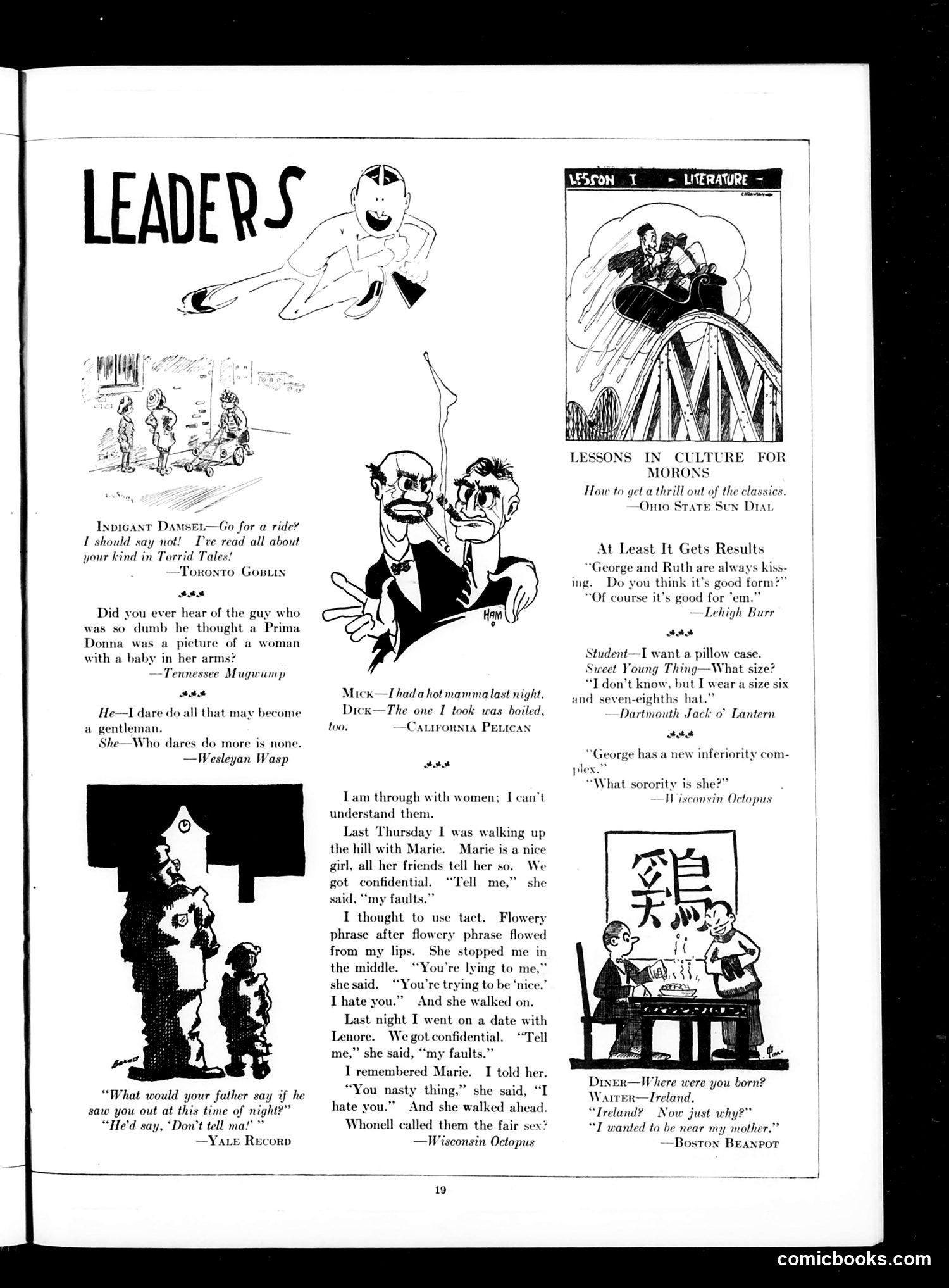
This page from *Judge* magazine contains humorous quotes and cartoons, mostly targeting college students and dating culture circa the 1920s-30s. **Main themes:** The "Leaders" section mocks naive young men confused by women's behavior. One lengthy joke depicts a man who can't win: when he flatters a woman (Marie), she accuses him of lying; when he's honest with another (Lenore), she calls him cruel. The humor satirizes the era's dating conventions and the apparent impossibility of pleasing women. **Visual elements include:** - A diver labeled "Leaders" (unclear reference) - Caricatured figures in various scenarios - A "Literature" lesson mocking students who seek "thrills" from classics **Recurring joke types:** - Dating mishaps and misunderstandings - Mock-intelligent dialogue from college publications (credited to various universities) - Ethnic/regional stereotypes (Irish immigrant humor in the final exchange) The satire targets young people's social pretensions and romantic fumbling during the Jazz Age.
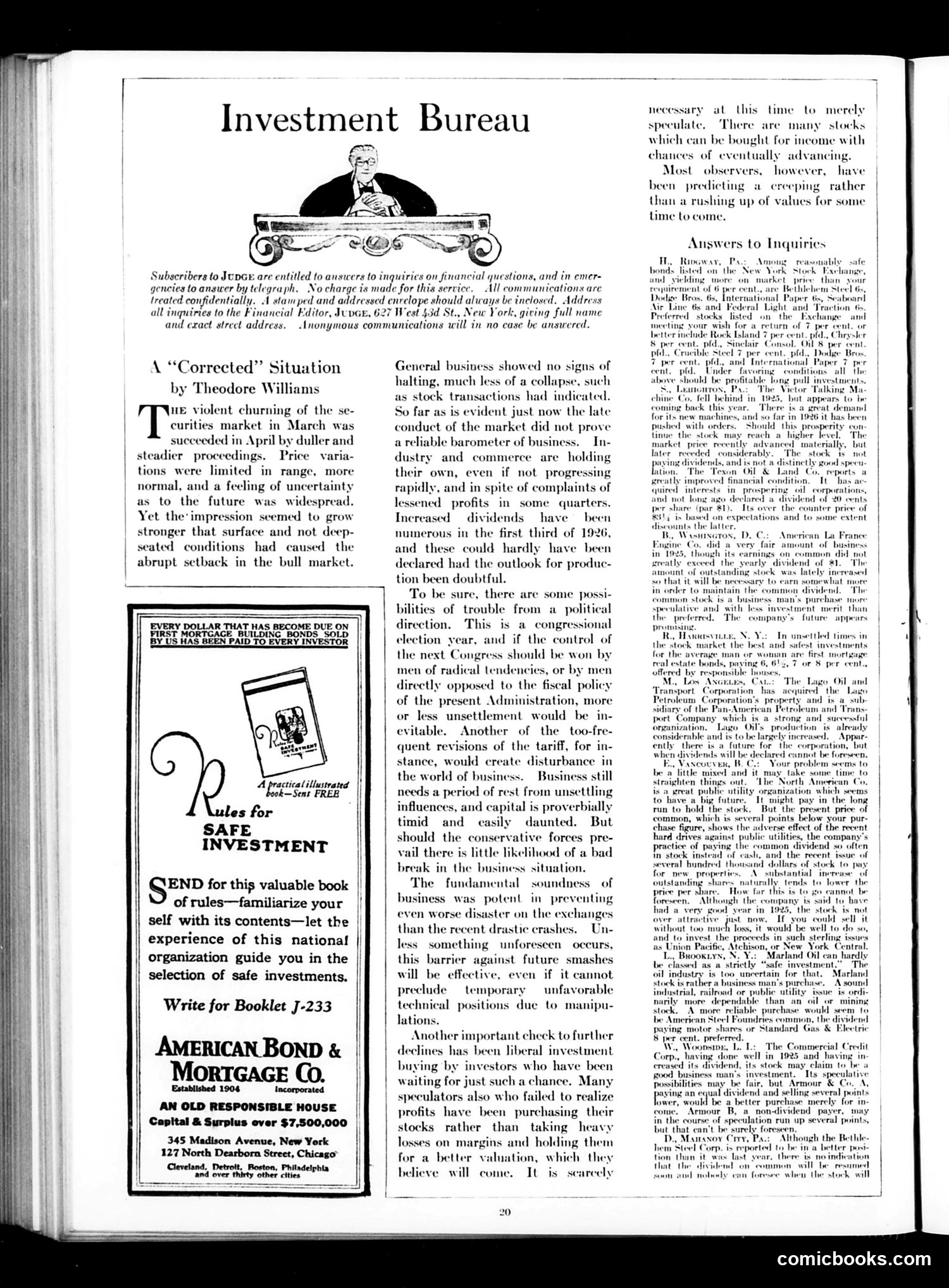
This page from *Judge* magazine (circa 1926) contains financial advice rather than political satire. The main article, "A 'Corrected' Situation" by Theodore Williams, discusses the March 1926 stock market volatility and reassures readers that the underlying economy remains sound. The key argument: while stock prices fluctuated dramatically, industrial production and commerce continued steadily, and companies increased dividends. Williams identifies potential political risks—specifically the upcoming congressional elections and fear that "radical" or anti-administration forces might gain control, disrupting business through tariff changes. The sidebar advertisement for American Bond & Mortgage Co. emphasizes reliability and safety, capitalizing on investor anxiety from recent market crashes. The satire is subtle: the cartoon critiques investors' tendency to panic-sell during downturns, suggesting fear drives irrational behavior regardless of actual economic fundamentals.
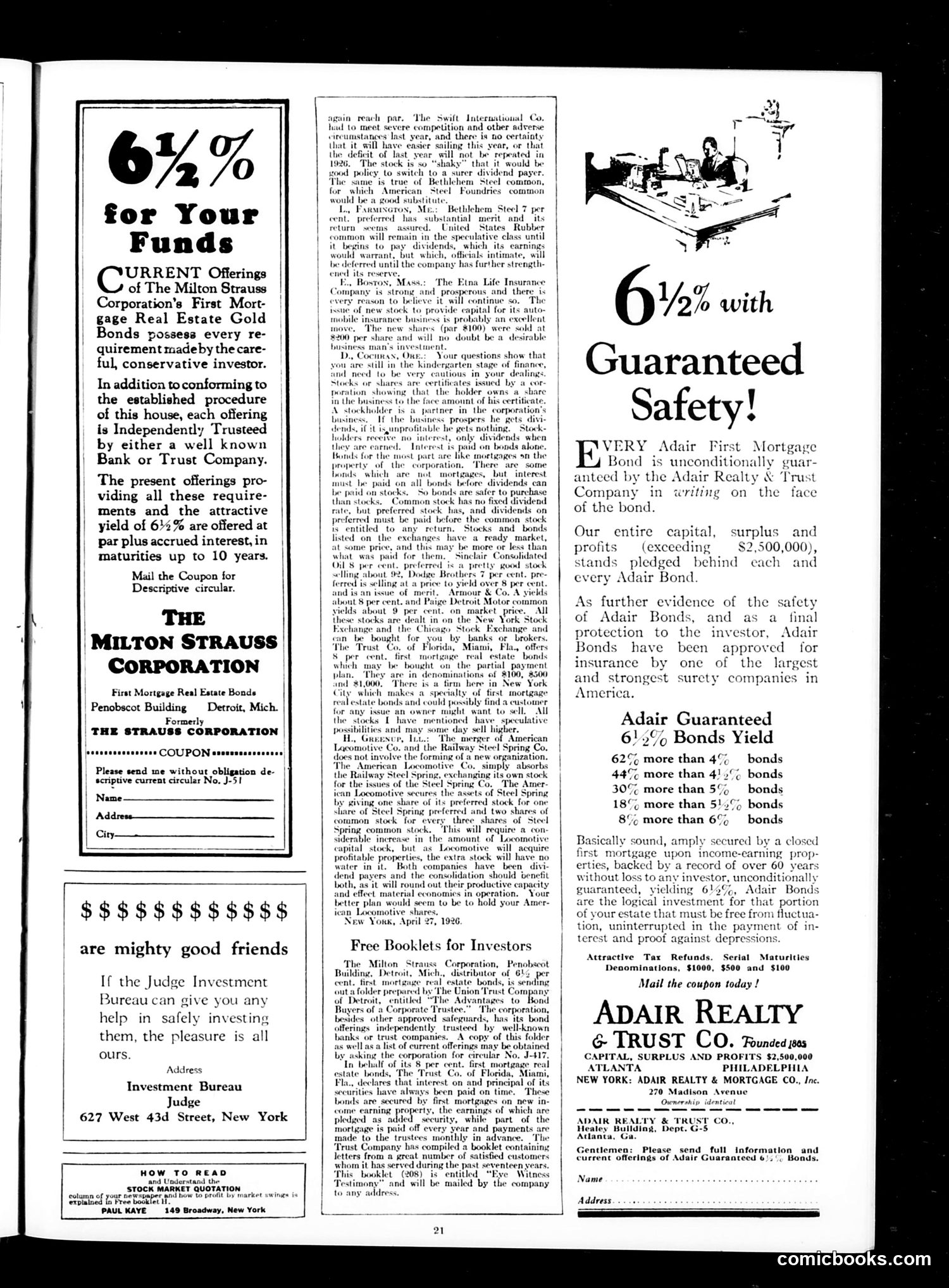
This page is primarily **financial advertising and investment advice**, not political satire. The main content comprises: 1. **Milton Strauss Corporation advertisement** (left) promoting 6½% real estate bonds as safe investments 2. **Adair Realty & Trust Company advertisement** (right) offering similar guaranteed bonds 3. **Investment Bureau advice column** (center) answering readers' stock questions about companies like Bethlehem Steel, US Rubber, and Dodge Brothers The page reflects the **1920s investment boom**, when magazines like Judge served affluent readers seeking guidance on stocks and bonds. The repeated emphasis on "safety," "guaranteed" returns, and "conservative investors" reflects pre-1929 confidence in financial markets. The "$$$" decoration at bottom and phrase "are mighty good friends" humorously suggest money itself is the best friend—typical light advertising humor for Judge's wealthy audience. **No political cartoons or caricatures appear on this page.** It's essentially a financial services marketplace circa mid-1920s.
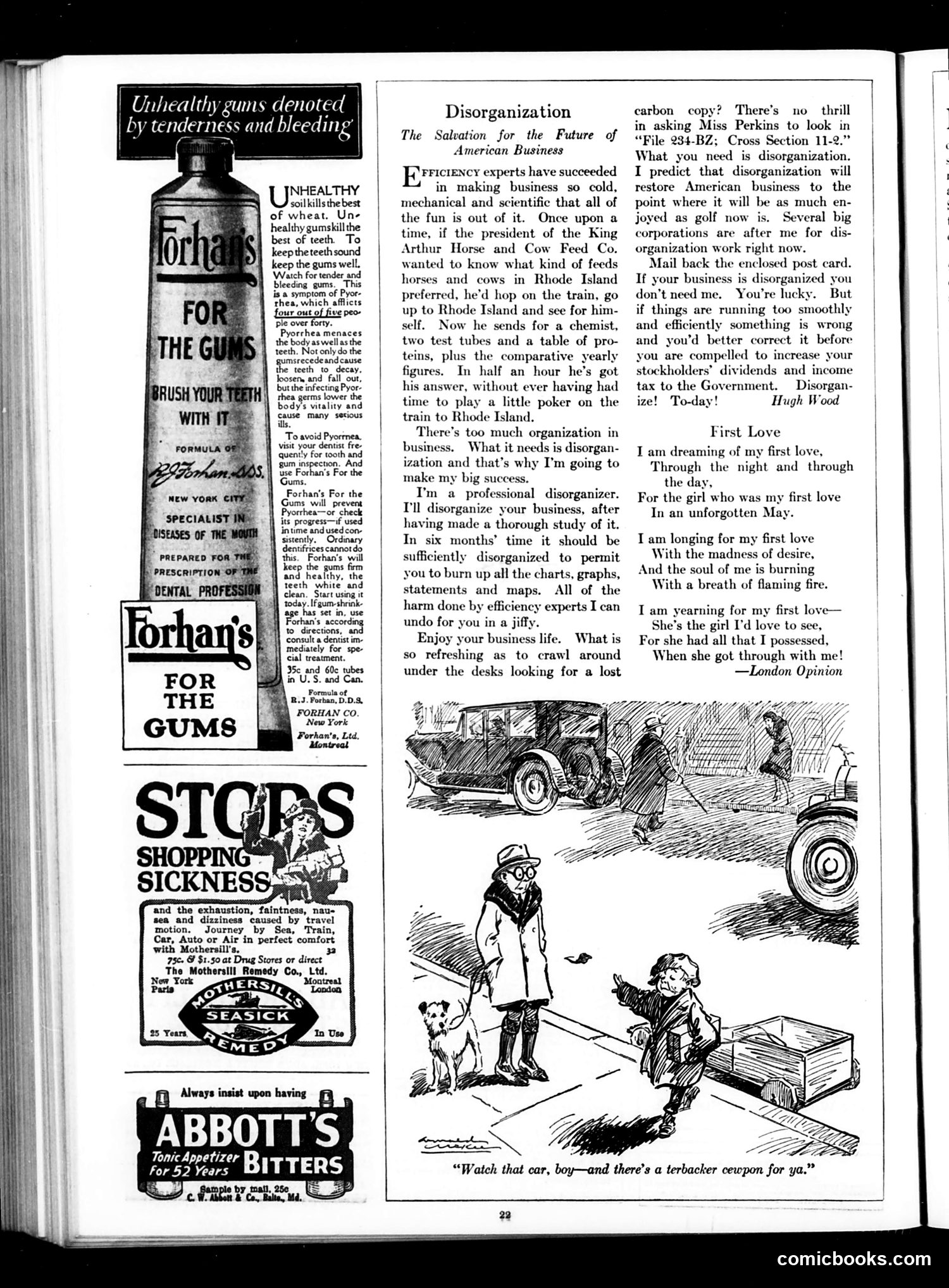
This page contains **satirical commentary on business efficiency**, presented as a humorous essay titled "Disorganization: The Salvation for the Future of American Business." **The Main Satire:** The piece mocks the early 20th-century obsession with scientific management and efficiency experts who had stripped business of personal relationships and spontaneity. The author—a self-proclaimed "professional disorganizer"—ironically argues that excessive organization has made business joyless. He claims that restoring chaos (like searching under desks for lost files rather than using filing systems) would make business enjoyable again, like golf. **The Joke:** This inverts contemporary business logic. While efficiency experts promised progress through systematization, the satirist suggests their methods created sterile, mechanical workplaces. The humorous proposal to hire someone to deliberately *undo* efficiency is hyperbolic social criticism. The page also features period advertisements (Forhan's toothpaste, seasickness remedy) and a poem titled "First Love" (a romantic piece, unrelated to the satire). The **cartoon** depicts a street scene with a man and child watching a car, with the caption about a "terbacker crayon"—appears to be unrelated visual humor.
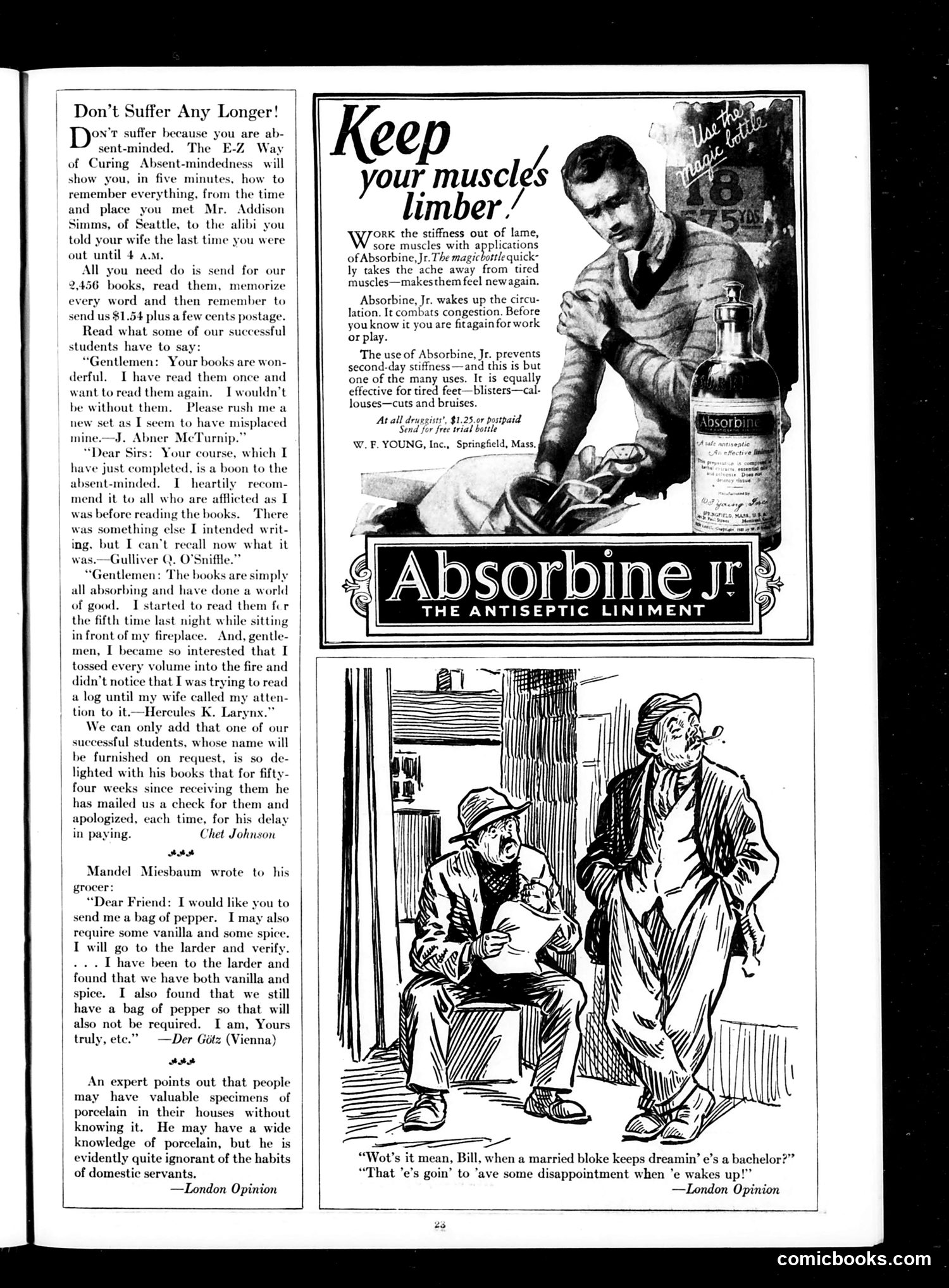
This page combines satirical humor with period advertising. The left column features mock testimonials for an "E-Z Way" memory-improvement course—a classic scam advertisement. The humor lies in the absurd contradictions: customers claim the books work wonderfully while simultaneously proving they're absent-minded (losing the books, forgetting why they wrote, burning them in a fireplace). One customer has been "mailing in checks" for fifty-four weeks while apologizing for delays—suggesting the company exploits forgetful people. The center features a genuine advertisement for Absorbine Jr. liniment, a real muscle rub product. At bottom, a British cartoon jokes about married men dreaming of bachelorhood, with the punchline that disappointment awaits upon waking—a dig at marriage's constraints. The working-class dialect ("Wot's," "'e's") marks this as London Opinion content, imported into Judge to appeal to anglophile readers.
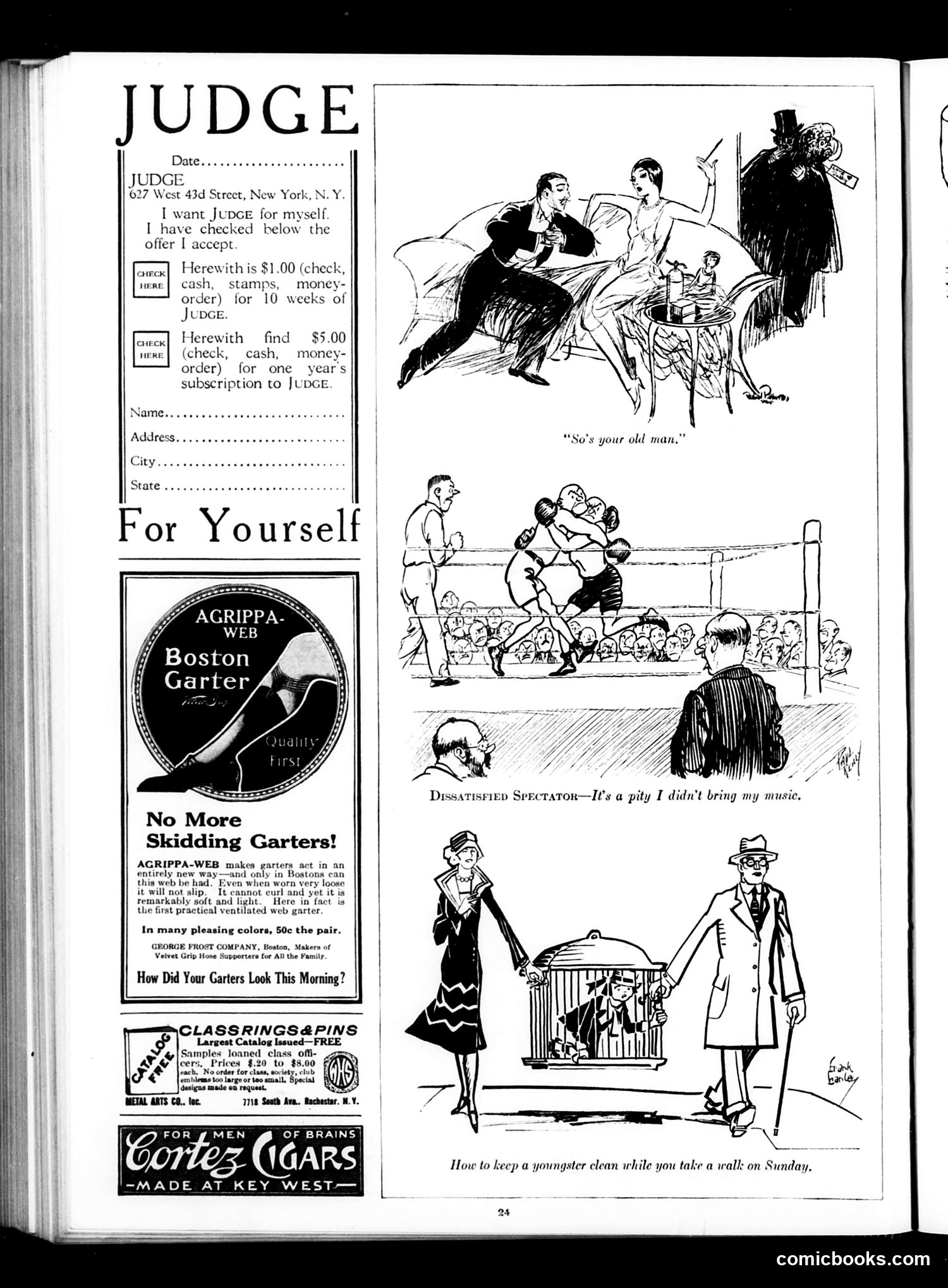
This is primarily a **subscription/advertising page** for Judge magazine (circa 1927, based on the address and style). The left side contains subscription offers ($1 for 10 weeks, $5 for one year) and unrelated advertisements for Boston Garter stockings, class rings/pins, and Cortez Cigars. The right side features three **satirical cartoons** mocking domestic life: 1. **"So's your old man"** - A couple in bed with an older man looming over them, referencing the period slang phrase used as a comeback insult. 2. **"Dissatisfied Spectator"** - A man at a boxing match lamenting he didn't bring music, sarcastically suggesting entertainment was inadequate. 3. **"How to keep a youngster clean while you take a walk on Sunday"** - Parents with a child in a cage-like baby carriage, a dark joke about containing messy children during outings. The humor targets **middle-class frustrations**: marital bickering, entertainment expectations, and parenting challenges. The cartoons use exaggeration and absurdist scenarios typical of 1920s satirical magazines.
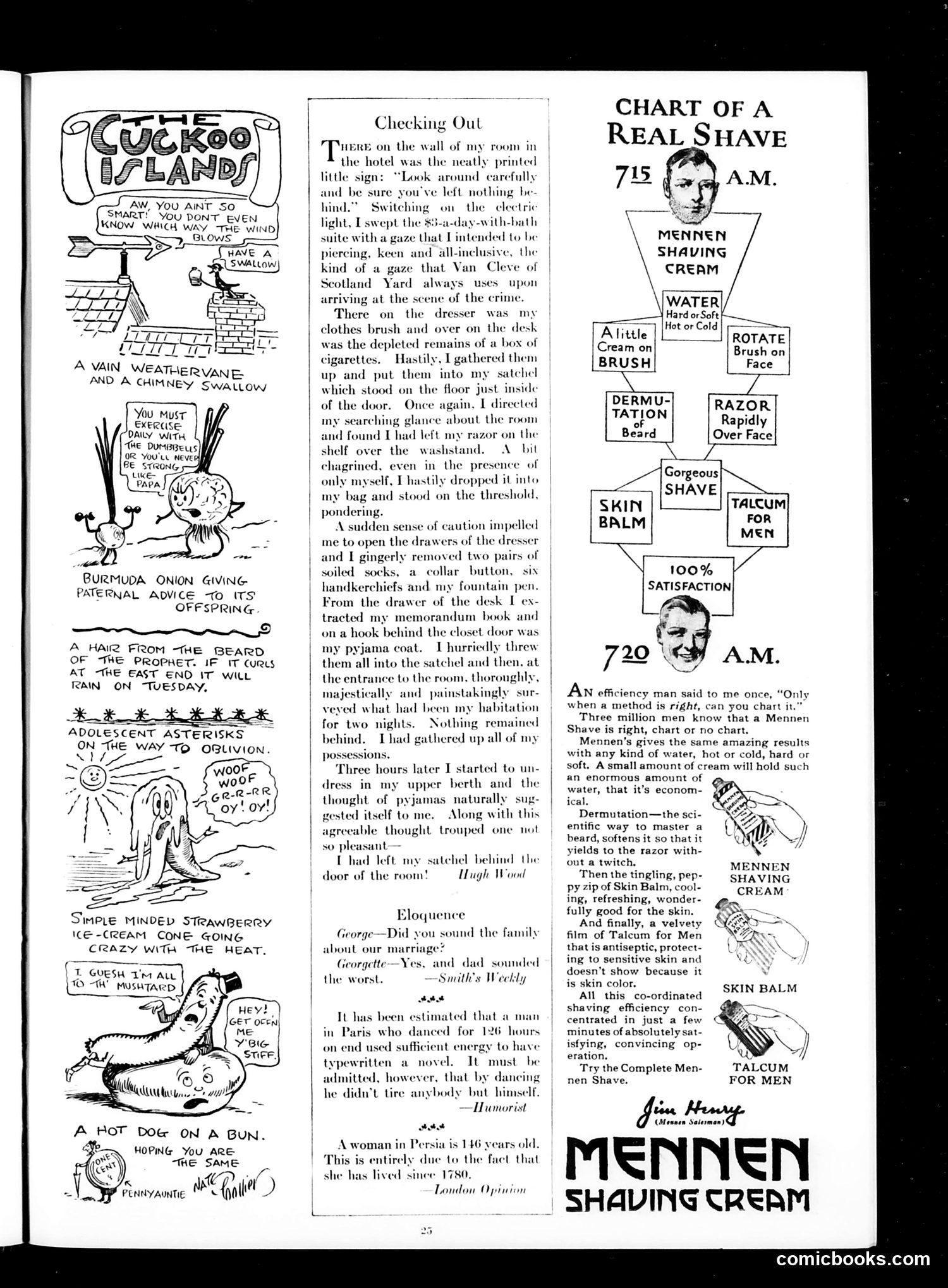
## Left Side (Cartoons): The left column contains humorous, absurdist comics mocking various subjects: - A weather vane and chimney arguing about wind direction (satirizing indecisiveness) - A Bermuda onion giving gym advice to offspring (personification humor) - A dubious weather prediction method using a prophet's hair - Teenage asterisks heading toward "oblivion" - A strawberry ice-cream cone "going crazy with the heat" These appear to be gentle, whimsical satire rather than sharp political commentary—typical light magazine filler. ## Center (Article "Checking Out"): A humorous first-person account of a hotel guest obsessively searching his room before checkout, only to realize at the train station he forgot his pajamas. The satire targets travelers' anxiety and thoroughness. ## Right Side (Advertisement): A Mennen Shaving Cream advertisement with a flowchart showing the shaving process at 7:15 and 7:20 AM, emphasizing efficiency and product benefits. The page is primarily entertainment and advertising rather than hard satire or political commentary.
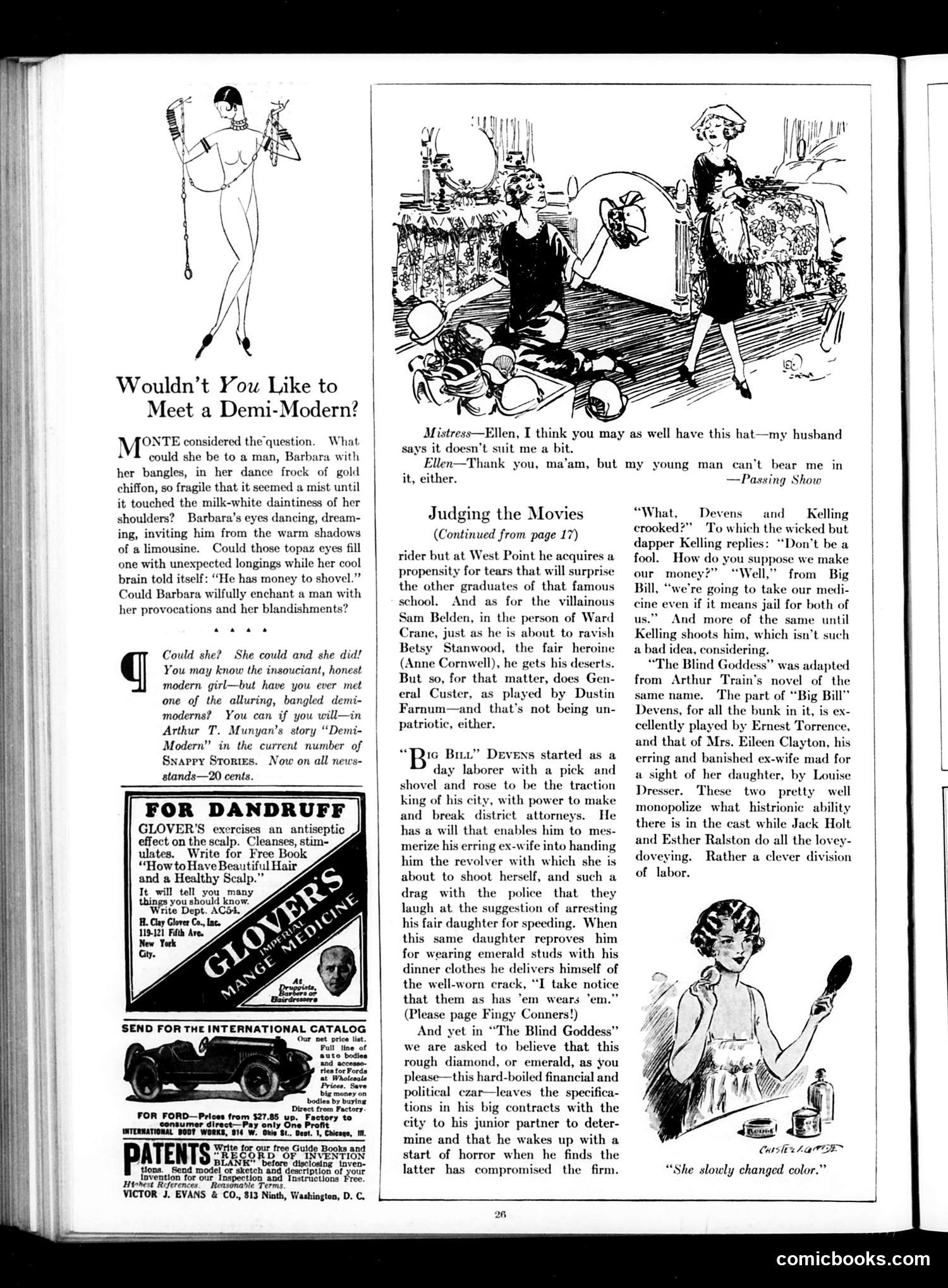
This page contains a short story advertisement ("Wouldn't You Like to Meet a Demi-Modern?") and a film review column ("Judging the Movies"). **The "Demi-Modern" story** advertises Arthur T. Munyan's tale about Barbara, a modern woman with "bangles" and a gold chiffon dress who uses charm and wit to manipulate a wealthy man. The satire targets the "new woman" of the 1920s—fashionable, independent-minded, and unsentimentally calculating about money. The phrase "demi-modern" suggests incomplete modernity: she performs modern sophistication while maintaining traditional feminine wiles. **The film reviews** critique contemporary movie plots for implausible characterization. The critic mocks "Big Bill" Devens (played by Ernest Torrence), a self-made industrial tycoon who supposedly leaves business details to subordinates despite his ruthless control—the filmmakers asking audiences to accept an illogical character arc. The page also includes period advertisements for dandruff treatment and Ford automobiles, typical for this era.
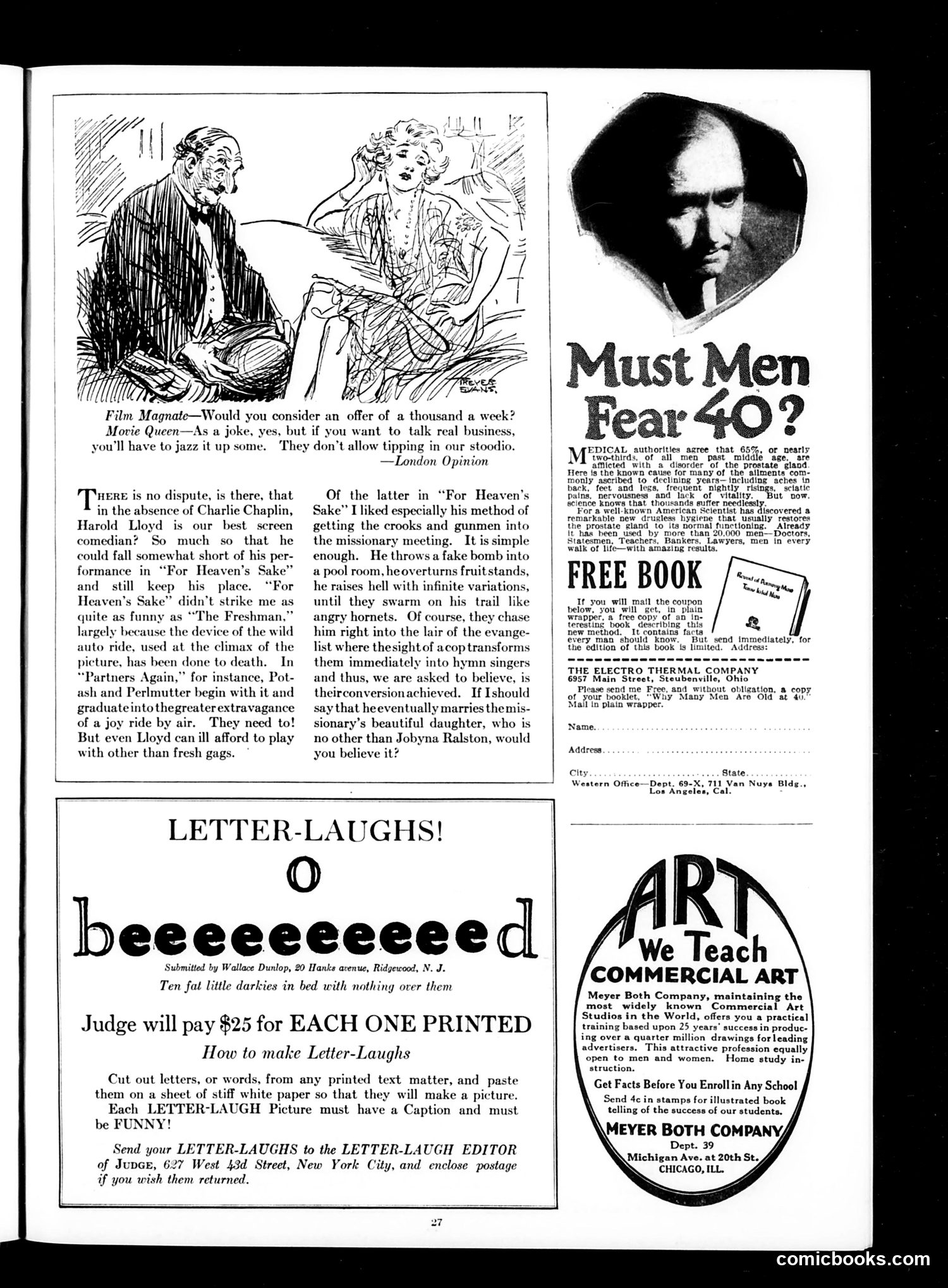
This page from *Judge* (a 1920s satirical magazine) contains several distinct elements: **Main Cartoon**: A sketch mocking Hollywood salary negotiations. A "Film Magnate" offers a "Movie Queen" $1,000/week, but she dismisses it as a joke, demanding he "jazz it up"—she wants real money. The satire targets both inflated Hollywood wages and the casual attitude toward enormous sums during the Jazz Age. **Film Criticism**: A lengthy review praising Harold Lloyd as the best silent-film comedian after Charlie Chaplin, discussing his recent films "For Heaven's Sake" and "The Freshman." It critiques Lloyd's reliance on recycled gags (the auto chase scene) but praises his creative comedic methods. **Advertisements**: Include a dubious medical pitch for a "drugless hygiene" treatment for prostate problems (targeting men over 40), and a commercial art school advertisement—both typical of period magazine advertising. **"Letter-Laughs" Section**: A reader-submission feature where audiences create visual puns by cutting letters from printed text. The example contains offensive racial content typical of 1920s casual racism.
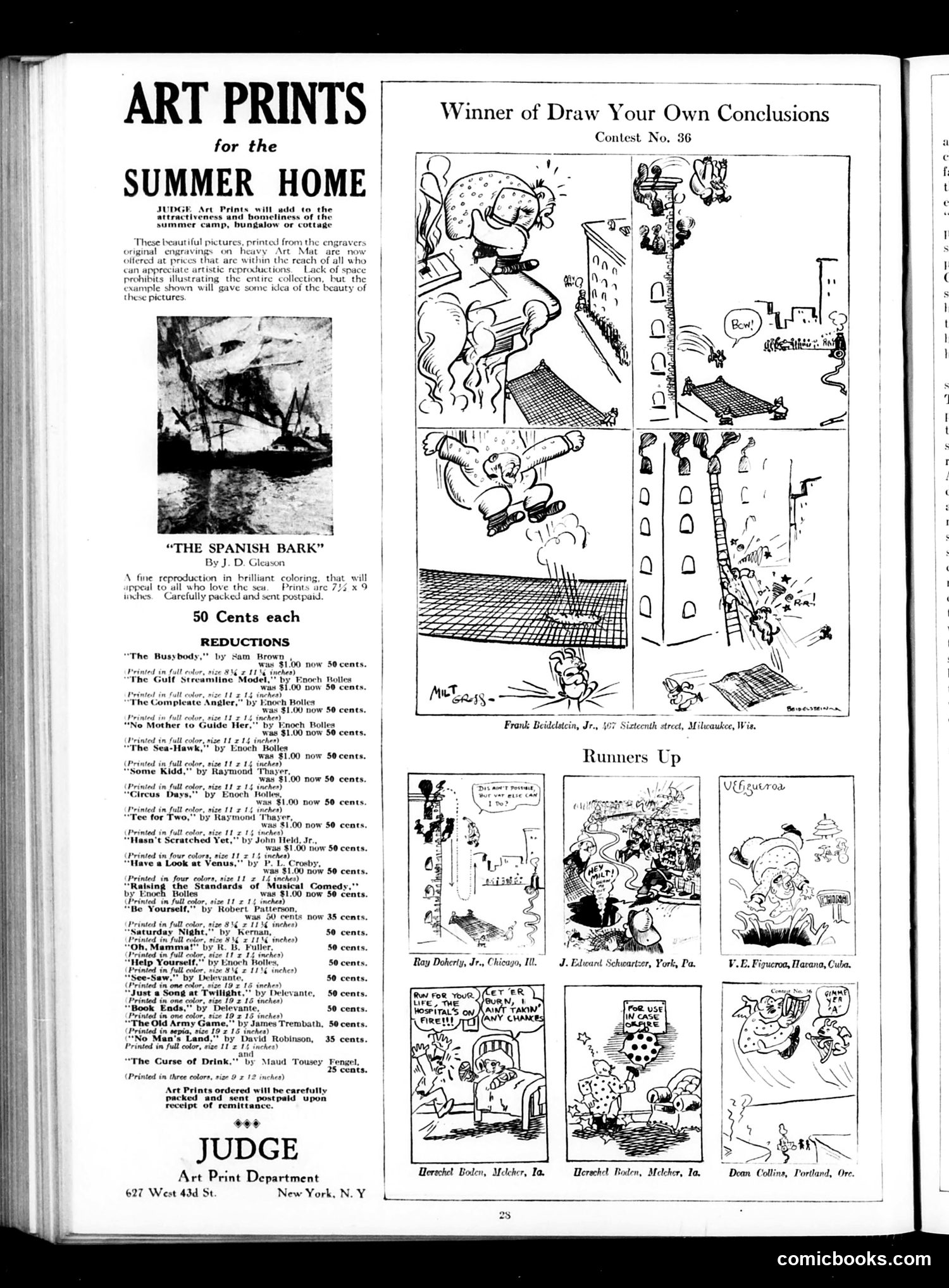
This page combines art print advertising with a comic contest winner. The main content is a "Draw Your Own Conclusions" contest entry by Frank Buddestein Jr. of Milwaukee, Wisconsin, featuring a multi-panel cartoon about a character (appears to be a rotund man) causing chaos in an urban setting—jumping from buildings, landing on people, creating general mayhem. The humor relies on visual slapstick: the character's antics escalate absurdly across panels, with bystanders reacting in alarm. There's no clear political or social satire; it's pure comedic physical humor typical of early-to-mid 20th century cartoons. The page also advertises affordable art reproductions (50 cents each) for summer homes—seascapes and genre scenes by artists like Enoch Bolles and Raymond Thayer. "Runners Up" entries from other contest participants appear below, similarly featuring lighthearted visual gags without apparent political commentary.
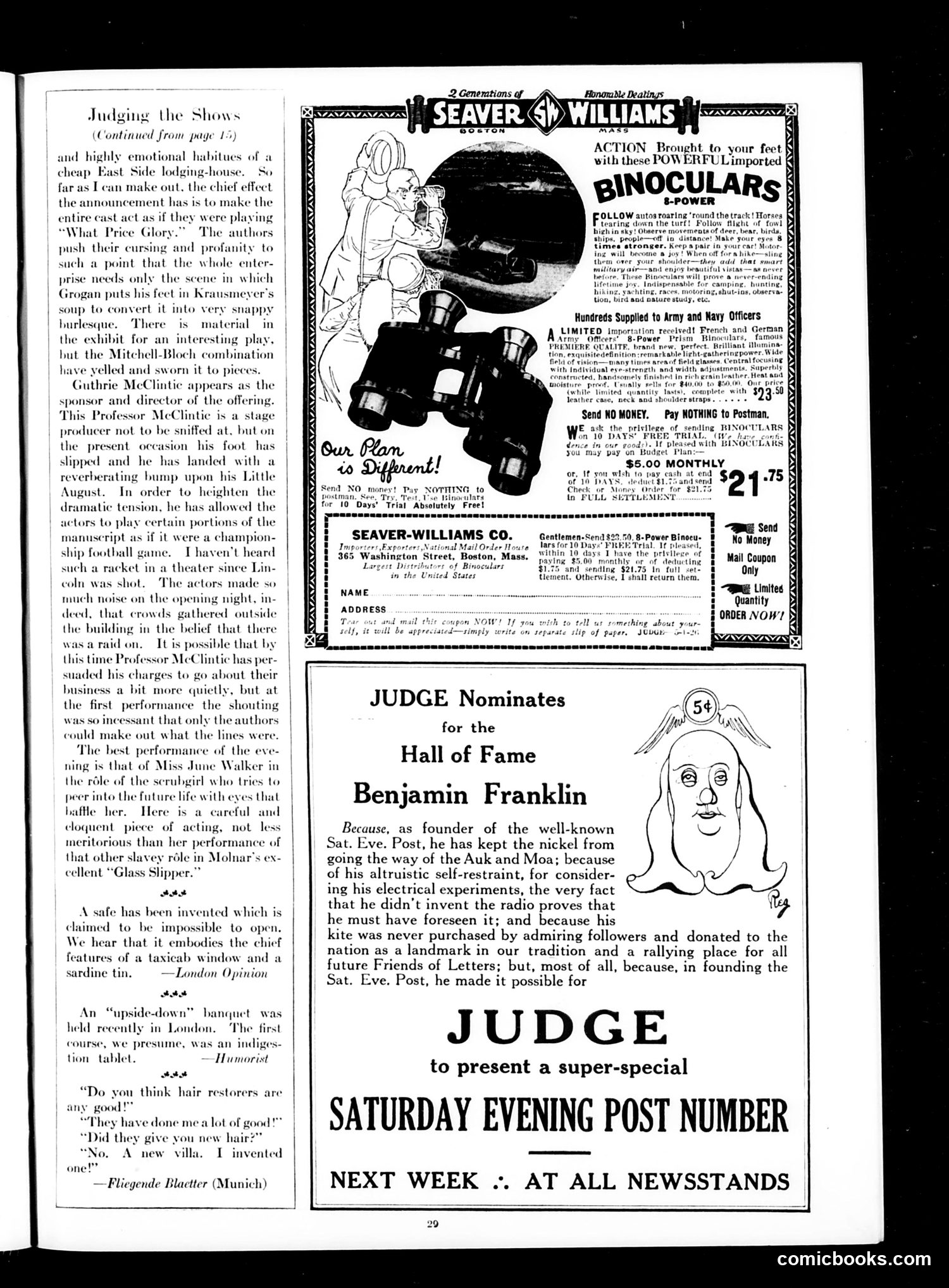
This page contains theater criticism and advertising, with one satirical piece worth noting: **"JUDGE Nominates for the Hall of Fame: Benjamin Franklin"** is mock-serious satire. The "reasons" for nominating Franklin are deliberately absurd: he kept the nickel in circulation (trivial), showed restraint by *not* inventing the radio (nonsensical), and his kite was never commercialized (irrelevant). The joke targets how institutions cynically honor historical figures with inflated or backwards logic—Franklin's actual achievements are ignored in favor of silly pseudo-reasons. This mocks the superficiality of "Hall of Fame" selections. The remainder is straightforward period content: a theater review criticizing a loud production of "What Price Glory," and a vintage mail-order advertisement for Army binoculars. The theater piece complains the cast shouts too much, making dialogue inaudible—a practical complaint about 1920s stage performance practices.
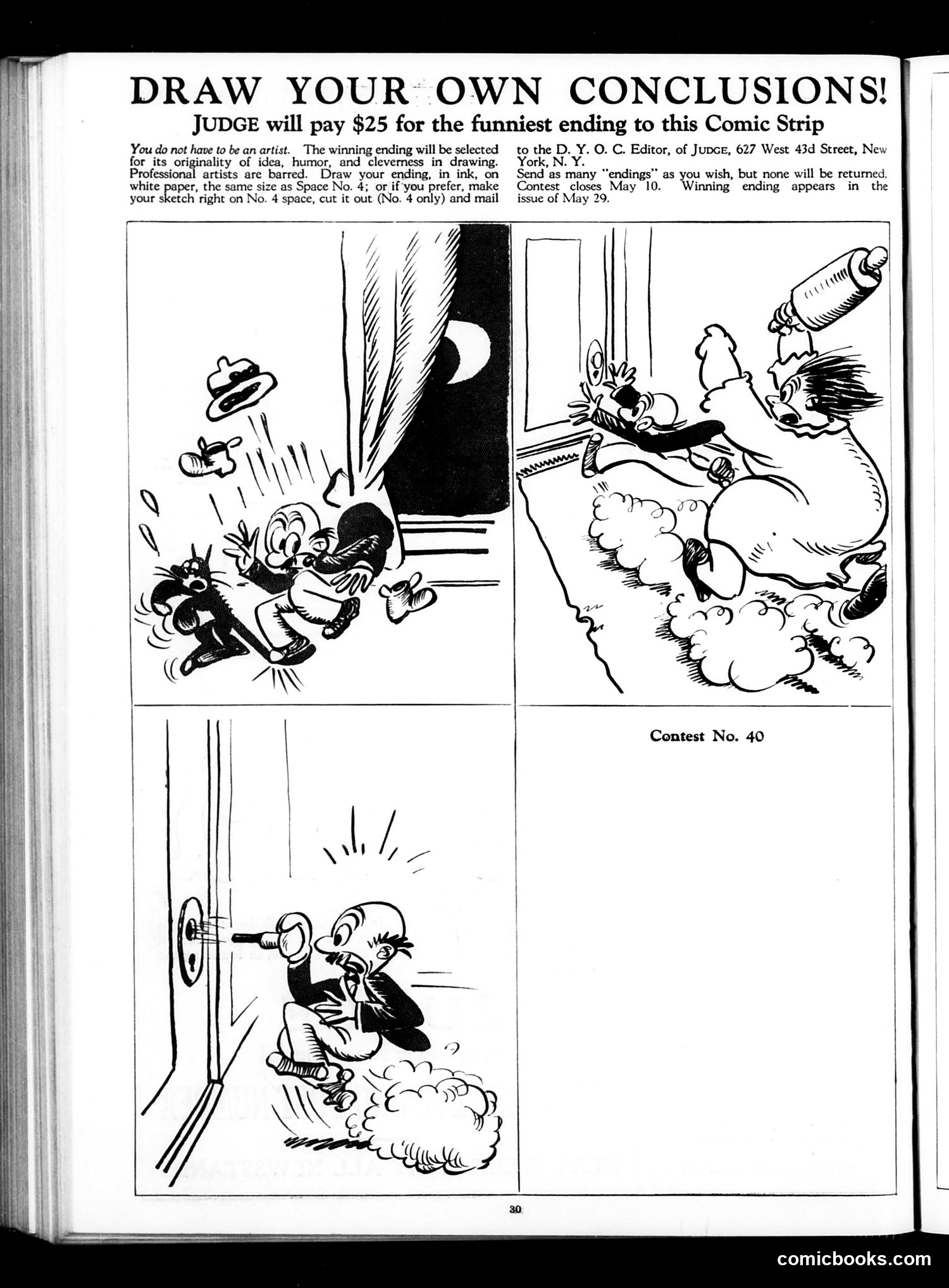
This is a reader-participation contest page from *Judge* magazine. The publication invites readers to complete an unfinished three-panel comic strip (Contest No. 40) for a $25 prize—substantial money in the early 20th century. The existing panels show slapstick comedy: a character with a hat and what appears to be a cat are ejected from a doorway; next, chaos erupts in clouds (possibly a dream sequence or heaven); finally, a figure with a telescope appears to be looking through a wall. The joke setup is nonsensical physical comedy typical of the era—the humor comes from absurdist situations rather than social commentary. Readers were challenged to invent a punchline that would make sense of this deliberately absurd sequence. This format reflects *Judge*'s interactive approach to humor and was common in early 20th-century magazines, predating modern comic strips' narrative continuity.
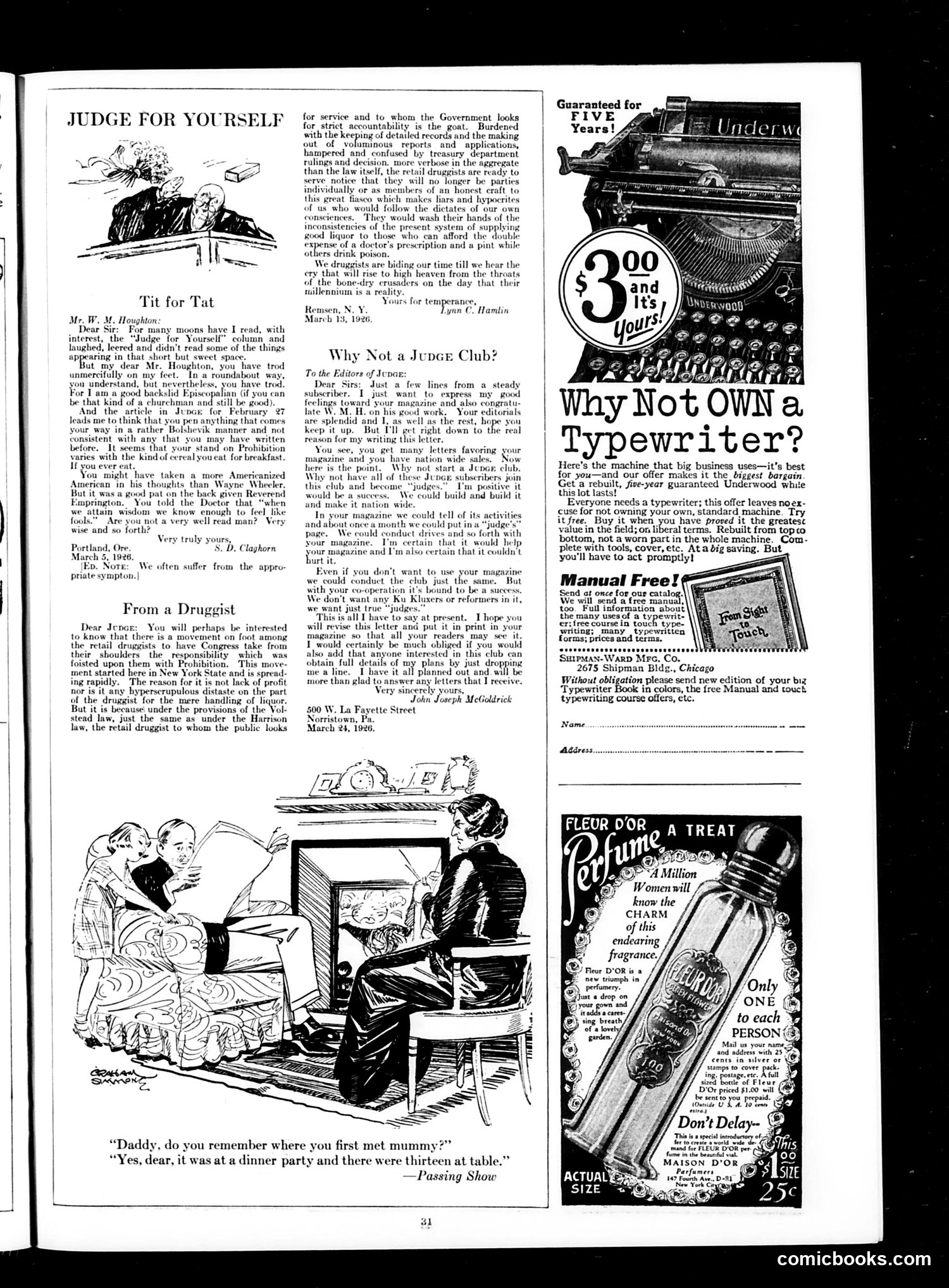
This page contains reader letters to Judge's "Judge for Yourself" column and advertisements—not political cartoons. The content reflects 1920s Prohibition-era concerns. **Key Content:** The letters address ongoing Prohibition enforcement problems. A druggist complains that retail pharmacists bear unfair legal responsibility under the Volstead Act for dispensing medicinal alcohol, facing detailed record-keeping while being blamed for enabling circumvention of dry laws. Another reader proposes a "Judge Club"—a nationwide organization of magazine subscribers—suggesting the magazine's popularity warrants a formal membership organization. **Historical Context:** These letters illustrate how Prohibition created practical bureaucratic burdens and black-market workarounds. Druggists legally sold alcohol as "medicine," creating obvious hypocrisy that frustrated both enforcement officials and honest merchants. The advertisements (Underwood typewriter, Fleur d'Or perfume) are period consumer goods, typical of Judge's revenue model.
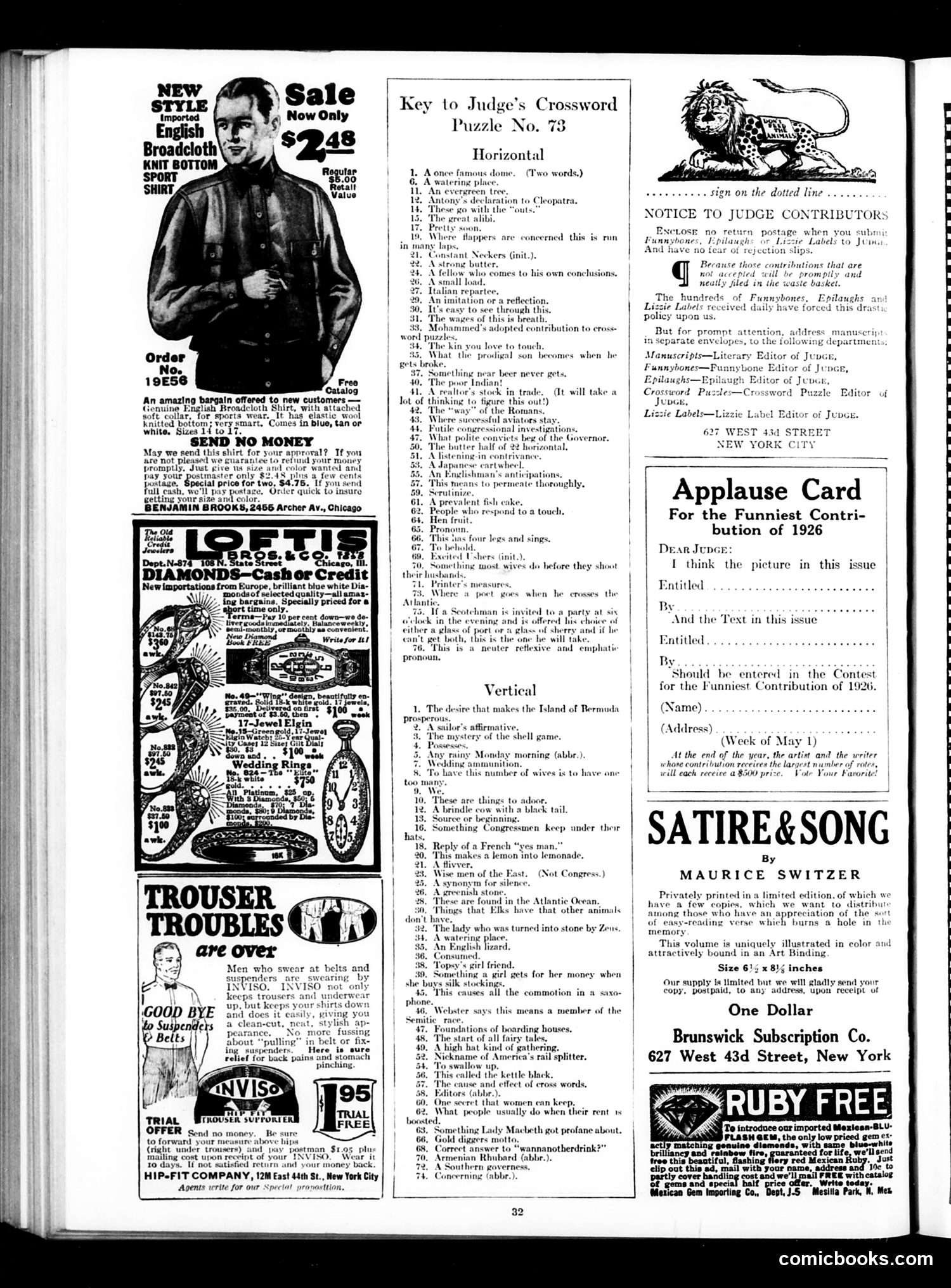
This page is primarily **advertisements and reader-submission materials** rather than editorial cartoon content. The main elements include: **Advertisements:** - A broadcloth shirt offer (top left) - "Trouser Troubles" ad for an "Inviso" suspender/belt system (bottom left) — the humor plays on men's frustration with traditional suspenders and belts that slip or pinch - Jewelry/diamond ads - A "Ruby Free" gemstone offer **Editorial Content:** - A crossword puzzle answer key - An "Applause Card" inviting readers to vote on the funniest contribution submitted to Judge in 1926 - Advertisement for *Satire & Song*, a book of illustrated verse by Maurice Switzer **Context for modern readers:** This reflects Judge's business model — a humor magazine sustained by paid advertising and reader participation contests. The "Trouser Troubles" ad humorously references everyday male annoyances, typical of 1920s consumer advertising that used relatable complaints to sell solutions.
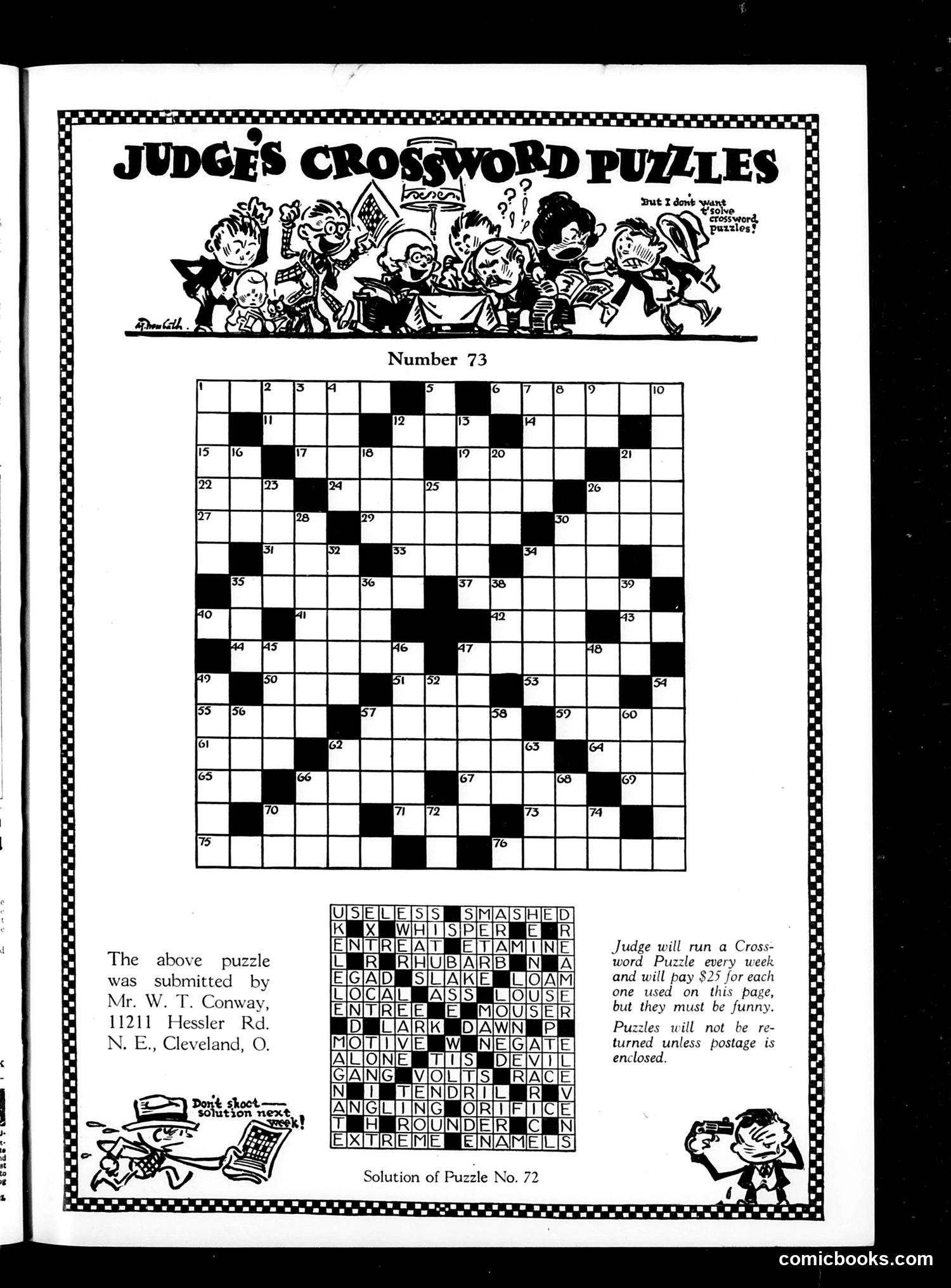
This page features **Judges Crossword Puzzles**, a regular feature where the magazine paid $25 for reader submissions—provided they were humorous. The main content is Crossword Puzzle #73, submitted by a Cleveland reader (W.T. Conway). Below it appears the solution grid for the previous week's puzzle (#72), filled with words that appear to reference contemporary topics and wordplay typical of Judge's satirical humor. The cartoon header shows exuberant figures celebrating around a large question mark, emphasizing the puzzle's entertaining appeal. The page includes editorial notes stating puzzles must be funny and won't be returned without postage—standard magazine practices of the era. Without knowing the specific date, it's difficult to identify particular political or social references in the word solutions shown, though the word list suggests typical Judge-style wordplay mixing current events with clever language humor that would have resonated with readers of that period.
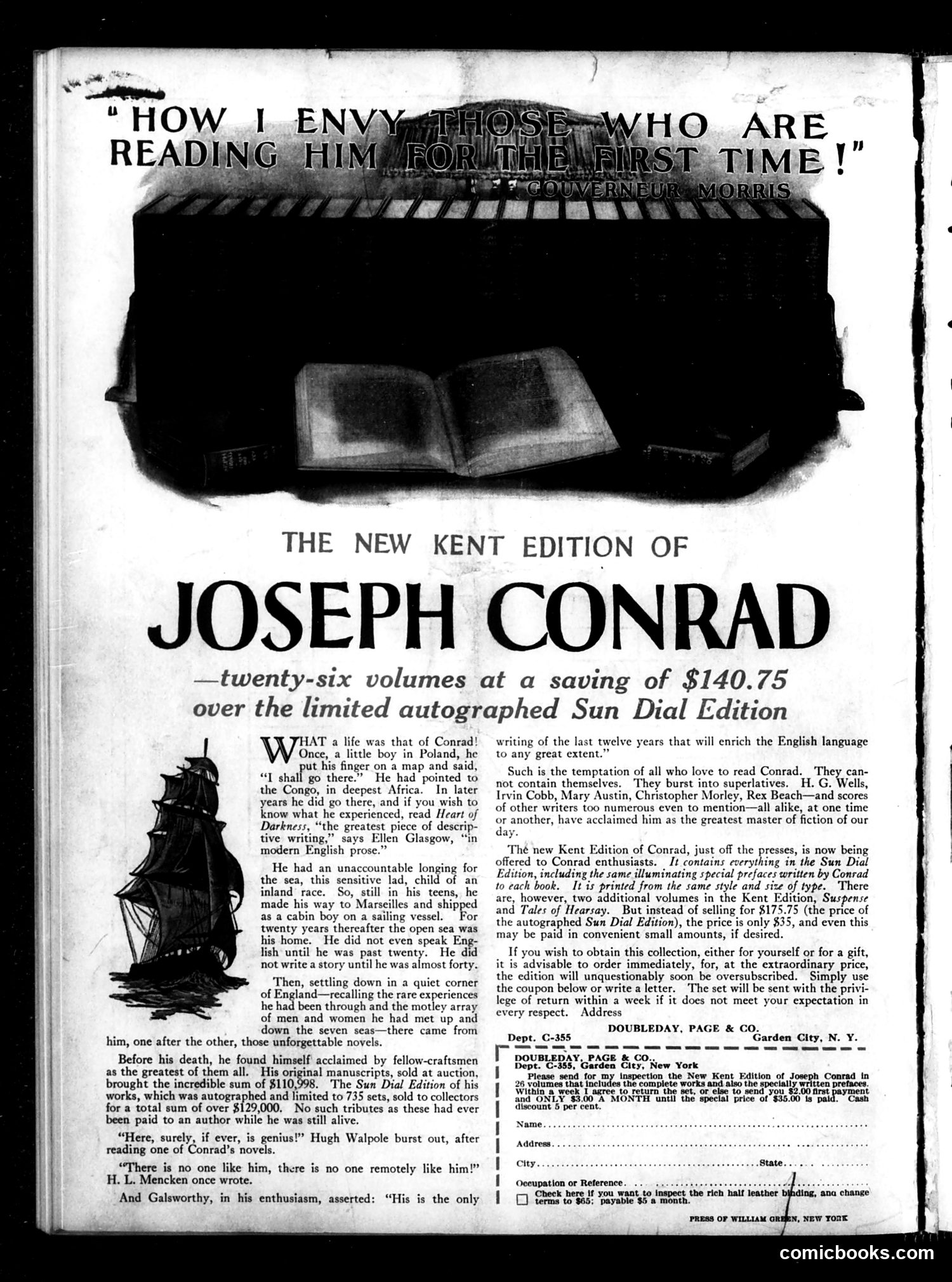
This is primarily a **book advertisement**, not a political cartoon. The page promotes the "Kent Edition" of Joseph Conrad's collected works. The satire is subtle: the quote at the top—"How I envy those who are reading him for the first time!"—captures the common literary snobbery of the era. By featuring glowing testimonials from famous writers (H.G. Wells, H.L. Mencken, John Galsworthy), the ad satirizes how intellectuals compete to praise Conrad most effusively, with each quote more hyperbolic than the last ("His is the only writing..."). The **key point**: The ad exploits this intellectual one-upmanship to sell books. It mocks the pretentiousness of literary culture while simultaneously leveraging that pretentiousness as a marketing tool. The illustration of Conrad's ship represents his adventurous life—a selling point emphasizing authenticity and experience behind the prose. The price comparison ($35 vs. $175.75 for the autographed edition) suggests this was pitched to aspirational middle-class readers wanting the prestige of owning "serious literature" affordably.