
Judge, 1926-05-01 · page 17 of 36
Judge — May 1, 1926 — page 17: what you’re looking at
What you’re looking at
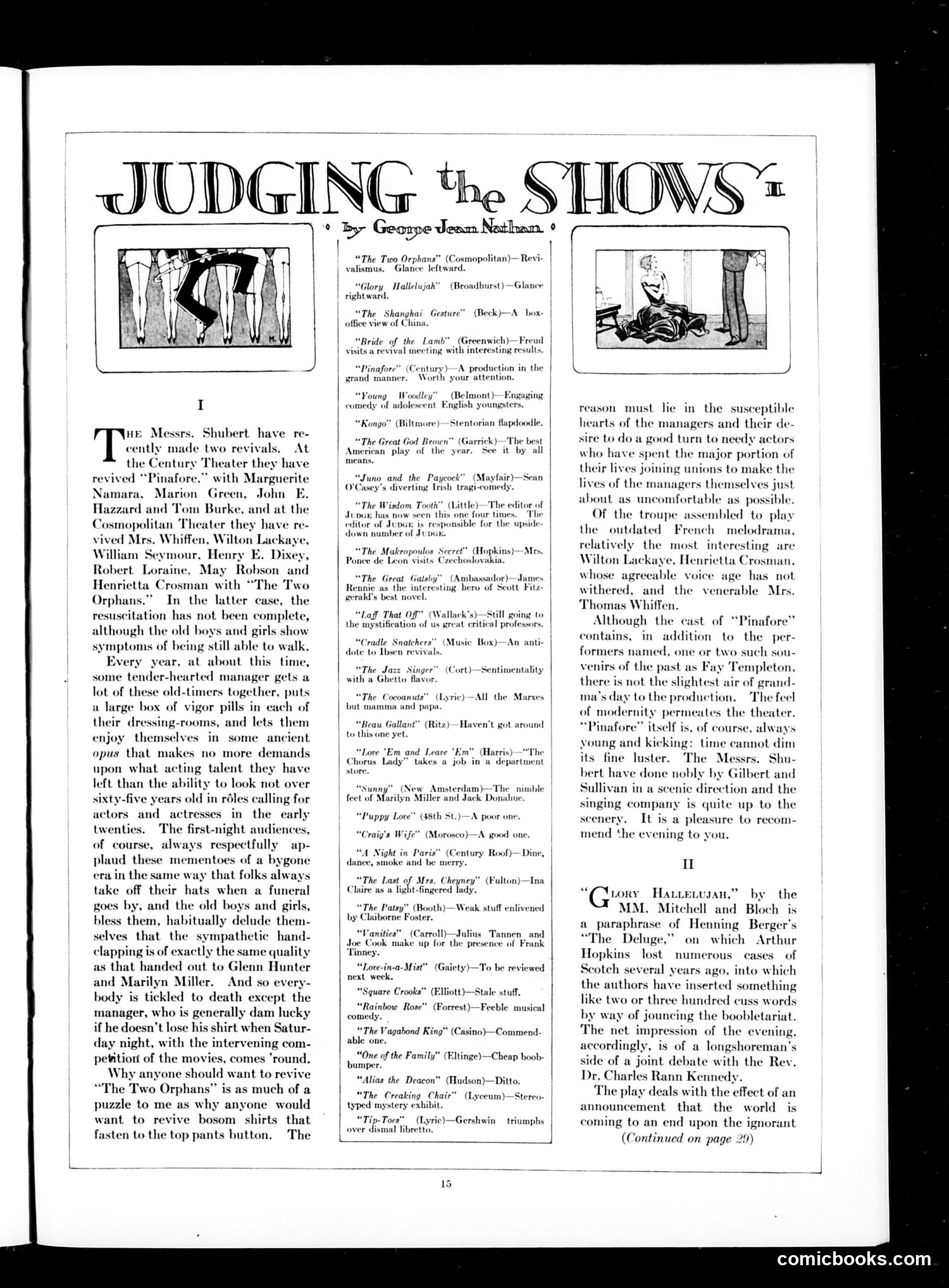
This is a theater review column covering Broadway productions, not a political cartoon. The page discusses recent theatrical revivals by the Shubert brothers, particularly criticizing their revival of "The Two Orphans" and "H.M.S. Pinafore" featuring aging performers. Nathan satirizes the annual theatrical tradition where managers resurrect old plays with veteran actors, supplying them "vigor pills" to appear functional. He mocks both the sentimental audiences who applaud out of nostalgia and the financially struggling managers hoping to profit from revivals of outdated material—comparing the trend to reviving old-fashioned "bosom shirts." The right column briefly reviews "Glory Hallelujah," a satirical paraphrase of Henning Berger's work about a world-ending announcement debated by Rev. Dr. Charles Rann Kennedy. The list of theater productions provides contemporary Broadway context for 1920s entertainment.
📄 Transcribed text from this page (OCR, searchable)
Machine-transcribed from the original scan — historical spelling and the odd misread are preserved.
ce be SH HE Messrs. Shubert have re- T ently made two revivals. At the Century Theater they have revived “Pinafore,” with Marguerite Y Marion John E. urd and Tom Burke, and at the Cosmopolitan Theater they have re- vived Mrs. Whiffen, Wilton Lackaye, William Seymour, Henry E. Dixey Robert Loraine, May Robson and Henrietta Crosman with “The Two Orphans.” In the latter case, the resuscitation has not been complete, although the old boys and girls show symptoms of being still able to walk. Every year, at about this time, some tender-hearted manager gets a lot of these old-timers together, puts a large box of vigor pills in each of their dressing-rooms, and lets them enjoy themselves in some ancient opus that makes no more demands upon what acting talent they have left than the ability to look not over sixty-five years old in réles calling for actors and actresses in the early twenties. The first-night audiences, of course, always respectfully ap- plaud these mementoes of a bygone era in the that folks aly take off their hats when a funeral goes by, and the old boys and girls, bless them, habitually delude them- selves that the sympathetic hand- clapping is of exactly the same quality as that handed out to Glenn Hunter and Marilyn Miller. And so every- body is tickled to death except the manager, who is generally dam lucky if he doesn’t lose h hirt when Satur- day night, with the intervening com- petition of the movies, comes ‘round. Why anyone should want to revive “The Two Orphans” is as much of a puzzle to me as why anyone would want to revive bosom shirts that fasten to the top pants button. The Green, ame way | with a Ghetto flavor. | Joe Cook make up for the presence of Frank | (Cosmopolitan)—Revi- “Glory hurst) Glance rightward, Hallelujah” (Bro: “The Shanghai Gesture” (Beck)—A_box- office view of China. “Bride of the Lamb" (Greenwich)—Freud | visits a revival mecting with interesting results. tury)—A. producti ufore”™ (C Worth your attentid grand manner. Young Woodley” — (Belmont)—En wedy of adolescent English youngster “Kongo” “The Great God Brown” ( tick)—The best American play of the year. See it by all | (Biltmore)—Stentorian flapdoodle. uno and the Paycock jair)—Sean asey’s diverting Irish tra The Wisdom Tooth” (Little)—T! jow seen this one four tim The for the upside P* (Hopkins) —Mrs. Ponce de Led s Czechoslovaki “The Great Gatsby” (Ambassador) —James nie a interesting hero of Seott Fitz- ld’s best novel. La’ That Of" the mystification of us gre (Wallack’s)—Still ge critical prof “Cradle Snatchers" dote to Ibsen revivals. “The Ja Music Box)—An anti- Singer” (Cort)—Sentimentality but mamma and pa (Lyric) All the Marxes “Beau Gallant” to this one yet. (Ritz) —Haven’t got around (Harris) “The takes a job in a department “Lore ‘Em and Leave Chorus Lady” store. “Sunny” (New Amsterdam)—The nimble feet of Marilyn Miller and Jack Donahue (48th St.) uppy Love” A poor one. “Craig's Wife” (Morosco)—A good one. “A Night in Paris” (Century Roof)—Dine, dance, smoke and be merry. The Last of Mrs. Cheyney” as a li fing lad; (Fulton)—Ina | The Patsy" (Booth) —We: by Claiborne Foste stuff enlivened “Vanities” (Carroll) —Julius Tannen and Tinney. “Lore-in-a-Mist” (G next week. (Elliott) (Forrest) “Square Crooks” “Rainbow Rose” The Vagabond King” (Casino)—Commend- able one. “One of the Family” (E bumper. “Alias the Deacon” (Hudson)—Ditto. “The Creaking Chair” typed mystery exhibit. “Tip- Toes over dis ge)—Cheap boob- (Lyceum)—Stereo: rshwin triumphs | = reason must lie in the susceptible hearts of the managers and their de- sire to do a good turn to needy actors who have spent the major portion of their lives joining unions to make the lives of the managers themselves just about as uncomfortable as possible. Of the troupe assembled to play the outdated French relatively the most Wilton Lackaye, whose agreeable voice age |b withered, and the venerable Thomas Whiffen. Although the cast of “Pinafore” addition to the per- formers named, one or two such sou- venirs of the past as melodrama, interesting are Henrietta Crosman, Ss not Mrs. contains, in Fay ‘Templeton, there is not the slightest air of grand- ma’s day to the production. The feel of modernity permeates the theater. “Pinafore” itself is, of course, always young and kicking: time cannot dim its fine luster. The Messrs. Shu- bert have done nobly by Gilbert and Sullivan in a scenic direction and the singing company is quite up to the scenery. It is a pleasure to recom- mend the evening to you. II “Qn Haietusan,” by the MM. Mitchell and Bloch is a paraphrase of Henning Berger's “The Deluge,” on which Arthur Hopkins lost numerous cases of Scotch several years ago, into which the authors have inserted something like two or three hundred cuss words by way of jouncing the boobletariat. The net impression of the evening, accordingly, is of a longshoreman’s side of a joint debate with the Rev. Dr. Charles Rann Kennedy. The play deals with the effect of an announcement that the world is coming to an end upon the ignorant (Continued on page 29) comicbooks.com