
A complete issue · 36 pages · 1926
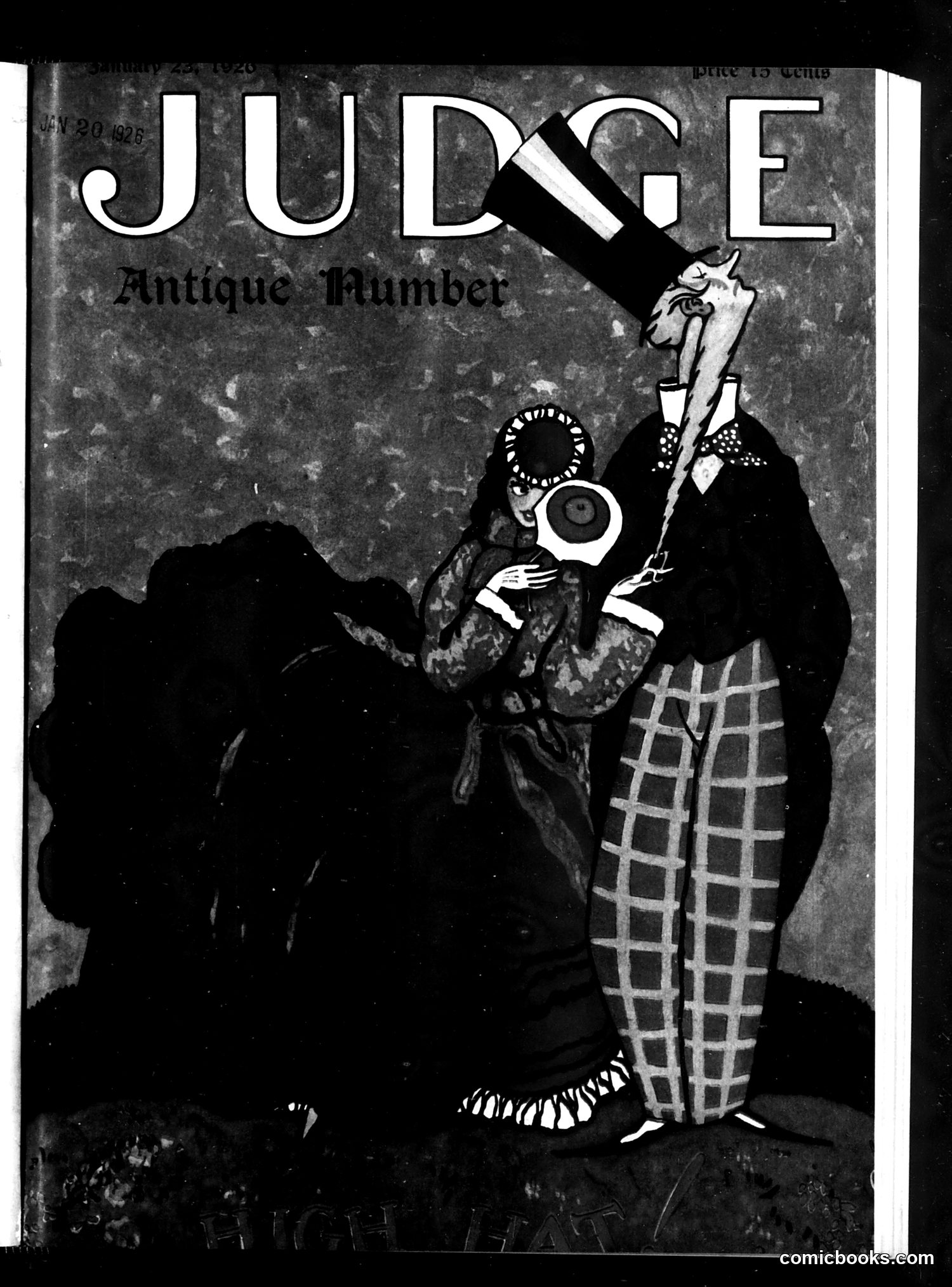
Judge — January 23, 1926
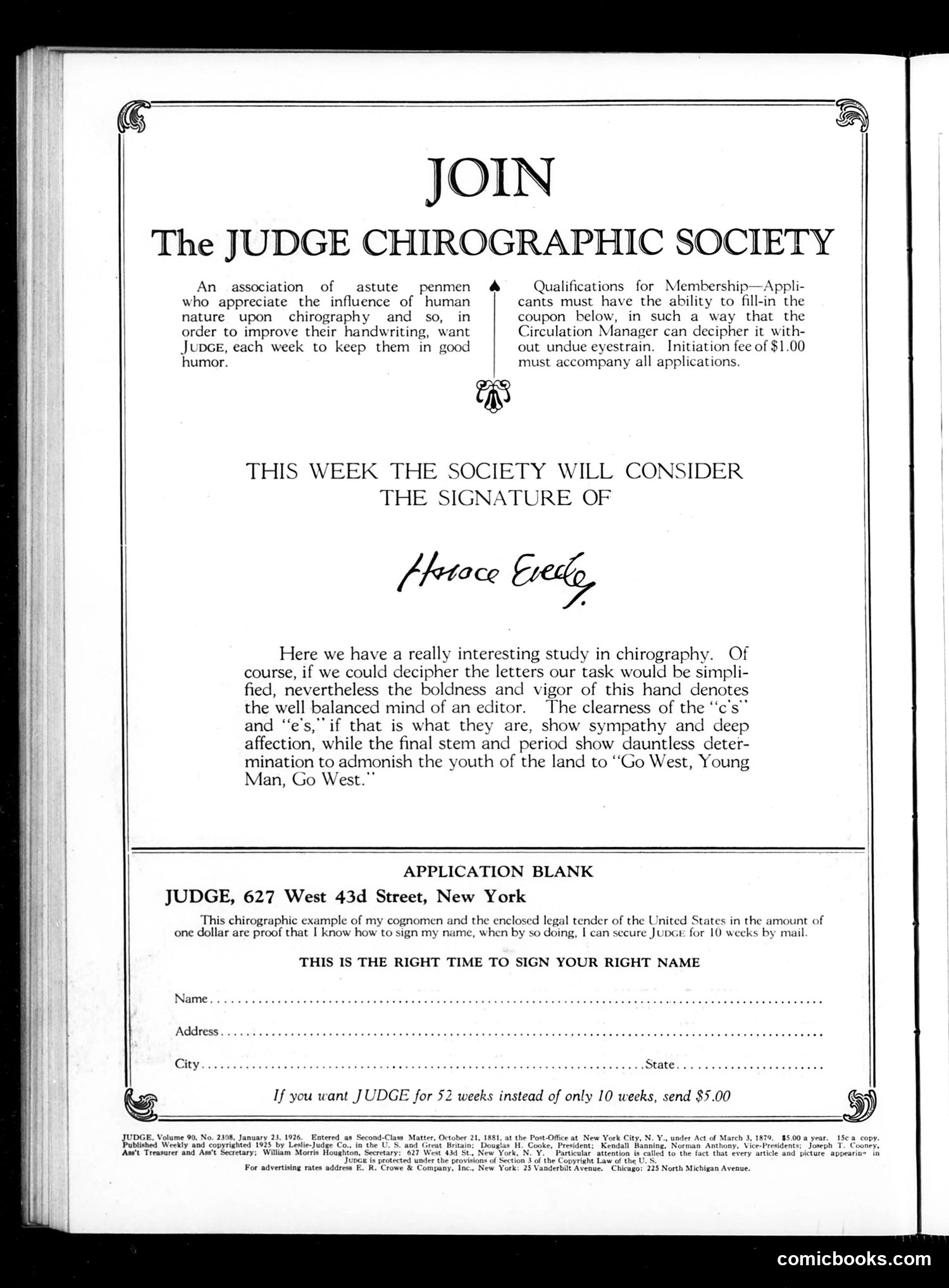
This page is primarily a humorous advertisement for "Judge" magazine's fictional "Chirographic Society"—a club supposedly dedicated to studying handwriting. The society announces it will analyze the signature of **Horace Greeley** this week. The satire examines Greeley's handwriting as a window into his character: the bold letters suggest an editor's balanced mind, the clear "c"s denote sympathy, and the firm final stroke represents his famous exhortation to young men: "Go West, Young Man, Go West." The piece gently mocks both the pseudoscience of graphology and Greeley himself—the most prominent newspaper editor of his era. An application blank follows, inviting readers to join for $1.
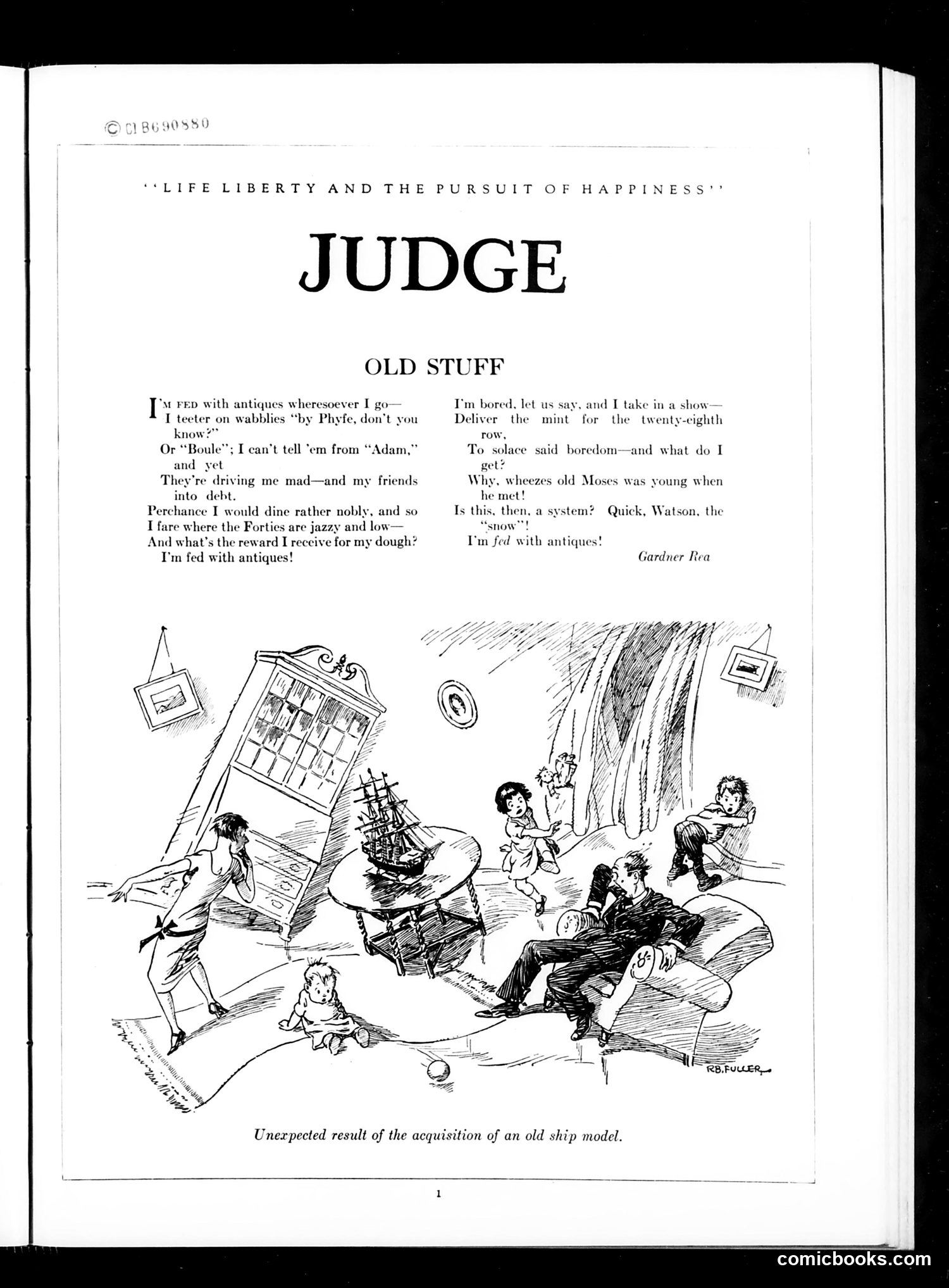
This satirical piece mocks obsessive antique collecting, a leisure pursuit among wealthy Americans in the early 20th century. The poem by Gardner Lea complains about being "fed with antiques"—friends constantly discussing old objects, their origins, and valuations ("twenty-eighth row"). The cartoon illustrates the chaos this hobby causes: adults and children play chaotically around giant antique furnishings—a tilted cabinet, ship model, and drapery—scattered as if throughout a home. The figures appear overwhelmed and somewhat trapped by the clutter. The satire targets how antique collecting disrupted domestic life and social relationships, transforming homes into museums and consuming owners' time, money, and attention. The "unexpected result" caption suggests that hobby enthusiasm produces disorder rather than refined living.
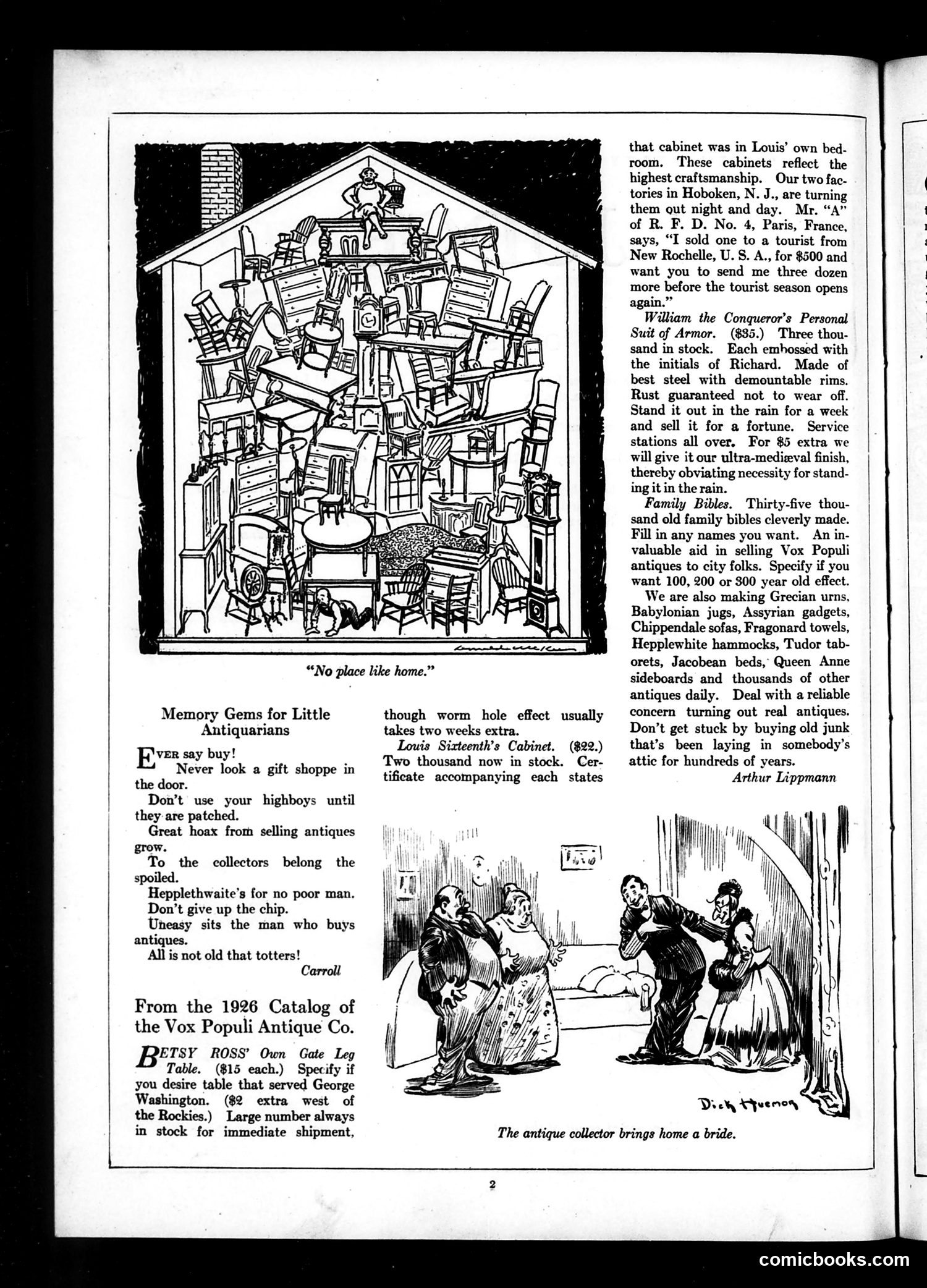
This page is primarily **advertising content** disguised as editorial material, circa 1926. The main illustration—"No place like home"—depicts an impossibly crowded interior stuffed with furniture, satirizing the antique dealer's business. It's a visual joke about cluttered Victorian homes and the antique craze. The bottom cartoon, titled "The antique collector brings home a bride," shows a domestic scene where the groom appears more interested in displaying his antique acquisitions than attending to his new wife—a gentle jab at collectors' obsession with possessions over human relationships. The text consists of humorous testimonials promoting various antiques (Louis XVI cabinets, armor, family bibles) from the Vox Populi Antique Co., encouraging readers to purchase "real antiques" rather than "old junk." The satire mildly mocks both collectors' pretensions and dealers' marketing tactics.
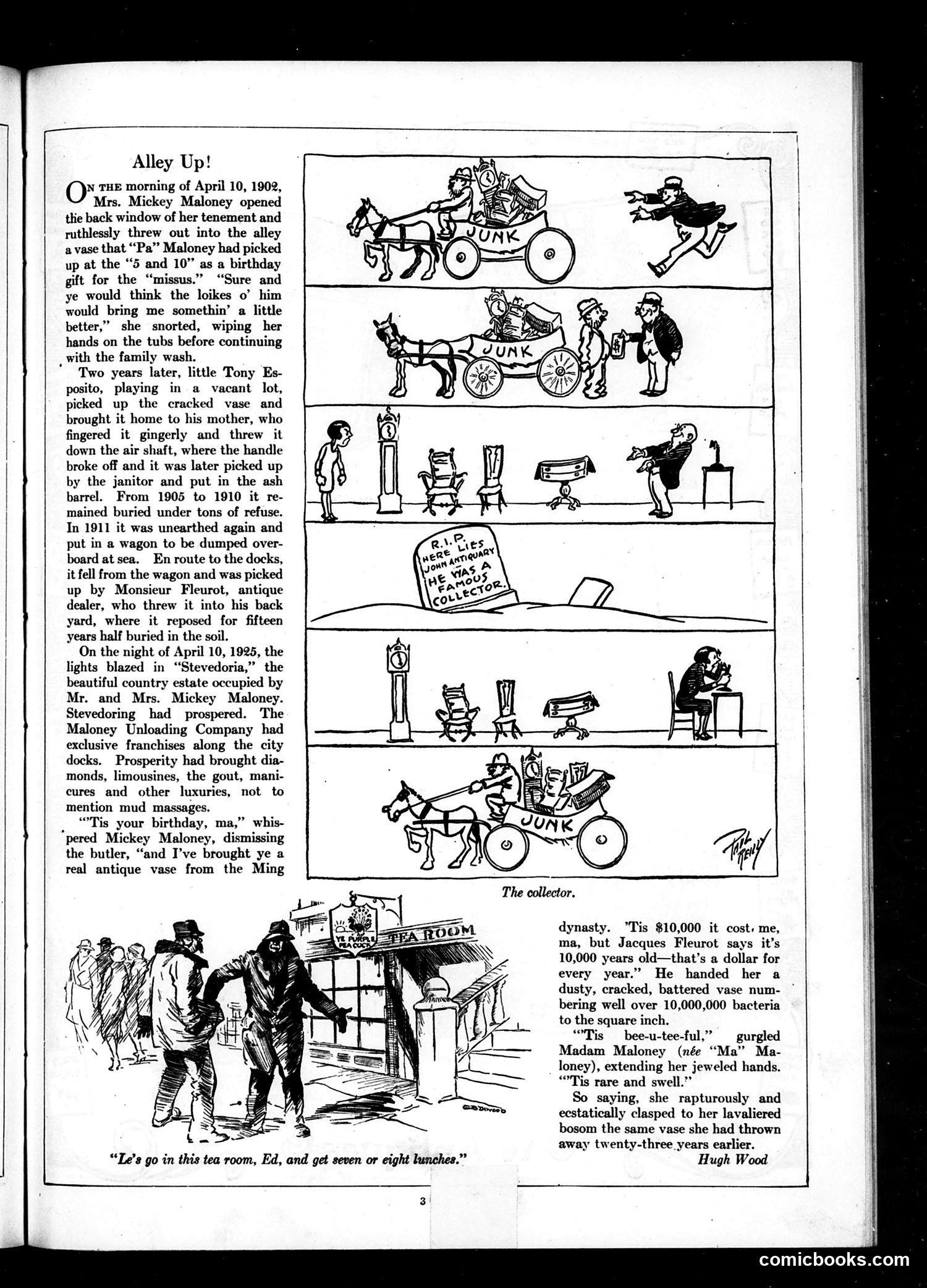
This Hugh Wood cartoon satirizes the obsession with collecting valuable antiques among the wealthy Maloney family. The narrative follows a Ming vase discarded by Mrs. Maloney in 1902, which circulates through various hands—a junk collector, an antique dealer (Monsieur Fleurot), and eventually returns to the Maloneys in 1925 as a "rare" acquisition worth $10,000. The comic strip panels humorously depict the vase's journey, ultimately mocking upper-class pretension: the Maloneys treasure what they'd previously deemed worthless junk. The satire targets how wealth and social status drive artificial value in the antiques market, and how collectors mistake providence for connoisseurship. The title "Alley Up" plays on the vase's humble origins in an alley.
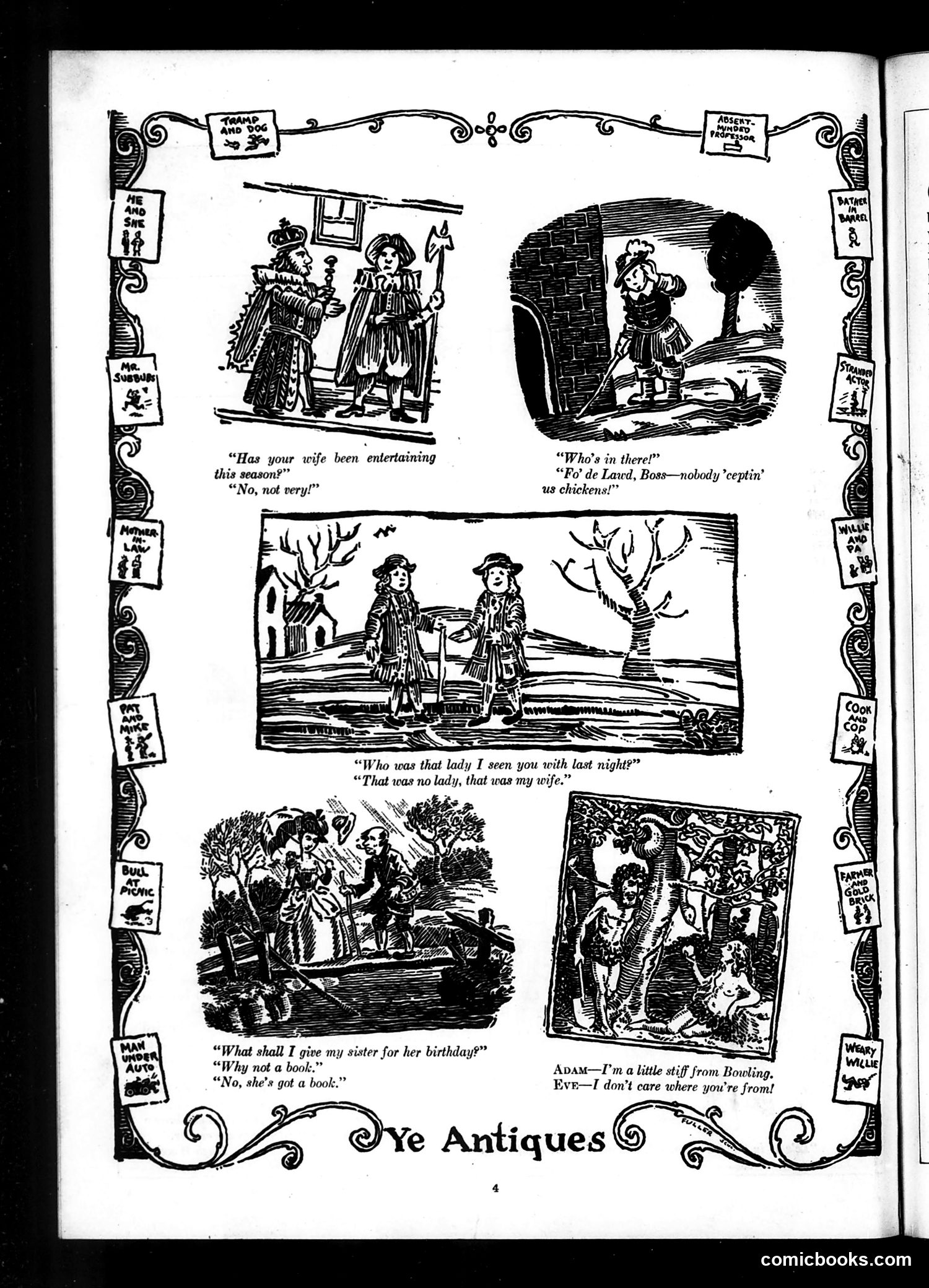
This page presents a series of domestic comedies playing on Victorian/Edwardian social conventions. The sketches satirize: 1. **Marital deception**: A husband denies entertaining women while his wife was away, then claims the woman seen was actually his wife. 2. **Gift-giving awkwardness**: A dialogue about gifting a book to a sister, with the punchline that books aren't suitable gifts. 3. **Romantic jealousy**: A man confronts another about being seen with a woman the previous night. 4. **Literary references**: The final panel references Bowen and Shakespeare's *Adam and Eve*, using classical allusions for comic effect. The satire targets upper-class manners, marital suspicion, and social pretension rather than specific political figures. The decorative border with character names suggests this is part of Judge's ongoing comedic commentary on genteel society.
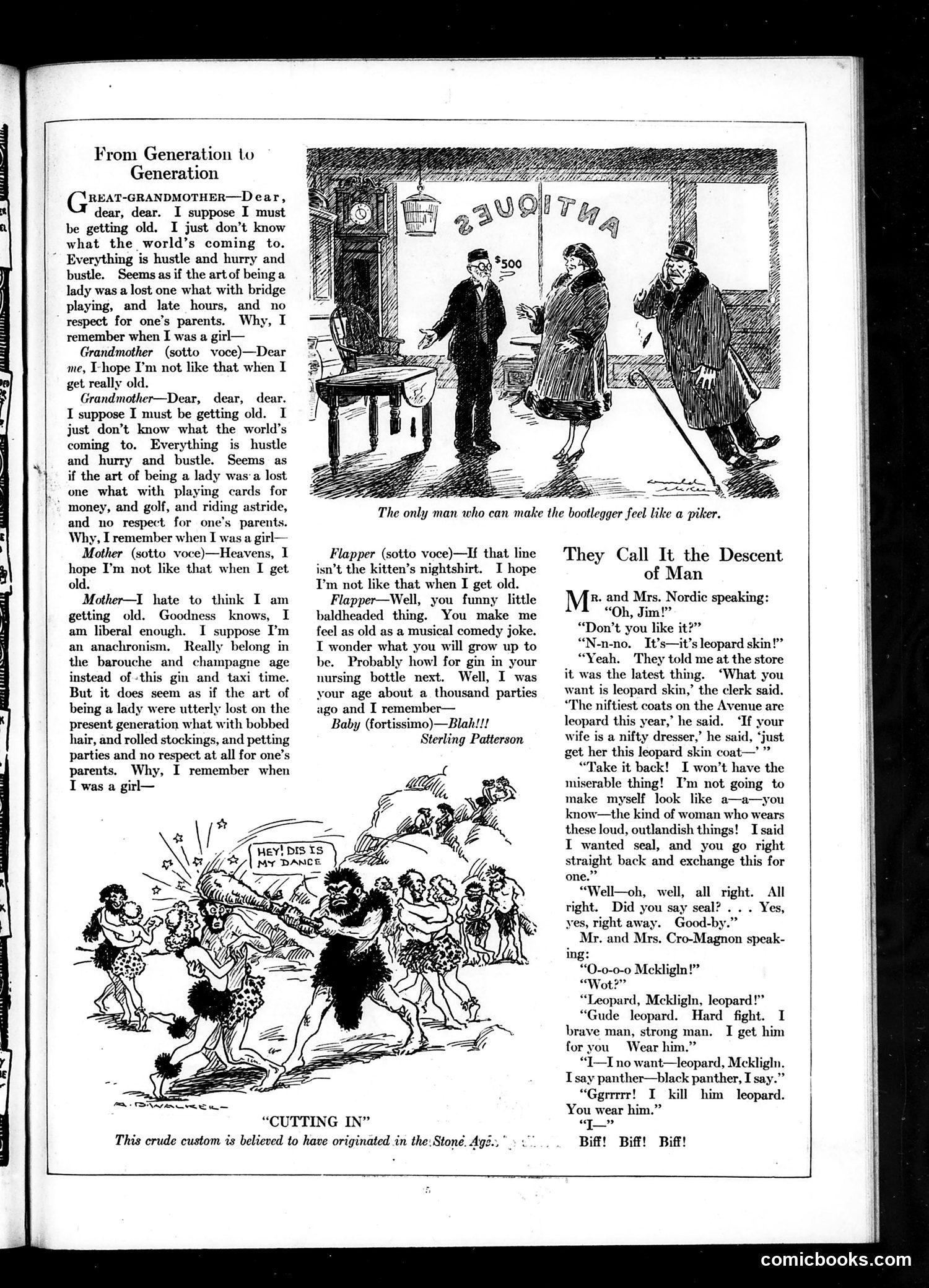
This Judge page contains two separate pieces: **"From Generation to Generation"** (left): A dialogue between Great-Grandmother, Grandmother, Mother, and Flapper about changing social customs. Each generation laments that young women have lost respectability—the Flapper dismisses these concerns, defending modern freedoms. The satire mocks generational anxiety: each older generation believed *their* youth marked civilization's decline. **"They Call It the Descent of Man"** (right): A sketch about a woman purchasing a leopard-skin coat. The husband protests it's unfashionable; she insists it's the height of style on the Avenue. The joke satirizes how women follow fashion trends uncritically and husbands' powerlessness to stop wasteful spending. Both pieces target 1920s social change: generational conflict and consumer culture, particularly women's evolving roles.
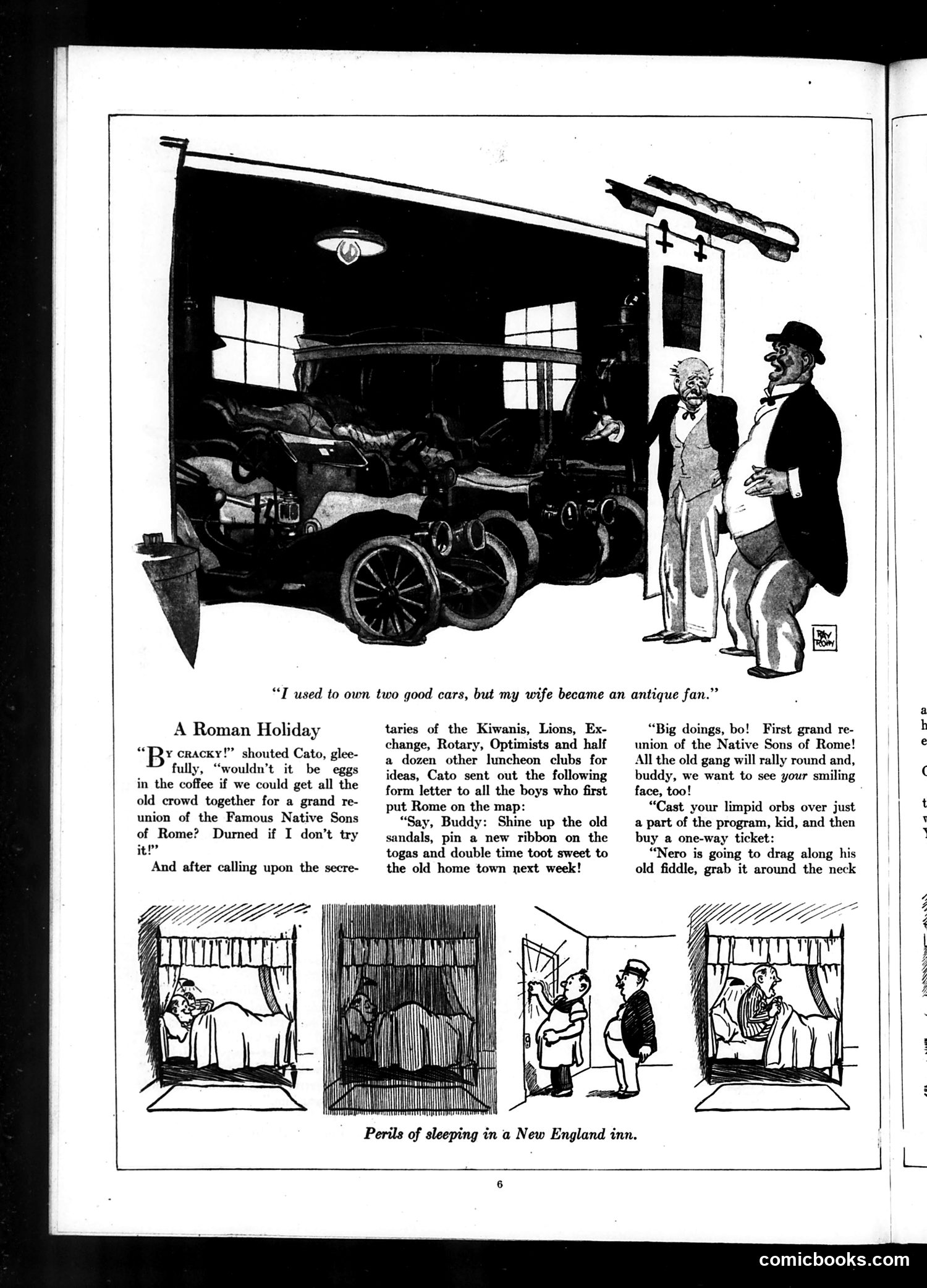
This two-part satirical piece mocks fraternal organizations and nostalgia tourism. The top cartoon depicts a man and woman examining antique cars in a garage, with the caption joking that his wife became an "antique fan"—a play on collecting old objects and obsessing over the past. The main story ridicules "Native Sons of Rome" reunion organizers who contact Kiwanis, Lions, Rotary, and similar civic clubs to drum up attendance. The satire targets the absurdity of grown men dressing in togas and adopting Roman personas for a homecoming celebration. Below, "Perils of Sleeping in a New England Inn" depicts travelers encountering bizarre bedside experiences—likely satirizing the uncomfortable, cramped conditions in regional accommodations. The humor lies in poking fun at small-town boosterism, male fraternal pretension, and the gap between romanticized historical fantasy and actual experience.
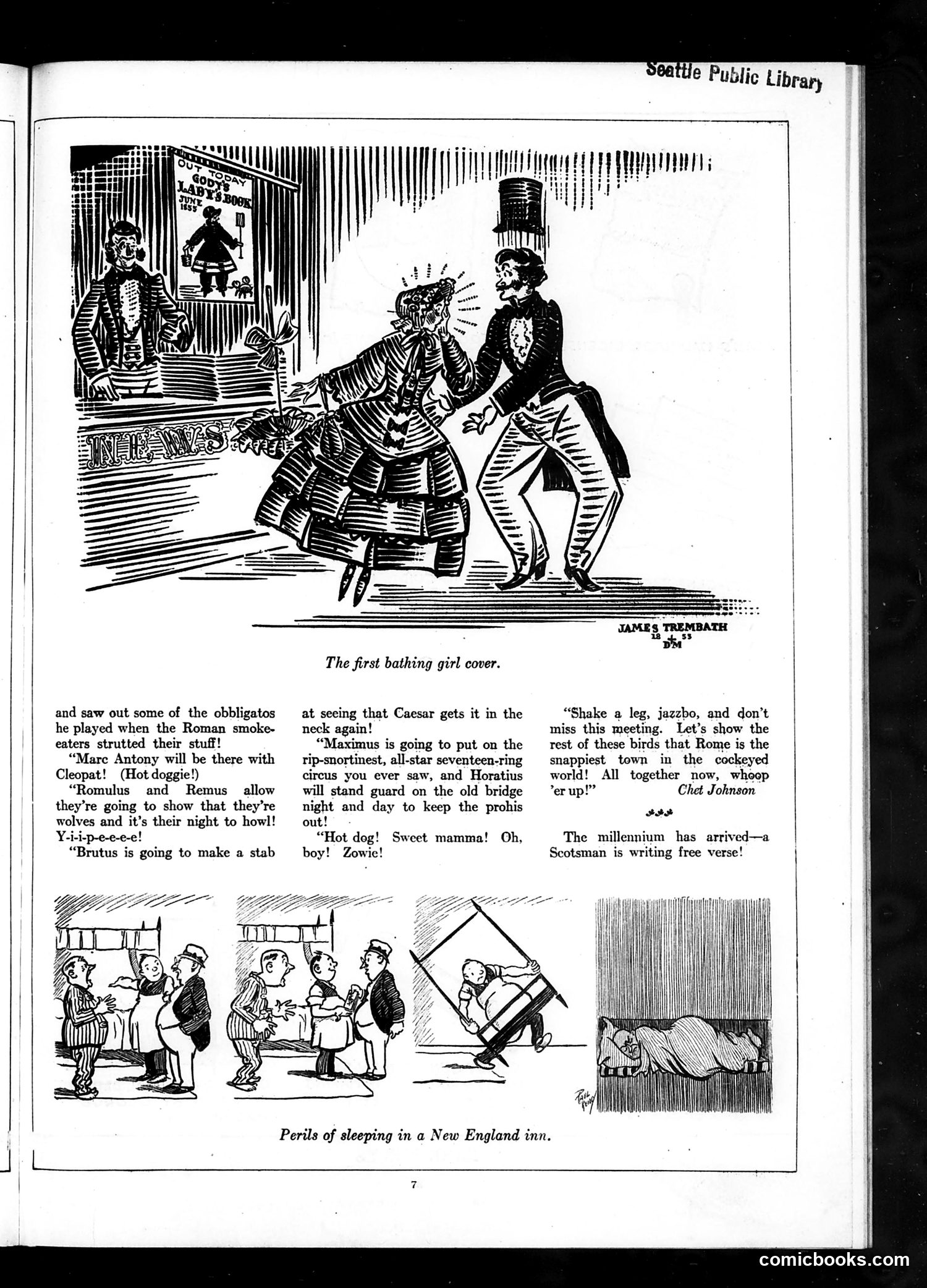
**Top Cartoon**: "The first bathing girl cover" depicts what appears to be a scandalous moment—a woman in a bathing costume encountering a formally-dressed man. The satire targets the novelty of women appearing in bathing attire in public media, which was controversial in early 20th-century America. This represents Judge's commentary on changing social mores around female dress and public display. **Middle Section**: The dialogue references a Roman circus spectacular, with characters boasting about attractions featuring famous figures (Caesar, Cleopatra, Romulus and Remus). This satirizes contemporary American enthusiasm for grand entertainment spectacles and sensationalism, using Roman analogies. **Bottom Cartoons**: "Perils of sleeping in a New England inn" shows comedic chaos—crowded sleeping quarters and cramped conditions, satirizing the poor accommodations at period New England inns. **Final Joke**: "A Scotsman is writing free verse" mocks Scottish frugality—implying even a notoriously stingy Scot would adopt free verse (which costs nothing) rather than pay for structured poetry.
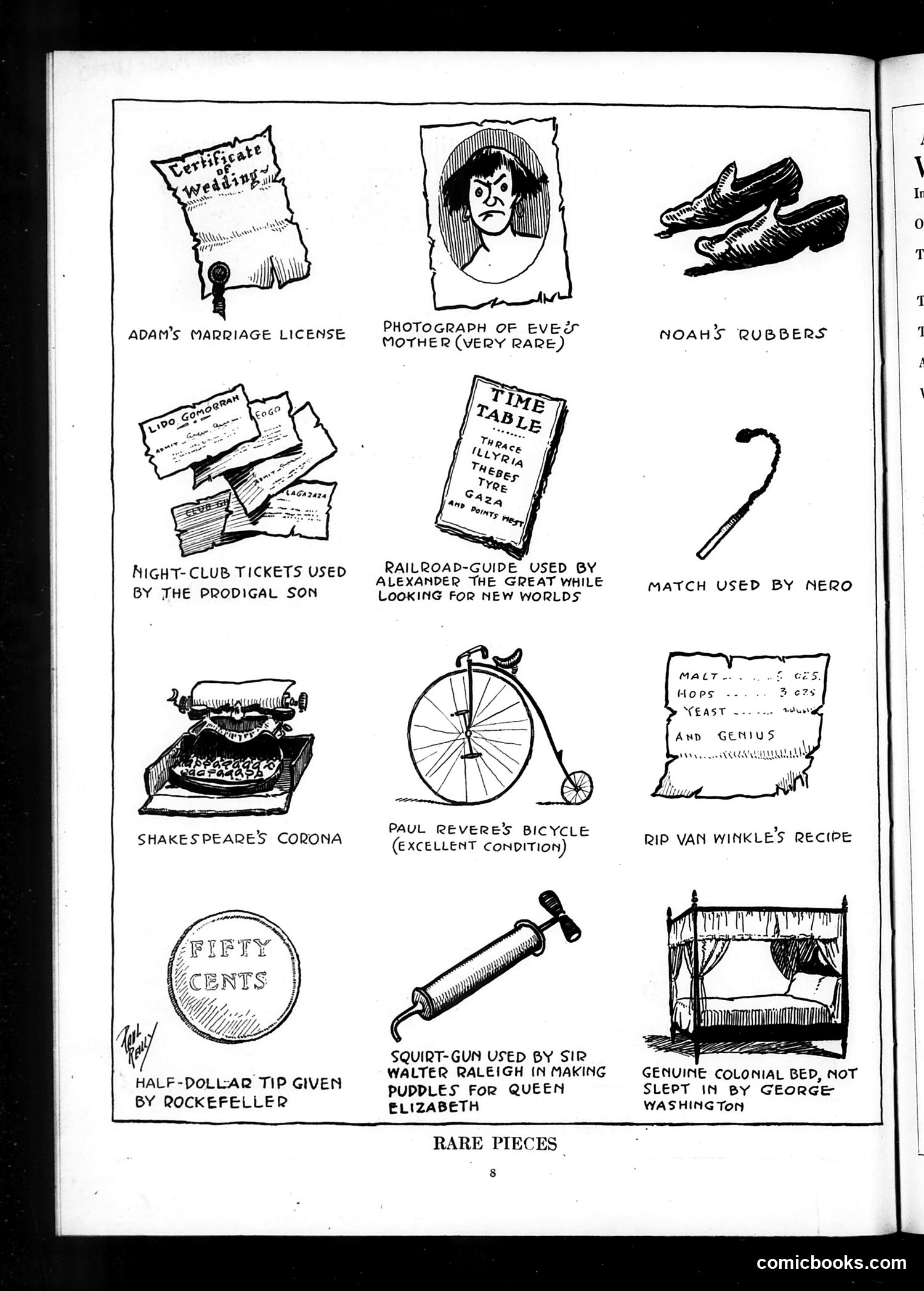
This full-page cartoon from *Judge* presents a humorous "museum catalog" of fictional "rare pieces"—impossible or ridiculous historical artifacts. The satire mocks both the era's obsession with collecting historical memorabilia and the gullibility of collectors. The joke structure pairs famous historical figures (Shakespeare, George Washington, Paul Revere, Queen Elizabeth, Sir Walter Raleigh) with laughably anachronistic or nonsensical items attributed to them. For instance: "Photograph of Eve's Mother (very rare)" satirizes the impossibility of pre-photography biblical figures, while Rockefeller's "half-dollar tip" mocks the wealthy businessman's reputation for miserliness. The overall effect ridicules the American Gilded Age's appetite for purchasing "authentic" historical relics—often dubious—while poking fun at both the acquisitiveness of the rich and the absurdity of claiming provenance for items that logically couldn't exist.
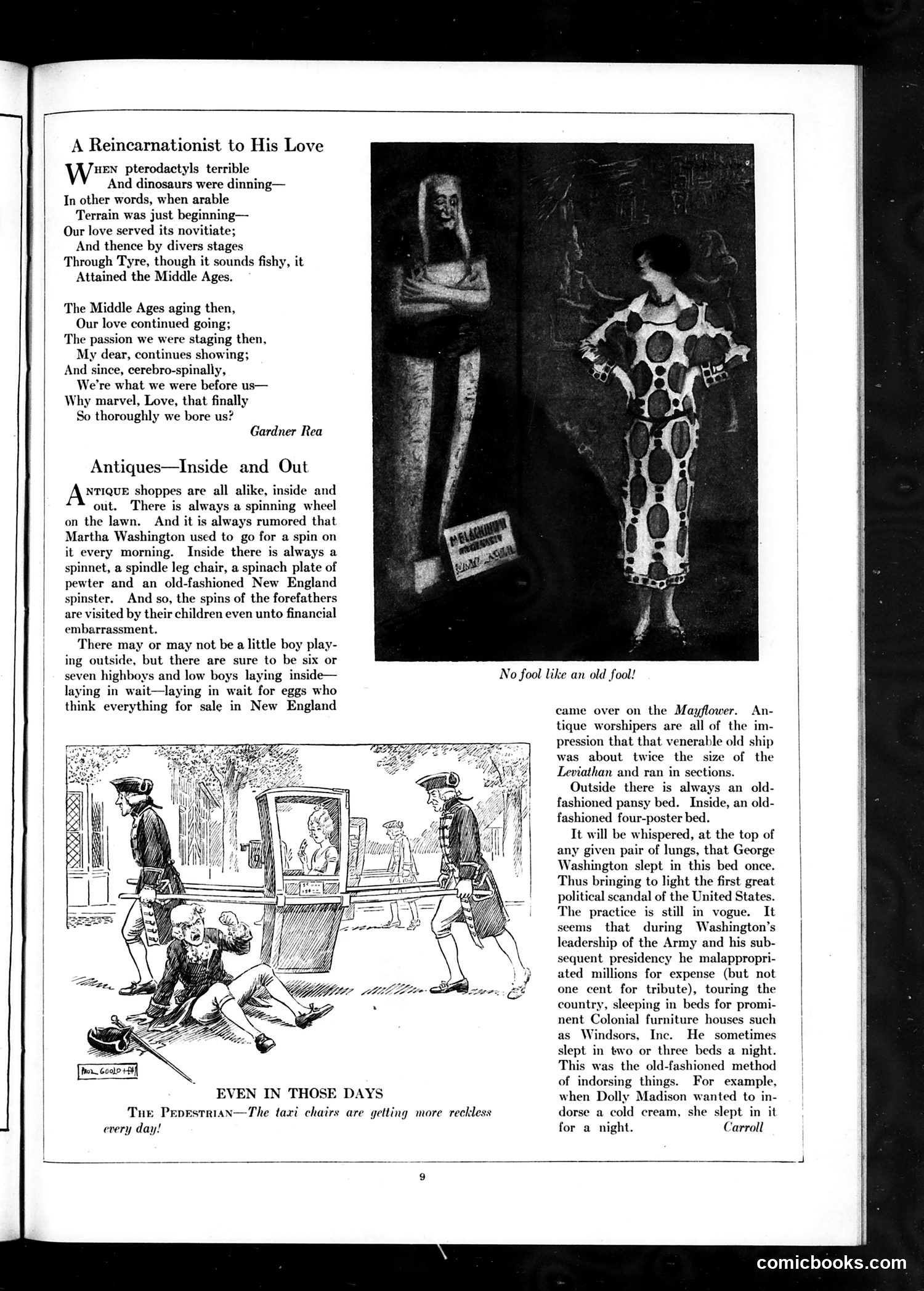
This page contains three distinct pieces of satirical content: **"A Reincarnationist to His Love"** (Gardner Rea): A witty poem mocking reincarnation philosophy. The speaker traces his love through geological ages (pterodactyls, Middle Ages, etc.), concluding that despite evolving through countless lifetimes together, they've simply become bored with each other—undermining the romantic notion that eternal love transcends reincarnation. **"Antiques—Inside and Out"**: Satirizes America's obsession with Colonial-era antiques and historical tourism. The piece mocks antique shops' ubiquitous spinning wheels (falsely attributed to Martha Washington) and their tendency to claim every old piece belonged to George Washington. The joke escalates absurdly: Washington allegedly "malappropriated millions" by sleeping in various beds across the country—turning endorsement into a founding father scandal. **"Even in Those Days"**: A single-panel cartoon about taxi chairs becoming reckless pedestrians, likely commenting on traffic safety in urban areas. The page satirizes both romantic sentimentality and Americans' reverence for historical artifacts and celebrity associations.
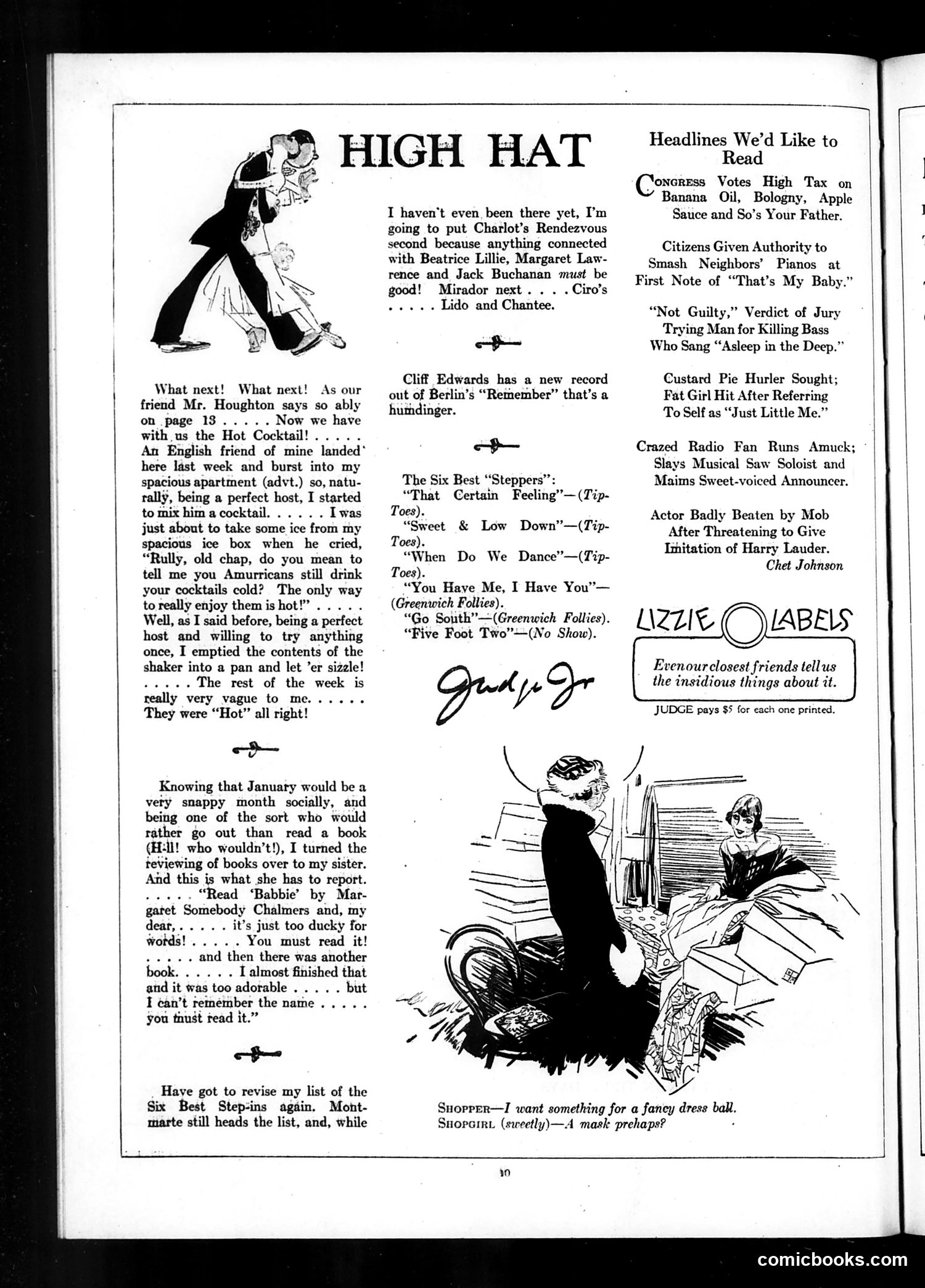
This page from **Judge** magazine (a 1920s satirical publication) contains three main comedic elements: **The Hot Cocktail Anecdote**: A humorous story about an English visitor insisting cocktails be served hot—a satirical jab at affected British pretension and American hospitality. The punchline mocks both the visitor's absurd claim and the narrator's gullible willingness to accommodate it. **"Lizzie Labels" Section**: A humor column where readers submit fake newspaper headlines mocking contemporary annoyances—noisy pianos, bad radio performers, overwrought theatrical actors. This reflects 1920s frustrations with new entertainment technologies and culture. **Book Reviews & Entertainment Listings**: The column critiques nightclubs, musical recordings (including Cliff Edwards), and Broadway shows. The "Six Best Steppers" lists popular songs, reflecting Judge's focus on New York entertainment trends. The overall tone is lighthearted social satire targeting urban sophistication, entertainment fads, and modern inconveniences—typical of Judge's sophisticated, upper-middle-class audience during the Jazz Age.
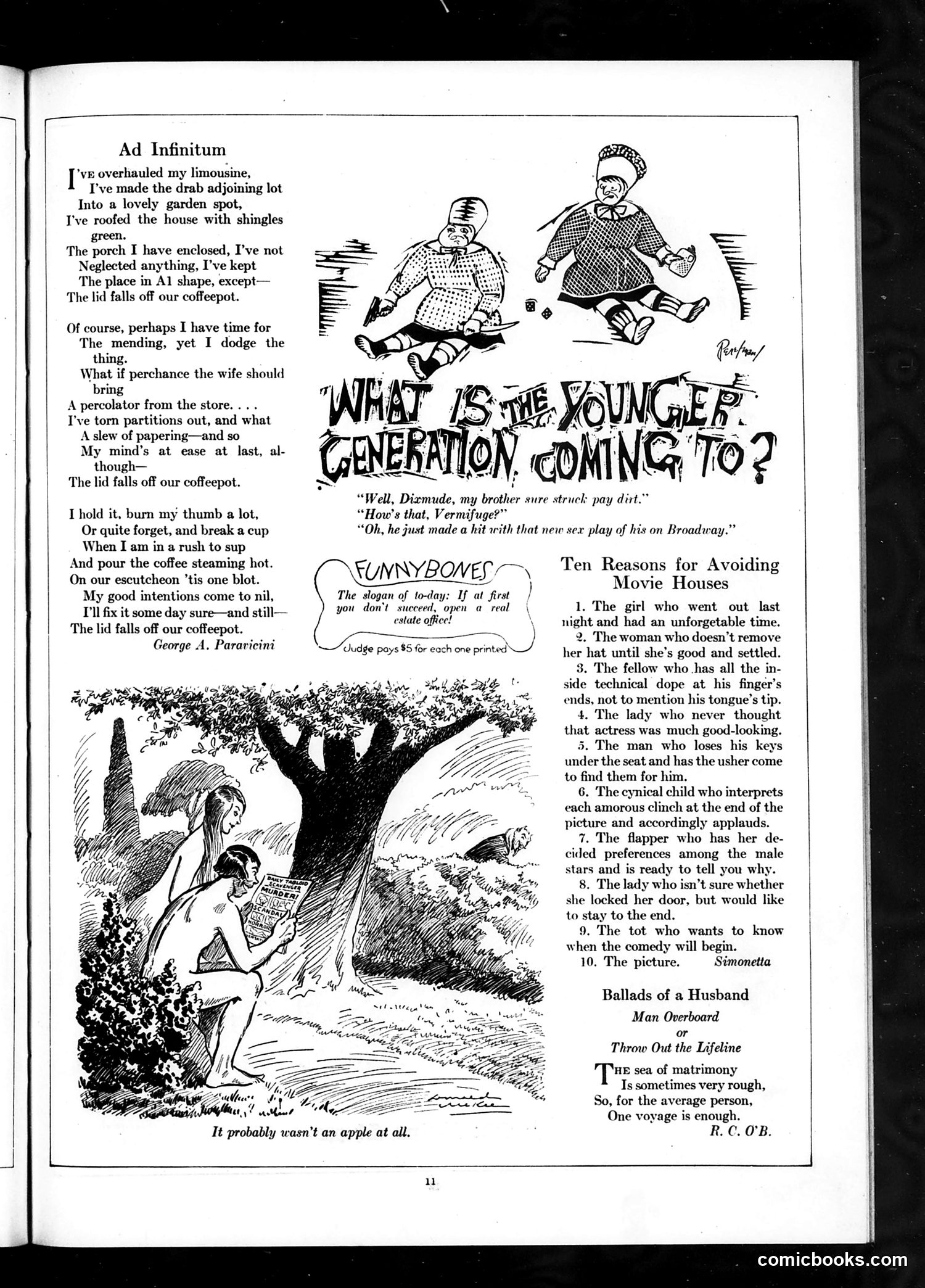
**Main Poem ("Ad Infinitum"):** A humorous complaint about home improvement obsession. The speaker has renovated extensively—limousine, garden, roof, porch—yet remains unable to fix a simple broken coffeepot lid. The satire targets middle-class anxiety about maintaining appearances and completing projects; despite elaborate efforts to achieve respectability ("Al shape"), a trivial domestic failure undermines it all. **"What Is the Younger Generation Coming To?":** A cartoon dialogue mocking contemporary Broadway theater. Two characters discuss someone's theatrical success with a "new sex play"—likely referencing the sexually explicit theatrical trends of the Jazz Age, which conservative readers viewed as scandalous. **"Ten Reasons for Avoiding Movie Houses":** A satirical list targeting annoying moviegoers—chatty spectators, children asking questions, women refusing to remove hats—reflecting early cinema's social adjustment period when audience etiquette remained undefined. **Supporting items** include brief jokes about real estate speculation and marriage dissatisfaction, typical Judge magazine filler content mocking contemporary American social anxieties.
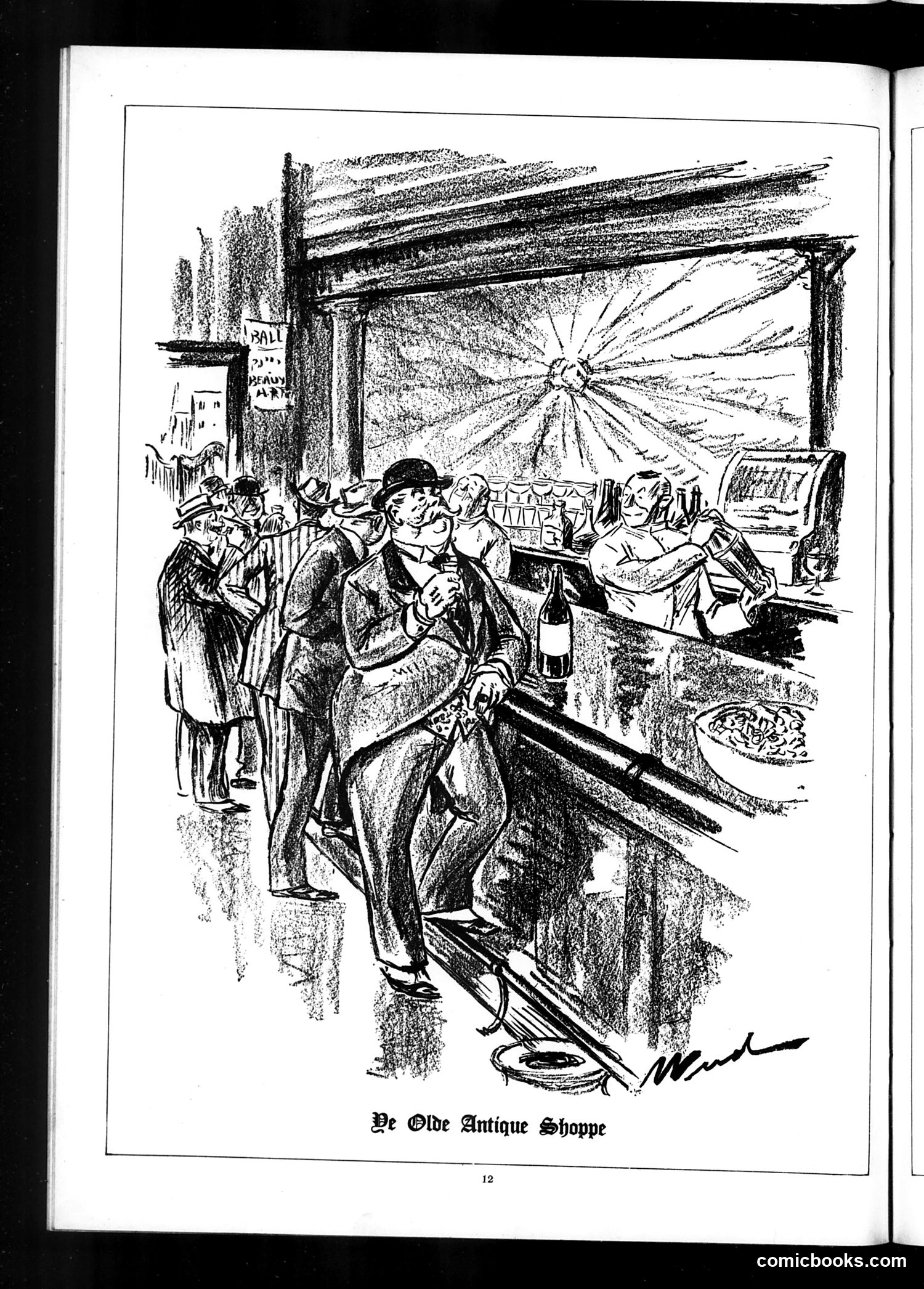
This cartoon satirizes the antique trade and nostalgia commerce. The scene depicts a shop interior where a rotund, well-dressed proprietor (likely the shopkeeper) stands prominently in the foreground, apparently conducting business. The shop is filled with various patrons and merchandise, with sunlight streaming through windows above. The satire appears to target the commercialization of "antique" goods—suggesting these shops sold items marketed as old and valuable when they may have been newly manufactured fakes or worthless junk. The exaggerated, caricatured shopkeeper implies deception or hucksterism. Judge magazine frequently mocked consumer culture and commercial fraud, making this a commentary on how merchants exploited middle-class desires for status through supposed historical objects.
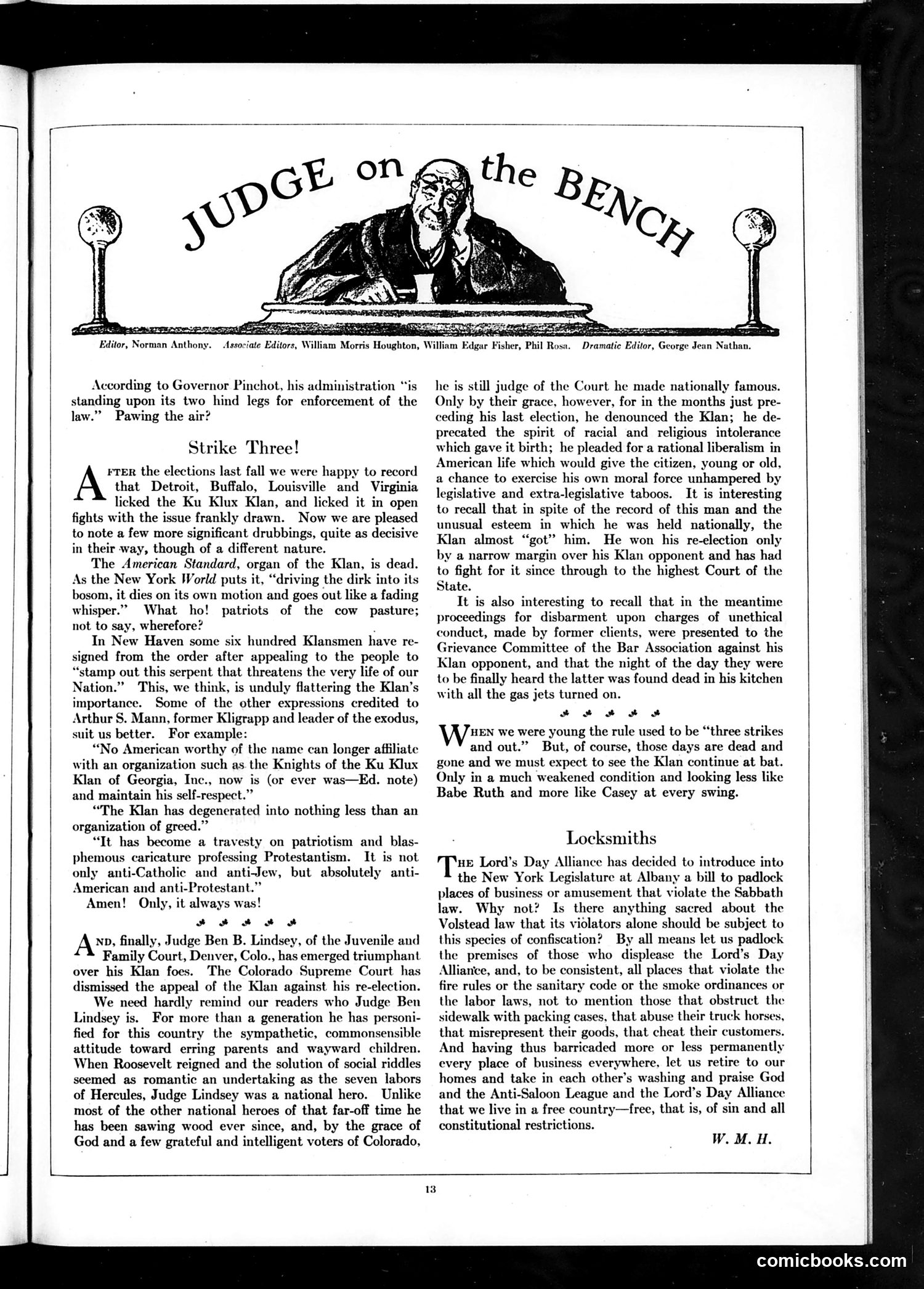
This editorial celebrates recent electoral defeats of the Ku Klux Klan, using the metaphor "Strike Three!" to declare the organization's decline. The text highlights victories in Detroit, Buffalo, Louisville, and Virginia where voters rejected the Klan's political influence. The main focus is Judge Ben B. Lindsey of Denver's Juvenile Court, who narrowly won re-election despite Klan opposition and successfully defended against their legal appeal. The satire emphasizes the irony: Lindsey—a celebrated progressive reformer famous for championing children and opposing moral intolerance—barely survived a campaign where the Klan nearly "got him," and his Klan opponent faced unethical conduct charges before mysteriously dying. The piece also notes the American Standard (the Klan's publication) folding and 600 New Haven Klansmen resigning, citing the organization's degeneration into greed and hypocrisy rather than genuine patriotism. The underlying point: American institutions and progressive values are prevailing against Klan extremism, though only narrowly and with difficulty.
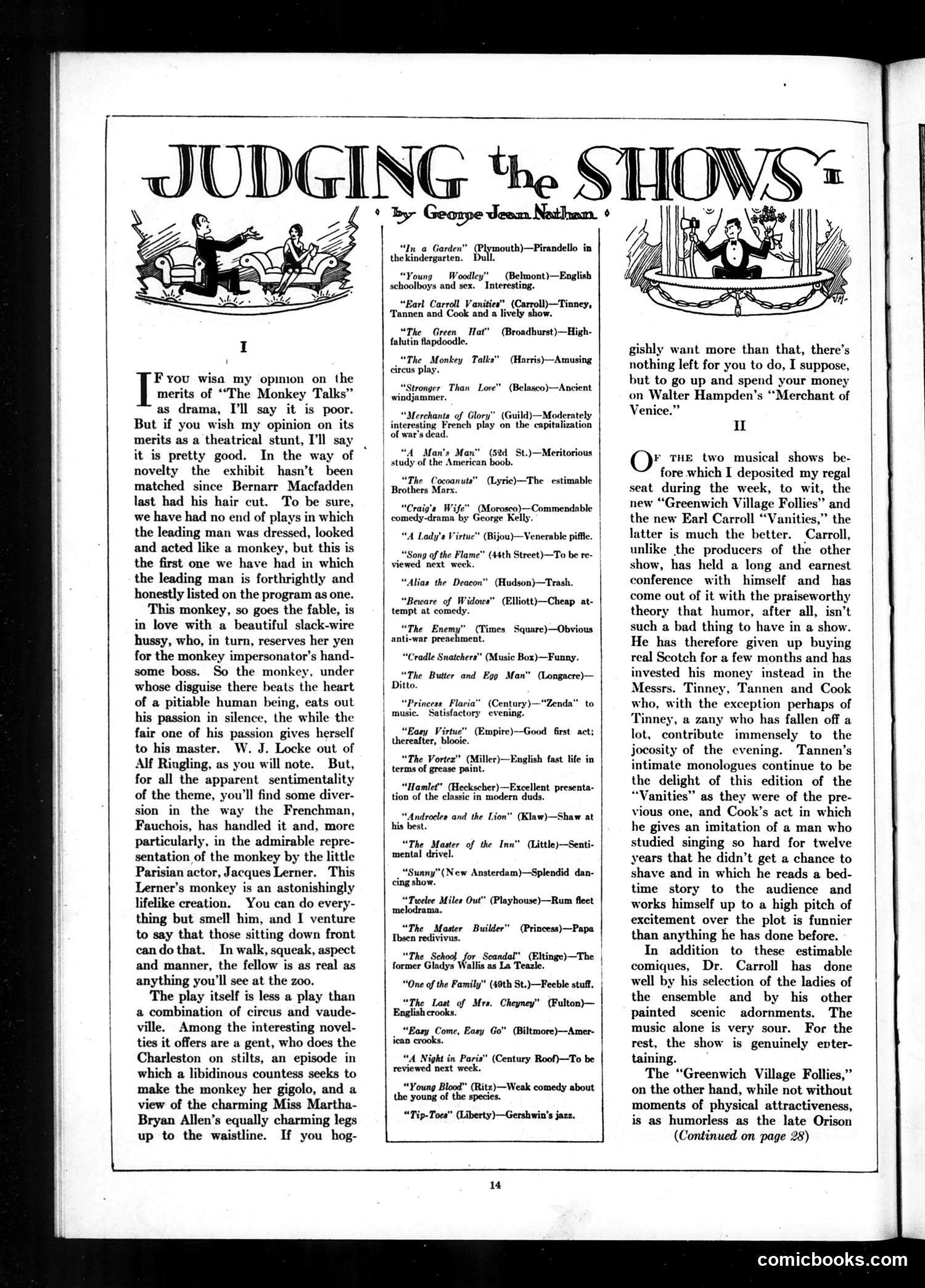
This is a theater critic's column reviewing Broadway productions. The page's main content concerns "The Monkey Talks," a play where the lead actor is billed honestly as playing a monkey—a novelty the critic finds theatrically striking if dramatically weak. The critic praises the Parisian actor Jacques Lerner's convincing monkey performance and notes the play combines circus and vaudeville elements, including a character doing the Charleston on stilts and actress Martha Bryan Allen's prominent leg display. The right column lists brief reviews of other current shows, rating their merits. The critic's overall point: "The Monkey Talks" succeeds as entertainment spectacle rather than serious drama, comparing it to producer Alf Ringling's circus background and noting its W.J. Locke-derived sentimental plot (monkey loves slack-wire performer; she loves his human master).
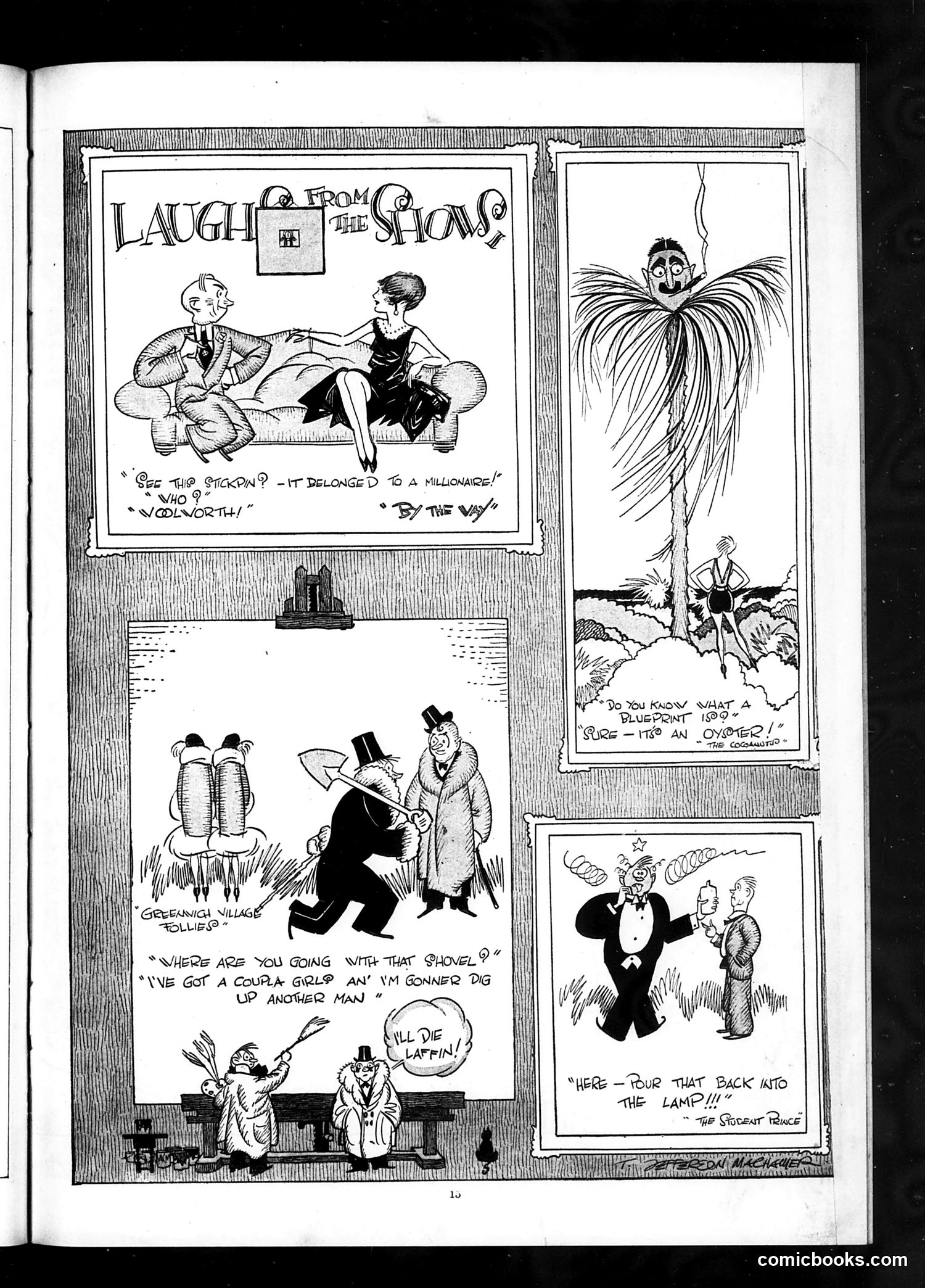
This page collects comic vignettes satirizing wealthy society and romantic entanglements. The top panel mocks nouveau riche pretension: a woman claims a stolen stickpin belonged to "a millionaire" named Woolworth—likely referencing the Woolworth retail fortune. The "Greenwich Village Follies" section satirizes bohemian and working-class characters. One sketch jokes about digging up another man—crude innuendo about affairs. Another depicts a well-dressed man with a shovel and his companion, humorously suggesting illicit activity or grave-digging as metaphor for romantic betrayal. The right panel shows a fantastical winged creature (appears to be a genie or fairy) with the caption about "blueprints" for an oyster—obscure wordplay, possibly mocking pretentious artistic or culinary claims. The final panel references a magic lamp, invoking the Aladdin tradition to satirize class mobility and wish-fulfillment fantasies among ordinary people aspiring to wealth. Overall, the page mocks wealth aspiration, romantic deception, and bohemian pretense through exaggerated visual humor.
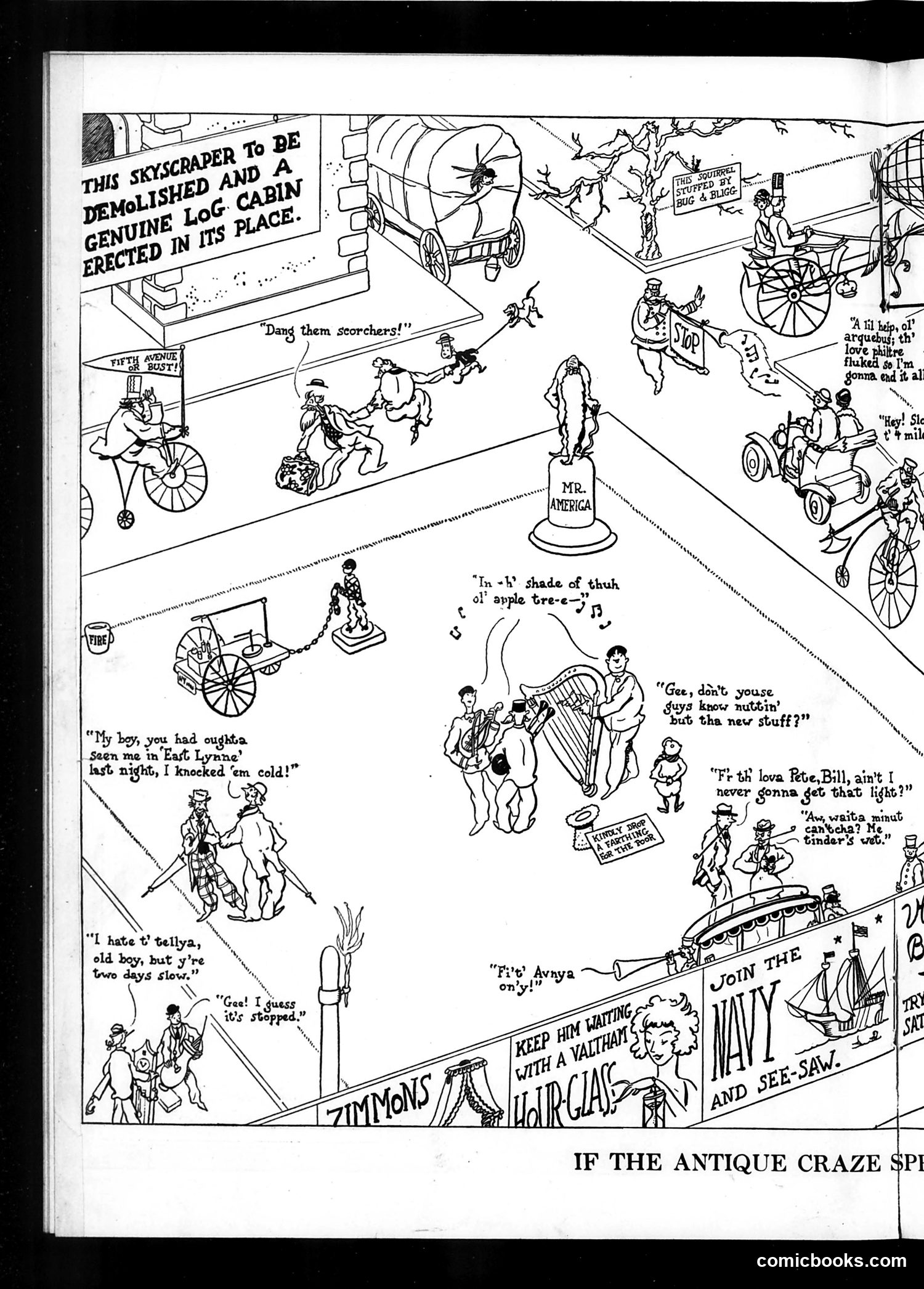
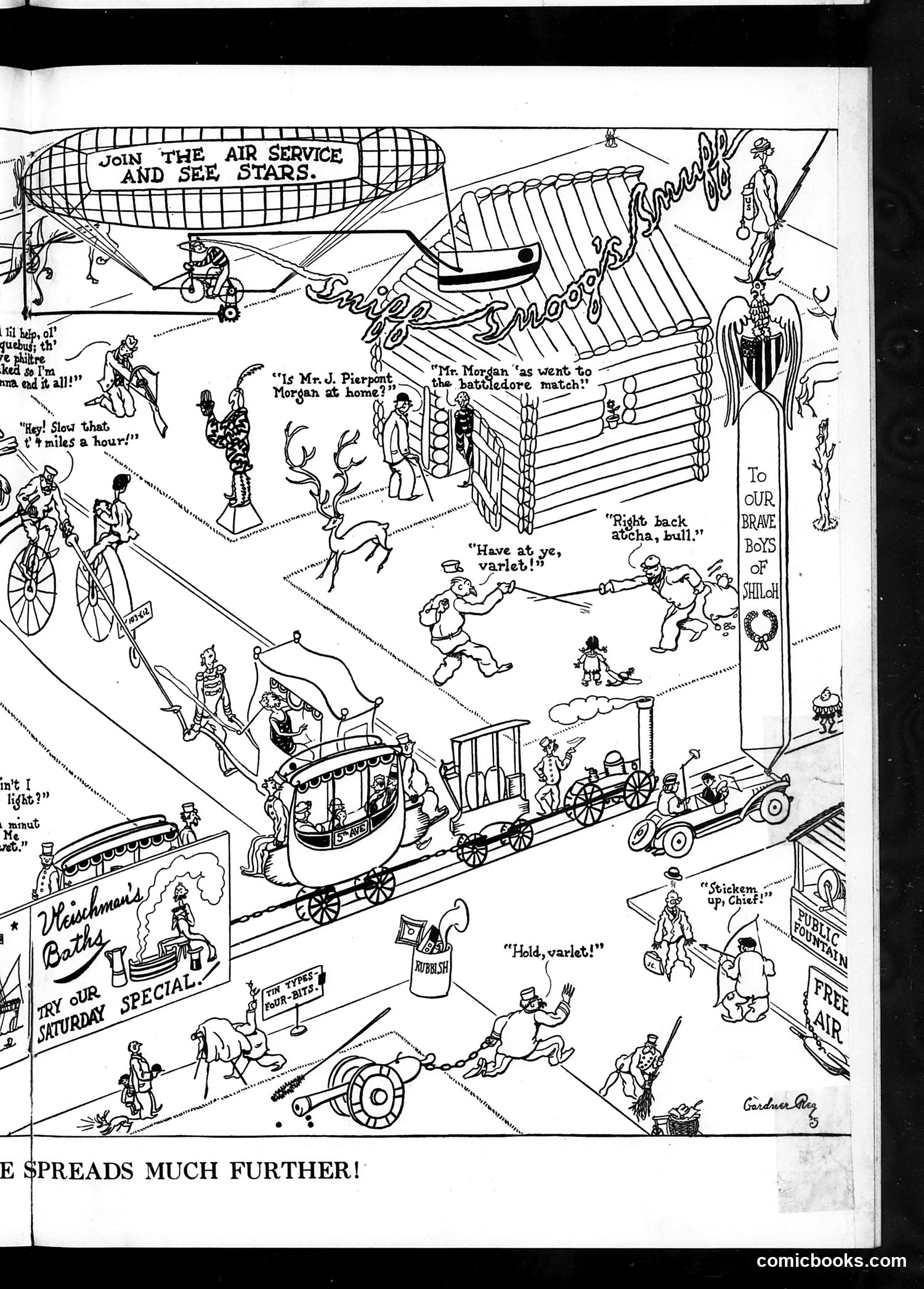
This cartoon satirizes an early 20th-century fad for antiquing—collecting or fashioning items to look old. The scene depicts people gathered around a statue labeled "Mr. America" in what appears to be a public square, with various characters discussing outdated entertainment and styles. The satire mocks those who cling to yesterday's cultural references: one man boasts about seeing the melodrama "East Lynne" (a Victorian-era play), while others debate old-fashioned theater and novelties. Dialogue like "two days slow" and dismissive responses ("don't youse guys know nuthin' but tha new stuff?") highlight the tension between those enthusiastically pursuing antiquity and those viewing such pursuits as hopelessly out-of-date. The bottom includes period advertisements (Zimmons, Navy recruitment) typical of Judge magazine. The overall joke: Americans' obsessive trend-chasing has become so fickle that *even antiquity itself is going out of style*.
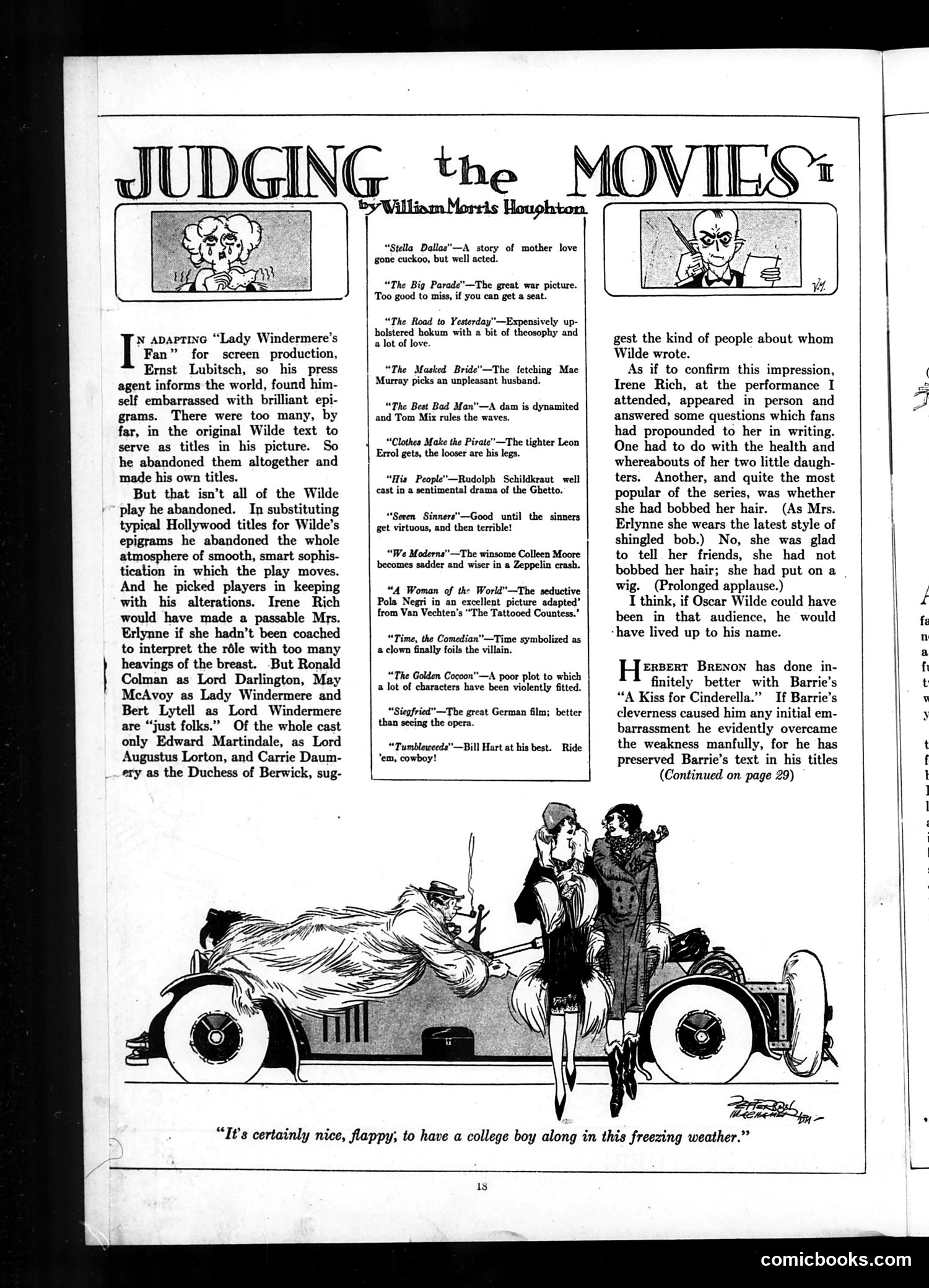
This page reviews recent Hollywood films through film critic William Morris Houghton's column. The main critique concerns director Ernst Lubitsch's adaptation of Oscar Wilde's "Lady Windermere's Fan." Houghton argues that Lubitsch, uncomfortable with Wilde's abundant witty epigrams, abandoned them entirely and substituted generic Hollywood titles. More problematically, this removed the sophisticated atmosphere essential to Wilde's play. Houghton criticizes the casting—particularly Irene Rich—as "just folks" lacking the urbane quality Wilde's characters demand. The satire culminates when Rich appears in person at a screening discussing mundane topics (her children, whether she bobbed her hair) rather than Wilde's brilliant wit. Houghton quips that Wilde himself, witnessing this ordinariness, would have "lived up to his name"—a pun on "Oscar" (suggesting he'd be literally called out/exclaimed at). The sidebar lists brief reviews of other current films, mostly comedies and adventure pictures. The cartoon below depicts a flapper scene typical of 1920s cinema.
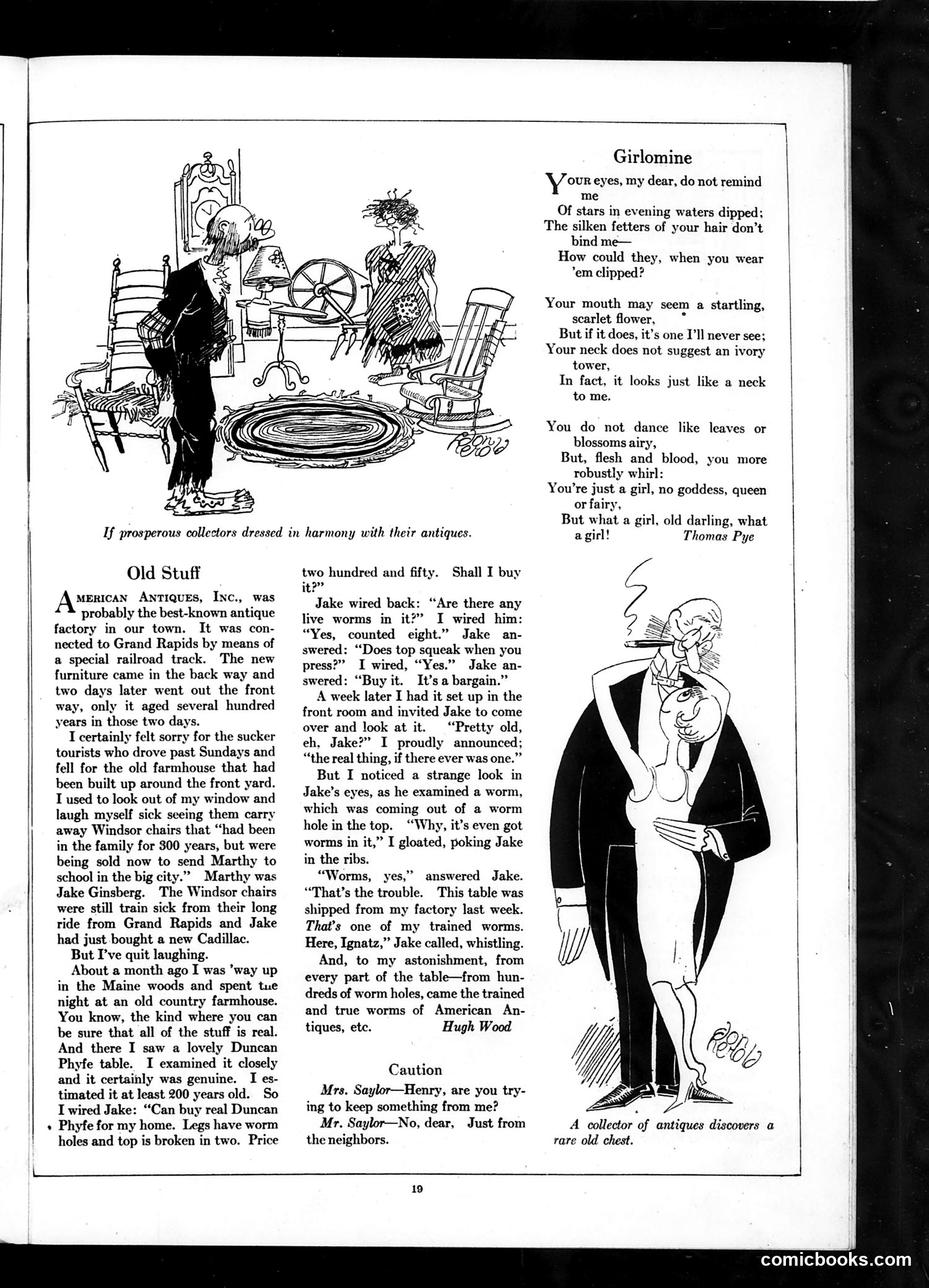
This story mocks the booming antique-dealing racket of the era. "American Antiques, Inc." is a factory that manufactures "aged" furniture—new pieces arrive by rail, artificially aged over two days, then sold as genuine 300-year-old heirlooms to gullible tourists. The narrator initially laughs at suckers buying fake Windsor chairs, until he himself falls victim. He purchases what he believes is a genuine 200-year-old Duncan Phyfe table from a Maine farmhouse. Jake Ginsberg, the antique dealer, reveals the humiliating truth: the table is from his own factory—even the worms in it are "trained" promotional insects he ordered by whistling. The satire targets both the deceptive antique trade and the narrator's embarrassment at being outwitted by his own scam. It's a cautionary tale about how even those who mock fraudsters can become their victims.
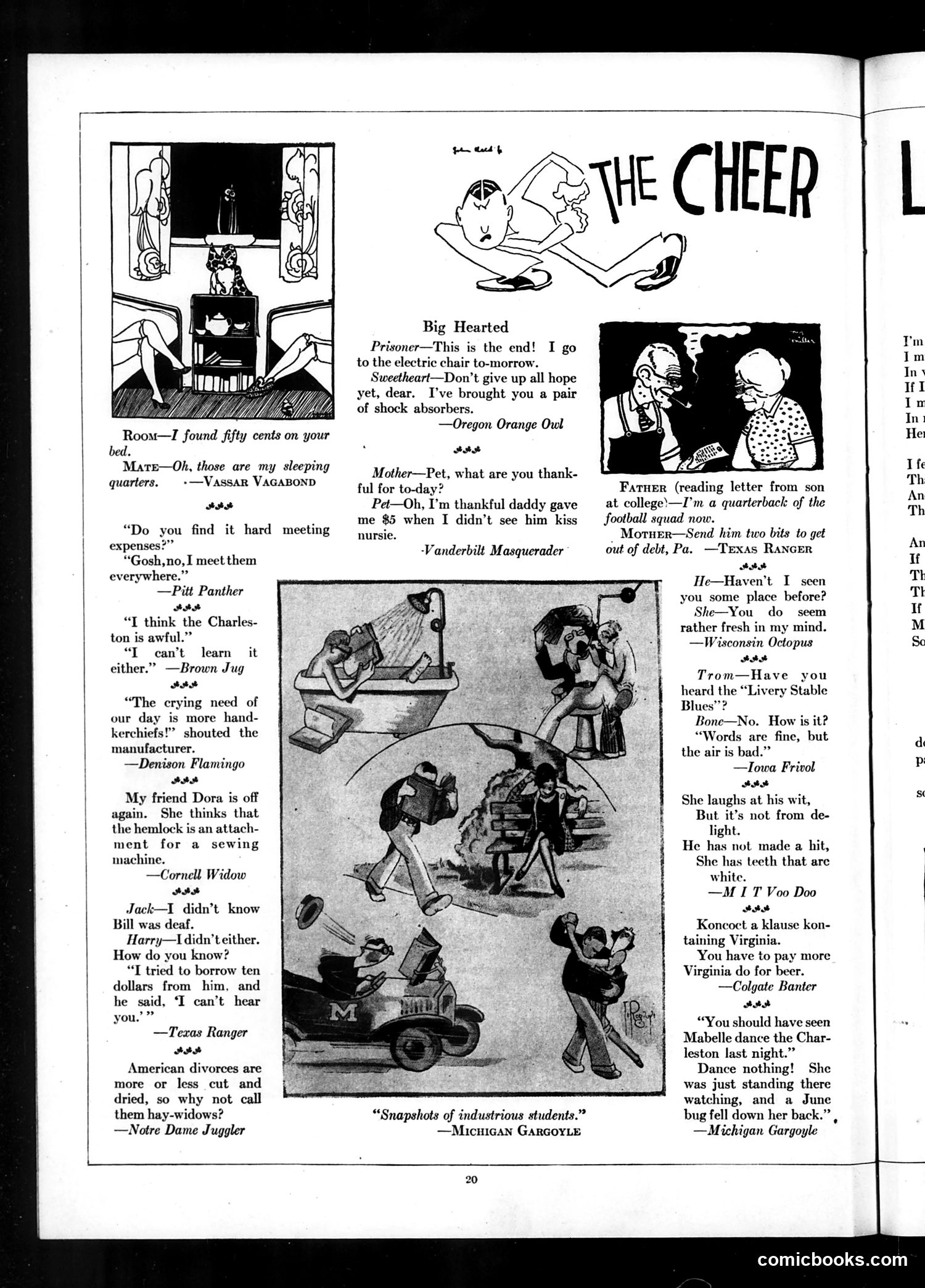
This is a humor page collecting short jokes and one-liners from college publications (Vassar, Brown, Cornell, etc.), centered on 1920s social themes. **The cartoon** depicts students in various manual labor scenarios—factory work, construction, etc.—captioned "Snapshots of industrious students," likely mocking college students' work-study jobs or summer employment. **The jokes** address period concerns: the Charleston dance craze (too difficult to learn), expense-meeting struggles, divorce culture ("hay-widows"), and dating rituals. Several target behavioral expectations—a father rewarding his daughter for *not* watching his kiss the nursemaid; a woman feigning attraction to a man with good teeth; shock absorbers as "comfort" for execution. The humor is mostly light social satire targeting middle-class anxieties and youthful behavior, with occasional darker gallows humor (execution joke) typical of 1920s collegiate wit. The compilation format itself—reprinting campus paper humor—reflects Judge's role as outlet for college-based comedy writers.
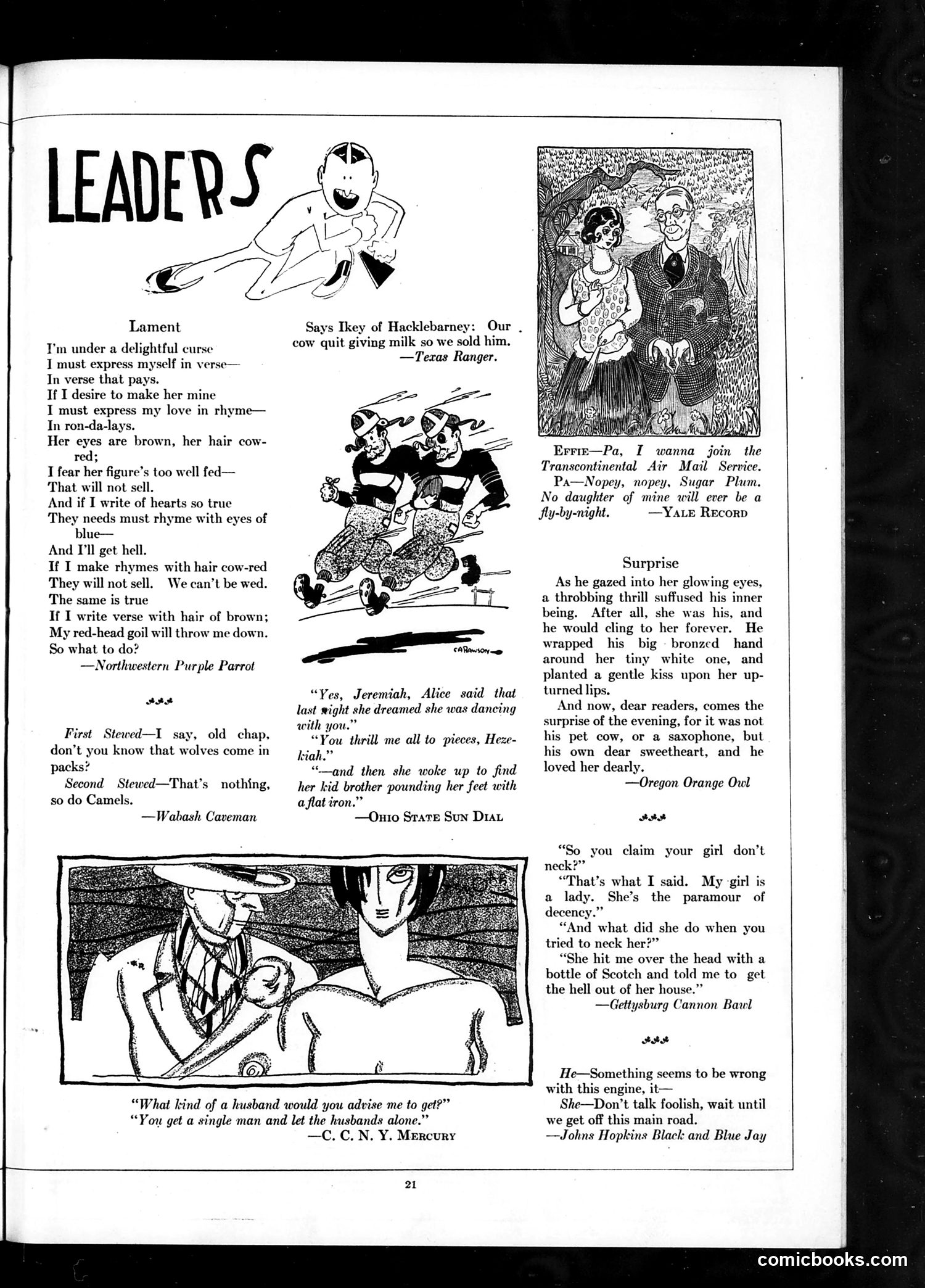
This is a humor page from *Judge* magazine featuring brief jokes and satirical verses, likely from the 1920s based on references to air mail service and contemporary slang. **Content:** The page collects short comedic pieces from college humor magazines (Northwestern, Yale, C.C.N.Y., etc.) and newspapers. Most jokes target: - **Dating/Romance conventions**: A poet lamenting that love verses must follow rigid rhyming schemes with predictable imagery (brown hair, blue eyes), making authentic expression impossible. - **Modern anxieties**: References to air mail, automobiles, and new technologies creating social friction. - **Gender role reversals**: A woman claiming to be a "lady" while violently rejecting a man's advances—mocking both Victorian propriety and flapper-era behavior. - **Unexpected punchlines**: The "Surprise" story teases sentimental romance before revealing the beloved is a cow, mocking both pastoral sentimentality and rural humor. The cartoons are generic illustrations supporting these college-campus and rural jokes. The satire is gentle, targeting changing social customs and dating rituals rather than political figures.
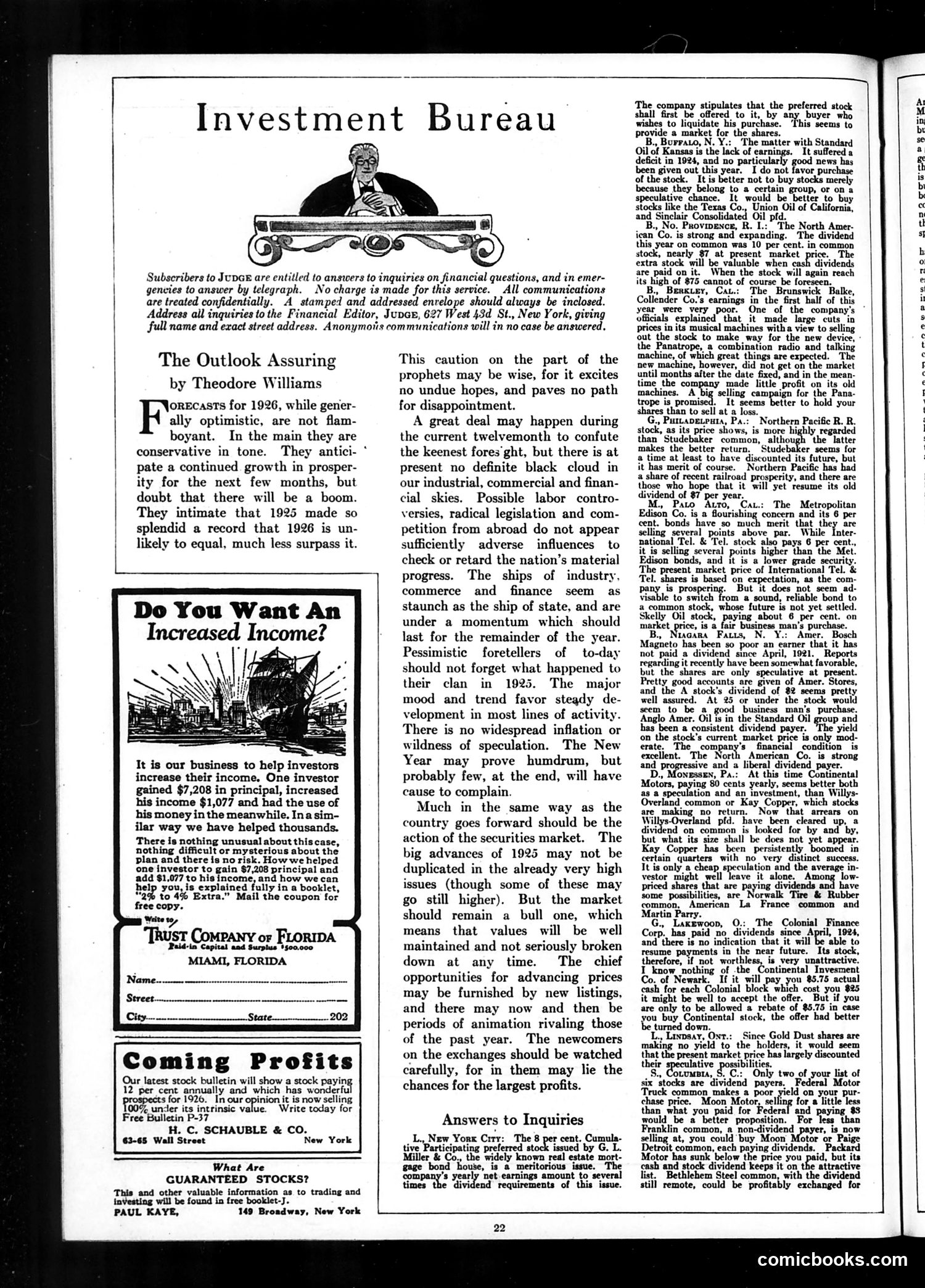
This page primarily contains **financial advice columns and investment advertisements**, not political satire. The main article, "The Outlook Assuring" by Theodore Williams, offers cautiously optimistic economic forecasts for 1926, predicting steady growth without dramatic booms or busts. The content reflects the **prosperity of the 1920s** ("Roaring Twenties"), when stock market investment was booming among middle-class Americans. Multiple ads promise investment gains—one claims an investor gained $7,208 in principal while retaining use of his money. The tone is conservative, warning against excessive speculation while encouraging market participation. References to "radical legislation" and potential "labor controversies" suggest contemporary anxieties, though these remain vague threats rather than specific targets. Notable: this page was published during the pre-1929 crash era when optimism about the market was widespread. Judge's "Investment Bureau" section apparently served as a financial advice column for readers.
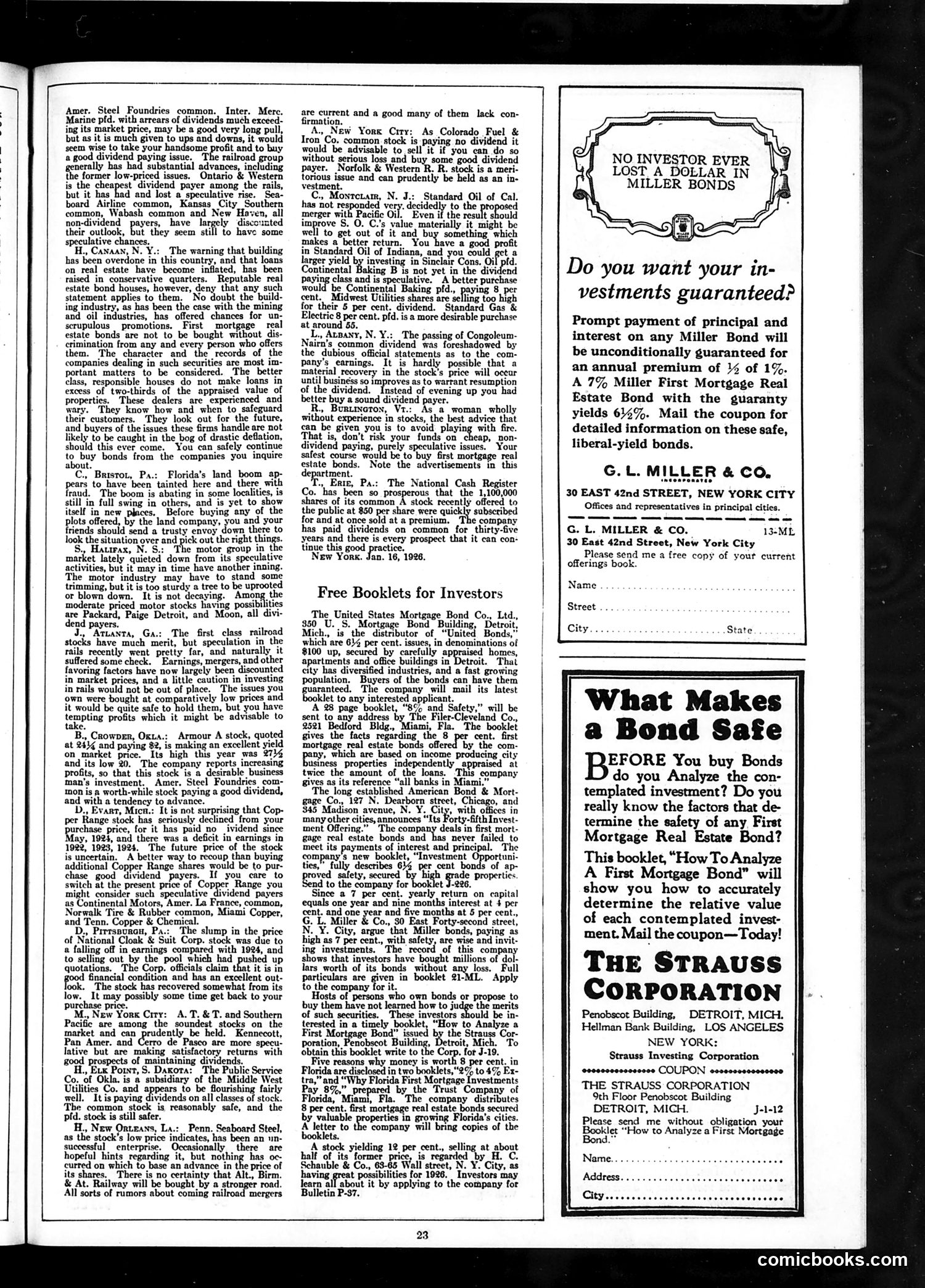
This page is primarily **financial advice and investment advertising**, not political satire. It contains: 1. **Left column**: Reader investment questions answered by a financial columnist, covering stocks (Steel Foundries, Armour, Copper Range) and real estate bonds. The advice emphasizes caution about inflated building loans and fraud in Florida land schemes—reflecting post-WWI economic concerns. 2. **Right side**: Multiple advertisements for bond investment products from companies like C. L. Miller & Co. and The Strauss Corporation, emphasizing safety and guaranteed returns on first mortgage real estate bonds. **The satire (if any)**: The irony appears implicit—this financial advice page promises safety and sound judgment in investments, yet Judge readers would have known such advice preceded major market crashes. The repeated assurances ("No investor ever lost a dollar") read as naive in retrospect. **Historical context**: This appears from the 1920s boom era, before 1929's crash exposed how such "safe" investments often weren't.
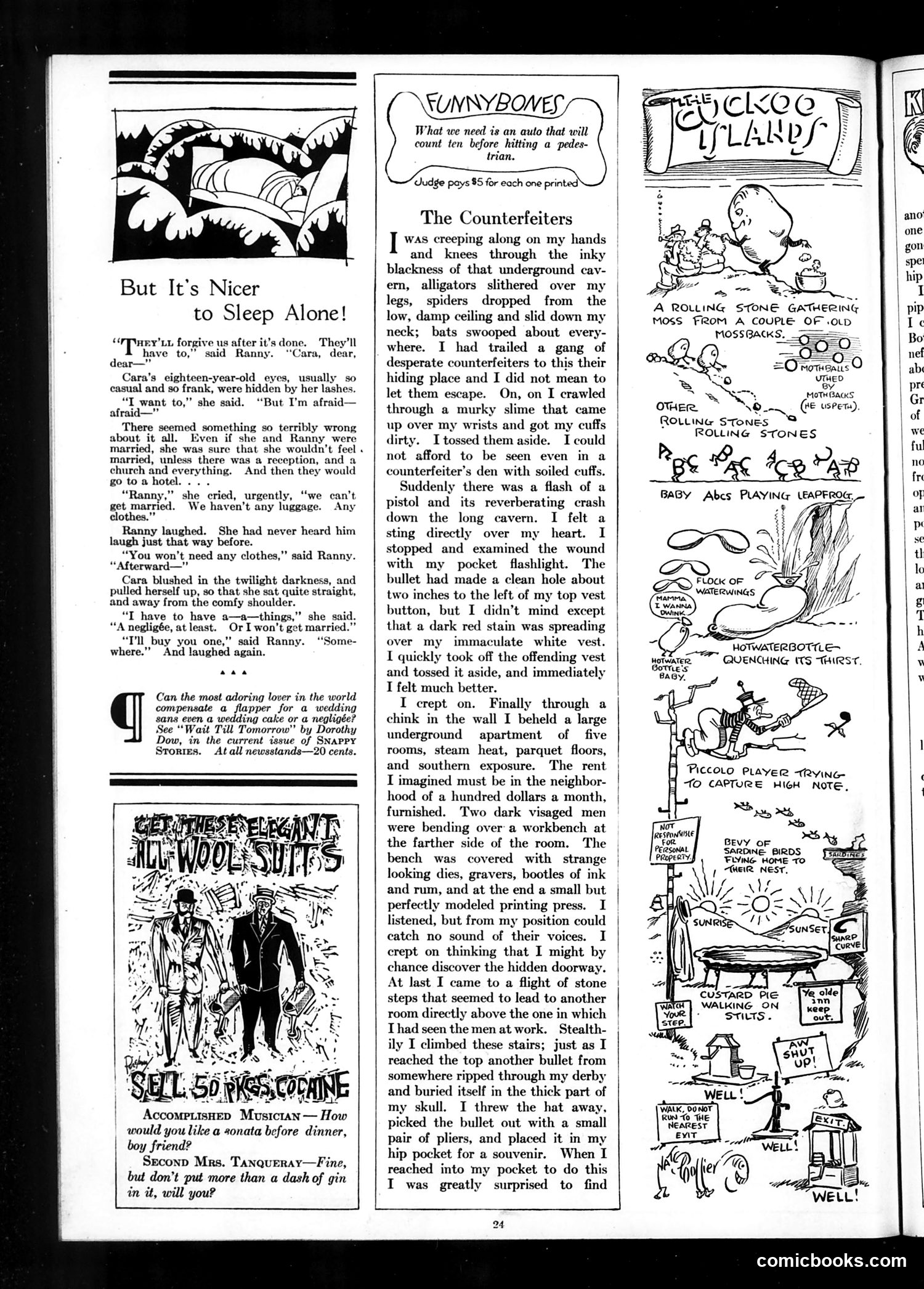
**"But It's Nicer to Sleep Alone!"** is a romantic fiction excerpt mocking 1920s flapper culture and changing courtship norms. A young woman (Cara) hesitates about marrying her boyfriend Ranny because they lack proper wedding trappings—no church, reception, or negligée. The satire targets how consumer culture and material possessions had become central to marriage, with the absurd implication that a couple cannot marry without fashionable clothing and hotel accommodations. **"The Counterfeiters"** is pulp fiction parody. A detective chases counterfeiters into an underground cavern, getting shot multiple times (in the vest, derby hat, skull) yet continuing undeterred—fixating bizarrely on keeping his clothing clean rather than, say, survival. The exaggerated melodrama and protagonist's absurd priorities mock sensationalist adventure stories popular in pulp magazines. Both pieces satirize contemporary American consumer values and lowbrow entertainment conventions.
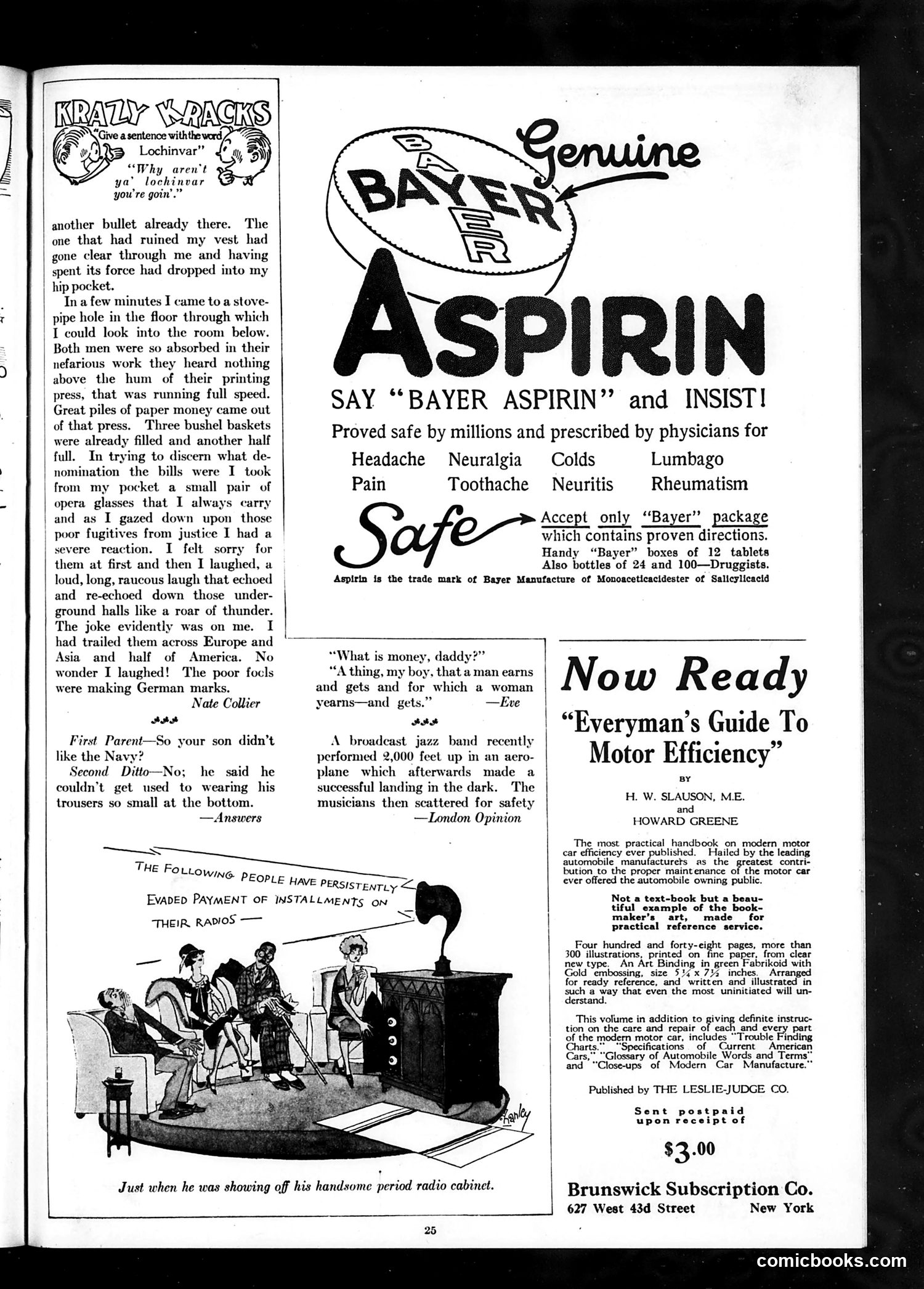
This page contains three distinct elements: **"Krazy Kracks" Story (left):** A humorous narrative by Nate Collier about pursuing counterfeiters across continents, only to discover they're printing worthless German marks—the joke being the currency's hyperinflationary worthlessness during the post-WWI period (likely 1920s). **Bayer Aspirin Advertisement (center-right):** A straightforward product advertisement emphasizing that genuine Bayer aspirin is "safe" and physician-approved. This reflects early 20th-century patent medicine marketing before FDA regulation. **Radio Installment Cartoon (bottom-left):** A satirical illustration depicting people who've avoided paying radio purchase installments. The cartoon critiques consumer debt and the emerging consumer credit culture of the 1920s—people displaying radios they haven't actually paid for. **Motor Efficiency Book Advertisement (right):** A book promotion for automotive maintenance guides. The page reflects 1920s concerns: economic instability (German marks), consumer credit practices, and the rise of modern appliances like radios.
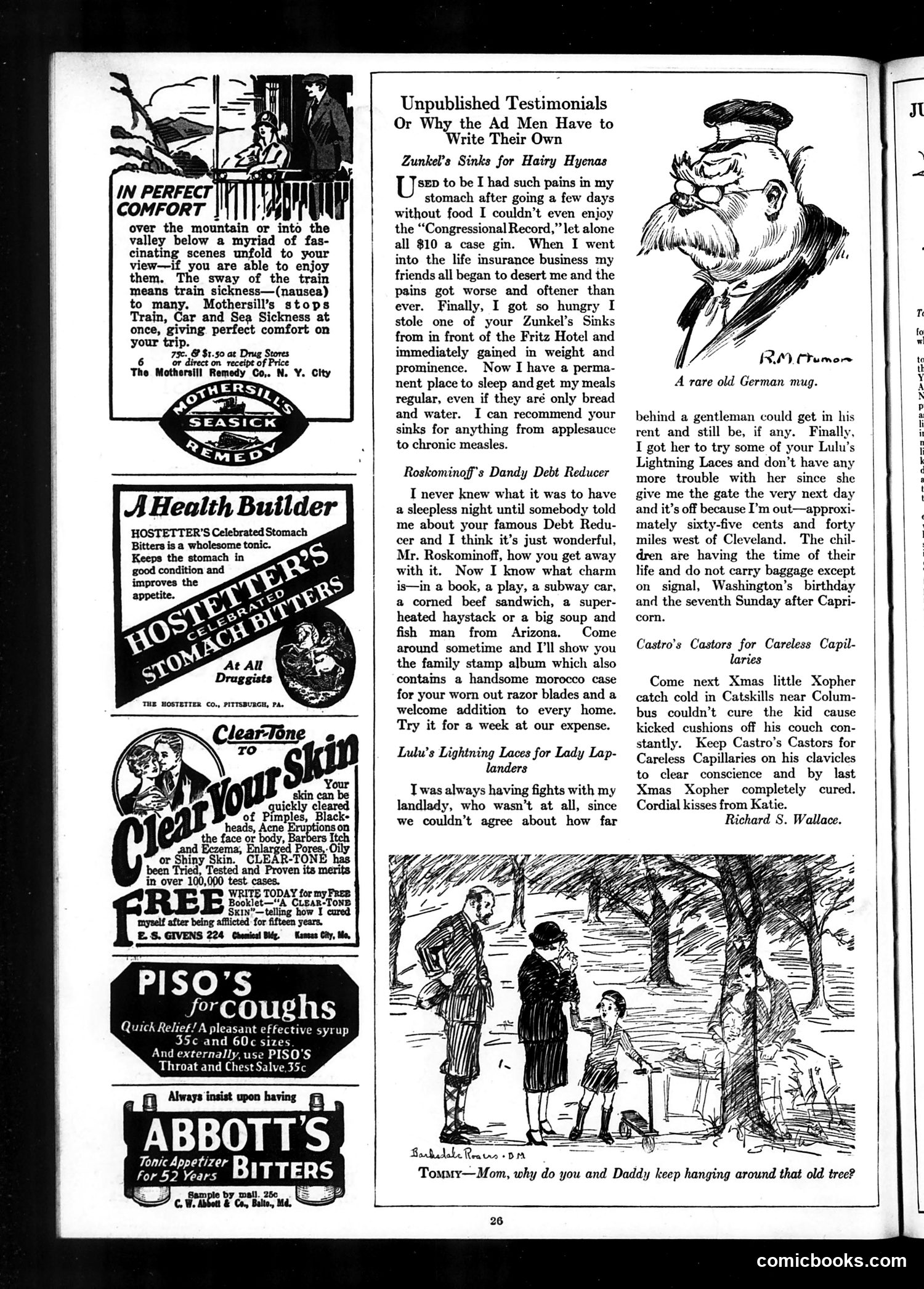
This page satirizes patent medicine advertising and fraudulent testimonials. The left side features genuine contemporary ads for dubious health products (Mothersill's for seasickness, stomach bitters, skin treatments, cough syrup), while the right side parodies them. The main satire, titled "Unpublished Testimonials," mocks the absurd fake testimonials these ads rely upon. The fictional products have ridiculous names ("Zunkel's Sinks for Hairy Hyenas," "Roskominoff's Dandy Debt Reducer") and the testimonials are intentionally incoherent and contradictory—claiming products solve problems unrelated to what they supposedly treat. One testimonial boasts about gaining prominence through stealing a sink; another describes a product that supposedly solved debt by making the writer homeless. The humor targets the gullible advertising industry's reliance on fabricated endorsements and consumers' willingness to believe implausible health claims. The cartoon at bottom shows unrelated family humor. This reflects Progressive Era skepticism toward unregulated patent medicines and deceptive marketing practices.
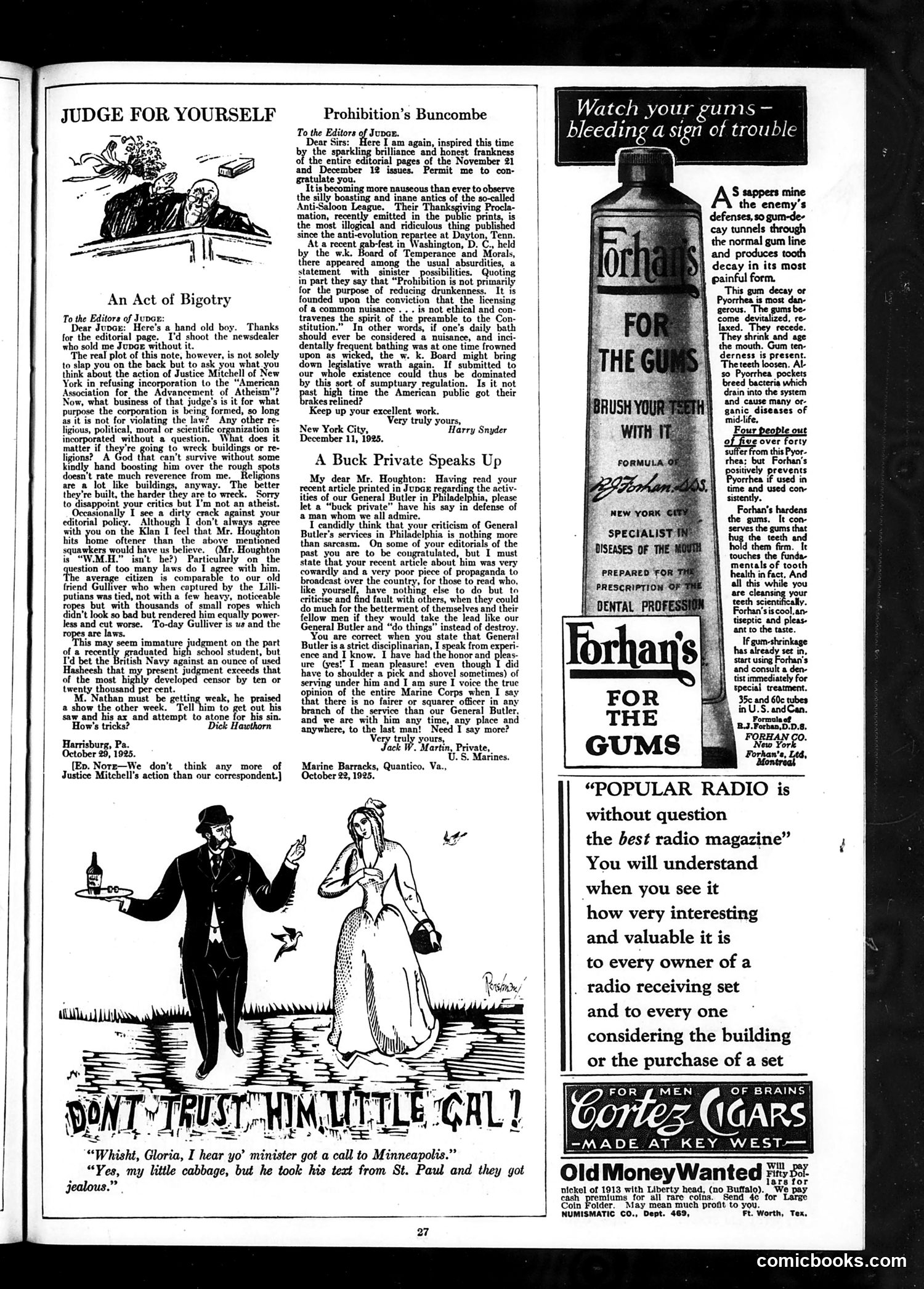
This page from *Judge* magazine (circa 1925) contains reader letters and editorial cartoons critiquing American social policies. **"An Act of Bigotry"** discusses Justice Mitchell's refusal to incorporate the "American Association for the Advancement of Atheism" in New York. The letter argues this denies equal treatment—other organizations (religious, political, scientific) receive incorporation without state scrutiny of their purposes. The writer defends atheist organizations' right to exist while claiming not to be atheist himself, using a Gulliver metaphor to warn against excessive laws. **"Prohibition's Buncombe"** attacks the Anti-Saloon League's defense of Prohibition, quoting their claim it's "not primarily for reducing drunkenness" but rather for moral/constitutional reasons. The writer mocks this as illogical overreach—suggesting government shouldn't regulate personal behavior (bathing, daily activities) under vague "nuisance" doctrines. Both letters represent *Judge's* libertarian critique of government overreach during the 1920s, opposing religious discrimination and paternalistic laws. The bottom cartoon ("Don't Trust Him, Little Gal") appears unrelated domestic humor about a minister's wandering eye.
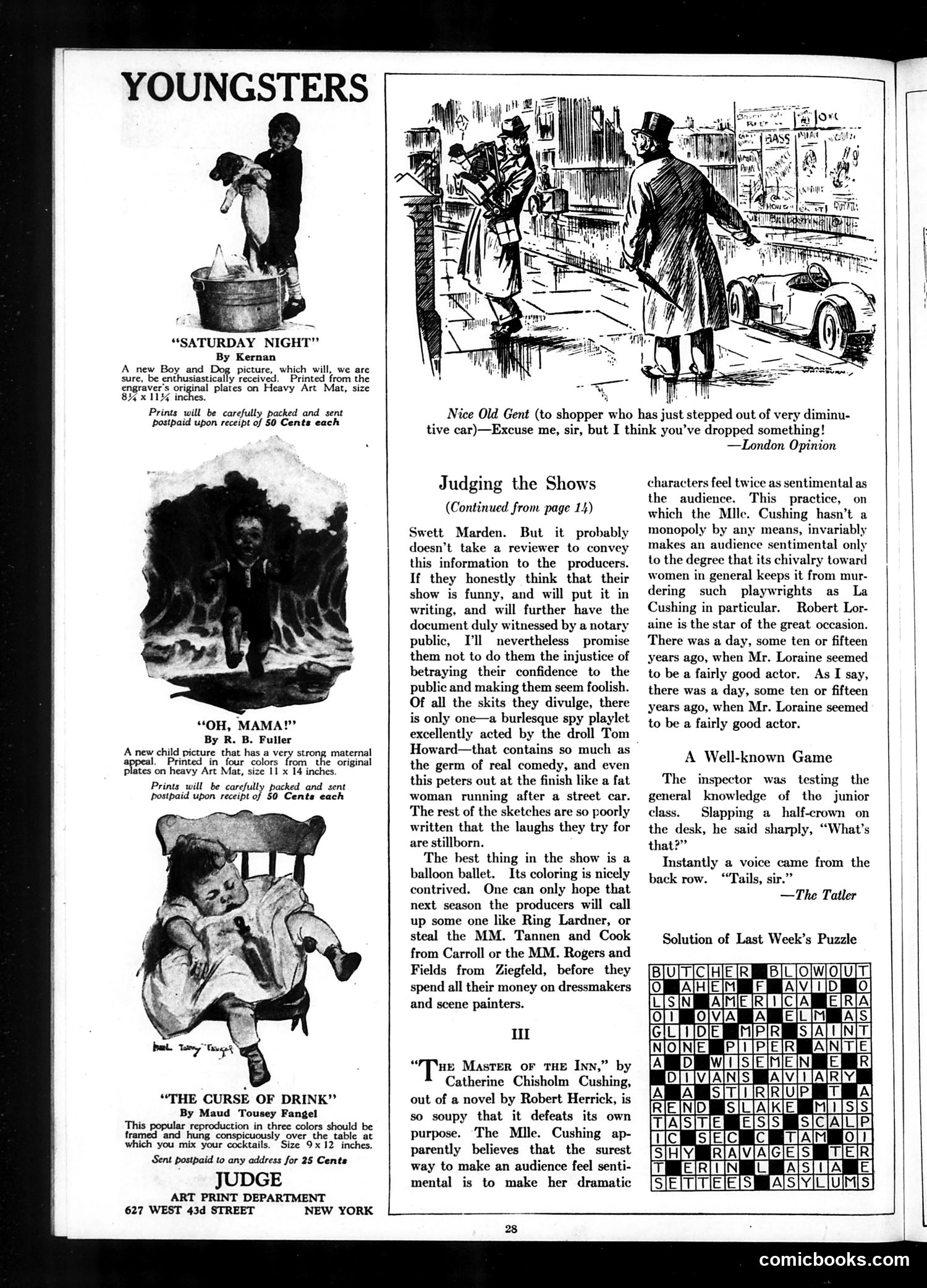
This page from *Judge* (a satirical weekly) contains primarily **advertisements for art prints** and **theater criticism**, rather than political satire. The **"Youngsters" section** advertises reproducible illustrations—sentimental domestic scenes ("Saturday Night," "Oh, Mama!") and a temperance-themed print ("The Curse of Drink")—available for 25-50 cents. The main editorial content, **"Judging the Shows,"** critiques Broadway theater. The reviewer dismisses most sketches in a current production as poorly written, praising only a spy-comedy bit by actor Tom Howard and a "balloon ballet." He mocks playwright Catherine Chisholm Cushing for excessive sentimentality, and notes that actor Robert Loraine has declined since his peak fifteen years prior. A small cartoon jokes about a gentleman thinking a shopper has dropped something from an extremely small car—a mild visual gag about compact automobiles. The page reflects *Judge*'s mix of consumer culture advertising and urbane theatrical commentary for educated middle-class readers.
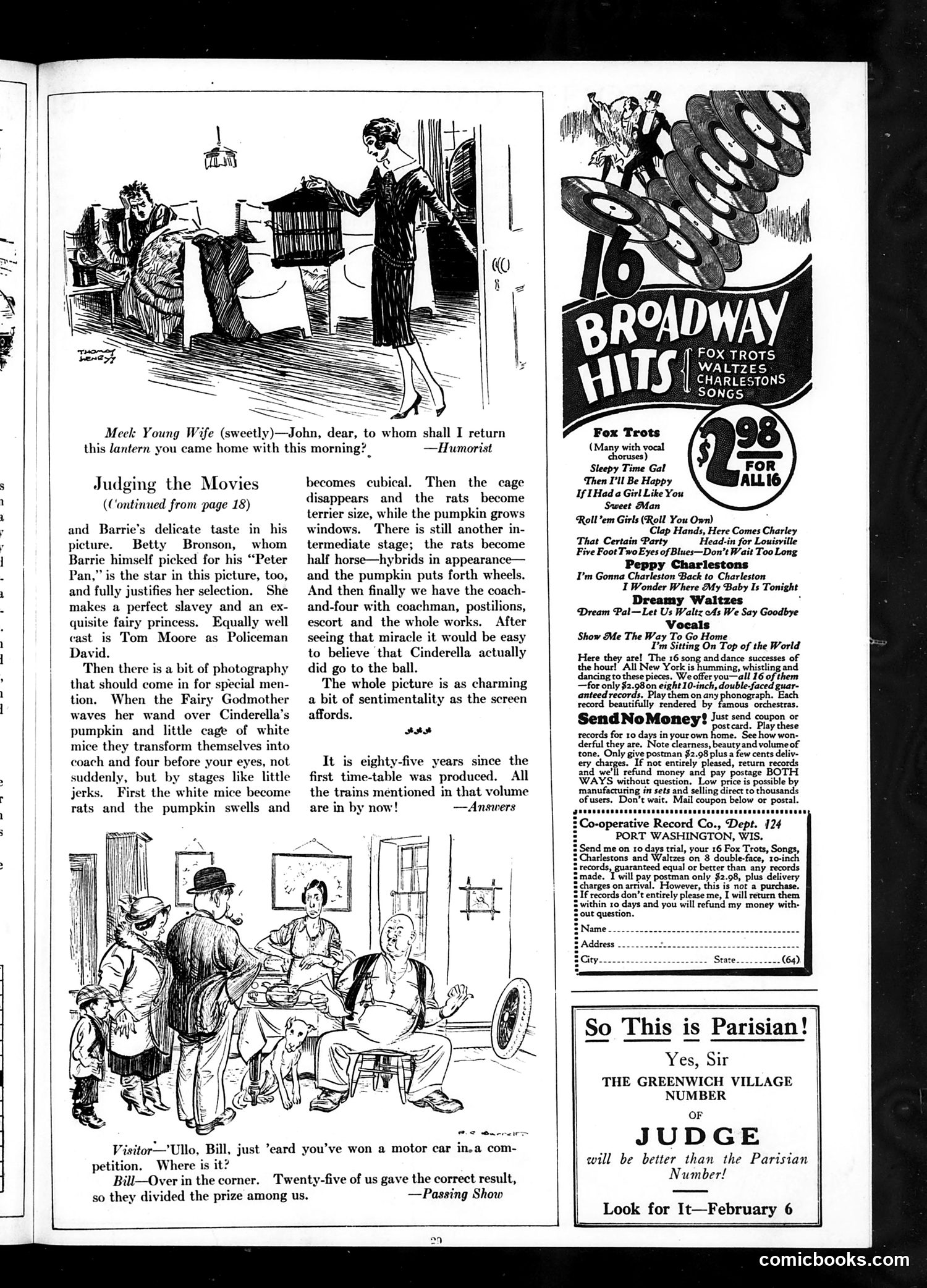
This page contains three distinct elements: **Top Left Cartoon ("Mock Young Wife")**: A domestic humor joke about a wife questioning her husband about a lantern he brought home. The humor lies in the implication of marital suspicion—likely suggesting infidelity or questionable behavior, typical of Judge magazine's satirical take on middle-class domestic life. **Center Article ("Judging the Movies")**: A film review praising the movie *Cinderella*, starring Betty Bronson. The reviewer particularly admires the special effects showing the pumpkin transforming into a coach "by stages like little jerks"—early stop-motion animation technology that was genuinely impressive in the 1920s. **Bottom Left Cartoon**: A working-class humor piece about a man who won a motor car in a competition but must share it with 24 others who also submitted correct answers, so they divided the prize equally. The joke satirizes the impracticality of such divisions. **Right Side**: Advertisements for Broadway sheet music (fox trots, waltzes, charlestons) and promotional copy for Judge's upcoming "Greenwich Village Number," suggesting a themed upcoming issue.
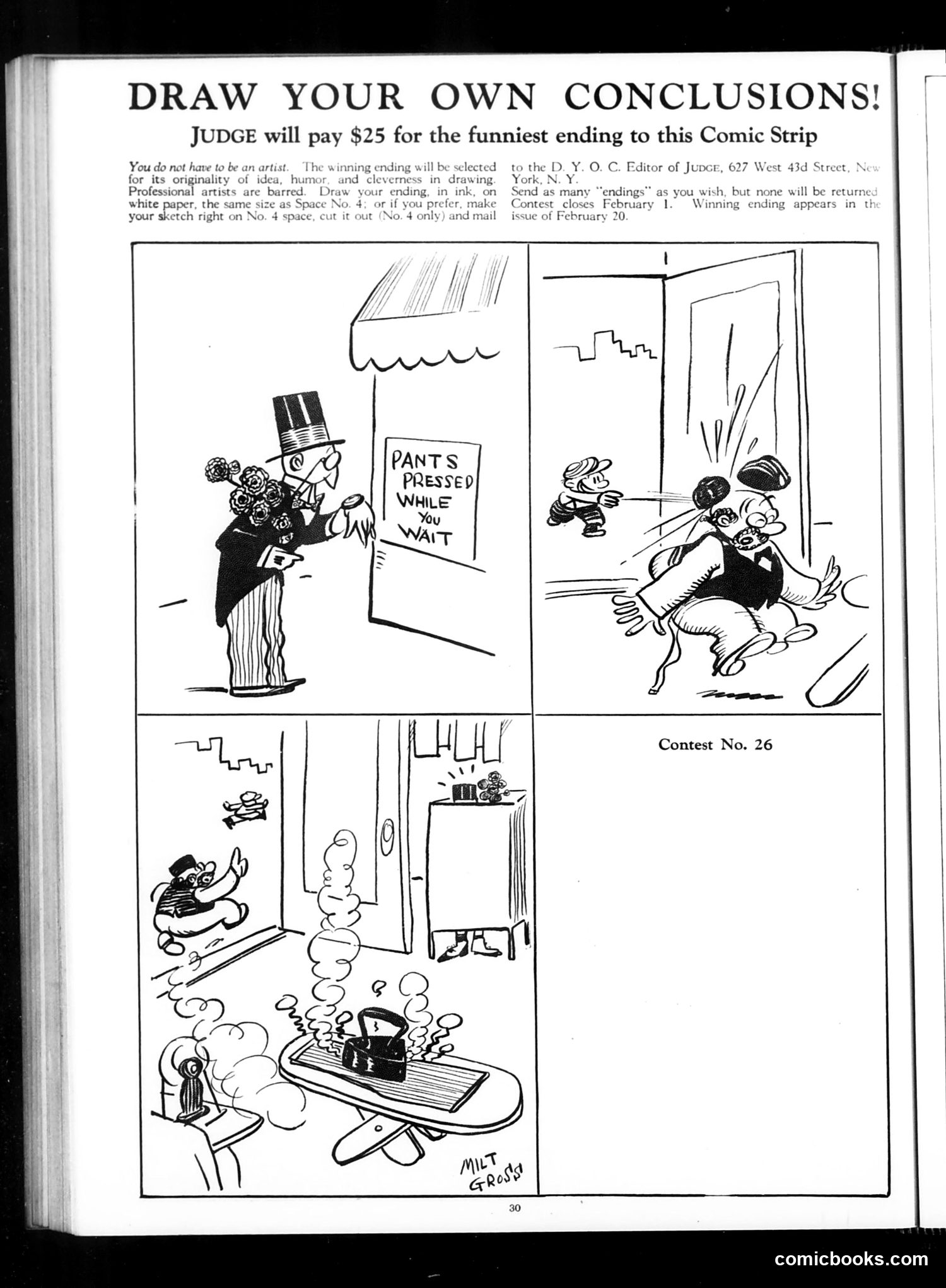
This is a reader-participation contest where Judge magazine invites submissions to complete an unfinished comic strip. The incomplete three-panel strip shows a man in a top hat with flowers at a tailor shop advertising "Pants Pressed While You Wait." Subsequent panels depict escalating chaos—figures being launched into the air, and what appears to be an explosion or catastrophic malfunction inside the building. The joke premise seems to be that the pants-pressing service goes comically wrong. Readers were invited to supply their own punchline for the final panel, with the winner receiving $25. The contest leverages visual slapstick humor typical of early 20th-century comic strips, where mechanical mishaps and physical comedy were standard entertainment fare.
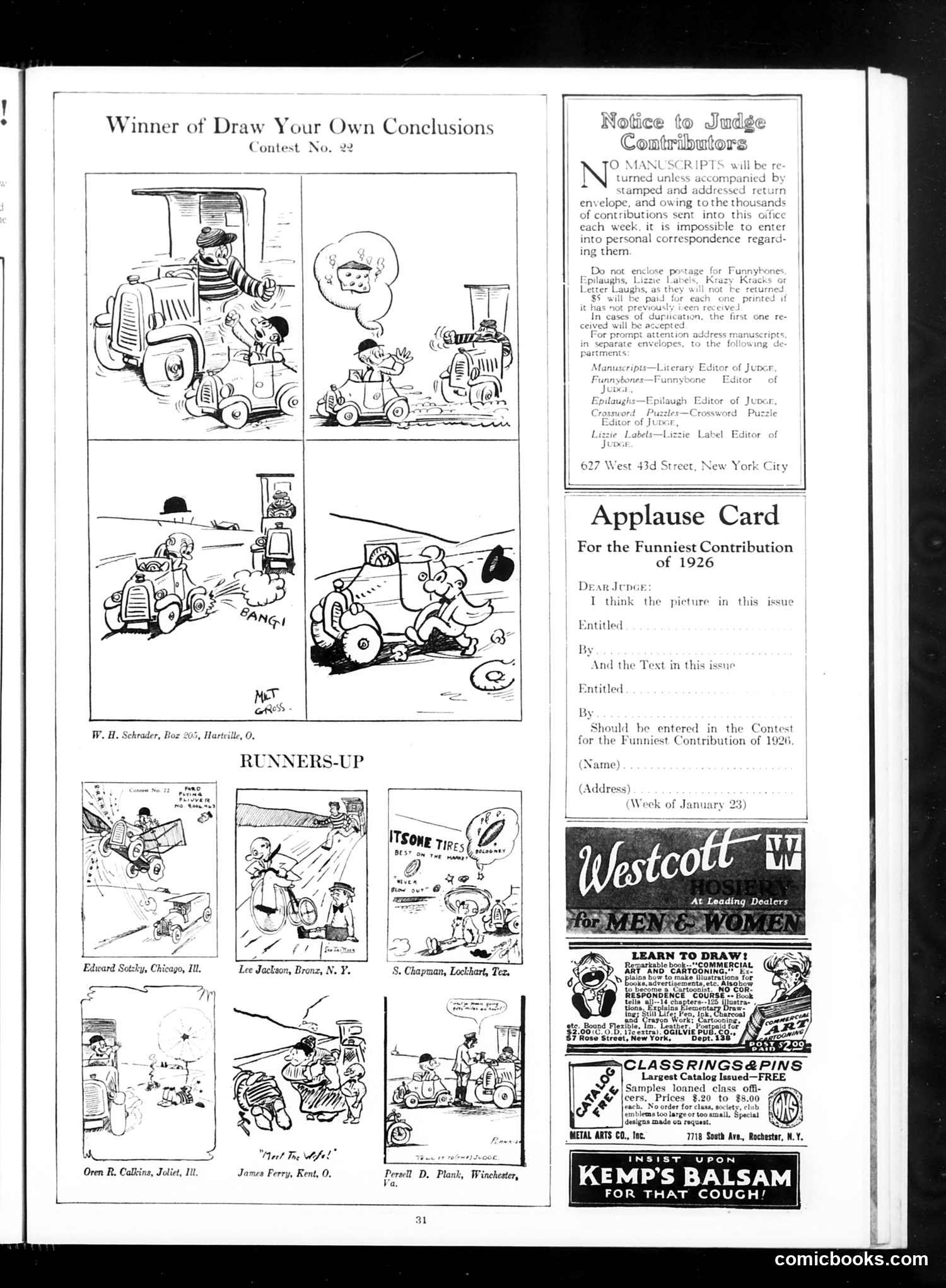
This page showcases the winning entry in Judge's "Draw Your Own Conclusions" Contest No. 22—a humor-cartooning competition. The winning cartoon by W. H. Schrader depicts slapstick automotive mayhem: toy cars colliding, characters tumbling, and general comedic chaos involving early automobiles. The "Runners-Up" section displays five additional contest entries, all featuring similar visual gags centered on cars and collisions—reflecting 1920s fascination with automobiles as inherently comic subjects. The remaining content is advertising and administrative notices typical of magazine pages from this era, including drawing instruction courses, jewelry catalogs, and patent medicines. No political satire or specific caricatures appear here; this is entertainment-focused humor reflecting the era's interest in slapstick comedy and modern technology as comedy fodder.
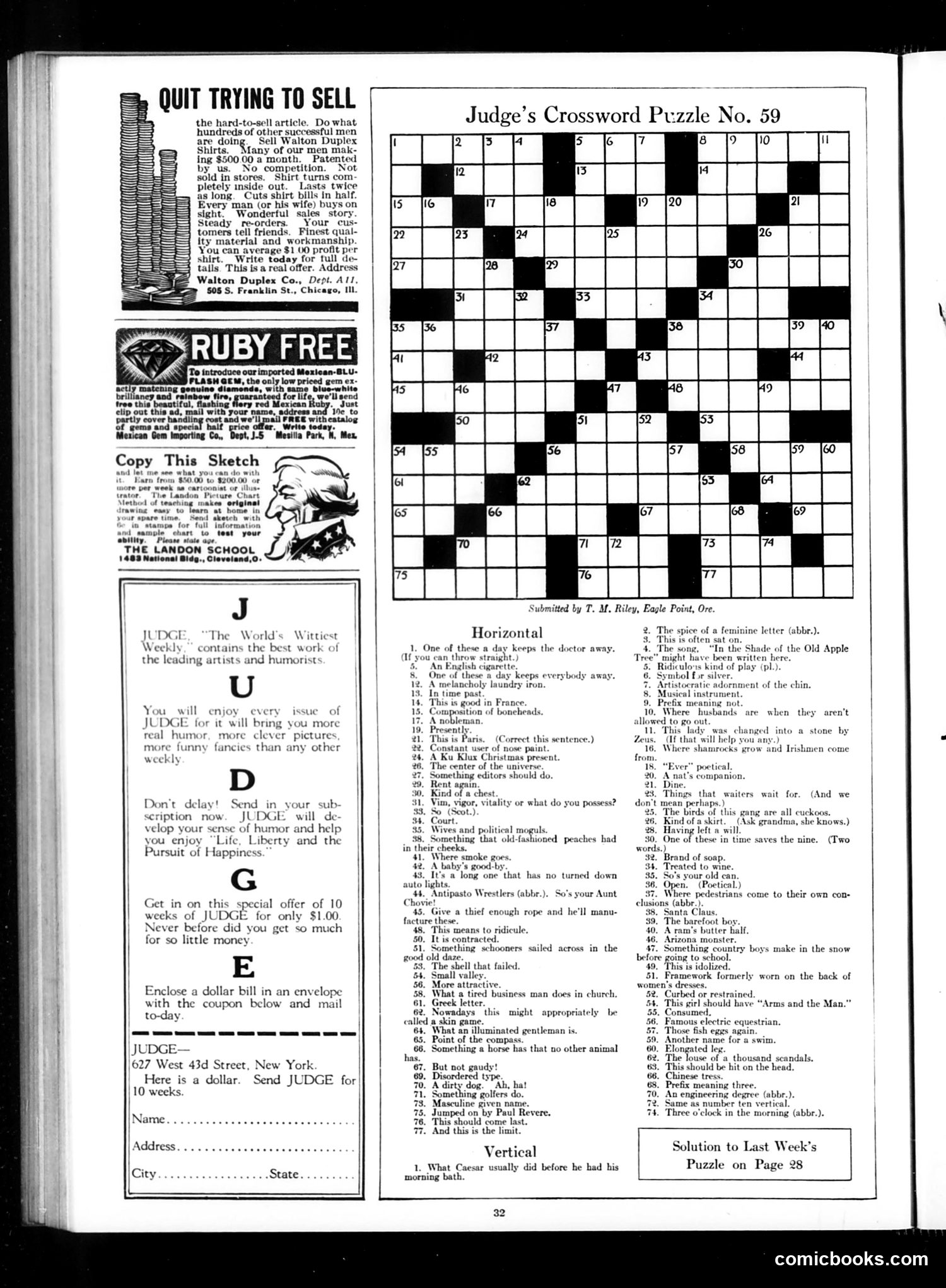
This page consists primarily of a crossword puzzle ("Judge's Crossword Puzzle No. 59") with accompanying clues, plus several period advertisements in the left margin. The advertisements promote: - **Walton Duplex Shirts**: A sales opportunity promising $500+ monthly income selling patented "inside-out" shirts - **Ruby Free gemstones**: Importing Mexican gems with claims of brilliance and durability - **Landon School**: Art instruction via correspondence - **Judge magazine itself**: Subscription offers for "The World's Wittiest Weekly," emphasizing humor and satirical cartoons The crossword clues contain typical Judge-era humor and references—wordplay, puns about "old-fashioned peaches," references to "antipasto wrestlers," and topical allusions. The puzzle itself appears to be standard crossword fare with no visible political content in the visible grid. This is essentially a puzzle-and-advertising page typical of 1920s-era magazine filler, rather than containing editorial satire.
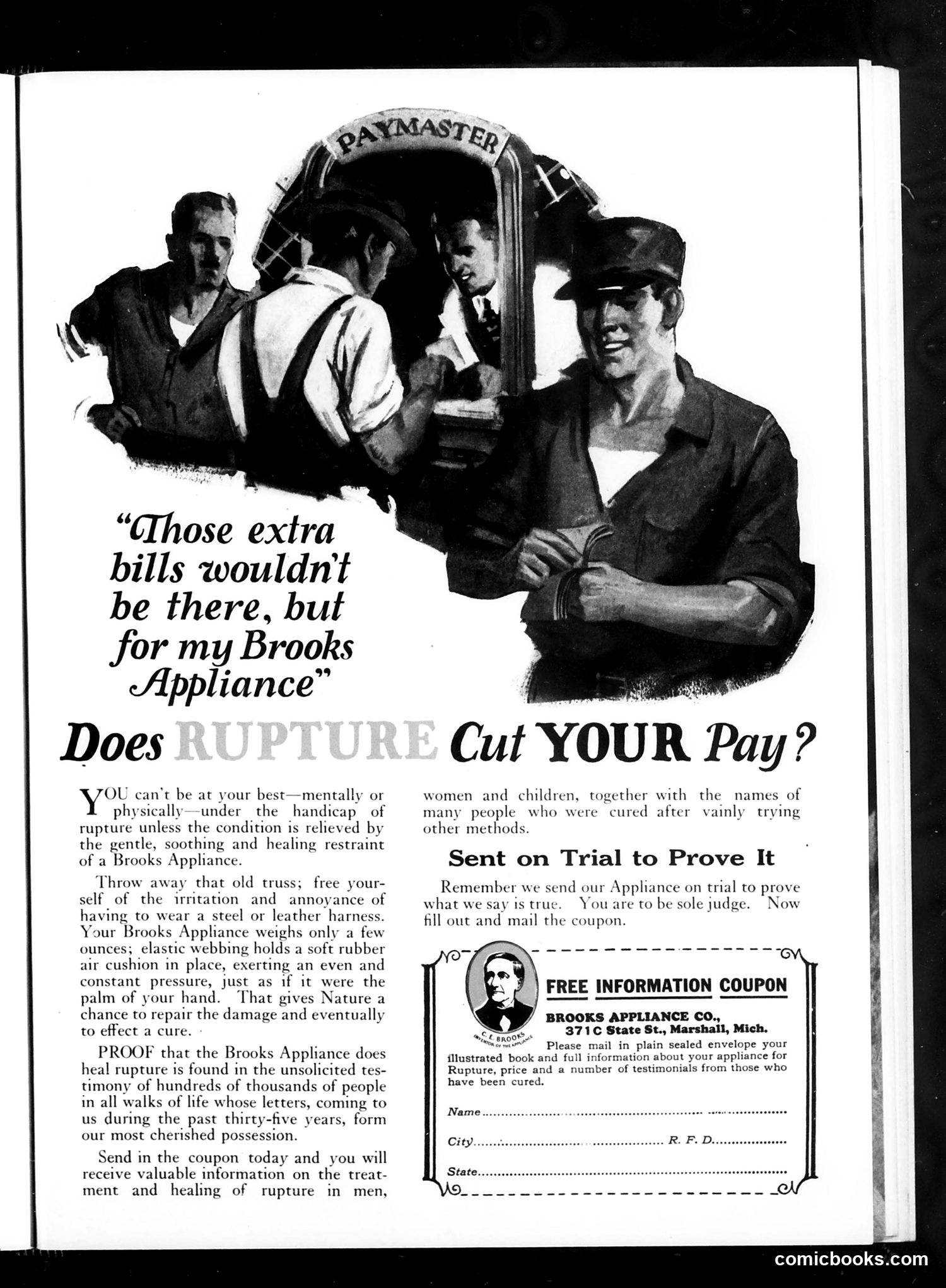
This is primarily a **medical device advertisement**, not political satire. It promotes the Brooks Appliance, a truss designed to treat hernias ("rupture")—a common condition before modern surgery. The advertisement uses a narrative hook: a working man blames unexpected bills on his untreated hernia, suggesting lost productivity from pain and discomfort. The pitch claims the Brooks Appliance is superior to old-fashioned steel trusses—lighter, more comfortable, and allegedly curative rather than merely supportive. The testimonial approach (claiming "hundreds of thousands" cured over thirty-five years) and free trial coupon were standard direct-response advertising tactics of the era. The accompanying illustration shows men in working-class dress, emphasizing the product's appeal to laborers. There is **no political satire** here—Judge magazine carried commercial advertisements alongside satirical content. This page represents straightforward health marketing from an early 20th-century medical device company.
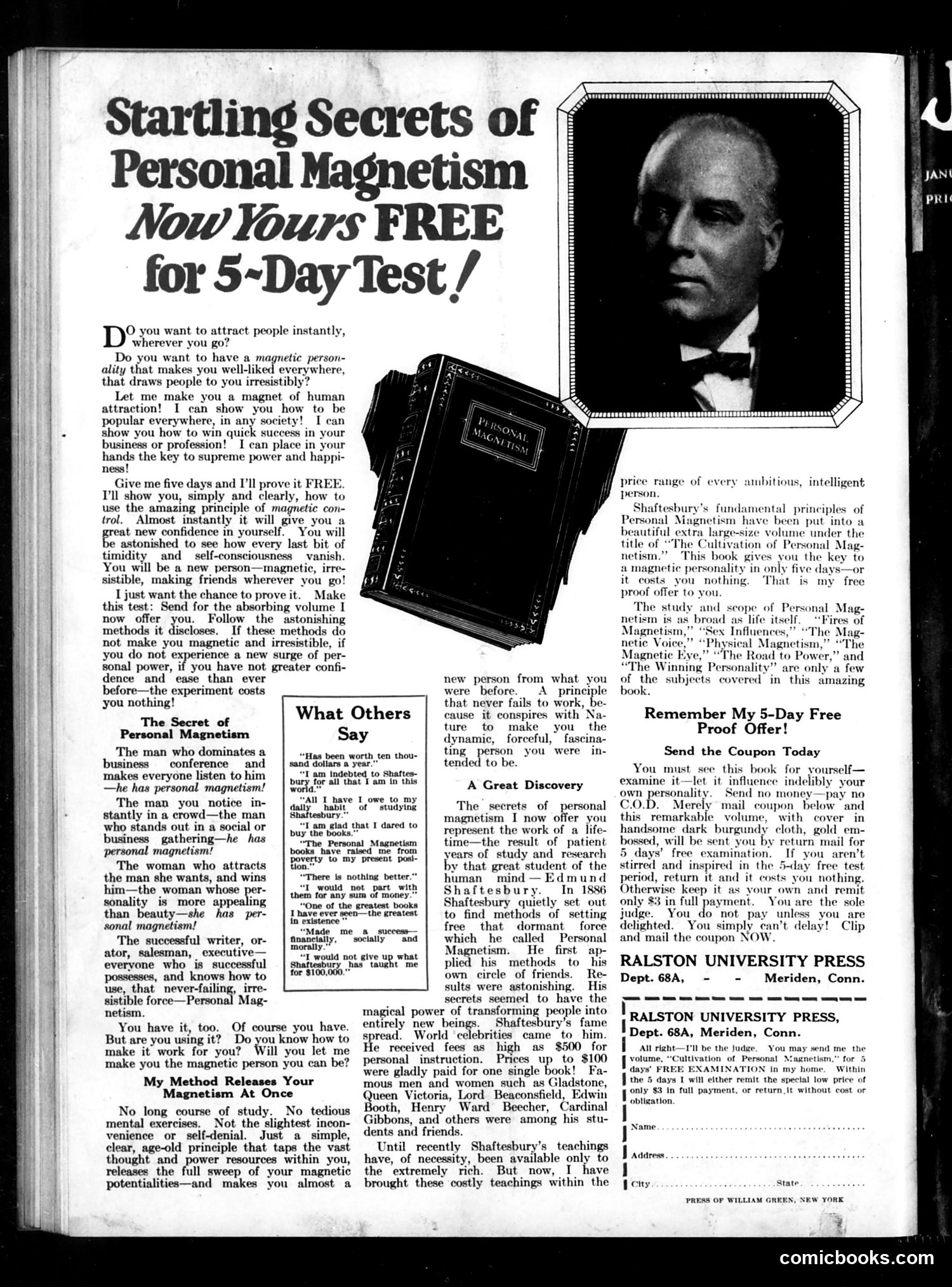
This is primarily a **mail-order advertisement**, not satire, though it's the type of pseudoscientific pitch that Judge magazine's readers would have recognized as comical. The ad promotes a self-help book by "Edmund Shaftesbury" claiming to teach "Personal Magnetism"—a pseudo-scientific concept popular in early 20th-century self-improvement culture. The pitch promises that five days of study will make readers irresistibly attractive and successful in business and social situations. The satire lies in the **earnest absurdity**: the grandiose promises ("makes you almost a new person"), testimonials claiming fortunes made, and the notion that a simple "principle" can fundamentally transform personality and social power. This reflects period anxieties about self-improvement and the emerging "success literature" industry. Modern readers would recognize this as early snake-oil marketing—though the psychological manipulation techniques it describes remain relevant to contemporary self-help advertising.