
Judge, 1926-01-23 · page 20 of 36
Judge — January 23, 1926 — page 20: what you’re looking at
What you’re looking at
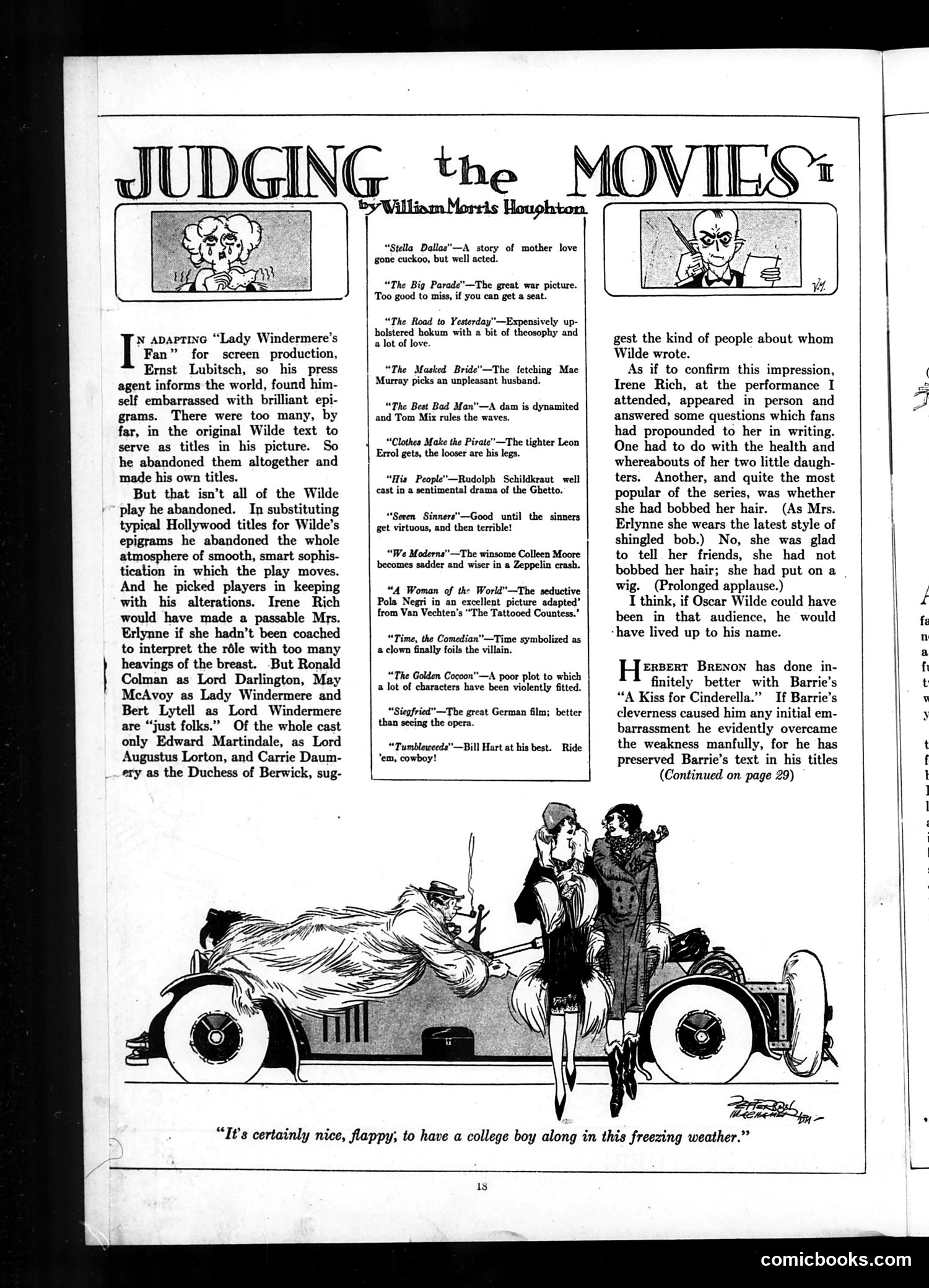
This page reviews recent Hollywood films through film critic William Morris Houghton's column. The main critique concerns director Ernst Lubitsch's adaptation of Oscar Wilde's "Lady Windermere's Fan." Houghton argues that Lubitsch, uncomfortable with Wilde's abundant witty epigrams, abandoned them entirely and substituted generic Hollywood titles. More problematically, this removed the sophisticated atmosphere essential to Wilde's play. Houghton criticizes the casting—particularly Irene Rich—as "just folks" lacking the urbane quality Wilde's characters demand. The satire culminates when Rich appears in person at a screening discussing mundane topics (her children, whether she bobbed her hair) rather than Wilde's brilliant wit. Houghton quips that Wilde himself, witnessing this ordinariness, would have "lived up to his name"—a pun on "Oscar" (suggesting he'd be literally called out/exclaimed at). The sidebar lists brief reviews of other current films, mostly comedies and adventure pictures. The cartoon below depicts a flapper scene typical of 1920s cinema.
📄 Transcribed text from this page (OCR, searchable)
Machine-transcribed from the original scan — historical spelling and the odd misread are preserved.
Fan” for screen production, Ernst Lubitsch, so his press agent informs the world, found him- self embarrassed with brilliant epi- grams. There were too many, by far, in the original Wilde text to serve as titles in his picture. So he abandoned them altogether and made his own titles. But that isn’t all of the Wilde play he abandoned. In substituting typical Hollywood titles for Wilde’s epigrams he abandoned the whole atmosphere of smooth, smart sophis- tication in which the play moves. And he picked players in keeping with his alterations. Irene Rich would have made a passable Mrs. Erlynne if she hadn’t been coached to interpret the réle with too many heavings of the breast. But Ronald Colman as Lord Darlington, May McAvoy as Lady Windermere and Bert Lytell as Lord Windermere are “just folks.” Of the whole cast only Edward Martindale, as Lord Augustus Lorton, and Carrie Daum- ery as the Duchess of Berwick, sug- I AbaptinG “Lady Windermere’s “Stella Dallas"—A story of mother love gone cuckoo, but well acted. “The Big Parade”—The great war picture. Too good to miss, if you can get a seat. “The Road to Yesterday"—Expensively up- bolstered hokum with a bit of theosophy and a lot of love. “The Masked Bride”—The fetching Mae Murray picks an unpleasant husband. “The Best Bad Man"—A dam is dynamited and Tom Mix rules the waves. “Clothes Make the Pirate” —The tighter Leon Errol gets, the looser are his legs. “His People”—Rudolph Schildkraut well cast in a sentimental drama of the Ghetto. “Seren Sinners"—Good until the sinners get virtuous, and then terrible! “We Moderns” —The winsome Colleen Moore becomes sadder and wiser in a Zeppelin crash. “A Woman of the World”—The seductive Pola Negri in an excellent picture adapted’ from Van Vechten's “The Tattooed Countess.’ “Time, the Comedian”—Time symbolized as a clown finally foils the villain. “The Golden Cocoon"”—A poor plot to which a lot of characters have been violently fitted. “Siegfried” —The great German film; better than secing the opera. “Tumbleweeds"”—Bill Hart at his best. Ride ‘em, cowboy! gest the kind of people about whom Wilde wrote. As if to confirm this impression, Irene Rich, at the performance I attended, appeared in person and answered some questions which fans had propounded to her in writing. One had to do with the health and whereabouts of her two little daugh- ters. Another, and quite the most popular of the series, was whether she had bobbed her hair. (As Mrs. Erlynne she wears the latest style of shingled bob.) No, she was glad to tell her friends, she had not bobbed her hair; she had put on a wig. (Prolonged applause.) I think, if Oscar Wilde could have been in that audience, he would -have lived up to his name. ERBERT Brenon has done in- finitely better with Barrie’s “A Kiss for Cinderella.” If Barrie’s cleverness caused him any initial em- barrassment he evidently overcame the weakness manfully, for he has preserved Barrie’s text in his titles (Continued on page 29) PE, “It’s certainly nice, flappy; to have a college boy along in this freezing weather.” comicbooks.com