
Judge, 1926-01-23 · page 16 of 36
Judge — January 23, 1926 — page 16: what you’re looking at
What you’re looking at
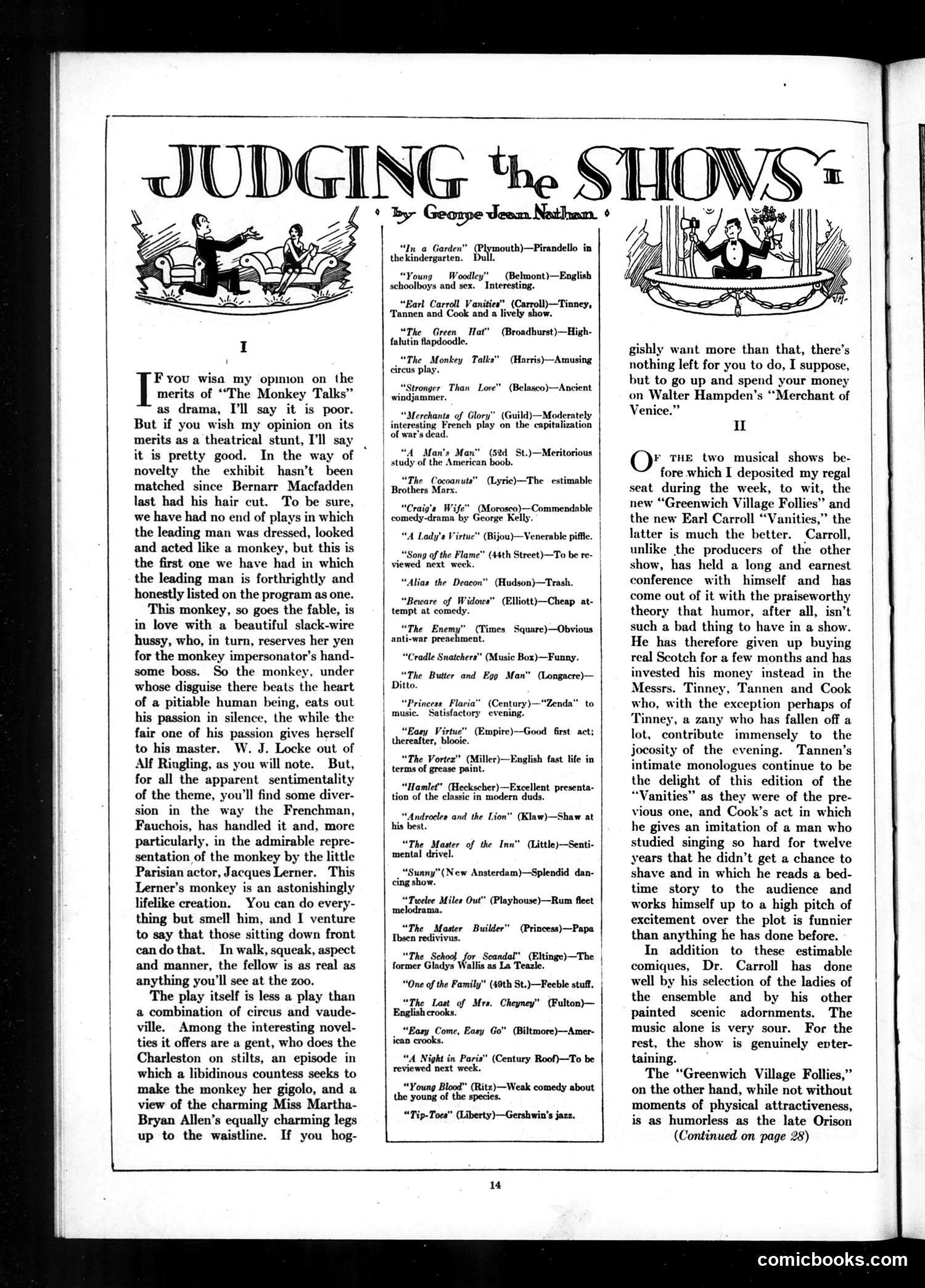
This is a theater critic's column reviewing Broadway productions. The page's main content concerns "The Monkey Talks," a play where the lead actor is billed honestly as playing a monkey—a novelty the critic finds theatrically striking if dramatically weak. The critic praises the Parisian actor Jacques Lerner's convincing monkey performance and notes the play combines circus and vaudeville elements, including a character doing the Charleston on stilts and actress Martha Bryan Allen's prominent leg display. The right column lists brief reviews of other current shows, rating their merits. The critic's overall point: "The Monkey Talks" succeeds as entertainment spectacle rather than serious drama, comparing it to producer Alf Ringling's circus background and noting its W.J. Locke-derived sentimental plot (monkey loves slack-wire performer; she loves his human master).
📄 Transcribed text from this page (OCR, searchable)
Machine-transcribed from the original scan — historical spelling and the odd misread are preserved.
JUDGING ‘e SHOWS* F you wisa my opinion on the merits of “The Monkey Talks” as drama, I'll say it is poor. But if you wish my opinion on its merits as a theatrical stunt, I'll say it is pretty good. novelty the exhibit hasn’t been matched since Bernarr Macfadden last had his hair cut. To be sure, we have had no end of plays in which the leading man was dressed, looked and acted like a monkey, but this is the first one we have had in which the leading man is forthrightly and honestly listed on the program as one. This monkey, so goes the fable, is in love with a beautiful slack-wire hussy, who, in turn, reserves her yen for the monkey impersonator’s hand- some boss. So the monkey, under whose disguise there beats the heart of a pitiable human being, eats out his passion in silence, the while the fair one of his passion gives herself to his master. W. J. Locke out of Alf Ringling, as you will note. But, for all the apparent sentimentality of the theme, you'll find some diver- sion in the way the Frenchman, Fauchois, has handled it and, more particularly, in the admirable repre- sentation of the monkey by the little Parisian actor, Jacques Lerner. This Lerner’s monkey is an astonishingly lifelike creation. You can do every- thing but smell him, and I venture to say that those sitting down front candothat. In walk, squeak, aspect and manner, the fellow is as real as anything you'll see at the zoo. The play itself is less a play than a combination of circus and vaude- ville. Among the interesting novel- ties it offers are a gent, who does the Charleston on stilts, an episode in which a libidinous countess seeks to make the monkey her gigolo, and a view of the charming Miss Martha- Bryan Allen’s equally charming legs up to the waistline. If you hog- In the way of * “In a Garden” (PI thekindergarten. Du “Young Woodley" —(Belmont)—English schoolboys and sex. Interesting. “Earl Carroll Vanities” (Carroll)—Tinney, ‘Tannen and Cook and a ee show. “The Green Hat” (Broadhurst)—High- falutin flapdoodle. “The Monkey Talks” circus play. “Stronger Than Lore" (Belasco)—Ancient windjammer. | “Merchants of Glory” (Guild) Moderately | interesting French play on the capitalization | of war's dead. fa jouth)—Pirandello in (Harris)—Amusing “A Man's Man” (52d St.)—Meritorious f the American boob. “The Cocoanuts” (Lyric)—The estimable Brothers Marx. comedy-drama by George Kelly. “A Lady's Vi viewed next week. “Alias the Deacon" (Hudson)—Trash. “Beware of Widows" (Elliott)—Cheap at- tempt at comedy. “The Enemy” (Times Square)—Obvious anti-war preachment. “Cradle Snatchers” (Music Box)—Funny. or Butter and Egg Man" (Longacre)— ito. “Princess Flavia” (Century)—“Zenda” to music. Satisfactory evening. “Easy Virtue” (Empire)—Good first act; thereafter, blooie. “The Vortex” (Miller)—English fast life in terms of grease paint. “Hamlet” (Heckscher) — Selet Presenta- tion of the classic in modern duds. wo and the Lion” (Klaw)—Shaw at his be: “The Meee of the Inn” (Little)—Senti- mental “Sunny” (New Ansterdam)—Splendid dan- cing show. “Twelve Miles Out” (Playhouse)—Rum fleet melodrama. “The Master Builder” (Princess)—Papa Ibsen redivivus. “The icant Gladys V falls a3 La Teazle. “The Last of Mra. Cheyney” (Pulto Bogie Bre Chegnea” rultan)— “Easy Ce Easy Go” (Bilt )—Amer- eee Come Eat jiltmore) “A Night in Paris” (Century Roof)—To be reviewed next week. “Young Blood” (Ritz)—Weak comedy about the young of the species. prea “Tip-Toes” (Liberty)—Gershwin's jazz. “Craig's Wife” (Morosco)—Commendable | ue” (Bijou)—Venerable piffle. “Song of the Flame” (44th Street)—To be re- | Schoo} for Scandal” (Eltinge)—The “One of the Family” (49th St.)—Feeble stuff. | gishly want more than that, there’s nothing left for you to do, I suppose, but to go up and spend your money on Walter Hampden’s “Merchant of Venice.” Il THE two musical shows be- fore which I deposited my regal seat during the week, to wit, the new “Greenwich Village Follies” and the new Earl Carroll “Vanities,” the latter is much the better. Carroll, unlike the producers of the other show, has held a long and earnest conference with himself and has come out of it with the praiseworthy theory that humor, after all, isn’t such a bad thing to have in a show. He has therefore given up buying real Scotch for a few months and has invested his money instead in the Messrs. Tinney, Tannen and Cook who, with the exception perhaps of Tinney, a zany who has fallen off a lot, contribute immensely to the jocosity of the evening. Tannen’s intimate monologues continue to be the delight of this edition of the “Vanities” as they were of the pre- vious one, and Cook’s act in which he gives an imitation of a man who studied singing so hard for twelve years that he didn’t get a chance to shave and in which he reads a bed- time story to the audience and works himself up to a high pitch of excitement over the plot is funnier than anything he has done before. In addition to these estimable comiques, Dr. Carroll has done well by his selection of the ladies of the ensemble and by his other painted scenic adornments. The music alone is very sour. For the rest, the show is genuinely epter- taining. The “Greenwich Village Follies,” on the other hand, while not without moments of physical attractiveness, is as humorless as the late Orison (Continued on page 28) ————E comicbooks.com