
A complete issue · 36 pages · 1925
Judge — April 25, 1925
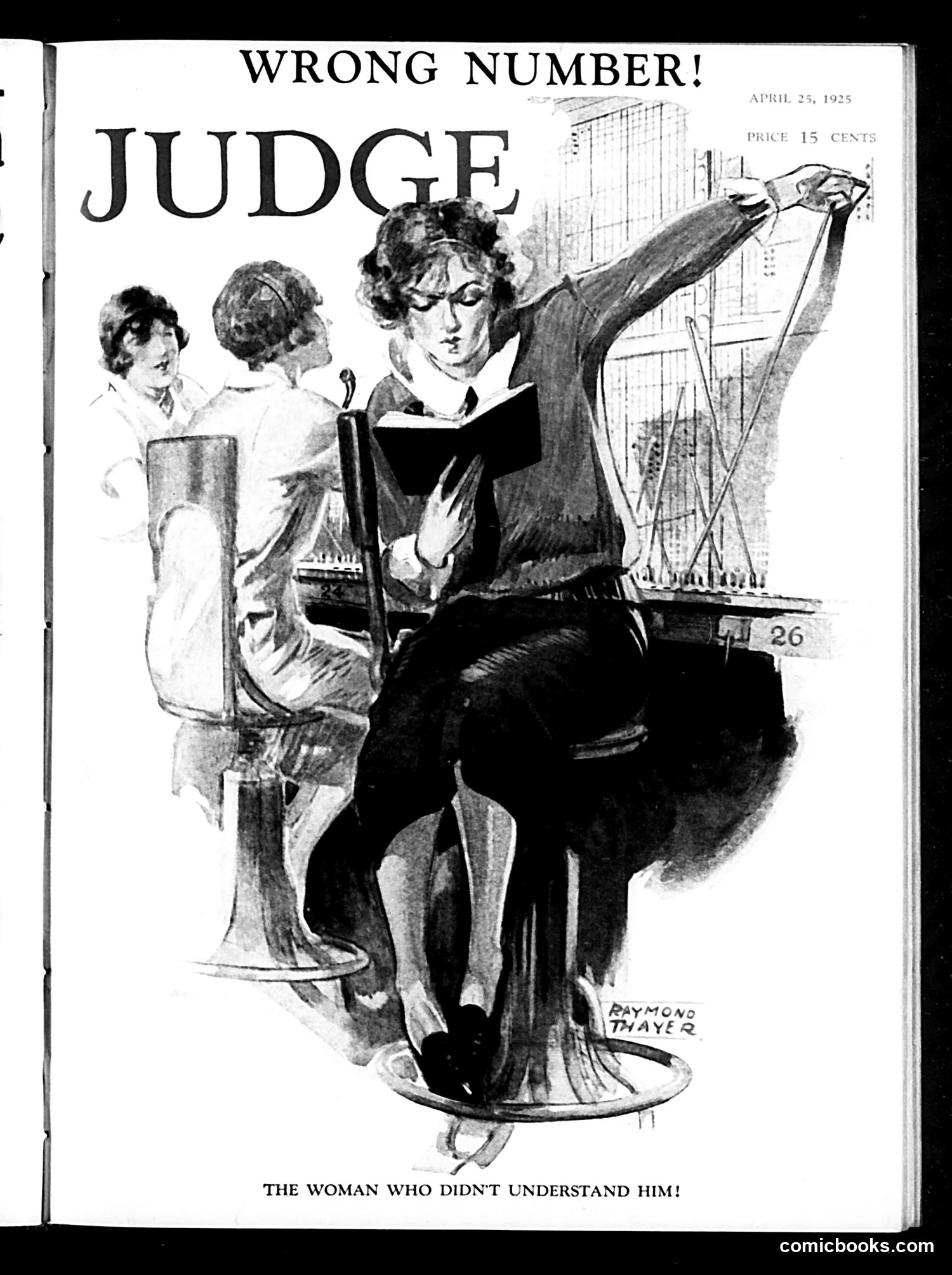
This cartoon depicts a woman in an elegant dress sitting at a telephone, having dialed what appears to be the wrong number. She's shocked or distressed by what she's hearing on the line. Two figures (appearing to be children or servants) stand behind her looking concerned. The title "The Woman Who Didn't Understand Him!" suggests a domestic comedy scenario—likely satirizing relationship misunderstandings or miscommunication in marriage. The "wrong number" joke plays on the era's telephone humor: she may have reached an unexpected or compromising conversation, leading to her dramatic reaction and raised arm. This reflects 1920s humor about modern technology (telephones) and gender relations, rendered in Raymond Thayer's distinctive illustration style.
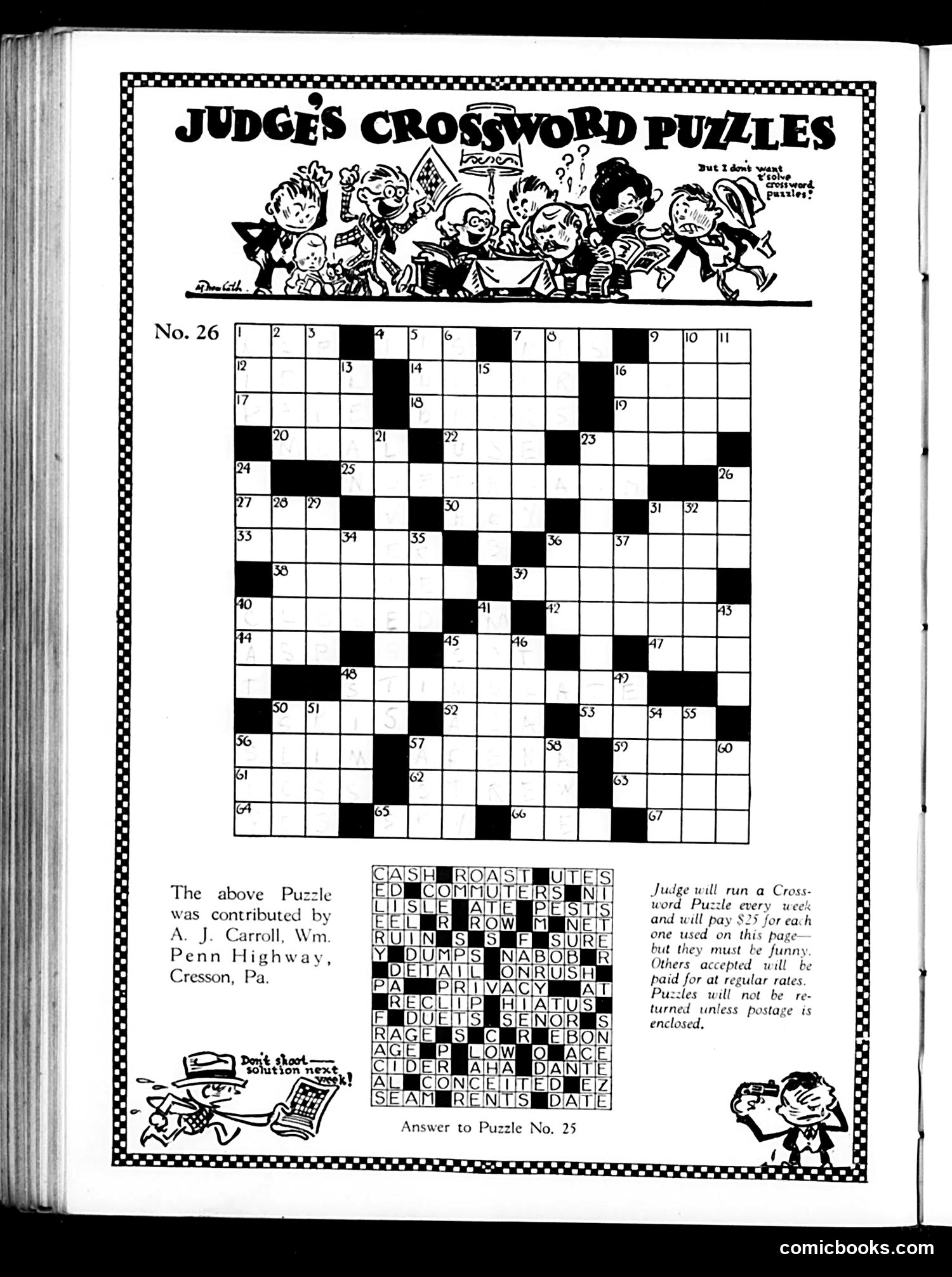
This page presents "Judge's Crossword Puzzles" No. 26, a recreational feature typical of Judge magazine's content. The crossword itself contains no apparent political satire—it's simply a word puzzle for readers to solve. The page includes the answer key to the previous puzzle (No. 25), displayed in a small grid format. The decorative header features cartoon children and characters in a cheerful, lighthearted style, establishing the playful tone. Small cartoon illustrations appear at the bottom of the page—one showing a figure with a newspaper and text about finding the solution, another showing a smiling character. This appears to be filler content rather than satirical commentary, demonstrating how Judge balanced its political humor with mainstream entertainment features to appeal to general readers.
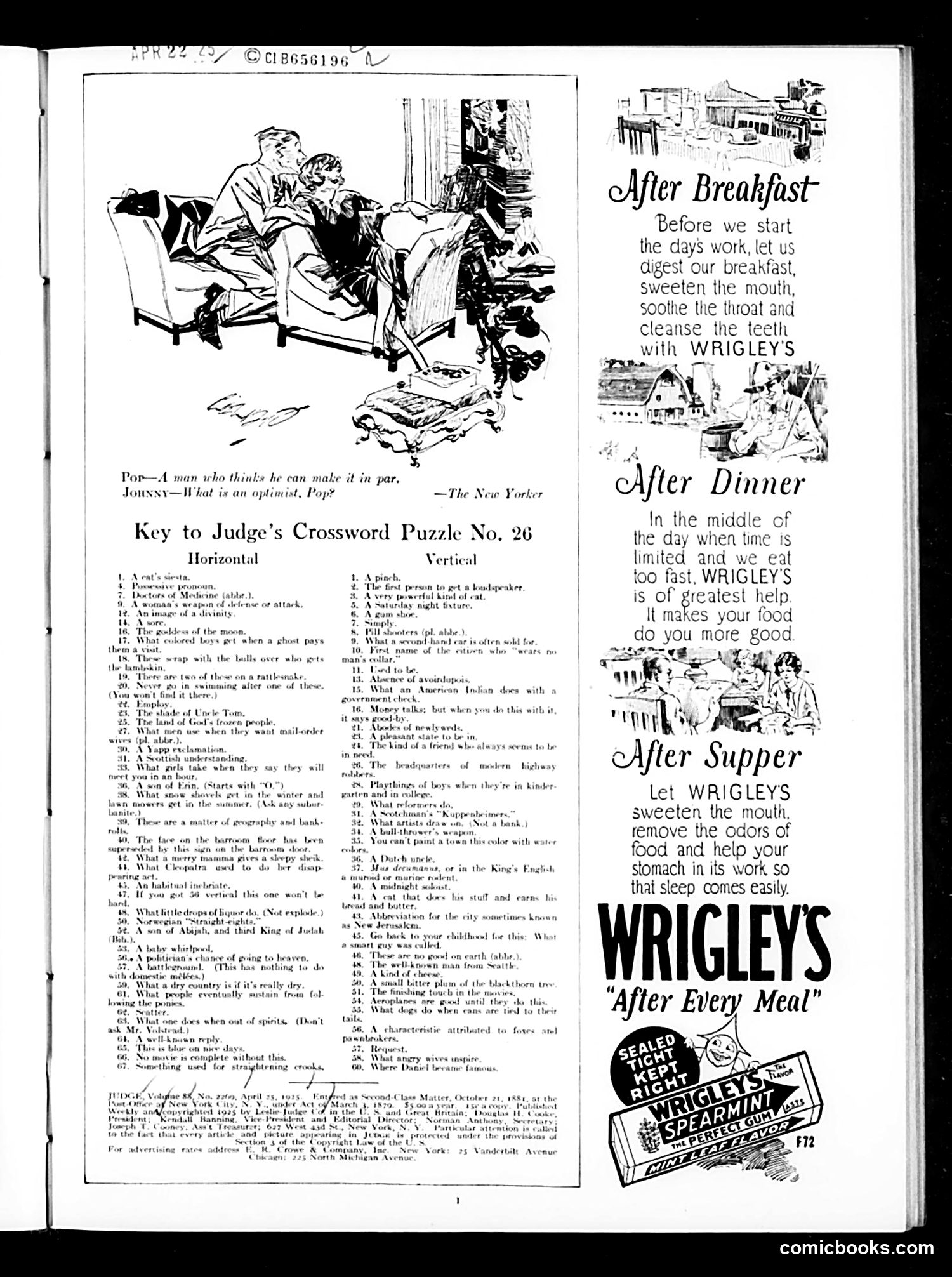
This page is predominantly **advertising for Wrigley's chewing gum**, not political satire. The left side contains a humorous cartoon captioned with a quote from *The New Yorker*: "Pop—A man who thinks he can make it in par. Jonesy—What is an optimist, Pop?" It's a golf joke about optimism, unrelated to the advertisement. The right side showcases Wrigley's marketing strategy promoting gum consumption "After Every Meal"—after breakfast, dinner, and supper. The ads claim gum aids digestion, freshens breath, and helps sleep. Below is the "Key to Judge's Crossword Puzzle No. 26" with horizontal and vertical clues. This is a typical Judge page mixing entertainment content with commercial advertising.
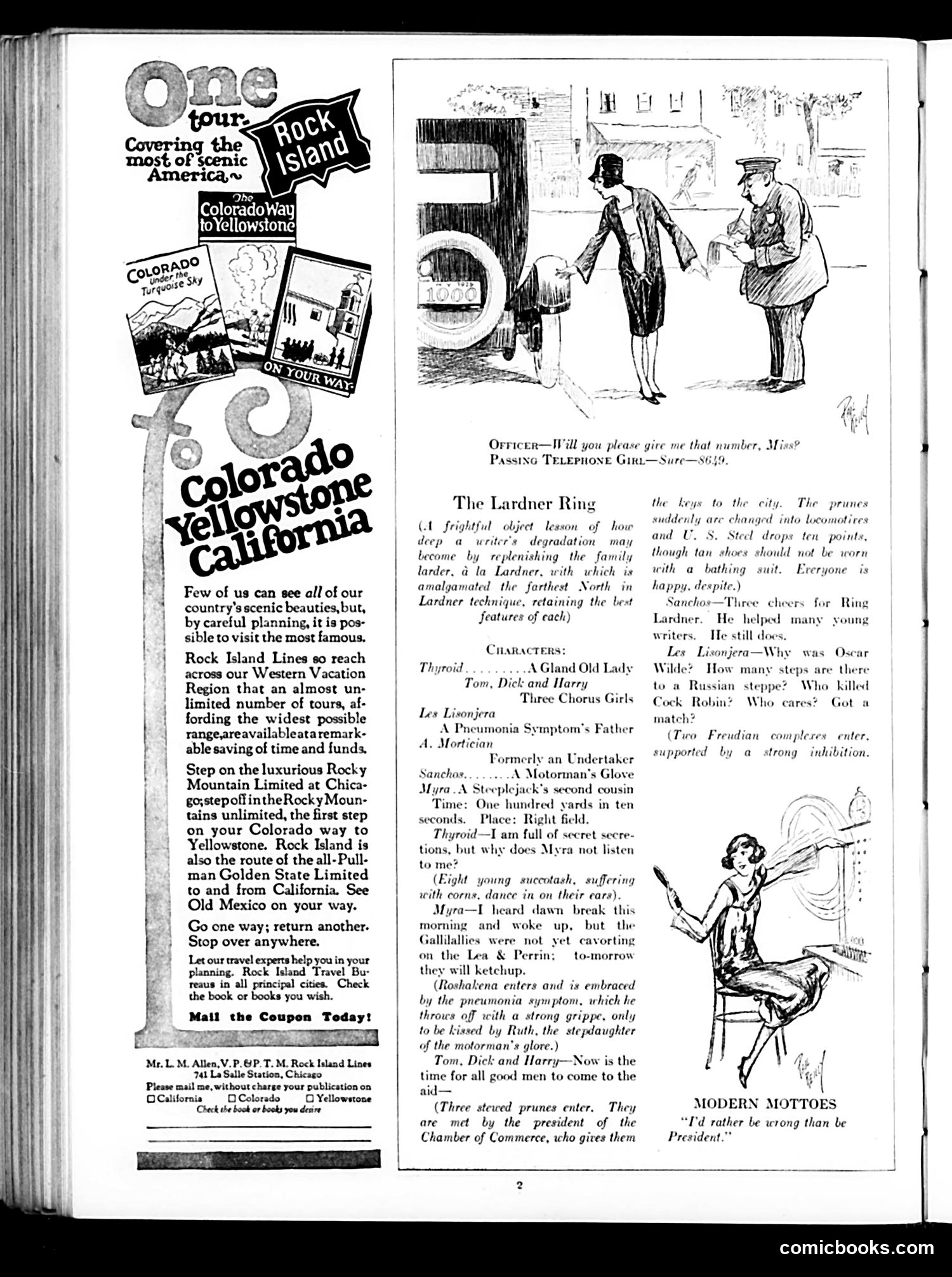
This page is **primarily advertising** for Rock Island Lines railroad tours (left) mixed with fiction content (right). The main cartoon depicts an officer asking a "Passing Telephone Girl" for a phone number, with the joke being a play on the double meaning of "number"—he wants her phone number (romantically), while she apparently thinks he's asking for a telephone exchange number for official purposes. Below is "The Lardner Ring," a short story about a writer's degradation and redemption through boxing, featuring characters with humorous names (Thyroid, Les Lisonjera, Sanchez, Myra). The bottom right includes "Modern Mottoes"—a caption reading "I'd rather be wrong than be President"—likely satirizing political leadership of the era. The page reflects early 20th-century humor styles and technology references.
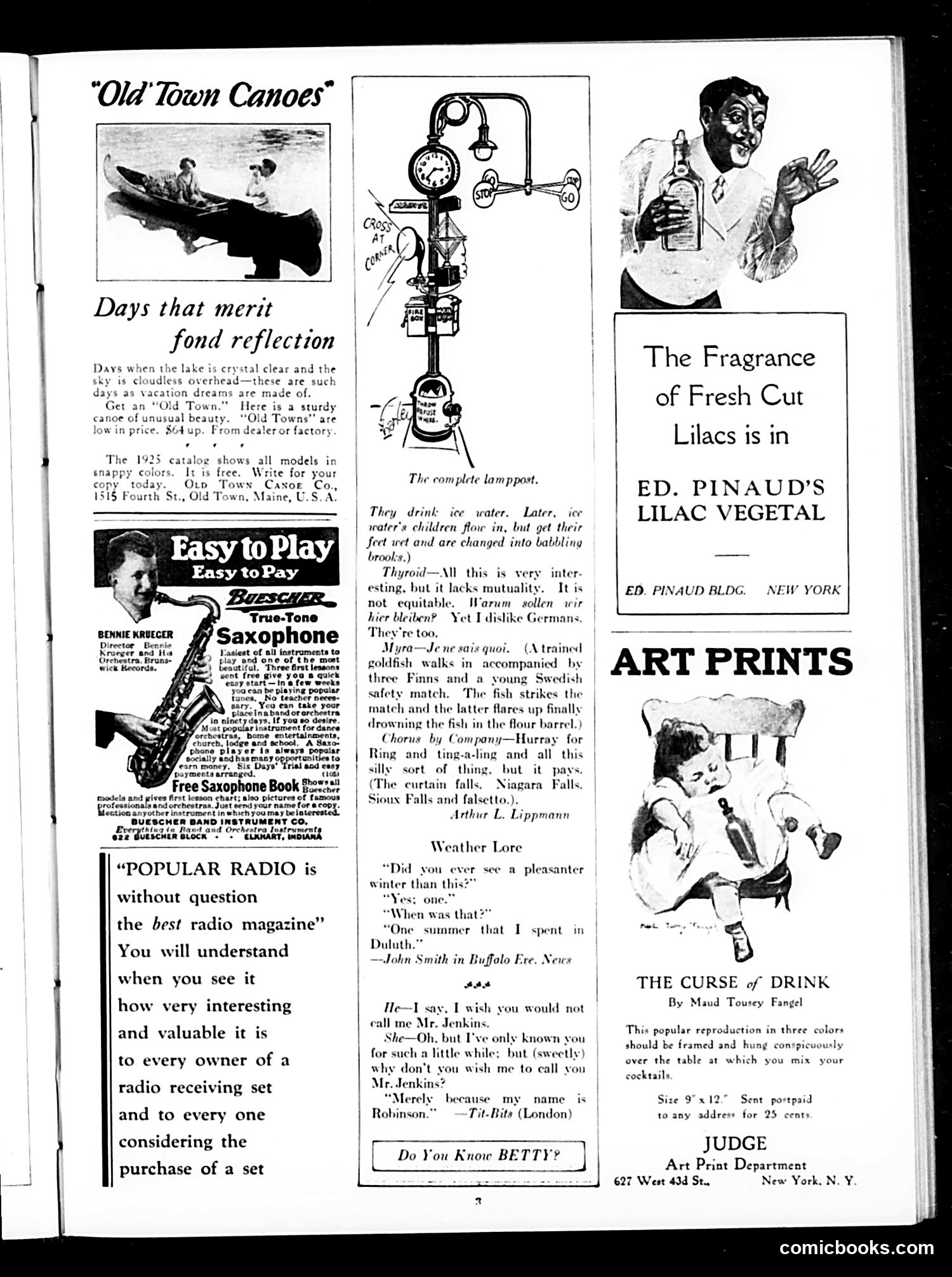
This page is primarily **advertising and lifestyle content** rather than political satire. The main elements include: 1. **"Old Town Canoes"** advertisement (top left) promoting affordable canoes for vacation leisure. 2. **Musical instruments ads**: A Buescher saxophone and Popular Radio magazine promotion, targeting middle-class consumers. 3. **"The Fragrance of Fresh Cut Lilacs"** - a perfume advertisement for Ed. Pinaud's Lilac Vegetal. 4. **"Art Prints"** section (right side) advertising "The Curse of Drink," a three-color reproduction print about alcohol's dangers—a temperance-era social message. The page reflects **1920s consumer culture and moral reform concerns**, with ads targeting leisure activities and products. The temperance art print suggests Judge's engagement with Prohibition-era social issues, though the overall page emphasizes commercial advertising over political commentary.
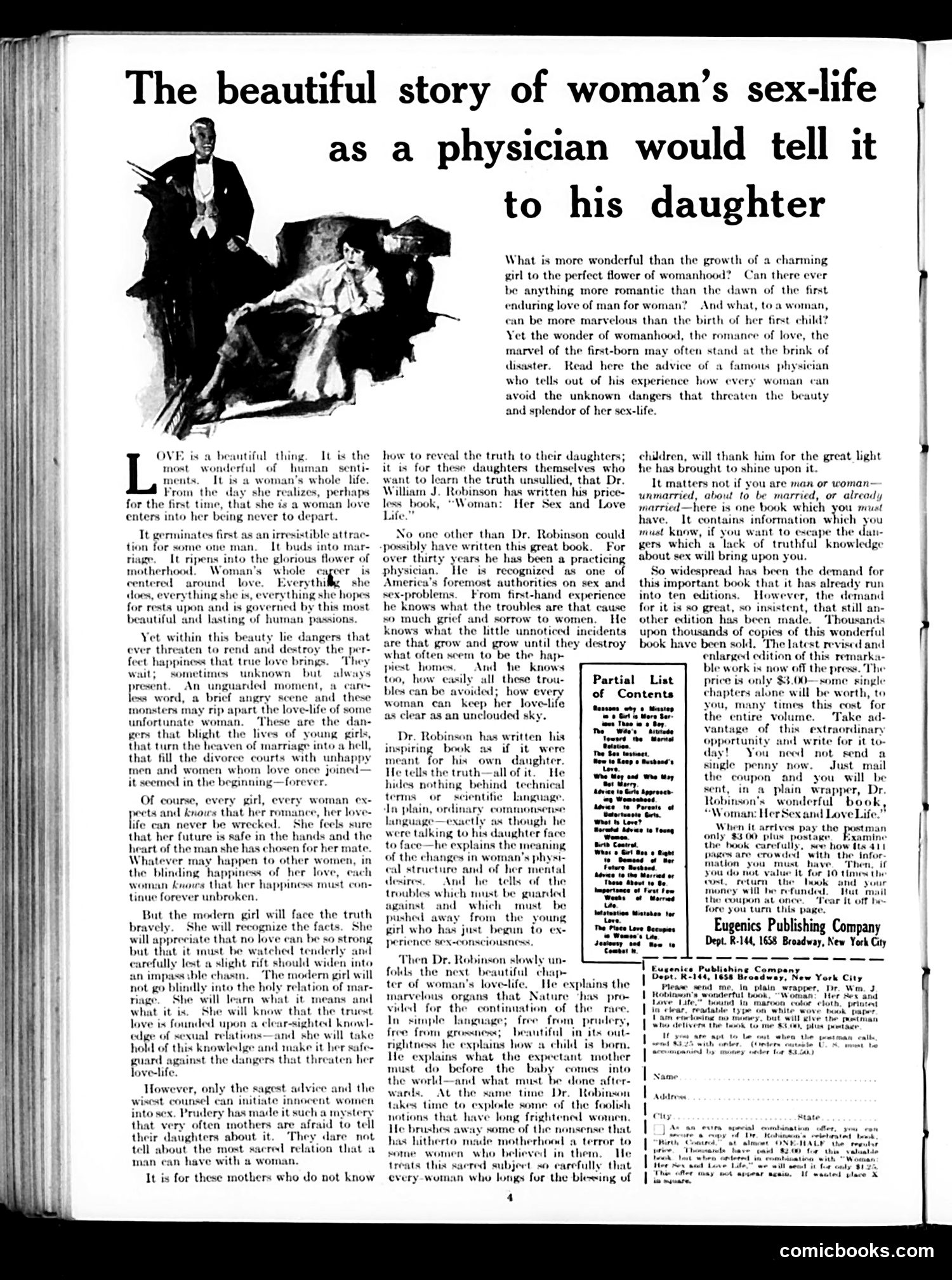
This page is primarily an advertisement for Dr. William J. Robinson's book "Woman: Her Sex and Love Life," not a political cartoon. The illustration shows a distinguished older man (presumably Dr. Robinson) with a young woman and child, framing the book as educational guidance. The ad's satire is subtle: it ironically positions explicit sexual instruction as "beautiful" and "romantic," using flowery language about womanhood while actually promoting frank discussion of sexuality. The framing as advice "a physician would tell his daughter" lends medical authority to justify discussing taboo subjects. The ad appears to mock both prudishness and commercialism—promising that knowledge prevents "dangers" to women's sexuality while simultaneously marketing the book aggressively across multiple publications.
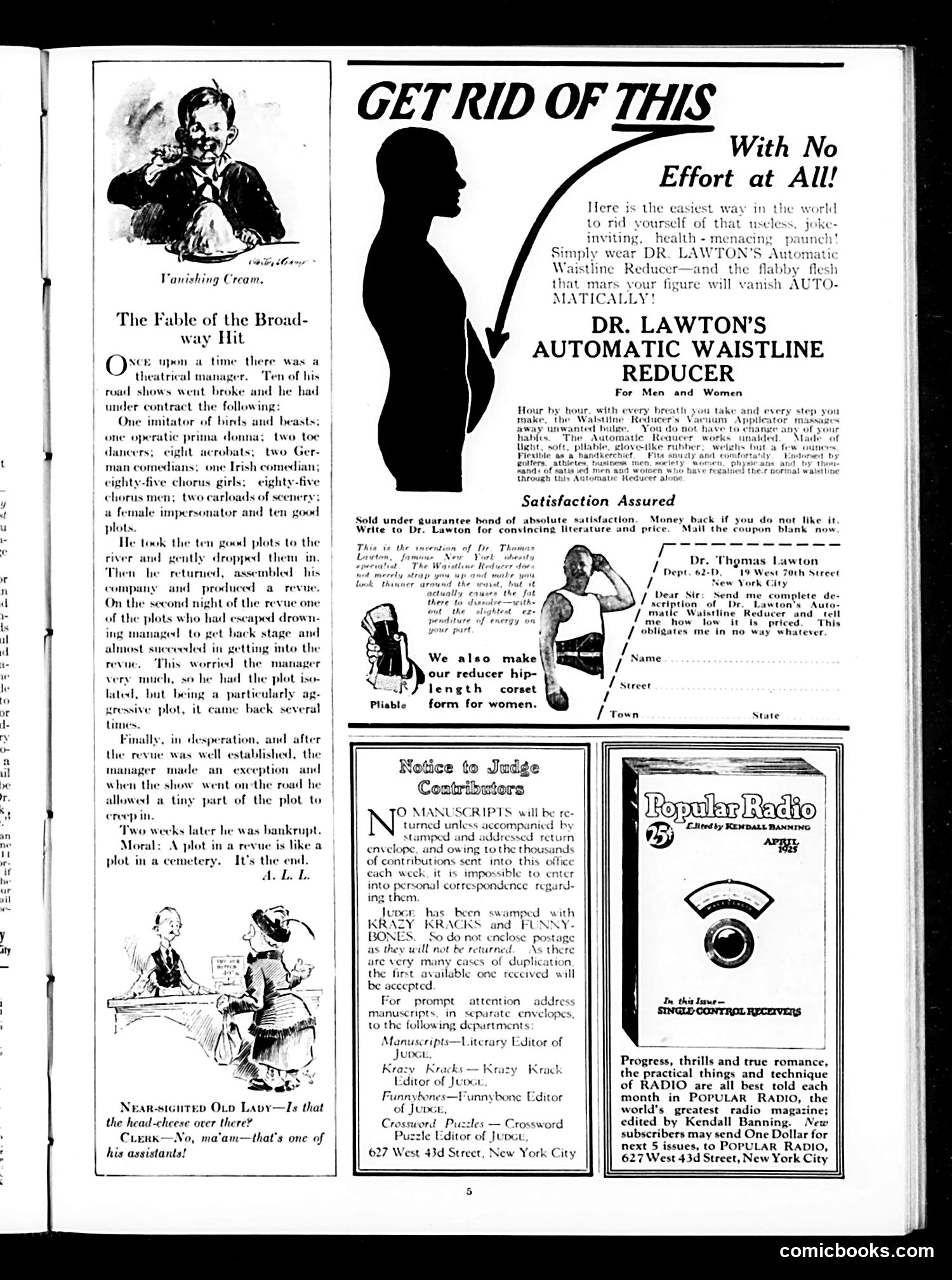
This page is primarily **advertising rather than political satire**. The dominant content is a full-page ad for "Dr. Lawton's Automatic Waistline Reducer"—a corset-like device claiming to automatically reduce body size without effort. The small cartoon on the left, "The Fable of the Broadway Hit," is a satirical story about theatrical management, mocking how producers assemble shows from disparate acts (acrobats, comedians, chorus girls). The moral critiques the formulaic nature of Broadway revues—comparing plot construction to cemetery burial, suggesting such plots lack originality and life. The page also contains notices to contributors and a Popular Radio magazine advertisement. The weight-reduction ad reflects early 20th-century consumer culture's obsession with body modification through dubious products.
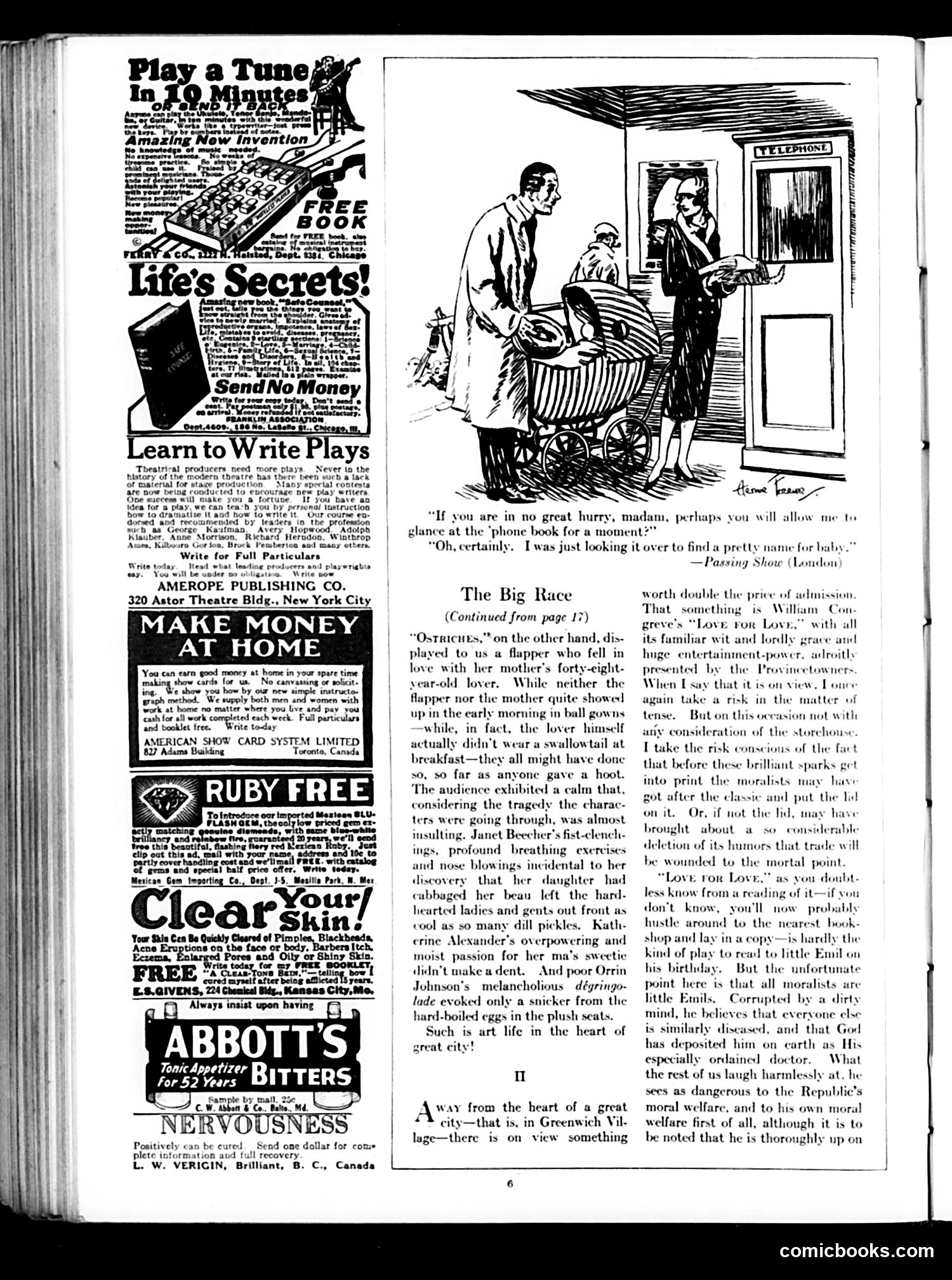
This page from *Judge* magazine is primarily **advertisements and a theater review**, not political satire. The cartoon at top-right depicts a mundane domestic scene: a man with a baby carriage encounters a woman at a telephone booth. The caption quotes their exchange about using a phone directory to find a baby name. This is gentle, observational humor about everyday life—typical of *Judge's* lighter content. The bulk of the page is the review "The Big Race," discussing theatrical productions: "Ostricues" (a play featuring a romantic triangle among a flapper, her mother, and the mother's lover) and Congreve's "Love for Love," presented by the Provincetown Players. The reviewer critiques the audience's cold reception to emotional performances, and warns that moralists may censor the classic play's ribald content. The remaining content is vintage advertising: mail-order education courses, work-from-home schemes, patent medicines, and beauty products—typical early 20th-century magazine filler.
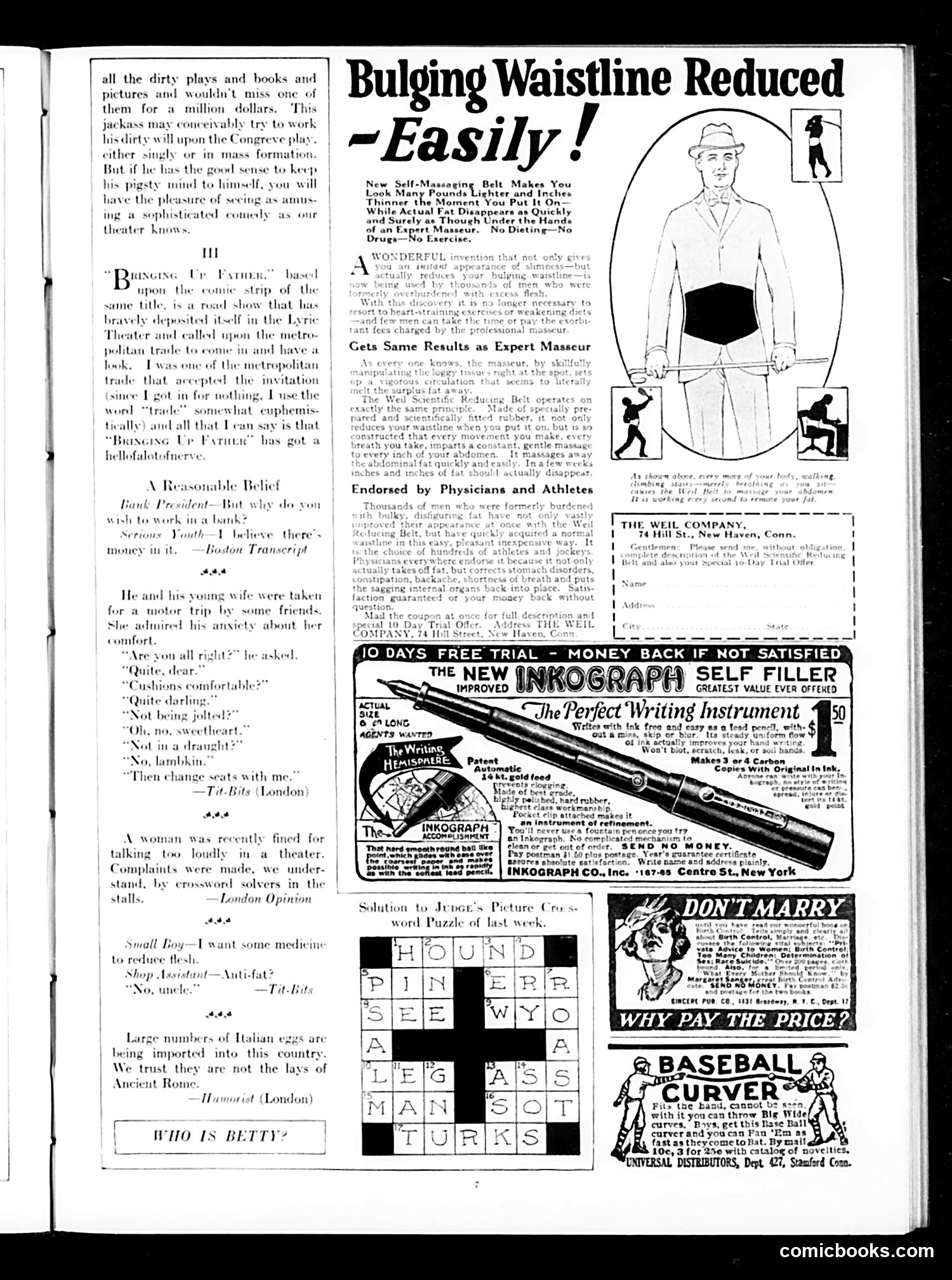
This page is primarily **advertisements and filler content** rather than political cartoons. The main feature is a large ad for the "Weil Scientific Reducing Belt"—a self-massaging device claiming to reduce waistlines without dieting or exercise, endorsed by "physicians and athletes." The surrounding content consists of brief humorous anecdotes and jokes typical of 1920s magazines: a bank president's quip about money, a couple's car trip dialogue, a theater fine for loud talking, and ethnic humor about Italian eggs imported to America (implying they might be from ancient Rome—a dated "classical" joke). **Social context for modern readers**: This page reflects early-20th-century American consumer culture and its promotion of dubious weight-loss devices. The reducing belt advertisement exemplifies the era's unregulated patent medicine industry—making extravagant claims without scientific backing. The surrounding humor is typical period magazine filler: mild, family-friendly jokes relying on wordplay and gentle social observation rather than political satire.
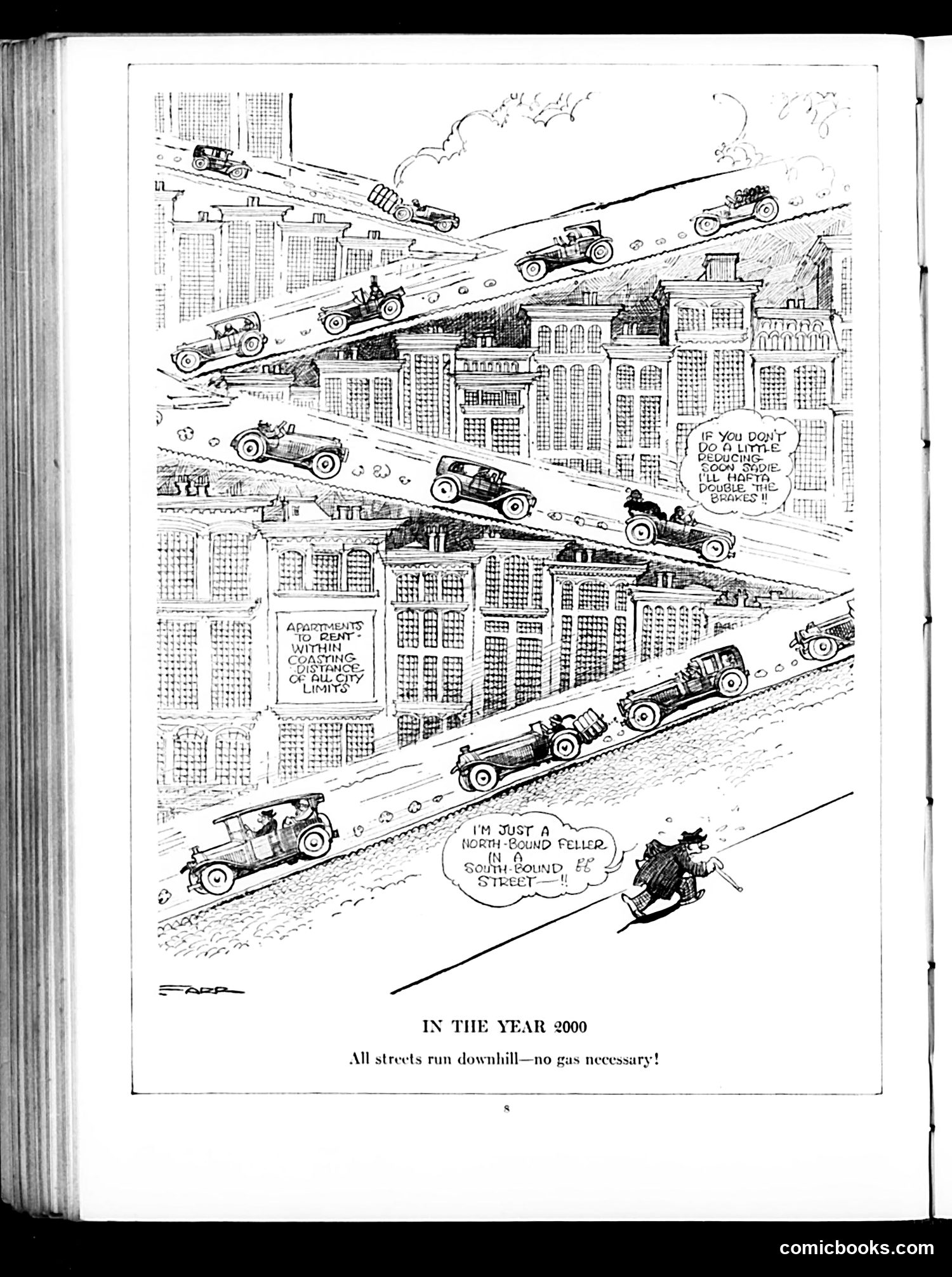
This is a satirical vision of future urban life. The cartoon depicts a steeply inclined cityscape where multiple vehicles—cars, trucks, and motorcycles—coast downhill on streets arranged at severe angles. The satire targets early 20th-century urban congestion and automobile culture. By imagining all streets running downhill "with no gas necessary," the cartoonist mocks: 1. **Traffic chaos**: Multiple vehicles competing on crowded streets 2. **Housing density**: Apartment buildings advertising rent within walking distance 3. **Automobile dependence**: The implication that gravity replacing gasoline represents "progress" One character says he's "just a north-bound feller in a south-bound street"—highlighting confusion from the absurdly tilted geography. The joke's pessimistic humor suggests cities are becoming increasingly chaotic and crowded, with tongue-in-cheek "solutions" (gravity-powered vehicles) that highlight rather than resolve the problem.
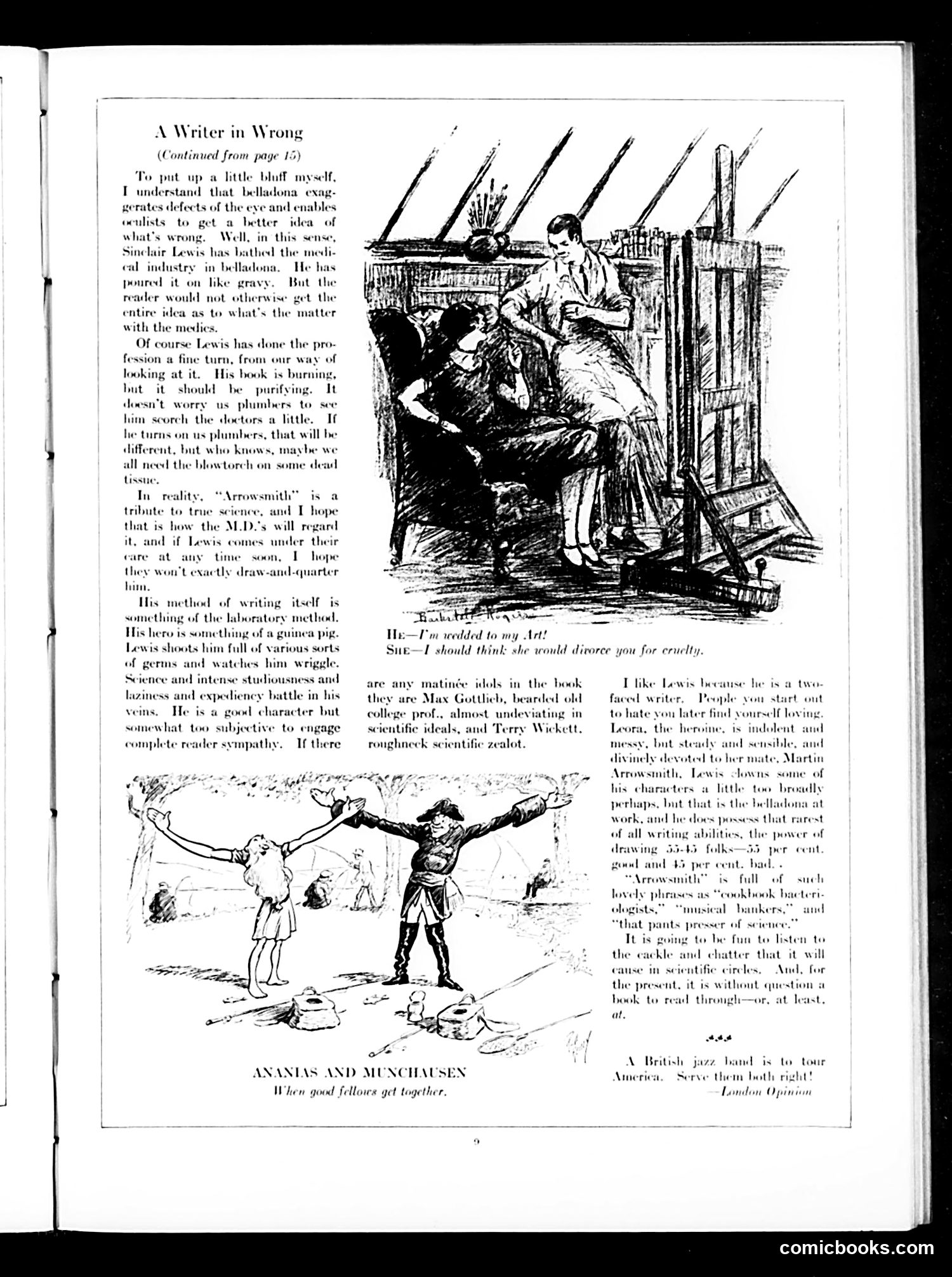
This page reviews Sinclair Lewis's novel "Arrowsmith," a satirical critique of the medical profession. The review praises Lewis for exposing problems in medicine ("bathed the medical industry in belladona") while noting the book's literary merit despite its subjective protagonist. The two cartoons provide comic relief: the top illustration shows a domestic scene about art versus marriage; the bottom, titled "Ananas and Munchausen" (referencing a medical syndrome about fabricated illness), depicts two figures—likely representing types discussed in Lewis's novel—meeting casually. The review acknowledges Lewis's "two-faced" writing style creates characters readers come to appreciate despite initial resistance. It criticizes certain character types in the book (Max Gottlieb, Terry Wickett) as scientific stereotypes while praising the heroine Leora's devotion. The final quote mocking a British jazz band's American tour reflects contemporary Anglo-American cultural tensions typical of Judge's satirical stance.
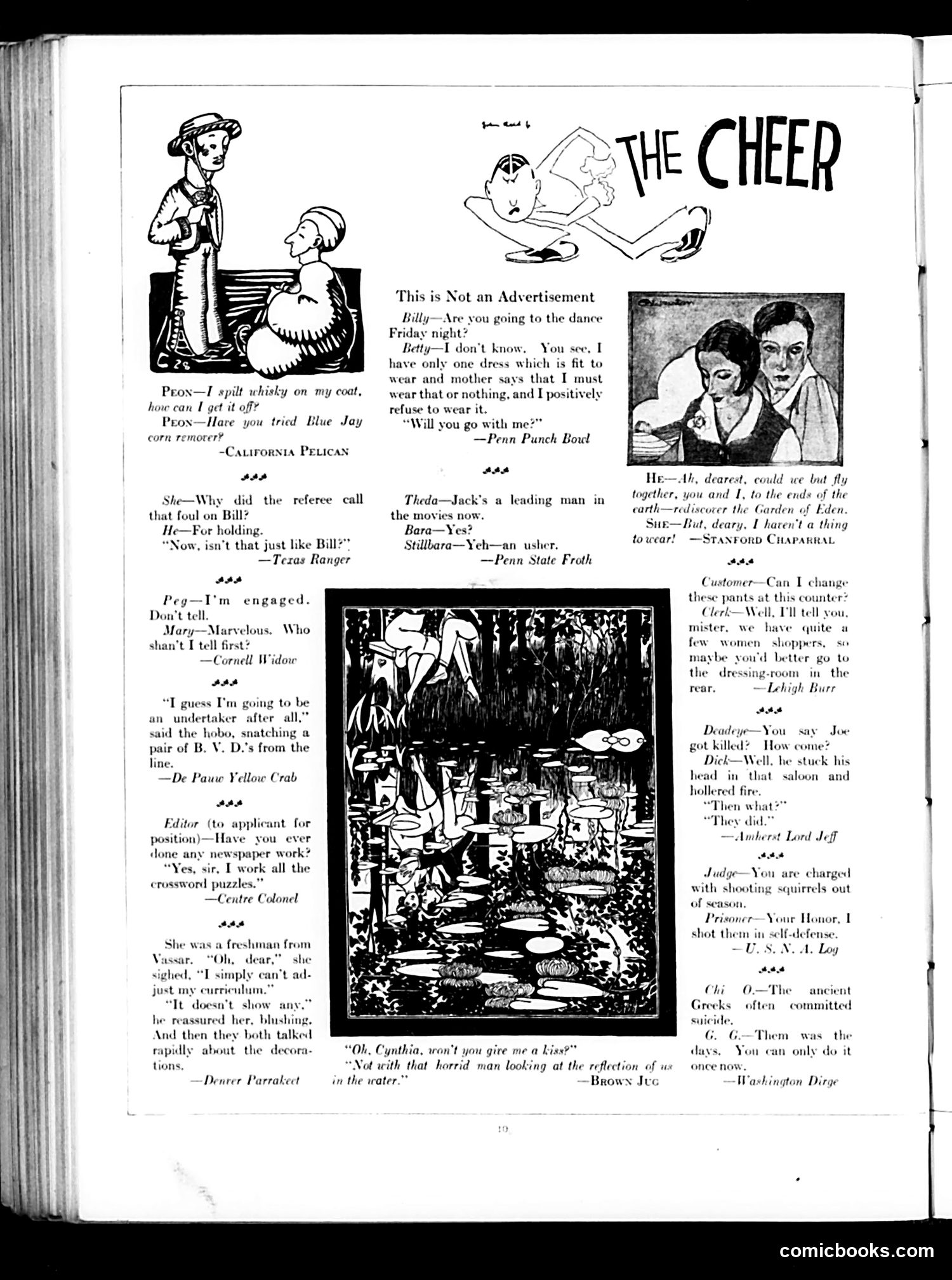
This page from *Judge* magazine collects brief, gag-based humor across multiple categories: student life jokes, one-liners about courtship and gender roles, and workplace comedy. **Key humor themes:** **Gender/Fashion**: Several jokes mock women's clothing constraints—one woman refuses to attend a dance because she owns only one acceptable dress; another laments having "nothing to wear" even in romantic scenarios. This reflects 1920s-era social expectations about female appearance. **College Life**: References to "freshman," "curriculum," and campus publications (Penn Punch Bowl, Cornell Widow) target collegiate audiences with relatable absurdities. **Dating/Romance**: Multiple exchanges play on awkward courtship dynamics—proposals, kiss-asking, and romantic clichés. **Occupational humor**: An editor asks about "newspaper work"; applicants claim experience with "crossword puzzles." The large central illustration shows a 1920s party scene, likely supporting one of the captioned jokes about social dancing or romantic entanglement. The overall tone is light, collegiate satire typical of *Judge*'s era, with no apparent political content—purely social comedy targeting young, educated readers.
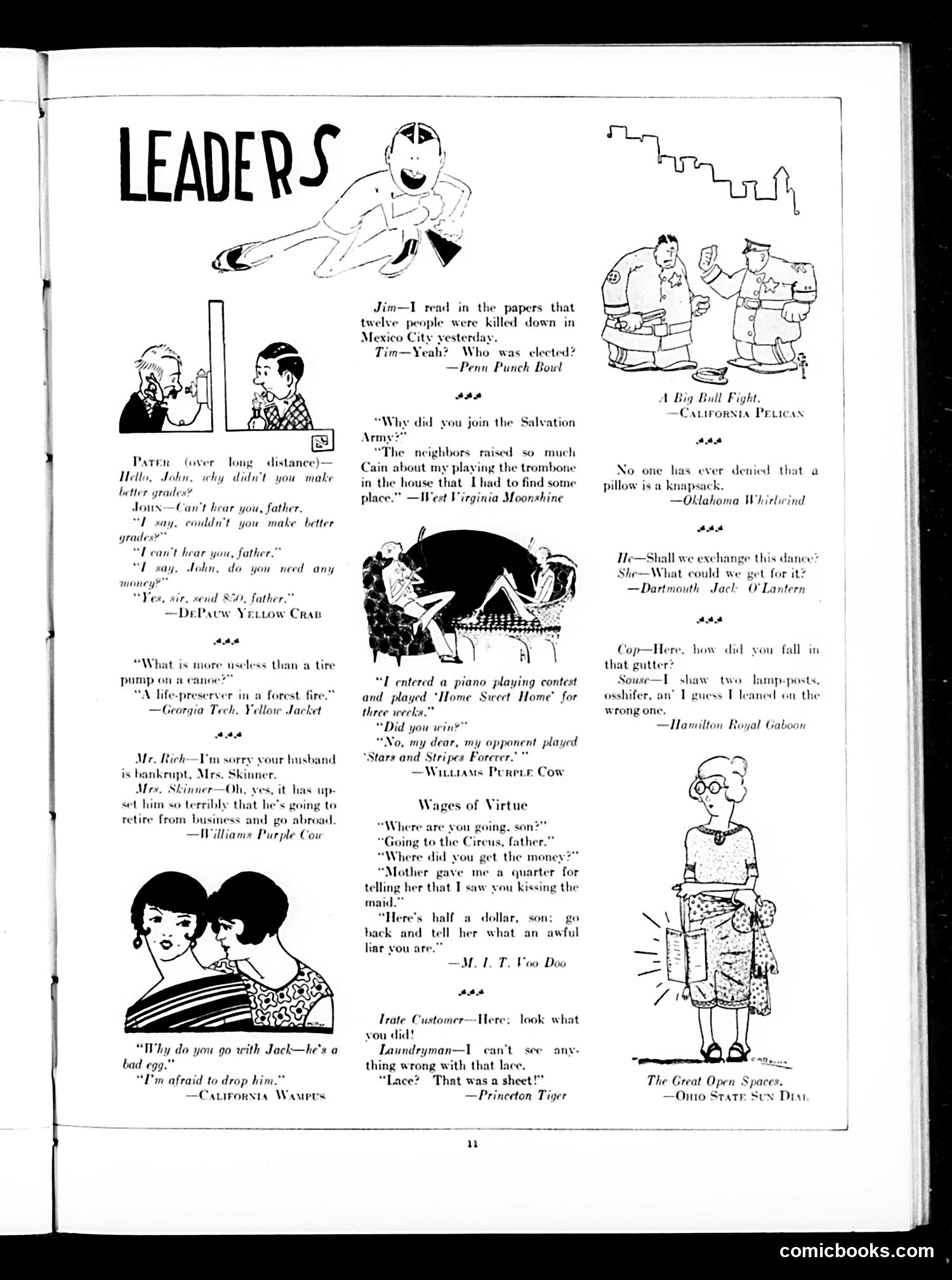
This is a "Leaders" page from *Judge* magazine—a collection of short jokes and quips from various college humor publications and newspapers. The content reflects early 20th-century American campus and social humor. The jokes satirize common situations: a father who can't hear his son over long-distance phone calls (then a novel, unreliable technology), a woman escaping bankruptcy through her husband's "retirement," a drunk man mistaking a lamppost for a gutter, and a laundry mishap. One recurring theme mocks poor musical performance (three-week piano recitals, trombone playing). The "Wages of Virtue" section humorously depicts a boy blackmailing his mother for money by threatening to report her kissing the maid, then his father doubling the bribe to admit he lied—inverting moral expectations for comedic effect. Most jokes rely on puns, misunderstandings, or absurdist scenarios typical of college humor magazines, which *Judge* frequently republished to fill space. The attributions (DePauw, Georgia Tech, Williams, Princeton) indicate these originated from campus publications.
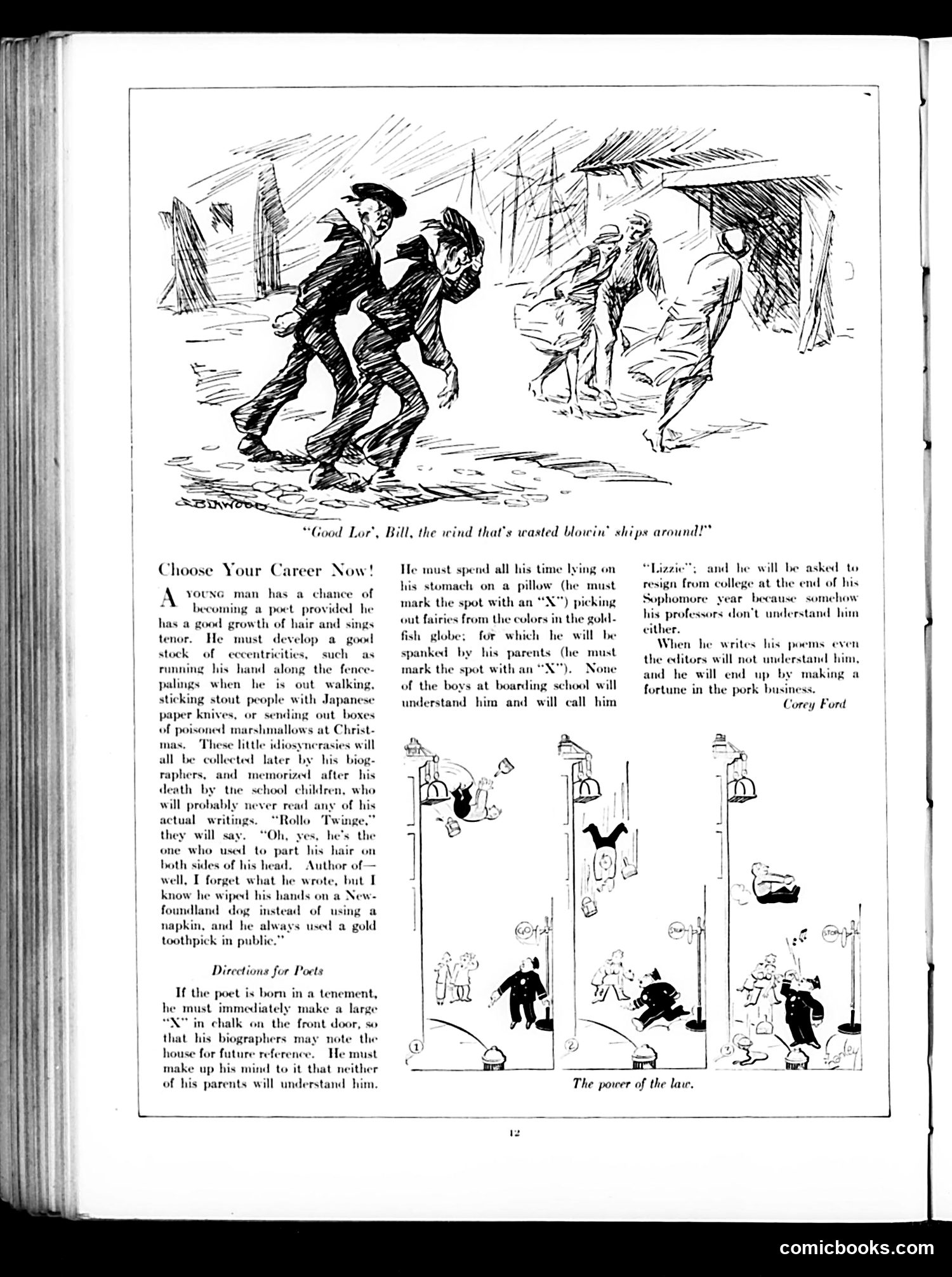
This satirical piece mocks the romantic stereotype of the "tortured poet" — a figure celebrated in early 20th-century culture. The text ridicules how poets cultivate deliberate eccentricities (bizarre habits, affectations) that biographers later mythologize, while their actual work goes unread. The satire targets several absurdities: poets are valued for quirks like unusual hairstyles or cruelty to strangers rather than talent. Biographers obsess over trivial biographical details ("marking X's") to memorialize in school curricula. The punchline — that the misunderstood poet ultimately succeeds in *pork business*, not literature — deflates pretension entirely. By attributing the piece to "Corey Ford," this appears to be humorous advice literature mocking bohemian affectation and the public's gullible veneration of artistic eccentricity divorced from actual artistic merit. The comic strips below ("The power of the law") seem to continue this mockery.
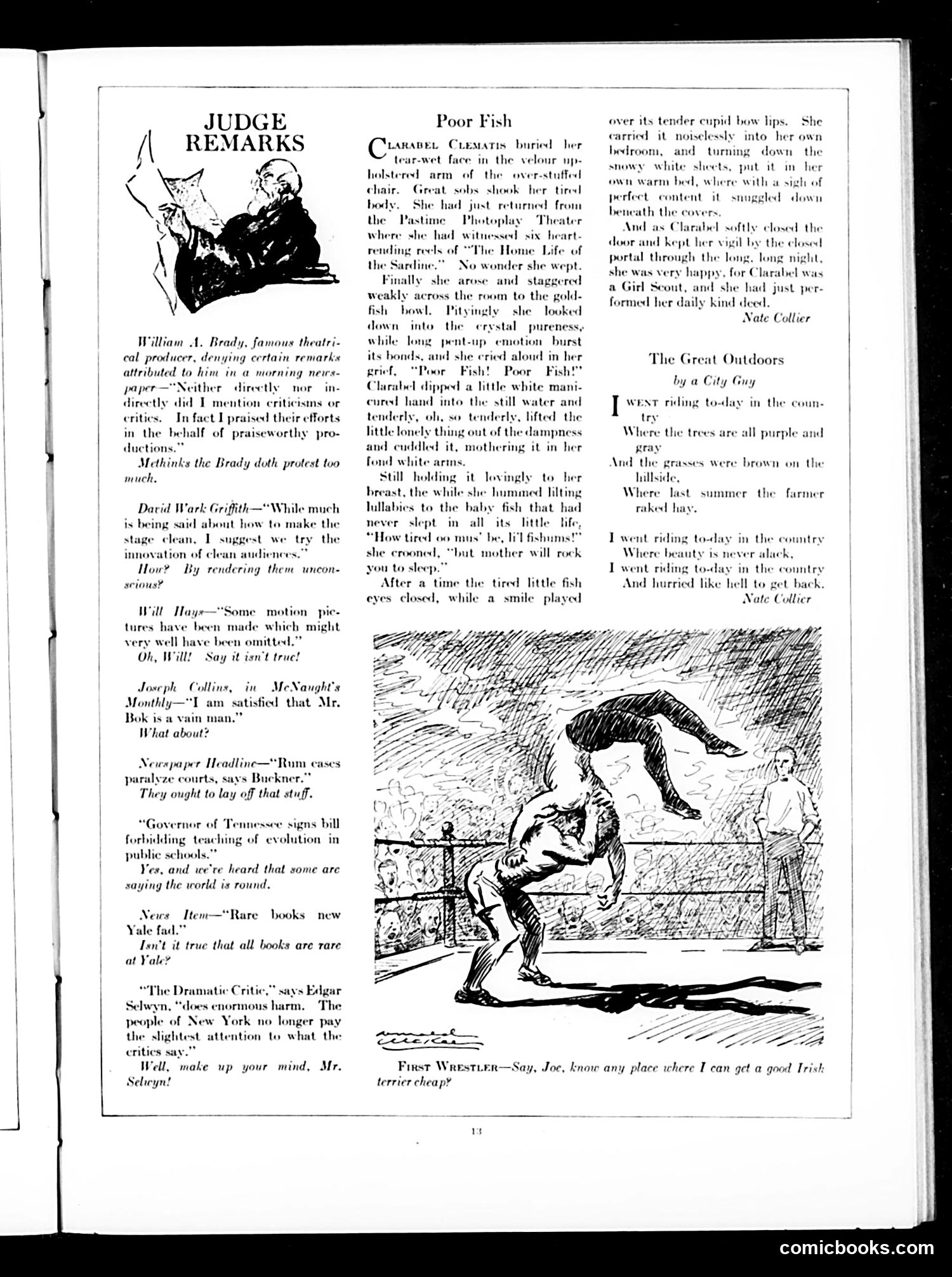
This page contains brief satirical "Judge Remarks" about theatrical and literary figures, plus two humorous pieces. **Judge Remarks** mock various celebrities through exaggerated praise or ironic commentary: William A. Brady over-defending himself (the "doth protest too much" reference), director D.W. Griffith's impractical suggestion about cleaning audiences, and jabs at critic Edgar Selwyn and others. **"Poor Fish"** is a sentimental parody—likely mocking melodramatic theater or film. A woman (Clarabel Clematis) cries over a goldfish, tenderly rescues it, and puts it in her bed, all while performing her "daily kind deed" as a Girl Scout. The satire targets overwrought emotion and performative virtue. **"The Great Outdoors by a City Guy"** is a brief poem mocking urban pretension: someone praises nature's beauty while riding in the country, then admits they fled back to the city as fast as possible—satirizing superficial appreciation of rural life. The bottom cartoon is a brief joke about a wrestler seeking a cheap Irish terrier dog.
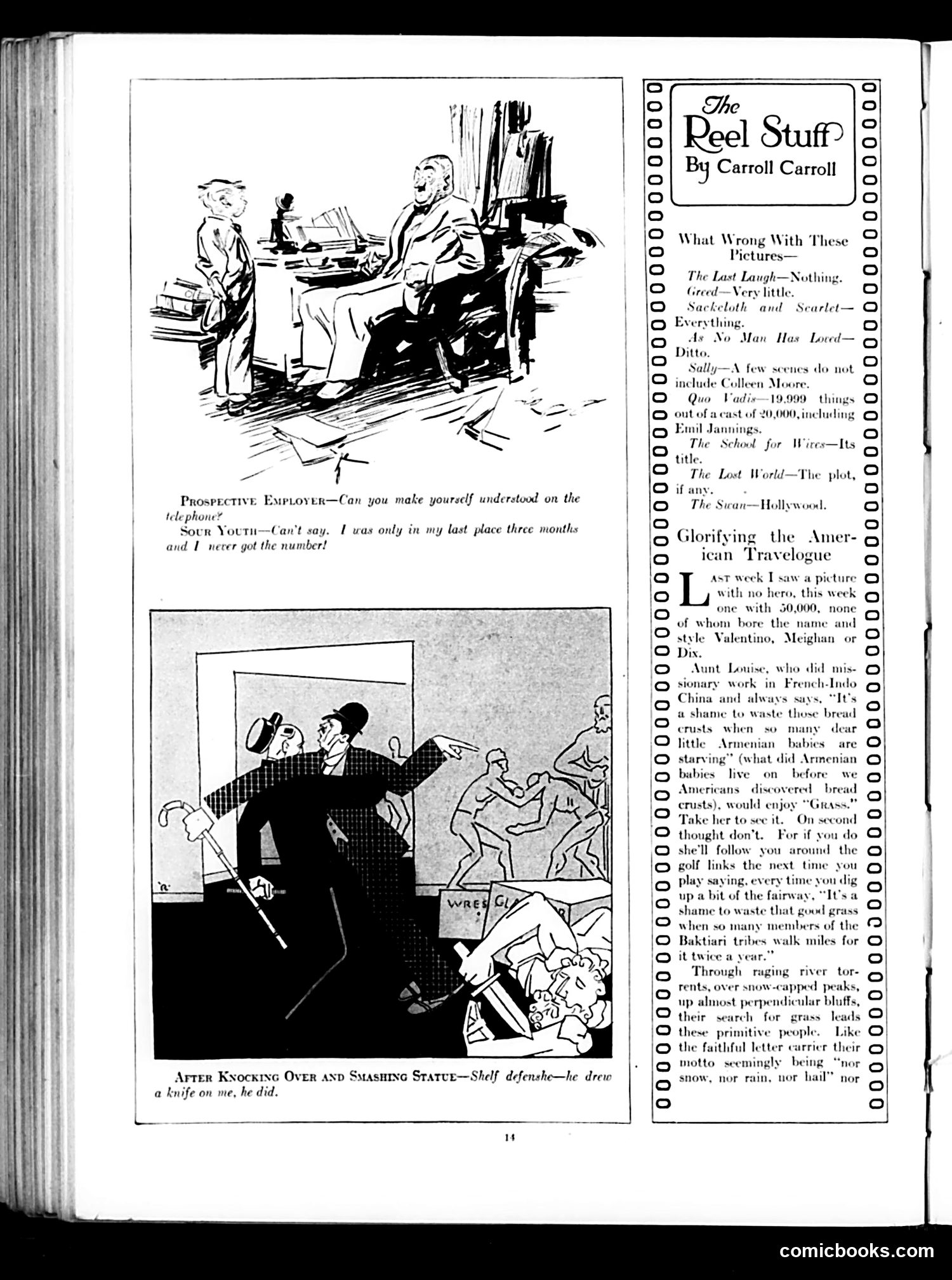
This page contains two satirical cartoons about Hollywood and employment, plus a film review column by Carroll Carroll. **Top cartoon:** A job applicant claims he can use a telephone, but admits he only lasted three months at his previous position and "never got the number"—mocking workplace incompetence and poor communication skills. **Bottom cartoon:** Titled "After Knocking Over and Smashing Statue," depicts a "self defense" scenario where someone claims to have drawn a knife in response—satirizing absurd legal justifications for violence or destruction of property. **Right column:** "The Reel Stuff" critiques contemporary films (likely 1920s releases), listing what's "wrong" with each picture. It mocks Hollywood excess—noting *Quo Vadis* has 19,999 of 20,000 things wrong, and *The Swan* satirizes Hollywood itself. A secondary item jokes about a charitable woman who would be insufferable watching a travel film about the Baktiari people, unable to stop guilt-tripping about wasted resources. The humor targets both employment absurdity and Hollywood's pretensions.
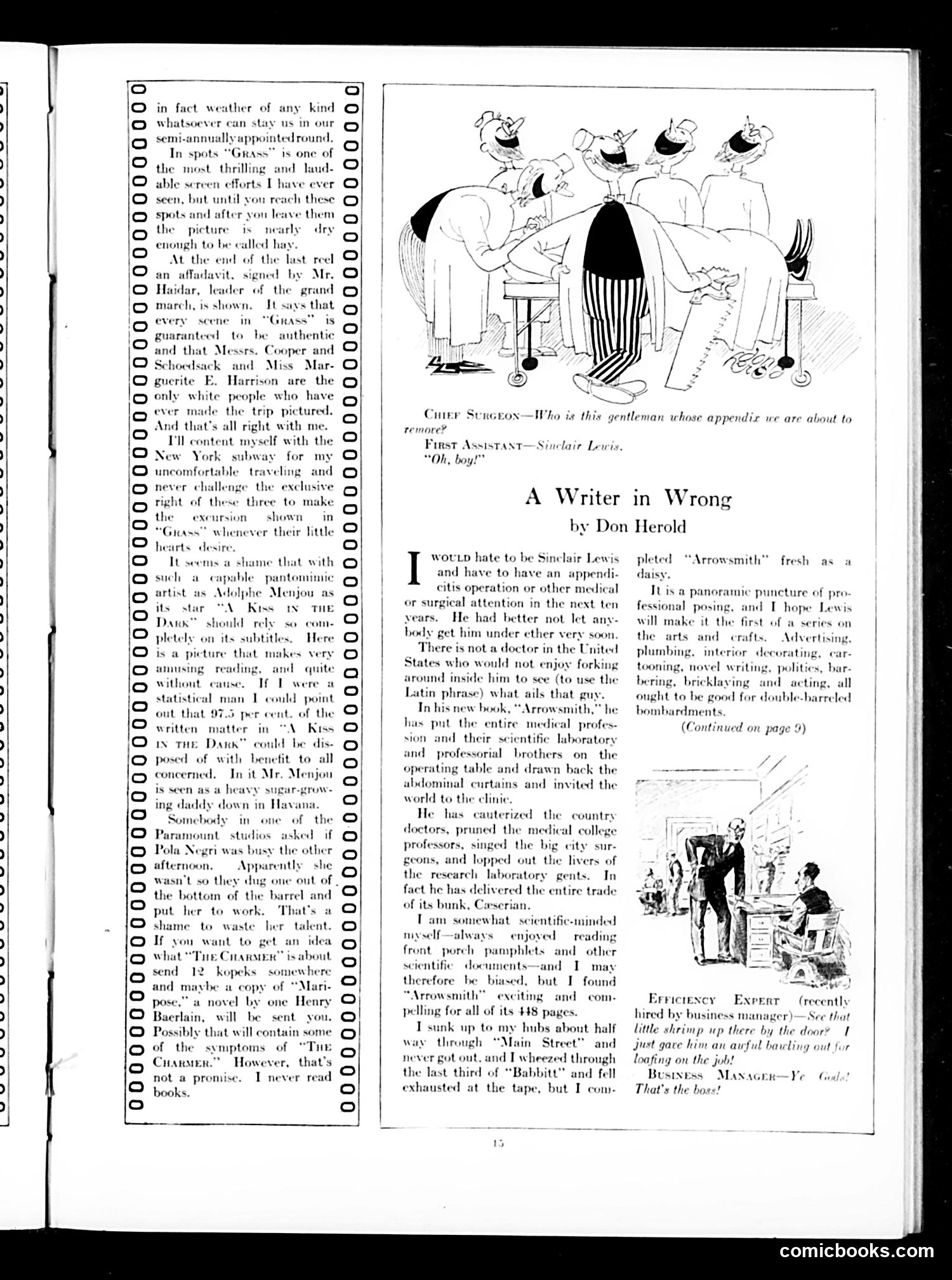
The top cartoon depicts a surgical scene where doctors are about to operate on a patient identified as **Sinclair Lewis**, the famous American novelist. The joke is a satirical attack on Lewis's new novel *Arrowsmith* (about the medical profession), suggesting doctors would eagerly want to "operate" on him in revenge for his critical exposure of their profession. The accompanying article by Don Herold elaborates this satire, praising *Arrowsmith* as Lewis's best work for excoriating medical hypocrisy—he "cauterized the country doctors" and exposed the profession's "bunk." Herold notes Lewis previously criticized advertising, business, and small-town life in *Main Street* and *Babbitt*. The lower cartoon about an "efficiency expert" appears unrelated office humor. The satire targets professional pretension and corruption, presenting Lewis as a fearless cultural critic who debunks institutional fraudulence.
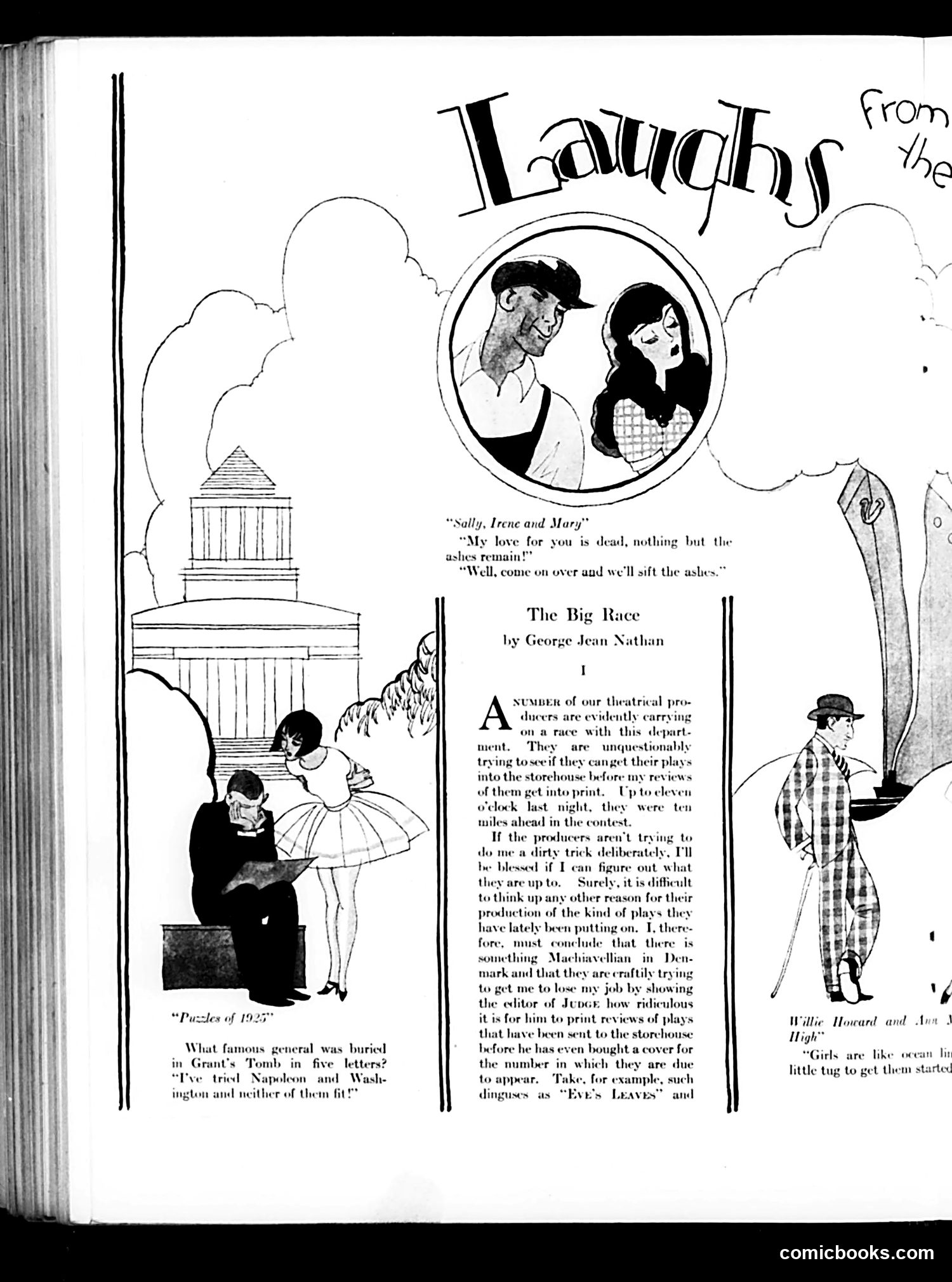
This page from Judge magazine contains theatrical humor and a riddle. The top features "Sally, Irene and Mary," a play being mocked through a cynical joke about dead love and sifting ashes—likely satirizing the play's melodramatic sentimentality. The main article, "The Big Race" by George Jean Nathan, is a humorous complaint from the theater critic about producers deliberately rushing their plays into production ahead of his review deadlines, trying to embarrass him professionally. Nathan sarcastically suggests this is a coordinated conspiracy to make him look foolish to his editor. The illustrations show vaudeville scenes ("Puzzles of 1925" and references to Willie Howard and Ann Pennington), typical entertainment of the 1920s. The riddle mocking Grant's Tomb (asking what general in five letters was buried there—the answer being "Grant") provides light comic relief. This reflects 1920s theater-world tensions and Judge's satirical take on show business vanity and competition.
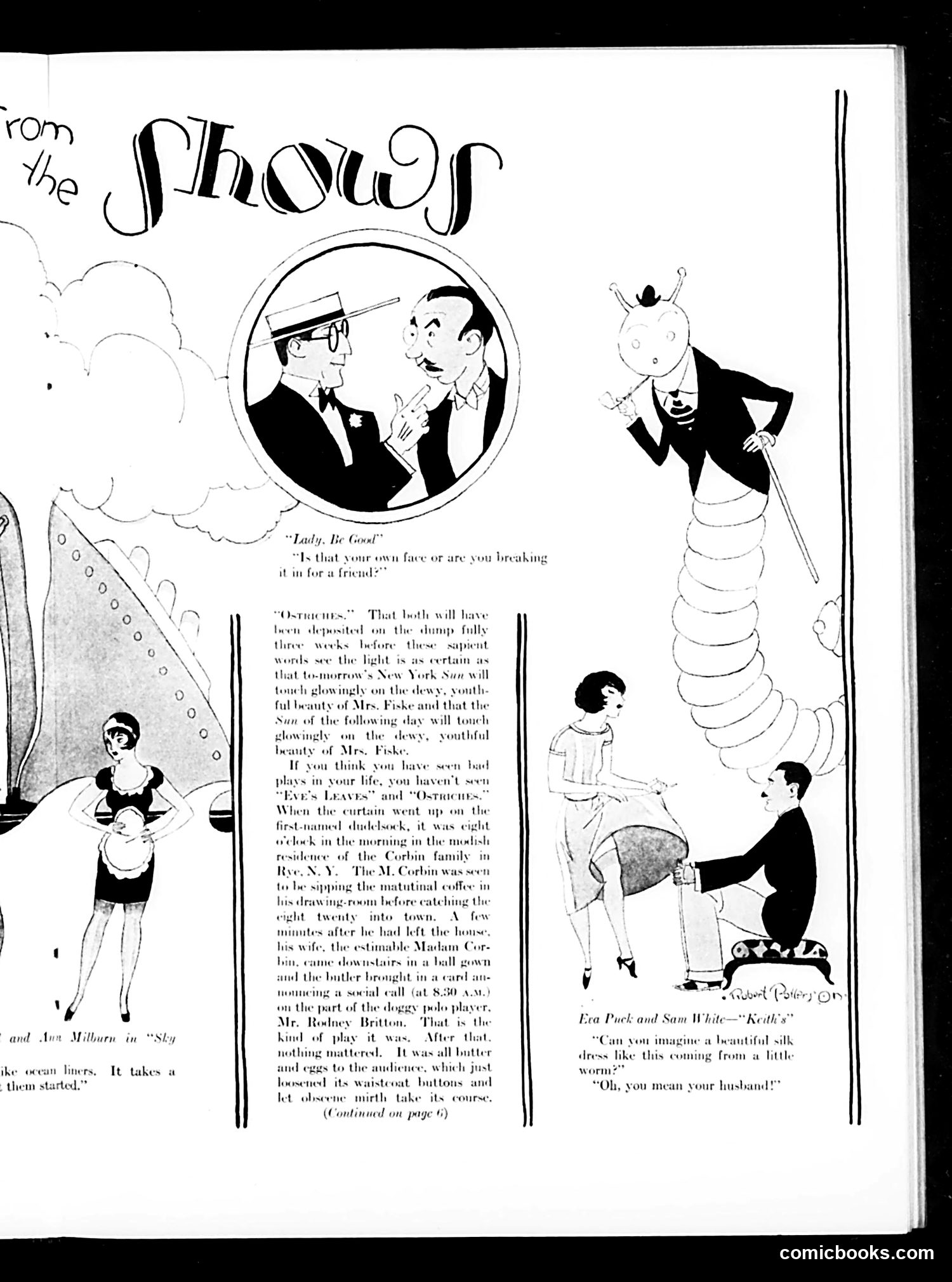
This page from *Judge* magazine features theatrical satire centered on New York high society and Broadway productions circa the 1910s-1920s. The main cartoon mocks the famous Fiske family (Mrs. Fiske was a renowned actress). The text jokes that the *New York Sun* newspaper will praise the "dewy, youthful beauty" of Mrs. Fiske one day, then praise another society woman the next—suggesting superficial, inconsistent gossip journalism. The illustrated scenes reference theatrical productions: "Sky" (with Ann Milburn) and what appears to be "Keith's" (featuring Eva Puck and Sam White). The humor derives from absurdist situations—a woman receiving a silk dress from a "little worm," and dialog about husbands—typical vaudeville-era theatrical comedy. The overall satire targets how newspapers covered wealthy theatrical figures and their social scandals, treating celebrity gossip as interchangeable fodder regardless of actual merit.
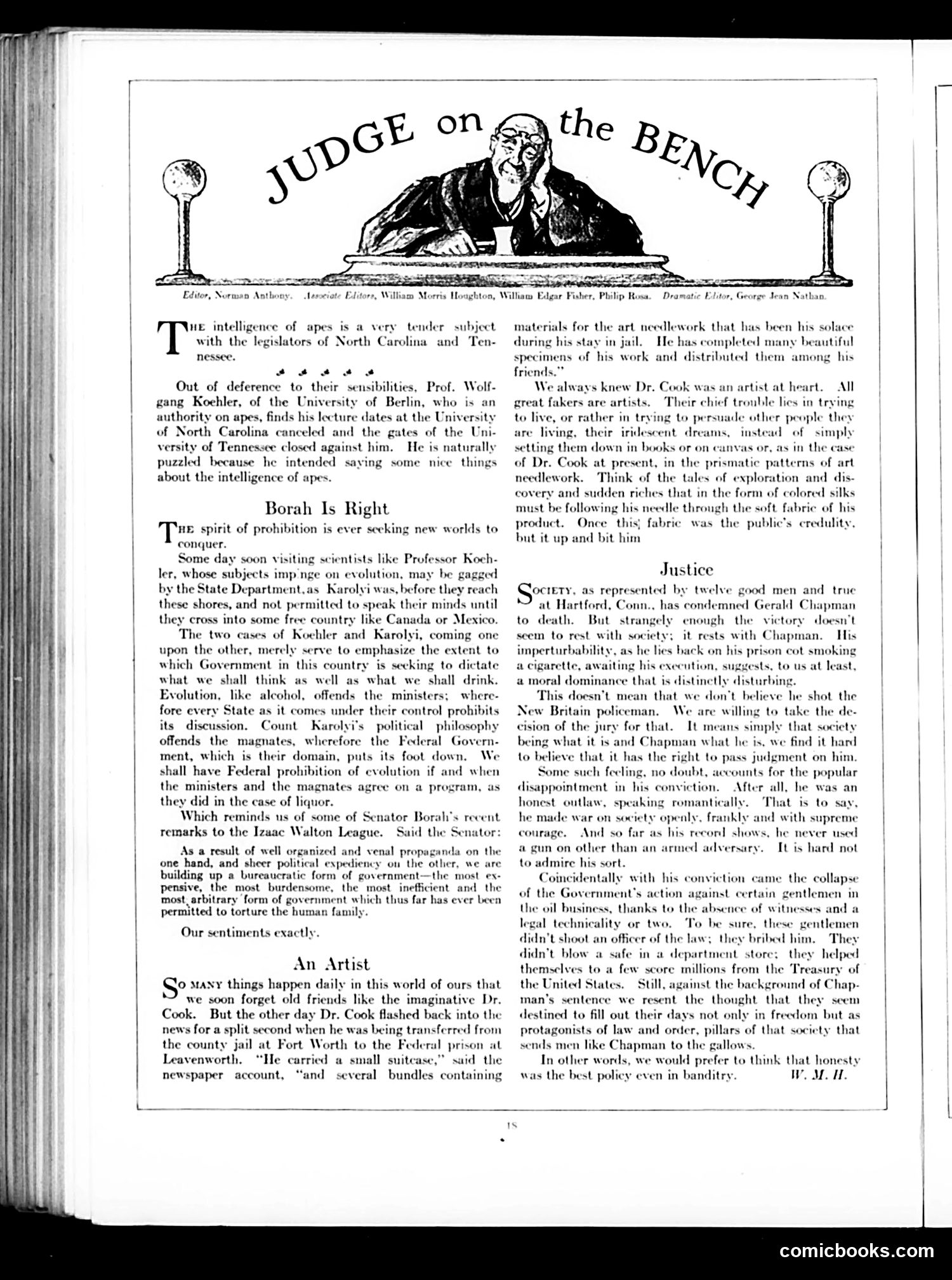
This page satirizes government censorship and hypocrisy through three sections: **"Judge on the Bench" (header)**: Depicts a judge overseeing the content below. **"Borah Is Right"**: Criticizes American prohibition of ideas. Professor Wolfgang Koehler (real Berlin zoologist) had university lectures canceled in North Carolina and Tennessee for discussing ape intelligence—apparently because evolution threatened religious sensibilities. The piece equates this intellectual suppression with alcohol prohibition, arguing both represent government overreach dictating what citizens think and drink. **"An Artist"**: References Dr. Frederick Cook (real explorer, convicted fraudster), imprisoned for crimes but now doing needlework in jail. The satire mocks Cook's earlier public deceptions about Arctic exploration—his "fabric was the public's credulity, but it up and bit him"—suggesting great con artists are fundamentally artists exploiting people. **"Justice"**: Comments on Gerald Chapman's death sentence in Connecticut, noting his calm demeanor suggests moral superiority over society's judgment—a disturbing reversal. The page attacks institutional power: censoring science, imprisoning con men, executing criminals.
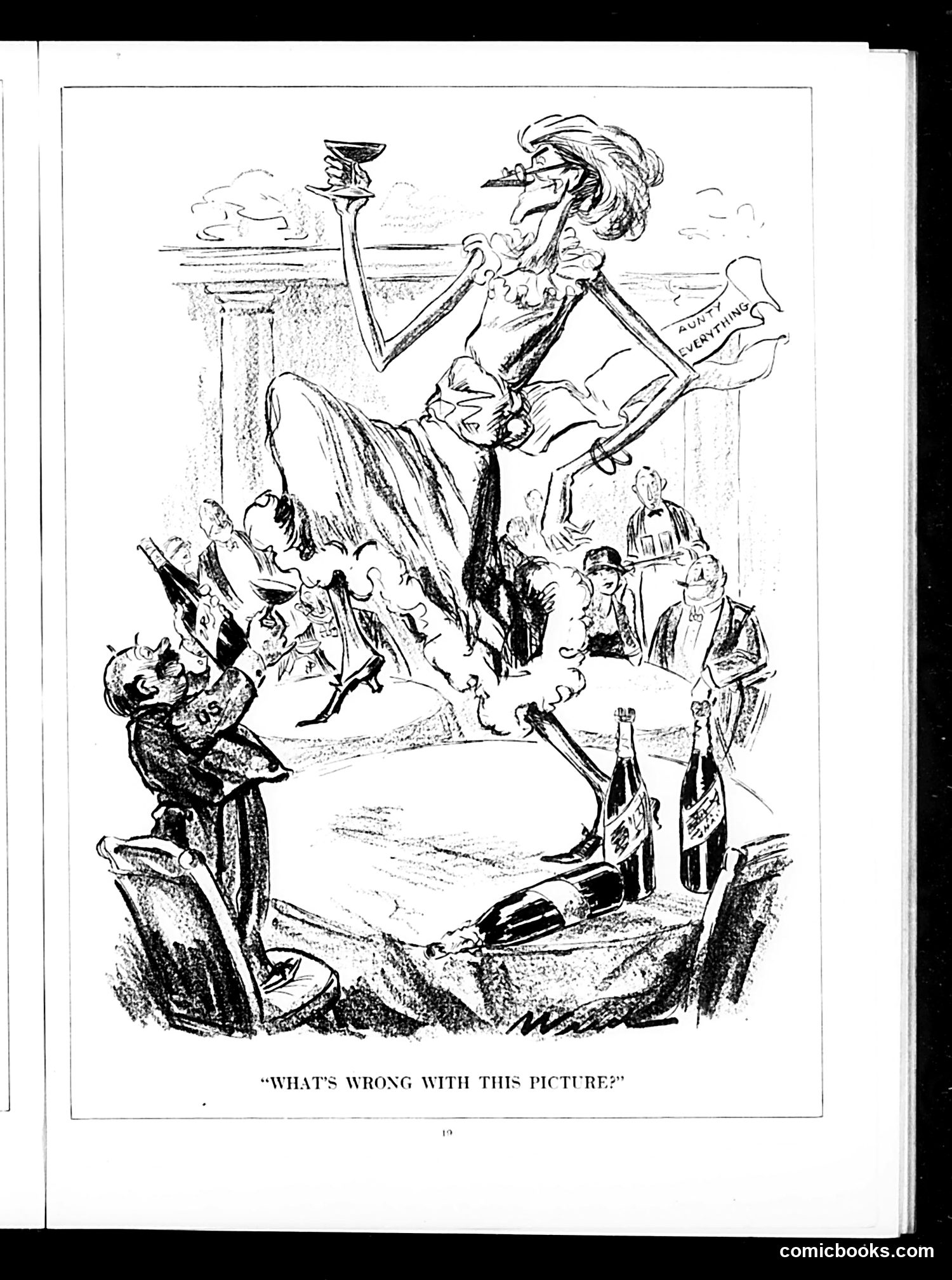
This Judge magazine cartoon presents a visual puzzle for readers. A grotesquely caricatured figure dominates the center, holding a torch labeled "Advertising" and a scroll reading "Everything." Below, various observers (appearing to be businessmen, politicians, and ordinary citizens) examine this towering character with apparent confusion or concern. The satire likely critiques the expanding influence of advertising in American society—suggesting that advertising has grown into an oversized, dominating force claiming to control "everything." The observers' bewildered expressions invite readers to identify what's "wrong": presumably the cartoon argues that advertising's pervasive reach has become absurdly disproportionate to its legitimate role in commerce. The image satirizes early 20th-century concerns about commercial manipulation and market influence.
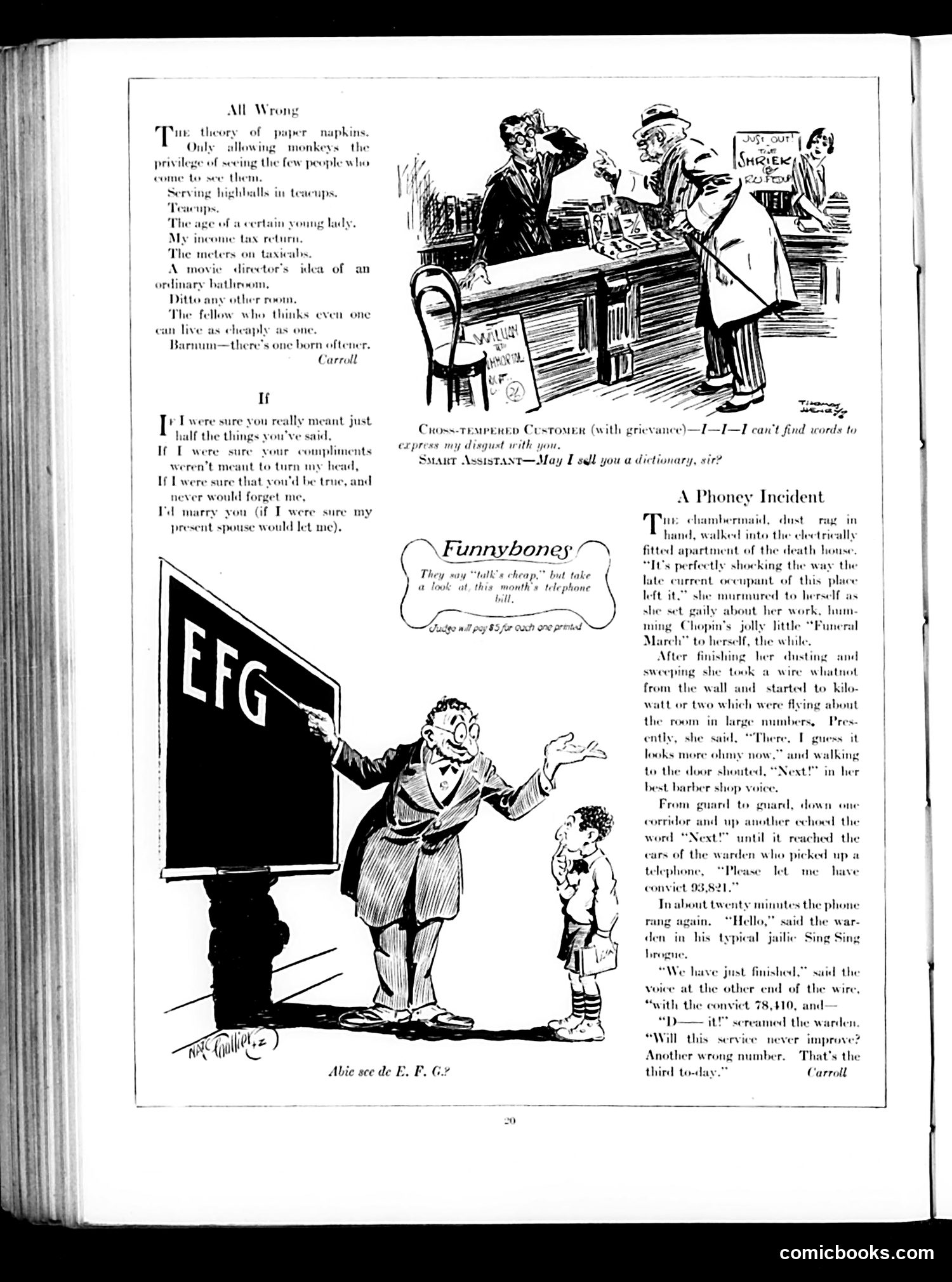
This page contains three separate humorous pieces satirizing early 20th-century American life: **"All Wrong"** lists absurdities: paper napkins for monkeys, taxi meters, movie directors' bathroom designs, and P.T. Barnum's maxim about gullible people—typical social commentary on modern conveniences and human folly. **The "Smart Assistant" cartoon** jokes about customer service: an angry customer cannot articulate their complaint, so the condescending clerk offers to sell them a dictionary. This mocks both rude customers and insufferable retail workers. **"A Phoney Incident"** satirizes prison telephone communication. A chambermaid at a death-row facility repeatedly shouts "Next!" while cleaning, which echoes through corridors and reaches a warden's phone, causing him to believe he's receiving calls from execution witnesses reporting completed executions. The humor derives from bureaucratic confusion and the absurd mix-up of prison protocols with ordinary service interactions. All three pieces target social pretension, customer service failures, and institutional incompetence.
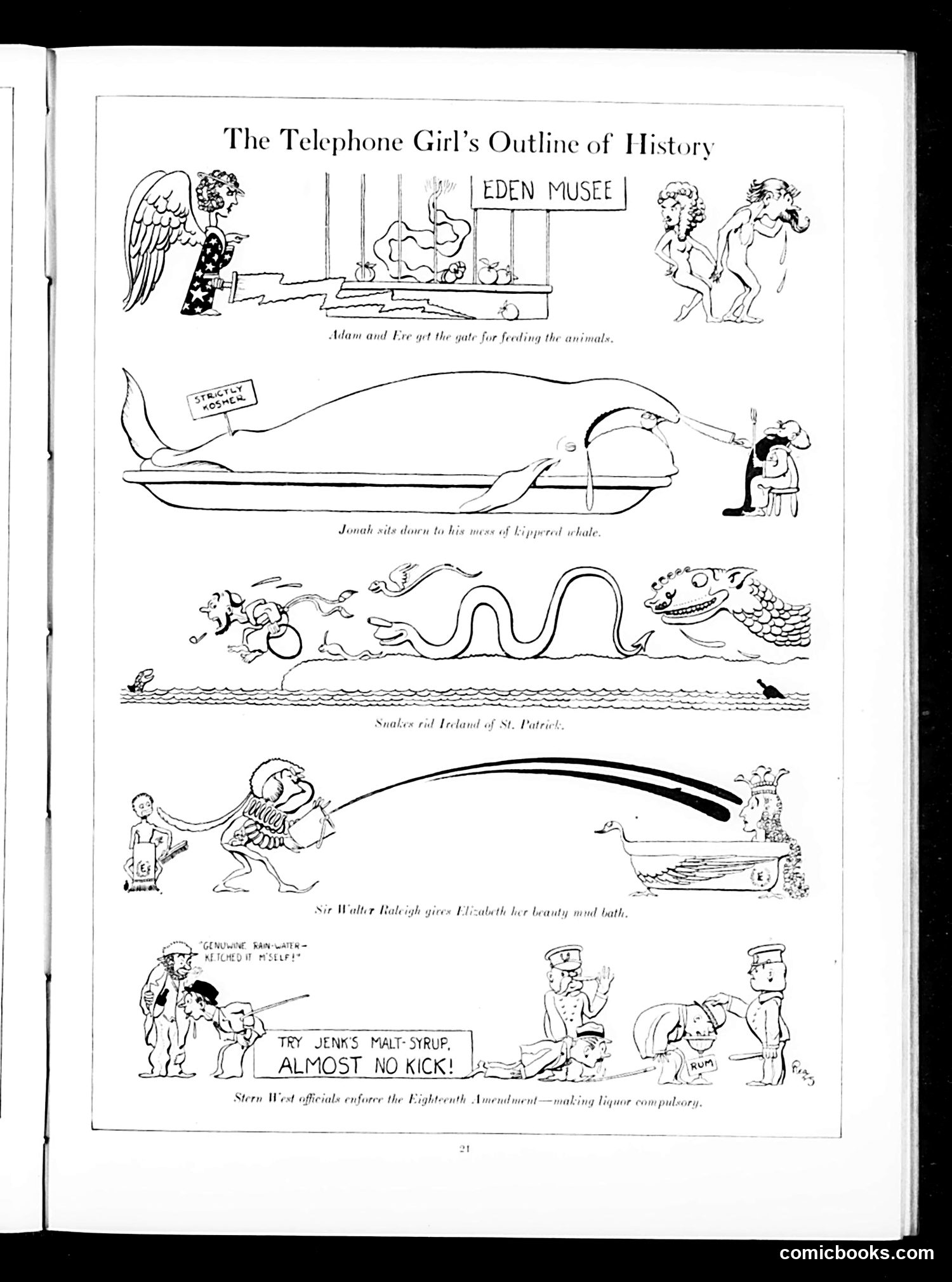
This satirical comic rewrites famous historical moments through absurdist humor. Each panel pairs a well-known historical event with contemporary social commentary: 1. **Eden Museum**: Adam and Eve feeding animals—mocking popular dime museums. 2. **Sir Walter Raleigh and Elizabeth I**: A beauty bath joke (Raleigh's famous cloak gesture reimagined). 3. **Jonah and the whale**: Standard biblical reference. 4. **St. Patrick and snakes**: Irish historical legend. 5. **The final panel**: The key satire—"Stern West officials enforce the Eighteenth Amendment—making liquor compulsory." This mocks Prohibition (ratified 1919) by reversing it: instead of banning alcohol, officials *force* its consumption. The advertisement for "Jenk's Malt Syrup" with "almost no kick" satirizes how Prohibition-era beverages claimed medicinal purposes to skirt alcohol laws. The humor lies in the absurdist inversion of recognizable history.
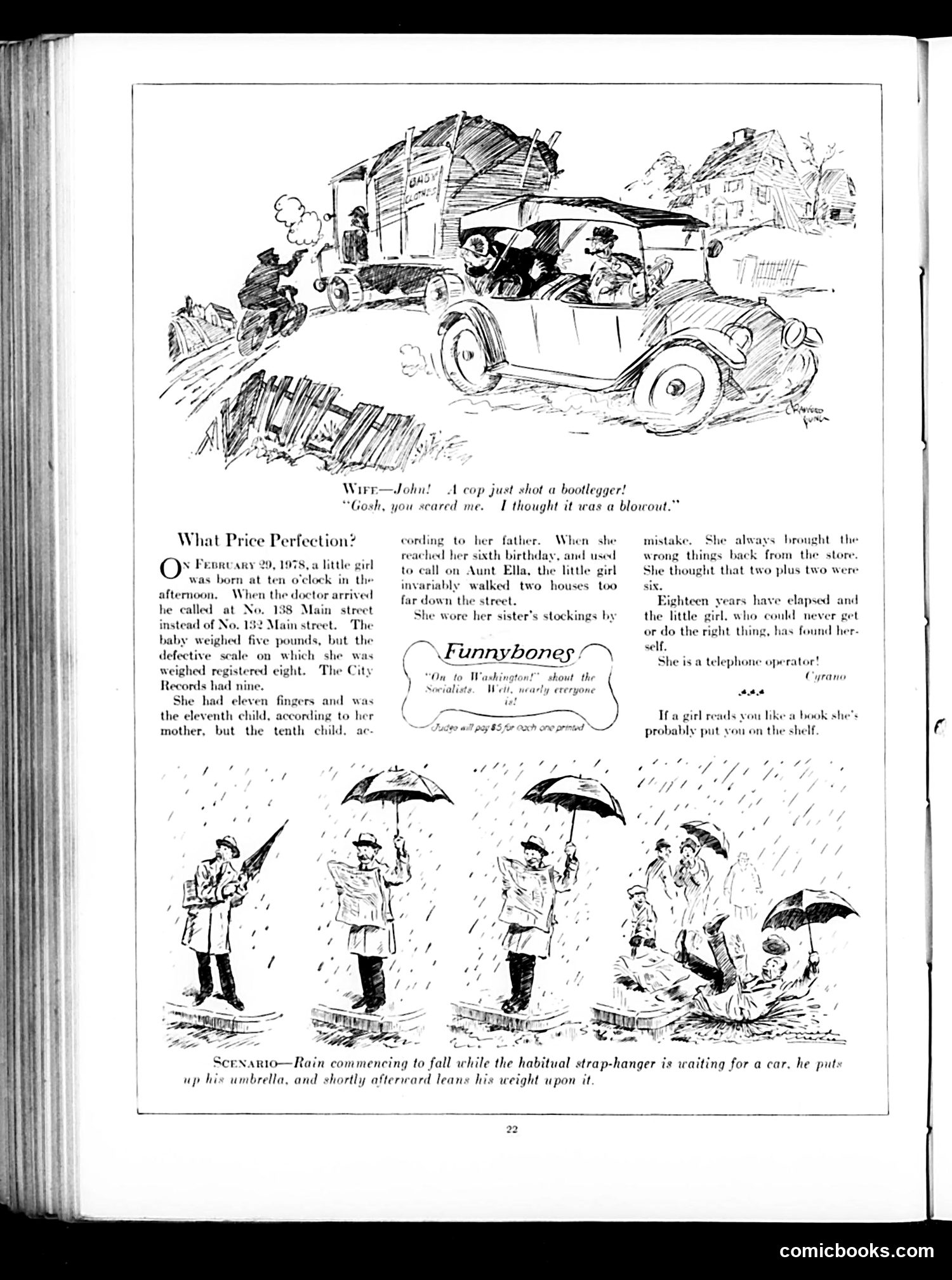
**Top Cartoon:** A domestic scene satirizing Prohibition-era dangers. A wife mistakes gunfire (a cop shooting a bootlegger) for a car blowout—the joke being that such violence has become so normalized in speakeasy culture that it barely registers as noteworthy to ordinary citizens. This mocks both the prevalence of illegal alcohol trafficking and the casual indifference to the consequent lawlessness. **"What Price Perfection?":** A humorous anecdote about a girl born on February 29, 1908 (a leap year date, explaining the temporal confusion in the narrative). The story satirizes bureaucratic absurdity: she's counted as the 8th child by a defective scale, the 9th by city records, the 10th by her mother—yet after 18 years, she remains fundamentally unchanged, unable to grasp basic arithmetic or make correct decisions. The implied critique targets either heredity, educational failure, or simply the futility of precision in a chaotic world. **Bottom Scenario:** A visual gag about public transit etiquette during rain—a commuter puts up an umbrella while waiting, then leans his weight on it, presumably collapsing it. Satirizes thoughtless behavior in crowded urban spaces.
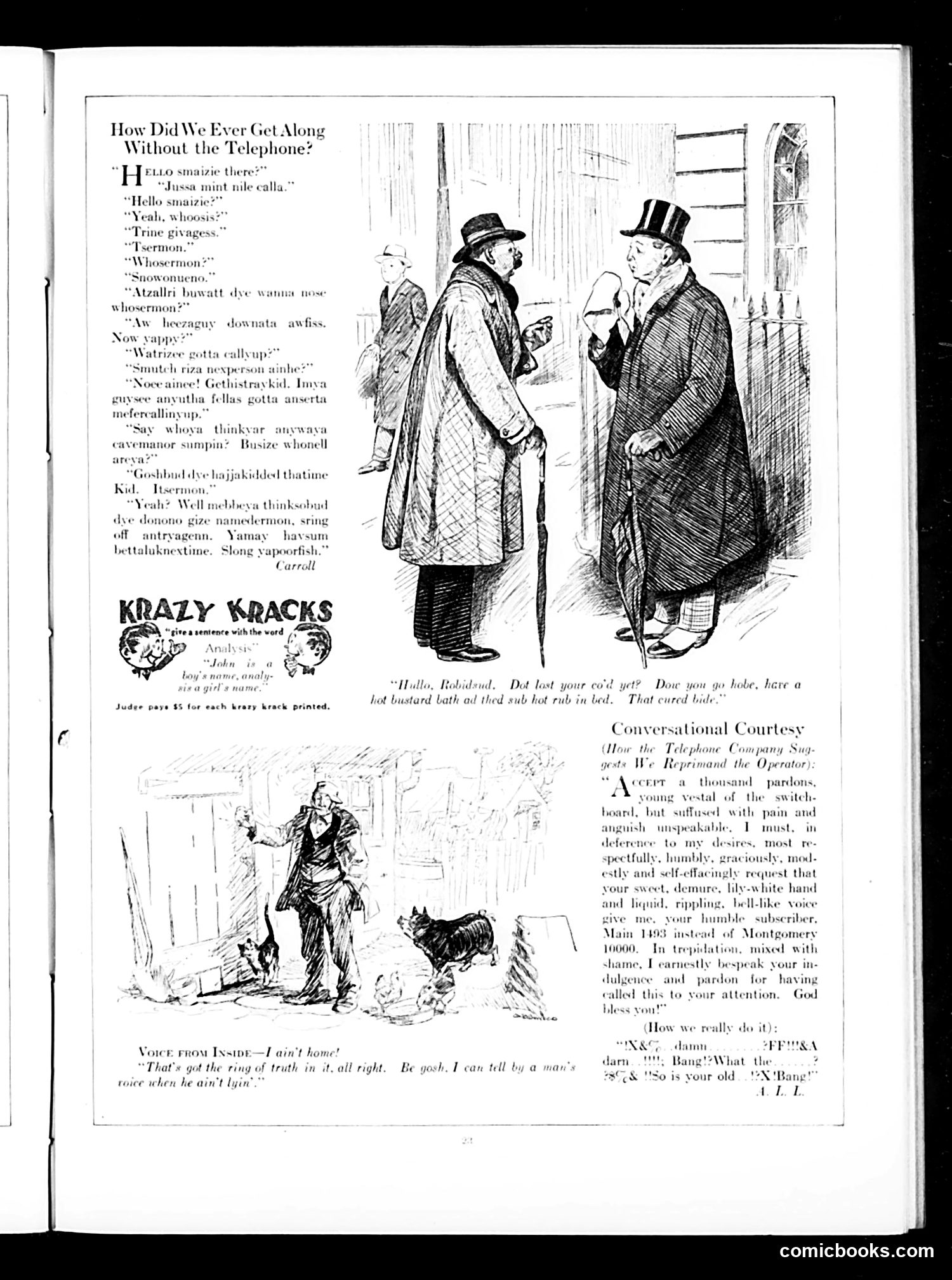
This Judge magazine page satirizes the telephone's newness and impact on American manners circa the early 1900s. **Top cartoon:** Two gentlemen in formal dress greet each other on the street. The title "How Did We Ever Get Along Without the Telephone?" is ironic—the accompanying text shows the chaotic, profanity-laden telephone conversations people actually have, filled with slang and rudeness. The joke: pre-telephone communication was orderly; now phones enable crude interruptions. **"Krazy Kracks":** A humor section offering five-dollar prizes for submitted jokes. **Bottom section:** "Conversational Courtesy" mocks the contrast between *proper* telephone etiquette (the ornate, obsequious formal request to the operator) versus *actual* practice (people yelling "Bang!" and demanding connections). The illustration shows someone frantically gesturing on a telephone with a dog nearby. The satire targets how new telephone technology was breaking down social formality—people were speaking to operators and each other with unprecedented casualness and rudeness, shocking polite society.
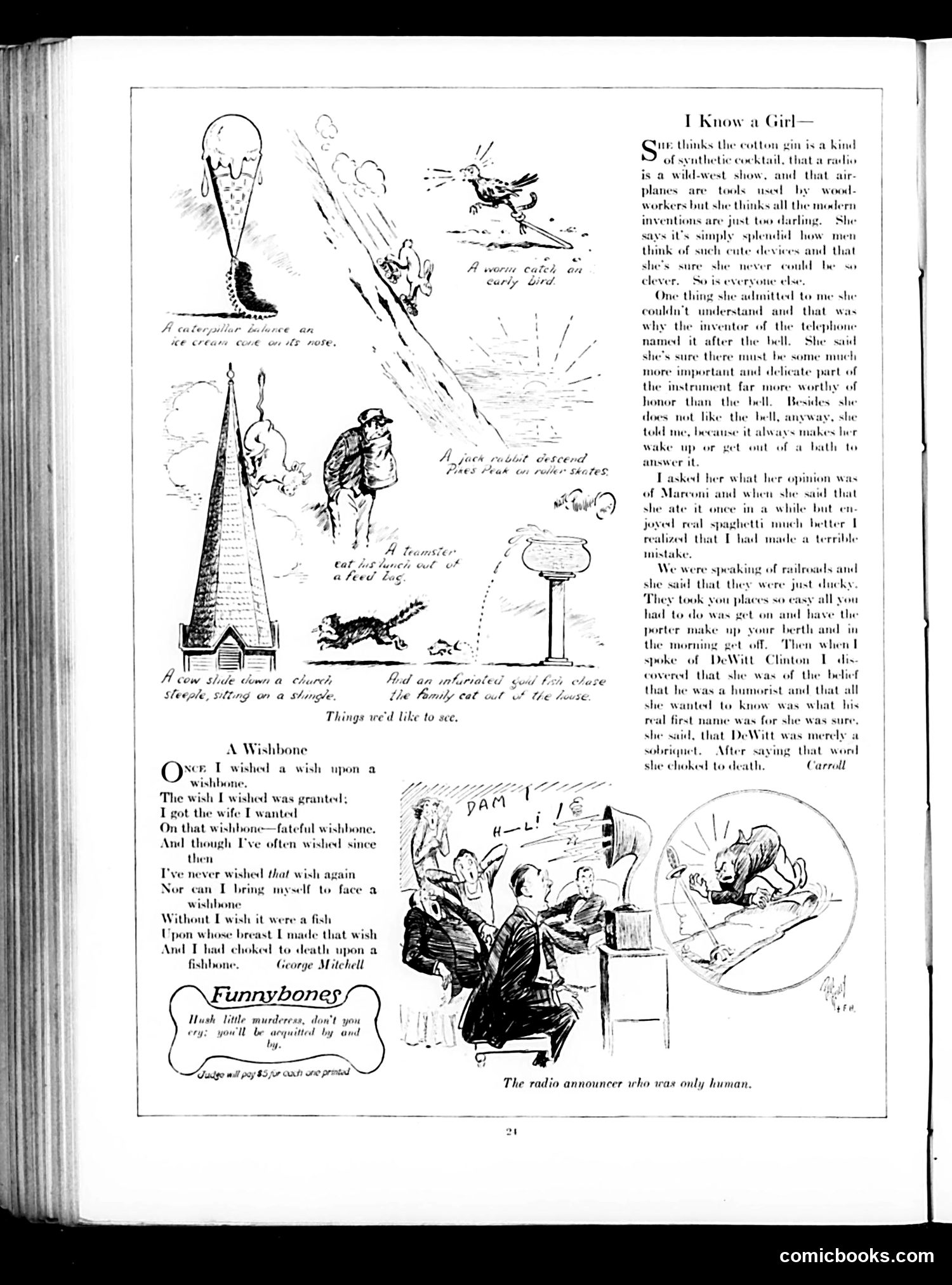
This page lampoons modern inventions and contemporary attitudes toward them. "I Know a Girl" mocks a woman who holds contradictory views about new technology—dismissing the cotton gin and airplanes as frivolous while simultaneously praising all modern innovations. The joke centers on her illogical stance that the telephone's inventor wasted effort naming it after Alexander Graham Bell rather than something more "important." The accompanying cartoons satirize absurd scenarios ("Things we'd like to see")—a cow sliding down a church steeple, a radio announcer revealed as merely human rather than superhuman. "A Wishbone" is a darkly humorous poem about wishing upon a wishbone, ending with the speaker nearly choking to death—a cautionary joke about folklore and superstition. The "Funnybones" caption provides additional comic commentary. Overall, the page uses exaggeration and irony to critique both uncritical enthusiasm for progress and resistance to it.
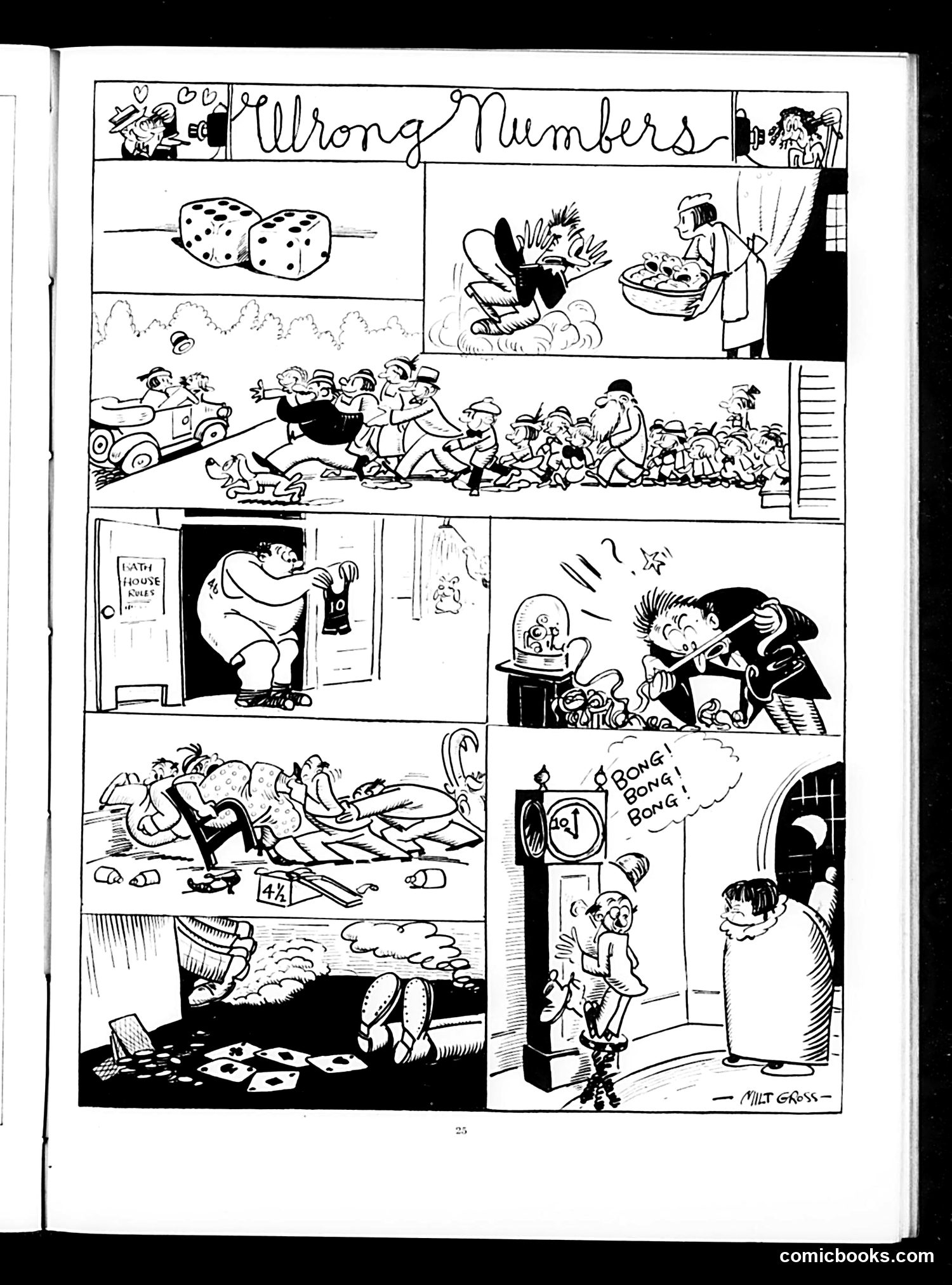
This comic strip satirizes gambling and luck through absurdist humor. The title references "wrong numbers"—a pun suggesting both telephone mishaps and bad luck at games of chance. The narrative follows characters encountering dice, a tug-of-war, a bathroom scene (labeled "Bath House Knives"), chaos and destruction, and finally a gong-sounding that startles a child. The visual progression suggests escalating misfortune and disorder stemming from gambling or chance. Milt Gross uses exaggerated, slapstick physical comedy typical of 1920s-30s humor. The strip mocks the unpredictability of games of chance and their chaotic consequences, presenting gambling as leading to domestic disruption and general mayhem rather than prosperity.
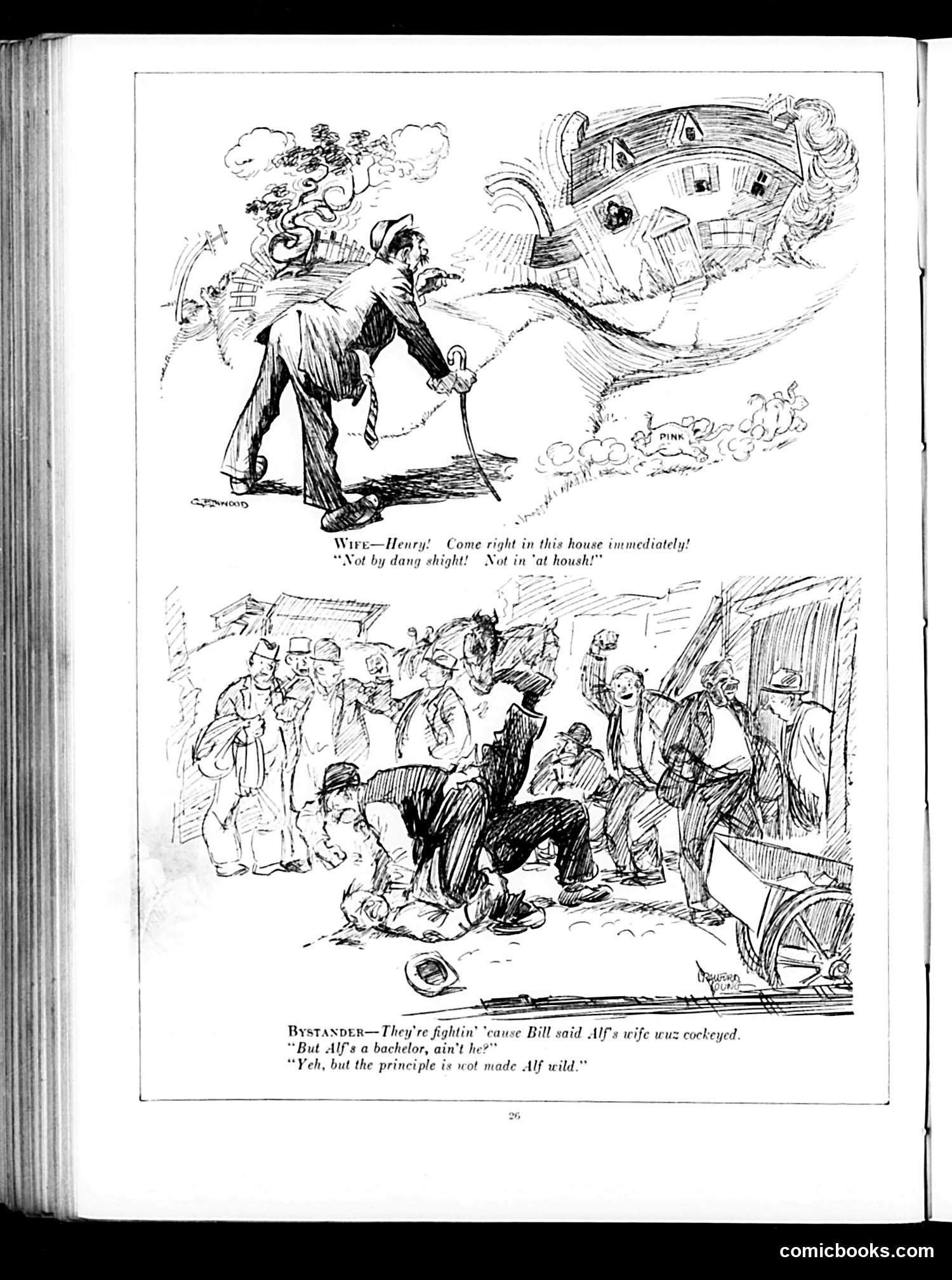
This is a two-panel humor cartoon satirizing working-class masculine pride and absurd logic. The top panel shows a man refusing to enter a house despite his wife's demands. The bottom panel reveals the joke: two men are fighting because one insulted the other's wife—except the insulted man (Alf) is a bachelor with no wife. A bystander explains Alf fought anyway because "the principle" mattered more than facts. The satire mocks the illogical honor culture among working-class men, where defending abstract principles of respect trumps rational assessment of actual circumstances. The crude dialect and rough clothing reinforce stereotypes about laboring-class masculinity as governed by emotion and pride rather than reason.
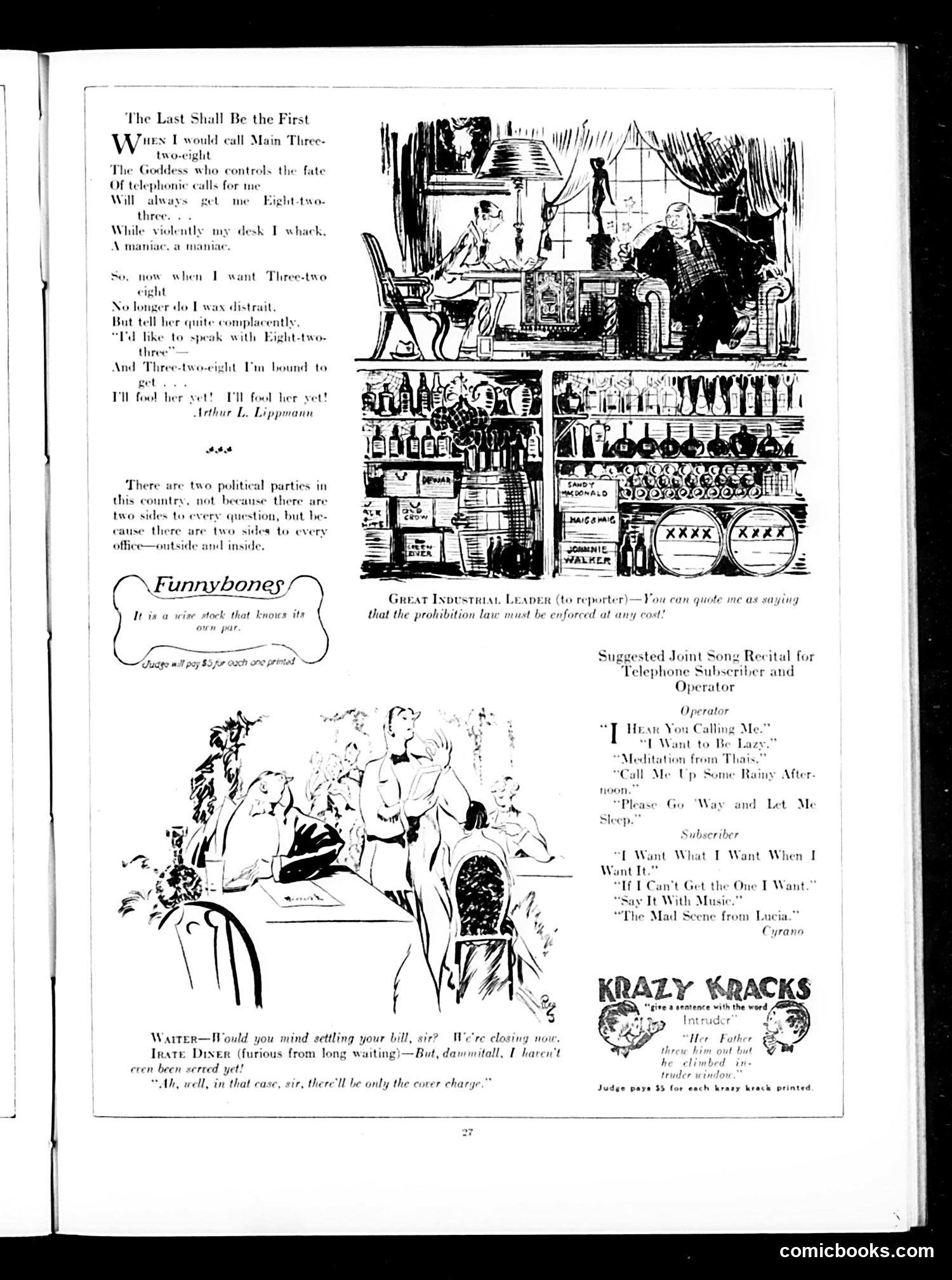
This page from Judge magazine contains three distinct satirical pieces: **"The Last Shall Be the First"** (poem by Arthur L. Lippmann): Satirizes telephone operators who connect callers to wrong numbers. The speaker boasts he'll fool the operator by memorizing extension numbers rather than asking her—a jab at the operators' apparent incompetence or indifference. **Political Commentary**: A brief note mocking the two-party system, suggesting both parties have identical inside/outside positions on issues—cynical commentary on political hypocrisy. **"Great Industrial Leader" Cartoon**: A wealthy industrialist tells a reporter the prohibition law "must be enforced at any cost"—likely satirizing wealthy businessmen who publicly supported Prohibition while privately flouting it or profiting from it. **"Song Recital" Section**: Humorously pairs a telephone operator's and subscriber's favorite songs, suggesting mutual frustration in their relationship. **"Waiter/Irate Diner" Joke**: A diner angry about slow service is told he'll only pay the cover charge since he wasn't served—dark humor about restaurant economics.
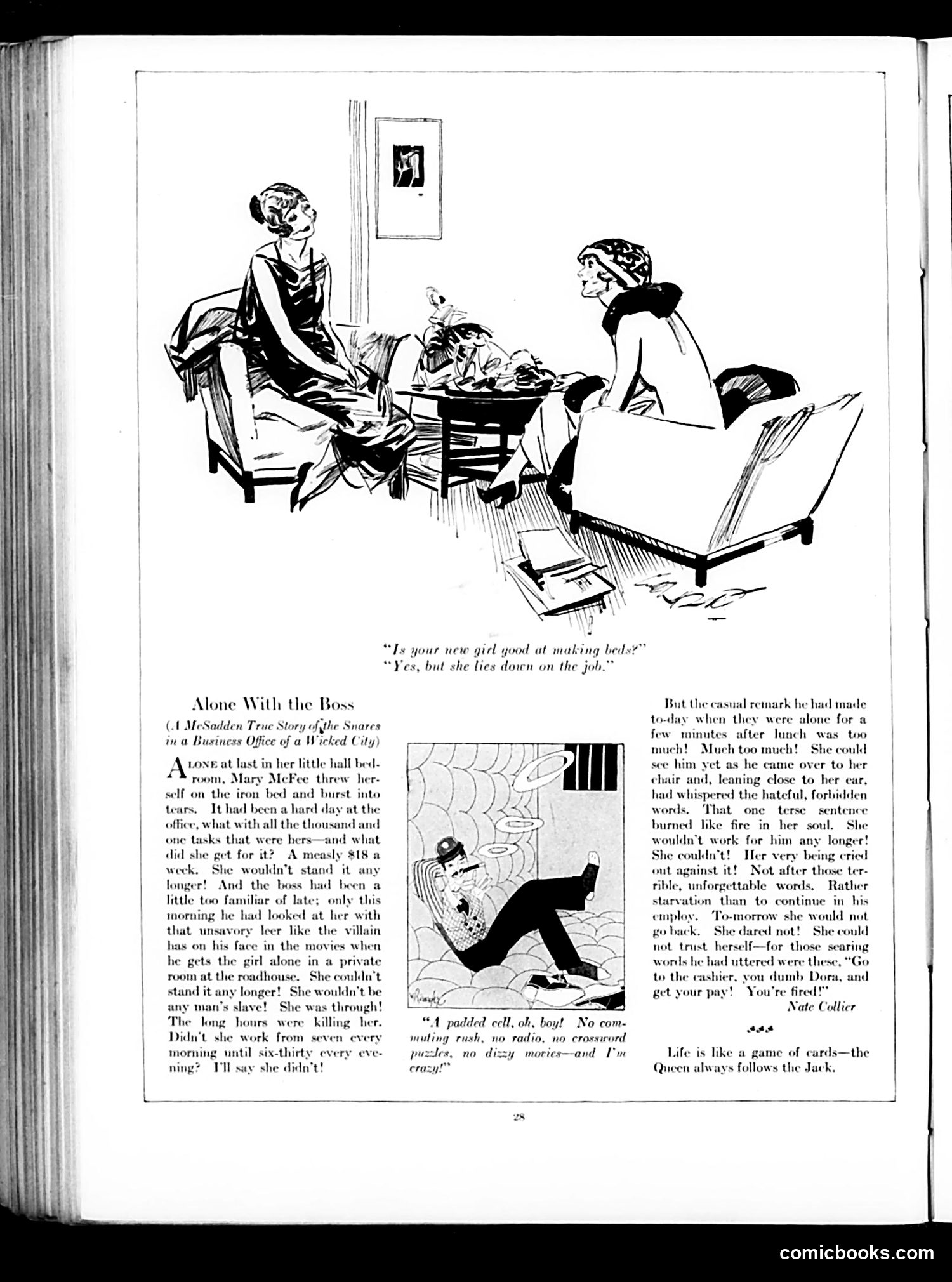
This is a satirical short story mocking melodramatic workplace fiction. Mary McFee, a poorly paid office worker ($18/week), is depicted as emotionally overwrought after her boss allegedly makes an improper advance. The narrative builds suspense through overwrought language ("burned like fire in her soul," "searing words"). The joke's reveal: the "hateful, forbidden words" the boss whispered were simply "Go to the cashier, you dumb Dora, and get your pay! You're fired!"—a mundane firing, not a sexual proposition. The satire targets two things: (1) pulp fiction's tendency toward melodramatic moral panic about workplace "dangers," and (2) the gap between women's expectations of mistreatment and actual workplace indignities (getting fired). The accompanying joke about a new maid "lying down on the job" reinforces themes of workplace incompetence. This reflects 1920s attitudes dismissing women's workplace concerns as hysteria.
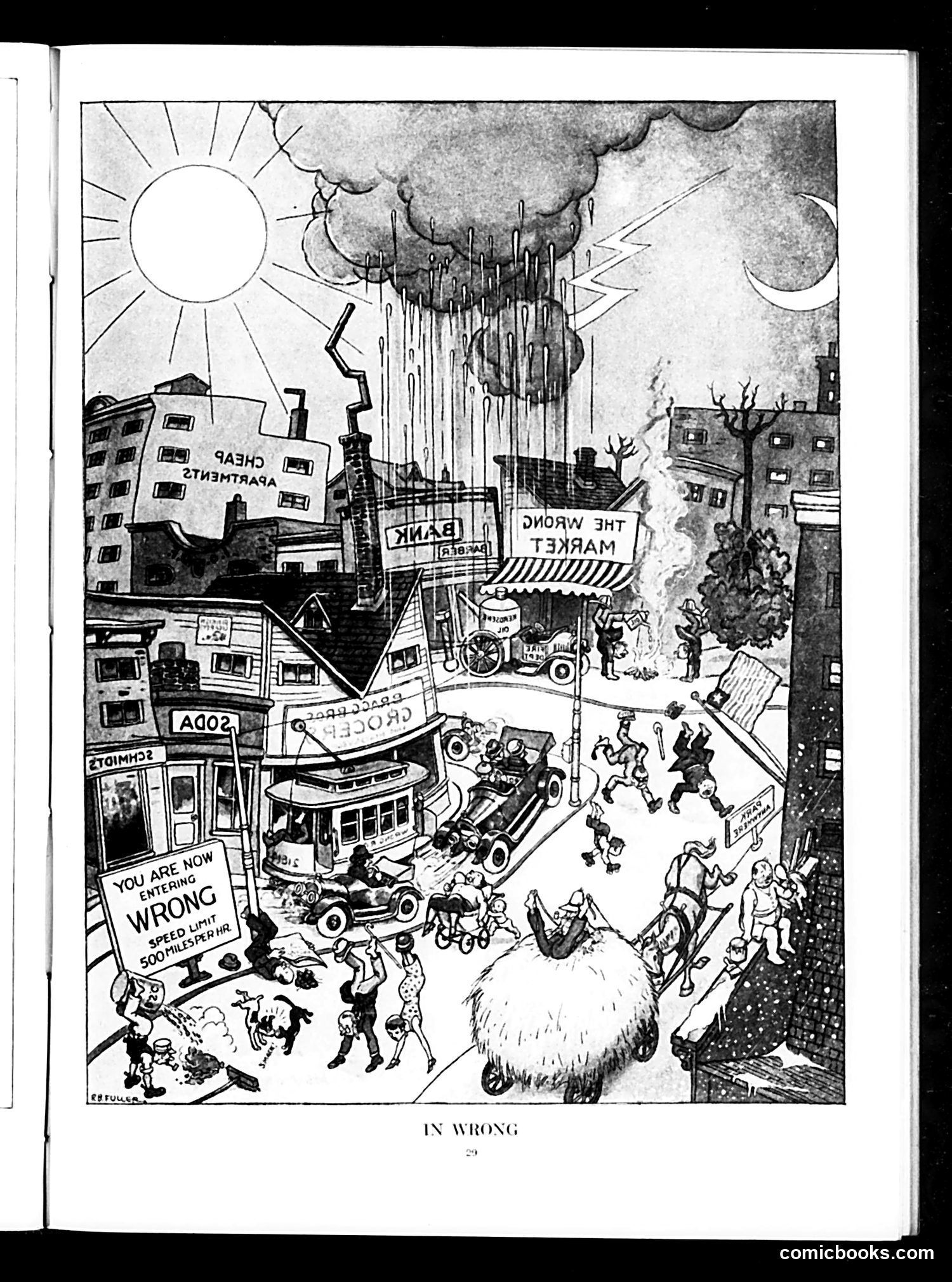
This satirical cartoon depicts a chaotic urban street scene titled "In Wrong," portraying what appears to be a dystopian or satirized city environment. The image shows: - Damaged/collapsing buildings on either side - A storefront with a sign reading "YOU ARE NOW GOING WRONG / FEED LIONS 500 MILES" (absurdist warning) - Crowded street activity with numerous figures - Various vehicles including what appears to be early automobiles or buses - Ominous weather (dark clouds, celestial bodies) - Fires and destruction in the background The cartoon likely satirizes urban overcrowding, poor city planning, dangerous traffic conditions, or general social disorder of the era. The repeated "WRONG" messaging suggests commentary on misdirected development or societal mistakes, though the specific historical reference remains unclear without additional context about Judge magazine's publication date.
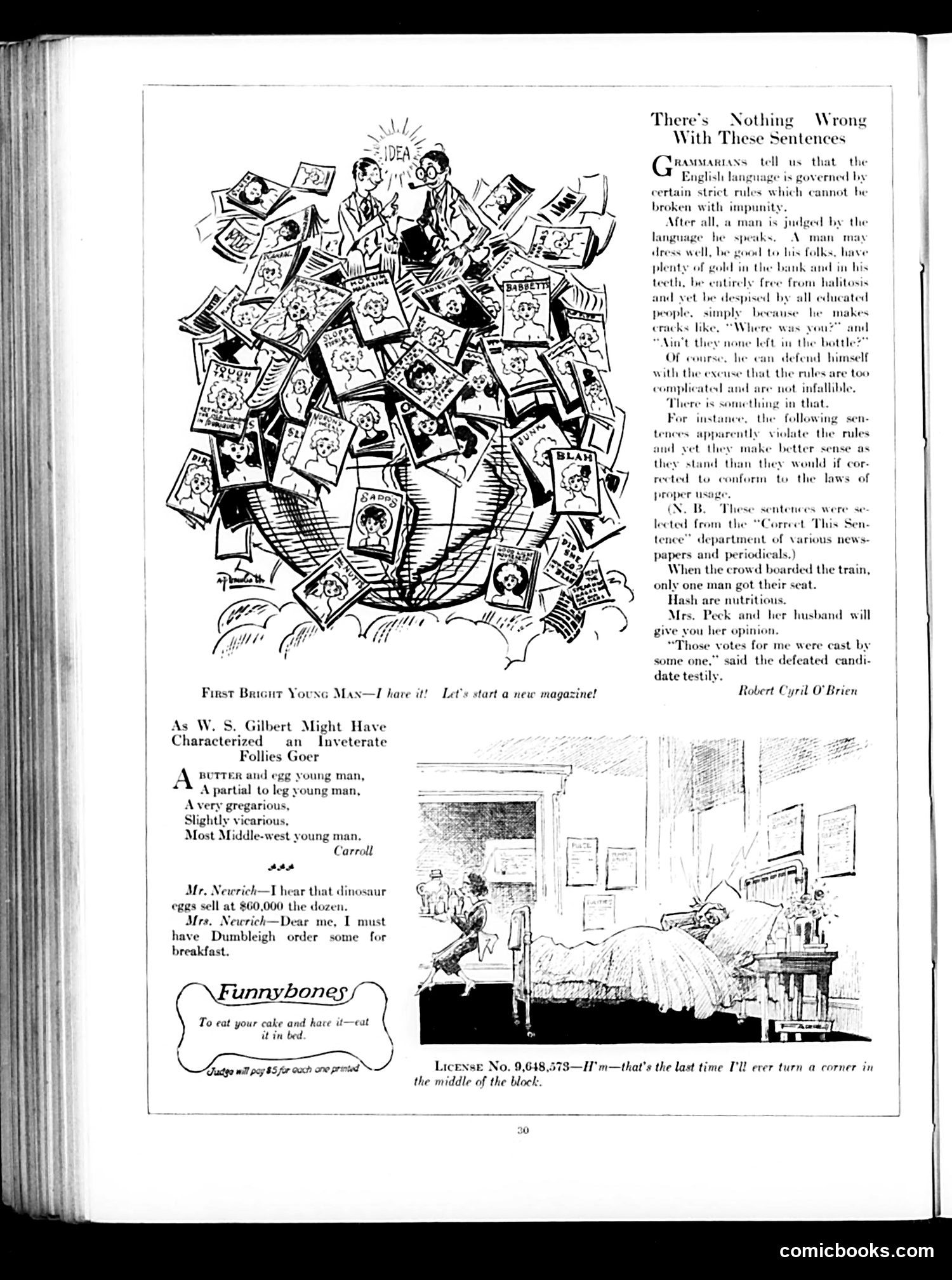
This page contains several distinct satirical pieces: **"First Bright Young Man"** (top cartoon): Shows two men surrounded by flying magazine pages labeled "IDEA," depicting the creative chaos of starting a new publication. It's a visual gag about editorial brainstorming. **"As W.S. Gilbert Might Have Characterized..." (left column)**: A parody poem mocking the "butter and egg man"—a wealthy, unsophisticated Midwestern businessman who frequents theaters and nightclubs. This was a contemporary type satirized in 1920s culture. **"The Newrich" joke**: Mocks nouveau-riche pretension; "Mrs. Newrich" orders dinosaur eggs for breakfast, not understanding their rarity or that they're fossils, not food. **"There's Nothing Wrong With These Sentences"** (right): A grammar lesson showing common grammatical errors appearing in newspapers. Examples include subject-verb disagreement ("Hash are nutritious") and pronoun confusion, likely teaching readers about proper English usage. **Bottom cartoon**: A woman in a taxi discussing a traffic citation, making a joke about traffic laws. The page is primarily humor and social commentary aimed at educated readers.
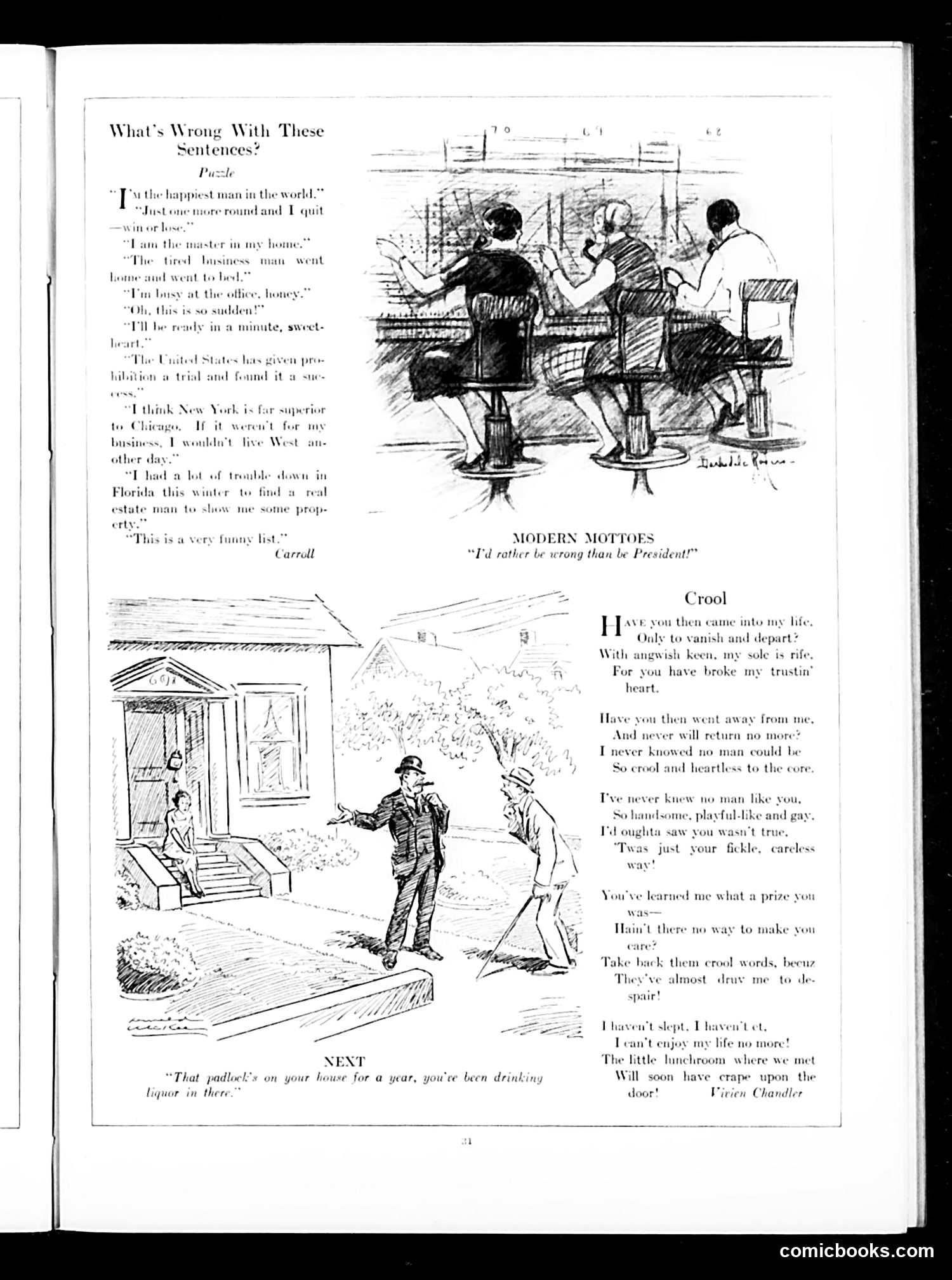
The top section, "What's Wrong With These Sentences?" presents domestic claims that are satirical contradictions—a man claiming to be "master in my home" while his wife controls him, a "tired business man" going home to rest but finding no peace. These mock the gap between male authority *claimed* and male authority *actually possessed* in marriage. The "Modern Mottoes" section includes a cynical quote ("I'd rather be wrong than be President!"), likely satirizing political hypocrisy or the undesirability of office during this era. The poem "Crool" (cruel, in dialectal speech) depicts a woman lamenting an unfaithful or heartless man, written in exaggerated vernacular ("I've never knew," "druyv"). The crude language and spelling appear deliberately comedic—mocking sentimental Victorian tearjerker poetry while also portraying working-class or rural speech patterns. The cartoons illustrate domestic scenes supporting these themes: marital discord and role reversals. The satire targets both unrealistic male boasting about home authority and melodramatic expressions of romantic suffering.
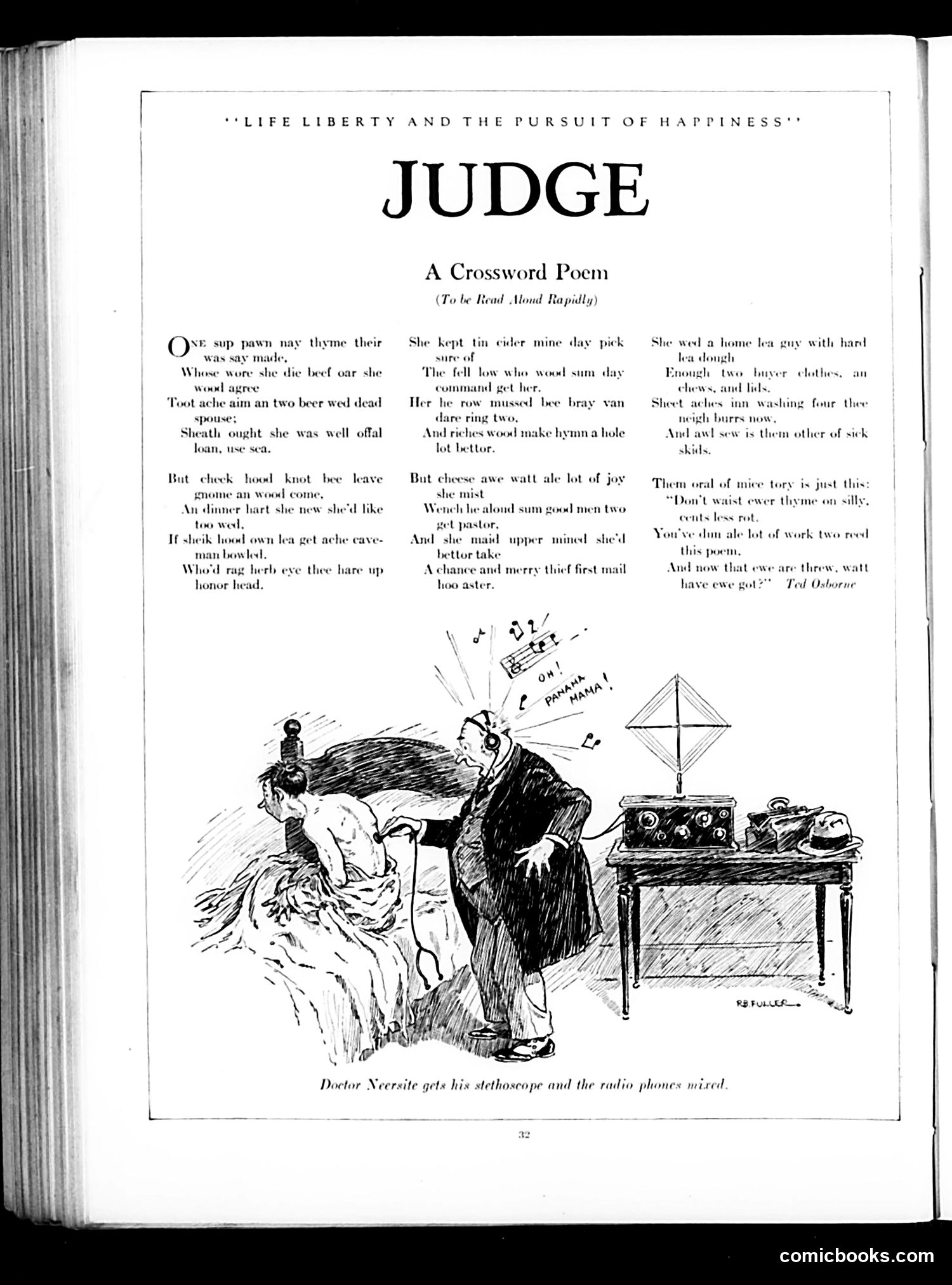
This is a humorous "crossword poem" designed to be read aloud rapidly—a sound-based wordplay joke rather than a visual cartoon. The text uses homonyms and phonetic spellings to create a double-meaning effect when spoken aloud versus read on the page. The poem tells a domestic story: a woman seeks a wealthy husband ("riches wood make hymn a hole lot bettor"), marries a poor man instead, and ends up doing laundry and domestic drudgery. The moral warns against wasting time on frivolous pursuits. The accompanying illustration shows a doctor getting his "stethoscope and radio phones wired"—likely satirizing either early radio technology confusion or medical quackery. The satire targets marriage expectations and gender roles (women's limited options), presented as light domestic humor typical of 1920s-30s Judge magazine. The "Life, Liberty and Pursuit of Happiness" header ironically frames this tale of constrained female choices.
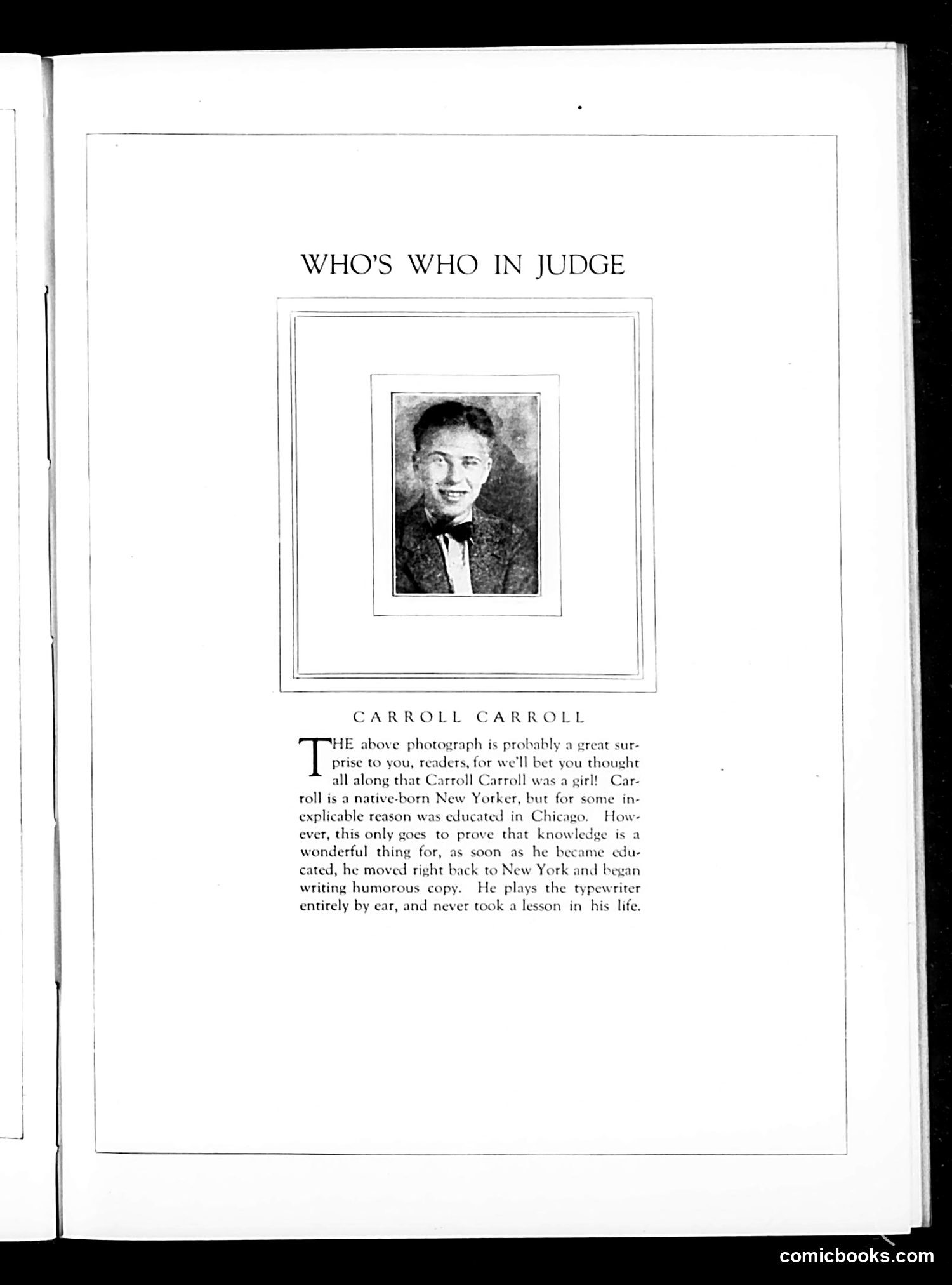
This is a biographical profile page featuring **Carroll Carroll**, a humorist and writer. The entry plays on the surprise that someone with this feminine-sounding name is male—a joke playing on gender expectations in 1920s-30s publishing. The satire highlights Carroll's unconventional path: a native New Yorker educated in Chicago who immediately returned to New York to write humorous copy. The piece humorously describes his typewriter skills as self-taught ("plays the typewriter entirely by ear, and never took a lesson in his life"), suggesting he's a natural talent who needed no formal training. This is a lighthearted "society column" style feature common in *Judge*, celebrating a magazine contributor through biographical wit rather than hard satire or political commentary.
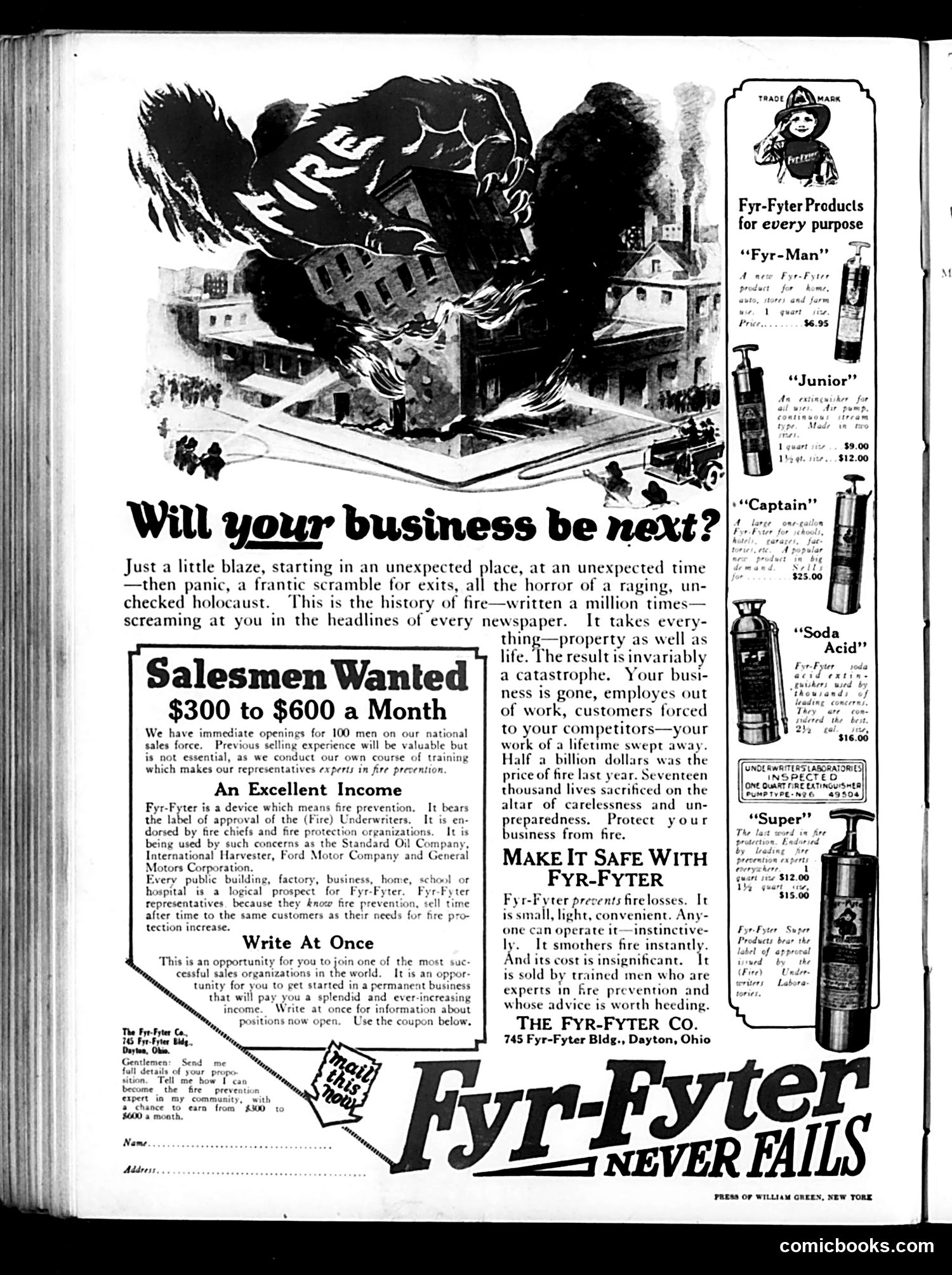
This page is primarily **advertising, not satire or political cartoons**. It's a full-page advertisement for Fyr-Fyter fire extinguishers from the Fyr-Fyter Company in Dayton, Ohio. The dramatic illustration at top—showing a massive fire consuming buildings with panicked crowds below—is designed to frighten readers into recognizing fire risk. The headline "Will your business be next?" uses fear-based marketing common to the era. The page combines two pitches: a recruitment ad (left) seeking 100 salesmen at $300-600/month to sell fire prevention products, and product advertising (right) showing various extinguisher models with prices ($9-$25). **Historical context**: This reflects early-20th-century American industrial anxiety about workplace fire hazards—a genuine public safety concern before modern building codes. Fire extinguishers were relatively new consumer products, so aggressive marketing and door-to-door sales forces were necessary to establish the market. The endorsements from Standard Oil and Ford Motor Company lend credibility, targeting both industrial and residential customers.