
Judge, 1925-04-25 · page 20 of 36
Judge — April 25, 1925 — page 20: what you’re looking at
What you’re looking at
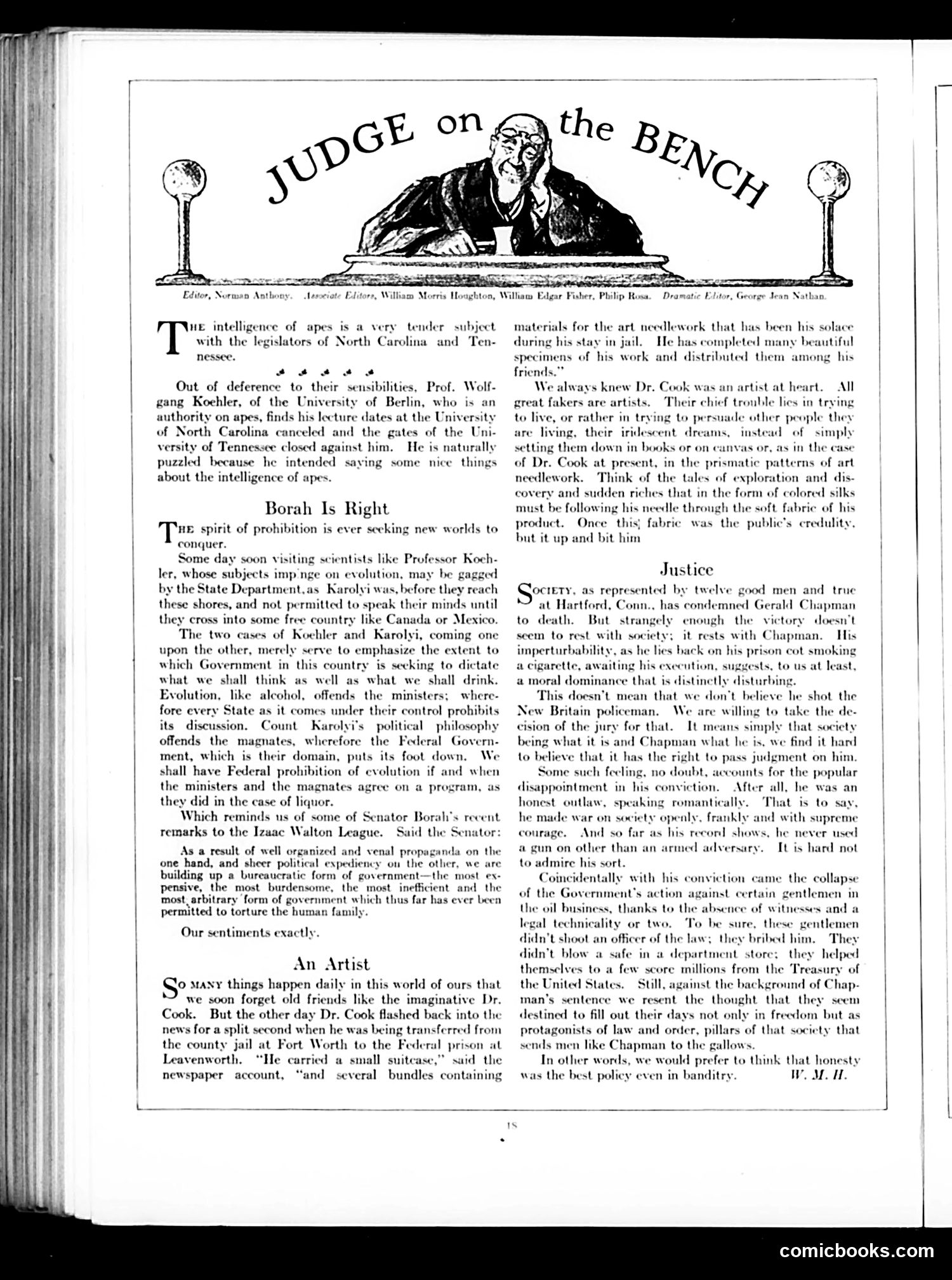
This page satirizes government censorship and hypocrisy through three sections: **"Judge on the Bench" (header)**: Depicts a judge overseeing the content below. **"Borah Is Right"**: Criticizes American prohibition of ideas. Professor Wolfgang Koehler (real Berlin zoologist) had university lectures canceled in North Carolina and Tennessee for discussing ape intelligence—apparently because evolution threatened religious sensibilities. The piece equates this intellectual suppression with alcohol prohibition, arguing both represent government overreach dictating what citizens think and drink. **"An Artist"**: References Dr. Frederick Cook (real explorer, convicted fraudster), imprisoned for crimes but now doing needlework in jail. The satire mocks Cook's earlier public deceptions about Arctic exploration—his "fabric was the public's credulity, but it up and bit him"—suggesting great con artists are fundamentally artists exploiting people. **"Justice"**: Comments on Gerald Chapman's death sentence in Connecticut, noting his calm demeanor suggests moral superiority over society's judgment—a disturbing reversal. The page attacks institutional power: censoring science, imprisoning con men, executing criminals.
📄 Transcribed text from this page (OCR, searchable)
Machine-transcribed from the original scan — historical spelling and the odd misread are preserved.
] lligence of apes is a very tender subject I with the legislators of North Carolina and Ten- nessee. se a ae Out of deference to their sensibilities, Prof. Wolf- gang Koehler, of the University of Berlin, who is an authority on apes, finds his lecture dates at the University of North Carolina canceled and the of the Uni- versity of Tennessee closed against him. He is naturally puzzled because he intended saying some nice things about the intelligence of apes. Borah Is Right HE spirit of prohibition is ever seeking new worlds to conquer. Some day soon visiting scientists like Professor Koeh- ler, whose subjects imp nge on evolution, may be gagged by the State Department,as Karolyi was, before they reach these shores, and not permitted to speak their minds until they cross into some free country like Canada or Mexic The two cases of Koehler and Karolyi, coming one upon the other, merely serve to emphasize the extent to which Government in this country is secking to dictate what we shall think as well as what we shall drink. Evolution, like alcohol, offends the ministers; where- fore every State as it comes under their control prohibits its discussion. Count Kuarolyi's political philosophy offends the magnates, wherefore the Federal Govern- ment, which is their domain, puts its foot down, We shall have Federal prohibition of evolution if and when the ministers and the magnates agree on a program, as they did in the case of liquor. Which reminds us of some of Senator Borah’s r remarks to the Izaac Walton League. Said the Ser ind venal propagand ent tor: As a result of well organiz one hand, and sheer political expediency on the other, building up a bureaucratic form of government—the most ex- pensive, the most burdensome, the most inefficient and the most, arbitrary form of government which thus far has ever been permitted to torture the human family. on the Our sentiments exactly. An Artist ‘oO MANY things happen daily in this world of ours that we soon forget old friends like the imaginative Dr. Cook. But the other day Dr. Cook flashed back into the news for a split second when he was being transferred from the county jail at Fort Worth to the Federal prison at Leavenworth. “He carried a small suitcase,” newspaper account, “and several ny said the bundles containing Willits Edgar Fisher, Phill materials for the art needlework that has been his sol: during his stay in jail. He has completed many beautiful specimens of his work and distributed them among. his friends.” s knew Dr. Cook was « e artists, urtist at heart. All great Their chief trouble lies in trying to live, or rather in trying to persuade other people they are di iri t dreams, setting them di of Dr. Coo instead of simply sor on canvas or, as in the t present, in the prismatic patterns of needlework. Think the tales ef exploration and dis- covery and sudden riches that in the form of colored silks must be following his needle through the soft fabrie of his product. Once this) fabric was the public's credulity, but it up and bit him Justice Socery, as represented by twelve good men and true at Hartford, Conn., has condemned Gerald Chapman to death. But strangely enough the vie doesn't seem to rest with society; it rests with Chapman. His imperturbability, as he lies hack on his prison cot smoking a cigarette, awaiting his execution, suggests, to us at least, a moral dominance that is distinetly disturbing. This doesn’t mean that we don’t believe he shot the »w Britain policeman, take the de- of the jury for that. [It means simp! at society being what it is and Chapman what he is, we find it hard to believe that it has the right to pass judgment on him. ome such feeling, no doubt, accounts for the popular disappointment in his conviction. After honest outlaw, speaking romantically. he made war on society openl courage. We are willing I, he was an at is to say, frankly and with supreme And so far as his record shows, he never used a gun on other than an armed adversary. [t is hard not to admire his sort. Coincidentally with his conviction came the collapse of the Government's action against certain gentlemen in the oil business, thanks to the abser legal technicality or two. To be sure, these gentlemen didn’t shoot an officer of the law; they bribed him. They didn’t blow a safe in a department store; they helped themselves to a few score millions from the Treasury of the United States. Still, against the background of Chap- man’s sentence we resent the thought that they seem destined to fill out their days not only in freedom but as protagonists of law and order, pillars of that society that sends men like Chapman to the gallows. In other words, we would prefer to think that honesty was the best policy in banditry. WMH. of witnesses and a Bt comicbooks.com